




Abstract
Background:
Fourth-generation cephalosporins have been developed to improve their potency, that is, low minimal inhibitory concentrations (MICs) and to prevent resistance selection of derepressed AmpC-producing mutants in comparison to third-generation cephalosporins as ceftazidime.
Objectives:
We investigated the role of the administered cefpirome dose on the efficacy of treatment of a Klebsiella pneumoniae lung infection as well as in the selection of resistant Enterobacter cloacae isolates in the intestines of rats treated for a K. pneumoniae lung infection.
Materials and Methods:
Rats with K. pneumoniae lung infection received therapy with cefpirome doses of 0.4 to 50 mg/kg/day b.i.d. for 18 days. Resistance selection in intestinal E. cloacae was monitored during 43 days. Mutants were checked for β-lactamase activity, mutations in their structural ampC gene, ampD gene, and omp39–40 gene.
Results:
A 45% and 100% rat survival rate was obtained by administration of 3.1 and 12.5 mg/kg b.i.d. of cefpirome. A significant correlation was demonstrated in the reduction of the susceptible E. cloacae isolates with %fT>MIC at days 7, 14, 22, and 29. Cefpirome E. cloacae mutants, with increased cefpirome MICs, were obtained in only four rats.
Conclusions:
The treatment with cefpirome resulted in less selection of derepressed mutants in comparison to ceftazidime as shown by their low number per gram of feces and in a limited number of animals.
Introduction
It is well known that some genera of the Enterobacteriaceae like Enterobacter cloacae and Citrobacter freundii have a relatively high mutation frequency of 10−6 to 10−7 toward expanded-spectrum β-lactam antibiotics due to the presence of derepressed ampC mutants.1–3 Exposure of these organisms to an expanded β-lactam antibiotic results in eradication of the susceptible organisms, but at the same time selects for resistant organisms that will increase in number during further antibiotic treatment.4,5 In critically ill patients, such resistant organisms selected from the endogenous flora during treatment may lead to invasive infection and the need for special hygienic precautions preventing spread of these resistant organisms throughout the hospital.6,7
In a previous article, using an animal model of severe pulmonary Klebsiella pneumoniae infection, it was shown that therapy with ceftazidime selected ceftazidime-resistant E. cloacae isolates from the intestine. These mutants were already present as a subpopulation of the initial ceftazidime-susceptible E. cloacae population. 8
Furthermore, it was shown that selection of resistant subpopulations can be manipulated by the dose and frequency of administration of the antibiotic, thereby demonstrating that the time that antibiotic concentrations remain in the mutant selection window (MSW) affects resistance selection.9–11
In this respect the upper boundary of the MSW is defined by the mutant prevention concentration (MPC), whereas the lower boundary is approximated by the minimal inhibitory concentration (MIC). 12
To improve activity of cephalosporins and preventing resistance selection against strains harboring stably derepressed AmpC β-lactamases, fourth-generation cephalosporins were developed such as cefpirome and cefepime. 13 Most fourth-generation cephalosporins demonstrate improved penetration through the outer membrane, have poor affinity for β-lactamases, including AmpC and are potent binders to the PBPs. 14 Fourth-generation cephalosporins have enhanced activity against Enterobacteriaceae and Pseudomonas aeruginosa, which produce inducible and derepressed AmpC β-lactamases. 13 Stable derepressed mutants in E. cloacae are most of the time the result of mutations in the ampD gene resulting in decreased turnover of a peptidoglycan metabolite, that is, anhydro-N-acetylmuramic acid tri-,tetra-, and pentapeptides, which bind to the repressor ampR resulting in release of the repressor leading to massive amounts of AmpC β-lactamase. 15 In addition, cefpirome has a 50% lower selection capacity of derepressed AmpC mutants in comparison to ceftazidime. 16
Due to these properties, we investigated, in the present study, the efficacy and role of the dose of cefpirome administration in the possible selection of cefpirome-resistant E. cloacae isolates present in the intestinal flora of rats treated for a Klebsiella pneumoniae lung infection.
Materials and Methods
Ethics
The animal experiments were performed in a protocol fashion. Before the start of the in vivo experiments, all protocols were subjected to an examination by the Institutional Animal Care and Use Committee of the Erasmus MC and were accordingly approved in study protocols (1177-04-02, 117-05-01, and 117-07-02). All protocols fulfilled the criteria described in the Dutch Experimentation Act (1977) and the published Guidelines on the Protection of Experimental Animals by the council of the European Community (EC) (1986).
Animals
Male animal rats RP/AEur/RijHsd (age of 11–15 weeks; body weight of 250–350 g) were used throughout all experiments. Animals were bred and housed individually in ventilated cages and were provided food and water ad libitum at the Animal Facility Center of the Erasmus MC University Medical Center Rotterdam. Group sizes were based on estimates of the hazard ratio resulting in a group size of minimum 10 animals per treatment group.
Bacterial strains
For establishing the experimental lung infection in the rats, K. pneumoniae (ATCC 43816) was applied throughout all experiments. The susceptibility for cefpirome (MIC) for the K. pneumoniae as well as the E. cloacae was 0.125 μg/mL. 12
Animal model of unilateral pneumonia
The model of left-sided unilateral pneumonia has been described in detail elsewhere. 17 In brief, before intubation, rats were treated with fluanisone and fentanyl citrate (Hypnorm) (Janssen, Animal Health, Saunderton, United Kingdom) as anesthetics, followed by pentobarbital (Nembutal) (Sanofi Santé b.v., Maassluis, The Netherlands). After intubation and cannulation of the trachea, 20 μL containing 2 × 10⁶ K. pneumoniae bacteria were inoculated in the left lung. As narcotic antagonist naloxone hydrochloride (Narcan) (Bristol-Myers Squibb, Woerden, The Netherlands) was administered. Control animals, receiving no antibiotic treatment, succumbed at day 3 after inoculation. The treated group of animals was checked every 12 hr during 43 days for changes in body weight and body temperature. In addition, the animals were checked for symptoms like respiratory distress, inactivity, and instability of the animal to assess the disease progression.
Antimicrobial treatment
Twenty-four hours after inoculation of the rat lung with the K. pneumoniae, therapy with cefpirome (Cefrom, Aventis Pharma B. V. Hoevelaken, The Netherlands) was started. By intramuscular injection every 12 hr, different dosages of cefpirome were applied in a volume of 100 μL during 18 days. For studying the efficacy as well as the selective activity of cefpirome on E. cloacae cefpirome mutants, cefpirome dosages were given in two-step escalating concentrations starting at 0.4 up to 50 mg/kg/day. Each treatment group consisted of 10 animals per group.
Determination of therapeutic efficacy
Efficacy of cefpirome treatment was checked by daily monitoring of the survival of the animals up to day 43 after bacterial inoculation. In case the welfare of the animals was affected (reaching a Disease Progression score 5), or when animals reached the termination of the experiments, the animals were euthanized by CO2 exposure. In case of a premature death of the animals, the left lung and blood was checked for the presence of K. pneumoniae and the respective susceptibility for cefpirome.
Plasma cefpirome concentrations
Cefpirome levels were determined in healthy rats. Blood samples needed for cefpirome monitoring were taken after one intramuscular gift of cefpirome at different dosages. Samples were collected, under isofluorane anesthesia, by orbital puncture at 0, 15, 30 min, 1, 2, 4, 8, 12, and 24 hr after administration of cefpirome. Cefpirome levels were determined in triplicate by making use of a bioassay. As indicator organism an E. coli 62 was used and a range of cefpirome concentrations (0.125–2 μg/mL) was applied to generate a standard curve. 17
Isolation of susceptible and E. cloacae cefpirome mutants in feces of cefpirome-treated infected rats
At different time intervals, that is, at day 0, 8, 15, 22, 29, 36, and 43, fresh stool specimens of surviving rats were collected to determine the number of cefpirome-susceptible and the number of E. cloacae mutants with increased MICs for cefpirome in the intestine. The sampled feces (250–500 mg) were suspended in 1 mL of saline and subsequently vortexed and 10-fold diluted and subcultured (200 μL) on MacConkey agar containing 8 μg/mL of amoxicillin/clavulanic acid and on a MacConkey agar containing 2 μg/mL of cefpirome and 35 μg/mL of vancomycin. After incubation (48 hr), colony counts were performed and converted to colony-forming unit/gram (cfu/g) feces.
Characterization of E. cloacae mutants with increased MICs to cefpirome
Only stable mutants with increased MICs to cefpirome (≥2 μg/mL) were used for further characterization. Stability of the mutants was assessed by picking random colonies (one colony per rat per treatment group) of the mutants growing on cefpirome-containing media and were subsequently subcultured five times in antibiotic-free broth. Subsequently, MIC determinations for cefpirome were repeated and compared with the MIC of the initial susceptible E. cloacae isolate. Isolates with an MIC ≥2 μg/mL for cefpirome were tested by VITEK 2 (BioMérieux, Marcy L'Étoile) for their susceptibility profile.
β-lactamase activity determinations and genetic characterization
β-lactamase activity of the Wild Type (WT) and mutants was determined under cefoxitin-induced and noninduced conditions, as described previously. 8 Determinations of the genetic relationship of the different obtained mutants was performed by means of pulsed-field gel electrophoresis (PFGE) as described in the previous article. 8
Determination of MPC
The MPC of E. cloacae was determined according to the method as described by Lu et al. 18 Of an overnight culture, concentrated by centrifugation (10 min at 3,000 g) to 1010 cfu/mL, 1 mL was sub-cultured on five Mueller Hinton agar plates (5 × 200 μL) containing several concentrations of cefpirome. To determine accurately the MPC, first an approximated MPC value was determined by application of two-fold dilutions series of cefpirome. A more precise determination of the MPC was obtained by using plates containing linear drug concentrations increments. Agar plates were incubated for 18 hr at 37°C. The MPC was defined as the lowest drug concentration that prevented bacterial colony formation from a culture containing 1010 bacteria. To test the stability of the mutants, colonies growing at the highest concentrations of cefpirome, were subcultured (5 × ) on agar plates Mueller Hinton (MH) without cefpirome.
Pharmacokinetic/pharmacodynamic and statistical analysis
Miclab 2.32 (Medimatics, Maastricht, The Netherlands) was used to determine the pharmacokinetic/pharmacodynamic (PK/PD) indices for the unbound fraction of cefpirome. According to Tabata et al. 19 a serum protein binding of 10% was applied and values were assumed to follow steady-state conditions. Statistical and data analysis was performed using GraphPad Prism version 6.0. (GraphPad Software, Inc., San Diego, CA). To be able to determine statistical significance between the different treatment groups and the effect on the number of E. cloacae mutants, with reduced susceptibility to cefpirome, a log transformation of the number of E. cloacae was performed. The two sample Student's t test was used to calculate differences between groups making use of calculated geometric means. Differences in the number of E. cloacae in time (i.e., between different sampling times) were statistically analyzed by making use of the paired-samples t test again on log-transformed cfu numbers. The number of cefpirome-susceptible E. cloacae isolates was obtained by subtraction of the total number of E. cloacae cfu minus the number of cefpirome-resistant E. cloacae per gram of feces.
The effect of cefpirome dosage and PK/PD indices (fAUC/MIC, %fT>MIC, MPC, tMSW) on log cfu (susceptible or resistant E. cloacae) were assessed with linear regression analysis, with log cfu as outcome, and the logarithm of dosing, or the pharmacodynamic indices, as independent variables in the regression model.
Whole genome sequencing
Genomic DNA of five isolates (one control and four mutants) was extracted and samples were subjected to whole genome sequencing using an Illumina iSEQ platform (Illumina, San Diego). Library prep was conducted using the Nextera DNA Flex Kit (Illumina). Raw reads were processed and assembled using CLC Genomics Workbench v12.0 (Qiagen, Hilden, Germany). The presence of target genes in the assembled genomes was verified by a BLAST search. To further evaluate the assembly, also the resequencing option was applied by mapping the unassembled read data to the appropriate reference sequences.
Results
Therapeutic efficacy of different cefpirome treatment regimens on K. pneumoniae lung infection
After bacterial inoculation of the lung, untreated infected animals died between day 3 and 8. The animals receiving cefpirome treatment showed 45%, 60%, and 100% survival at day 43 with 3.1, 6.3, and 12.5 mg/kg b.i.d. of cefpirome, respectively. The cefpirome dosage resulting in 50% and 90% survival at day 43 is 12.5 and 25 mg/kg/day. Pharmacokinetics appeared to be linear over the dosing range studied (data not shown).
Composition of the intestinal aerobic flora of rats before cefpirome treatment
To study the effect of cefpirome treatment on the microbial flora, the initial aerobic intestinal flora of uninfected animals were cultured, quantified, and identified before assessment of the effect of cefpirome treatment. All animals harbored the same E. cloacae strain, as determined by PFGE. Before treatment, the number of E. cloacae ranged from 1.7 × 10⁵ to 8.4 × 10⁵ cfu/g of feces. In addition, the presence of Streptococcus spp., coagulase-negative staphylococci, Enterococcus spp., and Lactobacillus spp. was also determined.
Effect of different cefpirome dosages on the number of intestinal cefpirome-susceptible E. cloacae during and after treatment
In Figure 1 the remaining number of cefpirome-susceptible E. cloacae is displayed and is showing an initial reduction of susceptible E. cloacae isolates depending on the dose administered. After stopping of the administration of cefpirome, the number of E. cloacae organisms returned to pretreatment levels.

Effect of cefpirome treatment on susceptible Enterobacter cloacae population. The number of cefpirome-susceptible E. cloacae isolates at indicated time intervals during and after cefpirome treatment for 18 days at various dose categories. Each bar represents log10 geometric mean cfu counts per gram of rat feces, with SD. cfu, colony-forming unit; SD, standard deviation.
The remaining number of cefpirome-susceptible E. cloacae in the rats treated with 25, 50, and 6.3, 12.5, and 3.1 mg/kg, respectively, were significantly different (p < 0.05) at day 36, 29, and 22, respectively, in comparison to the E. cloacae numbers cultured at day 0.
After stopping of cefpirome therapy, it took more than 7 days to reach the initial normal levels by E. cloacae. The rate of outgrowth of the E. cloacae and the final levels achieved at day 43 varied considerably resulting in large standard deviations. The increase in the number of susceptible E. cloacae from day 22 to 29, after stopping of therapy, was statistically significant at the dosages of 50, 25, 12.5, and 6.3 mg/kg.
Relationship between pharmacodynamic indices and reduction of intestinal cefpirome-susceptible E. cloacae
The steady-state volume of distribution of cefpirome was 0.36 ± 0.10 L/kg. Elimination half-lives ranged from 1.22 to 1.63 hr (0.48 ± 0.055 hr), and total body clearances ranged from 1.23 to 1.64 mL/min (1.45 ± 0.18 hr).
The demonstration, which pharmacodynamic indices were correlating with a change in the number of cefpirome-susceptible E. cloacae during treatment was obtained by linear regression. At each time point the correlation of fAUC/MIC ratio, %fT>MIC and fCmax on the number (log cfu) of cefpirome-susceptible E. cloacae was calculated. In Fig. 2, the associations obtained for day 7 are shown in a scatterplot with regression lines. Figure 2a is showing a scatterplot and corresponding regression line showing an association for %fT>MIC and reduction in cefpirome-susceptible E. cloacae for day 7. According to the regression equation, one point increase in %fT>MIC correlates with −0.0561 (95% confidence interval: −0.092 to −0.0202) lower log cfu of cefpirome-susceptible E. cloacae.
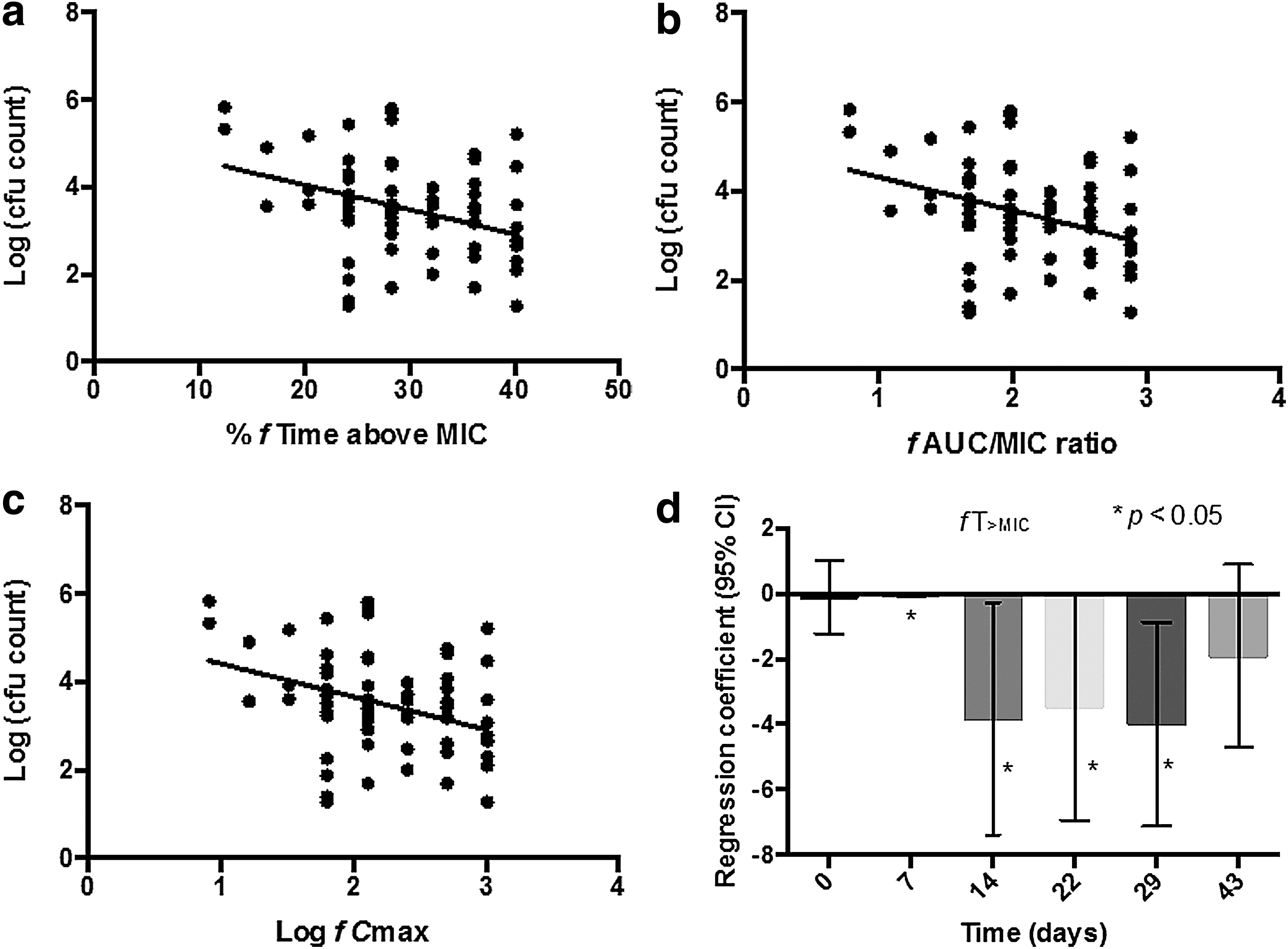
Degree of E. cloacae suppression by various cefpirome pharmacodynamic indices. The relationship on day 7 between %fT>MIC
These initial calculations were followed by calculating regression coefficients for all time points and resulted in an association between %fT>MIC and the reduction in the number of cefpirome-susceptible E. cloacae as shown in Fig. 2d. This correlation was statistically significant for days 7, 14, 22, and 29.
Also a significant correlation was demonstrated for fAUC/MIC ratios and fCmax levels at days 7 and 29 and the decrease in the number of cefpirome-susceptible E. cloacae. Due to these results, regression coefficients were calculated for each sampling moment. In Fig. 2b and c the regression coefficients are shown and demonstrated an association between fAUC/MIC ratio and fCmax and the number in cefpirome-susceptible E. cloacae isolates. Only at day 7 and 29 a significant correlation was obtained.
Absolute number of intestinal cefpirome E. cloacae mutants
We also determined the absolute number of cefpirome E. cloacae mutants with increased cefpirome MICs and growing at a concentration of 16 × MIC of the WT (Fig. 3). Mutants with increased MICs to cefpirome (≥2 μg/mL) were obtained from day 7 onward in two rats treated with 50 mg/kg/day, one rat treated with 25 mg/kg/day, and one rat treated with 12.5 mg/kg/day. The exact number of E. cloacae mutants differs, for instance in one rat treated with 50 mg/kg, 550 cfu mutants per gram of feces were obtained at day 7 and only 20 cfu/g at day 36. The other rat treated with 50 mg/kg, started at day 7 with 440 cfu/g and ended at day 43 with 400 cfu/g. The rat receiving 25 mg/kg started with 180 cfu/g at day 7 and ended with 1 × 10³ cfu/g at day 43. In the remaining rats treated with 12.5 mg/kg, only 500 cfu/g were cultured at day 43.
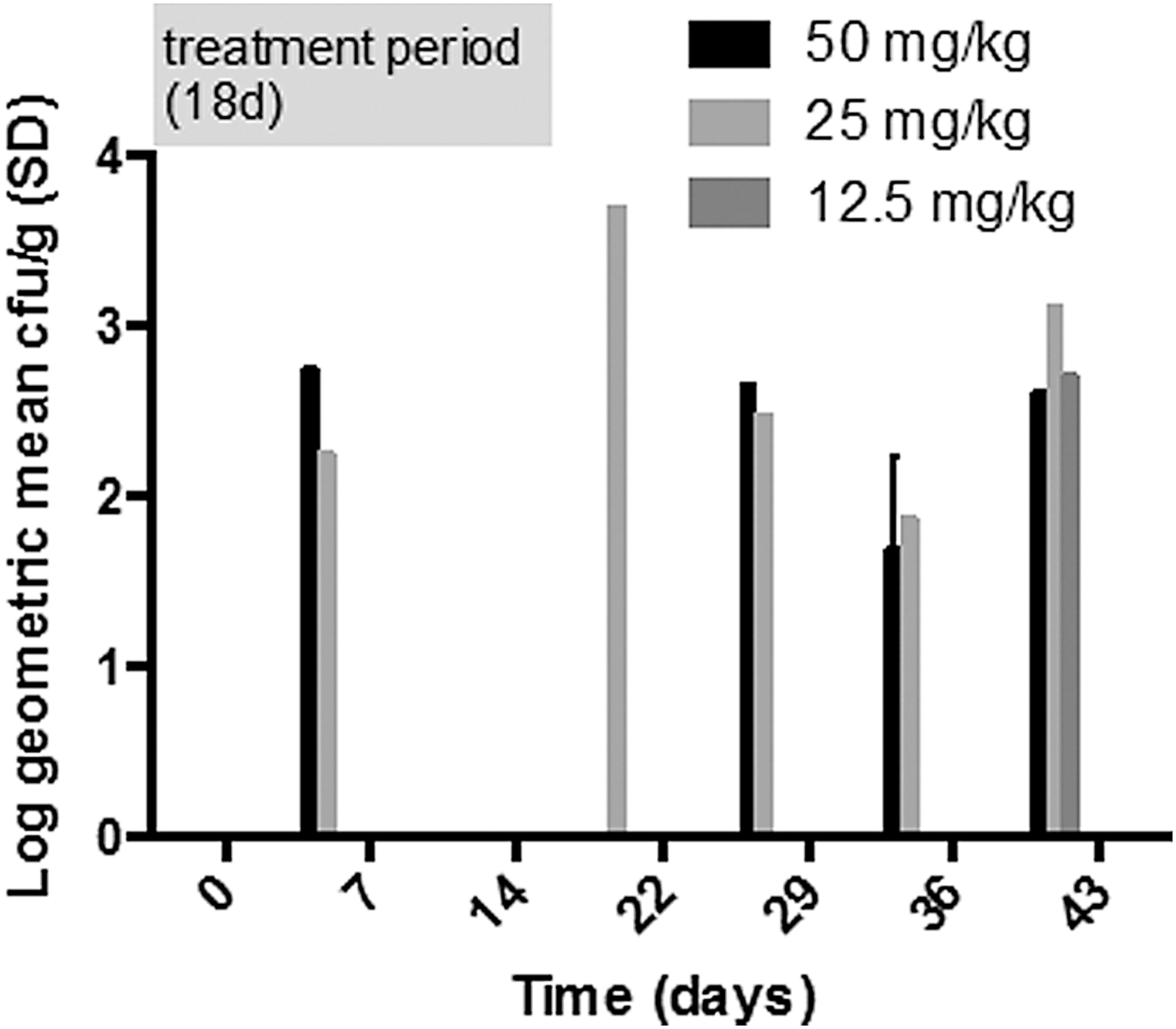
Effect of cefpirome treatment on the selection of mutants with reduced susceptibility to cefpirome. The number of cefpirome E. cloacae mutants obtained at indicated time intervals during and after cefpirome treatment for 18 days at various dose categories. Samples were cultured on plates containing 16 × MIC of cefpirome of the Wild Type (WT) organism. Each bar represents log10 geometric mean cfu counts per gram of rat feces, with SD.
Characterization of intestinal cefpirome E. cloacae mutants
To determine the antibiotic susceptibility profile of the E. cloacae mutants growing on cefpirome-containing agar plates (16 × MIC concentration of cefpirome), one colony per treatment group was randomly picked. Cefpirome MICs of the mutants were determined before and after mutants had been subcultured successively for five times on cefpirome-free agar plates. The MIC results of the initially cefpirome-susceptible E. cloacae isolates and the cefpirome E. cloacae mutants are shown in Table 1.
Minimal Inhibitory Concentrations and β-Lactamase Activity Determinations of Enterobacter cloacae Isolates Obtained Before and After Therapy with Cefpirome
Cefpirome-resistant mutants were obtained at day 43 from rats treated with cefpirome q = 12 hr at various dosages for 18 days.
MICs of E. cloacae isolates obtained before cefpirome treatment.
Cefpirome-resistant mutants obtained at day 43 from rats treated with cefpirome q = 12 hr at various dosages for 18 days.
MICs of E. cloacae isolates obtained directly after cefpirome treatment.
MICs of E. cloacae isolates obtained after cefpirome treatment and successively subcultured (5 × ) in antibiotic-free broth.
MIC, minimal inhibitory concentration.
Besides determining MICs of cefpirome, susceptibilities to other antibiotics were determined by the VITEK 2 system, as shown in Table 2. Mutants with increased MICs for cefpirome also appeared to be resistant to ampicillin, amoxicillin/clavulanic acid, cefalotin, cefotaxime, ceftazidime, cefuroxime, piperacillin, piperacillin/tazobactam, and cefoxitin but remained susceptible to cefepime (MIC ≤1 μg/mL). These susceptibility results match the phenotype of a derepressed ampC chromosomal β-lactamase. By determining the β-lactamase activity under noninduced and induced conditions of initially cefpirome-susceptible E. cloacae and E. cloacae mutants with reduced susceptibility to cefpirome, the derepression of the AmpC was confirmed. As the β-lactamase extract under the “induced” conditions is obtained under an arbitrarily chosen cefoxitin concentration and collection time point also a disk approximation test with cefoxitin and the indicator ceftazidime was performed. The zone size diameter of ceftazidime was showing a flattening of the diameter at the site opposite of the cefoxitin indicating that the isolate harbors an inducible AmpC (data not shown). From these data, it is concluded that the reduced susceptibility to cefpirome of the mutants is at least partly due to increased activity of the β-lactamase enzyme probably as a result of a mutation in the ampD gene resulting in derepression of the ampC β-lactamase gene. Additional mechanisms contributing to reduced susceptibility to cefpirome are loss of porins and mutations in the structural ampC-gene resulting in an extended character of the enzyme. So, to exclude the possibility of the presence of mutations in the structural ampC gene, the ampC gene of the mutants was sequenced and showed no mutations compared with the initial cefpirome susceptible isolate, obtained at day 0 before cefpirome exposure (Table 3). As ampD is more often involved in the upregulation of ampC, also the ampD was analyzed and these results revealed that in the control isolate, obtained at day 0 before cefpirome exposure, the ampD gene is intact while in all mutants the ampD gene is corrupted due to insertions and deletion of large part of the encoding region or of the entire gene (Table 3). To exclude the influence of porin loss, also the omp39–40 was checked but showed no mutations in comparison to the noncefpirome-exposed control E. cloacae, thereby ruling out porin loss as an explanation for the increased cefpirome MICs.
Antibiotic Susceptibility Patterns of an Enterobacter cloacae Isolate Obtained Before Starting Therapy with Cefpirome and the Mutant Obtained During Therapy
A representative cefpirome E. cloacae mutant obtained at day 43 from a rat treated every 24 hr with cefpirome 50 mg/kg/day, for 18 days.
Overview of Changes in ampC, ampD, and Porin39–40 Relative to the Control Isolate at day 0
Genotypic characterization of intestinal cefpirome E. cloacae mutants with increased MICs to cefpirome
The E. cloacae mutants growing on cefpirome-containing plates were genotyped by PFGE to check if they were genotypically identical to the initial cefpirome-susceptible E. cloacae isolates. All cefpirome-resistant mutants (n = 11) are displaying identical PFGE patterns in comparison to the initial cefpirome-susceptible isolates. These results prove that the cefpirome-resistant mutants were derived from the already present initial population and were not selected from a “genetically different minor E. cloacae subpopulation.”
Relation of MPC to emergence of intestinal cefpirome mutants of E. cloacae
The current study was undertaken to study the PK/PD parameters responsible for selection of mutants with reduced susceptibility to cefpirome. The initial E. cloacae isolate present in the intestine has an MIC of 0.125 μg/mL for cefpirome. The MPC for this particular isolate is 1 μg/mL. Due to this relatively low MPC of the initial isolate, the corresponding MSW is small (0.125–1 μg/mL), meaning that the time isolates are exposed to concentration-selecting conditions is limited. As only a limited number of mutants with increased MICs for cefpirome were cultured, we were not able to do any statistical analysis with respect to the relationship of PK/PD or time within the MSW on the selection of cefpirome mutants.
Discussion
The major objectives of the present study was to investigate the efficacy of cefpirome administration in the treatment of a K. pneumoniae lung infection on one hand and on the other hand whether cefpirome treatment resulted in the selection of stable derepressed mutants in initial cefpirome-susceptible E. cloacae present in the intestine of rats. The efficacy of cefpirome treatment in comparison to the efficacy results obtained with ceftazidime, in the same model with respect to the treatment of K. pneumoniae lung infection, it is observed that cefpirome is more efficacious in the treatment of the lung infection than ceftazidime. In the article from 2007, we have shown that a ceftazidime dose of 25 mg/kg (b.i.d) results in a 50% survival of the rats. 8 While, in the present study, 50% survival of rats is obtained by a dosing regimen of 6.3 mg/kg of cefpirome (b.i.d) making cefpirome more efficacious than ceftazidime.
More important, however, is the enrichment of cefpirome E. cloacae mutants with reduced susceptibility to cefpirome. In a previous study, we have shown that treatment with ceftazidime, in the same lung pneumoniae model, resulted in the selection of a considerable number of ceftazidime-resistant E. cloacae mutants, that is, 22.2% of rats (6 out of 27 rats) harbored high numbers of (>105 cfu/g) ceftazidime-resistant mutants treated with 12.5, 25, and 50 mg/kg of ceftazidime (b.i.d.). 8 In the present study, we demonstrated that treatment with fourth-generation cefpirome (b.i.d.) in the therapeutic range in our lung infection model only had a moderate effect on intestinal colonization with cefpirome stable derepressed mutants of E. cloacae. In a limited number of rats, 4 out of 32 (12.5%) stable derepressed mutants were selected by cefpirome from the E. cloacae population during cefpirome therapy. In each treatment group 1 out of 11 rats receiving 12.5 and 1 out of 11 rats receiving 25 mg/kg and 2 out of 10 rats in the 50 mg/kg (b.i.d) mutants with increased MICs for cefpirome were cultured. Furthermore, it has been demonstrated that once selection of cefpirome mutants has occurred during the treatment period, this population remained present in low numbers per gram of feces up to 25 days after the therapy was stopped. The resistant subpopulation selected by cefpirome, in contrast to ceftazidime, represented only a small part of the total population. The frequency of mutants found within the total population of E. cloacae per gram of feces was 1 × 10⁻⁴ to 1 × 10⁻³, and did not completely replace the susceptible population, in contrast to the result obtained by ceftazidime in which the whole population became ceftazidime resistant.8,20
The limited selection of cefpirome mutants with reduced susceptibility to cefpirome is reflected in a relative MPC of 1 μg/mL. The low MPC of 1 μg/mL will result in a relative short-time cefpirome level fall within the boundaries of the MSW, especially in a twice-daily treatment schedule. Therefore, the potential advantage with respect to resistance selection of cefpirome over ceftazidime is probably based on its shorter time period of cefpirome levels in the MSW, reducing the risk for selection of derepressed Enterobacter mutants. 5
Characterization of the mutants showed that only stable derepressed mutants were selected and the mutants with reduced susceptibility to cefpirome did not show mutations in the structural ampC in comparison to the initial cefpirome-susceptible E. cloacae thereby ruling out mutations leading to an extended character as described by Morosini et al. and Vakulenko et al.21–23 In the article of Fung-Tomc et al. they demonstrated that cefpirome selected for porin mutants with a diminished level of Omp39–40 resulted in a “Mar” phenotype, that is, resistant to unrelated antibiotics as chloramphenicol and ciprofloxacin. 23 In the mutants selected during therapy no “Mar” phenotype was demonstrated, all mutants were susceptible to chloramphenicol, ciprofloxacin, and tetracycline indicating that omp39–40 is still intact. These results are confirmed by WGS results in showing no mutations in the omp39–40 gene of the mutants in comparison to the control isolate.
In comparison to the ceftazidime treatment investigated in the previous study, this fourth-generation cephalosporin seems to be more promising in clinical use, based on our lung infection model in rats. It has a narrow MSW for E. cloacae with WT MICs, resulting in less selection of cefpirome-resistant subpopulations. Therefore, it causes less collateral damage to the colonizing flora and has also a higher efficacy in comparison to ceftazidime. As observed in other studies for β-lactam group of drugs, the PK/PD index, %fT>MIC, best correlated with the therapeutic efficacy of cefpirome on 18 days administration. Henceforth, compared with the third-generation cephalosporin, this fourth-generation cephalosporin has a clear advantage in selecting lower number of resistant subpopulations.
Footnotes
Acknowledgment
The authors are grateful to Mrs. Heleen van der Spek for technical assistance.
Disclosure Statement
No competing financial interests exist.
Funding Information
This research received funding from the Erasmus University Medical Center, Department of Medical Microbiology and Infectious Diseases.