




Abstract
Although edible offal can be easily contaminated with foodborne bacteria and regarded as important transfers of antimicrobial resistance to humans, the characterization of bacteria from edible offal have not been researched sufficiently. This study is the first to focus on the molecular characterization of Salmonella isolated from edible pork offal. From a total of 52 Salmonella isolates from edible pork offal, 44 (80.7%) were resistant to at least one antimicrobial agent and 24 (46.2%) exhibited multidrug resistance (MDR). All MDR Salmonella were also resistant to β-lactams and 12 (50.0%) of the isolates were positive for blaTEM-1. Eleven (68.8%) of the 16 gentamicin-resistant isolates harbored the ant(2′′)-I gene. Among 18 tetracycline-resistant isolates, tetA and tetB genes were found in 9 (50.0%) and 3 (16.7%) isolates, respectively. The sul1 gene was identified in 9 (81.8%) of 11 trimethoprim/sulfamethoxazole-resistant isolates, and the cmlA gene was identified in only 2 (18.1%) among 11 chloramphenicol-resistant isolates. Eighteen (75.0%) of the 24 MDR Salmonella were identified as containing class 1 integrons, within which dfrA12-aadA2 (55.6%) was the most prevalent resistance gene cassettes. Twenty-one (87.5%) of the MDR isolates were also found to have the plasmid replicons. Replicon B/O (41.7%) was the most prevalent replicon types. These results suggest that edible pork offal can become a reservoir that not only harbors MDR Salmonella, but also contributes to their dissemination through cross-contamination processes.
Introduction
The edible offal is used globally for human consumption in various traditional dishes.1,2 Among them, edible pork offal including heart, liver, lung, small intestine, and large intestine is commonly consumed in East Asian countries such as China and Korea.1,3,4 In particular, the small and large intestines of edible pork offal are more commonly consumed grilled or as chitterlings in Korea. 3 However, edible pork offal could become easily contaminated with bacteria that are major causes of food poisoning in humans such as Salmonella and Escherichia coli during animal slaughter and food processing. 5
Salmonella is a major cause of foodborne illness, and the increased incidence of antimicrobial-resistant Salmonella is a serious global public health problem.6,7 The injudicious use of antimicrobials in swine husbandry for different purposes, such as treatment, prophylaxis, or growth promotion, is a major cause of antimicrobial resistance.8,9 Therefore, outbreaks of antimicrobial resistance of Salmonella and emergence of multidrug-resistant (MDR) Salmonella in pigs has been reported worldwide.8,10–13 However, Salmonella from edible pork offal remains relatively uncharacterized, despite its importance in the transfer of antimicrobial-resistant Salmonella. In this study, we investigated the antimicrobial resistance and genetic diversity of Salmonella isolated from the small and large intestines of pork, which are commonly found in traditional markets in Korea.
Materials and Methods
Salmonella isolates and serotyping
From 2016 to 2017, a total of 52 Salmonella were isolated from edible pork offal at 12 pig slaughterhouses throughout the country. Five small and large intestines were randomly collected from four farms at each slaughterhouse. Small and large intestines offal samples were collected from the rehang belt before the rehanging of the carcasses on the drip line. Each sample was aseptically placed into a vacuum bag (Sealed Air, Elmwood Park, NJ), and 400 mL of sterile buffered peptone water (BPW; Difco, Sparks, MD) was added. The bag was shaken 50 times, and ∼50 mL of rinse water was transferred into a sterile specimen cup. All samples that completed overall processing were collected in Whirl-Pak stomacher bags (Nasco) using sterile equipment and were transported to the laboratory and stored at 4°C within 12 hr of arrival. A total of 42 among 480 samples were positive for Salmonella. All Salmonella isolates were serotyped according to the Kauffmann–White scheme. 14 If isolates obtained from the same farm showed the same serovar and antimicrobial susceptibility patterns, only one isolate was randomly chosen for this study. A total of 11 Salmonella serotypes were identified as given in Table 1.
Salmonella Serotypes Used in This Study
Antimicrobial susceptibility testing
All Salmonella isolates were investigated for antimicrobial susceptibility by the disk diffusion method, according to the Clinical and Laboratory Standards Institute guidelines. 15 Seventeen antimicrobial agents were tested: penicillin [ampicillin (10 μg)], β-lactam/β-lactamase inhibitor combinations [amoxicillin–clavulanic acid (20/10 μg)], cephems [cefazolin (30 μg), cefepime (30 μg), cefotaxime (30 μg), cefoxitin (30 μg), ceftazidime (30 μg), cefuroxime (30 μg), cephalexin (30 μg), cephalothin (30 μg)], phenicols [chloramphenicol (30 μg)], fluoroquinolones [ciprofloxacin (5 μg)], aminoglycosides [gentamicin (10 μg)], tetracyclines [tetracycline (30 μg)], folate pathway inhibitors [trimethoprim–sulfamethoxazole (1.25/23.75 μg)], quinolones [nalidixic acid (30 μg)], and carbapenems [imipenem (10 μg)]. E. coli ATCC 25922 was included as a quality control. MDR was defined as acquired resistance to at least one agent in three or more antimicrobial classes.11,16
Detection of integrons and antimicrobial resistance genes
Detection of integrons and antimicrobial resistance genes was performed by PCR using the primers given in Table 2. All positive PCR products were submitted to Cosmogenetech Corporation (Seoul, Korea) for sequencing. The following genes were tested for all MDR Salmonella isolates: β-lactam antibiotics (blaTEM, blaSHV, blaOXA, and blaCTX-M families), gentamicin (aac (6′)-Ib-cr, aac (3)-II, and ant (2′′)-I), tetracycline (tetA and tetB), chloramphenicol (cmlA and catA1), sulfonamides (sul1 and sul2), and quinolone (qnrA, qnrB, qnrD, qnrS, and qepA). Class 1 and 2 integrons (intl1 and intl2) were also investigated.
Primer Sequences Used for Amplification
Detection of gene cassettes
The presence of gene cassettes in the integron-positive isolates was also assessed by PCR using the primers given in Table 2, and PCR products were sequenced using an automatic sequencer (Cosmogenetech, Korea). The sequences were compared with those in the GenBank nucleotide database using the Basic Local Alignment Search Tool (BLAST) program available through the National Center for Biotechnology Information website.
Plasmid replicon typing
The MDR isolates were screened for 18 major plasmid replicons in Enterobacteriaceae by PCR-based typing method using three multiplex panels as previously described. 31
Results
Antimicrobial resistance
The antimicrobial resistance of 52 Salmonella isolates from small (n = 28) and large (n = 24) intestines of edible pork offal is given in Fig. 1. Forty-two (80.7%) isolates were resistant to at least one antimicrobial agent. A high proportion of Salmonella isolates were resistant to tetracycline (63.5%), ampicillin (57.7%), gentamicin (34.6%), and chloramphenicol (30.8%). Moreover, low-level resistance against cephalosporins was observed as follows: cefazolin (11.5%), cephalothin (7.7%), ceftazidime (3.8%), cefepime (1.9%), cefotaxime (1.9%), cefuroxime (1.9%), and cephalexin (1.9%). None of the isolates was resistant to cefoxitin, ciprofloxacin, and imipenem.
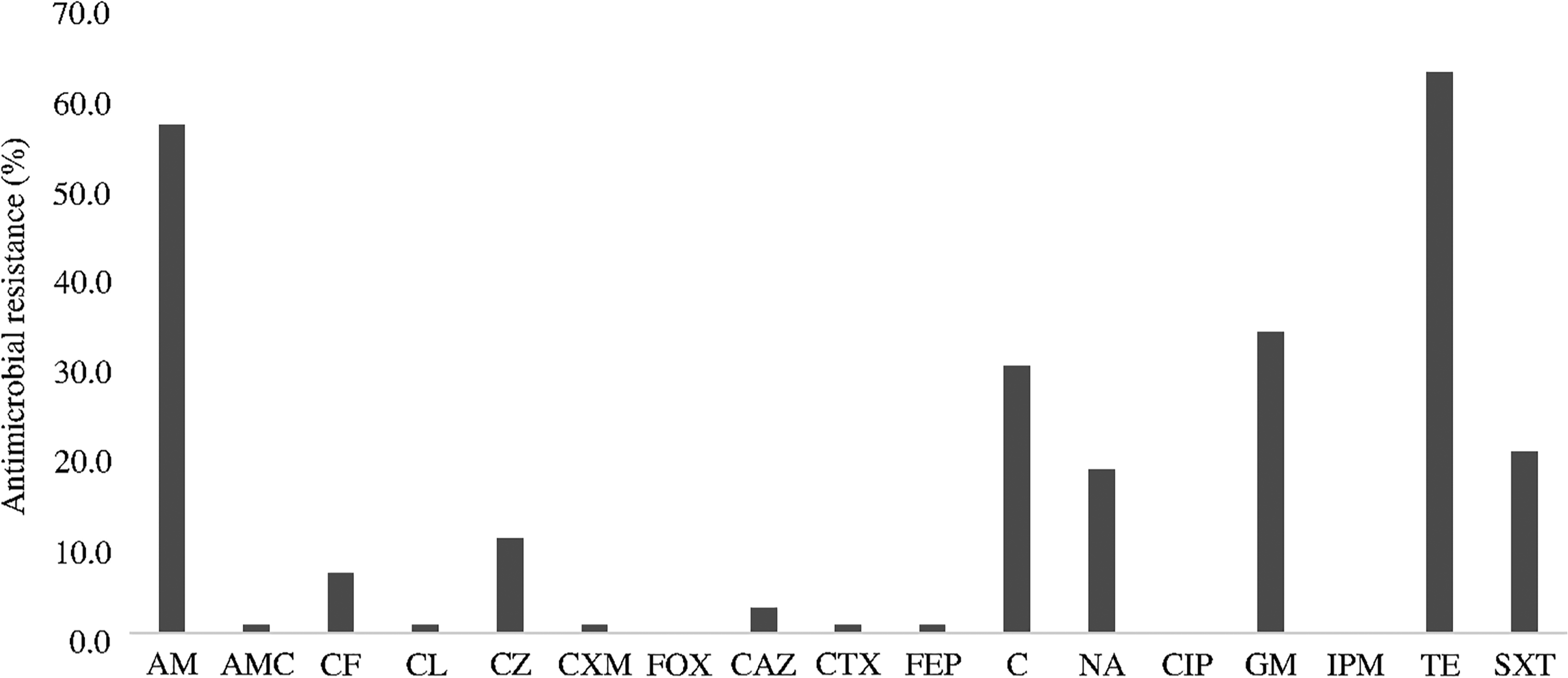
Antimicrobial-resistant profile of 52 Salmonella isolated from edible offal. AM, ampicillin; AMC, amoxicillin–clavulanate; CF, cephalothin; CL, cephalexin; CZ, cefazolin; CXM, cefuroxime; FOX, cefoxitin; CAZ, ceftazidime; CTX, cefotaxime; FEP, cefepime; C, chloramphenicol; NA, nalidixic acid; CIP, ciprofloxacin; GM, gentamicin; IPM, imipenem; TE, tetracycline; SXT, trimethoprim–sulfamethoxazole.
Phenotypic and genotypic characteristics of MDR isolates
A total of 24 (46.2%) isolates among 52 Salmonella were MDR and their characteristics are given in Table 3. MDR isolates were revealed in Salmonella Rissen (n = 10), Typhimurium (n = 9), monophasic Typhimurium 4,[5],12:i:- (n = 4), and Virchow (n = 1).
Characteristics of Phenotypic and Genotypic in 24 Multidrug-Resistant Salmonella Isolated from Edible Offal
AM, ampicillin; AMC, amoxicillin–clavulanate; CF, cephalothin; CL, cephalexin; CZ, cefazolin; CXM, cefuroxime; CAZ, ceftazidime; CTX, cefotaxime; FEP, cefepime; C, chloramphenicol; NA, nalidixic acid; GM, gentamicin; TE, tetracycline; SXT, trimethoprim sulfamethoxazole.
—, not detected.
All MDR isolates showed β-lactams resistance, and 12 (50.0%) isolates were positive for blaTEM-1. Eleven (68.8%) of the 16 gentamicin-resistant isolates harbored the ant(2′′)-I gene. Among 18 tetracycline-resistant isolates, tetA and tetB genes were found in 9 (50.0%) and 3 (16.7%) isolates, respectively. The sul1 gene was identified in 9 (81.8%) of 11 sulfonamide-resistant isolates, and the cmlA gene was identified in only 2 (18.1%) of 11 chloramphenicol-resistant isolates. No isolates carried the plasmid-mediated quinolone resistance genes (qnrA, qnrB, qnrD, qnrS, qepA, and aac(6′)-Ib-cr), the β-lactam genes (blaSHV, blaOXA, and blaCTX-M families), the sulfonamide-resistant gene (sul2), the ampicillin-resistant gene (aac(3)-II), and the chloramphenicol-resistant gene (catA1).
Eighteen (75.0%) of the 24 MDR Salmonella were identified to harbor class 1 integrons and showed four types of resistance gene cassettes as follows: dfrA12-aadA2 (55.6%), aadA2-blaPSE-1 (22.2%), aadA1-aadA2 (16.7%), and aadA1(5.6%). None of the isolates showed class 2 integrons.
Twenty-one (87.5%) MDR isolates were also found to have the plasmid replicons. Replicon B/O (41.7%) was more prevalent than the other replicon types, followed by FIB (25%), FIIA (16.7%), Frep (12.5%), and I1(8.3%). None of the isolates had A/C, FIA, FIC, N, HI1, HI2, K/B, L/M, P, T, W, X, and Y replicons.
Discussion
Although edible offal is widely used in traditional dishes, there are no specific regulations for processing edible offal in Korea. 3 However, edible offal could more easily be contaminated in slaughterhouses, which could be a major source of contamination of carcass particularly during evisceration. 12 Chon et al. 3 reported that the levels of indicator bacteria isolated from porcine small and large intestines were significantly higher than those detected in other organs, and 23.8% of pork offal was to be positive for Salmonella. Salmonella is the major cause of bacterial foodborne poisoning in Korea. 16 Furthermore, the emergence and spread of antimicrobial resistance in Salmonella is a global public health hazard. 32
The Korea Animal Health Products Association reported that >502 tons of antimicrobials were sold for use in the pig industry during the past 5 years; this accounts for the majority (52.0%) of antimicrobials sold, followed by sales in fishery (24.0%), poultry (16.0%), and cattle (7.0%) 33 Correspondingly, a high frequency of antimicrobial resistance (75.0%) has already been reported in Salmonella from fecal samples of pig farms in Korea, 34 which is higher than in China (64.3%) 11 and the United States (44.0%). 8 In this study, antimicrobial resistance in Salmonella isolated from edible pork offal was reported for the first time, and 80.7% of Salmonella tested showed the resistance to at least one antimicrobial. In particular, resistance to tetracycline, ampicillin, and gentamicin were most frequent, which is consistent with a previous reported on Salmonella from pig farms in Korea. 34 In addition, 46.2% of Salmonella tested in this study exhibited the MDR, which is slightly higher than the 33.3% described for pork meat. 33 The frequent resistance to these antimicrobials is explained by the high sales of the antimicrobials in the Korean poultry industry. 35 In contrast, the low incidence of cephalosporin-resistant isolates may be due to their limited usage in the veterinary and public health sectors.12,35,36
β-lactams are broad spectrum antimicrobial agents widely used veterinary medicine and food animal production 30 and can be divided into the penicillin's, 1° to 5° generation, monobactam, carbapenem and the β-lactamase inhibitors. Resistance to β-lactams in Gram-negative bacteria is primarily mediated by β-lactamases. 30 In this study, all 24 MDR isolates showed the resistance to ampicillin, and 50% of MDR isolates harbored the β-lactamase encoding gene, blaTEM-1. TEM β-lactamase is a major mediator of ampicillin-resistance in Salmonella worldwide including Korea.37–39 Although the β-lactamase genes found in this study are non-ESBL genes, are still meaningful, because ESBLs are derived from mutation of genes that encode the narrow-spectrum beta-lactamases such as blaTEM.40,41
In this study, resistance to tetracycline was most frequently (63.5%) observed in the Salmonella isolates, and the tetA gene was frequently found in the tetracycline-resistant isolates, which is consistent with the findings of Karczmarczyk et al. 42 The sul1 gene, which encodes a sulfonamide-resistant dihydropteroate synthase, was identified in 9 (81.8%) of 11 sulfonamide-resistant isolates, and the ant(2′′)-I gene, which encodes an aminoglycoside adenylyltransferase, was identified in 11 (68.8%) of 16 gentamicin-resistant isolates. The sul1 and ant(2′′)-I genes have been already reported as major determinants of sulfonamides and gentamicin resistance in Gram-negative bacteria, respectively. 43 Although chloramphenicol is banned in food-producing animals because of its suspected carcinogenicity, 44 we found that 2 (18.1%) of 11 chloramphenicol-resistant isolates carried the cmlA gene, which encodes a specific chloramphenicol transporter. In a previous study, cmlA (43.2%) was detected in chloramphenicol-resistant Salmonella isolated from fecal pools of pig farms in Spain. 45 Therefore, although chloramphenicol is already prohibited worldwide, there is a reservoir of chloramphenicol resistance in bacteria from food animals, which is probably because of historically frequent use and transmission in related elements, such as cmlA.
Integrons are one of the most important genetic elements responsible for the spread of antimicrobial resistance genes among bacteria including MDR isolates.46,47 This is because they carry antimicrobial resistance gene cassettes and specific resistance genes. 47 In this study, 18 (75.0%) of the 24 MDR isolates carried class 1 integrons, within which dfrA12-aadA2 was the most frequent cassette (55.6%). Similar results have been reported in other studies from Thailand 48 and Portugal. 10
Plasmids are also important agents of horizontal gene transfer, playing a major role in bacterial adaptation to environmental change. 31 Among the MDR isolates, IncB/O (41.5%) and FIB (25.0%) were the most common type identified, which is representative of the major plasmid incompatibility groups circulating among the Enterobacteriaceae. 49 In addition, IncFIIA (16.7%), which has been recognized as the major virulence-associated replicon in Salmonella, was identified. 50
To the best of our knowledge, this is the first report that focuses on the molecular characterization of MDR Salmonella from edible pork offal. Our results suggest that edible pork offal can become a reservoir that not only harbors MDR Salmonella, but also contributes to their dissemination through cross-contamination processes.
Footnotes
Disclosure Statement
No competing financial interests exist.
Funding Information
This work was supported by Korea Institute of Planning and Evaluation for Technology in Food, Agriculture, Forestry and Fisheries (IPET) through Agriculture, Food and Rural Affairs Research Center Support Program, funded by Ministry of Agriculture, Food and Rural Affairs (MAFRA) (716002-7).