




Abstract
Antimicrobial resistance (AMR) is a serious global threat driven by the overuse of drugs in humans, animals, as well as the contamination of natural environments with antimicrobial residues. In recent years, the rise of community-acquired infections resistant to antibiotics has drawn renewed attention to the environmental compartment, in particular for pathogens found in aquaculture systems. We quantified the prevalence of antibiotic resistance in Vibrios isolated from the Cochin Estuary as well as the adjoining shrimp farms, and seafood from markets. A total of 280 Vibrio strains were subjected to antimicrobial susceptibility testing and screened for the presence of blaTEM, blaCTX-M, and blaNDM-1 genes. All strains identified were resistant to at least three antimicrobials, and the percentage of drugs resistant per strain ranged from 16% up to 60%. All the strains from the estuary were resistant to amoxicillin, ampicillin, cephalothin, and colistin. Similarly, strains isolated from seafood were resistant to enrofloxacin, furazolidone, and trimethoprim, and all strains from shrimp farms were resistant to colistin. Plasmid-mediated antibiotic resistance was observed in 21% of the strains. In addition, the presence of blaNDM-1 gene was confirmed in 22.85% of the strains. The presence of multiple resistant phenotypes in vibrios, including resistance to last-resort compounds in domestic food sources, raises serious concerns for public health in the Cochin Estuary. Although localized in nature, our findings also have vital implications for the spread of AMR internationally, given the prominence of South India for seafood exports.
Introduction
Antimicrobial resistance (AMR) is the ability of microbes to evolve and withstand the effect of treatment and it is a rising global threat. This slow-moving crisis is driven by the overuse of antimicrobial drugs in humans, animals, as well as the contamination of natural environments with antimicrobial residues and resistant pathogens.1–3 The interconnectedness of those compartments is emphasized through the One Health approach of the global action plan on AMR of the World Health Organization. 4 In recent years, the rapid increase in community-acquired infections due to resistant bacteria has drawn renewed attention to the environmental compartment, in particular for pathogens found in aquaculture systems.5,6
Fish and seafood are important sources of protein, providing up to 20% of the animal protein consumed by the world's growing population. 7 Increased global demand for animal protein 8 is projected to make aquaculture surpass the production of fisheries by 2030. 9 This trend will contribute to improve protein supply, food security, and create economic opportunities in Asia where 90% of the world aquaculture production is concentrated. 10 However, aquatic animal diseases such as vibriosis are a major challenge to the development of the aquaculture industry. 11 Thus far, antimicrobials have been used routinely in aquaculture thorough out Asia to control disease and maintain productivity. 12 Some of the antibiotics permitted for use in aquaculture in India include ampicillin, cloxacillin, sulfadiazine, trimethoprim, and virginiamycin. The impact of those farming practices on the spread of AMR in the food chain remains poorly understood but may have important implications for public health.
In India, drug-resistant infections are among the highest in the world.13,14 This situation is driven not only by poor hygiene but also the indiscriminate use of antimicrobials in human medicine and food animals. In 2030, India is projected to become the fourth largest consumer of antimicrobials in food animals. This is the largest relative increase in consumption compared with 2010. 15 These unsustainable practices have taken the aquaculture industry on a rollercoaster ride, bringing it intermittently close to collapse. This trend has started to negatively affect India's exports. For instance, the presence of antibiotic residues in shrimp has become a serious threat to India's seafood industry exports. Recently the European Union rejected many shipments of shrimp from India due to the presence of banned antibiotics such as chloramphenicol, and nitrofuran residues in white legged shrimp (Litopenaeus vannamei). 16 Solutions are urgently needed to understand the epidemiology of AMR in aquaculture, and to improve farming practices to reduce the reliance on antimicrobials for the control of aquatic pathogens in India.
In shallow coastal aquaculture systems, such as Cochin Estuary on the southwest coast of India, some of the most common pathogens are vibrios 17 (gram-negative halophilic bacteria). Vibrio spp. are pathogens of fish, coral, shellfish, and shrimp. 17 Several Vibrio spp. are also known human pathogens and have been implicated in water and seafood-related outbreaks of gastrointestinal infections in humans.18,19 Despite their public health significance, the AMR profiles of pathogenic Vibrio have not been extensively studied in India compared with other South Asian countries and are typically not included in routine AMR monitoring, in contrast to other foodborne pathogens such as Escherichia coli, Campylobacter spp., and Salmonella spp.20,21 Several studies on AMR among Vibrio spp. have been reported from other South Asian countries.22–27
Natural environments such as the Cochin Estuary used for food production can also become reservoirs of antibiotic resistance genes (ARGs). 28 Thus far, limited studies from the Cochin Estuary have investigated AMR patterns, or the presence of ARGs to last-resort antibiotics in Vibrios.29–31 The blaNDM-1 gene was first reported in 2009 and has since then received considerable attention because strains harboring blaNDM-1 are resistant to penicillin, monobactams, extended-spectrum cephalosporins, and carbapenems (the last-resort drug for infections caused by extended-spectrum β-lactamase producing bacteria). 32 The pathogenic bacteria acquire the ARGs from an environmental gene pool through horizontal gene transfer (HGT) processes such as transduction, transformation, and conjugation. Natural water bodies are the hotspots for HGT of ARGs between environmental bacteria and human and animal pathogens. Thus, the search for genetic elements such as plasmids, transposons, and integrons associated with AMR in microorganisms becomes important. Bacterial plasmids harbor genes that confer resistance to antibiotics and facilitate the fast spreading of AMR among bacteria. Plasmid curing eliminates the bacterial plasmid and is used to determine the antibiotic resistance mediation. 33
Beyond its potential for economic development for aquaculture, the Cochin Estuary forms the lifeline of people around the estuary. It is a breeding ground for commercially important shrimp and fish species. It also supports traditional, seasonal, and perennial prawn fisheries, 34 and in recent years it has become a renowned tourist destination. A better assessment of the AMR situation in the region is thus needed to appreciate its impact across the different sectors of the local economy.
Our study aimed to establish the phenotypic resistance profile of Vibrios isolated from the Cochin Estuary as well as adjoining shrimp farms, and seafood from local markets. We also attempted to screen the strains for plasmid-mediated drug resistance, as well as for the presence of ARGs blaTEM, blaCTX-M, and blaNDM-1.
Materials and Methods
Sampling
Vibrios were isolated from water and sediments sampled from 10 stations in the Cochin Estuary (76°10′E, 9°40′N) and from four traditional shrimp farms adjoining the estuary (76°11′E, 10°5′N), and also from seafood samples collected from retail markets situated around Cochin (76°27′E, 11°28′N). Sampling was conducted previously during the year 2012. Preliminary screening was performed using oxidase test, gram staining, and O/F test. All the gram-negative, oxidase-positive, and fermentative without gas producing presumptive isolates were further identified and confirmed as Vibrios using the dichotomous key. 35 Details of the strains are given in Supplementary Table S1. A total of 280 Vibrio strains were used in this study. This included 180 strains from Cochin Estuary, 70 isolates from shrimp farms, and 30 isolated from seafood.
Antibiotic susceptibility test
The antibiotic sensitivity of the strains was screened using the disc diffusion method. 36 Twenty-five different antibiotic discs (HiMedia, Mumbai, India) were used for the study. This included amikacin (Ak-30), streptomycin (S-10), gentamicin (Gen-10), netilmicin (Net-10) (aminoglycosides); amoxicillin (Amx-10), ampicillin (Amp-10), carbenicillin (Cb-100), cephalothin (Cep-30), ceftriaxone (Ctr-30), ceftazidime (Caz-30) (beta-lactams); ciprofloxacin (Cip-5), enrofloxacin (Ex-5), norfloxacin (Nx-10) (fluoroquinolones); trimethoprim (Tr-5) (folate pathway inhibitors); erythromycin (E-15) (macrolides); furazolidone (Fr-50), nitrofurantoin (Nit-100) (nitrofurans); colistin (Cl-10) (polymyxin); cotrimoxazole (Cot-25), sulfamethoxazole (Sm-100); doxycycline hydrochloride (Do-30), oxytetracycline (O-30), tetracycline (Te-30) (tetracyclines); and chloramphenicol (C-30) (amphenicol). Discs containing the following antibacterial agents were placed on Mueller Hinton agar (HiMedia) plates that were swabbed with enriched bacterial culture and incubated overnight at 37°C. After incubation, the diameter of the zone of inhibition was measured and the results were interpreted based on the recommendations of Clinical Laboratory Standards Institute. 37
Isolates that were resistant to three or more antibiotics were designated as “multiple antibiotic resistant.” Multiple antibiotic resistance (MAR) indexing of the isolates was determined by calculating the ratio between the number of antibiotics to which an isolate is resistant and the total number of antibiotics to which the isolate was exposed. 38 Correlation between the resistance rates among vibrios from different settings was analyzed using the R software package.
β-Lactam ARG detection
Bacterial DNA was extracted using the boiling method. 39 Details of the primers used are given in Table 1. PCR conditions for blaTEM 40 and blaCTX-M 41 included 1 cycle of initial denaturation for 5 min at 94°C followed by 30 cycles of denaturation at 94°C for 30 sec, annealing at 50°C/60°C (blaTEM/blaCTX-M) for 30 sec, extension at 72°C for 1.5 min; one cycle of final extension for 5 min at 72°C. PCR conditions for blaNDM-1 gene 42 included an initial denaturation for 10 min at 94°C; 36 cycles of amplification consisting of 30 sec at 94°C, 40 sec at 52°C, and 50 sec at 72°C; and 5 min at 72°C for the final extension. PCR amplification was optimized in a total reaction volume of 25 μL consisting of sterile MilliQ water (15.5 μL), 10× PCR buffer (2 μL), primer (1 μL each), dntpmix (1 μL, 200 mM), template (4 μL), and Taq DNA polymerase (0.5 μL). The PCR amplified products were separated by electrophoresis on agarose (1.5% w/v) gel in 1× TBE buffer (HiMedia) containing 0.5 μg/mL of ethidium bromide. The amplicon size was compared with a 100 bp DNA ladder. The gels were then visualized under UV transilluminator and recorded as tiff file by using the Gel Documentation System (GelDoc EZ imager; Bio-Rad).
Details of Primers Used
Plasmid profiling
The drug-resistant strains were screened for the presence of plasmids. Bacterial strains were grown in 10 mL Luria Bertani (LB) broth (HiMedia) containing 1% sodium chloride and ampicillin (0.1 mg/mL) and incubated overnight at 37°C in a shaker incubator (200 rpm) (Scigenics Biotech, India) for 16–18 hr. About 1.5 mL of this culture was used for plasmid extraction following the alkaline lysis method. 43 The extracted plasmids were subjected to electrophoresis in 0.8% agarose gel (Agarose; HiMedia), 1% (w/v) in 1× Tris Boric Acid EDTA (TBE) buffer (HiMedia) containing 0.5 μg/mL of ethidium bromide. Electrophoretic separation was carried out at 75 V for 1 hr and a molecular weight marker (Supercoiled DNA ladder; HiMedia) was included. The gels were then visualized under a UV transilluminator and recorded as tiff file by using the Gel Documentation System (GelDoc EZ imager; Bio-Rad). The obtained plasmid profiles were noted.
Plasmid curing
Plasmid curing treatments were carried out using acridine orange. 44 An overnight culture of plasmid containing the antibiotic-resistant Vibrio strain (200 μL) was added into 5 mL of LB broth supplemented with 0.1 mg/mL of acridine orange and incubated at 37°C for 24 hr under constant agitation. Subsequently, the plasmid cured strains were tested for the antibiogram pattern for the antibiotics to which they were originally resistant. The resistance was considered chromosomal DNA mediated when observed even after the curing procedure; otherwise, it was characterized as plasmid mediated.
Results
Antibiotic resistance among Vibrios from Cochin Estuary, shrimp farms, and seafood
All the Vibrio strains from Cochin Estuary, shrimp farms, and seafood were multidrug resistant. Figure 1 shows the percentage of antibiotic resistance among Vibrios isolated from the three sources. All the strains from estuary (100%) were resistant to amoxicillin, ampicillin, cephalothin, and colistin. All the strains were sensitive to netilmicin, ciprofloxacin, and ceftriaxone. All the strains from shrimp farms were resistant to cephalothin (beta-lactam) and all of them exhibited sensitivity to ciprofloxacin, cotrimoxazole, netilmicin, and tetracycline. All the strains from seafood were resistant to enrofloxacin, furazolidone, and trimethoprim and all were sensitive to cotrimoxazole, ceftriaxone, doxycycline hydrochloride, gentamycin, nalidixic acid, netilmicin, norfloxacin, and sulfamethoxazole.

Percentage of antibiotic resistance among Vibrio isolates from the three sources.
MAR indexing and antibiotic resistance pattern among Vibrios
The MAR index ratios among Vibrio isolates from the three sources are shown in Tables 2–4. The MAR index among Vibrios from the Cochin Estuary ranged from 0.24 to 0.6 and among the shrimp farm isolates it ranged from 0.16 to 0.48. The MAR index among Vibrios from seafood ranged from 0.16 to 0.44. The highest MAR index of 0.6 was observed among the Vibrio strains from Cochin Estuary.
Multiple Antibiotic Resistance Indexing and Antibiotic Resistance Pattern Among Vibrios from Cochin Estuary
Ak, amikacin; S, streptomycin; Gen, gentamicin; Net, netilmicin; Amx, amoxicillin; Amp, ampicillin; Cb, carbenicillin; Cep, cephalothin; Ctr, ceftriaxone; Caz, ceftazidime; Cip, ciprofloxacin; Ex, enrofloxacin; Nx, norfloxacin; Tr, trimethoprim; E, erythromycin; Fr, furazolidone; Nit, nitrofurantoin; Cl, colistin; Cot, cotrimoxazole; Sm, sulfamethoxazole; Do, doxycycline hydrochloride; O, oxytetracycline; Te, tetracycline; C, chloramphenicol.
Multiple Antibiotic Resistance Indexing and Antibiotic Resistance Pattern Among Vibrios from Shrimp Farms
Multiple Antibiotic Resistance Indexing and Antibiotic Resistance Pattern Among Vibrios from Seafood
There was variation in the antibiotic resistance pattern among Vibrios from estuary, shrimp farms, and seafood. A total of 33 different antibiotic resistance patterns were observed among Vibrio strains from estuary. The most frequently observed pattern was Amp, Amx, Cb, Cep, Cl, Ex, Fr, Nit, and Sm. A total of 35 different antibiotic resistance patterns were observed among the strains from shrimp farms. The most repeated pattern was Amp, Amx, Caz, Cb, Cep, E, Sm, and Tr. Among the Vibrios from shrimp farms, a total of 19 different antibiotic resistance patterns were observed and the most frequently observed pattern was Amp, Amx, C, Cb, Cep, Cl, Ex, Fr, Nit, and Tr.
Figure 2 shows the correlation in resistance rates among Vibrio isolates from the three different sites. Correlation was assessed by the distance to the dividing line. By definition, points that are close to the lines have correlated resistance rates. Proximity to the dividing gray line indicates good correlation in resistance rates between sites for a given antimicrobial compound.
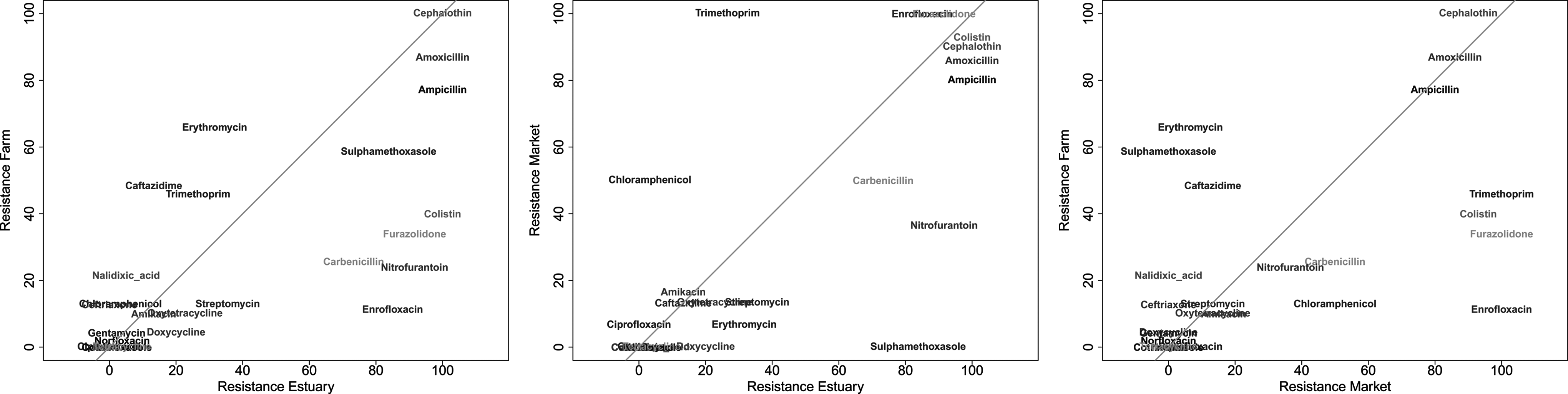
Correlation in resistance rates among Vibrio isolates from three sites.
Distribution of ARGs in Vibrios from Cochin Estuary, shrimp farms, and seafood
All the Vibrios isolated from the three sources harbored the blaTEM gene. The blaCTX-M gene was present in 1.1% of the strains from Cochin Estuary. None of the strains from seafood and shrimp farms harbored blaCTX-M gene. New Delhi metallo-beta lactamase (blaNDM-1) gene was present in 13.3% of the strains from Cochin Estuary, 6.6% from seafood, and 14.2% of strains from shrimp farms.
Plasmid profiling and curing of Vibrios from Cochin Estuary, shrimp farms, and seafood
Plasmid profiling revealed the presence of plasmids in 58 Vibrio strains. The size of plasmids ranged from 0.5 to 33 kb. Plasmids were present in 30 strains (16.6%) from Cochin Estuary, 23 strains (32.8%) from shrimp farms, and 5 strains (16.6%) from seafood. Plasmid of size 33 kb was the most frequently encountered. All the plasmid harboring strains were further subjected to plasmid curing experiments for the detection of plasmid-mediated antibiotic resistance. Among the 30 Vibrio strains from Cochin Estuary, 24 revealed the presence of plasmid-mediated antibiotic resistance. Among the Vibrios from shrimp farms 13 and all the 5 isolates from seafood exhibited plasmid-mediated antibiotic resistance. Plasmid-mediated resistance was shown toward 13 antibiotics (Ak, Amp, Amx, Caz, Cb, Cl, E, Ex, Fr, Nit, S, Sm, and Tr). Detailed results are given in Supplementary Tables S2, S3, S4.
Discussion
The study aimed to determine the prevalence of MAR among Vibrios from estuary, shrimp farms, and seafood along the southwest coast of India, and to check for the presence of AMR genes. Our findings revealed that all the Vibrio strains isolated from Cochin Estuary, shrimp farms, and seafood exhibited MAR phenotypes. The presence of those strains in Cochin Estuary area may be due to long-term exposure to antibiotic containing effluents discharged from hospitals, farms, or aquaculture ponds, as well as horizontal transfer of antibiotic genes from human pathogens.6,45 For some antimicrobials such as sulfamethoxazole, gentamycin, nalidixic acid, carbenicillin, and erythromycin, resistance pattern for the strains isolated from the three sources (estuary, shrimp farms, and seafood) varied considerably. While for compounds such as ampicillin, amoxicillin, and cephalothin, we observed an association in resistance levels from the correlation graph. As pointed out by Hsu et al. 46 differences in the percentage of bacterial resistance to various antibiotics may reflect the history of antibiotic application in different locations. However, so far the absence of surveillance for on-farm antibiotic use and sewage antimicrobial residues in India prevents such inference to be made unequivocally. The MAR index of the strains varied from 0.16 to 0.6. The highest MAR index was observed among the strains from estuary. In a previous study on Vibrio from shellfish in Malaysia, the MAR index ranged from 0.00 to 0.79. 23
A high percentage of β-lactam resistance was observed in the sampled isolates. Resistance to β-lactam antibiotics has been previously reported in V. parahaemolyticus and other vibrios from India31,47 and other countries.23,27 A previous study reported a low resistance of V. parahaemolyticus from the southwest coast of India toward nitrofurantoin and trimethoprim. 48 In contrast, in our study, a higher resistance was observed to these compounds. Antibiotics such as ampicillin, tetracycline, oxytetracycline, doxycycline, nalidixic acid, gentamycin, sulfafurazole, and trimethoprim are commonly used in the aquaculture farms to ensure continuous production of seafood.30,49,50 In addition, treatment recommendations for Vibrio infections include cephalothin, cefuroxime, cefotaxime, ceftazidime, tetracycline, doxycycline, fluoroquinolone, amikacin, gentamicin, and trimethoprim/sulfamethoxazole.51–53 In the present study, most of the Vibrio strains have reached resistance to medically important drugs such as cephalothin, ceftazidime, doxycycline, enrofloxacin, nitrofurantoin, trimethoprim, sulfamethoxazole, streptomycin, amikacin, and nalidixic acid. Treatment of infections caused by such Vibrios has major clinical implications as this may lead to therapeutic failure and even death of the patient. To combat the global issue of emergence of antibiotic resistance, recent studies focus mostly on alternative strategies to antibiotics in aquaculture farms. Various researchers have come forward with nonantibiotic management strategies such as use of bacteriophage therapy, immunostimulants, and probiotics/prebiotics.54–56
Detection of AMR genes mediating antibiotic resistance is very important for effective disease control measures. Despite a high degree of genetic heterogeneity among the Vibrio strains from estuary, farm, and seafood using Enterobacterial Repetitive Intergenic Consensus and Random Amplified Polymorphic DNA-PCR,57,58 β-lactam genes were found among them at a very high level. The blaTEM gene was present in all the Vibrio strains from Cochin Estuary, shrimp farms, and seafood. This gene encodes resistance to narrow-spectrum β-lactams. Resistance lost frequently after plasmid curing was toward carbenicillin, a β-lactam. This shows that the presence of this gene conferred resistance to carbenicillin, and the gene was located on a plasmid. The blaCTX-M gene was found only in a few Vibrio strains isolated from Cochin Estuary. This β-lactamase family confers resistance toward narrow-spectrum and extended-spectrum β-lactams (third- and fourth-generation cephalosporins and monobactams). A large number of variants have been described in the last years in the CTX-M family. 59 Hence, the absence of a particular variant of the gene in the strains does not imply that the gene is absent. The New Delhi metallo-β-lactamase (blaNDM-1) gene, was detected in 13.3% of the strains from Cochin Estuary, 14.2% of the strains from shrimp farms, and 6.6% of the strains from seafood. This is an alarming situation since strains harboring blaNDM-1 are known to be resistant to carbapenems, extended-spectrum cephalosporins, and penicillin. Carbapenems are the last drug of choice for the infections caused by extended-spectrum β-lactamase producing bacteria. Our study gives the first report on the presence of blaNDM-1 gene in Vibrios from the southwest coast of India. This is in contrast to a previous study on antibiotic resistance in Vibrios isolated from Palk Bay (South India) where blaNDM-1 gene was not detected in any of the isolates studied. 32 Carbapenem-resistant V. parahaemolyticus was recently reported from marine and freshwater fish samples in Selangor, Malaysia. 27
Even among the strains with similar resistance patterns, the plasmid patterns varied considerably, and some strains even lacked plasmids. This was similar to the findings by Lajnef et al. 58 Since antibiotic resistance can be either plasmid or chromosomal borne, in few of the strains resistance may be plasmid coded, while in others it may be chromosomally borne. To ascertain the antibiotic resistance mediation, plasmid curing experiments were performed. Plasmid-mediated carbenicillin resistance was the most frequently observed phenotype in our study. In a previous study by Reboucas et al., 59 plasmid-mediated oxytetracycline resistance was the frequently observed profile in Vibrio species isolated from marine shrimp. Similarly, in a study on Vibrios from shrimp farms in Thailand, oxytetracycline resistance was eliminated through plasmid curing. 51 In another study on Vibrios isolated from coastal waters of Kerala, chromosomal-borne resistance was observed toward amoxicillin, ampicillin, furazolidone, and tetracycline after plasmid curing. 30 The presence of ARGs in the bacterial plasmid may lead to rapid dissemination of drug resistance among the pathogenic strains populating our environment.
Mutations are said to contribute to phenotypic changes in antibiotic resistance. 60 Hence, in the future it is recommended to carry out phenotype–genotype mapping of the drug-resistant strains to get a detailed picture. Our study sites were limited to Cochin Estuary and aquaculture farms adjoining the estuary, as well as local markets in Cochin. To understand the gravity of the issue of emergence of multidrug-resistant Vibrio in our country, future works should explore other locations in India where aquaculture is a commonplace.
Conclusion
Our findings indicate that the Vibrio strains from Cochin Estuary are multidrug resistant, and also constitute natural reservoirs of drug resistance genes such as blaNDM-1. The study also highlights that drugs such as chloramphenicol, nitrofurans, and furazolidone, which are banned for aquaculture use by the European Union due to their harmful effects to humans, may still be continued in aquaculture in South India. The multiple drug resistance among Vibrios in our areas may have future complications for those who consume the seafood contaminated with these pathogenic strains, and also for the recreational and commercial users of these environments. Even though our findings are of local nature, it may cause global consequences, if these antibiotic-resistant strains are transported through ballast water, water currents, or consumption of seafood by international visitors.
Footnotes
Acknowledgments
The authors thank the Head of Department of Marine Biology, Microbiology and Biochemistry, CUSAT, for all the research facilities and University Grants Commission-Basic Scientific Research fellowship for the financial assistance. T.P.V.B. and J.P. were supported by ETH Zurich, the Swiss National Science Foundation, and the Branco Weiss Foundation.
Disclosure Statement
No competing financial interests exist.

References
Supplementary Material
Please find the following supplemental material available below.
For Open Access articles published under a Creative Commons License, all supplemental material carries the same license as the article it is associated with.
For non-Open Access articles published, all supplemental material carries a non-exclusive license, and permission requests for re-use of supplemental material or any part of supplemental material shall be sent directly to the copyright owner as specified in the copyright notice associated with the article.
