




Abstract
The aims of this study were to investigate the plasmid-mediated colistin resistance genes (mcr-1, mcr-2, mcr-3, mcr-4, and mcr-5), phenotypic colistin resistance in Escherichia coli O157:H7+/H7− strains isolated from cattle and sheep, and whole-genome sequence (WGS) analysis of colistin-resistant sorbitol fermentative E. coli O157:H7. According to the results, 5 of the 49 isolates were found to harbor mcr-2 and/or mcr-3 genes. Three isolates, including a sorbitol fermentative E. coli O157:H7, were found phenotypically resistant to colistin with a minimum inhibitory concentration value of 128 μg/mL. The genome of sorbitol fermentative E. coli O157:H7 did not show 100% similarity to any of the other genome sequences found in the universal genome database. It has also been determined that this isolate carried 62 different antimicrobial resistance genes. This is the first report of plasmid-mediated mcr-2 and mcr-3 genes carrying E. coli O157:H7 from cattle and sheep isolates and WGS of a colistin-resistant sorbitol fermentative E. coli O157:H7. Findings of this study indicate that cattle and sheep can be an important source of colistin resistance in E. coli O157:H7, and slaughterhouse wastewater might be a significant route for dissemination of the plasmid-mediated colistin genes. Therefore, the use of colistin in veterinary medicine should be restricted to reduce the development of resistance. Also it may be necessary to review the non-sorbitol fermentation-based isolation protocol for not missing the sorbitol fermentative E. coli O157:H7 in epidemiological studies.
Introduction
Colistin is one of the last-lines of defense against gram-negative bacteria which belong to the class of polymyxins originates from Paenibacillus polymyxa. 1 It shows its mechanism of action by deterioration of lipopolysaccharides molecules in the bacterial membranes.2,3 Although colistin was not a preferred treatment option in human medicine because of its kidney toxicity, it has become a last resort antibiotic in the past decade due to the increase of multidrug-resistant gram-negative bacteria such as Pseudomonas aeruginosa, Acinetobacter baumannii, and Enterobacteriaceae.4,5 Commercial colistin consisting antibiotics are commonly used in veterinary medicine particularly to treat gastrointestinal infections in cattle, sheep, and poultry worldwide and in Turkey. 6
Ruminants are considered to be the most important reservoir of Escherichia coli O157:H7, which is still a big concern for human health in many countries by causing hemorrhagic colitis (HC) and hemolytic uremic syndrome (HUS). 7 The use of antibiotics for the treatment of E. coli O157:H7 infections in humans is controversial due to their potential of promoting Shiga-like toxin (Stx) release, which may result in serious kidney failure. However, Percivalle et al. reported that colistin protects the Vero (African green monkey kidney) cells from E. coli O157:H7 by inhibiting cytotoxin release and binding endotoxins. 8 Therefore, colistin can be a significant alternative for the treatment of E. coli O157:H7 infections.
Since the first plasmid-mediated colistin resistance gene (mcr-1) in E. coli was identified in 20159 in E. coli, four more mcr genes (mcr-2, mcr-3, mcr-4, and mcr-5) were discovered in E. coli strains obtained from animals.10–13 These reports clearly indicate that colistin resistance E. coli is increasing and there is an urgent need to reevaluate the use of colistin globally for the protection of this last resort antibiotic. In this study, investigation of plasmid-mediated colistin resistance genes (mcr-1, mcr-2, mcr-3, mcr-4, and mcr-5), phenotypic colistin resistance in E. coli O157:H7+/H7− strains isolated from cattle and sheep and whole-genome sequence (WGS) analysis of colistin-resistant sorbitol fermentative E. coli O157:H7 were reported.
Materials and Methods
Isolates
Forty-nine E. coli O157 isolates were included in the study. The isolates were part of a collection obtained from 720 cattle (240 rectoanal mucosal swap [RAMS], 240 carcass sponge [CS], 240 bile), 200 sheep (100 RAMS, 100 CS), and 24 slaughterhouse wastewater samples. Among these 49 isolates, 39 were E. coli O157:H7+ and 10 were E. coli O157:H7−. One of 39 E. coli O157:H7+ and 3 of 10 E. coli O157:H7− were sorbitol fermentative.14,15
Screening of mcr genes
DNA extraction was performed as described before. 16 The presence of mcr-1, 9 mcr-2, 10 mcr-3, 11 mcr-4, 12 and mcr-5 4 genes was screened by PCR (Table 1).
Primers Used for Screening mcr Genes
Phenotypic colistin resistance profile
Minimum inhibitory concentrations (MIC) of the isolates were determined by broth microdilution method using the FRCOL (Sensititre FRCOL; Thermo Scientific, West Sussex, United Kingdom) following the manufacturer's instructions. The range of colistin in the test was between 0.12 and 128 μg/mL and the results were interpreted according to the The European Committee on Antimicrobial Susceptibility Testing (Table 2). MIC values higher than 2 μg/mL were defined as resistant.
Colistin Resistance Profile of Escherichia coli O157 Isolates
E. coli O157:H7−.
Sorbitol fermentative E. coli O157:H7+.
Non-sorbitol fermentative E. coli O157:H7+.
MIC, minimum inhibitory concentrations.
Whole-genome sequencing of strain 25KA
DNA isolation
Sorbitol fermentative E. coli O157:H7 strain 25KA colonies were suspended in 25 μL of buffer (200 mM Tris-HCl, pH 8.0; 20 mM ethylenediaminetetraaceticacid; 10% Triton X-100) and 10 μL of lysozyme (200 μg/μL) and incubated at 37°C for 15 min. Then, 250 μL of lysis buffer (0.5 μg/μL) proteinase K, 5% Tween 20, 3 M guanidiniumthiocyanate, and 20 mM Tris-HCl (pH 8.0) were added to the sample. After incubation at 70°C for 15 min and then at 95°C for 5 min, 250 μL of isopropanol was added and centrifuged through silica columns. DNAs bound to the silica column were washed twice with buffer (20 mM NaCl, 2 mM Tris-HCl pH 7.5, and 80% v/v ethanol). The DNA elution was carried out with 50 μL of 100 mM Tris-HCl (pH 8.0) and the DNA stored at −20°C until use. DNA's amount and purity were determined by spectrophotometric measurements at 260 and 280 nm.
Genome sequencing with next-generation sequencing
Sequencing libraries were prepared using the TruSeq Nano DNA Low Throughput Library Prep Kit (Cat. no. 20015964; Illumina). Quality control in terms of size distribution and quantity of the libraries was performed by 2100 Bioanalyzer (Agilent Technologies). For normalization, the DNA buffer was diluted to 10 nM using dilution buffer (Tris-HCl 10 mM, pH 8.5, 0.1% Tween 20). The cBot 2 system (Illumina) was used to construct clusters with bridge amplification, and the IlluminaHiSeq 2500 platform was used for sequencing.
The comparison of the obtained genome sequence with the other genome sequences in the gene bank was performed with “MicrobialGenomeBlast” (www.ncbi.nlm.nih.gov) tool. CVTree3 program was used for phylogenetic dendrogram with similar genomes (tlife.fudan.edu.cn/cvtree/). Finally, analysis of antibiotic resistance and secondary metabolite gene clusters was completed using the antiSMASH (antismash.secondarymetabolites.org) database and program. In addition, antibiotic resistance genes were analyzed using the Antibiotic Resistance Genes Database and the search tool with the BLAST algorithm.
Dataset accession
Individual data sequence is available at GenBank under BioProject accession number ID PRJNA503568. Review link to the data: https://ncbi.nlm.nih.gov/nuccore/CP033605.1
Results
Among 49 E. coli O157 isolates 5 (10.2%; 5/49) of them harbored at least one mcr gene. Two were positive only for mcr-3, one of them was E. coli O157:H7− (210KB), and the other was E. coli O157:H7+ (34GA). In three of the E. coli O157:H7 isolates (44GA, 68GA, and 168KA) both mcr-2 and mcr-3 genes were detected (Table 2). None of the sorbitol fermentative isolates harbored any of the mcr genes. However, one sorbitol fermentative E. coli O157:H7 isolate (25KA) was found to be resistant to colistin with an MIC value of 128 μg/mL.
According to the microdilution test results, all of the isolates were susceptible to colistin except three E. coli O157:H7 strains. The MIC values of susceptible isolates were ≤1.0 μg/mL. Despite the absence of mcr genes in 25KA and 44KA strains, they showed resistance to colistin with 128 and >128 μg/mL, respectively. Only strain 168KA was found to be resistant to colistin and harbored mcr-2 and mcr-3 genes at the same time (Table 2).
In this study, the WGS of the sorbitol fermentative E. coli O157:H7 25KA was analyzed (Fig. 1). The reasons for choosing this strain were (i) the sorbitol fermentative character along with being phenotypically resistant to colistin, and (ii) the absence of any of the mcr genes. The obtained sequence was compared with all other genome sequences found in the universal genome database. It was certainly determined that the genome belonged to the E. coli species.
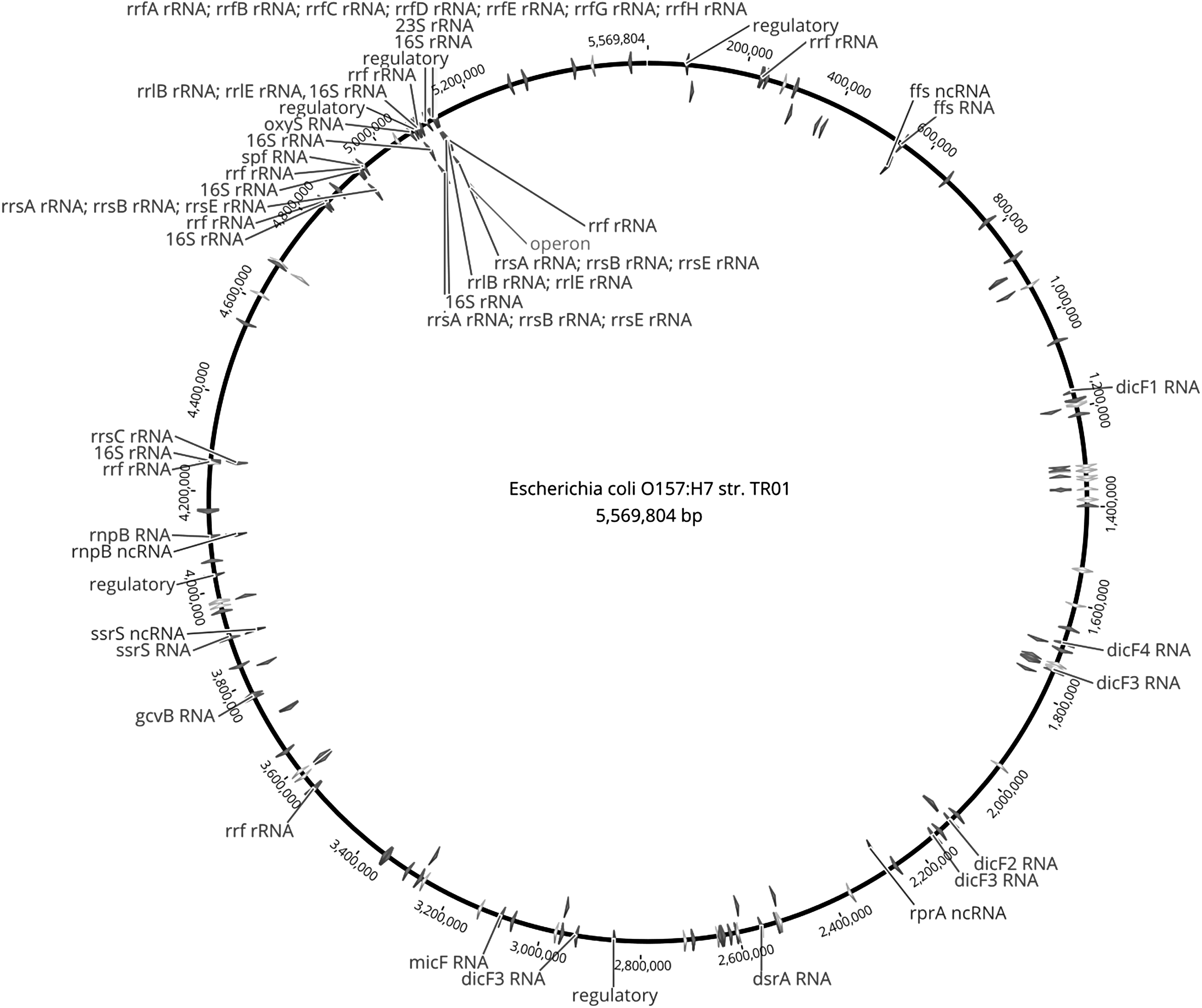
Circular representation of the complete genome sequence of sorbitol-positive Escherichia coli O157:H7 strain 25KA.
As this is the first report of a sorbitol fermentative E. coli O157:H7, the genome of 25KA does not show 100% similarity to any of the other genome sequences found in the universal genome database (Fig. 2). The highest similarity was found with E. coli O157:H7 strain EC4115 with 99%. In addition, it has been determined that this isolate carries 62 different antimicrobial resistance genes, which makes it a superbug with resistance to several antibiotic groups, including β-lactams, aminoglycosides, fluoroquinolones, tetracyclines, macrolides, phenicols, and penams (or penicillins, which are a subclass of the broader β-lactam family of antibiotics and related compounds) (Table 3).
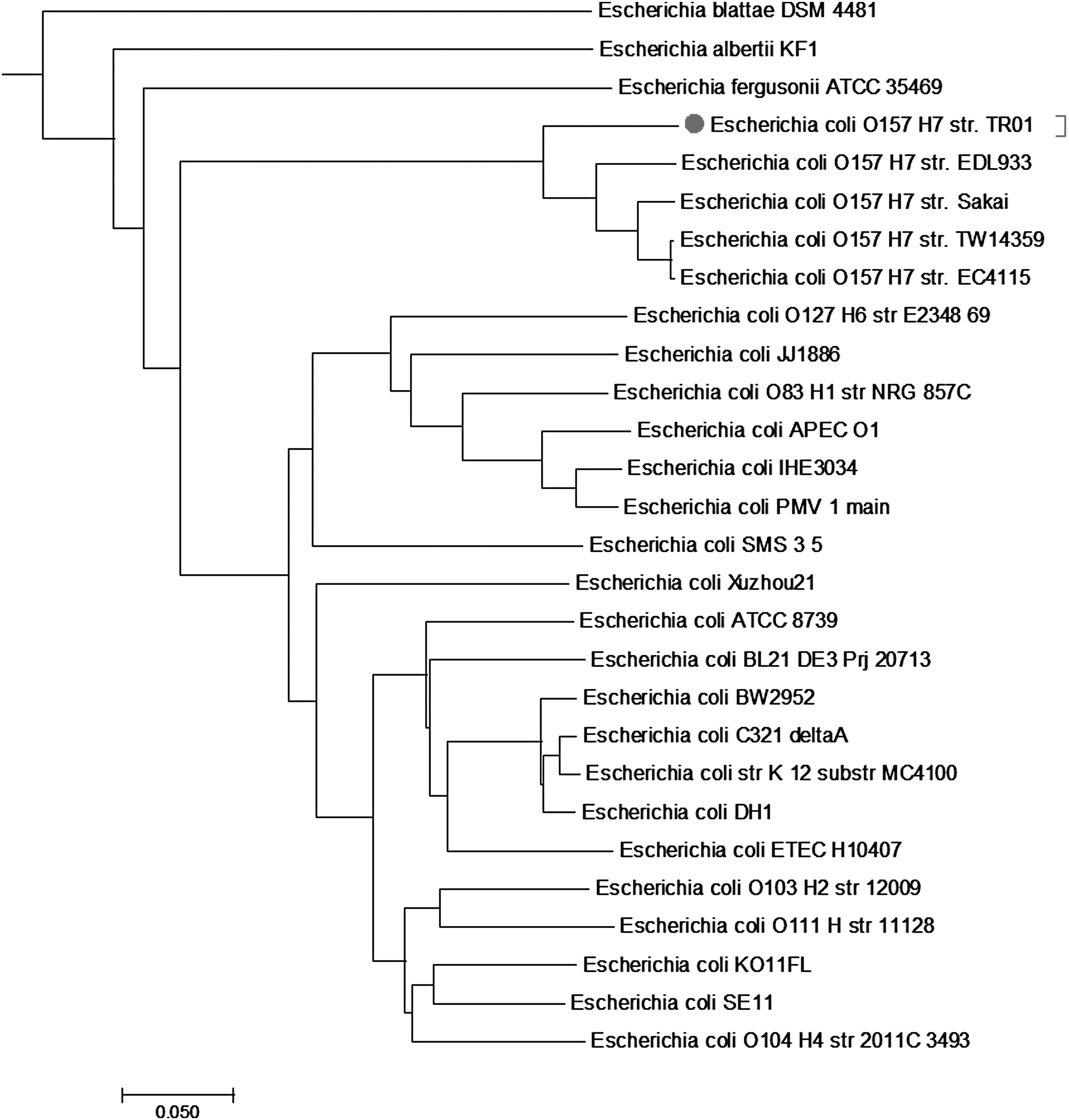
Phylogenetic dendrogram of the genomes of E. coli O157:H7 strain 25KA and other E. coli species.
Antibiotic Resistance Genes of Escherichia coli O157:H7 str. TR01 According to the Antibiotic Resistance Genes Database
Source: https://card.mcmaster.ca
ARO, antibiotic resistance ontology; AMR, antimicrobial resistance.
Discussion
In the study, 10.2% (5/49) of the isolates were found to be mcr carriers harboring mcr-2 and/or mcr-3. According to the results, two of the isolates (4.1%) were positive for only mcr-3. The presence of mcr-3 in E. coli isolates has been also reported by Hernández et al. 17 in cattle and by Yin et al. 11 and Fukuda et al. 18 in pigs. Notably, reports for the presence of mcr-2 are limited: 11/53 of porcine colistin-resistant E. coli isolates 10 ; 21% of extended-spectrum beta-lactamase-producing E. coli isolates collected from calves. 19 This contrast was summarized by Sun et al. with the fact that the mcr-2 gene is carried by a rare plasmid (IncX4-type). 20 Although mcr-1 has been the most prevalent gene in animals so far,9,17,19,21 none of our isolates was found to harbor this gene as well as mcr-4 and mcr-5.
Co-occurrence of mcr genes has been found in several studies.5,13,17,18,22 Importantly, we found co-occurrence of mcr-2 and mcr-3 genes, which has not been reported to our knowledge. Our results are in contrast to the data obtained where the mcr-2 gene was not detected in 186 enterotoxigenic E. coli and Shiga toxigenic E. coli (STEC) isolates of pig feces, 13 and in 152 E. coli isolates of cattle feces both conducted in Spain. 17
According to the International Organization for Standardization and bacteriological analytical manual's conventional cultivation methods, E. coli O157:H7 is isolated by its sorbitol negative phenotypic character.23,24 In recent years, some sorbitol-positive E. coli O157 isolates were detected from different sources such as human, food of animal origin, and food-producing animals in different geographical areas. However, these isolates were generally reported as H7 negative and some of them were negative for any of the stx genes.25–27 To the best of our knowledge, only Sallam et al. reported a sorbitol-fermenting E. coli O157, which harbored fliCH7 gene, isolated from retail beef, similar to our sorbitol-fermenting E. coli O157:H7 isolate. 28 These new isolates may necessitate modifications of conventional isolation methods, because sorbitol fermenting E. coli O157:H7 naturally cannot be recovered from Sorbitol MacConkey Agar and also from CHROMagar by non-sorbitol fermentation-based cultivation protocoles according to the previous studies. 29
Based on the WGS analysis, our sorbitol-fermenting E. coli O157:H7 isolate (25KA) carries srlA, srlE, and srlR genes, which are encoding phosphotransferase system glucitol/sorbitol transporter subunits and sorbitol 6-phosphate dehydrogenase (S6PDH), respectively. Especially, S6PDH has been reported to be an essential in sorbitol synthesis. 30 In the present study, the chromosomal sequencing data of 25KA isolate also showed that in addition to the Shiga toxin subunit A and B, this strain is also carrying eaeA encoding gamma intimin and E. coli HlyD family type I secretion periplasmic adaptor subunit. This data showed that 25KA has the potential to cause a typical enterohemorrhagic E. coli (EHEC) infection in humans such as HUS and HC. Other important virulence factors of this isolate can be seen by searching dataset accession (PRJNA503568). This knowledge will be important for public health because both sorbitol- and H7-positive strain-related infections have not yet been reported.
The use of antibiotics in the treatment of STEC infections is not recommended. 31 Although the treatment options with antibiotics are limited, studies on the subject are carried out and the different types of antimicrobial resistance of E. coli O157:H7 is also important according to the study results. 32 In some cases, Bauwens et al. stated that only rifaximin and azithromycin might be considered as an option of an antibiotic therapy of EHEC infections in humans. 33 On the contrary, Percivalle et al. remarked that colistin has a protecting effect on Vero cells from E. coli O157:H7 by inhibiting Shiga toxin releasing and binding endotoxin. 8 This result indicated that in some cases colistin might be a unique treatment option for EHEC infections.
Even if the use of colistin as a treatment option for EHEC is on the agenda, our results show that different isolates have already been developed resistance (Table 2). All isolates except 25KA, which were phenotypically showed colistin resistance, were determined to have different plasmid-mediated colistin resistance genes. These results coincide with the results of colistin resistance and other studies conducted to determine the mechanism. Because colistin resistance was reported to occur by two different chemical modification mechanisms on the bacterial lipid A that are encoded in the plasmid and chromosomes.9,34–36 Our plasmid-mediated mcr (mobilized colistin resistance) carrying isolates might be explained by this mechanism. Nevertheless, chromosomal-mediated colistin resistance needs a two sets of bacterial two-component systems (pmrAB and phoPQ) and the regulator mgrB.34,35 Although these systems have been well studied in Enterobacteriaceae (like Klebsiella pneumoniae and Salmonella), to the best of our knowledge, our finding will be the first report for E. coli O157:H7. WGS analysis showed that isolate 25KA harbored both of the systems with regulator mgrB in the chromosome. In addition, 25KA is carrying eptA gene encoding phosphoethanolamine transferase, which catalysis the addition of phosphoethanolamine moiety to the lipid A and basR for the positively autoregulation. As a result of this modification, the bacterium is able to acquire colistin resistance. In addition, the bacterium can be defined as a superbug because it has been determined by WGS analysis that it carries 62 different antimicrobial resistance genes.
This is the first report of plasmid-mediated mcr-2 and mcr-3 genes carrying E. coli O157:H7 cattle and sheep isolates and WGS of a colistin-resistant sorbitol fermentative E. coli O157:H7. Findings of this study indicate that cattle and sheep are important sources for colistin resistance E. coli O157:H7, and slaughterhouse wastewater is a significant route for dissemination of the plasmid-mediated colistin resistance genes. Therefore, the use of colistin in veterinary medicine may be considered to be banned to reduce the development of resistance. Also, sorbitol fermentative E. coli O157:H7 strain 25KA, which cannot be isolated with sorbitol fermentation-based standard isolation methods, was found to be colistin-resistant phenotypically. This finding can be considered as the non-sorbitol fermentation-based isolation protocol that needs to be reviewed if the prevalence of bacteria with this character will be found to be epidemiologically important in future studies. In addition, other mechanisms that cause colistin resistance should be investigated when taking into consideration the presence of phenotypically colistin-resistant isolates that did not carry any of the mcr genes.
Footnotes
Disclosure Statement
No competing financial interests exist.