




Abstract
The spread of carbapenem-resistant Klebsiella pneumoniae has become a significant problem for public health in recent years. In this study, we reported a New Delhi metallo-β-lactamase 1 (NDM-1)-producing K. pneumoniae strain KP14003 from a neonate in Beijing, China. Whole-genome sequencing was performed. The strain belonged to sequence type ST719. Coexistence of blaNDM-1 and blaSHV-12 was found on a self-transferable plasmid, which had a typical IncX3 backbone. The horizontal transfer of blaNDM-1 was associated with Tn125 followed by possible transposition events. Other class A extended-spectrum β-lactamase genes (blaSHV-27 and blaTEM-1) were also identified on chromosome or plasmid. The dissemination of NDM-1-producing K. pneumoniae causes great challenges to the treatment of clinical infections. Effective actions need to be taken to control the further spread of this pathogen.
Introduction
The emergence of carbapenem-resistant Enterobacteriaceae (CRE) has become a challenge to clinical therapy. Klebsiella pneumoniae is one of the most common CRE species and has been a leading cause of nosocomial infections in health care settings. 1 New Delhi metallo-β-lactamase 1 (NDM-1), a newly emerged mediator of carbapenem resistance, has spread throughout the world since its initial identification in K. pneumoniae and Escherichia coli from a Swedish patient previously hospitalized in India in 2009. 2 The first blaNDM-1-positive K. pneumoniae in China was detected in Nanchang in 2013. 3 Since then, such pathogens have been increasingly reported in several regions of China.4–7 In recent years, the infections of multidrug-resistant K. pneumoniae producing NDM-1 in newborns have been rising and of great concern.8–11 Considering the limited drug selection for neonates, investigation of the characteristics of K. pneumoniae carrying blaNDM-1 is crucial.
In this study, we report an NDM-1-producing K. pneumoniae isolate from a 16-day neonate in China. Whole-genome sequencing and analysis were undertaken to gain an insight to the genomic and plasmid characterization of the isolate.
Materials and Methods
Bacterial isolation and identification
The NDM-1-producing K. pneumoniae strain KP14003 was isolated from the blood sample of a 16-day neonate in Beijing, China, in 2014. Species identification was performed with VITEK II automated system (bioMérieux, France). The common genes encoding carbapenemases and extended-spectrum β-lactamases (ESBLs) were screened by PCR. 12 The entire blaNDM gene was amplified with previously described primers and confirmed by sequencing. 13 Written informed consent was obtained from the parents of the neonate. All experimental protocols were approved by the institutional ethics committees of Academy of Military Medical Sciences.
Antimicrobial susceptibility testing
Antibiotic susceptibility testing was performed using the VITEK 2 Compact system (bioMérieux). The minimum inhibitory concentration (MIC) results of ampicillin, amoxicillin/clavulanic acid, piperacillin, cefazolin, ceftazidime, ceftriaxone, cefepime, amikacin, gentamicin, levofloxacin, ciprofloxacin, aztreonam, imipenem, meropenem, trimethoprim-sulfamethoxazole, tetracycline, and nitrofurantoin were interpreted following the Clinical and Laboratory Standards Institute guidelines. 14 E. coli ATCC25922 was used as quality control.
Southern blotting and conjugation experiment
Bacterial genomic DNA was prepared in agarose plugs and digested with S1 nuclease (Takara, Dalian, China). Linearized plasmids and partially digested genomic DNA were separated by pulsed-field gel electrophoresis (PFGE) through the CHEF-DR III system (Bio-Rad, Hercules). The plasmid DNA was transferred onto a positively charged nylon membrane (Roche) as described previously. 15 The membrane fixed by UV exposure was hybridized with PCR-generated probes (digoxigenin labeled) specific to blaNDM-1.
Conjugation experiment was performed by broth and filter mating using the strain KP14003 as the donor and E. coli J53 AzR (resistant to sodium azide) as the recipient. 16 Donor and recipient organisms were incubated in 4 mL Luria-Bertani for 18 hours. The transconjugants were selected on trypticase soy agar plates containing 2 μg/mL imipenem and 300 μg/mL sodium azide after 18 hours of incubation. The acquired drug resistances were assessed by antimicrobial susceptibility testing. Transferability of plasmids was evaluated by the S1-PFGE experiment with the transconjugants as described above. The blaNDM-1 gene and common ESBL genes in the tranconjugants were screened by PCR amplification.
Whole-genome sequencing and plasmid assembly
Genomic DNA of strain KP14003 was extracted from cultured bacterium using the QIAamp DNA minikit (Qiagen, Inc., Valencia, CA). Whole-genome sequencing was performed using both the Illumina Hiseq 2500 platform at Novogene Company (Beijing, China) and the MinION sequencer (Nanopore, Oxford, United Kingdom). The de novo hybrid assembly of short Illumina reads and long MinION reads was performed using Unicycler (v0.4.8), including a polishing step with Pilon. 17 The genomic sequence was annotated using RAST. 18 The sequence type (ST) of strain KP14003 was assigned by uploading the assembled genome onto the MLST web server. 19 Plasmid replicon types were identified using PlasmidFinder. 20 Capsular serotype was identified using Kaptive. 21 Virulence factors were identified by aligning the assembled genome against the sequences for 80 virulence genes provided by the Pasteur Institute.
Nucleotide sequence accession numbers
The complete sequences of the chromosome and plasmids of strain KP14003 have been deposited in GenBank under the accession no. CP041934 (chromosome), CP041935 (plasmid unnamed1), CP041936 (plasmid unnamed2), CP041937 (plasmid unnamed3), and CP041938 (pNDM-KP14003).
Results
Microbiological and genetic features of strain KP14003
Strain KP14003 was recovered from the blood sample of a 16-day neonate through routine surveillance in Beijing, China, in 2014. The bacterial isolate was identified as K. pneumoniae using the VITEK 2 Compact system (BioMérieux). Antimicrobial susceptibility testing showed that KP14003 was resistant to ampicillin, amoxicillin-clavulanic acid, trimethoprim-sulfamethoxazole, piperacillin, aztreonam, imipenem, and cephalosporins, but still susceptible to meropenem, amikacin, gentamicin, ciprofloxacin, levofloxacin, tetracycline, and nitrofurantoin (Table 1). Presence of blaNDM-1 was identified by PCR amplification and confirmed by sequencing. S1 PFGE revealed that KP14003 contained four different plasmids (∼60, ∼105, ∼175, and ∼230 kb) (Fig. 1). Southern blotting indicated that blaNDM-1 was carried by the ∼60 kb plasmid, which was transferable to E. coli strain J53 at a frequency of 2.14 × 10⁻³ per donor cell. The transconjugants acquired majority of the antimicrobial resistances of KP14003, but were susceptible to trimethoprim-sulfamethoxazole. Further analysis revealed the nontransferability of the plasmid harboring trimethoprim-sulfamethoxazole resistance genes sul1 and dfrA1. The presence of the blaNDM-1-carrying plasmid alone in the transconjugants was identified by S1-PFGE. Interestingly, PCR amplification and sequencing revealed that a blaSHV-12 gene was transferred to E. coli J53 simultaneously, indicating the coexistence of blaNDM-1 and blaSHV-12 on the same plasmid.

Antibiotic Susceptibilities of Klebsiella pneumoniae Strain KP14003, the Escherichia coli J53 Transconjugant, and the Escherichia coli J53 Recipient
MIC, minimum inhibitory concentration; R, resistant; S, susceptible.
K. pneumoniae KP14003 belonged to ST ST719 and capsular serotype K9. The whole-genome analysis for virulence factors revealed the presence of the mrk gene cluster encoding type 3 fimbriae and the iutA gene encoding the aerobactin receptor in strain KP14003. A hybrid de novo assembly of short Illumina reads and long MinION reads indicated the blaSHV-27 gene on the chromosome and revealed the coexistence of blaTEM-1, aac(3)-IId, aadA5, dfrA1, and sul1 genes on an IncH plasmid of 287,790 bp. The blaTEM-1 gene was flanked by an upstream IS110 and a downstream ISCfr1.
Characterization of plasmid pNDM-KP14003
The plasmid carrying blaNDM-1 had 60,125 bp in length and was designated as pNDM-KP14003. It has 58 open reading frames with an average GC content of 49.1%. pNDM-KP14003 belonged to the incompatibility group IncX3. BLAST search indicated that the sequence of pNDM-KP14003 was identical with that of plasmid pNDM-BJ03 in Enterobacter cloacae from China. 22 It also presented high similarity with plasmids pNDM-HN380 (96% coverage and 99% identity) 23 and pEC27-1 (95% coverage and 99% identity) (CP020090). The above plasmids shared a typical IncX3 plasmid backbone of 30.2 kb, which contained a set of core genes for partition (parA), replication (bis and repB), maintenance (topB and hns), and conjugation/T4SS (pilX genes) (Fig. 2).
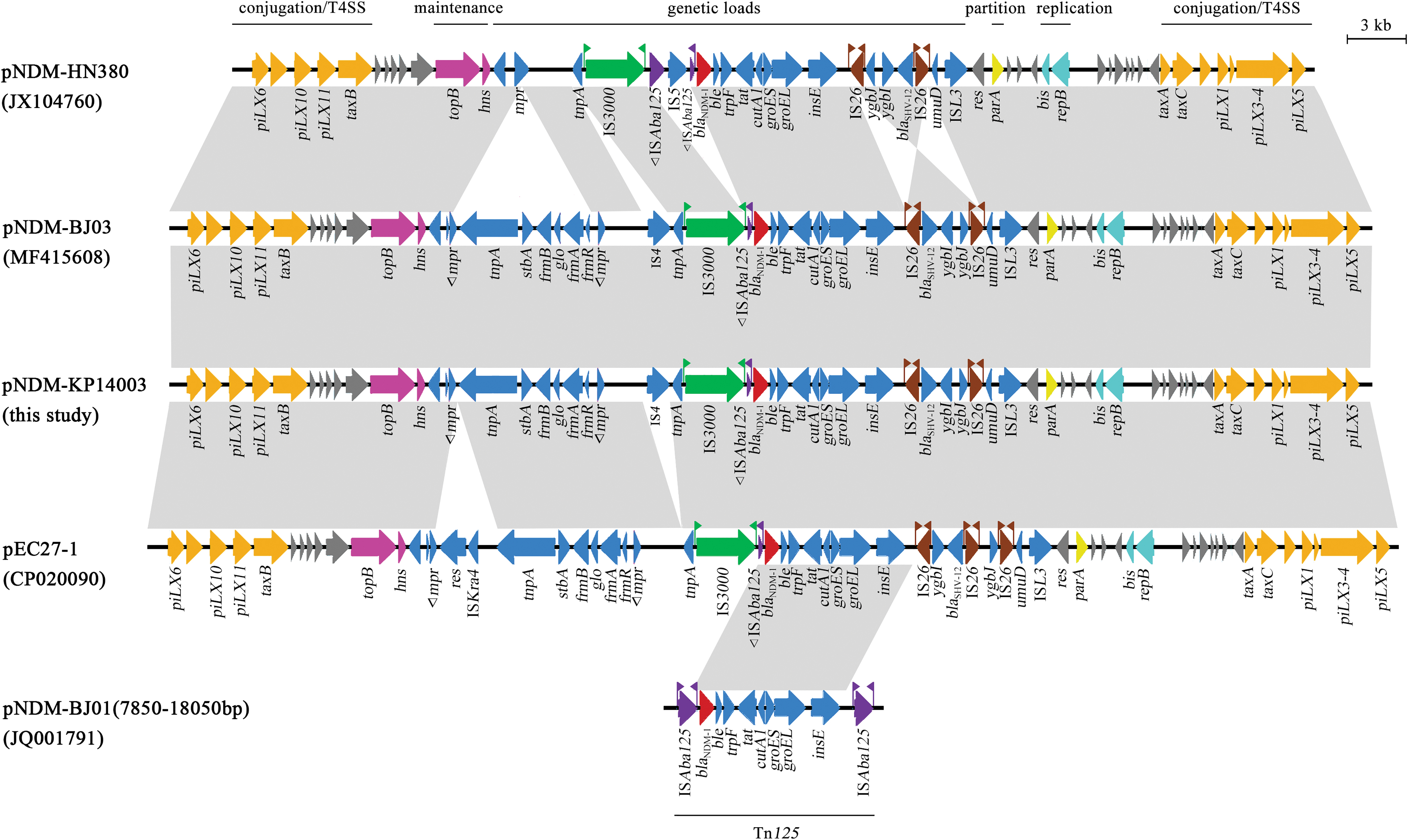
Linear comparison of plasmids pNDM-HN380, pNDM-BJ03, pNDM-KP14003, pEC27-1, and pNDM-BJ01 (Tn125). The open reading frames are shown with arrows. The orange, pink, gold, and cyan arrows indicate genes related to conjugation/T4SS, maintenance, partition, and replication, respectively. The blaNDM-1 gene is presented in red. The insert sequences IS3000, ISAba125, and IS26 are presented in green, purple, and brown, respectively. The accessory modules are indicated in blue. Other genes of the backbone are indicated in dark gray. Homology regions among different plasmids are denoted in light gray. Color images are available online.
The 29.9-kb genetic load region in pNDM-KP14003 was inserted between the res gene and the hns gene. It consisted of an IS4, a truncated tnpA, an IS3000, a 7.9-kb blaNDM-1-carrying Tn125 remnant, and an IS26-blaSHV-12 composite transposon. Compared with the prototype Tn125, the Tn125 remnant in pNDM-KP14003 had undergone a truncation of the upstream ISAba125 by IS3000 and a deletion of the downstream copy, suggesting possible transposition events. No flanking direct repeats of Tn125 could be detected. The genetic structure of blaNDM-1 is different from that in pNDM-HN380, of which the upstream ISAba125 was interrupted by an IS5. The IS26-blaSHV-12 composite transposon included blaSHV-12, ygbI, and ygbJ, which were flanked by two oppositely oriented copies of IS26. The inversion of the transposon had been observed in pNDM-HN380, while the insertion of an additional copy of IS26 in pEC27-1. Interestingly, there existed a 6.9-kb conjugative fragment integrated into the mpr gene, which was interrupted into two fragments in pNDM-KP14003 compared with plasmid pNDM-HN380. This conjugative fragment contained stbA (plasmid transfer), frmRAB operon (degeneration of formaldehyde), and tnpA, which was homologous to that of plasmid pKPN1482 (CP020846) and was likely introduced through the horizontal transfer.
Discussion
Carbapenems are used as the last resort antibiotics available for the treatment of severe nosocomial infections caused by multidrug-resistant Enterobacteriaceae. 24 The issue of carbapenem resistance of important pathogen K. pneumoniae deserves special attention. Our study identified an NDM-1-producing K. pneumoniae strain isolated from a 16-day neonate, which harbored multiple resistance determinants (blaTEM-1, blaSHV-12, and blaSHV-27). The infections of such carbapenem-resistant K. pneumoniae were known to be associated with significant morbidity and mortality. The situation was even worse in newborns due to the strictly limited drug selection and their poor immunity. Urgent efforts should be taken to reinforce infection control measures.
This study provided detailed characteristics of the IncX3 plasmid pNDM-KP14003 with coexistence of blaNDM-1 and blaSHV-12. Plasmids belonging to the IncX3 incompatibility group are broad-host-range. 25 This plasmid was previously detected in an E. cloacae isolate. 22 Our study reported its additional presence in K. pneumoniae and observed a high transfer frequency from K. pneumoniae to E. coli. These findings emphasized its great potential to transfer across different species, which would facilitate the rapid spread of blaNDM-1 among Enterobacteriaceae. Plasmid pNDM-BJ03 was isolated from a patient living in Shanxi, China, in 2012. Despite the lack of epidemiological links, the different geographical origin between pNDM-KP14003 and pNDM-BJ03 indicated potential dissemination of this plasmid. Further surveillance is needed to monitor the epidemic spread of such blaNDM-1-carrying IncX3 plasmids among Enterobacteriaceae.
Interestingly, strain KP14003 and the transconjugants were resistant to imipenem, but susceptible to meropenem. However, elevated meropenem MICs (1 μg/mL) were observed compared to that of recipient E. coli J53 (≤0.25 μg/mL), indicating NDM-1 as an effective mediator for meropenem resistance. A previous study indicated that the imipenem-resistant, but meropenem-susceptible phenotype was associated with the mutations of the oprD gene in Pseudomonas aeruginosa, 26 which encoded an outer membrane porin. However, the oprD gene has not been detected in K. pneumoniae or E. coli. The mechanism of meropenem susceptibility in strain KP14003 still needs further investigation.
In summary, this study characterized a K. pneumoniae ST719 isolate carrying multiple resistance determinants. Although K. pneumoniae ST719 has been rarely detected in clinical infections, their growing resistance to carbapenems would become an additional challenge for medical treatment. The coexistence of blaNDM-1 and blaSHV-12 on a self-transmissible plasmid is of significance as the mobile vehicle confers resistances to both carbapenems and cephalosporins. Our findings highlight the urgent need for effective actions to control the potential spread of such plasmids.
Footnotes
Disclosure Statement
No competing financial interests exist.
Funding Information
This work was supported by grants from the Beijing Noval program (No. xx2018042), the Mega-projects of Science and Technology Research (No. 2017ZX10303405-003), the Beijing Natural Science Foundation (No. 5172029), and the National Nature Science Foundation of China (No. 31200942).