




Abstract
The aim of this study was to assess the efficacy of benzyl isothiocyanate (BITC) in combination with efflux inhibitors and metal chelators against multidrug-resistant Escherichia coli. In vitro synergism between testing molecules was observed based on the minimal inhibitory concentration (MIC), minimal bactericidal concentration (MBC), fractional inhibitory concentration index (FICI), bactericidal kinetics, and growth inhibition assay. BITC alone exhibited moderate antibacterial activity against E. coli strains with MIC and MBC values of 0.625–1.25 μM and 1.25–2.5 μM, respectively. In contrast, double and triple combinations of BITC, ethylenediaminetetraacetic acid (EDTA), and phenylalanine-arginine β-naphthylamide (PAβN) resulted in synergistic activities with FICI values between 0.18 and 0.5, whereas combination of BITC with carbonyl cyanide m-chlorophenyl hydrazone or 2, 2′-dipyridyl revealed additive or indifference effect with FICI values of 0.75–1.5 and 1–1.5, respectively. Results of bactericidal kinetics and growth inhibition assays also supported the synergistic effects of EDTA and PAβN with BITC against E. coli strains. Our data demonstrate the possible use of adjuvant agents, such as the chelating agent EDTA and the efflux inhibitor PAβN to improve the antibacterial potential of isothiocyanate and may help to develop an alternative strategy for reducing the occurrence of multidrug resistance.
Introduction
The rapid emergence and dissemination of multidrug-resistant (MDR; defined as resistant to three or more antibacterial drug classes 1 ) bacteria have contributed to the global burden of infectious diseases. 2 This represents a serious threat to public health and has led to the development of new antibiotics. However, the discovery of new antibiotics cannot keep pace with the emergence of MDR bacteria. 3 Therefore, alternative strategies to fight against MDR bacteria are highly desirable. One of the effective ways is identification of bioactive natural compounds with bactericidal activity. 3 Furthermore, researchers have sought to identify adjuvant compounds for improving the antimicrobial activity. 4 Combination of two or more antimicrobial agents during a treatment regimen is currently being investigated.5–7
Natural isothiocyanates (ITCs) are degradation products of glucosinolates found in cruciferous plants, 8 which have been demonstrated to be effective chemopreventive agents. 9 Furthermore, the antimicrobial properties of ITC have been proven.8,10 Previous studies have shown that the aromatic ITC, for example, benzyl isothiocyanate (BITC), has a higher antibacterial ability than aliphatic ITCs. 11 BITC has been demonstrated to have significant bactericidal action against many Gram-negative pathogens.10,12,13
Previous studies have demonstrated that the application of efflux pump inhibitors or metal chelators results in synergistic bactericidal activities of some antimicrobial agents. For example, ethylenediaminetetraacetic acid (EDTA) is a chelating agent used to remove divalent cations that destabilize the lipopolysaccharide structure of Gram-negative bacteria, rendering the membrane more permeable to antimicrobial agents.7,14 Another chelating agent commonly used to deplete free iron is 2,2′-dipyridyl. Depletion of iron leads to delayed bacterial growth, thus modulating biofilm formation and the drug resistance mechanism.15,16 Phenylalanine-arginine β-naphthylamide (PAβN) and carbonyl cyanide m-chlorophenyl hydrazone (CCCP) are efflux pump inhibitors and are widely used to reverse resistance to some antibiotics.17–19
Escherichia coli is one of the most common causative pathogens of urinary tract infections and is a major cause of enteric and systemic infections.20,21 Because of the increasing importance of MDR E. coli, clinicians should be aware of the treatment failures associated with serious infections caused by this pathogen.22,23
In this study, we assessed the efficacy of BITC in combination with efflux inhibitors and metal chelators against MDR E. coli strains. We showed that the use of EDTA and PAβN as antimicrobial adjuvants considerably improves the antibacterial potential of BITC against MDR E. coli and thus avoids possible bacterial regrowth.
Materials and Methods
Antimicrobial agents and bacterial strains
All the materials were purchased from Sigma-Aldrich (St. Louis, MA) unless otherwise stated. Thirteen isolates of E. coli from Kaohsiung Veterans General Hospital Pingtung branch and one reference strain (ATCC 25922) were used in this study. The strains were grown in Luria–Bertani (LB) broth at 37°C with continuous shaking.
Antibacterial activity evaluation
The minimal inhibitory concentrations (MICs) and minimal bactericidal concentrations (MBCs) of BITC and the testing molecules (EDTA, CCCP, 2,2′ dipyridyl, and PAβN) were determined by standard broth microdilution assay as previously described. 6 Bacteria at a final density of ∼5 × 10⁵ colony forming unit (CFU)/mL were seeded in 96-well plates and challenged with the specified compounds at serial twofold dilutions. The growth of the strains was monitored in microtiter plate reader. OD595nm measurements were recorded after 24 h at 37°C.
The MIC was defined as the lowest concentration of antimicrobial agent preventing the appearance of turbidity. Then, aliquots from each MIC well were transferred to agar plates and incubated overnight at 37°C. MBCs of the antimicrobials were determined by subculturing the content of the no growth wells from the mentioned MIC test onto LB agar plates. The MIC and MBC values represent the median of at least three independent experiments. Dimethyl sulfoxide (DMSO) was used as a solvent control. The OD595nm values of each well were measured by a spectrophotometer before incubation and after incubation at 37°C for 24 h. Each assay was performed in three replicates, and the mean value was recorded with standard deviation. The concentrations that did not permit any visible growth (no colonies) were considered bactericidal, and those with visible growth were considered bacteriostatic.
To measure MBC, an aliquot of 100 μL of the cell suspension was taken from two wells above the MIC and centrifuged and washed three times with phosphate-buffered saline (PBS). Then, 10 μL of each cell suspension was plated on an LB agar plate, and bacterial cells were enumerated after incubation at 37°C for 24 h. MBC was defined as the lowest concentration of the antimicrobial at which >99.9% of the bacteria were killed compared with a nontreated control.
Determination of fractional inhibitory concentration index
The fractional inhibitory concentration index (FICI) was determined by testing a range of drug combinations between one-eighth the MIC to two times the MIC. The FICI for each double [Eq. (1)] or triple [Eq. (2)] combination was calculated as follows:
Synergy was defined by an FICI ≤0.5; additive effect by an FICI between 0.5 and 1.0; indifference by an FICI between 1.0 and 2.0; and antagonism by an FICI ≥2. 24
Bactericidal kinetics
A bacterial suspension of ∼5 × 10⁵ CFU/mL final density was incubated in LB broth at 37°C in the presence of sub-MIC (1/8–1/2) BITC with or without adjuvant molecules such as EDTA (2 mM) or PAβN (0.22 mM). Dilutions of BITC were prepared in DMSO, and 5 μL of each dilution was added to the bacterial suspension to obtain final concentrations of 0.16, 0.31, and 0.62 mM. The culture with DMSO was used as a bacterial growth control. After inoculation, all bacterial suspensions were incubated at 37°C under continuous shaking conditions. After cultivating for 0, 1, 2 and 3 h, aliquots (100 μL) were aseptically removed, serially diluted in PBS, and plated on LB plates. The plates were incubated at 37°C, and cell survival was determined by colony counts. At least three replicates were performed for each sample. Synergy of an antimicrobial combination was defined as a ≥2 log10 decrease in CFU/mL compared with the most active single agent. 6
Bacterial growth inhibition assay
The overnight cultured bacterial suspensions were diluted 100-fold and incubated in LB broth at 37°C in the presence of sub-MIC (0.31 mM) BITC with or without adjuvant molecules, EDTA (2 mM), or PAβN (0.22 mM). These cultures were grown at 37°C, and the OD595nm was determined after cultivating for 0, 2, 4, 6, 8, 10, and 24 h. At least two replications were performed for each sample.
Results
MIC and MBC determination
The MIC and MBC of BITC, metal chelators (EDTA and 2,2′-dipyridyl), and efflux pump inhibitors (PAβN and CCCP) against E. coli strains, including 13 MDR clinical isolates as well as 1 reference strain, were determined. MIC and MBC values of BITC ranged from 0.625 to 1.25 mM and from 1.25 to 2.5 mM, respectively. In addition, the MIC values of EDTA, 2,2′-dipyridyl, PAβN, and CCCP for testing strains were 8–16 mM, 50–100 μM, 1.76–3.52 mM, and 0.31–0.63 mM, respectively (Table 1).
Minimum Inhibitory Concentrations and Minimum Bactericidal Concentrations of BITC, Metal Chelators (EDTA and 2,2′-Dipyridyl), and Efflux Inhibitors (PAβN and CCCP) on Escherichia coli Strains
BITC, benzyl isothiocyanate; MIC, minimal inhibitory concentration; MBC, minimal bactericidal concentration; EDTA, ethylenediaminetetraacetic acid; PAβN, phenylalanine-arginine β-naphthylamide; CCCP, carbonyl cyanide m-chlorophenyl hydrazone; ND, not determined.
Synergistic activity analysis
To further test which compounds have synergistic effects against E. coli strains, the antibacterial effects of BITC alone or in combination with metal chelators (EDTA and 2,2′-dipyridyl) and efflux inhibitors (PAβN and CCCP) on bacterial strains were determined by a checkerboard dilution assay. 10 FICI values of two-drug combinations are given in Table 2. The results of three representative E. coli strains (two MDR isolates and one reference strain) showed that BITC together with EDTA or PAβN displayed a synergistic effect against E. coli strains (FICI of 0.18–0.25 and 0.37, respectively). The combination of BITC with EDTA or PAβN resulted in an eightfold MIC reduction compared with that of BITC alone against E. coli. Furthermore, a predominant synergism was detected when BITC was combined with either EDTA (11/13, 84.6%) or PAβN (13/13, 100%) against 13 MDR clinical isolates. In addition, we extended our study to investigate the in vitro effectiveness of triple combination of BITC, EDTA, and PAβN against tested strains. Synergy was consistently observed for triple drug combination against tested E. coli isolates (FICI = 0.41–0.44). However, the combination of BITC with CCCP and 2,2′-dipyridyl gave the additive or indifference effects with FICI of 1 and 1.25, respectively (Table 2). For all testing strains, the negative control with the solvent (DMSO only) used in preparation of the compounds was ineffective in the suppression of bacterial growth.
Results of Checkerboard Assay with Fractional Inhibitory Concentration and Fractional Inhibitory Concentration Index Values of Benzyl Isothiocyanate on Escherichia coli Strains
Values indicate the representative result from three independent experiments. Numbers in parentheses indicate the fold reduction in inhibitory concentration in the presence of metal chelators or efflux pump inhibitors compared with those of BITC only.
FICI: ≤0.5: synergism (S); 0.5–1: additive effect (A); 1–2: indifference (I).
FICI, fractional inhibitory concentration index.
Bactericidal kinetics
Furthermore, we analyzed the antimicrobial potential of BITC alone or in combination with EDTA or PAβN against three E. coli strains, including two randomly selected MDR isolates and one reference strain. Since bacterial inhibition does not mean bacterial death, to further distinguish and confirm the bactericidal and bacteriostatic effects of the combined use of BITC with EDTA and PAβN, the kinetics of the bacterial killing of E. coli strains was conducted. Overnight cultured bacterial suspensions were diluted to a concentration of ∼5 × 10⁵ CFU/mL with fresh LB broth in the presence of sub-MIC of (1/8–1/2 MIC) BITC with or without EDTA or PAβN. After exposure to BITC, viable cell count of the reference strains (ATCC) fell below the lower threshold of detection at 1 h (Figs. 1A, B, and 2B) or 3 h (Fig. 2A). In the case of two randomly selected MDR strains (EC33 and EC61), the rate of killing by BITC was relatively slower and less effective than the reference strain (Figs. 1 and 2). In contrast, the same dosage of BITC combined with EDTA and PAβN exhibited synergistic bactericidal effects in a time- and dose-dependent manner and considerably reduced the colony count by >5 log10 to completely kill all testing bacteria at the limit of quantification (102 CFU/mL) within 1–3 h (Figs. 1 and 2).
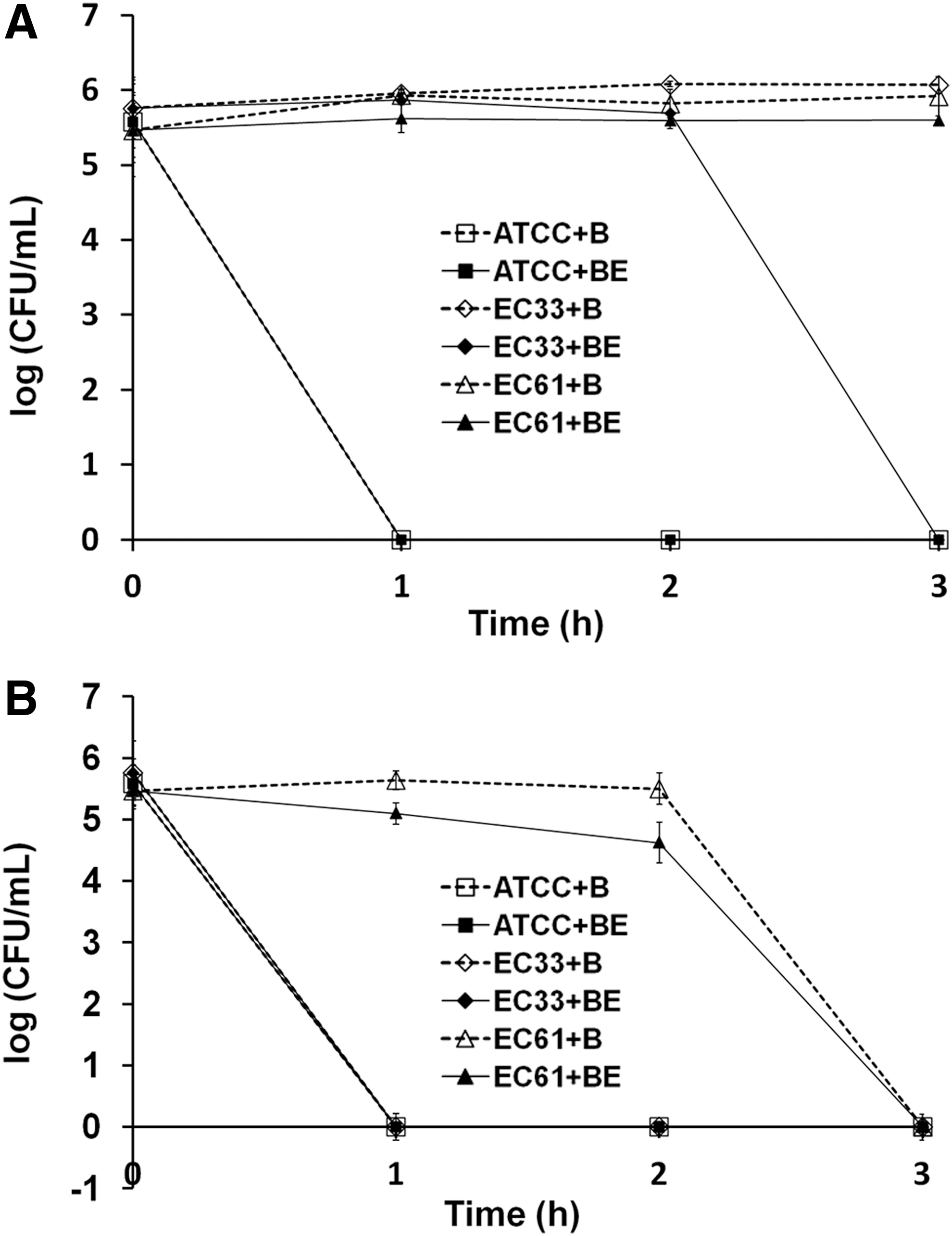
Time–kill curves of sub-MIC BITC alone and in combination with EDTA (2 mM) on one reference strain and two representative MDR Escherichia coli strains. Results show log10 CFU/mL values of BITC (0.31 mM) ± EDTA
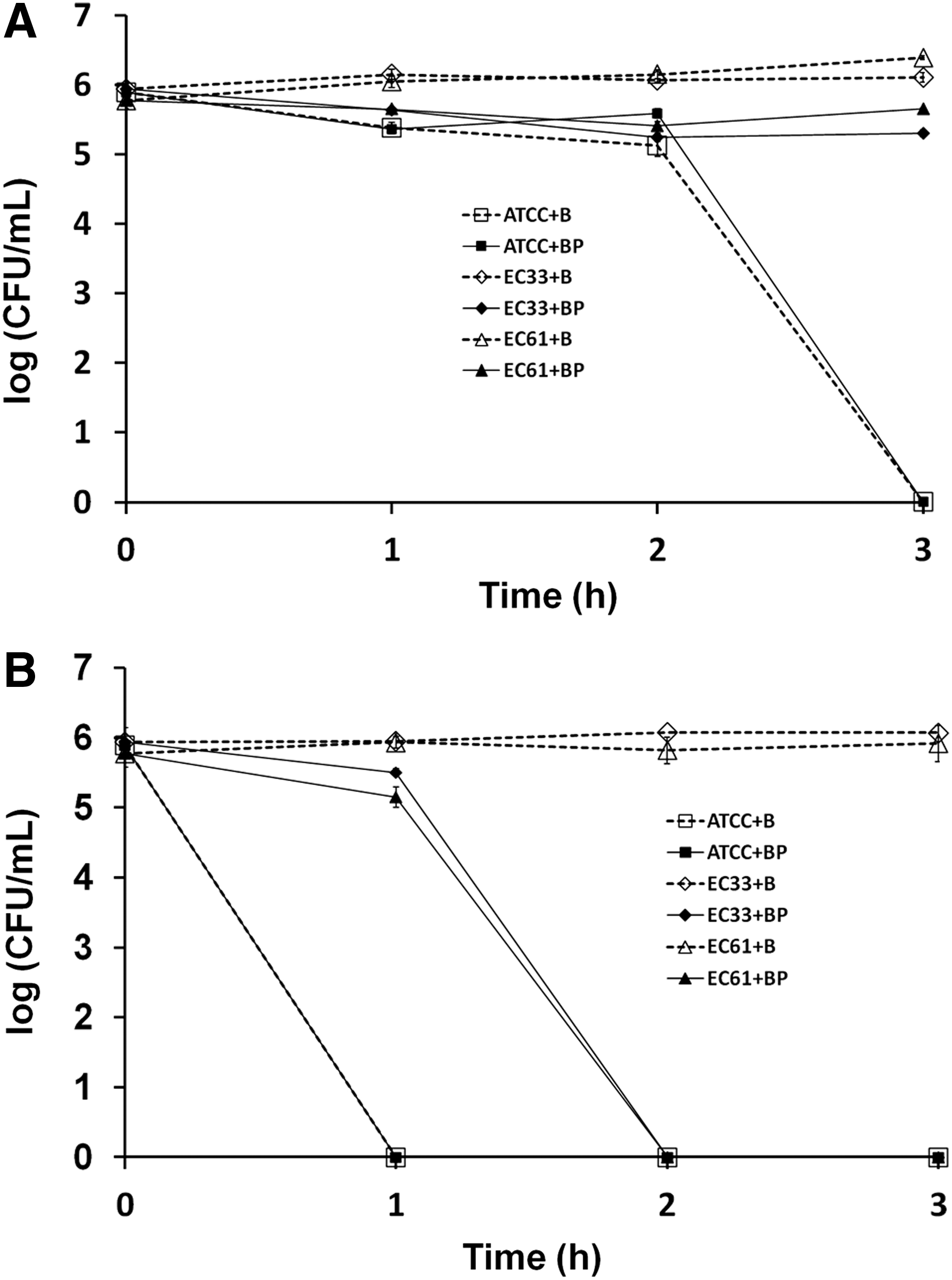
Time–kill curves of sub-MIC BITC alone and in combination with PAβN (0.22 mM) on one reference strain and two representative MDR E. coli strains. Results show log10 CFU/mL values of BITC (0.16 mM) ± PAβN
Bacterial growth inhibition assay
We further evaluated the effect of BITC alone or in combination with adjuvant agents (EDTA and PAβN) on bacterial growth inhibition. The bacterial growth was evaluated by measuring the OD595nm at times 0, 2, 4, 6, 8, 10, and 24 h postinoculation. BITC alone repressed the growth of testing bacterial strains by 10 h; however, those strains regrew thereafter (Fig. 3A). In contrast, BITC in combination with EDTA or PAβN effectively inhibited the growth of all testing strains throughout the study (Fig. 3B, C).
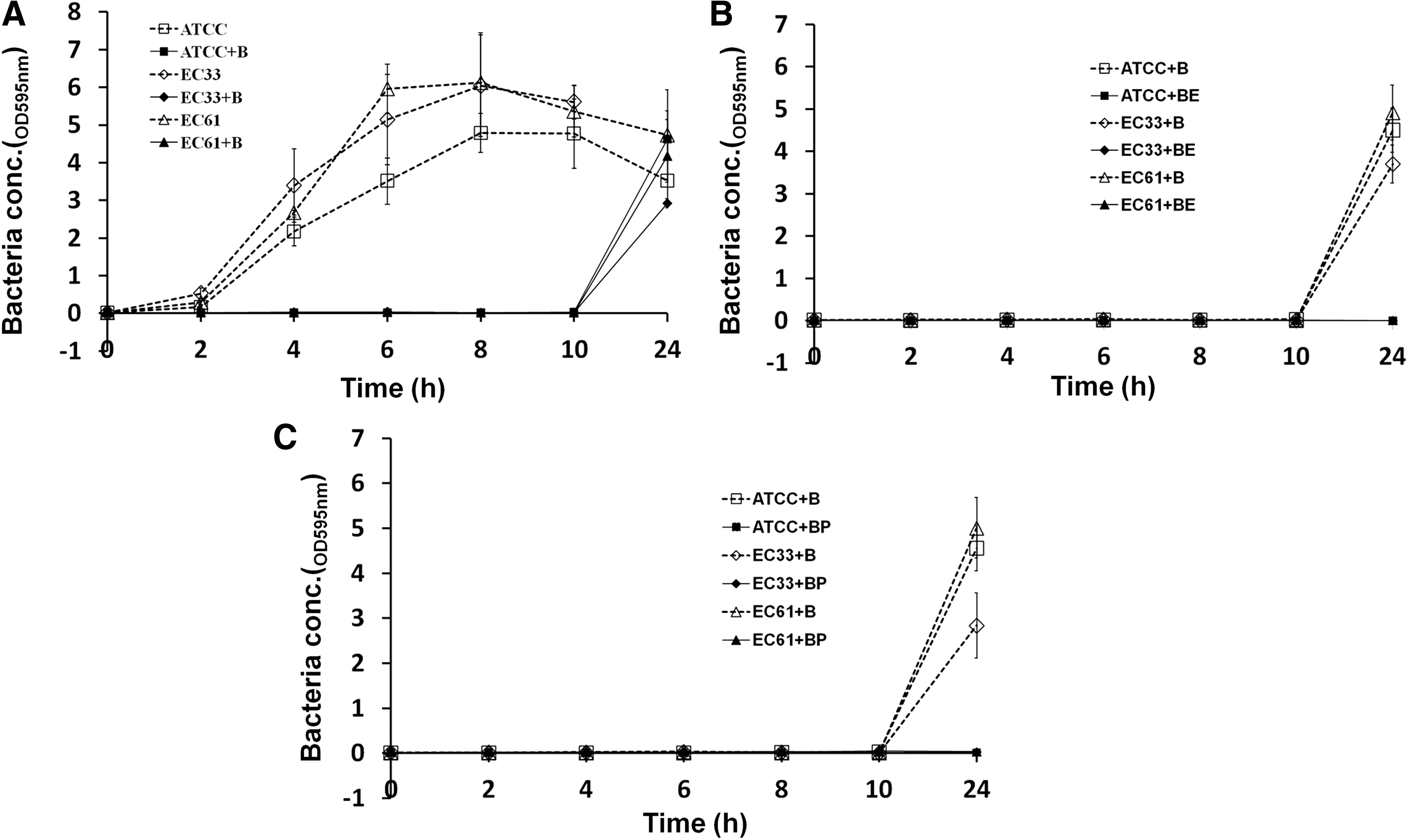
Growth inhibitory effect of sub-MIC BITC alone and combined with EDTA or PAβN on one reference strain and two representative MDR E. coli strains. For growth inhibition, BITC (0.31 mM) was used alone
Discussion
Increasing resistance to last-resort antibiotics is paving the way for research on novel antimicrobials. 25 ITCs represent an inhibitory effect on a variety of pathogens making them promising antimicrobial candidates. 8 Previous studies have shown that aromatic ITCs, such as BITC, have a higher antibacterial ability than aliphatic ITCs. 11 We observed that BITC has a lower MIC value for Gram-negative bacteria such as Klebsiella pneumonia, Acinetobacter baumannii, and E. coli than that of allyl isothiocyanate, an aliphatic ITC (data not shown). It has been proposed that the lipophilicity of BITC makes it interact more easily with biomembranes and bind covalently to proteins with free amino groups, changing the conformation and normal physiological functions of the affected proteins. 11 Although sub-MIC (1/8–1/2 MIC) BITC repressed the growth of the testing bacterial strains or killed the reference strain well below the detection limit (102 CFU/mL), those persisting cells regrew after exposure to BITC for 10 h (Fig. 3A), suggesting that E. coli strains have the ability to adapt to ITC treatment. Cells persistent to antimicrobials are responsible for the recalcitrant nature of chronic infections and contribute to the antibiotic tolerance, which can even lead to antibiotic resistance. 26
To achieve effective bacterial clearance, the combination of two or more antimicrobial agents during a treatment regimen is being conducted.6,7 In this study, the in vitro effectiveness of double and triple combinations of BITC, efflux inhibitors (PAβN and CCCP), and metal chelators (EDTA and 2,2′-dipyridyl) against MDR E. coli was determined. We consider that PAβN is a specific inhibitor of the resistance–nodulation–division (RND) efflux pump and can be applied as an adjuvant agent for antibacterial compounds because RND-type multidrug efflux pumps are a critical contributor for intrinsic drug resistance in Enterobacteriaceae. 27 The use of a specific efflux pump inhibitor might promote the intracellular accumulation of antibacterial compounds and effectively reduce the concentration required for bacterial eradication. In Pseudomonas aeruginosa, expression of the mexEF-oprN efflux pump is elevated after treatment with a natural ITC, suggesting that the efflux system might play a role in ITC resistance. 28 In agreement with previous studies, our results indicate that PAβN synergistically enhances the bactericidal effect of BITC on MDR E. coli (Table 2; Fig. 2) and reveal the significant role of bacterial efflux systems as potential drug targets and as a bacterial defense mechanism against antimicrobials. The combination of BITC with metal ion chelating agent, EDTA, also showed a synergistic effect on MDR E. coli strains (Table 2; Fig. 1). Lipopolysaccharides are strongly anionic and are stabilized by divalent metal ions Mg2+ and Ca2+. It has been reported that treatment of Gram-negative bacteria such as E. coli with EDTA causes 50% release of outer membrane polysaccharides.29,30 We hypothesized that the observed synergy was the result of outer membrane permeabilization altered by EDTA, leading to the enhanced susceptibility of E. coli strain to BITC. Whether the application of EDTA reduces the antimicrobial transport activity that promotes the intracellular accumulation of ITC remains to be determined.
RND efflux pumps can be inhibited by different ways. For example, CCCP has been found to interfere with the proton motive force (PMF) that is required to power the RND efflux pumps, 31 and PAβN is a specific efflux inhibitor that competes with the substrates for the binding site of the efflux pump. 27 We proposed that exposure of efflux inhibitors (PAβN and CCCP) might promote the accumulation of antimicrobial agents in the cytoplasm, thereby enhancing the killing of bacteria. However, BITC in combination with CCCP did not display a synergistic effect against clinical MDR isolates (Table 2). Like all uncouplers, CCCP has a very general mode of inactivation, not only affecting PMF-driven drug efflux pumps but also the entire energetics of the cell. 31 CCCP has been reported to decrease ATP production through the dissipation of the PMF, thereby leading to metabolic inactivity and bacterial persistence. 32 Persister cells are phenotypic variants of regular cells that exist in a dormant state with low energy levels and metabolic activity, allowing them to exhibit high tolerance to antibiotics such as aminoglycosides and fluoroquinolones,32–35 but are expected to remain susceptible to membrane active agents such as colistin.36,37 Exposure to CCCP may induce formation of persister cells and diminish the cellular target activity in E. coli, thus affecting the susceptibility to BITC. Previous studies have demonstrated that CCCP18 and 2,2′-dipyridyl38 combined with antimicrobial agents show synergistic effects against the MDR pathogens. However, neither CCCP nor 2,2′-dipyridyl could reduce the MIC values of BITC against MDR E. coli strains (Table 2), providing evidence that they are most likely not involved in BITC resistance. However, further studies would need to ascertain the mechanism behind this observation.
In conclusion, this study illustrates the potential of double and triple drug combinations against MDR pathogens. Especially powerful were the combinations of the aromatic ITC; BITC together with EDTA or PAβN completely inhibited the regrowth of the persistent subpopulation of E. coli strains during the growth inhibition assays. Whether other commonly used efflux pump inhibitors and chelating agents have the same effect remains unknown and deserves further investigation.
Footnotes
Disclosure Statement
No competing financial interests exist.
Funding Information
This study was supported by Ministry of Science and Technology of Taiwan, Grant No. MOST 107-2637-B-242-003, and Kaohsiung Veterans General Hospital Pingtung branch, Grant No. VHLC-106012.