




Abstract
Dear Editor:
P
This study reports a genomic assessment involving the identification of two carbapenem-resistant clonally unrelated K. pneumoniae isolates (B29/ST340 and KPC05/ST11), carrying the blaKPC-2 gene, belonging to the clonal group (CG)258, recovered in 2010 and 2014, from urine and rectal swab cultures from hospitalized patients in southeastern and northeastern Brazil, respectively. Interestingly, these strains harbor mobilizable IncQ1 plasmids (pB29 and pKPC05 plasmids, at 10,796 and 10,784 bp, respectively), much smaller than the sizes reported in the literature. 3
The total genomic DNA of both K. pneumoniae strains (B29 and KPC05) was sequenced using an Illumina NextSeq 500 paired-end reads (150 bp). The de novo assemblies were performed using the Unicycler (v0.4.0) software, 4 whereas the contigs were curated using the Geneious (R9) and Bandage programs, being possible to close the plasmids. IncQ1 differentiation was assessed by comparisons with the pKPN535a plasmid genome (GenBank accession no. MH595533.1).
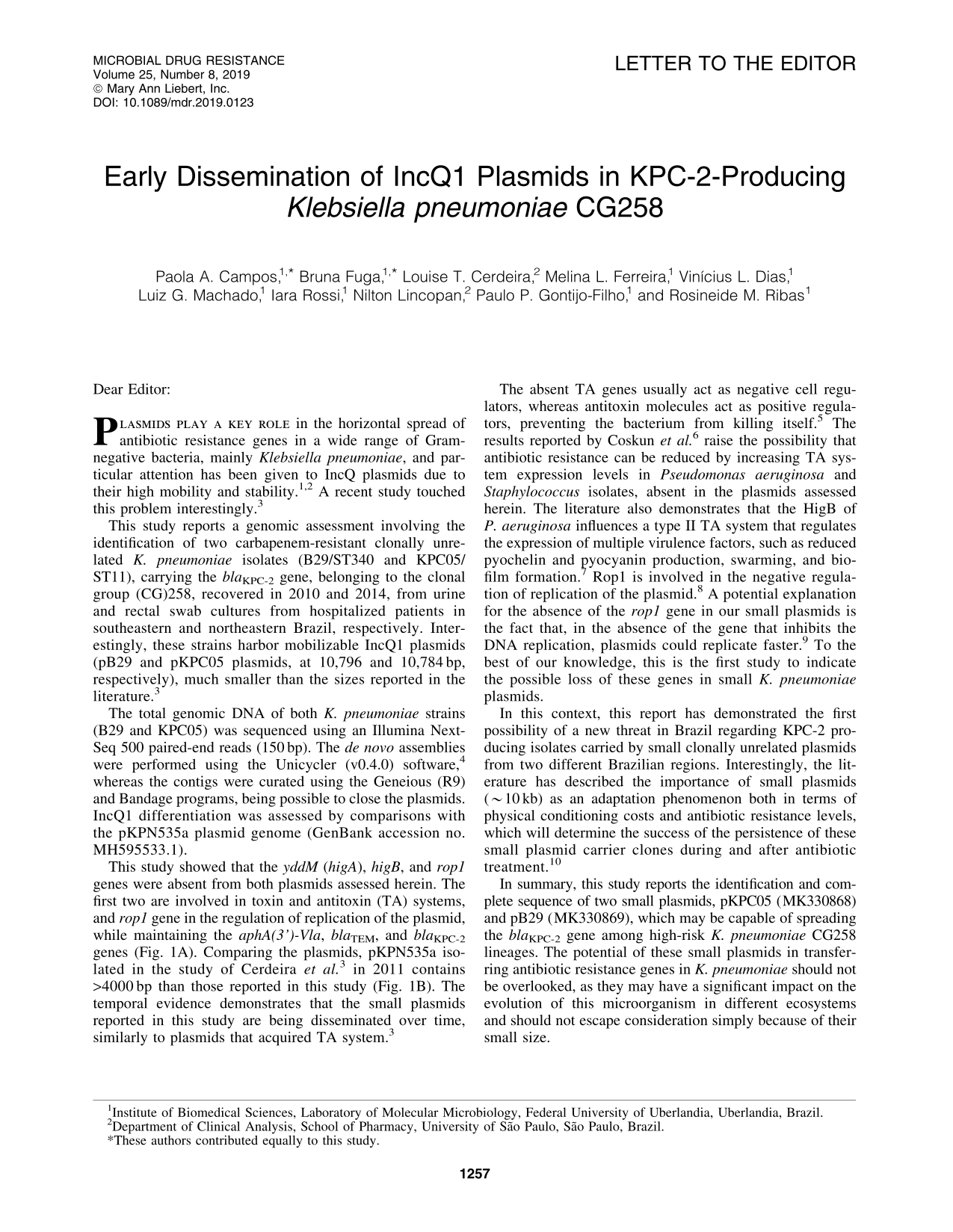
This study showed that the yddM (higA), higB, and rop1 genes were absent from both plasmids assessed herein. The first two are involved in toxin and antitoxin (TA) systems, and rop1 gene in the regulation of replication of the plasmid, while maintaining the aphA(3’)-Vla, blaTEM, and blaKPC-2 genes (Fig. 1A). Comparing the plasmids, pKPN535a isolated in the study of Cerdeira et al. 3 in 2011 contains >4000 bp than those reported in this study (Fig. 1B). The temporal evidence demonstrates that the small plasmids reported in this study are being disseminated over time, similarly to plasmids that acquired TA system. 3
The absent TA genes usually act as negative cell regulators, whereas antitoxin molecules act as positive regulators, preventing the bacterium from killing itself. 5 The results reported by Coskun et al. 6 raise the possibility that antibiotic resistance can be reduced by increasing TA system expression levels in Pseudomonas aeruginosa and Staphylococcus isolates, absent in the plasmids assessed herein. The literature also demonstrates that the HigB of P. aeruginosa influences a type II TA system that regulates the expression of multiple virulence factors, such as reduced pyochelin and pyocyanin production, swarming, and biofilm formation. 7 Rop1 is involved in the negative regulation of replication of the plasmid. 8 A potential explanation for the absence of the rop1 gene in our small plasmids is the fact that, in the absence of the gene that inhibits the DNA replication, plasmids could replicate faster. 9 To the best of our knowledge, this is the first study to indicate the possible loss of these genes in small K. pneumoniae plasmids.
In this context, this report has demonstrated the first possibility of a new threat in Brazil regarding KPC-2 producing isolates carried by small clonally unrelated plasmids from two different Brazilian regions. Interestingly, the literature has described the importance of small plasmids (∼10 kb) as an adaptation phenomenon both in terms of physical conditioning costs and antibiotic resistance levels, which will determine the success of the persistence of these small plasmid carrier clones during and after antibiotic treatment. 10
In summary, this study reports the identification and complete sequence of two small plasmids, pKPC05 (MK330868) and pB29 (MK330869), which may be capable of spreading the blaKPC-2 gene among high-risk K. pneumoniae CG258 lineages. The potential of these small plasmids in transferring antibiotic resistance genes in K. pneumoniae should not be overlooked, as they may have a significant impact on the evolution of this microorganism in different ecosystems and should not escape consideration simply because of their small size.
Footnotes
Acknowledgments
This study was supported by the Brazilian Funding Agency FAPEMIG (Fundação de Amparo à Pesquisa de Minas Gerais) and CNPq (Conselho Nacional de Desenvolvimento Científico e Tecnológico).
Disclosure Statement
No competing financial interests exist.