




Abstract
Poultry are currently regarded as reservoirs from which multidrug resistance can be readily transferred to the surrounding ecosystem. The aim of this study was to explore the prevalence of extended spectrum beta-lactamases (ESBLs) and ampC and mcr-1 Gram-negative bacilli in chicken, farmers, and environment in Lebanon. In May 2017, we revisited the farm where the first mcr-1 was detected in 2015 in Lebanon. Overall 200 chicken fecal swabs, 6 farmers' fecal samples, and 41 environmental samples were collected. Real time (RT)-PCR was performed for beta-lactamases and mcr genes' screening using newly designed primers/probes. Multilocus sequence typing (MLST) was also performed. ESBL/ampCs were found in 118 samples from chicken, 4 from workers, and all environmental ones. mcr-1 was detected in all chicken and farmers' samples from which 314 and 7 strains were isolated, respectively. Three mcr-1 Escherichia coli strains were isolated from litter and feed. Compared to 2015, the prevalence of ESBL/ampC producers, TEM and CTX-M genes increased significantly in 2017. Main spectra profiles dendrogram of isolated E. coli strains in 2015/2017 and MLST revealed the presence of different clones and sequence types. The evolution of resistance appears to be multi-clonal and related to the diffusion of plasmids carrying ESBL and mcr-1 genes. More work is needed to quantify the magnitude of this emerging problem in Lebanon.
Introduction
Gram-negative bacilli (GNB) are among the most common causative agents of hospital and community-acquired infections. 1 Among other organisms, resistance in Gram-negative bacteria has become a major concern in the last decade.2,3 This is due to their rapidly evolving and disseminating mechanisms of resistance against commonly prescribed antibiotics in human medicine that is, cephalosporins.4,5 Extended spectrum beta-lactamases (ESBLs), ampC beta lactamases, and carbapenemases are the main mediators of resistance encountered currently in GNB.6,7 Recently, the emergence of colistin resistance worsened the situation.
Colistin is a polymyxin antibiotic that has previously been discontinued in clinical settings, but has recently been reintroduced due to the wide dissemination of multidrug-resistant Gram-negative bacteria, notably the carbapenem resistant ones. 8 Colistin resistance is mediated either through chromosomal mutations that mediates the modification of the lipid A moiety of the lipopolysaccharides chain, 9 or via plasmidic acquisition of a phosphoenolamine transferase gene that is, mcr-1, 10 mcr-2, 11 mcr-3, 12 mcr-4, 13 and mcr-5. 14
Previously, the epidemiology of resistant GNB was thought to be restricted to the hospital setting. However, nowadays, evidence has shown the presence of an external reservoir of resistance in “livestock.” 15 Many studies reported a high prevalence of ESBLs and colistin-resistant GNB in farm animals.16,17 One possible cause for this abundance is the unregulated usage of antibiotics in veterinary medicine. 18 The European Centre for Disease Prevention and Control/European Food Safety Authority/European Medicines Agency (ECDC/EFSA/EMA) report showed that in 2014, the average antibiotic consumption in animals (152 mg/kg) exceeded the level in humans (124 mg/kg). 19
Univariate analysis showed a significant correlation between tetracycline and polymyxin consumption, and resistance in Escherichia coli in animals and between fluoroquinolones and E. coli in both human and animal sectors. 19 Furthermore, a recent publication of the WHO guidelines on use of medically important antimicrobials in food producing animals recommended an overall reduction but also a complete restriction of use of all medically important antimicrobial classes for growth promotion and disease prevention in food producing animals. 20 According to the WHO CIA report, these antimicrobials include third, fourth, and fifth generation cephalosporins, glycopeptides, macrolides, ketolides, and polymyxins. 21
The main concern about the spread of resistant organisms in animals is their potential zoonotic transmission to humans where they could be causative agents of infections with limited therapeutic options when multidrug resistance is encountered. 22
The increased carriage of ESBLs in humans with frequent contact with broilers, 23 sharing the same plasmids/ESBL genes, 24 sequence types (STs), virulence, and pulsed-field gel electrophoresis patterns 25 between humans and animals have all been considered evidence of transmission of antibiotic resistance between these two compartments. Although, direct contact with animals has been suggested to be the main player in this transmission, environmental routes in farm animals are increasingly being considered. 23 The latter includes transmission via air, 26 dust, 27 soil fertilized with animal manures, 28 and contaminated wastewaters. 29 The epidemiology of multidrug-resistant Gram-negative bacteria is thus complex at the human-animal-environment interface. 30
In Lebanon, our group reported a considerable nationwide prevalence of ESBL/ampC-producing GNB (20.6%) in poultry farms in 2015 and pigs (66.5%) in 2017.31,32 Similarly, a study conducted in cattle revealed high abundance of CTX-M-15 producing E. coli over the Lebanese territory. 33 Other scattered reports described the detection of OXA-23/OXA-58-producing Acinetobacter baumannii, VIM-2-producing Pseudomonas aeruginosa and OXA-48 E. coli strains in livestock and fowl, respectively.34,35 In addition, our group reported the first detection of one mcr-1-positive E. coli strain from chicken in Lebanon in 2015 in a farm in southern Lebanon. 36 This is in addition to the first detection of mcr-1-positive E. coli strains in swine farms in the south of Lebanon. 32
In this context, the purpose of this study was to return to the same farm where we found the first mcr-1-positive isolate 2 years ago and to do further investigations on the prevalence of ESBL and mcr-1-positive GNB, not only in chicken, but also in farm workers and the surrounding environment.
Materials and Methods
Ethics statement
The Ministry of Agriculture of Lebanon has agreed for the collection of fecal swabs from broilers in the south in accordance with national animal handling and sampling standards. Sampling was in accordance with international animal safety guidelines. The farm workers provided us with fecal samples with their complete satisfaction and without any obligation.
Collection of samples from broilers, environment, and workers
On May 15, 2017, 200 fecal swabs were collected from healthy broilers on the farm where the first mcr-1-positive E. coli strain was first isolated in 2015 in Saida, Southern Lebanon. 36 Collection of fecal samples was done from two herds of the same farm, containing each 5000 broiler Ross-308. Ten chicken feed samples, 10 poultry litter samples, and 21 soil samples surrounding the farm were also collected using sterile cups. Six fecal samples were also provided by the workers in this farm using sterile urine cups. All collected samples were put in a portable refrigerator and transported directly to the University laboratory where they were stored at −80°C for later use. In addition, the list of antibiotics used on this farm was recorded.
Screening of beta lactamase and colistin-resistant Gram-negative bacteria
MacConkey agar supplemented with cefotaxime (2 mg/L), ertapenem (1 mg/L), and colistin (4 mg/L) were used for the screening of ESBL, carbapenemase producers, and colistin-resistant Gram-negatives, respectively. The chicken fecal swabs were simply subcultured on different media. This also applies to the workers' fecal samples; however, for these, each fecal sample was first mixed using a swab and then this swab was used for subculture. The soil, feed, and litter samples were incubated in a 400 mL of sterile distilled water for 2 hours at room temperature. Thereafter, an initial vacuum pump filtration using filter papers (pores size 10–15 μm) to remove sediments was performed and the 400 mL filtered from each sample was divided into three sterile cups containing each 100 mL.
Then, using mixed ester cellulose filter papers with 0.45 μm pores size, each 100 mL was filtered again and put on separate selective media and incubated overnight at 37°C. Following incubation, colonies with different morphologies from each selective plate were taken separately and identified using matrix assisted laser desorption ionization-time of flight mass spectrometry with a score value ≥1.9 using the Microflex LT spectrometer (Bruker Daltonics, Bremen, Germany) for correct identification.37,38 For each strain, the spectra obtained were stored and downloaded into a MALDI Biotyper 3.0 system for the construction of main spectra profiles (MSP) dendrogram. Following identification, the strains were conserved in 40% glycerol aliquots and preserved at −80°C for later testing.
Antibiotic susceptibility testing
Antibiotic susceptibility testing was performed using the Kirby-Bauer disk diffusion method. Sixteen antibiotics were used: ampicillin (10 μg), amoxicillin-clavulanic acid (20/10 μg), aztreonam (30 μg), ceftazidime (10 μg), cefotaxime (5 μg), cefepime (30 μg), cefoxitin (30 μg), piperacillin-tazobactam (30/6 μg), colistin (10 μg), meropenem (10 μg), ertapenem (10 μg), imipenem (10 μg), tigecycline (15 μg), ciprofloxacin (5 μg), gentamicin (10 μg), and trimethoprim-sulfamethoxazole (25 μg) (Bio-Rad, Marnes-la-Coquette, France). The inhibition zone diameters were interpreted according to European committee on antimicrobial susceptibility testing guidelines 2017. 39 Furthermore, colistin micro-dilution test was performed as previously described. 39
An isolate showing resistance to at least three different classes of antimicrobials was termed as being multidrug resistant. 40 Phenotypic detection of ESBL, ampC beta lactamases, and carbapenemases was performed using the double disk synergy test, ampC disk test, and Carba NP test, respectively.41,42
Real-time PCR screening of beta lactamase and mcr genes
All strains having a colistin minimum inhibitory concentration (MIC) of >2 mg/L were subjected to real time-PCR for the screening of mcr colistin-resistant genes.43,44 For a more rapid screening, new primers and probes were designed for the detection of mcr-3, mcr-4, and mcr-5 plasmid-mediated colistin resistance genes by real-time PCR (Table 1). Furthermore, isolates showing a keyhole effect or having cefoxitin resistance with nonsusceptibility to cefepime were screened for the presence of blaCTX-M, blaSHV, and blaTEM genes. 45 Bacterial DNA was extracted using an EZ1 DNA extraction kit (Qiagen, Courtaboeuf, France) with an EZ1 Advanced XL biorobot.
Primers and Probes Used for the Detection of mcr Genes via RT-Polymerase Chain Reaction in This Study
RT, real time.
Multilocus sequence typing
Colistin-resistant E. coli strains isolated from workers and environmental samples along with 15 selected isolates from chicken were subjected to multilocus sequence typing (MLST) based on their allelic profiles using 7 housekeeping genes: adk, fumC, gyrB, icd, mdh, purA, and recA. 46 For the selection of 15 chicken isolates, the spectra of colistin-resistant strains isolated from chicken and from workers and environment were plotted and an MSP dendrogram was constructed (Supplementary Fig. S1). Chicken isolates with nodes adjacent to the ones isolated from workers, feed, and litter samples were subjected to MLST. Furthermore, ESBL producers isolated from workers were also subjected to MLST. The ST of each strain was determined using the allelic profiles analyzed based on the Warwick MLST database.
Statistical analysis
The prevalence of multidrug-resistant GNB, resistance genes, and resistance patterns, were compared between the years 2015 and 2017 via Fisher Exact test using Epi Info™ version 7.2. 47 A p value ≤0.05 was considered statistically significant.
Results
Identification of isolated strains
Of the 200 rectal swabs collected from chicken, 181 E. coli strains were isolated on the medium supplemented with cefotaxime. The number of collected chicken fecal swab samples versus the number of isolates was not one strain per one sample, this is because for some samples more than one isolate was obtained. In farm workers and poultry litter, 4 and 17 E. coli strains were detected, respectively. In feed samples, three A. baumannii, three P. aeruginosa, one Achromobacter xylosoxidans, and one Serratia rubideae were isolated from eight samples. Similarly, in soil samples, four Pseudomonas putida, two Pseudomonas monteilii, four Acinetobacter genomospecies, four Stenotrophomonas maltophilia, four Enterobacter cloacae, five E. coli, and one Ochrobactrum haematophilium were found.
On the other hand, on the medium supplemented with colistin, 121 colistin-resistant E. coli strains, 30 Klebsiella pneumoniae, and 1 Enterobacter asburiae were isolated from chicken. All six workers carried colistin-resistant isolates: six E. coli and one K. pneumoniae. From feed samples, two colistin-resistant E. coli strains and one A. baumanii were detected. In poultry litter, a single colistin-resistant E. coli strain was isolated while in soil, no colistin-resistant bacteria were found.
Resistance phenotypes of isolated strains
The detailed antimicrobial susceptibility testing of GNB isolated in this study is summarized in Table 2. Overall, ESBL was the main mechanism of resistance found in all sources followed by ESBL/ampC and ampC production. In chicken, 163/181 (69%) ESBL/ampC strains were co-resistant to colistin.
Resistance Profiles of Gram-Negative Bacilli Isolated in This Study
Resistance profiles are presented as number (percentage).
Colistin resistance was determined by colistin broth micro-dilution test.
Susceptibility to carbapenem was based on imipenem and meropenem.
%, percentage; AMC, amoxicillin-clavulanic acid; AMP, ampicillin; AZT, aztreonam; CAR, carbapenems that is, imipenem, meropenem, and ertapenem; CAZ, ceftazidime; CIP, ciprofloxacin; COL, colistin; CTX, cefotaxime; ESBL, extended spectrum beta-lactamase; FEP, cefepime; FOX, cefoxitin; GNT, gentamicin; n, number; SXT, trimethoprim-sulfamethoxazole; TGC, tigecycline; TZP, piperacillin-tazobactam.
Compared to 2015, the prevalence of antimicrobial resistance has increased significantly for all beta-lactams and non beta-lactams except cefepime, ciprofloxacin, and tigecycline (p ≤ 0.05) (Fig. 2A). As for colistin-resistant isolates grown on the media supplemented with colistin, broth micro-dilution testing revealed mainly colistin MICs ranging from 4 to 16 mg/L in E. coli strains isolated from chicken. Most of the K. pneumoniae isolates from chicken displayed colistin MICs reaching 256 mg/L. Furthermore, one E. asburiae with a colistin MIC of 256 mg/L was also detected. In workers, feed, and litter strains, colistin MICs ranged from 4 to 8 mg/L. From all sources, phenotypic test revealed that all strains grown on the media supplemented with colistin were non ESBL producers and were sensitive to the majority of the beta-lactams tested.

This is except for only five and one in chicken and workers, respectively, being ESBL producers. As depicted in Fig. 2B, gentamicin, ciprofloxacin, and trimethoprim-sulfamethoxazole resistance were significantly more prevalent in ESBL producers isolated from chicken compared to non ESBL-producing strains “mcr-1-positive isolates” (p ≤ 0.05).
Prevalence of ESBL/ampC and colistin-resistant isolates in all sources
As shown in Fig. 1, ESBL/ampC producing GNB were detected in all feed, soil, and litter samples; on the other hand, these latter were detected in 59% and 67% of collected chicken and farm workers' fecal samples, respectively. The abundance of colistin resistance was higher in chicken (73%) and farmers (100%) as compared to the environmental samples [litter (6%), feed (20%)]. In fact, the prevalence of ESBL/ampC producers detected in poultry in Saida region has significantly increased, from 27% in 2015 to 59% in 2017 (p ≤ 0.05).

Prevalence of colistin-resistant and ESBL/ampC-producing Gram-negative bacilli in chicken, farmers, and environment. Prevalence is expressed as “number of positive samples (percentage)” C, chicken; W, worker; S, soil; L, litter; F, feed; gray highlight, colistin resistance, white highlight, ESBL/ampC; ESBL, extended spectrum beta-lactamase.
Detection of beta lactamase and mcr genes
In chicken CTX-M, TEM, and SHV genes were detected in 70, 116, and 23 ESBL/ampC-positive E. coli strains, respectively. As shown in Fig. 2A, the prevalence of CTX-M and TEM beta lactamase genes has significantly increased in 2017 compared to 2015. All isolates obtained from farmer and feed samples harbored CTX-M with two and four of them co-harboring also the TEM gene, respectively. In poultry litter, CTX-M and TEM genes were detected in 16 strains. TEM encoding gene was found in 15 strains isolated from soil samples, CTX-M in 14, and SHV in 3 isolates.
Furthermore, of the 181 ESBL and/or ampC producers detected in 2017, 163 were also positive for the mcr-1 colistin resistance gene compared to one strain isolated mcr-1 strain in 2015. In 2017, all colistin-resistant E. coli and K. pneumoniae strains isolated from chicken, farm workers, poultry litter, and feed were positive for mcr-1. No other mcr variants were detected. One A. baumannii and one E. asburiae isolates from feed and chicken were negative for all mcr genes, respectively.
MSP dendrogram analysis and MLST
As shown in Fig. 3, no cluster formations were formed in the MSP dendrogram neither at the level of the geographical location in 2015 nor at the level of the resistance phenotype in 2017. Combining the spectra of ESBL E. coli strains isolated from Saida in 2015 with those isolated in 2017, shows that the latter do not form independent clusters.
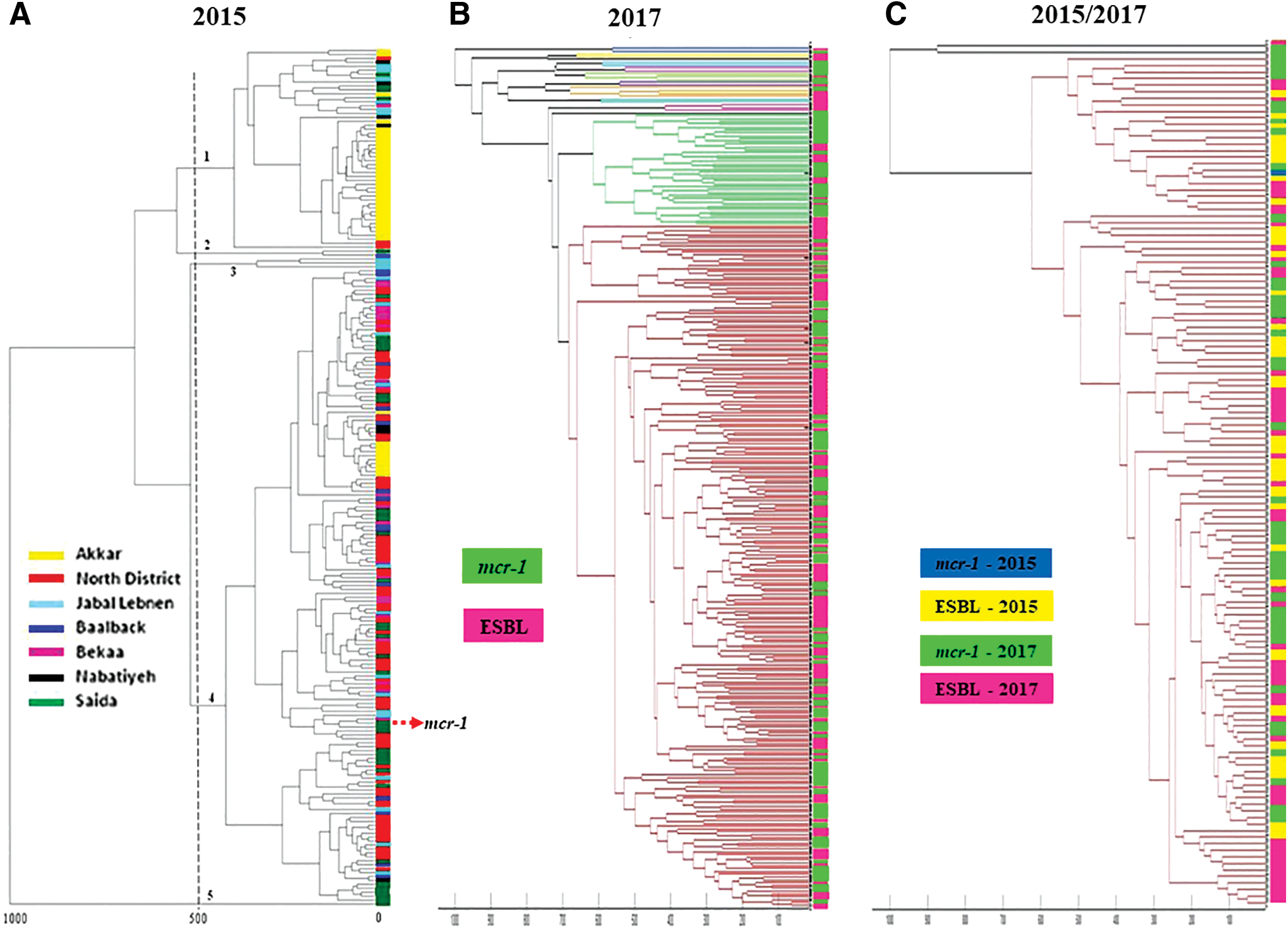
MSP dendrogram of
MLST of the colistin-resistant strains isolated from chicken revealed the presence of: ST101, ST746, ST1196, ST359, ST1140, ST2220, ST5687, and ST2481 in addition to unknown STs. The colistin-resistant E. coli strain isolated from litter was ST746, whereas the two E. coli isolates detected in feed samples were ST101 and ST3941. ST101 was shared by chicken and feed strains whereas ST746 was shared between litter and chicken isolates. Farm workers' isolates displayed with ST1011 and unknown STs for colistin-resistant E. coli; similarly, unknown STs in addition to ST10, ST59 were identified in ESBL-producing E. coli strains isolated from farmers.
Discussion
It is now becoming clear that the epidemiology of multidrug-resistant organisms has changed and is no longer confined to the hospital setting. 15 ESBL, carbapenemase producers, and colistin-resistant GNB are frequently detected in livestock, pets, and wildlife animals.7,48 The poultry production system is of special interest since it forms a complex and vulnerable ecosystem that can be easily hacked by resistant organisms. Indeed, once introduced, the latter can disseminate nationally and also globally due to the frequent import/export of broilers worldwide. 49
Moreover, it has been shown that resistant organisms in food producing animals can be readily transmitted to humans via direct or indirect contact 23 and via environmental routes. 27 In their study, Laube et al. reported the detection of ESBL/ampC-producing E. coli strains from broiler fecal samples (100%), dust samples (71%), litter (95%), and farmers' boot swabs (90%) in addition to 54% of different environmental samples, including swabs from scales, water, and feeding troughs. 7
Following our first detection of the mcr-1-positive strain of E. coli in poultry in southern Lebanon in 20157,36 and in addition to the high abundance of ESBL/ampC producers detected at the national level in chicken farms during the same year,7,31 we found it crucial to return to the same farm in southern Lebanon where we found the mcr-1 strain and explore the evolution of bacterial resistance in this farm. Our study shows that from 2015 to 2017, the prevalence of ESBL/ampC producers has significantly increased from 27% to 59% in Saida, Southern Lebanon. In addition, mcr-1-positive strains are highly prevalent in the chicken feces but also in feed, litter, and workers. The abundance of multidrug resistance in all sources and in farmers illustrates the complexity and multiplicity of transmission routes from poultry, farm workers. and environment.
It is important to mention that from 2015 to 2017 no infection control measures were taken in the chicken farm. Regarding environmental samples, some studies have even suggested air and dust as possible routes of resistance transmission within broiler farms. 7 Moreover, the presence of multidrug resistance in feed samples is questionable and can have two plausible explanations: first that these resistant organisms are contaminated from the farm housing environment as some studies have suggested 50 ; or it can be due to the hidden use of antimicrobials as growth promoters in this farm. The role of poultry litter in the transmission chain is mainly exhibited when chicken flocks are renewed. Daehre et al. demonstrated the importance of housing environment contamination in the transfer of multidrug resistance to broilers via horizontal transmission. 51
This is especially true when poor hygiene practices and waste management are applied within the farm. In this study, the application of chicken fecal materials as soil manures explains the resistance found in soil samples. Multidrug resistance in farming soils risks to be transmitted to human residential areas via waste and running water flows. 29 Moreover, as for antimicrobial use, gentamicin and colistin were often prescribed as treatment for gastrointestinal infections and doxycycline for respiratory infections.
The mcr-2, mcr-3, mcr-4, and mcr-5 colistin-resistant genes were not detected in any sample in this study. This finding is unlike what has been reported in livestock worldwide where mcr variants are frequently found, such as in Japan, Italy, and Spain.52–54 Two recent studies conducted in China showed that mcr-2, mcr-3, mcr-4, and mcr-5 genes were more abundant in the nasal/oropharyngeal swabs than in the cloacal ones in both pigs and poultry.55,56 This suggests that future studies in Lebanon should not only target the fecal carriage of colistin resistance in food producing animals but also the nasopharyngeal samples so that mcr variants might be detected. This also suggests that an mcr-1-positive plasmid has spread in this farm during the last 2 years.
In our investigation, we found that ESBL producers were more resistant to gentamicin compared to the non ESBL ones (mcr-1 strains). This suggests that ESBL-producing GNB are co-selected with the frequent use of gentamicin, while non ESBL mcr-1 strains are selected with colistin use in the chicken farm. Gentamicin was previously described as being among the most common antibiotic administered to livestock in Lebanon. 33 Rami et al. demonstrated a significant correlation between the use of gentamicin and tetracycline as growth promoters and the corresponding number of resistant E. coli strains in poultry farms. 57 Similarly, another study showed an association between the use of gentamicin as food additive and the number of gentamicin-resistant E. coli isolates. 58
As for the other non-beta lactam antibiotics, ESBL producers were significantly more resistant to ciprofloxacin and trimethoprim-sulfamethoxazole. These two antimicrobials are not used for therapeutic purposes in the visited farm in this study. In addition, their use in the Lebanese veterinary medicine is unknown and so their possible contribution to the selection and dissemination of multi-drug resistant organisms (MDROs) cannot be assumed. Strains exhibiting ESBL production and colistin resistance could have been disseminated by the double selection of gentamicin and colistin use in poultry.
Constructed MSP dendrogram (Fig. 3) reveals no cluster formation, at either the geographical location or at the phenotypic level. MLST analysis of mcr-1 E. coli strains also revealed the presence of different STs in chicken, workers, and environment, except the detection of two mcr-1 colistin-resistant E. coli strains sharing the same ST “ST101” and phenotype from chicken and feed. ST101 is an international ST described in broilers, 59 pigs, 60 and clinical settings. 61 Many studies even associated ST101 to clinical E. coli strains harboring NDM-1 in Canada, Germany, U.K., Australia, and Pakistan. 61 ST101 is thus a potent candidate for the zoonotic transmission to humans.
Furthermore, ST746 was shared between mcr-1 E. coli strains detected in chicken and poultry litter. Again, this ST has been reported in animals 27 and in OXA-48-producing E. coli strains isolated in clinical settings. 62 The variety of STs detected together with the MSP dendrogram patterns observed suggest that the dissemination of bacterial resistance from 2015 to 2017 is multi-clonal and is related to the diffusion of plasmids carrying ESBL and mcr-1 genes.
This study has two main limitations. The first one is the lack of ampC genes detection. ampC producers are not nowadays frequently reported in the clinical settings nor in animals and the environment. Our concern is more to address rather, MDROs that are causing public health concerns in Lebanon. This is mainly illustrated by the wide dissemination of ESBL, carbapenem, and colistin resistance across all ecosystems.35,63–67 The second limitation is the un-evaluation of resistance genes in terms of subgroups.
To summarize, this study reported a huge dissemination of mcr-1 E. coli strains in broilers, farmers, and the surrounding environment in Southern Lebanon. The overuse of antimicrobials appears to have played a key role in the massive spread of colistin resistance since the first detection of mcr-1 in 2015. 36 Interestingly, a study conducted in Great Britain found that the prevalence of mcr-1 E. coli strains was 76% in a pig farm. Twenty months later, upon the cessation of colistin use, no mcr-1-positive E. coli strains were detected in this same farm. 68 This suggest that colistin use cessation may help in reducing the dissemination of mcr-1 strains in livestock. 68
Moreover, the relatively high abundance of multidrug resistance in all sources emphasizes the hypothesis that when aiming to control the dissemination of resistant organisms, besides controlling antimicrobial use in veterinary medicine that is, colistin as well as other antibiotics used in the human medicine, environmental routes should be also targeted. Moreover, it is worth mentioning that this study is the first in Lebanon to report the isolation of mcr-1-positive E. coli strains from humans. Okdah et al. previously reported the detection of colistin-resistant K. pneumoniae strains isolated from patients in Beirut. 69 However, in these latter, the mechanism of colistin resistance was due to mutations in the phoP/Q, pmrA/B, and mgrB genes. 69
Therefore, our study points out that mcr-1 is present in the Lebanese farmers and might be introduced to the community and hospital settings if no strict infection control measures in animals and their surrounding environment are implemented. Further works are warranted to quantify the magnitude of this emerging problem in Lebanon.
Footnotes
Acknowledgment
We thank CookieTrad for English corrections.
Disclosure Statement
No competing financial interests exist.
Funding Information
This work was supported by the Lebanese Council for Research and the French Government under the “Investissements d'avenir” (Investments for the Future) program managed by the Agence Nationale de la Recherche (ANR, fr: National Agency for Research), (reference: Méditerranée Infection 10-IAHU-03).

References
Supplementary Material
Please find the following supplemental material available below.
For Open Access articles published under a Creative Commons License, all supplemental material carries the same license as the article it is associated with.
For non-Open Access articles published, all supplemental material carries a non-exclusive license, and permission requests for re-use of supplemental material or any part of supplemental material shall be sent directly to the copyright owner as specified in the copyright notice associated with the article.
