




Abstract
Background:
This study determined the prevalence and antibiotic susceptibility profiles of Staphylococcus aureus isolated from selected critical control points (farm, transport, abattoir, and retail product) in an intensive poultry production system in the uMgungundlovu District, South Africa, using the “farm to fork” approach.
Materials and Methods:
Three hundred eighty-four samples from poultry and poultry products were examined across the “farm to fork” continuum for S. aureus using selective media, biochemical tests, and API Staph kit and confirmed by polymerase chain reaction identification of the nuc gene. Antibiotic susceptibility testing of the isolates was determined by the Kirby–Bauer disc diffusion method to 19 antimicrobials and to vancomycin by the broth microdilution technique.
Results:
The overall prevalence rate of S. aureus was 31.25% (n = 120/384), distributed across the continuum: farm site (40), transport (15), abattoir (30), and retail point (35). The isolates were resistant to tetracycline (61.67%), penicillin G (55.83%), erythromycin (54.17%), clindamycin (43.33%), doxycycline (36.67%), ampicillin (34.17%), moxifloxacin (30.83%), amikacin (30.83%), trimethoprim-sulfamethoxazole (30.00%), and levofloxacin (23.33%). A 100% susceptibility to tigecycline, teicoplanin, vancomycin, nitrofurantoin, chloramphenicol, and linezolid was observed in all isolates. The rate of multidrug resistance and the multiple antibiotic resistance index of the strains were 39.17% and 0.23%, respectively. The isolates showed similar patterns of resistance to commonly used growth promoters and antibiotics in veterinary and human medicine belonging to the same class.
Conclusion:
It is evident that the different antibiotics and growth promoters used in poultry production are exerting selection pressure for the emergence and co-selection of antibiotic-resistant bacteria in the production system, necessitating efficient antibiotic stewardship guidelines to streamline their use.
Introduction
Foodborne pathogens are among the leading causes of infection and death with severe public health, economic, and social problems worldwide.1,2 The global foodborne diseases (FBDs) estimations conducted by the World Health Organization (WHO) indicate that about 30% of the populations in the industrialized countries suffer from FBDs. 3 The continent of Africa has been reported to have the highest burden of FBDs per population with ∼91 million related diseases and 137,000 death per annum, 3 requiring an urgent stakeholder and policy direction to curb its escalation. Microbial contaminants, mainly bacteria, constitute the primary cause of FBDs and a risk factor for the zoonotic transmission of infections.4–7 Recently, various bacterial food outbreaks leading to significant mortality rates have been reported to threaten food safety, hence the need for effective surveillance and monitoring systems for early detection of such events. 8
Staphylococcus aureus is an important opportunistic pathogen of humans and animals, and a leading cause of FBD globally.9,10 S. aureus infections have been detected in livestock with varying rates of morbidity and mortality.11–13 A current meta-analysis study estimated the global S. aureus contamination prevalence rate to be 29.2% in raw meats. 14 Furthermore, S. aureus has been reported as the leading pathogen in poultry (raw meats and processed food products), averaging 38.5% prevalence in 21 European countries. 15 Poultry as a potential zoonotic source of S. aureus in the food chain has also been reported in a few countries.14,16,17 However, the understanding of its prevalence and significance for human health is currently incomplete. This is because, although bacteria can contaminate meat during production, processing, packaging, and transporting within the food chain, most studies have sampled at specific points in the “farm to fork” continuum (i.e., either on the farm or slaughter or retail point) without any comparison, making it challenging to monitor the links with human health. 18
Poultry is the most consumed meat in South Africa with a consumption of ∼2.152 million tonnes per annum according to the South African Poultry Association (SAPA).19–22 South Africa accounts for 13 times the average per capita poultry consumption in sub-Saharan Africa and almost 3 times the average per capita world poultry consumption. 23 Furthermore, its consumption in 2016 accounted for 60% of the total animal protein consumption in the country, dwarfing the total consumption of other food animals such as sheep, beef, veal, and pork.23,24 Owing to its intensive nature and high demand, different antimicrobial agents such as penicillin, erythromycin, tetracycline, and sulfonamides are extensively used as growth promoters as well as for treating staphylococcal and other perceived infections during food production in the country.25,26 Despite the apparent dangers associated with the presence of bacterial contaminants in food, there are limited data on the microbial quality and safety in intensive poultry production, particularly in relationship to S. aureus contamination in the country. This study thus aimed to determine the prevalence and antimicrobial susceptibility profile of S. aureus from selected critical control points in an intensive poultry scheme in Kwazulu-Natal, South Africa, using the “farm to fork” approach.
Materials and Methods
Study clearance and ethical considerations
Ethics approval was received from the Animal Research Ethics Committee (reference: AREC 073/016PD) and the Biomedical Research Ethics Committee (reference: BCA444/16) of the University of KwaZulu-Natal. The study was further registered with the South African National Department of Agriculture, Forestry and Fisheries (reference: 12/11/1/5 (879)). All additional information obtained from the farm (herein, noted as Farm A) were kept confidential as part of the memorandum of understanding between the Antimicrobial Research Unit and the farm.
Study design
Study site and population
The study was conducted in the uMgungundlovu District in KwaZulu-Natal (KZN), South Africa (Fig. 1), where the vast majority of intensive poultry production occurs. The poultry production system (Farm A), its environments, with traced slaughterhouse, and retail products served as principal study sites for data and sample collection (Fig. 2).

Map of uMgungundlovu district municipality (sample site) in KwaZulu-Natal (KZN), South Africa.
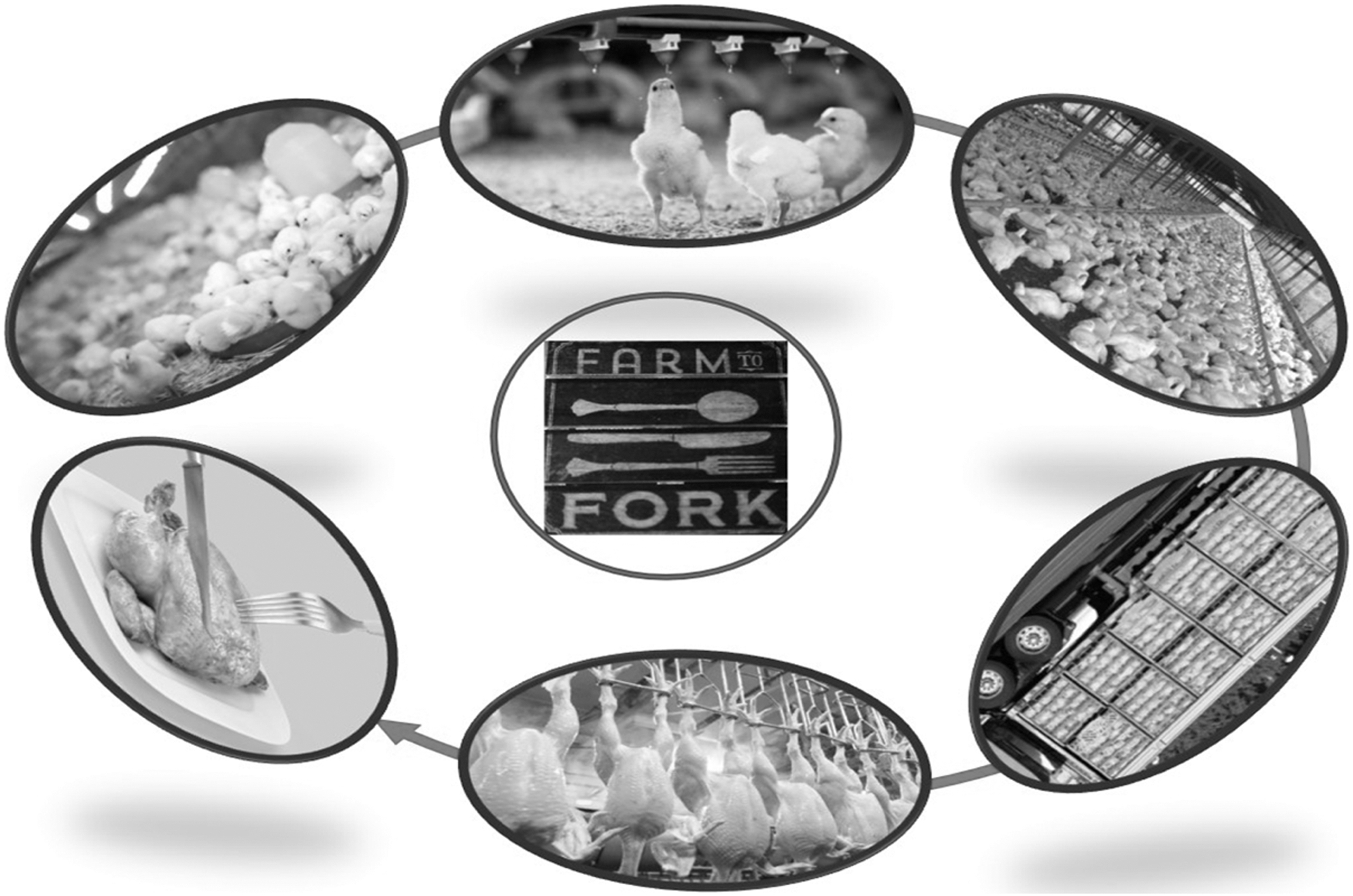
A schematic diagram depicting the “farm to fork” approach.
Sample collection
This was a longitudinal study conducted over 6 weeks between August 8 and September 14, 2017. The Kish-Leslie formula for a prevalence of 50% was employed (as there was no similar study of poultry in the food chain conducted in South Africa). 27 A minimum sample size of 384 was targeted across the continuum taking a degree of precision of 5% and critical value at 95% confidence level (Zα/2 = 1.96). A sampling scheme was set up based on the World Health Organization Advisory Group on Integrated Surveillance of Antimicrobial Resistance (WHO-AGISAR) guidelines 28 to sample isolates across the farm continuum (animals on the farm, transport/holding, postslaughter, and retail products) as depicted in Supplementary Fig. S1. Briefly, 1-day-old hatchlings (Cobb broiler breeds) were selected as the monitoring group from which litter and fecal samples were collected weekly over a 5-week period. The block sampling method (Supplementary Table S1) was used to ensure an even representation of the entire flock within the poultry houses. During the fifth week, when the flock was ready to be slaughtered, swab samples from holding/transport (crates and trucks swabs) were collected during transportation of the target flock to the slaughterhouse of Farm A. At the slaughterhouse, upon the sacrifice of the flock, the carcass rinsate and cecal contents were collected. A portion of the poultry meat from the same flock, in the form of the whole chicken, thigh, and neck, which is supplied to consumers in frozen packets, was purchased from Farm A at the retail point. Samples collected at each production stage of the “farm to fork” continuum included animals on the farm (fecal matter from healthy chicken [n = 50], litter samples [n = 50]), transport/holding (truck [n = 42] and crate [n = 42] swabs), abattoir (carcass rinsate [n = 50], cecal samples [n = 50]), and retail products (whole cuts-thigh [n = 30], whole cuts-neck [n = 30], and whole carcass sample [n = 40]). All collected samples were immediately stored at 4°C to maintain moisture and cell viability. These samples were transported to the laboratory and processed within 4 hours of sampling. In addition, demographic and general information (detailed constituent of the feed, growth promoters used in production, factors informing antimicrobial use on the farms, and processing plant flow) were obtained from Farm A as metadata for comparison and proper inference after the study.
Isolation and identification of S. aureus
Isolation of S. aureus
The samples were inoculated into tryptone soya broth (Basingstoke, Hampshire, England) and incubated at 37°C for 2 hours while shaking (100 rpm). These samples were then streaked on HiCrome Aureus Agar Base (Himedia Laboratories, Mumbai, India) and incubated overnight at 37°C in aerobic atmosphere. After incubation, colonies showing a unique brown-black color with a clear zone were streaked on mannitol salt agar (Himedia Laboratories, Mumbai, India) for further screening. Presumptive S. aureus colonies were examined for coagulase activity by the tube plasma agglutination test as well as DNAse tests. 29 The identified colonies were then confirmed using the API Staph kit (BioMérieux, Marcy-l'Etoile, France). The S. aureus colonies were maintained at −60°C in 10% glycerol stocks for further analysis.
Extraction of DNA
The stored isolates were cultured on nutrient agar (Oxoid, Basingstoke, Hampshire, England) and incubated at 37°C for 24 hours The boiling method was used for the isolation of the DNA. 30 Briefly, a loop full of colonies was suspended in 200 μL sterile distilled water followed by boiling at 100°C for 15 minutes. The suspensions were subsequently placed on ice for 10 minutes, and then centrifuged at 13,000 rpm for 5 minutes, and 100 μL of the supernatant was transferred into a new tube and used for polymerase chain reaction (PCR). The concentration and purity of the DNA were determined spectrophotometrically using the Nanodrop ND-1000 Spectrometer (Thermo Scientific, Waltham), and all samples had an A 260/280 ratio ranging from 1.7 to 2.1. The extracted DNA was stored at −20°C for PCR.
Molecular confirmation of S. aureus
Molecular confirmation was performed using S. aureus species-specific primers for the nucA gene, which codes for thermostable nuclease. 31 The primer sequences used were nucAF 5′-GCGATTGATGGTGATACGGTT-3′ and nucAR 5′-AGCCAAGCCTTGACGAACTAAAGC-3′ (Pinto et al.), generating a 270-bp fragment. PCR was performed in a 20 μL reaction tube with 3 μL DNA sample, 10 μL Luna universal qPCR master mix (New England Biolabs), 0.5 μL from each forward and reverse nucA primers (Inqaba Biotechnical Industries (Pty) Ltd., Pretoria, South Africa), and 6 μL of nuclease-free water (Thermo Scientific). The PCR protocol included denaturation for 5 minutes at 94°C; 35 cycles of 30 seconds at 94°C, 45 seconds at 62°C, and 45 seconds at 72°C; and a final extension step of 10 minutes at 72°C. A melt curve was prepared by ramping up the melting temperature from 60°C to 95°C at a rate of 0.15°C/second on a continuous mode following a premelt step at 95°C for 15 seconds on the first step. All reactions were performed on a QuantStudio 5 Real-Time PCR System (ThermoFisher Scientific, South Africa) and the melt curve analysis was performed using the QuantStudio Design & Analysis software version 1.4.3 (ThermoFisher Scientific, South Africa). The confirmed isolates were coded according to their collection sites.
Antimicrobial susceptibility Testing
The susceptibility profiles of the isolates were determined using the Kirby-Bauer disc diffusion method and interpreted according to the European Committee on Antimicrobial Susceptibility testing breakpoints. 32 The Clinical and Laboratory Standards Institute guidelines 33 was used for those antibiotic breakpoints absent from the EUCAST 2017 guidelines. The antibiotic panel selected for screening S. aureus was based on the WHO-AGISAR 201728 as well as their availability and frequency of use in the country, both in veterinary and human medicine. The following 20 antibiotics were used: penicillin G (PEN G 10 μG), ampicillin (AMP 10 μG), cefoxitin (FOX 30 μG), amikacin (AK 30 μG), gentamicin (CN 10 μG), ciprofloxacin (CIP 5 μG), moxifloxacin (MXF 5 μG), levofloxacin (LEV 5 μG), tetracycline (TET 30 μG), doxycycline (DO 30 μG), tigecycline (TGC 15 μG), erythromycin (E 15 μG), clindamycin (DA 2 μG), teicoplanin (TEC 30 μG), trimethoprim-sulfamethoxazole (T/S 1.25/23.75 μG), nitrofurantoin (NIT 300 μG), chloramphenicol (CHL 30 μG), linezolid (LZD 30 μG), and rifampicin (RD 5 μG). All the discs were purchased from Oxoid. The diameters of the zone of inhibition around the discs were measured to the nearest millimeter using rulers. The isolates were also examined using the broth microdilution method to determine the minimum inhibitory concentrations for vancomycin (VAN). The number of antibiotics each bacterium was resistant to in the disc diffusion test was noted for identification of multidrug resistance (MDR) strains. Isolates showing resistance to ≥1 agent in >3 antibiotic classes were considered MDR. 34
Quality control
S. aureus ATCC 25923 and Staphylococcus epidermidis ATCC 12228 were used as the positive and negative controls for the presumptive phenotypic, PCR nuc genotypic identification and AST determination of S. aureus.
Risk assessment parameters of S. aureus strains
The multiple antibiotic resistance (MAR) index was calculated as (a/b) where “a” is the number of antibiotics to which the isolates were resistant, and “b” is the total number of antibiotics to which the isolate was exposed. 35 Bacteria having MAR index >0.2 originate from a high-risk source of contamination where several antibiotics or growth promoters are used, while values <0.2 show bacteria from source with less antibiotic use. A completely resistant isolate has an MAR index of 1.0.
Data analysis and interpretation
The data were analyzed using GraphPad Prism statistical software package (GraphPad Prism v5; Software, Inc., San Diego, CA). Descriptive statistics were used to describe the frequency of S. aureus that was isolated from different samples, sites, and sources. The prevalence and antibiotic resistance of S. aureus from different sampling sites and sources were compared using the Chi-square (χ 2 ) test. A value of p < 0.05 was considered statistically significant.
Results
Prevalence of S. aureus along the “farm to fork” continuum
Of all 384 samples cultured for S. aureus, 120 (31.25%) were confirmed positive. S. aureus was obtained at each critical point across the “farm to fork” continuum. The sources and point for the acquisition of S. aureus isolates included animals on the farm (fecal matter from healthy chicken [n = 20] and litter samples [n = 20]), transport/holding (truck [n = 5] and crate [n = 10] swabs), abattoir (carcass rinsate [n = 20] and cecal samples [n = 10]), and retail products (whole cuts-thigh [n = 5], whole cuts-neck [n = 13], and whole carcass sample [n = 17] as shown in Table 1).
Multiple Antibiotic Resistance Index and Multidrug Resistance of the Staphylococcus aureus Isolates Across the “Farm to Fork” Continuum
p < 0.05 was considered statistically significant.
MAR, multiple antibiotic resistance; MDR, multidrug resistance; NA, not applicable; ns, not statistically significant.
Antimicrobial resistance profile of S. aureus
The antimicrobial susceptibility profiles showed resistance to tetracycline (61.67%), penicillin G (55.83%), erythromycin (54.17%), clindamycin (43.33%), rifampicin (40.83%), doxycycline (36.67%), ampicillin (34.17%), amikacin (30.83%), moxifloxacin (30.83%), trimethoprim–sulfamethoxazole (30.00%), and levofloxacin (23.33%). The isolates exhibited lower level resistance to ciprofloxacin (15.83%), gentamicin (8.33%), and cefoxitin (7.50%) (Fig. 3). All the isolates were fully susceptible to tigecycline, teicoplanin, vancomycin, nitrofurantoin, chloramphenicol, and linezolid. Of note, 26.67% (n = 32/120) of the isolates were susceptible to all the antimicrobial agents tested. None of the isolates was resistant to all the 20 antibiotics tested (Table 1). MDR was found in 39.17% (47/120) of the isolates (Table 1).

Antibiotic susceptibility profile of Staphylococcus aureus isolates across the food chain.
MAR phenotypes of S. aureus
The MAR index ranged from 0.00 to 0.65 with an overall mean of 0.23 (Table 1 and Fig. 4). The MAR index with the highest number of isolates was 0.00 (nonresistance to all the tested antibiotics) (Fig. 4). Of note, there was no statistically significant difference between the MAR index regarding the sampling points (p = 0.3961) and sources (p = 0.3477) (Table 1).
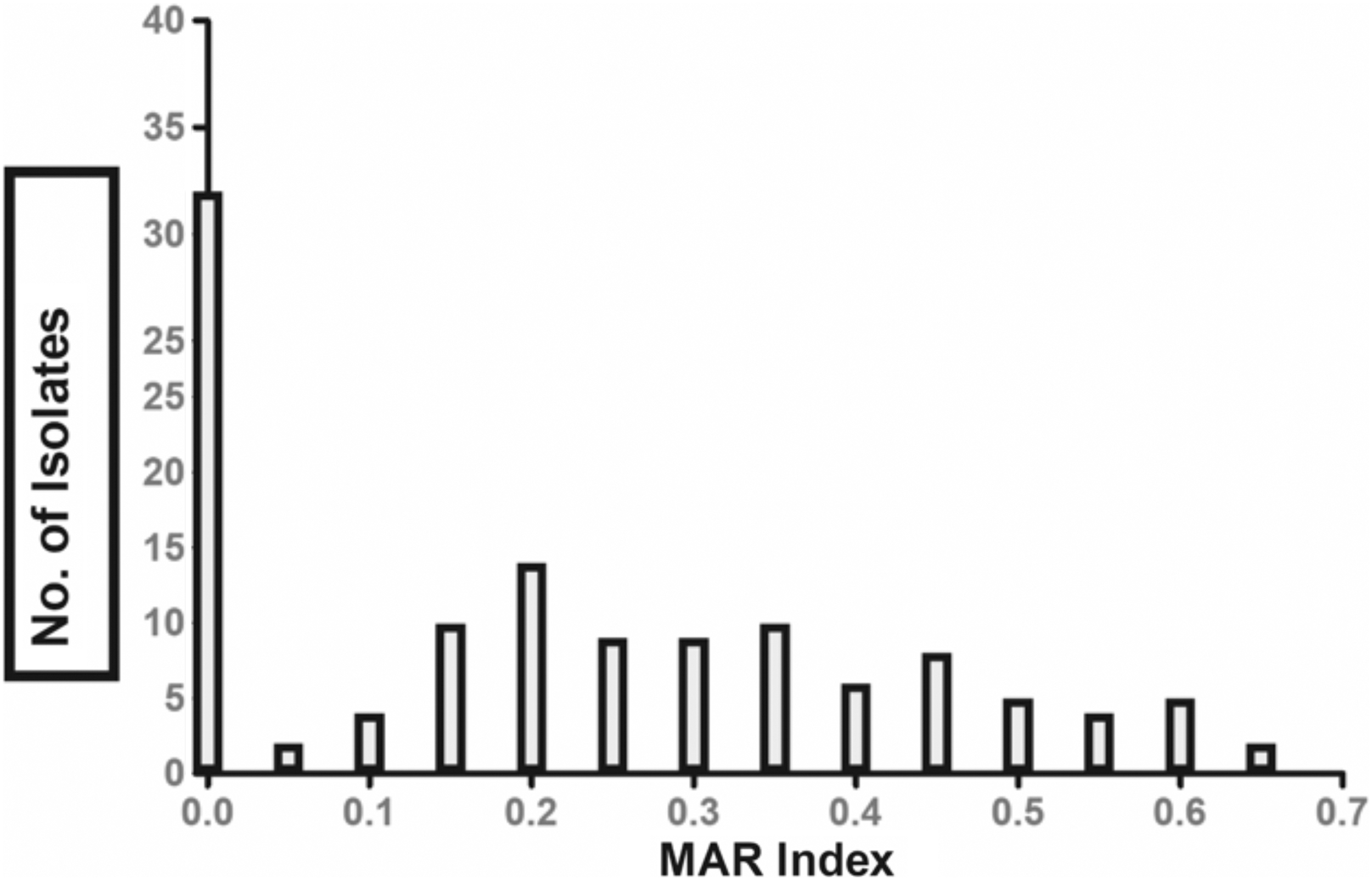
The frequency of MAR index trend of Staphylococcus aureus sampled across the “farm to fork” continuum. Bacteria having MAR index >0.2 originate from a high-risk source of contamination where several antibiotics or growth promoters are used. A completely resistant isolate has a MAR index of 1.0. MAR, multiple antibiotic resistance.
Discussion
The poultry industry accounts for 60% of the total national animal protein consumption in South Africa. Its intensive nature engenders the use of several antibiotic classes as growth promoters, prophylaxes, and therapeutics. Nevertheless, studies on the occurrence and antibiotic susceptibility of S. aureus isolates from the food chain are scarce. Thus, this study takes the lead for this interconnectivity concept and hopes that this study will serve as the bedrock for the integrated approach needed to tackle antimicrobial resistance in the continent.
The prevalence rate of S. aureus across the continuum (31.25%) in our study was slightly higher than the estimated global S. aureus contamination prevalence of 29.2% in raw meats, 14 but corroborated a study in 21 European countries, which reported S. aureus as the leading pathogen in poultry (raw meats, food, and food products) averaging 38.5%. 15 However, unlike other continents, the prevalence and antibiotic resistance of S. aureus infections in poultry in Africa are not monitored, 36 hence the difficulty in correlating our results with studies in South Africa and the African continent. The importance of S. aureus is perhaps overshadowed by the existence of more rampant FBD-causing agents such as Salmonella, Campylobacter, Escherichia coli, and Listeria. This calls for the need for S. aureus to be included in surveillance and monitoring schemes of foodborne bacteria that routinely contaminate food supplies on the continent. Moreover, the study revealed an MDR rate of 39%, which was lower than the 52% reported in the United States in meat and poultry, but higher than a study in Turkey, where the rate of MDR was 25%.37,38 These fluctuations in resistance to common antibiotics differ from country to country and are reflective of local legislation that regulates the use of antibiotics for animal production.
In South Africa, the Department of Agriculture regulates the use of antibiotics, prophylactically or as growth promoters, under the Stock Remedies Act No. 36 of 1947. Antibiotics for agricultural use are more freely available in South Africa compared to Denmark 39 and the United Kingdom, 40 where antibiotics for food animals can only be obtained by prescription from a veterinarian. Antibiotics that are regarded as important to human health are thus being used in animal food production in South Africa. 41 Standard commercial production systems make it challenging to treat individual animals, mainly because of the large numbers of animals in the groups, resulting in mass medication as the only option. However, the addition of antimicrobial agents to water or feed may result in individual animals receiving inadequate curative doses or excessive prophylactic doses. Such production practices lead to co-selection and cross-resistance, and escalate the emergence and spread of antibiotic-resistant bacteria in food-producing animals, which can then be transmitted through the food chain to humans.25,42
Antibiotic susceptibility testing showed various levels and cross-resistance to commonly used growth promoters and their analogs employed in the poultry production system. For example, there was a higher level of resistance to erythromycin (54.17%) and clindamycin (43.33%), probably attributable to the administration of the macrolides tylosin and kitasamycin as feed additives for treating and preventing diseases such as mycoplasmosis in poultry.43,44 The effect of tylosin use on erythromycin resistance as well as reducing the antimicrobial activity of members of the same class of antibiotics (clindamycin) in different food animals (poultry, pigs, and cattle) has been widely documented.45–48 This led to its ban as a growth promoter in Europe (EU) following recommendations by a WHO meeting in Geneva, in 1997, because of its relatedness to therapeutic antibiotics used in humans. 49
Furthermore, resistance to tetracyclines (61.67%) and doxycycline (36.67%) was associated with the use of tetracycline analogs in poultry production. The association between high tetracycline use in the animal production and tetracycline resistance due to selective pressure has also been reported globally.43,50–53 Interestingly, tetracyclines are the second largest group of antibiotics (16.7% of the total volume sold) sold in South Africa. 43 Consequently, various levels of resistance to tetracyclines in Salmonella, Listeria, Campylobacter, S. aureus, and E. coli from poultry abattoirs in the country have been previously reported.46,54–56
More so, the resistance to fluoroquinolones (ciprofloxacin, moxifloxacin, and levofloxacin) found in the poultry production industry can be associated with the use of enrofloxacin and olaquindox for treatment and growth promotion. A number of studies have linked the prophylactic and therapeutic use of fluoroquinolone antibiotics in the selection for ciprofloxacin-resistant bacteria in poultry production (broilers) and food products.46,57–61 Cross-resistance to antibiotics with the same mechanism of action was observed as expected. For example, strains resistant to ciprofloxacin also showed resistance to other quinolone antibiotics (moxifloxacin and levofloxacin) (Fig. 3). Fluoroquinolone residues can remain in the animal body post-treatment, and this advances the evolution of fluoroquinolone resistance even after the fluoroquinolone exposure has ceased.61,62 This is a cause for concern as quinolones are approved for therapeutic and preventative purposes in animal health in South Africa. Similarly, resistance to trimethoprim-sulfamethoxazole (30.00%) can be linked to the use of sulfonamides in farming systems. This is not surprising as sulfonamides have been reported as the third most used antimicrobial (12.4% of the total volume) in food animal production in South Africa.25,43 Its association with high rates of resistance may be attributed to the ready availability and a large number of trimethoprim-sulfamethoxazole analogs registered in terms of Act 36 of 1947 for treatment.43,63
The MAR index is a useful risk assessment tool, and the value of the MAR index (nominally 0.200) has been applied to differentiate low- and high-risk regions where antibiotics or growth promoters are overused. 64 Such an analysis indicates the number of bacteria showing antibiotic resistance in the risk zone of the susceptibility study. Our overall MAR index was 0.23, confirming that there were high antibiotic use and high selective pressure in these environments.65,66
Several antibiotics such as tetracyclines, macrolides, fluoroquinolones, and sulfonamides are essential for human health and listed in the WHO list of critically important antimicrobials. 67 The indiscriminate use of these antibiotics in food animal production is a cause for concern as this has led to a high prevalence of resistance to many antibiotics, including the emergence of MDR S. aureus.41,68 The termination or more efficient regulation of antibiotics in food animals resulting in decreased resistance in zoonotic bacteria has been reported in several studies globally.69–72 Unfortunately, South Africa has not taken any vigorous stance toward the cessation of use of antibiotics in animal feed. The country still adopts Act 36 of 1947 as Stock Remedies for the use of antibiotics, either as growth promoters or subtherapeutically, in animal feeds. This calls for urgent implementation of appropriate and suitable food safety measures involving all the policy and decision makers, as well as stakeholders in human, animal, and environmental health to address this public health issue. Furthermore, considering current surveillance reports, it is imperative that the legislation and regulations governing the use of veterinary products to be reviewed to meet current demands for the prudent use of antibiotics in intensive food animal production.
Conclusion
We showed relatively high levels of resistance to antibiotics commonly used as growth promoters and antibiotics with veterinary analogs. We contend that different antibiotic growth promoters used in poultry production have resulted in the emergence and circulation of drug-resistant bacteria in the poultry production system in South Africa through cross-resistance and co-selection. There is thus a need for efficient antibiotic stewardship guidelines to streamline their use in tandem with continued surveillance and monitoring schemes of S. aureus in food animals across the “farm to fork” continuum to monitor their emergence, spread, and significance to human health. To the best of the authors' knowledge, there has not been any study carried out on poultry production system regarding S. aureus isolates and their antimicrobial resistance pattern in Africa using the “farm to fork” approach. Thus, this study takes the lead for an interconnectivity concept and hopes that this study will serve as the bedrock for the integrated approach needed to tackle antimicrobial resistance in the continent.
Footnotes
Acknowledgments
We would like to acknowledge the managers of Farm A for their cooperation and the workers for their participation in this study. The logistics of sampling from Farm A was complicated and required the cooperation of farm production, slaughterhouse, and retail managers, staff, and workers.
Authors' Contributions
Co-conceptualized the study: D.G.A., K.P., L.A.B., and S.Y.E. Performed the experiments: D.G.A., A.M.S., A.A.L.K., and C.M. Analyzed the data: D.G.A. Vetting of the results: A.M.S., A.A.L.K., L.A.B., and S.Y.E. Wrote the article: D.G.A. Undertook critical revision of the article: All.
Disclaimer
Any opinion, finding, and conclusion or recommendation expressed in this material are those of the author(s) and do not necessarily reflect the views of the organizations or agencies that provided support for the project. The funders had no role in the study design or the decision to submit the work for publication.
Disclosure Statement
Prof. Sabiha Y. Essack is chairperson of the Global Respiratory Infection Partnership sponsored by an unrestricted educational grant from Reckitt and Benckiser. All other authors declare that they have no competing interests regarding the publication of this article.
Funding Information
The research reported in this publication was funded by the WHO Advisory Group on Integrated Surveillance of Antimicrobial Resistance (AGISAR) Research Project: “Triangulation of Antibiotic Resistance from Humans, the Food Chain and Associated Environments—A One Health Project” (reference ID: 204517), South African Research Chairs Initiative of the Department of Science and Technology and National Research Foundation of South Africa (grant no. 98342), the South African Medical Research Council (SAMRC) and U.K. Medical Research Council, and the SAMRC under a Self-Initiated Research Grant and the College of Health Sciences, University of Kwa-Zulu Natal, South Africa.

References
Supplementary Material
Please find the following supplemental material available below.
For Open Access articles published under a Creative Commons License, all supplemental material carries the same license as the article it is associated with.
For non-Open Access articles published, all supplemental material carries a non-exclusive license, and permission requests for re-use of supplemental material or any part of supplemental material shall be sent directly to the copyright owner as specified in the copyright notice associated with the article.
