




Abstract
Antimicrobial resistance (AMR) in bacteria is a frequent and widespread phenomenon. The European Food Safety Authority (EFSA) reports that multidrug resistant (MDR) Escherichia coli is considered an important hazard to public health. The lack of data on the correlation between the administration of antibiotics to pigs and the diffusion of MDR E. coli necessitates an in-depth study. The aims of our study were first of all to determine the presence of MDR and/or extended spectrum β-lactamase (ESβL) E. coli isolated from feces and carcasses of pigs; and second, to evaluate the correlation between antibiotic resistance and the antibiotic treatment administrated to the animals considered. The examined E. coli was isolated from 100 fecal swabs and 100 carcass sponges taken from farms and slaughterhouses located in Reggio Emilia province in Italy. The MDR isolates were tested following the protocol defined by EUCAST (2015). Subsequently, a real-time PCR and an endpoint-PCR were used for the genomic analysis. Data highlighted 76.5% of MDR E. coli with a marked presence of the ampicillin (AMP)-streptomycin (STRE)-tetracycline (TETRA) pattern. Moreover, 13 isolates were ESβL producers, and the blaCTXM gene was the most frequently observed in genomic analysis. Results confirm the complexity of the AMR phenomenon showing a partial correlation between the administration of antibiotics and the resistance observed. Pigs destined to the production of Protected Designation of Origin items are colonized by bacteria resistant to a wide range of antibiotic classes even if data are encouraging for colistin and third generation cephalosporin. Furthermore, in-depth study focused on food production could be useful in a view of high safety standards for consumers.
Introduction
In recent years, the prevalence of antimicrobial resistance (AMR) in bacteria of animal origin has been a subject of interest, with particular concerns about the risk of transfer of these microorganisms along the food chain. The acquired nonsusceptibility to at least one agent in three or more antibiotic categories 1 is defined worldwide as multidrug resistance. The European Food Safety Authority (EFSA) 2 has identified multidrug resistant (MDR) Escherichia coli, resulting from the swine production chain, as a significant hazard to public health.
Pig farming is an intensive industry where the use of antibiotics for treatment of various diseases is widespread. Several studies on AMR in E. coli of swine origin have been carried out on bacteria isolated at slaughterhouses. These samples are selected to better understand the dynamics of diffusion of MDR pathogens and to define the probable correlation with the administration of antibiotics during the breeding stages of pigs. 3 For example, it has been demonstrated that treatment of sows influenced the future microflora of their piglets and, as a consequence, the diffusion of AMR strains in the environment and along the food chain. 4 Resistance to colistin and production of extended-spectrum-β-lactamases (ESβLs) are two of the most widely studied phenomenon related to AMR due to their increasing diffusion.
E. coli is commonly present in the intestinal tract of farm animals, and different studies have identified the presence of high percentages of MDR isolates, mainly characterized by resistance to tetracycline, ampicillin, aminoglycosides, and fluoroquinolone.1,5 In the last decade, ESβL-producing E. coli has been identified in pigs and pig farms around the world. In Europe, however, including Italy, there is still a need for further data regarding the diffusion of these microorganisms in the pig production chain and eventual animal–human transmission of AMR. 6
The diffusion of ESβL has been reported as being responsible for hard-to-treat infections in humans. The last EARS-Net report 7 described that the majority of the third-generation cephalosporin-resistant isolates were ESβL positive (88.4% in 2016). Moreover, ESβL production is often seen in combination with other acquired resistance mechanisms, conferring resistance to important treatment alternatives such as fluoroquinolones and aminoglycosides. 7 It has been reported that, in hospitalized patients, the presence of ESβL strains isolated from feces was over 50%.8–10 In only 4 years, ESβL isolated from the urinary tract in United States passed from 7% to 18%. 11
Other antibiotics requiring study include polymyxin B and colistin. These antibiotics have been extensively used in animal production for prophylactic and therapeutic purposes and this induced the development of resistance clones that should now be involved in hard-to-treat human infections. 12 Colistin was rarely used in human medicine due to the negative side effects associated with treatment. 13 However, in case of septicemia or other systemic infection sustained by microbial agents resistant to the majority of available antibiotics, colistin may currently be used as a life-saving drug. 12 This is the main reason why the use of this molecule in veterinary medicine was banned in Europe from 2016.14,15
Many of the most important food industries that produce cured hams and other Protected Designation of Origin (PDO) and Protected Geographical Indication (PGI) pork meat products are located in the province of Reggio Emilia, together with Parma, Piacenza, and Bologna. In fact, the consumption of pork meat and PDO pork meat products is 37 kg pro capite in this geographical area. 16 Furthermore, worldwide export of these products recorded an increase of 75% in the last 10 years. In this context, an in-depth study on pigs reared in Emilia Romagna region is well inserted.
The purpose of this study was to identify MDR E. coli isolated from feces and carcasses of animals from the same batch, sampled in the aforementioned area of Italy. Furthermore, the aim was to verify eventual correlations between antibiotic resistance and antibiotic treatment to which the animals were subject. Ultimately, E. coli isolates have also been tested for a series of compounds to define the presence of ESβL and colistin resistance both phenotypically and genotypically.
Materials and Methods
E. coli isolation from pig feces and carcasses
From April 2017 to July 2018, pigs from five different fattening farms (A, B, C, D, E) were sampled. All farms considered were located in the Reggio Emilia province and were intensive, medium-sized fattening farms with 300 to 2,000 pigs for each production cycle. Animals were fed with medicated feed, and treatments were recorded for each batch of animals (see Fig. 1 for declared antibiotics used). Treatment was interrupted at least 30 days before slaughtering, as foreseen by DLgs. 158/2006. 17

Antibiotic treatments used in the five farms.
Samples were collected on the farms at least 30 days before slaughtering and then at the slaughterhouse. This allowed for the evaluation of administrated treatment and the correlation with AMR observed.
Four batches of pigs were sampled on each farm. Fecal swabs were collected from five animals for each batch, for a total of 20 fecal swabs/farm. Five carcasses from the same batch of pigs were then sampled at slaughterhouse by sponging. The total number of tested samples was 100 fecal swabs and 100 carcass sponges.
Each swab was put into a sterile tube with 9 mL of buffered peptone water (BPW), and 225 mL of BPW was added to each sponge. Samples were incubated at 37°C for 24 hours. Then, using a sterile calibrated handle, the broth culture was streaked onto Tryptone Bile X-gluc agar and incubated at 42°C. A typical blue-green colony was selected and subjected to indole test (UNI EN ISO 16649–2:2001). The indole positive colonies were finally confirmed as E. coli with the miniaturized API20E system (bioMérieux, France).
Antibiotic susceptibility and ESβL confirmation test
All the isolated E. coli were subjected to an antibiotic susceptibility test with the disc diffusion method following the protocol defined by European Committee on Antimicrobial Susceptibility Testing (EUCAST 2015). 18 The selected categories of antibiotics were as follows: tetracycline, aminoglycosides, β-lactams, phenicols, quinolones, and sulfonamides. The antibiotic agents were used following EUCAST guidelines: ampicillin (AMP, 10 μg), cefotaxime (CTX, 5 μg), ceftazidime (CAZ, 10 μg), chloramphenicol (CHLOR, 30 μg), ciprofloxacin (CIPRO, 5 μg), gentamicin (GEN, 10 μg), nalidixic acid (NAL, 30 μg), tetracycline (TETRA, 30 μg), trimethoprim–sulfamethoxazole (TRIM-SULF, 25 μg), imipenem (IMI, 10 μg), meropenem (MERO, 10 μg), and streptomycin (STRE, 10 μg).
In case of resistance to third generation cephalosporins, isolates were phenotypically confirmed as ESβL with the combination disc test 18 and subsequently with a real-time PCR targeting three genes coding for β-lactamases: blaCTXM, blaTEM, and blaSHV. 19
Finally, all the ESβL-producing E. coli were tested for susceptibility to colistin on Sensititre plates™ (Thermofisher Scientific, Italy) defining the minimal inhibitory concentration (MIC) following manufacturer's instructions (COL: S ≤ 2 μg/mL and R > 2 μg/mL). Isolates resistant to colistin were tested for the presence of mcr-1 gene following the endpoint-PCR protocol described by Liu et al. 20 with an optimized annealing temperature of 50°C defined after several internal tests. Strain NCTC 13846 was used as a positive control for mcr-1 gene.
Statistical analysis
To evaluate if the prevalence of AMR E. coli isolated from feces and carcasses of pigs is correlated with administration of the same molecules, the odds ratio (OR) has been calculated (Software R).
OR is defined as the ratio of the odds. These explain the probability between the prevalence of two events (resistance and sensibility). The first odds calculated is between the prevalence of resistant and sensitive E. coli isolated in pigs treated with antibiotics. The second odds is the prevalence of resistant E. coli and susceptible ones in pigs nontreated with antibiotic agents.
The ratio of these odds has been finally calculated to establish a connection between the events “treated pigs” and “non-treated pigs” (OR >1 positive association; OR = 1 no association; OR <1 negative association).
A chi-squared test was applied to check if the value found can be statistically significant (p < 0.05).
Results
E. coli identification and antibiotic susceptibility evaluation
A total of 200 E. coli (100 from fecal samples and 100 from carcasses) were isolated and tested with 12 antibiotics. These molecules belong to the six categories below: tetracycline (TETRA), β-lactams (AMP, CTX, CAZ, IMI, MERO), aminoglycosides (GEN, STRE), phenicols (CHLOR), quinolones (NAL, CIPRO), and sulfonamides (TRIM/SULF). The E. coli resistance was statistically analyzed to confirm a possible relationship between the use of specific antibiotics and the resistance found in sentinel bacteria isolated both from feces and carcasses of the treated animals.
Eighty-five percent of the E. coli isolated from fecal swabs resulted in resistance to tetracycline in animals treated with this category of compounds. When comparing animals that had never been treated with tetracycline, E. coli resistance was still observed at the same level (85%) (OR = 1; p = 1).
E. coli isolated from carcass sponges showed 67.5% of resistance to tetracycline in treated pigs and the 100% of resistance in nontetracycline treated animals (OR = 0.0103; p = 0.0014).
The percentages of resistance to β-lactams in E. coli from fecal samples were 70% and 90% for animals treated and not treated with this category of compounds, respectively (OR = 0.2593; p = 0.0007). The percentage of E. coli resistance isolated from carcasses was higher in nontreated animals (92.5%) compared to treated animals (45%) (OR = 0.0711; p < 0.0001).
For the aminoglycosides, in fecal swabs of treated pigs the resistance was 100% versus 81% in nontreated animals (OR = 48.092; p = 0.0072). In carcasses, values were 95% and 72.5%, respectively (OR = 7.3889; p = 0.0001).
A lower rate of resistance was recorded for phenicols, quinolones, and sulfonamides as reported in Fig. 2, but a significant relationship between AMR and the administration of treatments was found for quinolones analyzing feces (OR = 3.3387; p = 0.0001) and for sulfonamides both in feces (OR = 2.8519; p = 0.0004) and carcasses (OR = 6.3947; p < 0.0001).
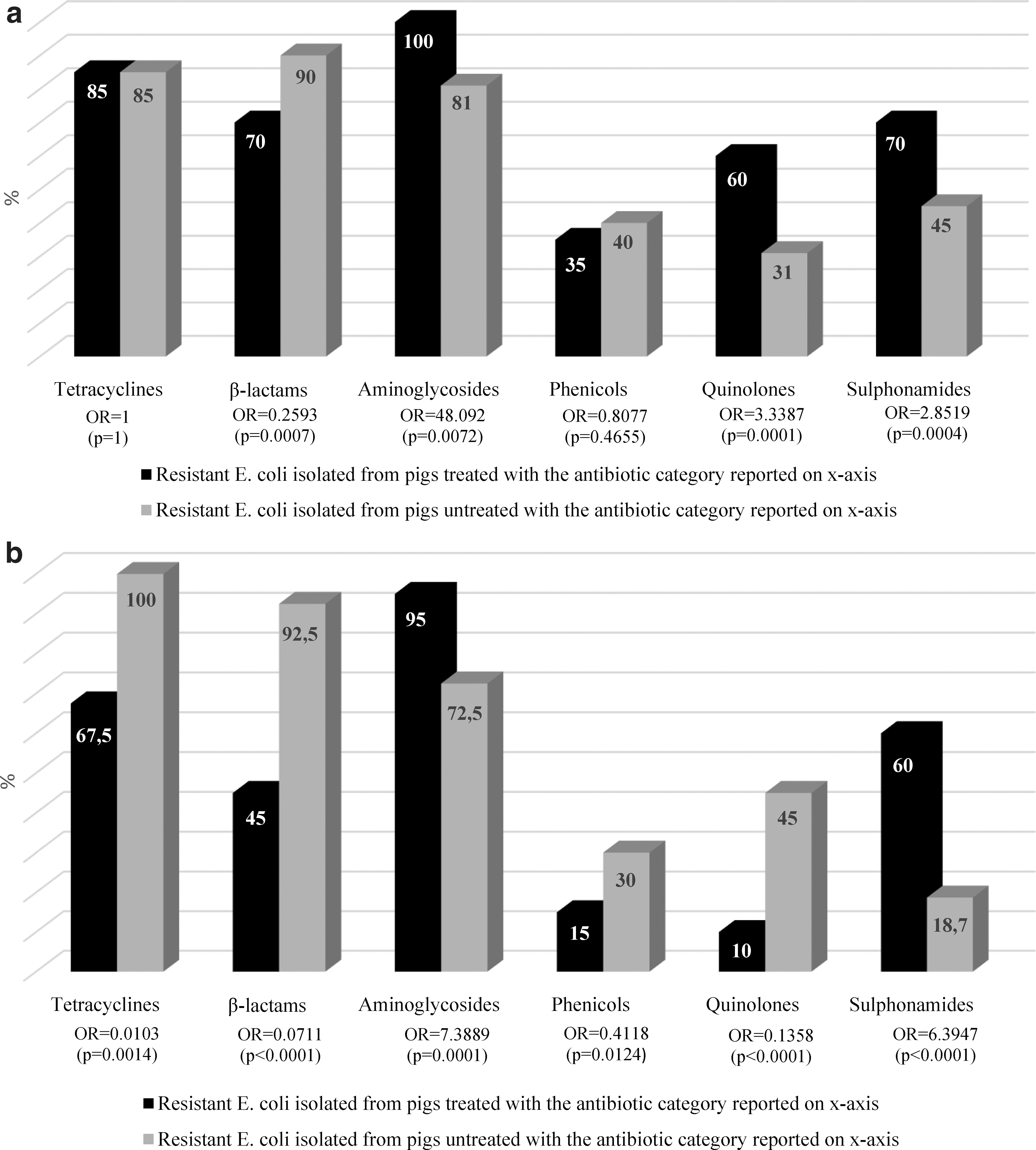
AMR in Escherichia coli isolated from fecal swabs
MDR profiles, intended as resistance to three or more antimicrobials belonging to different categories, were observed in 153 E. coli (76.5%). In particular, 85 MDR E. coli were isolated from pig feces and 68 from carcasses (Table 1).
Resistance Patterns and Multidrug Resistance Recorded by the 197 Escherichia coli Isolated from Fecal Swabs and Carcass Sponges
AMP, ampicillin; CAZ, ceftazidime; CHLOR, chloramphenicol; CIPRO, ciprofloxacin; CTX, cefotaxime; GEN, gentamicin; IMI, imipenem; MDR, multidrug resistant; MERO, meropenem; NAL, nalixidic acid; STRE, streptomycin; TETRA, tetracycline; TRIM-SULF, trimethoprim–sulfamethoxazole.
Three E. coli isolated from carcass sponges were susceptible to all the 12 antibiotics tested, while the other 197 isolates were resistant to at least one compound (59.5% is resistant to four or more antibiotic agents). No remarkable differences were found between isolates from fecal swabs and carcass sponges. The majority of MDR isolates fell into the following patterns: AMP-STRE-TETRA (33.33%), AMP-STRE-TETRA-TRIM/SULF (29.84%), AMP-CHLOR-STRE-TETRA-TRIM/SULF (34.09%), and AMP-CHLOR-GEN-STRE-TETRA-TRIM/SULF (33.33%).
When considering resistance to cephalosporin, 13 E. coli were ESβL, 7 (7%) isolated from fecal swabs and 6 (6%) from carcass sponges. They were all isolated from animals reared in farms B, C, D, and E and none from farm A (Table 2). Two E. coli ESβL isolates (one isolated from fecal samples and one from carcass sponges), genetically corresponding to gene blaSHV, were both from pigs of the same farm. Of the other ESβL identified, only one was positive for all the three genes. blaCTXM was harbored by 10 out of 13 phenotypically confirmed ESβL, blaTEM was present in 6 isolates and blaSHV in 4. Patterns blaTEM/blaSHV and blaTEM/blaCTXM were observed in two E. coli each, while blaSHV/blaCTXM profile was found in only one E. coli isolated from carcass sponges (Table 2).
Genotypes of Extended Spectrum β-Lactamase E. coli Isolated from Pigs Feces (F) and Carcasses (C)
bla, β-lactamases; ESβL, extended spectrum β-lactamase.
Two ESβLs isolated from carcasses were resistant to colistin (MIC = 4 μg/mL) and positive for mcr-1 gene.
Discussion
In the present study, animals reared in five intensive farms (20 animals/farm) and fed with medicated feed were followed.
Oral administration is the most common route for antimicrobials in pigs 21 and it is well known that the use of these products can increase the risk for development and dissemination of resistant bacteria. Very often it is preferred to treat animals with low doses of antibiotics for longer periods of time, but in this way the selection of resistant bacteria is favored. 22 Sun et al. 23 demonstrated that treatment with low doses of antibiotics induced an increase in the percentage of resistant-bacterial communities, in the presence of AMR genes (including resistance to antimicrobials not administered), and in the abundance of potential human pathogens. This was confirmed also by a recent study, in which the authors reported that the risk of ampicillin resistance in E. coli was higher in pigs treated with β-lactams compared to β-lactam-untreated pigs. 4 Moreover, the same study showed that piglets born from dams treated with this molecule displayed a significant level of resistance, suggesting that vertical transmission of resistant bacteria is possible. 4
The Kendall's model applied in a study conducted in Belgium confirmed a positive correlation between AMR and the use of corresponding antimicrobial class for ampicillin, colistin, sulfamethoxazole, trimethoprim, and tetracycline. 24
In our study, this hypothesis is partially confirmed. In fact, correlation between the use of determined categories of antibiotics and the development of resistance was only found in the considered farms for aminoglycosides, quinolones, and sulfonamides. At slaughterhouses, the same correlation was found for aminoglycosides and sulfonamides. For the other antibiotic categories considered, a higher percentage of resistant E. coli were isolated from pigs that had never been treated with these compounds.
This might be explained by a series of hypothesis; one certainly is the phenomenon of co-selection and co-resistance, where the use of one compound selects for resistance to unrelated molecules due to the near location of resistance genes.25,26 The use of trimethoprim/sulfonamide combination, for instance, was defined as a predictor of resistance to ampicillin, streptomycin, and tetracycline. 27 This was also evident in pigs from a farm considered in this study (farm C).
Moreover, it is well known that genes related to the antibiotic resistance are widely transmitted among bacteria through plasmids or gene transfer.28,29 Furthermore, Chen et al. 30 showed that the early environmental microbiota will also influence the primary gut colonization of piglets. These factors, 31 together with the use of antibiotics administered with medicated feed, may explain the presence of resistant E. coli in the feces of pigs analyzed here. For example, bacterial resistance to ampicillin, tetracycline, and aminoglycosides has been widely reported all over the world and was also frequent in E. coli isolated from β-lactam and tetracycline-untreated pigs.32–34 This could be the reason why, in our study, even if pigs had not been treated with these compounds, the level of resistance was high.
Results from the present study showed that 76.5% of E. coli isolated from fecal swabs and carcass sponges were MDR and 59.5% E. coli were resistant to four or more antibiotic agents. A remarkable presence of the AMP-STRE-TETRA pattern was found. This pattern was commonly recorded in animal bacterial strains,2,35 together with AMP-STRE-TETRA-TRIM/SULF, similar to what was observed in United States 36 or in Canada 37 for STRE-TETRA-SULF.
In Europe, percentages of MDR in E. coli isolates from fattening pigs are similar and, as quoted by the most recent EFSA report, 32 correspond to ∼60%. The same document also showed that in northern and central European countries such as Norway, Finland, Iceland, Estonia, Sweden, Latvia, Austria, and Switzerland, resistance to three or more antimicrobial classes was detected in <17% of the strains, and only occasional isolates were resistant to six or more classes. In most of these countries, animals are reared in nonintensive farms, and this contributes to their welfare. In fact, it is well known that poor animal welfare (heat, cold, dietary changes, overcrowding) may result in stress, which reduces immunocompetence, making animals more susceptible to infections.38,39
The European average value of third generation cephalosporin resistance is 1.2% for cecal content of fattening pigs, and it was reported that 4.7% of retail samples of swine meat showed ESβL strains. 2 In our study, this resistance was confirmed in 6.5% of isolates. Cephalosporins were not declared as one of the treatments used in the pigs considered. In any case, we found positive isolates, highlighting the importance of monitoring antimicrobial susceptibility in swine production and in animals producing food, as suggested by ECDC/EFSA/EMA European agencies in the report of 2017. 2
Two of these E. coli ESβLs, one from fecal samples and one from carcass sponges, were both isolated from the same batch of pigs. They had a different genetic profile, showing a match only for the blaSHV gene. This may suggest possible contamination at the slaughterhouse, in particular in the waiting area at the abattoir, during transport of animals or through close contact with veterinarians.40,41 It has been reported that clonal transfer of ESβL-producing E. coli between pigs and pig farmers may occur through direct contact or aerosols. 42 Looking attentively at the other ESβLs identified here, only one isolate was positive for all the three genes, and blaCTXM was the most common gene, followed by blaTEM and blaSHV as also reported in other studies conducted in Europe.40,43,44 As known, blaCTXM is mainly located on plasmids, thus facilitating the transfer among bacteria, which could explain its wide diffusion. 45
It is also important to note that two confirmed ESβL E. coli were resistant to colistin. In Europe, colistin was used (before the ban in 2016) to treat infections caused by Enterobacteriaceae in pigs, chickens, cows, sheep, and goats. 46 In Asian countries, it was heavily used as an in-feed antibiotic growth promoter 12 and its use was also approved in United States and in Brazil. 47 The resistance to this compound is worrying because, together with carbapenems, it is the only drug still efficacious against infections sustained by resistant strains to the majority of antibiotic classes. A recent study on the same type of samples collected between Lombardy and Emilia Romagna regions in Italy 43 reported a percentage of resistance against colistin ranging from 36.3% to 65% (fecal and carcasses ESβL E. coli isolates, respectively). A study from Portugal reported that 45.7% of colistin mcr-1 resistant E. coli isolated from food-producing animals and meat (bovine and swine origin) were also ESβLs. 48 Regarding the situation in Italy, EFSA reported much lower percentages (0.6%) of resistance to colistin in pigs. 2 The spread of resistance toward this compound, mainly mediated by the mcr-1 plasmid gene, has also been reported in China 20 and in E. coli isolated from food-producing animals in Portugal (8%). 48
In conclusion, data from our study are encouraging with regard to the susceptibility of bacteria to colistin and third generation cephalosporins. However, pigs destined to PDO products are colonized by bacteria resistant to a wide range of antibiotic classes. Furthermore, more in-depth studies on food production could be useful to understand the spread of antibiotic resistance along a monitored food chain and in a view of high safety standards for consumers.
Footnotes
Acknowledgments
The authors acknowledge Dr. Antonio Cuccurese and Dr. Aurelio Aldrovandi, Azienda AUSL Reggio Emilia for assistance in collection of samples.
Disclosure Statement
No competing financial interests exist.
Funding Information
The project was financed by Cariparma Foundation of Parma (Italy). Grant number: 2019.0065.