




Abstract
The dramatic increase in prevalence and clinical impact of infections caused by carbapenemase-producing Enterobacterales (CPE) are major and ongoing public health problems globally. The carbapenemase groups most commonly encountered include Klebsiella pneumoniae carbapenemase (KPC), New Delhi metallo-β-lactamase (NDM), and OXA-48, with OXA-48 thought to be endemic to North Africa. These enzymes are frequently found on mobile genetic elements and have the potential to be widespread over the world, while the situation in Algeria is not well documented. In this article, we provide an in-depth review of CPE in Algeria, providing up-to-date information on the subject.
Introduction
Carbapenem antibiotics are generally considered to be the most potent group of antimicrobial agents with proven efficacy in treatment of patients with severe bacterial infections, including those caused by extended-spectrum β-lactamase (ESBL)- and plasmidic AmpC (pAmpC)-producing Enterobacterales. 1 The rise of carbapenem-resistant bacteria is considered one of the most urgent, current, public health concerns since carbapenems are often used as a last resort to treat Gram-negative bacterial infections. 2
Resistance to carbapenems is mainly due to production of carbapenemases. Nowadays, carbapenemase-producing Enterobacterales (CPE) strains are divided into three classes according to the Ambler classification: (1) class A β-lactamases (e.g., Klebsiella pneumoniae carbapenemase [KPC]), which are inhibited by clavulanic acid or boronic acid; (2) class B metallo-β-lactamases (e.g. New Delhi metallo-β-lactamase [NDM], imipenemase [IMP], and Verona Integron-encoded metallo-β-lactamase [VIM]) hydrolyzing all β-lactams except aztreonam and inhibited by chelating agents such as Ethylenediaminetetraacetic acid; and (3) class D β-lactamases (oxacillinases), including OXA-48-like enzymes hydrolyzing carbapenems, but only weakly (or not) hydrolyzing cephalosporin and not inhibited by classical inhibitors. 3
These carbapenemases have been described worldwide, some of them are typically associated with specific regions or countries. 4 OXA-48-like carbapenemases were first detected in K. pneumoniae in Turkey in 2001. 5 Since then, these enzymes have been frequently reported in several countries, particularly in North Africa. 4
Importantly, genes encoding carbapenemases are mostly located on conjugative plasmids that allow their efficient dissemination among Enterobacterales species. Although the prevalence of particular plasmids may vary depending on the source and geographical site, they have been increasingly isolated from bacteria of human, animal, and environmental origin. 6
With nearly 2.4 million km2 of land, Algeria is the largest country in Africa and the 10th largest in the world. Situated in North Africa, it is bordered by the Mediterranean Sea in the north, Tunisia and Libya toward the east, Mauritania, Niger, and Mali in the south, and Morocco in the west. It has a population of 40.4 million people (in 2016), and about 90% of Algerians live in the north. International traveling is considered as one of the major risk factors for transmission of resistant strains. Thus, some articles reported outbreaks in France due to the transfer of patients from Algeria.7,8 Despite all this, little information has been reported on the epidemiology of CPE in Algeria. This article aims to review the available data reported on CPE from Algeria.
Methods
A comprehensive literature search of PubMed and Scopus was conducted using the following keywords: (“carbapenemases” and “Algeria”) and (“beta-lactamases” and “Algeria”). Articles published in French were searched from the Elsevier Masson Consulate database using the keywords: “carbapénémases Algérie.”
We included peer-reviewed articles (in English or French) reporting any data on CPE from Algeria. The last literature search was performed on 6th August 2019. We excluded reviews, editorials, and studies that did not give details of the resistance mechanism of carbapenem-resistant strains. All studies describing CPE isolated from human, animal, food, or environmental samples from Algeria were included.
The data extracted include the city in which the samples were collected, period of sampling, type of sample, bacterial species, type of carbapenemase described, clonality, associated resistance genes, and type of plasmid.
Results
Search results and regional distribution of CPE reports from Algeria
We have identified 30 studies reporting CPE in Algeria (Supplementary Table S1). Of these, 15 studies involved human clinical samples9–23 and the other studies involved other niches, including fecal samples from wild animals,24–27 fecal carriage in companion animals,28–30 fecal carriage in humans,31–33 food products,34,35 hospital environment, 36 and river water, 37 and one large study reported carbapenemase from different ecological niches (human fecal carriage, fecal samples from farm animals, companion animals, wild animals, food products, urban wastewater treatment plant, and aquatic environment). 38
The first records of CPE in Algeria were published in 2010 by two different research groups. Rodriguez-Martinez et al. have reported VIM-19-producing Escherichia coli and K. pneumoniae isolates in January 2008. They had been recovered from rectal swabs obtained at hospital admission (systematic screening for multidrug-resistant bacteria) from a 30-year-old patient transferred from Algiers, Algeria. 32 At the same time, Robin et al. also reported the same enzyme in five Enterobacterales strains (E. coli [n = 2], K. pneumoniae [n = 2], and Providencia stuartii [n = 1]) isolated from two patients hospitalized in the intensive care unit of the Central Military Hospital of Algiers from January to May 2008. 21
Except for one article from southern Algeria, 33 29 other articles were investigated from the central and eastern regions of Algeria involving 14 cities (Fig. 1). This situation is perhaps linked to localization of the research groups in Algeria, mainly in Bejaia University, Batna University, USTHB University (Algiers), and Annaba University.
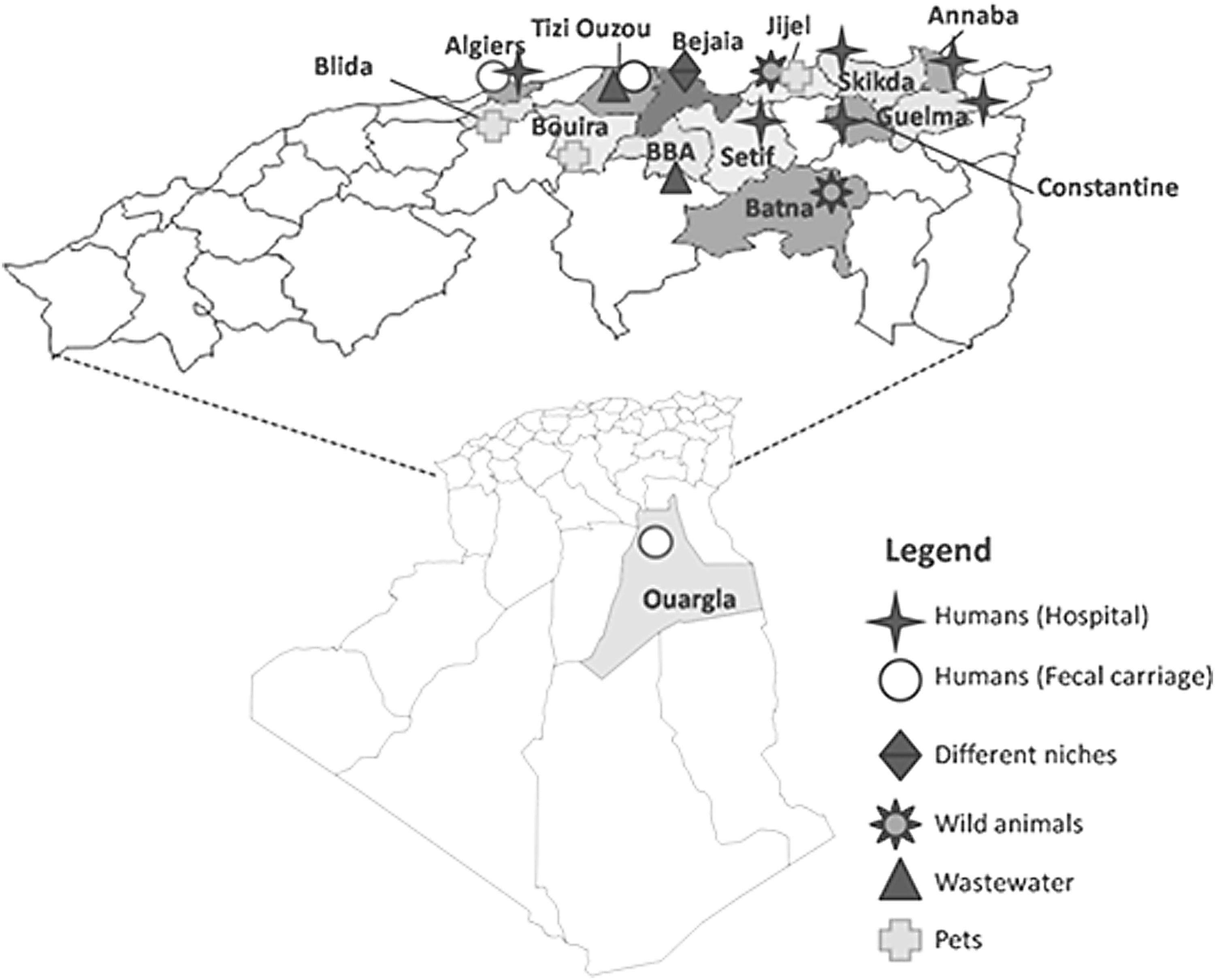
Distribution and number of publications reporting the presence of CPE in Algerian cities. Different niches included fecal carriage (including humans, wild animals, companion animals, and farm animals), river water, and food. CPE, carbapenemase-producing Enterobacterales.
Types of CPE species
A total of 212 CPE strains were reported and assigned to 13 different species (Fig. 2), including K. pneumoniae (n = 130; 61.3%), E. coli (n = 50; 23.6%), Enterobacter cloacae (n = 13; 6.1), Raoultella ornithinolytica (n = 7; 3.3%), Klebsiella oxytoca (n = 3; 1.4%), Cronobacter malonaticus (n = 2; 0.9%), Citrobacter braakii (n = 1; 0.5%), Citrobacter freundii (n = 1; 0.5%), Citrobacter werkmanii (n = 1; 0.5%), Proteus mirabilis (n = 1; 0.5%), P. stuartii (n = 1; 0.5%), Pluralibacter gergoviae (n = 1; 0.5%), and Raoultella planticola (n = 1; 0.5%).

Prevalence of CPE species identified from Algeria. *: Cronobacter malonaticus (n = 2), Citrobacter braakii (n = 1), Citrobacter freundii (n = 1), Citrobacter werkmanii (n = 1), Proteus mirabilis (n = 1), Providencia stuartii (n = 1), Pluralibacter gergoviae (n = 1), and Raoultella planticola (n = 1).
From the 79 CPE strains described in human samples, K. pneumoniae was the most isolated strain (n = 62; 78.5%), followed by E. coli (n = 14; 17.7%), E. cloacae (n = 1; 13%), P. mirabilis (n = 1; 1.3%), and P. stuartii (n = 1; 1.3%).
In the extrahuman samples, K. pneumoniae was the most isolated strain with 51.1% (68/133) of total CPE strains, followed by E. coli strains with a frequency of 27.1% (36/133) and E. cloacae with 9% (12/128). In addition to these major species, a set of environmental species of Enterobacterales producing OXA-48 were isolated from different niches, including R. ornithinolytica (n = 7; 5.3%), K. oxytoca (n = 3; 2.3%), C. malonaticus (n = 2; 1.5%), R. planticola (n = 1; 0.8%), C. freundii (n = 1; 0.8%), C. werkmanii (n = 1; 0.8%), C. braakii (n = 1; 0.8%), and P. gergoviae (n = 1; 0.8%).
Types of CPE carbapenemases
Concerning the types of carbapenemases isolated, OXA-48 was the most reported carbapenemase (n = 188; 88.7%). The remaining carbapenemases were as follows: NDM-5 (n = 9; 4.2%), VIM-19 (n = 7; 3.3%), OXA-244 (n = 3; 1.4%), KPC-3 (n = 2; 0.9%), NDM-1 (n = 2; 0.9%), and OXA-24 (n = 1, 0.5%) (Fig. 3).
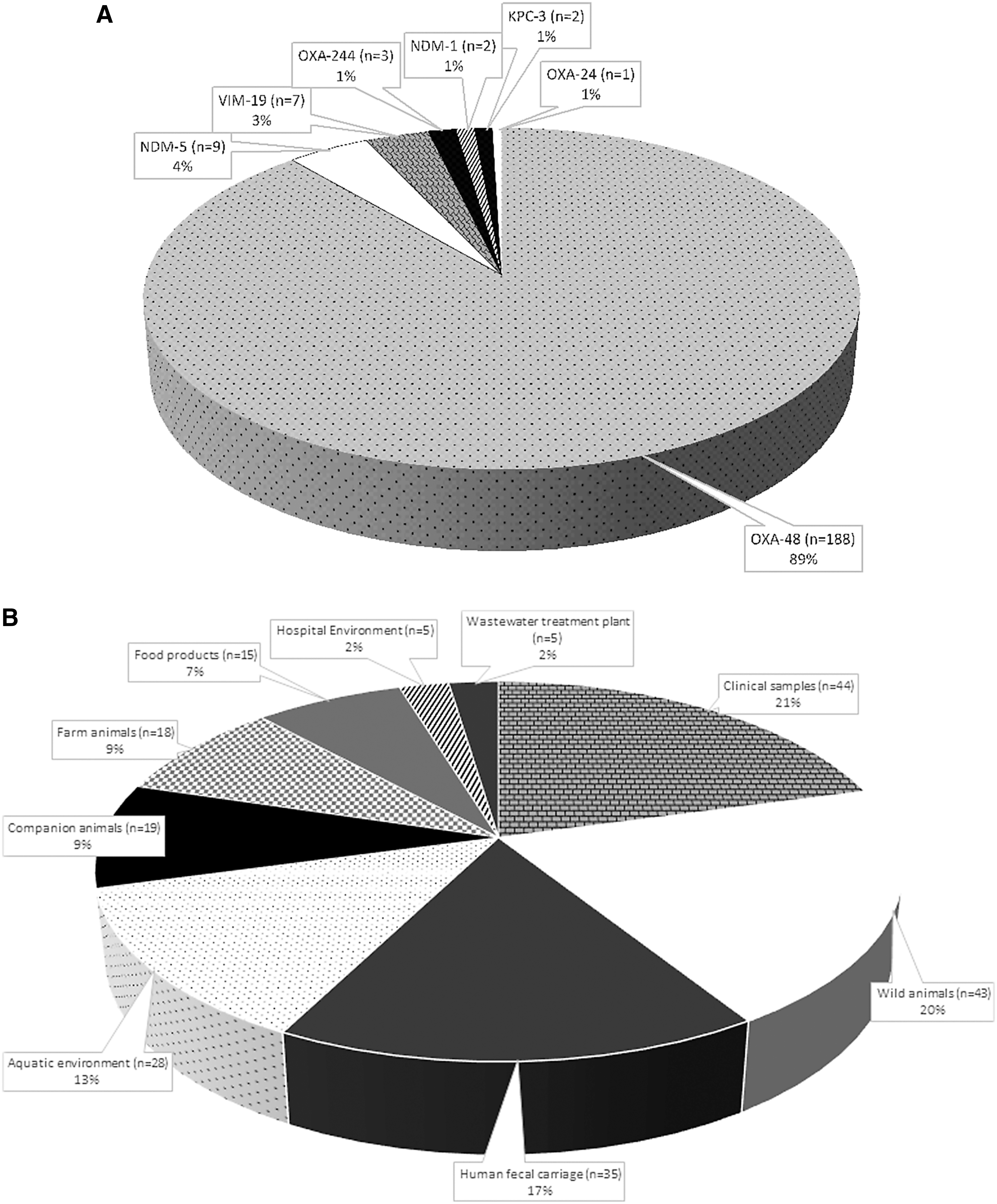
Prevalence of CPE reported in Algeria.
The first OXA-48 case in Algeria was signaled in one E. coli clinical isolate by Agabou et al. in Constantine Hospital. 10 Since then, this carbapenemase was reported in different Algerian regions and different niches (see below). In addition to the OXA-48 carbapenemase, OXA-244, a variant of OXA-48, was reported by Tafoukt et al. in three E. coli strains isolated from river water. 37 OXA-24, a carbapenemase largely reported in Acinetobacter baumannii strains, was reported in one P. mirabilis clinical strain by Leulmi et al. 17
A total of nine NDM-5-producing strains were reported in four studies.22,29,30,35 The first report of NDM-5 was identified in three E. coli strains recovered from urine and blood specimens of three patients between January 2012 and February 2013 in Annaba Hospital. 22 The other strains were recovered from fecal carriage in companion animals,29,30 cow milk, and cow teat. 35
KPC-3 was identified in two strains reported, respectively, by Bakour et al. from the cerebrospinal fluid of a child in Setif Hospital 12 and by Gharout-Sait et al. from bat guano. 26
Epidemiology of CPE
Strain distribution by sample type is shown in Fig. 3. The details for each niche are described below.
Epidemiology of CPE from human sources
A total of 79 CPE strains were recovered from human samples, including 44 strains from clinical samples (urine [ = 20], blood [n = 9], pus [n = 9], and others [n = 6]) and 35 strains from rectal swab screening. Two studies involved fecal carriage of CPE. Mairi et al. screened for fecal carriage of CPE in mothers and their newborns in Bejaia and Tizi Ouzou cities and reported an overall prevalence of 4.6% (19/414) and 1.6% (7/422) in mothers and newborns, respectively. 31 Yagoubat et al. reported a prevalence of 3.3% (2/60) in Ouargla Hospital. 33
In Constantine Hospital, Agabou et al. and Leulmi et al. reported, respectively, a prevalence of 0.22% (1/448) 10 and 1% (1/97) 17 in different clinical strains. In Annaba Hospital, a prevalence of 2.9% (3/105) and 10.4% (5/47) was reported, respectively, in 201422 and 2018. 15 A prevalence of 0.5% was reported in Setif Hospital in E. coli strains, recovered from urinary tract infections. 20
Three articles reported the death of patients due to CPE strains.11,16,18 In the study by Aggoun et al., the K. pneumoniae strain was isolated in October 2011 from two blood cultures belonging to a male patient, aged 18 months, hospitalized in the pediatric unit of the Central Military Hospital of Algiers. The patient had myeloblastic acute leukemia and was transferred from Constantine Hospital. He was febrile at admission and his state worsened despite treatment with imipenem. The patient died a few days later. 11 The three OXA-48-producing K. pneumoniae strains reported in the study by Cuzon et al. were collected from three patients hospitalized in intensive care units at the hospital of Constantine from May to June 2014. These patients had severe underlying diseases and received antibiotics, including imipenem, to treat febrile episodes. Following determination of antibiotic susceptibility of the isolates, colistin was added to imipenem. However, the three patients died, likely due to delayed appropriate therapy as well as their comorbidities. 16 Loucif et al. described a nosocomial outbreak in Batna Hospital linked to K. pneumoniae producing OXA-48. During the outbreak, five patients in the hematology unit were infected with an ertapenem-resistant K. pneumoniae strain and died. The patients were treated with a different combination of antibiotics (first step: cefotaxime, gentamicin, and metronidazole; second step: amikacin and piperacillin; and third step: imipenem, vancomycin, and ofloxacin). 18
From all of the published articles on human sources, only one study reported some risk factors linked to CPE. Thus, Mairi et al. have demonstrated that the previous hospital admission and low birth weight were independent factors associated with an increased risk of CPE carriage in the mothers and newborns, respectively. 31
Epidemiology of CPE from extrahuman sources
A total of 43 CPE strains were recovered from wild animals, including the intestines of different species of wild fish (n = 20), fecal samples of different species of wild birds (n = 17), fecal samples of wild boar (n = 3), bat guano (n = 2), and German cockroach (n = 1). All of these strains produced the OXA-48 carbapenemase, except one strain of K. pneumoniae isolated from bat guano, which produced a KPC-3 carbapenemase. Enterobacterales species isolated from this ecological niche included K. pneumoniae (n = 26), E. coli (n = 10), R. ornithinolytica (n = 2), E. cloacae (n = 1), K. oxytoca (n = 1), P. gergoviae (n = 1), R. planticola (n = 1), and C. werkmanii (n = 1).
A total of 19 CPE strains were recovered from fecal swabs of companion animals, including dogs (n = 9), cats (n = 4), birds (n = 2), and horses (n = 4). The strains identified were E. coli (n = 8), E. cloacae (n = 8), and K. pneumoniae (n = 3). All these isolates produced the OXA-48 carbapenemase except one strain of E. coli isolated from a dog, which produced the NDM-5 carbapenemase.
From farm animals, we have counted 18 CPE strains, in which 16 strains were isolated from fecal swabs of ovine (n = 9), bovine (n = 4), and goats (n = 3) and 2 strains were recovered from cow teat. All strains isolated from fecal swabs of farm animals were identified as K. pneumoniae producing OXA-48 carbapenemase, while the two strains isolated from cow teat were identified as E. coli and produced the NDM-5 carbapenemase.
Concerning food products, 15 CPE strains were isolated from raw milk (n = 8), vegetables (n = 5), pastry (n = 1), and sausage (n = 1). All of these strains produced the OXA-48 enzyme except two strains isolated from raw cow milk, which produced the NDM-5 carbapenemase. Species isolated were K. pneumoniae (n = 12), E. coli (n = 2), and E. cloacae (n = 1).
In the aquatic environment, a total of 28 CPE strains producing OXA-48-like (OXA-48 [n = 25] and OXA-244 [n = 3]) carbapenemases were reported, including river water (n = 24), fountain water (n = 1), seawater (n = 1), spring water (n = 1), and dam water (n = 1). The species isolated from this niche included E. coli (n = 14), K. pneumoniae (n = 5), R. ornithinolytica (n = 5), C. malonaticus (n = 2), C. braakii (n = 1), and C. freundii (n = 1).
Five strains producing OXA-48 were isolated from the urban wastewater treatment plant. The species identified included K. pneumoniae (n = 4) and E. cloacae (n = 1).
A total of five CPE strains have been recovered from the hospital environment (hospital surfaces [n = 3] and hospital effluents [n = 2]). All of these strains produced OXA-48 and belonged to K. pneumoniae (n = 2), K. oxytoca (n = 2), and E. cloacae (n = 1).
Associated β-lactamases and plasmid-mediated quinolone resistance genes
Of the 191 OXA-48-like producers, we found that 32 strains (16.8%) coproduced the CTX-M-15 ESBL type alone or in combination with other β-lactamases (TEM-1 [n = 19], TEM-183 [n = 2], and SHV-12 [n = 2]). Plasmid-mediated quinolone resistance (PMQR) genes were identified in 16 strains (8.4%), including qnrB (n = 10), qnrB+aac(6′)Ib-cr (n = 3), qnrA (n = 1), qnrS (n = 1), and qnrA+qnrS (n = 1). In addition, four strains were found to coproduce CTX-M-15 and PMQR (qnrB [n = 2] and qnrB+aac(6′)Ib-cr [n = 2]). However, the genes encoding for ESBL and PMQR are not carried in the same plasmid with blaOXA-48. We have noticed that the frequency of strains producing the combination OXA-48+CTX-M-15 was less in strains recovered from extrahuman samples (n = 8/123; 6.5%) compared with strains isolated from clinical samples (n = 22/67; 32.8%). Several studies describing ESBLs in association with OXA-48 in Enterobacterales strains have been reported, with the blaCTX-M-like gene being the most frequently detected. The PMQR genes have usually been associated with OXA-48 producers in clinical strains. 4
For the MβL producers, eight strains of the nine producing NDM-5 carbapenemase coproduced CTX-M-15 ESBL, in which five strains produced both CMY-42 and CTX-M-15. The two strains producing NDM-1 produced also a CTX-M-15. The pAmpC-type CMY-4 was produced simultaneously with VIM-19 in five strains, while the remaining strain producing VIM-19 produced the CTX-M-3 ESBL type.
Sequence type clones determined by multilocus sequence typing
Multilocus sequence typing results were available only for K. pneumoniae, E. coli, and E. cloacae. For K. pneumoniae strains, 31 different Sequence types (STs) were reported for 125 strains, in which 48% (n = 60) were assigned to ST13, 11.2% (n = 14) to ST1878, and 9.6% (n = 12) to ST101. Concerning E. coli strains, 18 different STs were assigned for 39 strains, in which ST38 (n = 8, 20.5%) was the most frequently identified ST. In the case of E. cloacae, ST527 was the most frequently reported ST (9/13), followed by ST296 (2/13), ST528 (1/13), and ST931 (1/13) (Supplementary Table S1).
STs of CPE identified from human sources
We have numbered 20 different STs for K. pneumoniae, with ST13 (n = 14/59; 23.7%), ST101 (n = 13/59; 22%), and ST1878 (n = 11/59; 18.6%) being the most frequently identified STs. ST101 was isolated from clinical samples, while both ST13 and ST1878 were recovered from fecal carriage.
Concerning E. coli strains, we have numbered six different STs, including ST2659 (n = 3), ST833 (n = 3/10), ST38 (n = 1/10), ST5 (n = 1/10), ST533 (n = 1/10), and ST638 (n = 1/10).
The two E. cloacae strains were assigned to ST296.
STs of CPE identified from extrahuman sources
E. cloacae strains were assigned to three different ST clones, including ST527 (n = 9), ST931 (n = 1), and ST528 (n = 1). However, it should be emphasized that eight of the nine ST527 strains were recovered from different companion animals and the RAPD analysis showed the same profile pattern, suggesting clonal dissemination. 28
In the case of E. coli, 12 different ST clones were available for 29 strains. The five E. coli strains producing NDM-5 were assigned to ST1284, in which four strains were reported in the same study and were recovered from two cows (milk and teat in both cases) from the same farm, and had identical PFGE profiles, suggesting a local outbreak. 35 OXA-244 recovered from three strains isolated in river water was assigned to ST3541. 37 For the 21 E. coli producing OXA-48 strains, they were assigned to 10 reported STs (ST38 [n = 8], ST559 [n = 3], ST635 [n = 2], ST1972 [n = 1], ST212 [n = 1], ST2142 [n = 1], ST443 [n = 1], ST4652 [n = 1], ST540 [n = 1], and ST34 [n = 1]) and to a new ST (n = 2).
ST13 was the most encountered ST (n = 46/65; 70.8%) for K. pneumoniae producing OXA-48 strains. The rest of the STs were represented by ST1878 (n = 3), ST1393 (n = 2), ST1877 (n = 2), ST35 (n = 2), ST133 (n = 1), ST1517 (n = 1), ST2055 (n = 1), ST2192 (n = 1), ST323 (n = 1), ST391 (n = 1), ST405 (n = 1), ST441 (n = 1), ST76 (n = 1), and a new ST (n = 1). The KPC-3 strain was assigned to ST512.
Comparison of STs between human and extrahuman sources
This comparison is made only for OXA-48-producing Enterobacterales strains. For K. pneumoniae strains, two STs were found both in human samples and in extrahuman niches. They included ST13 (human [n = 14/56; 25%] vs. extrahuman [n = 46/65; 70.8%]) and ST1878 (human [n = 11/56; 19.6%] vs. extrahuman [n = 3/65; 4.6%]). K. pneumoniae ST13 was recovered from human fecal carriage (n = 14), river water (n = 1), fecal swabs of farm animals (n = 16), intestines of wild fish (n = 16), milk (n = 5), feces of wild bird (n = 2), food products (pastry [n = 1] and sausage [n = 1]), fecal swab of a dog (n = 1),31,38 and fecal samples of wild boar (n = 1). 24 This large ST was reported from two border cities (Bejaia and Tizi Ouzou), suggesting local dissemination of this ST clone.
For E. coli strains, ST38 was described both in human (n = 1) and extrahuman (n = 7) samples. No common E. cloacae ST clones were found in common between human and extrahuman sources.
Antibiotic resistance pattern of CPE in human sources
We have extracted all antibiotic resistance patterns of CPE reported from human samples (only a few articles from extrahuman samples reported antibiotic resistance patterns of CPE strains). In all studies reviewed, the susceptibility of strains to antibiotics was tested by the disc diffusion method on Mueller–Hinton agar. As the antibiotic list tested by each research group was different, we have selected only eight antibiotics. Thus, high resistance rates were observed for aminoglycosides (gentamicin [34/35; 97.1%], tobramycin [20/21; 95.2%], and amikacin [42.9%]); co-trimoxazole (22/25; 88%); tetracycline (12/14, 85.7%); ciprofloxacin (26/33; 78.8%); and fosfomycin (11/17; 60.7%). Concerning colistin, 96.4% (62/65) of CPE strains were susceptible. However, two studies from Annaba Hospital in the eastern region of Algeria have reported three strains of K. pneumoniae resistant to colistin. This resistance was due to nucleotide substitutions in the pmrB gene in both studies.13,23
Plasmids carrying carbapenemase genes
Only seven studies reported a complete analysis of plasmids carrying the carbapenemase genes, in which five were dedicated to blaOXA-48 and the other two to blaNDM-like.
The IncL/M-type plasmids were reported to be associated with the blaOXA-48 gene.10,16,26,31,38 Moreover, Mairi et al. reported that PCR-based replicon typing analysis performed on the 78 OXA-48-producing Enterobacterales isolates showed that all plasmids carrying the blaOXA-48 gene were in the IncL-group plasmid and were transferred by conjugation in 76/78 strains. The same research group sequenced 21 pOXA-48 plasmids and revealed that all of these plasmids were ∼61.9 kb in size, showing maximum score (1.135 × 10⁵), coverage (100%), and identity (99.9%) with the pOXA-48a plasmid carried by the K. pneumoniae strain Kp11978, recovered in Turkey in 2001, and then reported worldwide. 38
Yaici et al. reported that blaNDM-5 was located on an IncX3 plasmid whose size was ∼50 kb. The IncX3 plasmid was conjugative, but at a low frequency. 35 Concerning NDM-1 carbapenemase, it was shown that the plasmid carrying the blaNDM-1 gene was 85 kb in size, assigned to the IncR type, and harbored the blaNDM-1 gene together with blaCTX-M-15, qnrB, aac(6′)-Ib-cr, and aac(3′)-II. 9
In addition to these studies, two earlier reports of the blaVIM-19 gene showed that this gene was carried by a 160-kb 32 or 180-kb conjugative plasmid and located inside a class 1 integron.21,32
Concluding Remarks
We are convinced that the prevalence of CPE in Algeria is underestimated since Algerian clinical laboratories use only phenotypic methods based on antibiotic susceptibility testing determined by disc diffusion on agar to identify CPE. Besides, several studies have highlighted the potential difficulties in detection of OXA-48-like-producing Enterobacterales as such isolates often have low carbapenem MICs. This situation could increase the risk of outbreaks due to CPE in Algeria. The molecular analysis of these strains has been made possible by a large network of collaborations between Algerian laboratories and French clinical microbiology laboratories by training PhD students who play a major role in the surveillance of resistance to antibiotics in Algeria.
In Algeria, three articles reported the death of patients infected by K. pneumoniae producing OXA-48. These deaths could be linked to inadequate antibiotic therapy since imipenem alone or in combination was used in all cases. Balkan et al. suggested that earlier active treatments with colistin-based regimens within 7 days are major predictors of survival in cases of bloodstream infections due to CPE. 39 However, the usage of colistin could select colistin-resistant strains, as observed in two studies.
In both human and extrahuman sources, K. pneumoniae is the most isolated species, followed by E. coli. Besides, OXA-48 is the main carbapenemase found in both human samples and extrahuman samples. Clonal comparison between the two types of samples showed the diversity of ST clones, indicating that diffusion of OXA-48 in Algeria is probably linked to plasmid diffusion. This plasmid is largely conjugative between Enterobacterales members and assigned to the IncL/M group.
Carbapenem resistance is a growing threat and serious health concern spreading in Algeria and worldwide. Given the importance of Algeria in terms of area and its geographical position, considerable efforts are needed to manage infections, including (1) systematic screening of fecal carriage at admission of patients to hospitals, (2) implementation of valuable methods for CPE detection, and (3) creating an active monitoring–surveillance program of CPE.
Footnotes

References
Supplementary Material
Please find the following supplemental material available below.
For Open Access articles published under a Creative Commons License, all supplemental material carries the same license as the article it is associated with.
For non-Open Access articles published, all supplemental material carries a non-exclusive license, and permission requests for re-use of supplemental material or any part of supplemental material shall be sent directly to the copyright owner as specified in the copyright notice associated with the article.
