




Abstract
In this study, a carbapenem-resistant Salmonella enterica serovar Typhimurium strain W131 (sequence type 34) was isolated from retail pork in Jiangsu province, China. An IncX3 plasmid carrying blaNDM-5 element was identified in this strain by whole-genome sequencing analysis. The conjugation experiment demonstrated that the plasmid can be transferred to Escherichia coli recipient J53 and conferred carbapenem resistance to the recipient strain. This study first reported a Salmonella Typhimurium strain with blaNDM-5 from retail pork, which revealed that retail meat as a potential transmission factor of carbapenem-resistant blaNDM-5 to be a threat human health.
Introduction
Carbapenemase-producing Enterobacteriaceae are an increasing threat to public health due to the resistance to carbapenems, which are a group of first-line antibiotic agents to treat multidrug-resistant (MDR) bacterial infections. 1 Several studies have reported carbapenemase-producing genes in Salmonella, such as the blaKPC-1, blaNDM-1, and blaVIM-1 genes.2–4 In 2011, the blaNDM-5 gene was primarily detected from an MDR Escherichia coli in a patient from the United Kingdom. 5 The blaNDM-5 gene has been differentiated from blaNDM-1 by the variation of the corresponding site at position 262 and 460 and can confer a high level of resistance to carbapenems and broad-spectrum cephalosporins. NDM-5 has been frequently reported in bacterial infections from hospital worldwide since 2011, it has not been reported in Salmonella isolates from pork food chain.6,7 In this study, an MDR Salmonella Typhimurium strain W131 isolated from a retail pork market in Jiangsu province of China carried an IncX3 plasmid with a blaNDM-5 gene, and showed resistance to carbapenem.
In this study, we investigated the minimum inhibitory concentrations (MICs) of 13 antimicrobial drugs for 402 Salmonella Typhimurium isolates from commercial farms, slaughterhouse, and retail pork markets. The antimicrobial susceptibility profile was determined through microbroth dilution method in accordance with the guidelines of Clinical and Laboratory Standards Institute 2018.8,9 Only one out of 402 Salmonella Typhimurium isolates was resistant to meropenem, which was named as W131 with the MIC value up to 64 mg/L. In addition, the isolate was resistant to ampicillin, cefazolin, streptomycin, tetracycline, nalidixic acid, and chloramphenicol (Table 1).
The Minimum Inhibitory Concentration Values of the Donor (W131), Transconjugant (J53-pYZPW131), and Recipient (J53)
MIC, minimum inhibitory concentration.
To analyze the genes of the MDR strain, in brief, DNA was fragmented with an insertion size of ∼500 bp to prepare the library and NEB Next Ultra DNA Library Prep Kit for Illumina (NEB, USA) was used to generate sequencing libraries following manufacturer's recommendation, and the whole-genome sequencing of W131 (GenBank accession number PRJEB33347) was performed on the Illumina platform Hiseq 2500. The replicon of pYZPW131 was identified as IncX3 by PlasmidFinder 2.0. De novo assembly of the raw reads was performed by SPAdes version 3.10.0. 10 Strain W131 belonged to sequence type (ST) 34 according to the multilocus sequence typing analysis. ISFinder was used to annotate the transposon and insertion sequences (IS) elements in pYZPW131. Chromosomal mutations and acquired antimicrobial resistance genes of W131 was detected by ResFinder 3.1, including aadA1, aadA2, aac(6’)-Iaa, aph(4)-Ia, aph(3)-Iva, strA, strB, blaTEM-1B, blaNDM-5, sul2, sul3, tetB, floR, cmlA1, and the mutation in codon 87 (D87Y) of the gyrA. All antibiotic resistance phenotypes of W131 was correlated to its antibiotic resistance genes, including ampicillin (blaTEM-1B and blaNDM-5), cefazolin (blaNDM-5), meropenem (blaNDM-5), streptomycin (strA and strB), tetracycline (tetB), nalidixic acid [gyrA(D87Y)], and chloramphenicol (floR and cmlA1).
The complete sequence of pYZPW131 (GenBank accession number MK848866) was finally acquired based on the genome sequencing. pYZPW131 had typical IncX plasmid backbone containing replication, conjugative transfer, maintenance, and stability region, which made this plasmid to be self-transmissible. Analysis of the segment flanking blaNDM-5 on pYZPW131 demonstrated that the segment had a high similarity (100% coverage and 100% identity) to the IncX3 plasmid reported in India (no. KF220657) (Fig. 1). 6 A common genetic background (IS3000-ΔISAba125-IS5-blaNDM-5-ble-trpF-dsbC-IS26) was also located in pYZPW131. Until now, the blaNDM-5 gene was only detected in Salmonella strains isolated from hospitals in China.7,11,12 This study first reported an NDM-5-positive Salmonella Typhimurium strain isolated from retail pork, which is alarming as pork is associated closely with human daily life in China.
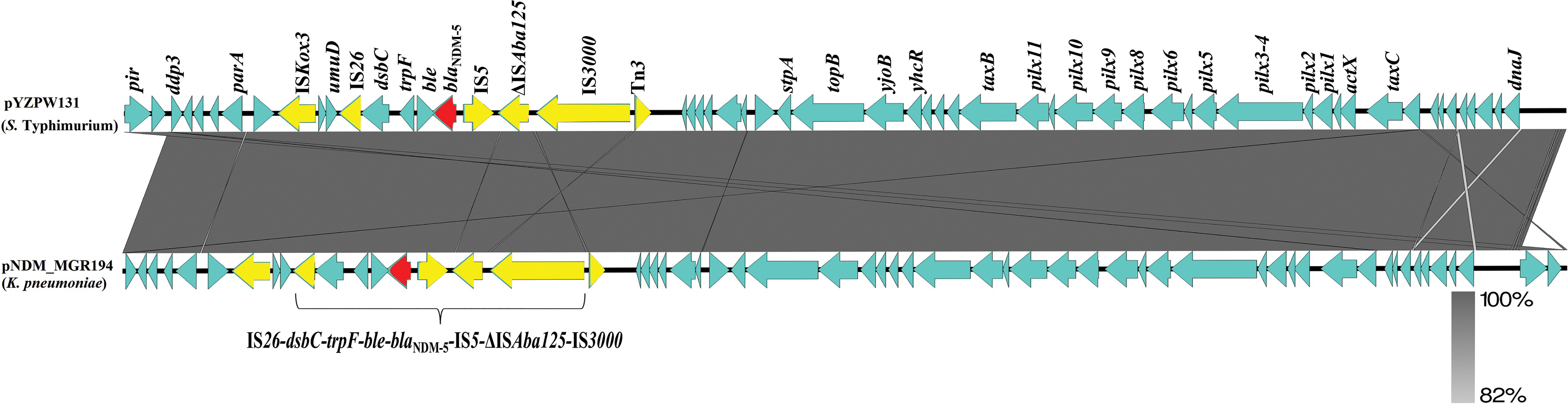
Linear genetic structure comparison of plasmid pYZPW131 (Salmonella Typhimurium, GenBank accession number MK848866) and pNDM_MGR194 (Klebsiella pneumoniae, GenBank accession number KF220657). The red arrows represent blaNDM-5. The yellow arrows represent the transposon and IS elements. The depth of shadowing is indicative of the BLASTn matching degree. IS, insertion sequences. Color images are available online.
To investigate the horizontal transfer ability of pYZPW131, plasmid conjugation experiment was performed between donor Salmonella Typhimurium W131 and recipient sodium azide-resistant Escherichia coli J53, and transconjugants were selected on MacConey Agar plate containing 1 mg/L meropenem and 100 mg/L sodium azide. The IncX3 plasmid pYZPW131 can be successfully transferred to Escherichia coli J53 with a frequency of 4.3 × 10⁻⁸ transconjugants/donors based on identification of the blaNDM-5 and stn gene by PCR analysis (Fig. 2; Table 2). 13 The PCR amplification of the blaNDM-5 gene was performed in a 25 μL solution containing 9.5 μL 2 × Taq PCR Master Mix (Vazyme™), 1 μL concentrations of each primers, 1 μL DNA template, and 12.5 μL soft water. The PCR reaction conditions were performed as predenaturation at 94°C for 5 minutes, followed by 30 cycles of 94°C for 30 seconds, 54°C for 1 minute, and 72°C for 30 seconds, with a final extension at 72°C for 5 minutes. The antimicrobial susceptibility of the donor W131, recipient J53AziR, and transconjugants J53-pYZPW131 was further determined by using microbroth dilution method (Table 1) with Escherichia coli ATCC25922 as quality control strain. These results indicated that the plasmid pYZPW131 carrying the blaNDM-5 gene was a self-transmissible plasmid, which can confer the transconjugants with resistance to carbapenems.
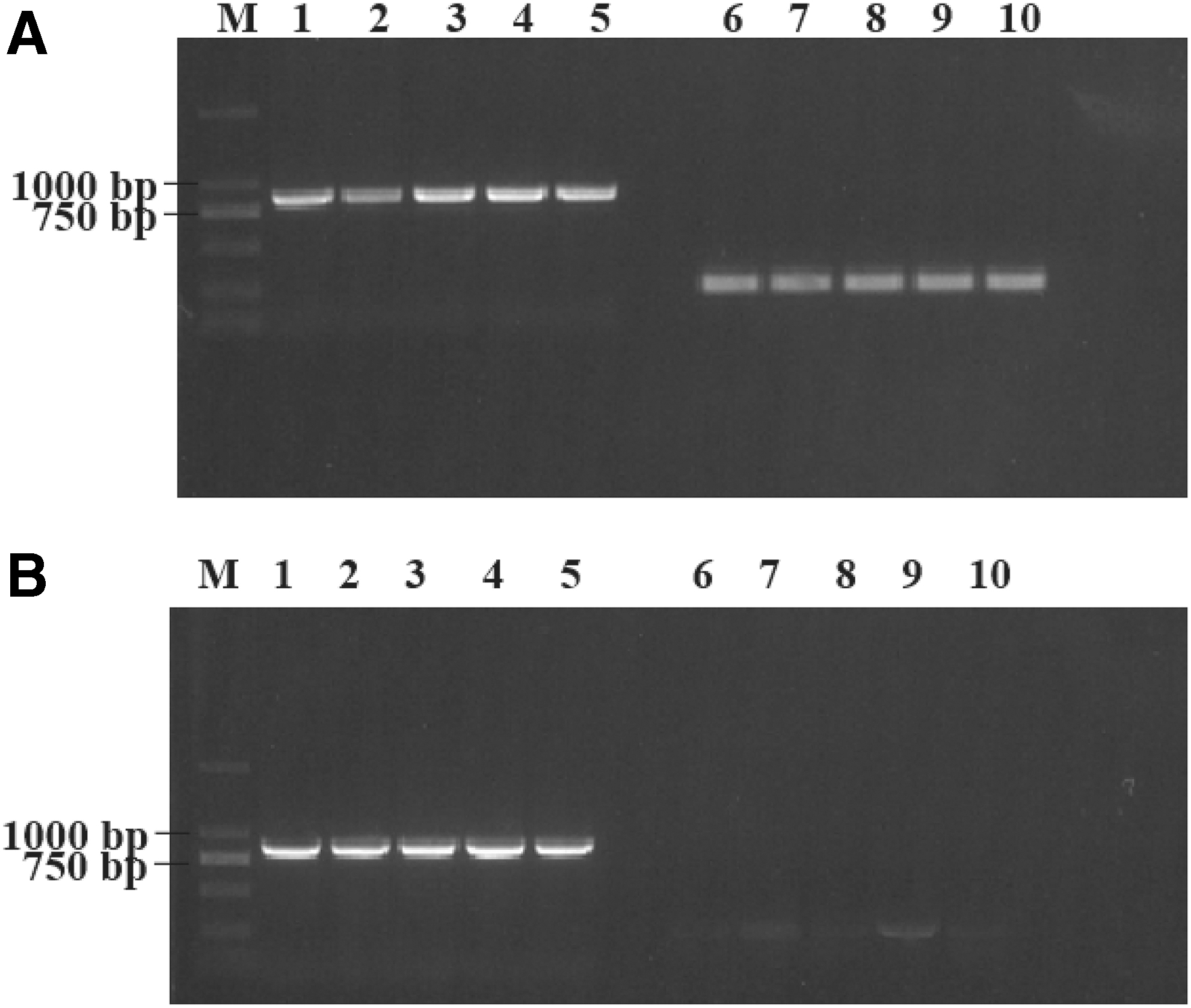
Identification of W131 strains and transconjugants by PCR.
PCR Primers Used to Identify stn Gene and blaNDM-5 Gene
F, forward primer; R, reverse primer; Tm, melting temperature.
In our study, an NDM-5-producing Salmonella Typhimurium ST34 strain has been observed in the retail pork in an open market in China for the first time. The occurrence of this strain in pork indicates that Salmonella Typhimurium producing NDM-5 has a potential to be transmitted by handling or consuming pork. Since China has the world's largest pork consumption, the occurrence of Salmonella Typhimurium producing NDM-5 in pork is of great concern. Further studies will be needed to elucidate the extent to which the transmission routine of Salmonella Typhimurium producing NDM-5 in the pork supply chain.
Footnotes
Disclosure Statement
No competing financial interests exist.
Funding Information
This study was supported by the National Key Research and Development Program of China (2017YFD0500102), the National Natural Science Foundation of China (31730094), the Qinglan Project, Six Talent Peaks Project, and Priority Academic Program Development of Jiangsu Higher Education Institutions (PAPD).