




Abstract
Both mcr-1 phosphoethanolamine transferase enzymes and extended-spectrum β-lactamases (ESBLs) are the main plasmid-mediated mechanisms of resistance to colistin and third-generation cephalosporins, respectively, and currently considered a major concern to humans and food animals. Prevalence of mcr-1 gene in Escherichia coli from dairy cattle has rarely been reported. Our objective was to determine prevalence and characteristics of mcr-1 carrying E. coli isolated from clinical mastitis cases in large dairy farms (>500 cows) in 16 provinces of China. A total of 249 E. coli was isolated from 2,038 mastitic milk samples. Among these isolates, 2.0% (n = 5) and 19.7% (n = 49) were colistin resistant mcr-1-positive and ESBL-producing isolates, respectively. All mcr-1-positive isolates that produced ESBLs also carried the blaCTX-M-15 gene and belonged to phylogroup-A. Most mcr-1 and blaCTX-M-15 genes were located on conjugative plasmids (IncP and IncF, respectively) that were successfully transferred to transconjugants in conjugation experiments. All mcr-1-positive E. coli isolates were multidrug resistant, exhibiting resistance to common antimicrobials. Multilocus sequence typing of these mcr-1-carrying E. coli isolates revealed four sequence types, reflecting substantial diversity. Multilocus sequence analysis detected evolutionary connection of mcr-1 carrying isolates with our recently reported ESBL-producing E. coli isolates, raising concerns regarding fast dissemination between bacteria. To our knowledge, this was the first nation-wide report describing isolates of E. coli from mastitic milk samples collected on large dairy farms in China, carrying mcr-1 and blaCTX-M-15 genes on conjugative plasmids. We concluded that dairy cattle are a potential source of mcr-1-carrying and ESBL-producing E. coli.
Introduction
Antimicrobial resistance is a serious global threat to both human and animal health. 1 Increasing prevalence of pathogenic multidrug resistant (MDR) Gram-negative bacteria, particularly extended-spectrum β-lactamase (ESBL)- and carbapenemase-producing Escherichia coli, has narrowed therapeutic choices and especially redeemed interest in older, relatively more toxic compounds, for example, colistin. 2 In that regard, colistin (polymyxin E) has been considered one of the last-resort drugs to treat infections caused by MDR ESBL- and carbapenemase-producing Gram-negative bacteria. 3 However, recent emergence of mcr-1, a transferable plasmid-mediated colistin resistance gene encoding for phosphoethanolamine transferase, has threatened efficacy colistin. The mcr-1 gene was first reported in China in Enterobacteriaceae in food animals and in humans, 4 with global reports of isolation from food animals, environment, and humans.5–8
Resistance to colistin in Gram-negative Enterobacteriaceae was acquired by a variety of means, mainly chromosomal mutation, which spread slowly and vertically. 9 Nevertheless, the recently described mechanism based on a plasmid-mediated gene is quite worrisome, due to its potential for fast dissemination. 10 The worst scenario is coexistence of mcr-1 gene with either ESBL or carbapenemase genes, 11 which could lead to serious pandrug resistance infections without efficacious therapeutic options. 12 Gram-negative bacteria, particularly Enterobacteriaceae, could serve as reservoirs for these resistance genes carried on mobile genetic elements such as plasmids and integrons, with robust potential for dissemination. 4 Due to these threatening situations, there are various initiatives to combat challenges of MDR pathogenic bacteria, 13 including a recent ban on adding colistin to animal feed in China. 14
Injudicious use of antimicrobial agents in agriculture is recognized as one of the important causes of antimicrobial resistance selection in bacteria. Polymyxins have been routinely fed to poultry and swine for prophylaxis and metaphylaxis, 15 and colistin has been used in agriculture for almost 70 years. 16 Long-standing use of colistin may be involved in spreading the mcr-1 gene in E. coli.4,17 Colistin resistance and mcr-1-encoding gene in E. coli are mostly reported from poultry and pigs in China.4,18,19 E. coli is the most prevalent bovine mastitis pathogen in China, 20 with emergence of several serious MDR strains of E. coli. 21 With increasing consumption of raw milk and cheese globally, dairy consumers and farm staff have a higher likelihood of exposure to MDR pathogens, which may also be transferred through waste milk to calves, thus further spreading antibiotic resistance genes in the farm environment.22,23 Active and large-scale surveillance efforts are imperative to monitor prevalence of mcr-1 and ESBL encoding genes in E. coli from bovine mastitis.
Therefore, the current study was designed to determine prevalence and characteristics of mcr-1 and ESBL encoding genes in E. coli from mastitic milk in large dairy herds in a nationwide surveillance program during the past 2 years.
Materials and Methods
Statement of ethics
This study was conducted in accordance with standard ethical guidelines implemented at China Agricultural University (CAU) and was approved by the Departmental Ethics Committee of College of Veterinary Medicine, CAU, Beijing, China. Standard protocols recommended by the National Mastitis Council 24 were followed to collect milk samples from the dairy cows, with appropriate consultation of farm owners or administration.
Isolation and identification of E. coli
The current retrospective cohort study was designed to detect prevalence of mcr-1-positive isolates among E. coli (n = 249) samples from mastitic cows collected from January 2015 to April 2017 as a part of our epidemiological and clinical study of ESBL-producing E. coli.21,25 In total, 2,038 mastitic milk samples (1 composite milk sample per cow) were collected from 73 dairy herds across China (Table 1). Milk samples were collected aseptically into sterile tubes (50 mL) and transported on ice to our laboratory. Milk samples (0.01 mL) were primarily streaked on MacConkey Agar (Difco™) and incubated at 37°C for 24 hours. Pink colonies were selected and subcultured on eosin methylene blue (EMB) agar and presumptively identified as E. coli. Further confirmation was done with biochemical methods, using an API-20E Kit (bioMérieux, Marcy I'Etoile, France) and PCR assay, as described. 20
Prevalence of Colistin Resistance MCR-1 and Extended-Spectrum β-Lactamase–Producing Escherichia Coli from Mastitic Bovine Milk in 16 Provinces of China
These samples were collected from mastitic cattle belonging to other large dairy herds in China, but herd location was not recorded.
ESBL, extended-spectrum β-lactamase.
Antimicrobial resistant phenotypes
All recovered E. coli isolates (n = 249) from mastitic cows were also processed to evaluate colistin resistance using MacConkey Agar plates supplemented with colistin (2 mg/L), as described, 4 and ESBL production using a microdilution technique in commercial standardized microplates (EUVSEC2; TREK), according to manufacturer's instructions. MDR is defined as nonsusceptible to at least one agent in three or more antimicrobial classes. 26 Minimum inhibitory concentrations (MICs) of colistin and other common antimicrobials, including ampicillin, amikacin, chloramphenicol, ciprofloxacin, cefotaxime, ceftriaxone, cefoxitin, kanamycin, tetracycline, and trimethoprim (Sigma-Aldrich), were also determined using broth microdilution method for all the mcr-1-positive E. coli isolates, according to Clinical and Laboratory Standards Institute guidelines. 27 Disc diffusion was also used to determine antimicrobial susceptibility of the 5 mcr-1 isolates against a panel of 19 antimicrobial agents, according to the guidelines of Clinical and Laboratory Standards Institute. 27 The panel of antimicrobials included: ampicillin (10 μg), amoxicillin/clavulanic acid (20/10 μg), cephalexin (30 μg), cefaclor (30 μg), cefoxitin (30 μg), cefotaxime (30 μg), ceftazidime (30 μg), cefepime (30 μg), aztreonam (30 μg), meropenem (10 μg), tetracycline (30 μg), amikacin (30 μg), kanamycin (30 μg), gentamicin (10 μg), ciprofloxacin (5 μg), norfloxacin (10 μg), chloramphenicol (30 μg), nalidixic acid (30 μg), and trimethoprim/sulfamethoxazole (1.25/23.75 μg), all purchased from Becton Dickinson (Sparks, MD). Reference E. coli strain ATCC25922 was used for quality control.
Detection of mcr genes and β-lactamase-encoding genes
All isolated 249 E. coli were prescreened for the presence of all known mcr genes (mcr-1 to mcr-9) by conventional PCR, using published primer sequences.28,29 The mcr amplicons were purified and sequenced bidirectionally with an ABI 3730 sequencer (Applied Biosystems, Foster City, CA). Retrieved sequences were aligned with BLASTN software and compared to those in GenBank. The mcr positive E. coli isolates were tested for presence of various ESBL-encoding genes (blaCTX-M, blaTEM, blaSHV, blaOXA, blaCMY, blaMOX, blaFOX, blaLAT, blaACT, blaMIR, blaDHA, blaMOR, and blaACC), as described. 21
Integron and plasmid typing
To determine the genetic environment of mcr-1-positive E. coli, these isolates were screened for presence of integrons (class 1–3) using a PCR scheme, as described. 30 For each isolate, the variable region between the 5′ CS (conserved segment) and 3′ CS was PCR amplified. 31 In addition, PCR-based plasmid replicon typing (PBRT) and phylogenetic typing were both done as described.32,33
Plasmid analysis and conjugation experiment
Two approaches, S1 nuclease-pulsed-field gel electrophoresis (S1-PFGE) and Southern blotting hybridization with both mcr-1 and blaCTX-M-15 probes, were performed to determine plasmid location. 28 Salmonella Braenderup H9812 digested with XbaI was used as the molecular weight marker. Transferability of mcr-1, ESBL-encoding genes, and plasmid(s) from the mcr-1-positive E. coli (donor strains) into E. coli J53 (recipient strains) was tested by a filter-mating method. Transconjugants were recovered on MacConkey agar plates supplemented with colistin (2 mg/L) and sodium azide (150 mg/L). Antimicrobial resistance profiles, mcr-1 and ESBL encoding genes, and PBRT in transconjugants were determined, as described above.
Multilocus sequence typing and analysis
For insights into molecular epidemiology of mcr-1-carrying E. coli isolates, multilocus sequence typing (MLST) of isolates was assessed as described. 34 Maximum likelihood tree was developed using MEGA 7 by choosing General Time Reversible model, Gamma distributed and Invariant sites (G+I). Resampling procedures were followed for statistical validation, with 1,000 bootstrap replication values implemented in MEGA 7. 35
The eBURST algorithm was used to determine clonal complexes of sequence type (ST), defined as the STs sharing five loci and by choosing double locus variants, as described. 36 The geoBURST tool was used to determine the relationship and population structure of the STs under study and STs available in the global MLST database (https://pubmlst.org/bigsdb). 37
Results
Co-occurrence of mcr-1 and ESBL encoding genes in E. coli
A total of 249 (20%) E. coli isolates were recovered from 2,038 milk samples from cows with clinical mastitis belonging to 73 large (>500 cows) dairy herds located in 16 provinces of China over the last 2 years (Fig. 1). Details of samples collected from various regions are shown (Table 1). A total of five E. coli isolates (2%) were identified to carry colistin resistance mcr-1 gene using PCR assay (Fig. 2). The sequence of a candidate mcr-1 gene was deposited in the NCBI database (Accession No. MF134664). Strikingly, all these mcr-1-positive E. coli were also ESBL producers, as determined by phenotypic and genotypic assays. PCR-based ESBL genotyping indicated that all these isolates carried blaCTX-M-15, thereby conferring resistance to β-lactam drugs. Only the five mcr-1 positive isolates were resistant to colistin (MIC ranged from 8 to 16 mg/L). Moreover, 49 (20%) E. coli isolates from dairy cows with mastitis were confirmed as ESBL producers (Table 1).
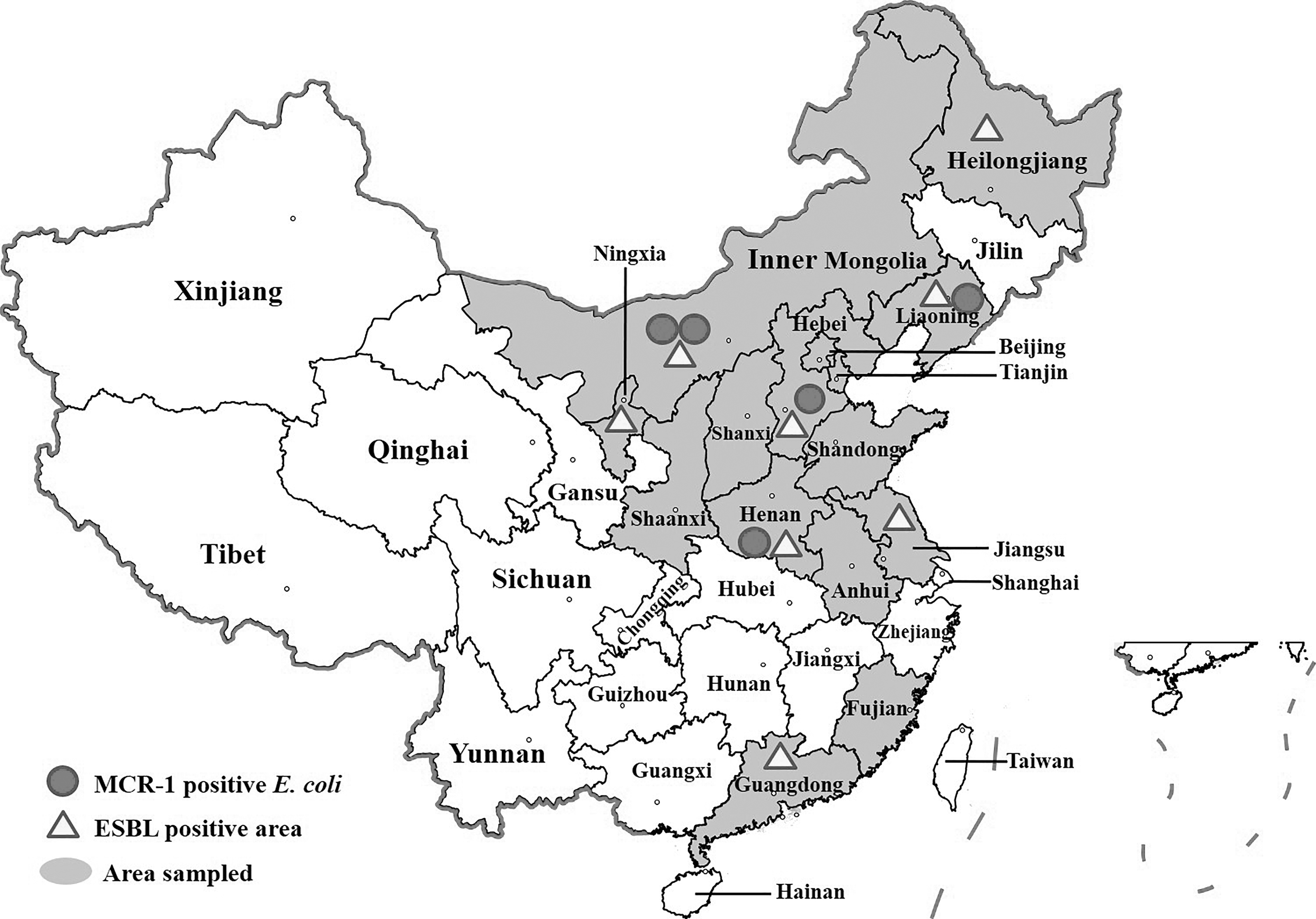
Location of areas positive for colistin resistance mcr-1- and ESBL-producing Escherichia coli. Lighter gray shaded areas represent provinces/regions sampled in the current study. ESBL, extended-spectrum β-lactamase.

Amplified products of plasmid-mediated colistin resistance mcr-1 and ESBL genes.
Antimicrobial susceptibility profile
Based on antimicrobial susceptibility of the five mcr-1-positive isolates, all had MDR phenotypes (Table 2) that conferred resistance to β-lactams (ampicillin, amoxicillin/clavulanic acid), cephalosporins (cefalexin, cefazolin, cefotaxime, ceftazidime, cefepime), monobactams (aztreonam), fluoroquinolone (ciprofloxacin, levofloxacin), sulfonamide (trimethoprim/sulfamethoxazole), tetracyclines (tetracycline), aminoglycosides (gentamycin, kanamycin, amikacin), and phenicol (chloramphenicol). However, they were susceptible to cephamycins (cefoxitin) and carbapenem (meropenem) antimicrobials. Furthermore, all these mcr-1-positive isolates also had relatively high MIC values against most common antimicrobials (Table 3).
Characterization of Colistin Resistance MCR-1 and Extended-Spectrum β-Lactamase–Producing Escherichia Coli and Plasmids
Plasmid carrying blaCTX-M-15 are shown in bold italic text.
Plasmid carrying mcr-1 are shown in bold roman text.
New type.
A, ampicillin; AMC, amoxicillin/clavulanic acid; AN, amikacin; AZT, aztreonam; C, chloramphenicol; CAZ, ceftazidime; CF, cefaclor; CIP, ciprofloxacin; CTX, cefotaxime; CX, cephalexin; FEP, cefepime; G, gentamicin; K, kanamycin; MLST, multilocus sequence typing; NA, nalidixic acid; NOR, norfloxacin; PBRT, PCR-based plasmid replicon typing; STX, trimethoprim/sulfamethoxazole; TE, tetracycline.
Antimicrobial Susceptibility of Colistin Resistance MCR-1 and Extended-Spectrum β-Lactamase–Producing Escherichia Coli as Determined by Broth Microdilution
CLSI, 2015.
A, ampicillin; AN, amikacin; COL, colistin; CRO, ceftriaxone; G, gentamicin; MIC, minimum inhibitory concentration; TRI, trimethoprim.
Characterization of integrons and variable regions
Presence of integron type and investigation of the variable region within integrons were done. The integron analysis showed that all the isolates harbored class 1 integrons (Fig. 3). Further characterization of the integrons revealed that they were complete clinical class 1 integrons. This contained a 5′ CS (conserved segment), followed by a variable cassette region (VCR) harboring gene cassettes (GC) and 3′ CS. The 5′ CS consisted of integrase gene (Int1) with promoter (P Int1 ), recombination site (attI1), and cassette promoter (Pc). The VCR contained GC encoding for dihydrofolate reductase dfrA17 and aminoglycoside adenyltransferase aadA5 (Fig. 3A), and dfrA5 and aadA5 (Fig. 3B). The 3′ CS contained qacEΔ1 and sul1 genes, encoding for quaternary ammonium compound and sulfonamide resistance, respectively. However, class 2 and 3 integrons were not detected in any mcr-1-positive E. coli isolated in the current study.
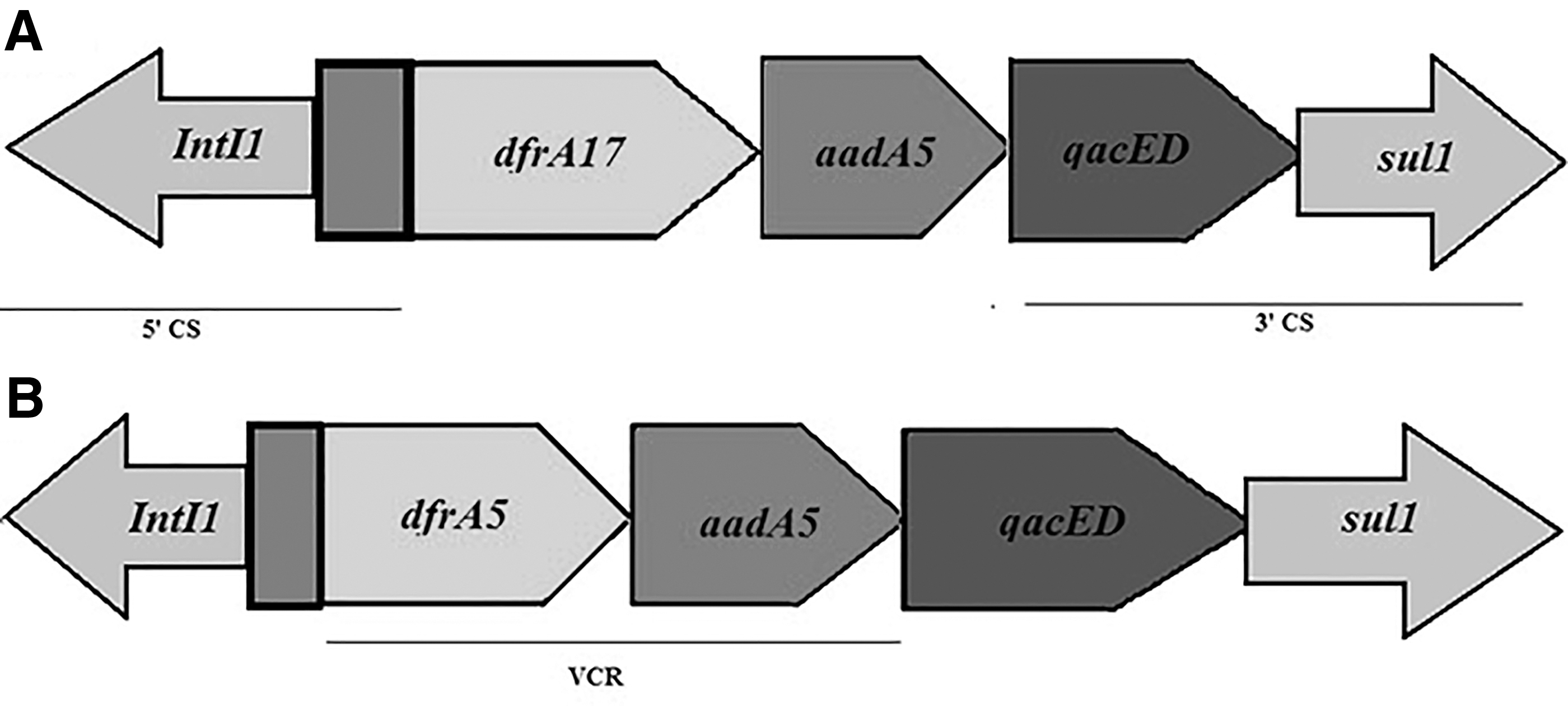
Schematic representations of class 1 integrons found in mcr-1-positive Escherichia coli isolated from bovine mastitis.
Plasmid characterization and resistance transfer experiments
Based on S1-PFGE and Southern blotting (data not shown), mcr-1 and blaCTX-M-15 genes were located on chromosomes in one isolate (24-Im) and on plasmids in the remaining four isolates (2-L, 24-Hn, 8-Hb, 6-Im). The size of mcr-1 genes carrying plasmids ranged from 50 to 62 kb, whereas that of blaCTX-M-15 genes was 35 to 225 kb. blaCTX-M-15 encoding genes were not located in the same plasmid that carried the mcr-1 gene. Based on PBRT, IncF and IncP were the major plasmid type in the mcr-1-positive isolates, carrying blaCTX-M-15 and mcr-1, respectively. In addition, phylogenetic grouping indicated that these five isolates all belonged to phylogroup-A.
To demonstrate transferability of mcr-1 gene along with the conjugative plasmid, transconjugants were PCR amplified. As a consequence, mcr-1 and blaCTX-M-15 genes were amplified in all the transconjugants except in 1 (i.e., Trans-24IM), suggesting that mcr-1 and blaCTX-M-15 genes were located on transferable plasmids and successfully transferred to transconjugants, except for 24-IM. In addition, the four transconjugants had similar antimicrobial profiles as parental clinical isolates.
MLST and analysis
Only two isolates 2L2 and 8Hb belonged to ST1290; these isolates were recovered from mastitic cows in Liaoning and Hebei provinces. The remaining three isolates could not be assigned to any ST due to allelic mismatches with the available ST in MLST databases (Table 4). Two of the three isolates that were not assigned with any ST were collected from the same dairy herd of Inner Mongolia, whereas the final isolate was from Henan province. Multilocus sequence analysis (MLSA), based on the analysis of allelic nucleotide sequences utilized in MLST, on five mcr-1 carrying isolates, indicated two main lineages, with a big lineage composed of four STs and a small lineage composed of only a single ST (ST 6-Im). To elucidate relationship of ESBL-carrying isolates with those harboring mcr-1 genes, MLSA was done by constructing maximum likelihood tree utilizing concatenated sequences of all seven alleles used for MLST analysis. Our MLSA revealed two main lineages, a big lineage composed of most isolates and a small tight lineage consisted of three isolates (Fig. 4). Interestingly, mcr-1 carrying isolates were all clustered tightly with each other and with isolates primarily from Inner Mongolia. Isolate 6-Im was placed separately from all other isolates (Fig. 5).

Molecular phylogenetic analysis of mcr-1-carrying Escherichia coli isolates together with ESBL-producing E. coli isolates collected from cases of bovine mastitis. The evolutionary history was inferred using the Maximum Likelihood method based on the General Time Reversible model. The tree with the highest log likelihood (−8234.8337) is shown. Molecular phylogenetic analysis indicated two main lineages, a big lineage composed of most isolates and a small lineage composed of three isolates. Isolates under study carrying mcr-1 (encircled) genes were tightly clustered with each other and with isolates carrying ESBL genes. Scale bar and bootstrap values are also shown.

Phylogenetic tree of colistin resistance mcr-1-carrying isolates with 1,000 bootstrap replications. Evolutionary history was inferred using the Maximum Likelihood method based on the General Time Reversible model. Three isolates were clustered tightly, indicating close evolutionary connection. Bootstrap values are indicated.
Multilocus Sequence Typing of Colistin Resistance MCR-1 and Extended-Spectrum β-Lactamase–Producing Escherichia Coli Isolated from Mastitic Milk Samples
Arbitrary no.
Not deposited.
ST, sequence type.
Analysis with eBURST algorithm indicated that isolates under study were divided into one BURST group (based on five identical loci for group definition) comprising four isolates (ST1290, 10011, and 10013) and a singleton ST10010 (data not shown). Results of the population snap short analysis with geoBURST indicated that only one ST (ST1290) was linked to another ST976, whereas the remaining four STs were unlinked to other STs. Overall, MLST analysis indicated high diversity among these isolates (Fig. 6).
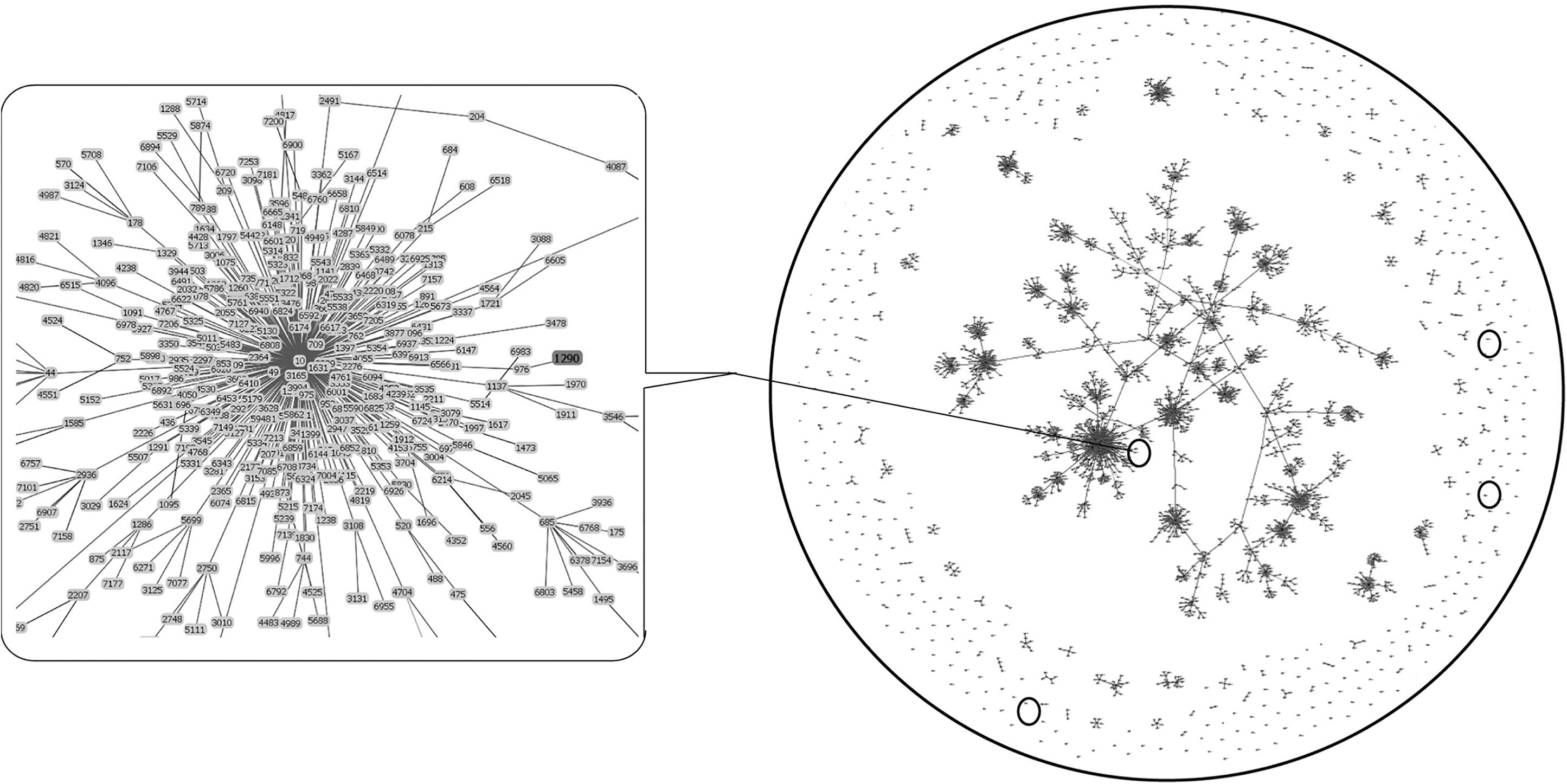
MLST and population structure analysis of five mcr-1-positive Escherichia coli isolates. Population snapshot of all E. coli isolates available to-date in the PubMLST database against Achtman scheme, including isolates of this study carrying mcr-1 gene. Individual dot represents a single ST. CCs were defined as groups of isolates linking STs that are DLV. All five STs were found dispersed and unlinked (encircled); however, ST1290 (highlighted) was linked to a single ST as shown (encircled). CC, clonal complex; DLV, double locus variants; MLST, multilocus sequence typing; ST, sequence type.
Discussion
Increasing prevalence of plasmid-mediated colistin resistance in E. coli from food-producing animals and humans is a serious global concern. In this study, we determined co-occurrence of mcr-1 and blaCTX-M-15 genes in E. coli isolates recovered from mastitic milk in large dairy farms across China from 2015 to 2017; to our knowledge, this has not been reported anywhere in Asia.
In Portugal, between 2010 and 2015, a high number of mcr-1 positive E. coli isolates (45.7%) being ESBL from food-producing animals, meat, meat products, and animal feed was observed. This finding highlights the spread of mcr-1 genes within a wide-ranging sample of food-producing animals and meat, in Portugal. 38 In addition, the prevalence of mcr-1 in colistin resistant E. coli isolates from cattle fecal swabs was 71.43% (30/42). 39 Therefore, interventions and alternative options are necessary to minimize dissemination of mcr-1 between food-producing animals and human. However, there are a limited number of reports on the low prevalence of mcr-1 from feces or mastitic milk from cattle or dairy cows in Europe and China.40,41 The isolation rate (2.0%) of mcr-1-positive isolates in this study was similar to recently reported prevalence of mcr-1-positive E. coli (1.0%) from feces of dairy cattle in China.17,41 In addition, it was reported that one E. coli isolate harboring mcr-1 gene from milk samples was recovered on three dairy farms in Jiangsu province. 42 This relatively low prevalence of mcr-1 in cattle compared to reports in swine and poultry was attributed to the rare use of colistin for growth promotion, prophylaxis, or metaphylaxis in dairy cattle. 43
All mcr-1-carrying isolates reported in our study were MDR phenotypes, with resistance to common antimicrobial agents, including β-lactams, fluoroquinolones, aminoglycosides, tetracyclines, and sulfonamides. For most of these compounds, high MIC values were needed to inhibit visible growth of mcr-1 isolates. The MDR phenotypes of mcr-1-carrying E. coli have previously been reported due to co-occurrence of mcr-1 gene along with other resistance conferring genes such as blaCTX-M, blaKPC, and blaNDM.4,5,18 The mcr-1-positive E. coli isolated in the current study was not confirmed to carry any carbapenemase encoding genes, for example, blaKPC-2 and blaNDM, in accordance with a previous study. 7 In our study, blaCTX-M-15 was detected in all five mcr-1-positive E. coli, more likely the reason to confer resistance against most cephalosporin groups. Recently CTX-M-15 type of ESBL-producing E. coli has been increasingly reported in bovine mastitis isolates from Asia25,44 and Europe.45,46 Of further concern was copresence of these elements in E. coli isolates belonging to commensal phylogroup 47 and existence of gene on a transferable conjugative plasmid, with potential for fast dissemination across species. 48
We observed that all isolates except 24-Im presented IncP and IncF types (IncFIA and IncFIB) as the mcr-1 and blaCTX-M carrying plasmids, which were successfully transferred in transconjugants. In contrast, IncI2 was the major incompatibility type of mcr-carrying plasmids, followed by IncX4, IncHI1B, IncHI2, IncFII, and IncFIB in mcr-1-positive E. coli isolated from various countries, including China. 49 Isolates in our recent study 21 carried the blaCTX-M gene; this gene has been associated with ISCR1 elements that could be responsible for mobilizing and transposing genes encoding ESBLs. Although genetic background of mcr-1-positive isolates was quite complex, it is crucial to understand how resistance features are spread.
Based on MLST, two of the mcr-1-positive E. coli from Liaoning and Hebei provinces belonged to ST1290, whereas the three E. coli isolates were novel STs. The ST1290 has been reported in a CTX-M-8 type of ESBL-producing E. coli isolated from a human stool sample in Germany. 50 The STs determined in our study were distinct from previously reported STs (ST10, ST40, ST13, et al.) of mcr-1-positive E. coli strains from food-producing animals and human patients in China,51,52 from ST457 and ST10 isolated from cattle in Japan 6 and from ST10, ST58, ST167 from cattle in Europe. 40 On the five mcr-1-positive E. coli, MLSA revealed two major lineages, namely a big lineage with four STs and a small lineage with a single ST (ST 6-Im). We inferred that there was more likely an evolutionary connection between strains, raising concerns of fast dissemination between similar species.
Mandatory heat treatment of milk in China, either by pasteurization or ultrahigh temperature, reliably inactivates E. coli in milk. However, there is increasing consumption of raw milk in China, as people are led to believe that it is fresher and more nutritious; on a global basis, this practice has increased exposure of dairy consumers and farm staff to MDR pathogens and caused diseases such as diarrhea.22,53 Furthermore, these pathogens may also be transferred to calves by feeding waste milk, thereby contaminating the farm environment.
Overall, co-occurrence of mcr-1 and blaCTX-M genes was unexpected and alarming. Although colistin is not used routinely in the dairy industry in China, perhaps mcr-1 genes were acquired from the environment, as colistin was massively used as growth promoter (banned in 2016) and prophylaxis in poultry and swine production in China. The present study provided indications of an advantage of rare usage of colistin in dairy cattle and strongly suggested that urgent interventions are needed to minimize emergence and spread of resistance elements against colistin in food animals. A limitation of the current study could be the recovery of small number of isolates, which could not be used to establish epidemiological relationships between isolates of current study and those previously published. There is great interest to determine the genetic background of the three isolates that could not be typed with MLST. For further research, whole-genome sequencing will be adopted to characterize the resistome and virulence of these isolates.
Conclusions
In conclusion, the present study revealed a high prevalence of ESBL-producing E. coli isolates recovered from dairy mastitic milk in large dairy farms across China. The association of ESBL-producing E. coli and colistin resistance was of particular concern, although a low prevalence of mcr-1 and ESBL-producing E. coli was detected, carrying mcr-1 and blaCTX-M-15 genes on conjugative plasmids. Based on these findings, dairy cattle represent a potential source of mcr-1-carrying and ESBL-producing E. coli.
Footnotes
Disclosure Statement
No competing financial interests exist.
Funding Information
This research was supported by the National Key R&D Program (No. 2016YFD0501203), the National Natural Science Foundation of China (Nos. 31572587, 31772813, 31550110200, and 31850410474), and the High-end Foreign Experts Recruitment Program (No. GDT20171100013).