




Abstract
Background:
Despite the existence of discrete and varied studies regarding extended-spectrum β-lactamase-producing Escherichia coli (ESBL-EC) in Iran, a comprehensive analysis on the prevalence of ESBL-EC has not yet been carried out. The current study analyzed published data regarding ESBL-EC in different regions of Iran to gain insight into this significant subject.
Methods:
A meta-analysis was performed using Comprehensive Meta-Analysis Software (version 2.2; Biostat) to determine the prevalence of ESBL-EC in Iran. A web-based search was conducted in electronic databases, including PubMed, Scopus, and Web of Sciences. The eligibility of articles published between 2008 and 2018 was assessed, and relevant data were extracted for statistical analysis. A random-effects model was used based on the heterogeneity test. Publication bias was determined using Begg's rank correlation and Egger's weighted regression methods.
Results:
Among 31,135 studies examined, 61 met inclusion criteria and were included for review. Iran's overall pooled proportion of ESBL-EC was 43.2% (confidence interval [95% CI] 39.2–47.3), and the overall heterogeneity (I2) between studies was significantly high (93.5%, p = 0.00). The most prevalent of ESBLs in E. coli was CTX-M and TEM, with prevalence of 31.2% (95% CI 25.4–37.6), 27.6% (95% CI 22.7–33.2), respectively.
Conclusion:
The available studies show a high rate of ESBL-EC in Iran. This result highlights a need for appropriate and rapid methods for estimating ESBL infection, which can help our understanding of the actual epidemiology of ESBL and provide protocols for the prevention and control of infection.
Introduction
Extended-spectrum β
The presence of these resistance genes on mobile genetic elements such as plasmids results in their dissemination within and between bacterial species. 7 Many ESBL-producing strains of E. coli and Klebsiella pneumoniae are multidrug resistant and the emergence of these organisms is now a serious concern for the development of therapies against bacterial infection.8,9 In a recent study, some of the new drugs active against multidrug-resistant bacteria, including ESBL-producing ones, were reported. Among them, ceftazidime–avibactam and ceftolozane–tazobactam have already received U.S. Food and Drug Administration (FDA) approval. 10 The conjugative transfer of multidrug resistance-mediating plasmids are of major concern and represents the urgent need of molecular analysis for pathogens harboring them. 4 Infections caused by extended-spectrum β-lactamase-producing E. coli (ESBL-EC) are increasing globally, in both hospitals 11 and community environments, 12 and these multidrug-resistant organisms have higher mortality rates and medical costs than those due to non-β-lactamase-producing strains. 13 Thus, the surveillance of these ESBL-EC is remarkable for clinical care, and it is important to take into consideration the needs of careful choosing of antibiotic therapy to control this issue in many countries. Phenotypic approaches to determine the prevalence of ESBL-EC isolated from various clinical samples as well as detection of genes conferring resistance against many life-saving antibiotics have shown the increased incidence of infections due to the presence of these E. coli strains and may explain a probable cause of antibiotic treatment failure in Iran and other countries.14–16 However, to date, no data on this subject from a comprehensive study in Iran have become available.
The present systematic review and meta-analysis was performed based on the Preferred Reporting Items for Systematic Reviews and Meta-Analyses (PRISMA) statement 17 to determine the prevalence of ESBL-EC with different gene variants in Iran (Supplementary Table S1).
Methods
Search strategy and selection criteria
For this systematic review and meta-analysis, a literature search was performed to identify articles reporting infections caused by ESBL-EC strains among Iranian patients. Two reviewers searched three major electronic databases (PubMed, Web of Science, and Scopus) from January 2008 to December 2018. The search terms included “E. coli” or “E. coli,” “extended-spectrum β-lactamases” or “ESBLs” together with “Iran.” The search was limited to published articles containing the desired keywords in the English language. Identified publications were then checked individually to eliminate any duplicates or irrelevant articles. To be eligible for inclusion, articles had to report both phenotypically detected ESBL-EC and the presence of at least one ESBL-coding gene by the PCR method among these isolates. Comments, editorials, reviews, letters, case reports, congress abstracts, meta-analyses, systematic reviews, and overlapping studies were not examined. Nonhuman studies and articles in which ESBL production detection was only restricted to either phenotypic or genotypic methods were also excluded.
Data extraction and definitions
The following details were extracted from all screened articles: first author's name; duration of study; year of publication; city in which the study was conducted; total number of isolates; and prevalence of phenotypically detected ESBL-EC and genes encoding ESBLs.
Quality assessment of studies
A quality assessment was performed independently by two authors using a checklist provided by the Joanna Briggs Institute (JBI). 17 Any disagreements were resolved through discussion with a third author. The checklist consisted of 10 questions to which the reviewers responded individually for each study. A “Yes” answer for each question received a point. Scores ranged from 0 to 10, and studies that attained >7 points were entered into the review.
Statistical analysis
Comprehensive Meta-Analysis v.2.2 (Biostat, Englewood, NJ) was used for the meta-analyses. Based on the heterogeneity between different studies, the random-effects model was used. Statistical heterogeneity among the included studies was assessed using Cochran's Q and the inconsistency I2 tests. In cases of significant heterogeneity (p < 0.1 or I2 >50%), the random-effects model was applied; otherwise, the fixed-effects model (p > 0.1 and I2 <50%) was used. Funnel plots, Begg's test, and Egger's test were used to detect publication bias, and p < 0.05 was regarded as statistically significant.
Results
Results of the critical appraisal (JBI checklist) of the included studies are presented in Supplementary Table S1. Sixty-one studies presented a low risk of bias (quality assessment score >7).
Electronic database searches yielded a total of 3,135 studies. After removal of duplicates, the titles and abstracts of 2,863 articles were screened, of which 123 were included in the full-text screening (Fig. 1). Sixty-one studies met the inclusion criteria and were included in the main meta-analysis (Table 1).18–78 The pooled prevalence of phenotypically detected ESBL-EC was 43.2% (confidence interval [95% CI] 39.2–47.3). The pooled prevalence rates of detected CTX-M, TEM, SHV, OXA-48, and VEB genes were 31.2% (95% CI 25.4–37.6), 27.6% (95% CI 22.7–33.2), 9.8% (95% CI 6.7–14), 8.3% (95% CI 4.1–15.9), and 2.3% (95% CI 1.2–4.4), respectively (Table 2). Heterogeneity between studies was determined by the random-effects model, and the results were as follows: I2 = 93.5, p = 0.00 for ESBL-EC; I2 = 96, p = 0.00 for CTX-M, I2 = 95, p = 0.00 for TEM, I2 = 95, p = 0.00 for SHV, I2 = 93, p = 0.00 for OXA-48, and I2 = 90, p = 0.00 for VEB (Table 2). As shown in Table 2, no publication bias was revealed for ESBL-EC (Begg's test, p = 0.4, Egger's test, p = 0.5), CTX-M (Begg's test, p = 0.5, Egger's test, p = 0.3), or TEM (Begg's test, p = 0.4, Egger's test, p = 0.4), but was observed for SHV (Begg's test, p = 0.004, Egger's test, p = 0.0009). For OXA-48, no publication bias was revealed by Begg's test (p = 0.5), but it was detected by Egger's test (p = 0.01). The prevalence rate of ESBL-EC as well as those of SHV, CTX-M, TEM, and VEB genes were determined in forest plots (Fig. 2). The publication bias among the evaluated articles was assessed using funnel plots (Fig. 3).
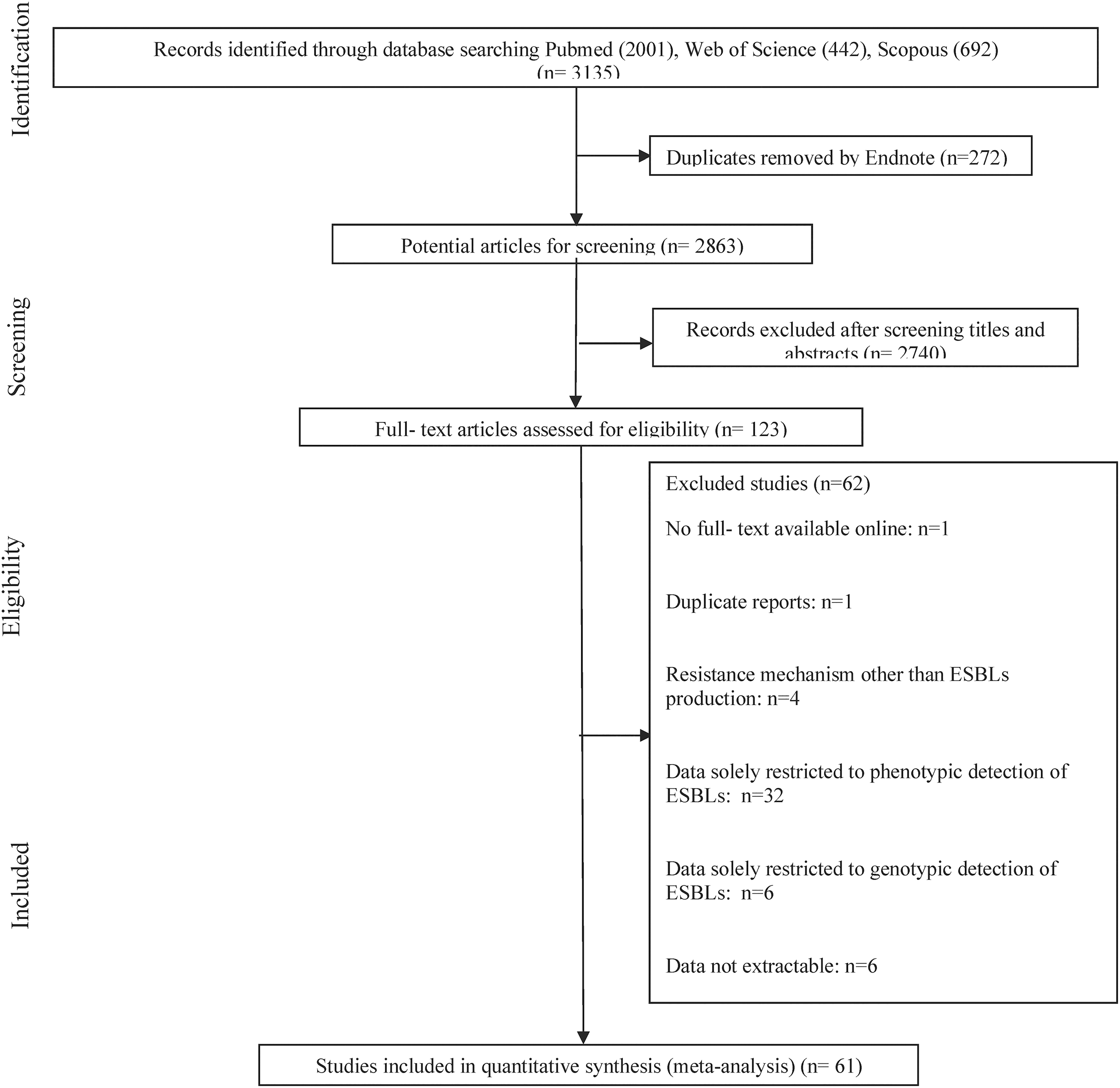
Summary of the literature search and study selection.

Forest plot of studies included in the meta-analysis in the present meta analysis: prevalence of
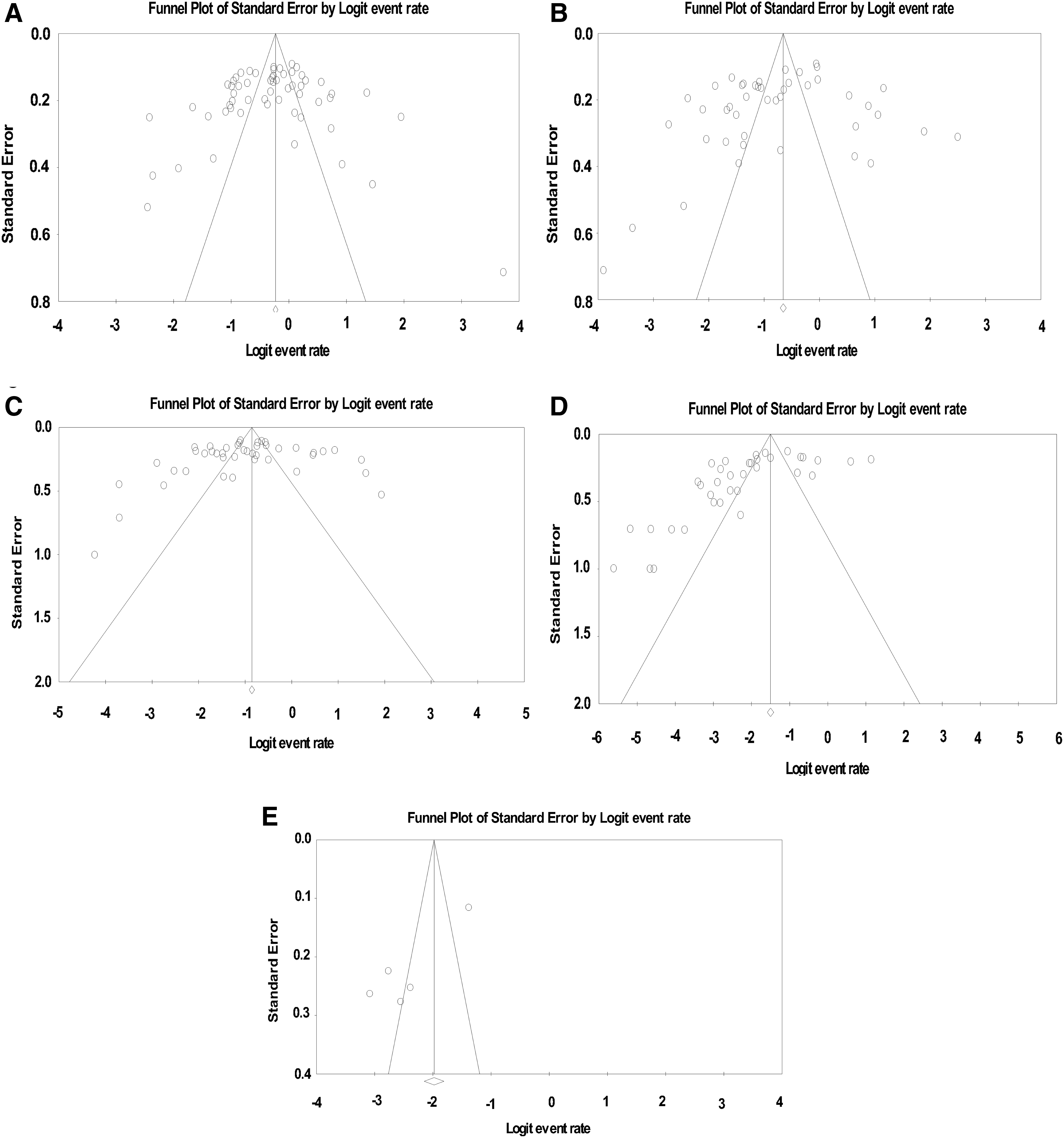
Funnel plot of publication bias for the included studies in the present meta analysis: prevalence of
Meta-Analysis of Extended-Spectrum β-Lactamase-Producing Escherichia coli and Genes Encoding Extended-Spectrum β-Lactamases
extended spectrum beta-lactamase.
CI, confidence interval.
Characteristics of Studies Included in the Meta-Analysis
DDST, Double-Disk Synergy Test; ESBL-EC, extended-spectrum β-lactamase-producing Escherichia coli.
Discussion
To the best of our knowledge, this is the first systematic review and meta-analysis addressing the prevalence of phenotypically detected ESBL-EC and ESBL genes among isolates recovered from patients in Iran. Based on this meta-analysis, a high rate of ESBL-EC was detected phenotypically (43.2%; 95% CI 39.2–47.3) in Iran. A lower prevalence of ESBL-EC was reported in other Middle Eastern countries, such as Egypt (36%) 79 and Saudi Arabia (33%). 80 However, the high prevalence of this phenotype in Iran is highlighted more when compared with developed countries such as Denmark (1.5%), 81 France (3.3%), 82 and Germany (8.0%). 83 The overall pooled proportion of ESBL-producing Enterobacteriaceae was estimated to be 42% in East Africa, which is close to the data reported in the current study. 84 In general, there are several possible factors, which may account for the variations observed between the present study and other reports. One of them is the difference between the sensitivity and specificity of phenotypic methods applied for ESBL detection in various studies. 84 The socioeconomic status of a society and availability of antibiotics which result in self-medication, consumption of counterfeit drugs, improper dosage, and nonadherence to antibiotic therapy84,85 may explain the higher prevalence of antibiotic resistance, particularly that of ESBL, in developing countries than in developed nations. Poor knowledge about antibiotic resistance as well as irrational use of antibiotics have contributed to the progressive loss of bacterial sensitivity to antibiotics and dissemination of resistant strains of bacteria, with substantial clinical and economic impact 86 such as treatment failure or increase morbidity and mortality in serious infections. Making both physicians and health care workers aware of this problem may prevent the mistreatment of infections and promote strong hygiene practices, which will ultimately reduce the risk of the spread of resistant infections in communities, even those with the most advanced and sophisticated health care systems.
Despite the high costs and limited availability of methods for detecting gene variants in β-lactamase-producing bacteria, the available methods allow for a more accurate characterization of resistance mechanisms among clinical isolates and provide necessary information for the appropriate and successful treatment of patients. Some ESBL genes, such as TEM and SHV, are mutant derivatives of established plasmid-mediated β-lactamases, while others are mobilized from environmental bacteria (e.g., CTX-M). 7 It was noted that the most common gene variants in Iranian studies are those encoding CTX-M, TEM, and SHV, whereas only five and two studies reported the presence of OXA-48 and VEB genes, respectively. Based on statistical analysis, the most prevalent ESBL genes were CTX-M (31.2%) and TEM (27.6%); the former was less prevalent than mentioned by Abrar et al., 87 who reported the prevalence of the CTX-M group (50%) in studied articles from Pakistan. The global prevalence of CTX-M ESBLs has been increasing since 2000, 88 and E. coli from the family Enterobacteriaceae is the predominant carrier of these genes.89,90 The global spread of CTX-M genes is fundamentally due to their horizontal gene transfer on conjugative plasmids, 91 which may be an important explanation for the high incidence of CTX-M β-lactamase-producing E. coli in the present study as well as other reported investigations from Tunisia 92 and China. 93 However, other possible reasons contribute to the global dissemination of this gene, such as the clonal spread of virulent strains of E. coli carrying CTX-M group genes, the possible colonization of CTX-M variants in some animal gut and raw meat used for human consumption, contamination of the environment, and poor standards of sanitation which result in increased cycling of CTX-M-producing E. coli between humans and the environment, particularly in developing countries.94,95 Finally, higher carriage rates of the CTX-M group-producing E. coli among individuals with ethnic origins in the Middle East or South Asia than in Europeans 95 may explain the current findings of a significant upward trend in ESBL community carriage rates in Iran, which is not only located in the Middle East, but is also known as a host country for Afghan and Pakistani immigrants. Although no report is available regarding the frequency of ESBLs in Afghanistan, the high acquisition of ESBL Enterobacteriaceae by French military personnel assigned to Afghanistan 96 and the indication of a high ESBL burden in Pakistan 86 may confirm the last explanation as one of the probable factors responsible for the high prevalence of ESBL genes in Iran. Moreover, result showing the worldwide predominance of sequence type 131(ST131) clone, as an explanation for alarming increase in the isolation of CTX-M-15-producing E. coli isolates, was also confirmed in a recent comparative analysis reported from Iran, which found a predominance of CTX-M-15 among ESBL-producing ST131 E. coli isolates and so, a significant association of ST131 with CTX-M-15. 97
Although the current systematic review and meta-analysis addressed key points in the prevalence of ESBL-E. coli from Iran, a number of limitations must be taken into account. Only published articles resulting from an English search were considered, so language bias should be considered. Furthermore, various areas in Iran have not been screened to target the subject of the current meta-analysis. Variations in study outcomes resulted mainly from differences in the different mix of in- and outpatients between studies and may also vary throughout the study period. The observed heterogeneity contributed to the variations in findings too. A further limitation is that the small sample sizes in a few studies caused wide CIs in some subanalyses.
It was ultimately attained that the high prevalence of ESBL-EC in Iran indicated in the present meta-analysis calls for active surveillance systems for monitoring the presence and spread of these organisms. The findings also highlight the necessity of developing proper screening guidelines for ESBL detection as well as targeted strategies to manage patients colonized with ESBL-EC and prevent antibiotic resistance in the community. Applying novel approaches such as patient-held electronic records 98 would also improve communication between physicians and laboratories, aid in managing medications, and restrict further transmission of disease to the wider community.
Footnotes

References
Supplementary Material
Please find the following supplemental material available below.
For Open Access articles published under a Creative Commons License, all supplemental material carries the same license as the article it is associated with.
For non-Open Access articles published, all supplemental material carries a non-exclusive license, and permission requests for re-use of supplemental material or any part of supplemental material shall be sent directly to the copyright owner as specified in the copyright notice associated with the article.
