




Abstract
Salmonella is the leading cause of foodborne illnesses worldwide. The widespread use of antimicrobials as prophylactic, therapeutic, and growth promoters in both livestock and human medicine has resulted in selective pressure regarding antimicrobial-resistant (AMR) bacteria. This systematic review summarizes phenotypic antimicrobial resistance profiles in Salmonella isolates from human and swine sources between 1990 and 2018 in Brazil. The 20 studies that matched the eligibility criteria—isolates from pigs and humans from Brazil, between 1990 and 2016, containing information on the number of Salmonella isolates, and applying the disk diffusion susceptibility method—were included. During the assessed period, Salmonella strains isolated from swine sources displayed the highest resistance rates for tetracycline (20.3%) and sulfonamides (17.4%). In contrast, human isolates displayed the highest resistance rates against ampicillin (19.8%) and tetracycline (17%). Salmonella Typhimurium was the most frequent AMR isolate from both swine and human sources, corresponding to 67% of all isolates. From 2001 to 2005, tetracycline and ampicillin were the top antimicrobial resistance compounds, and the most frequently detected in swine and human sources, respectively. A total of 63 and 58 multiple drug resistance profiles were identified in swine and human isolates, respectively. Antimicrobial resistance has decreased throughout the 1990–2016 period, except for gentamicin and nalidixic acid in swine and human isolates, respectively. The results indicate that Salmonella isolated from human and swine display resistance against clinically important antimicrobials, indicating that swine are possibly one of the main vectors for spreading human salmonellosis in Brazil.
Introduction
Salmonella is a member of the Enterobacteriaceae family, a part of the intestine microbiome of healthy humans and animals. 1 A variety of food matrices can serve as vehicles for the transmission of these microorganisms to humans, through fecal contamination. 2 Salmonella can cause salmonellosis, a foodborne infection in the intestinal tract, with symptoms such as fever, diarrhea, and abdominal cramps. In the United States, health authorities estimate that around 1.2 million individuals suffer from salmonellosis every year, resulting in 23,000 hospitalizations and 450 deaths. 3 Approximately 94 million cases of salmonellosis a year result in 155,000 deaths worldwide, and more than half of these are caused by contaminated food. 4
About 2,659 Salmonella serovars, classified as typhoid or nontyphoid, can cause salmonellosis. 5 Although their genomes are very similar, about 90% of them can cause distinct diseases and immune responses in humans. 6 Geographic and economic aspects of different countries determine serovar frequency and clinical symptoms. For example, nontyphoid Salmonella predominantly causes self-limiting diarrhea in healthy individuals in developed countries, 7 whereas nontyphoid Salmonella is frequently involved in systemic diseases with higher death ratios in developing countries. 8 Therefore, antimicrobial treatment should be prescribed for immune-compromised patients, the elderly or children, as well as in cases of severe systemic infections. 9
Since the discovery of penicillin, leading to a significant breakthrough in modern medicine, antimicrobials have been an effective method to control bacterial infections. 10 However, the misuse and overuse of these substances in livestock has led to selective antimicrobial-resistant (AMR) bacteria advantages. Bacteria develop resistance by various mechanisms, both intrinsic or acquired through mutations and horizontal gene transfer, for example, transposons, plasmids, and integrons. 11 Because of this, it is important to monitor the presence of resistant strains in livestock and control the excessive use of antimicrobials and the use of prohibited drugs. 12 In addition, recent studies based on whole genome sequencing have evidenced pathogenic bacteria movements, especially Salmonella, from livestock to humans, 13 resulting in AMR infections that are more difficult to treat. This is a significant current concern, as the transfer of AMRs to humans via animal-based foods results in infections that are, increasingly, becoming more frequent, severe, and difficult to treat. AMR is, thus, defined as a global public health concern. 11
Brazil ranks fourth worldwide in swine production and exports, exporting around 264,532 tons, mainly to European Union member countries, in 2017. 14 Brazil's per capita swine consumption has also increased since 2007, amounting to 14.7 kg in 2017. 14 Swine are an important Salmonella reservoir, since these animals can carry high microbial loads in their tonsils, gut, and mesenteric lymph nodes. During slaughter, poor hygiene during evisceration can disseminate Salmonella, contaminating carcasses.15–19 Therefore, Salmonella harboring antimicrobial resistance genes in their genome can be spread by swine consumption, transmitting resistant strains to consumers. The need for controlled antimicrobial use is a priority, to avoid increased bacterial resistance and reach Brazilian international trade quality standards for swine and derivatives.
The epidemiological surveillance of antimicrobial resistance through systematic literature reviews can be applied as a support tool for health authorities and epidemiologists in bacteria AMR vigilance actions worldwide, as they may complement information on bacteria reservoirs, identify antimicrobial resistance and geographical trends over time, as well as generate hypotheses regarding resistant foodborne pathogen sources and reservoirs and guide evidence-based policies to control antimicrobial use in hospitals, communities, agriculture, aquaculture, and veterinary medicine. 20 An efficient strategy to assess public health risk regarding AMRs bacteria in the gut core microbiota of the farm animals comprises determining the drug resistance profile of enterobacteria, especially pathogenic and resistant Salmonella isolates. This strategy is possibly the best therapeutic approach to consider for the treatment of severe salmonellosis.
Several studies have been carried out in Brazil regarding Salmonella resistance to antimicrobials, displaying regional differences over time.21–23 The metadata obtained from these studies is variable, making it a challenge to comprehensively interpret. Due to the lack of broad research comprising AMR rates in Salmonella from farmed swine and humans in Brazil, this study aims at carrying out a systematic literature review by evaluating and comparing phenotypic Salmonella antimicrobial resistance profiles isolated from humans and swine during the past three decades in Brazil.
Methodology
A systematic review was performed to collect data on antimicrobial resistance in Salmonella isolated from humans and swine in Brazil. The study was performed in four stages: identification, screening, eligibility, and inclusion, as recommended by the preferred reporting items for systematic reviews and meta-analysis—PRISMA. 24 Data screening was performed from July to August 2019, and no language restrictions were implemented. Editorials, letters, monographs, Master's dissertations, and PhD theses were excluded.
Focus questions
The following questions were formulated according to the population, intervention, comparison, and outcome parameters: (1) What is the current situation of Salmonella antimicrobial resistance in Brazil? (2) How has the Salmonella antimicrobial resistance scenario changed in the past three decades? (3) Which Salmonella serovar is prevalent in humans and/or in swine reservoirs? (4) Which Salmonella isolates from humans and/or swine display the highest prevalence of antimicrobial resistance? (5) Does a correlation between Salmonella serovar and antimicrobial resistance exist?
Information sources
A literature search was performed by using Medical Subject Headings (MeSH) terms at the Web of Science, PubMed, SciELO, Science Direct, and Google Scholar databases.
Search Component 1 (SC1)—Intervention: Brasil OR Brazil. Search Component 2 (SC2)—Health problem: (SC2a) “Salmonella”; (SC2b). “antimicrobial resistance” OR “microbial resistance” OR “bacterial resistance” OR “resistance pattern” OR “resistance” OR “susceptibility.” Search Component 3 (SC3)—Population studied: (SC3a) swine OR pigs OR porcine; (SC3b) human OR humans.
After retrieving the Search Component results, the Boolean operator “AND” was used to combine SC1, SC2a, SC2b, SC3a, and SC3b, respectively.
The primary article selection was based on the title and abstract of the selected studies only. During a second screening, all selected articles were thoroughly read and those matching the following selection criteria were chosen:
Salmonella strains isolated in Brazil. Salmonella strains isolated from pigs and/or humans. Salmonella strain isolation conducted from January 1990 to December 2016. Information of the number of Salmonella isolates and the year they were isolated. Use of the disk diffusion susceptibility method for screening phenotypical Salmonella resistance.
All references cited in the selected articles were investigated, to identify additional eligible studies, but none matched the eligible criteria. The time interval median was used to represent the time isolation in studies in which the exact year of strain isolation was not informed.
Finally, three criteria were used to qualify the studies to be included in the final quantitative analysis:
Studies informing the criteria applied for interpreting inhibition zones.
Studies used a standard strain as a control to qualify inhibition tests.
Studies where tests were performed following Clinical and Laboratory Standards Institute (CLSI) guidelines. 25
Statistical analyses
Prevalence was calculated by determining the ratio between the number of antimicrobial Salmonella resistance by the total number of AMR Salmonella strains isolated from each source. Occurrence was calculated to analyze the temporal distribution of antimicrobial resistance throughout the three assessed decades. The R software to cluster and construct prevalence heat maps through the heatmap base function was used, and the RColorBrewer package was used for graph preparation.
Risk of bias assessment
Possible bias sources include study inclusion/exclusion criteria, the chosen database, date, and type of article selected for the study. Another important bias assessment concerns the analytical methodologies used by the different researchers in Salmonella enterica antibiograms, that is, disk diffusion brands, the choice of antimicrobials, nonstandardization of the number of isolates in geographical regions over the years, specification of a time interval and not specific year regarding isolates procurement, differences in the number of isolates between studies, fieldwork, and database articles. Isolates identified as monophasic variants of Salmonella Typhimurium (S. 1,4,[5],12:i:-) were considered as a special Typhimurium serovar group.
Results
Systematic review characteristics
A summary of the criteria applied in systematic review process is displayed in Fig. 1. Initially, 540 articles were selected by the elected keywords, and 433 were excluded due to duplicates. The remaining 107 records were considered for further screening. Eighty-nine full studies of the 107 records were selected for the eligibility step after the exclusion of 18 unrelated articles. A further 69 articles were excluded during the final quantitative eligibility analysis.
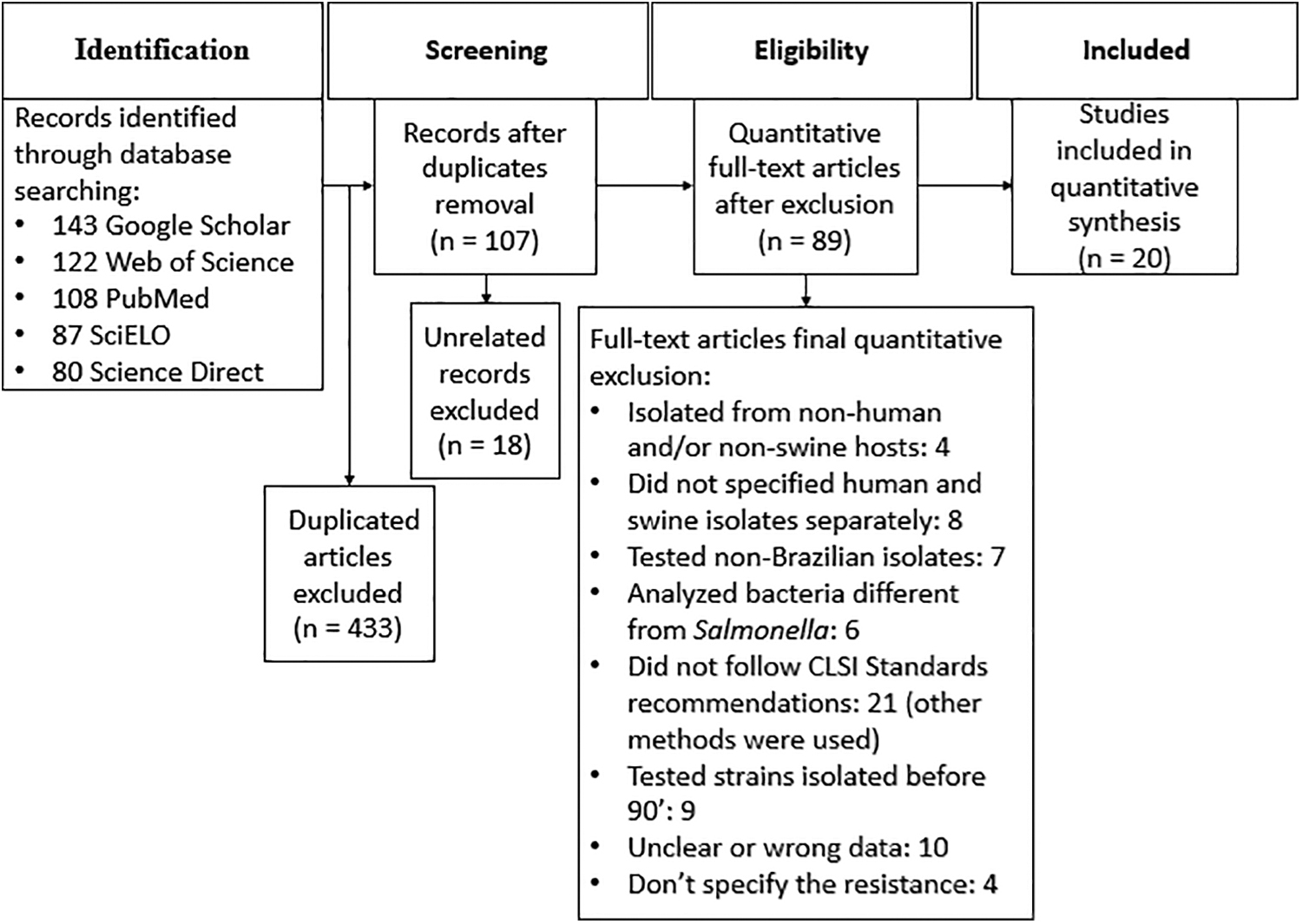
Flowchart describing the eligible criteria used in the systematic review process.
A total of 20 studies were included in the final quantitative analyses. Out of these, nine articles reported AMR in Salmonella strains isolated from humans, six from swine sources, and five from humans and swine, concomitantly.
Qualitative evaluation
Antimicrobial tests were performed as recommended by CLSI guidelines in the 20 included articles. 25 Eighteen articles (90%) matched at least two of the three criteria established for quality evaluation, whereas 14 informed the criteria used for interpreting the inhibition zones and the use of a standard strain for the quality control test.
Overall frequency of AMR Salmonella serovars isolated from swine and human sources
The metadata from the 20 included articles indicated 779 nontyphoid AMR Salmonella isolates (Table 1). A total of 259 were isolated from swine (feces, carcass swabs, lymph nodes, and urine) and 520 from human fluids and excreta (blood, feces, urine, and brain abscess).
Total Number of Salmonella Isolates with Antimicrobial Resistance Extracted from Eligible Records and Included in the Final Quantitative Synthesis of the Systematic Review
Other serovars: Dublin, Agona, Schwarzengrund, Mbandaka, Heidelberg, Anatum, Muenchen, Rissen, Bredeney, monophasic 1,4,[5],12:i:-, Cerro and London.
The most prevalent AMR Salmonella serovars isolated from swine were Salmonella Typhimurium (158/259) (61.0%), Salmonella Derby (25/259) (9.7%), Salmonella Brandenburg (21/259) (8.1%), and Salmonella Panama (21/259) (8.1%). In humans, there were Salmonella Typhimurium (364/520) (70.0%), Salmonella Enteritidis (100/520) (19.2%), and Salmonella Infantis (36/520) (6.9%). Regarding geographic region (Table 1), Southeastern Brazil harbors the most resistant isolates (n = 345), whereas the Salmonella resistant isolates from humans are found mainly in Southeastern and Southern Brazil. In addition, Southern Brazil presented the highest number of swine resistant strains, as well as the highest serovar diversity. Overall, Salmonella Typhimurium was the most frequently detected among isolates from Southeastern, Southern, and Central-West Brazil.
All Salmonella isolates displaying resistance to at least one antimicrobial drug were listed and included herein (Fig. 2A/B). A total of 2,571 antimicrobial drug resistance combinations were detected among swine (920) and human (1,651) isolates. Resistance against 19 and 28 distinct antimicrobial drugs was observed among isolates from swine and human sources, respectively.

Antimicrobial resistance prevalence in nontyphoid Salmonella isolates from swine
AMR prevalence among Salmonella serovars from swine origin
The highest AMR rates in swine isolates were against tetracycline (187/920) (20%), followed by sulfonamides (160/920) (17%), ampicillin (102/920) (11%), streptomycin (102/920) (11%), and nalidixic acid (97/920) (10.5%) (Fig. 2A). Regarding Salmonella serovars, AMR was detected mainly for Salmonella Typhimurium (622/920) (68%), Salmonella Panama (93/920) (10%), Salmonella Derby (71/920) (8%), and Salmonella Brandenburg (57/920) (6%). Most Salmonella Typhimurium strains were resistant to tetracycline (125/920) (13.6%), followed by sulfonamide (102/920) (11%) and ampicillin (76/920) (8%). Regarding Salmonella Panama, the highest prevalences were observed against tetracycline (15/920) (1.6%), ampicillin (15/920) (1.6%), streptomycin, and chloramphenicol (14/920) (1.5%) and against tetracycline (22/920) (2.4%), sulfonamide (19/920) (2.1%), and streptomycin (11/920) (1.2%) for Salmonella Derby. Finally, in Salmonella Brandenburg, AMR was observed against tetracycline and sulfonamide (15/920) (1.6%) and trimethoprim-sulfamethoxazole (14/920) (1.5%) (Fig. 2A).
Salmonella Anatum, Salmonella Enteritidis, Salmonella Cerro, and Salmonella Heidelberg presented the lowest AMR rates. Regarding Salmonella Anatum, the lowest resistances were equally detected against streptomycin, sulfonamide, and tetracycline (1/920) (0.1%). Salmonella Cerro and Salmonella Heidelberg displayed discrete resistance to sulfonamide (1/920) (0.1%), also observed for Salmonella Enteritidis, although only against sulfonamide and tetracycline (1/920) (0.1%) (Fig. 2A).
AMR prevalence among Salmonella serovars from human origin
The highest AMR rates among Salmonella serovars isolated from human sources were against ampicillin (327/1,651) (20%), followed by tetracycline (280/1,651) (17%), chloramphenicol (195/1,651) (12%), and sulfonamide (144/1,651) (9%) (Fig. 2B). Salmonella Typhimurium, Salmonella Infantis, and Salmonella Enteritidis comprised 1,617 out of 1,651 AMR isolates (97.94%) from human sources. Regarding Salmonella Typhimurium isolates, the highest AMR prevalences were noted against tetracycline (221/1,651) (13.4%), ampicillin (215/1,651) (13%), and chloramphenicol (166/1,651) (10.1%); whereas the Salmonella Infantis displayed antimicrobial resistance to ampicillin (34/1,651) (2.1%), tetracycline (33/1,651) (2.0%), cefalotin, and aztreonam (31/1,651) (1.9%). Regarding Salmonella Enteritidis, the highest identified AMR rates were against ampicillin (73/1,651) (4.4%), followed by nalidixic acid (28/1,651) (1.7%) (Fig. 2B).
Salmonella Muenchen was susceptible to almost all tested antimicrobials, presenting resistance only to nalidixic acid and enrofloxacin (2/1,651) (0.1%) (Fig. 2B).
Occurrence of temporal AMR distribution among Salmonella isolates from human and swine
Antimicrobial occurrence increased from 1995 to 2000, except for gentamicin (Fig. 3A). Between 2001 and 2005, Salmonella isolates displaying resistance to tetracycline, trimethoprim-sulfamethoxazole, streptomycin, nalidixic acid, chloramphenicol, and ampicillin increased significantly. On the other hand, the overall resistance of isolates against the majority of antimicrobials reduced after 2005. Resistance to gentamicin remained very low, with small variations from 1995 to 2012 (Fig. 3A).

Occurrence of temporal distribution of antimicrobials resistance within Salmonella isolates from swine
Isolates from human sources displayed an increase in antimicrobial resistance from 1990 to 2000 (Fig. 3B) and a subsequent increase in resistance against ampicillin, tetracycline, chloramphenicol, and nalidixic acid until 2005; whereas sulfonamide, streptomycin, trimethoprim-sulfamethoxazole, and gentamicin resistance decreased from 2001 to 2005. Nalidixic acid increased throughout almost the entire period and reached first in occurrence by 2010. In general, the occurrence of human isolates with resistance decreased after 2005 (Fig. 3B).
Multiple drug resistance in Salmonella isolated from swine and humans
A total of 213 out of 259 (82.2%) Salmonella isolates from swine displayed resistance to multiple drugs (multiple drug resistance [MDR] profile). Overall, 57 distinct MDR profiles were detected (Supplementary Table S1), the most frequent being the combination of ampicillin, chloramphenicol, nalidixic acid, streptomycin, trimethoprim-sulfamethoxazole, and tetracycline (42/213) (19.72%), followed by ampicillin, chloramphenicol, streptomycin, trimethoprim-sulfamethoxazole, and tetracycline (12/213) (5.63%); and ampicillin, nalidixic acid, streptomycin, sulfonamide, tetracycline, and trimethoprim (12/213) (5.63%). Among these profiles, 37.09% (79/213) of the isolates displayed resistance against a combination of six antimicrobials, 28.17% (60/213), against five, and 21.6% (46/213), against four antimicrobials (Supplementary Table S1). Regarding the MDR profiles of isolates grouped by antimicrobial classes, 26 distinct combinations of classes were found. From this combination, 42.3% (11/26) of the isolates presented resistance against four classes. Combined resistance against aminoglycosides, sulfonamides, penicillin, phenicol, quinolones, and tetracycline was the most common profile (55/213) (25.82%), displaying resistance against five out of the seven screened classes.
In humans, 217 out of 520 isolates (41.7%) presented MDR profiles. Overall, 54 distinct MDR profiles were detected: 53.0% (115/217) resistant against 3 antimicrobials, 22.6% (49/217) against 5, and 6.5% (14/217) against 14 (Supplementary Table S2). In addition, 3 MDR profiles presented the same prevalence of 16.6% (36 out of 217) (Supplementary Table S2). The MDR profiles considering antimicrobial compound classes presented 35 different combinations, and 42.9% (15/35) of the isolates displayed resistance against three classes. The MDR profile aminoglycosides—sulfonamide, penicillin, phenicol, and tetracycline—was the most frequent (43/217) (19.8%), demonstrating resistance against 5 out of 12 screened compound classes.
Discussion
In 1980, Brazilian swine producers followed the successful example from other countries and implemented genetic animal enhancement methods. 26 Subsequently, swine weight gain until slaughter increased gradually, intensifying in the 1990s, due to advances in industrial swine husbandry, based on intensive and technically raised livestock. 26 These changes in swine farming methods increased consumption, guaranteeing greater reliability of Brazilian swine meat. The emergence of several Salmonella serovars resistant to multiple antimicrobials was observed in parallel to the Brazilian meat production chain development, becoming a serious concern, as these bacteria can cause severe invasive infections in humans, which often require antimicrobial treatment.
Epidemiological data collected in Brazil since the 1990s provide useful information, aiding in the treatment of salmonellosis and in tracing the relationships between pathogenic strains from foods to humans, elucidating contamination routes and improving monitoring and the implementation of control programs. The extensive use of antimicrobials as growth promoters, prophylaxis, and treatment in swine seems to be related to the development of Salmonella resistance in humans in Brazil from 1990 to 2016. To the best of our knowledge, this review is the first to compile data from Salmonella strains isolated from both swine and humans in Brazil.
In 2006, 63% of small swine establishments were located in Northeastern and Northern Brazil, comprising 18% of the swine herd in the country. However, only 2% of the slaughterhouses in these regions are efficiently inspected by Brazilian authorities, 27 resulting in a gap between inspection and epidemiological survey data when compared with other geographic regions presenting higher socioeconomic development. Small establishments located in the South (16.0%), Southeast (15.6%), and Midwest (5.2%) regions were still the minority in 2006. However, the economic development of these regions is higher, making them more active pork production chain actors. 27 Currently, Southern and Southeastern Brazilian harbor the majority (∼85%) of swine herds compared with the North, Central West, and Northeastern regions. 14 This may explain why Southeastern and Southern Brazil harbor most resistant isolates and the highest diversity of serovars.
Salmonella Enteritidis and Salmonella Infantis were the most prevalent among the Salmonella serovars found in humans, although they are not significantly prevalent in swine. Salmonella Enteritidis is traditionally associated with the consumption of contaminated poultry meat, eggs, and egg derivatives in outbreaks or isolated cases worldwide.28,29 The high prevalence of Salmonella Enteritidis isolated from humans and poultry 9 corroborates the results reported herein and highlights the hypothesis that poultry or eggs are likely the main origins of Salmonella Enteritidis foodborne transmission to humans.
Salmonella Infantis has been grouped within the 15 most frequent serovars detected worldwide, including in Latin America. 30 Moreover, Salmonella Infantis is reported as the sixth most frequent serovar isolated from humans and swine in Brazil from 1996 to 2003. 31 Although Salmonella Infantis usually originates from the contamination of food sources,32–34 it has been mostly detected in human clinical samples and described in a single study. This sporadic high detection of single serovar isolates is likely a consequence of a specific outbreak. Careful monitoring of Salmonella Infantis is recommended, as other evidence has demonstrated its broad distribution throughout other food matrices. 35
In this study, Salmonella Typhimurium is reported as the most isolated in both humans and swine. This serovar is known as a generalist and cosmopolitan 35 and has been associated mainly with swine meat and swine.36–38 Experimental studies demonstrated that swine can asymptomatically transport Salmonella Typhimurium in tonsils, intestines, and mesenteric lymph nodes; whereas Salmonella can also be spread throughout the swine processing line during slaughter, contaminating equipment, and carcasses.15–17,19,39,40 This contributes to the dissemination and prevalence of Salmonella Typhimurium in swine and, consequently, transmission from contaminated swine and swine products to humans.
Salmonella Derby carrying antimicrobial resistance was the second most frequent serovar detected in swine sources in Brazil. This serovar is one of the most often associated with swine,35,41 as well as the most abundant regarding this source in Asia and Europe.39,42,43 Ferrari et al. reported swine as the main Salmonella Derby reservoir. 35 The mechanism beyond the global prevalence emergence of Salmonella Derby remains unclear. However, Salmonella Derby infection in humans may be less epidemiological important than the most commonly associated Salmonella Typhimurium and Salmonella Enteritidis. It has been demonstrated that Salmonella Derby lacks a combination of important virulence genes (irsA and msgA, among others), as well as the Salmonella Pathogenicity Island—SPI-3 integrity and multiple prophages lacking in several human associates isolates. 44 It may be speculated that the lack of many important virulence genes may make Salmonella Derby less virulent to humans.
Salmonella Typhimurium and Salmonella Enteritidis are the main serovars found in different Salmonella surveys. Our metadata reveal that these serovars isolated from human sources display broad and high antimicrobial resistance. Hendriksen et al., in 2011 and Quesada et al., in 2014, reported similar behavior for these Salmonella serovars isolated in Latin America.30,31 Salmonella Enteritidis was the most frequently isolated, followed by Salmonella Typhimurium, in 1990 and 1995, among 191 World Health Organization (WHO) member countries. 45 In agreement with these data, these serovars presented the highest AMR levels in this study. The high prevalence of Salmonella Enteritidis and Salmonella Typhimurium serovars in different sources worldwide can increase the transfer of resistance genes from animals to humans throughout the food chain.
The WHO does not recommend the use of the same classes of antimicrobials employed in human therapeutics or known to cause cross-resistance as growth promoters in animal husbandry. 46 However, some antimicrobials traditionally used in swine husbandry as growth promoters and/or for the treatment of gastrointestinal infections 47 are also used to control human infectious diseases in Brazil (e.g., quinolones, tetracyclines). Antimicrobial misuse in agriculture and clinical and veterinary medicine has resulted in an increase in AMR bacteria, including Salmonella. Quesada et al. demonstrated that Salmonella isolated from animal-based food displays significant antimicrobial resistance in Latin American countries, including Brazil. 31 The prophylactic, metaphylactic, and therapeutic use of antimicrobial compounds in animal husbandry for extended periods is the probable cause for the widespread resistance against antimicrobials observed in Brazil. In addition, clinical and microbiological evidence indicate that resistant bacterial are frequently transmitted from animals to humans, resulting in AMR infections that are more difficult and expensive to treat. 46
Regarding isolates from humans, the highest Salmonella resistance was found against ampicillin, tetracycline, chloramphenicol, and sulfonamide. It is important to note that tetracycline, sulfonamide, trimethoprim-sulfamethoxazole, ampicillin, and nalidixic acid use has been reported in swine husbandry as growth promoters. 48 It is also important to note Salmonella strains isolated from both humans and swine in Brazil displaying MDR combination (Fig. 3). Swine isolates displayed high resistance to tetracycline and sulfonamide, with a considerable resistance decrease against these drugs after 2005. As discussed by Voss-Rech et al., the probable reason for the noted decrease in antimicrobial resistance among these isolates is restrictions on their use in animal husbandry for clinical treatment, as set by Brazilian authorities in 1998. 9 Similarly, aminoglycosides have been widely applied in Brazilian animal husbandry, and both human and swine isolates display a high mutual frequency of streptomycin resistance. In general, a notable decrease in antimicrobial resistance against almost all antimicrobials observed in human and swine isolates after 2001–2005 (Fig. 3) is observed. However, an increase in nalidixic acid resistance in human isolates was also noted throughout this period. This corroborates the results reported by Gorman and Adley, who report that nalidixic acid resistance has followed increased resistance to quinolones, 49 the main antimicrobial class used to treat salmonellosis.50,51
In 1999, the Brazilian National Program to Control Residues and Contaminants in Animal-Based Food (PCRC) was instituted by the Federal Inspection Service, belonging to The Ministry of Agriculture, with the aim of controlling veterinary drug residues, agrochemicals, and environmental contaminants, and ensuring the safety of animal-based food offered for consumption. 52 The observed decline in the occurrence of antimicrobial resistance in swine and human isolates after 2001 may be a consequence of the controlled use policy established by federal authorities, as the PCRC supervises the safety limits of antimicrobials in food and distributes penalties to producers who do not respect those limits. Since the implementation of the control program in 2010, no nonconformities were found for the swine matrix regarding permitted antimicrobial levels. However, before the program implementation, antimicrobials belonging to the tetracycline class were the most commonly detected at nonconformity levels.
The World Organization for Animal Health (OIE) appoints seven antimicrobial classes as veterinary critically important antimicrobials. 53 The present assessment demonstrates that Salmonella isolates from swine presented resistance to five of eight classes of antimicrobials (aminoglycosides, amphenicols, cephalosporins, macrolides, penicillin, quinolones, sulfonamides, and tetracycline), namely aminoglycosides (172/920) (19%); sulfonamides (247/920) (27%); penicillin (102/920) (11%); quinolones (103/920) (11%); and tetracycline (206/920) (22%) (results not shown). On the other hand, the WHO also appoints certain antimicrobial classes as critically important (aminoglycosides, cephalosporins, macrolides, penicillins, polymixins, quinolones, and others) for human treatment and strongly advises for their moderate and conscious use, 54 and antimicrobial resistance against at least four classes has been reported in Salmonella isolated from humans, namely penicillin (20%) (330/1,651), aminoglycosides (201/1,651) (12%), quinolones (195/1,651) (12%), and cephalosporins (30/1,651) (2%) (results not shown). The results reported herein revealed serious public health issues and require attention and new measures to minimize resistant bacterial infection risks.
Another important issue is that two of the most frequent MDR profiles found in swine isolates presented resistance against nalidixic acid, one of the main antimicrobials chosen to treat salmonellosis in humans, as previously indicated. In addition, the number of isolates from swine displaying an MDR profile (213/259) (82.2%) is considered extremely high and dangerous to public health. Further, 16.21% (42/259) of the isolates displayed an MDR profile with resistance against six of the seven detected antimicrobial classes. These findings demonstrate the high risk regarding consumption of swine contaminated by Salmonella strains that are resistant to multiple antimicrobial compounds in Brazil. On the other hand, of the 520 Salmonella isolated from humans, 217 (41.73%) presented an MDR profile, most frequent being a combination of ampicillin, chloramphenicol, streptomycin, sulfonamide, and tetracycline (ACSSuT) resistance. This profile is commonly found in Salmonella Typhimurium phage type DT 104, whose genes are chromosomally encoded, involving integrons, and are horizontally widely and quickly transferred to other bacteria. 55
Conclusions
This systematic review indicates that Salmonella serovars detected in swine have developed resistance against clinically relevant antimicrobials such as quinolones, tetracycline, and penicillin. It seems that this resistance originates from the extensive use of these antimicrobials for control contamination and support growth in animal husbandry. All major resistance determinants, including those conferring resistance to β-lactams, extended-spectrum β-lactams, fluoroquinolones, aminoglycosides, tetracyclines, and chloramphenicol, have been identified in various Salmonella serovars isolated from the food supply, indicating that swine are possibly one of the leading vectors in spreading human salmonellosis in Brazil. The emergence of MDR in Salmonella isolated from swine and human indicates risk for possible failures in invasive salmonellosis treatments, requiring the control of AMR bacteria throughout the food chain. The results compiled herein contribute toward the epidemiological surveillance of resistant Salmonella and the control of widespread antimicrobial resistance in Brazil.
Footnotes

References
Supplementary Material
Please find the following supplemental material available below.
For Open Access articles published under a Creative Commons License, all supplemental material carries the same license as the article it is associated with.
For non-Open Access articles published, all supplemental material carries a non-exclusive license, and permission requests for re-use of supplemental material or any part of supplemental material shall be sent directly to the copyright owner as specified in the copyright notice associated with the article.
