




Abstract
Aims:
Fish pathogenic Lactococcus garvieae serotype II has been isolated from cultured fish species in Japan. This study aimed to investigate the molecular mechanisms of lincomycin (LCM)-resistant L. garvieae serotype II and assess the molecular basis for lincosamides–streptogramins A–pleuromutilins (LSAP)-resistant phenotype.
Results:
We identified a novel lsa(D)-encoded 497-aa ATP-binding cassette F (ABC-F) protein in the LSAP-resistant strains. Amino acid identities of 41.25–54.73% were obtained between the deduced amino acids from Lsa(D) and other Lsa-type ABC-F proteins. Furthermore, comparative analysis revealed that the allele of lsa(D) with single point mutation at 233 aa position (TGG → TAG; tryptophan→premature termination codon [PTC]) in LSAP-sensitive strains. The minimum inhibitory concentrations of antimicrobials against the lsa(D) complementary strain and lsa(D)-disrupted mutant confirmed that lsa(D) conferred the LSAP-resistant phenotype. The reverse transcription–polymerase chain reaction could not detect the noncoding region of lsa(D) allelic variant in the LSAP-sensitive strains. Additionally, the PTC (TAG) in LCM-sensitive strains was replaced by TGG, CAG, or TAT in the laboratory-induced revertant mutants.
Conclusions:
The novel lsa(D) conferred the LSAP-resistant phenotype in clinically LCM-resistant L. garvieae serotype II strains. However, the allele of lsa(D) gene containing the PTC was found in L. garvieae serotype II, resulting in the LSAP-susceptible phenotype.
Introduction
Lactococcus garvieae has been isolated from cultured fish, dairy products, vegetables, and humans.1–3 It was a widespread fish pathogen affecting rainbow trout Oncorhynchus mykiss in several countries, such as Australia, South Africa, and Mediterranean area.4,5 In Japan, fish pathogenic L. garvieae has spread to many fish farms and caused significant damage to the aquaculture industry. The economic losses to Japanese aquaculture due to infections caused by L. garvieae serotype I have been reduced since the introduction of various vaccines into fish farms. 6 However, in 2012, a new serotype of L. garvieae (serotype II) suddenly emerged in yellowtail (Seriola quinqueradiata) and amberjack (Seriola dumerili) farms. 7 As the vaccine protection against the emerging L. garvieae serotype II was lower than that against L. garvieae serotype I, the new serotype has spread to marine fish farms causing heavy damage.6,8 To prevent infection caused by L. garvieae serotype II, antimicrobials, such as lincomycin (LCM), erythromycin (EM), oxytetracycline (OTC), and florfenicol (FF), have been used in Japan. Recent antimicrobial susceptibility testing reported that all L. garvieae serotype II clinical isolates were sensitive to EM, OTC, and FF, but 38.5% (62/161) of the isolates were resistant to LCM. 8 In contrast, L. garvieae serotype I strains isolated from diseased fish exhibited high-level resistance to EM, LCM, and OTC, with the resistant strains possessing the erm(B) and tet(S) genes. 9 EM-resistant L. garvieae serotype I strains carrying the erm(B) gene were also cross-resistant to LCM. However, L. garvieae serotype I strains that were resistant to LCM in the absence of EM resistance prevailed in fish farms. 10 The mechanism for LCM resistance without EM resistance is unknown in both serotypes I and II of L. garvieae.
Gram-positive pathogens including the staphylococci, streptococci, and enterococci are cross-resistant to lincosamides (e.g., LCM and clindamycin [CM]), streptogramins A (e.g., virginiamycin M1 [VGM]), or pleuromutilins (e.g., tiamulin [TIM]) (hereinafter referred to as LSA(P)-resistant phenotype), and this resistance profile was attributed to ATP-binding cassette F (ABC-F) proteins, which were encoded by vga-, lsa-, and sal-type genes.11–13
In a previous study, we tried to detect several LCM resistance-related genes, including vga- and lsa-type genes, using the polymerase chain reaction (PCR) method. However, no LCM-resistant genes were detected in L. garvieae serotype II strains. 8 To elucidate the mechanism for LCM resistance without EM resistance in L. garvieae serotype II, genome shotgun sequencing and comparative genome analysis were performed for LCM-resistant and LCM-sensitive L. garvieae serotype II strains. As a result, a novel lsa-type ABC-F gene named lsa(D) was found in four clinically LCM-resistant strains. In addition, an amber mutation differing from lsa(D), which introduced a premature termination codon (PTC) into this novel lsa(D) gene, the allele of lsa(D) was found in four clinically LCM-sensitive strains of L. garvieae serotype II. Based on these genetic features, we hypothesized that lsa(D) might confer resistance to LCM. This study aimed to (i) investigate the genetic variation in the molecular characteristics of lsa(D) between LSAP-resistant and LSAP-sensitive phenotype strains and (ii) construct lsa(D)-disruption mutant and complementary strains to elucidate whether the lsa(D) gene in L. garvieae serotype II plays a role in the LSAP-resistant phenotype.
Materials and Methods
Bacterial strains and antimicrobial susceptibility testing
L. garvieae serotype II strains used in this study were isolated from diseased fish, including yellowtail S. quinqueradiata and amberjack S. dumerili, and were identified by PCR-mediated identification. 14 Table 1 shows the bacterial strains and plasmids used in this study. L. garvieae strains were grown overnight in Todd-Hewitt broth (Becton Dickinson, MD) or Todd-Hewitt agar (THA) at 25°C. Escherichia coli strains were cultured in Luria–Bertani (Becton Dickinson) broth or agar at 37°C. Minimum inhibitory concentrations (MICs) were determined using the agar dilution method. 10 LCM, TIM, and spectinomycin (SPC) were purchased from Wako Pure Chemical Industries, Ltd. (Osaka, Japan). CM, EM, and VGM were purchased from LKT Laboratories, Inc. (Minnesota), Nacalai Tesque, Inc. (Kyoto, Japan), and Sigma-Aldrich Co. LLC. (Missouri, USA), respectively. When required, SPC was added to the E. coli and L. garvieae media at 100 and 500 μg/mL, respectively.
Bacterial Strains and Plasmids Used in This Study
LCMr, lincomycin resistance; LCMs, lincomycin sensitive; Spcr, spectinomycin resistance.
DNA extraction and PCR assay
The genomic DNA of L. garvieae was extracted as described in a previous study. 7 Finally, the phenol:chloroform:isoamyl alcohol (Nippon Gene Co., Ltd., Toyama, Japan) was added, and the genomic DNA was purified according to the manufacturer's protocol. The plasmid DNA from L. garvieae was obtained using the illustra plasmidPrep Mini Spin Kit (GE Healthcare Life Sciences, MA) with sight modifications. 7 In addition, the plasmid DNA of E. coli was also directly obtained using the illustra plasmidPrep Mini Spin Kit. PCR was performed with the PrimeSTAR® GXL DNA Polymerase (Takara Bio, Inc., Shiga, Japan) according to the product manual.
Whole-genome shotgun sequencing of L. garvieae serotype II and TA cloning for lsa(D) variants sequencing
Three LCM-resistant phenotype strains (KGLA1504, KGLA1519, and KGLA1527) and one LCM-sensitive phenotype strain (KGLA1512) were used for whole-genome shotgun sequencing. Library preparation was performed using the Nextera XT DNA Sample Prep Kit (Illumina, Inc., San Diego, CA) according to the manufacturer's protocol. The libraries were sequenced using the NextSeq 500 sequencing system (Illumina), yielding paired-end reads of 151-bp. Raw reads were trimmed to <149 bp, and the trimmed reads were assembled using the CLC Genomics Workbench (CLC Bio, Aarhus, Denmark). The constructed contigs for each strain and the complete genome sequence of the LCM-sensitive L. garvieae serotype II 122061 strain (GenBank Accession No. AP017373)8,15 were annotated using Prokka. 16 Comparative genome analysis was performed using Roary v3.7.0. 17 Genes that differentiated LCM-resistant strains from LCM-sensitive strains were analyzed using the BLASTP search with the CARD reference sequences (E value threshold of 1E-5). 18
In addition, the PCR assay using TA-cloning primers, LSA-1f and LSA-1r (Supplementary Table S1), amplified a 1,724 bp fragment, including a 1,494 bp open reading frame of lsa(D) alleles with 129 bp in the upstream region and 101 bp in the downstream region, obtained from one LCM-resistant strain (KGLA1522) and two LCM-sensitive strains (IJF427 and KGLA1602). Each fragment was cloned into the pTAC-2 (Takara Bio, Inc.) vector and transformed into E. coli DH5α (Takara Bio, Inc.) using the Mighty TA-Cloning Kit (Takara Bio, Inc.). Then, the sequences of the lsa(D) alleles were verified.
Phylogenetic analysis
Lsa(D) (GenBank Accession No. AXF35727) obtained in this study was compared with five representative Lsa-type ABC-F proteins [Eat(A)v (AGQ48857), Lsa(A) (AAO43110), Lsa(B) (NP_899166), Lsa(C) (AEA37904), and Lsa(E) (AFM38048)] obtained from the Nomenclature Center for macrolide–lincosamide–streptogramin resistance genes. Sequence comparison and phylogenetic analysis were performed using the Neighbor-Joining method with the MEGA-7 software package. 19
Disruption mutation of lsa(D) in LCM-resistant L. garvieae serotype II
For PCR, all primers were designed based on shotgun sequences in the LCM-resistant KGLA1504 listed in Supplementary Table S1. In first step, the 5′ flanking region and the 3′ flanking region of lsa(D) in KGLA1504 were amplified by primers modified to include restriction site, KO-PstI-1f/KO-1r and KO-2f/KO-PstI-2r, respectively. The two PCR products were fused and amplified by overlap extension PCR 20 using primers KO-PstI-1f and KO-PstI-2r. The resulting PCR-amplified product was cloned into the pTAC-2 (Takara Bio, Inc.) vector and transformed into E. coli DH5α (Takara Bio, Inc.) using the Mighty TA-Cloning Kit (Takara Bio, Inc.). Then, the fragment was digested by PstI and directly cloned into the respective site of the temperature-sensitive shuttle vector pSET4s 21 to produce a lsa(D) knockout vector. After being introduced into E. coli DH5α, the sequence of the cloning site in the knockout vector was verified, and the lsa(D) knockout vector was subsequently introduced into a clinically L. garvieae LCM-resistant strain (serotype II, KGLA1504) using electroporation. Single-crossover mutants were obtained by shifting the incubation temperature to 37°C in the presence of SPC at 500 μg/mL in THA. The single-crossover mutants were then subcultured in THA at 28°C in the absence of SPC. Colonies were left to form overnight and were then screened to eliminate the vector by inoculating the colonies onto THA plates with and without SPC. SPC-susceptible colonies might have lost the lsa(D) gene or returned to the wild type as the result of a double-crossover recombination event. Finally, the Δlsa(D) [lsa(D)-disruption mutant] was confirmed by PCR with the Internal-f and Internal-r primers (Supplementary Table S1).
Construction of complementary strains, Δlsa(D)[pMX1::lsa(D)] and Δlsa(D)[pMX1::allele of lsa(D)]
The PCR assay by cloning primers LSA-PstI-f and LSA-EcoRI-r (Supplementary Table S1) modified to include PstI and EcoRI site that amplified a 1,583 bp fragment including 1,494-bp lsa(D) with 40 bp in the upstream and 49 bp in the downstream obtained from a clinically LCM-resistant strain (KGLA1504). A fragment, including the 1,494 bp allele of lsa(D) (including a 102 bp noncoding region with the PTC) with 40 bp in the upstream region and 49 bp in the downstream region, was obtained from a clinically LCM-sensitive strain (122061). Each fragment was cloned into the pTAC-2 (Takara Bio, Inc.) vector and transformed into E. coli DH5α (Takara Bio, Inc.) using the Mighty TA-Cloning Kit (Takara Bio, Inc.). In the second step, the inserted lsa(D) and allele of lsa(D) fragments were cut with EcoRI and PstI, respectively, and then ligated into the respective sites of the pMX1 expression vector possessed the malX promoter of Streptococcus suis for transgene expression. 22 The two expression vectors, pMX1::lsa(D) and pMX1::allele of lsa(D), were then electrotransformed into the lsa(D)-disruption mutant, respectively. The MICs and LCM resistance-related genes in the two complementary strains, Δlsa(D)[pMX1::lsa(D)] and Δlsa(D)[pMX1::allele of lsa(D)], were examined.
RNA extraction and reverse transcription–PCR
The expression of lsa(D) allelic variants was verified using three primer pairs (RT-1f/RT-1r, RT-2f/RT-2r, and RT-3f/RT-3r) (Supplementary Table S1) designed for the selected regions by reverse transcription (RT)-PCR (Fig. 3a, b). The total RNA was extracted from LSAP-resistant (KGLA1504 and KGLA1519) and LSAP-sensitive phenotype strains (122061 and KGLA1602) using the RNAiso Plus reagent method (Takara Bio, Inc.) according to the protocol recommended by the supplier. Subsequently, 1 μg of total RNA was used as a template to synthesize cDNA using the ReverTra Ace® qPCR RT Master Mix Kit (Toyobo Co., Ltd., Osaka, Japan) according to the manufacturer's protocol. Each sample was analyzed using 100 ng of cDNA and specific primers with the PrimeSTAR GXL DNA Polymerase kit (Takara Bio, Inc.) according to the product manual.
Selection of revertant mutants
Approximately 1 × 10⁸ cells of LSAP-sensitive phenotype strains (122061, IJF427, KGLA1512, KGLA1602, and Δlsa(D)[pMX1::allele of lsa(D)]) were spread onto THA containing 10 μg/mL of LCM and incubated for 144 hr at 25°C. After incubation, the MIC values of antimicrobials against five LCM-resistant mutants (122061-R, IJF427-R, KGLA1512-R, KGLA1602-R, and Δlsa(D)[pMX1::allele of lsa(D)]-R) were measured. In addition, the genetic variations in lsa(D) of all revertant mutants were analyzed.
Nucleotide and amino acid sequences accession number
The nucleotide sequence of lsa(D) and deduced amino acid sequence of Lsa(D) extracted from a L. garvieae serotype II LSAP-resistant phenotype strain (KGLA1504) were deposited in the GenBank database under the accession numbers MH473150 and AXF35727, respectively.
Results
MICs of antimicrobials against LSAP-resistant and LSAP-sensitive L. garvieae serotype II strains
Table 2 shows the MICs of LCM, CM, VGM, TIM, and EM against LSAP-resistant and LSAP-sensitive L. garvieae serotype II strains. All LCM-resistant strains had cross-resistance to CM, VGM, and TIM (LSAP-resistant phenotype). Meanwhile, all the LCM-sensitive strains exhibited an LSAP-sensitive phenotype. All strains were sensitive to EM.
Minimum Inhibitory Concentrations of Antimicrobials and lsa(D) Genetic Variants in Lactococcus garvieae Serotype II
LSAP: L (LCM and CM), SA (VGM), and P (TIM).
Amino acid variations in Lsa(D) were confirmed by sequencing all mutants.
CM, clindamycin; EM, erythromycin; LCM, lincomycin; MIC, minimum inhibitory concentration; PTC, premature termination codon; Q, glutamine; R, resistance; S, sensitive; TIM, tiamulin; VGM, virginiamycin M1; W, tryptophan; Y, tyrosine.
Identification and characterization of Lsa(D) in L. garvieae serotype II
The comparative genome analysis revealed that the deduced amino acid sequences of ABC-F proteins obtained from both LSAP-resistant and LSAP-sensitive L. garvieae serotype II strains aligned with Eat(A)v and Lsa(A) from Enterococcus faecium and Enterococcus faecalis, respectively (Fig. 1). A total of 497 deduced amino acids were found from ABC-F proteins in 4 LSAP-resistant strains (Figs. 1 and 3a). The ABC-F protein of LSAP-resistant strains, containing ABC signature motifs and canonical Walker A and B motifs, possesses homology with Eat(A)v and Lsa(A) from E. faecium and E. faecalis, respectively. Based on structural similarities, the novel ABC-F gene was recently designated as lsa(D) by the Nomenclature Center for macrolide–lincosamide–streptogramin resistance genes. In addition, the allele of lsa(D) with a point mutation was found in clinically four LSAP-sensitive L. garvieae serotype II strains. The amino acid of tryptophan (TGG) at position 233 was replaced to a PTC (TAG), and the in-frame translational start codon (ATG) was found at position 267, producing two possible truncated proteins (Figs. 1 and 3b). Table 2 shows the single point mutation site of lsa(D) variants in LSAP-resistant and LSAP-sensitive phenotypes of clinical L. garvieae serotype II strains.

Multiple-sequence alignment of deduced amino acid sequences of ABC-F-related proteins from Lactococcus garvieae serotype II LSAP-sensitive (122061, IJF427, KGLA1512, and KGLA1602) and LSAP-resistant (KGLA1504, KGLA1519, KGLA1522, and KGLA1527) strains, Eat(A)v protein (AGQ48857) from Enterococcus faecium strain HM1070, and Lsa(A) protein (AAO43110) from Enterococcus faecalis strain ATCC29212. The two copies of the deduced Walker A and B motifs, as well as ABC signatures, are indicated in boldface and underline. Asterisks indicated same amino acids. *: Amber codon (premature termination codon). White asterisk: In-frame transitional start codon. The gray box represents noncoding region. LSAP: L (LCM and CM), SA (VGM), and P (TIM). ABC-F, ATP-binding cassette F; CM, clindamycin; LCM, lincomycin; TIM, tiamulin; VGM, virginiamycin M1.
Phylogenetic tree of Lsa-type proteins
A phylogenetic tree was constructed based on the multisequence alignment of Lsa(D), Eat(A)v, Lsa(A), Lsa(C), Lsa(E), and Lsa(B) (Fig. 2). In a multisequence alignment, Lsa(D) displayed 54.73%, 52.91%, 43.46%, 41.45%, and 41.25% amino acid identities with other respective Lsa-type ABC-F proteins, Eat(A)v, Lsa(A), Lsa(C), Lsa(E), and Lsa(B) in various gram-positive organisms, respectively. In the phylogenetic tree, the newly characterized ABC-F protein of L. garvieae, Lsa(D), was confirmed to be more closely related to Eat(A)v from E. faecium and Lsa(A) from E. faecalis than Lsa(B) and Lsa(E).
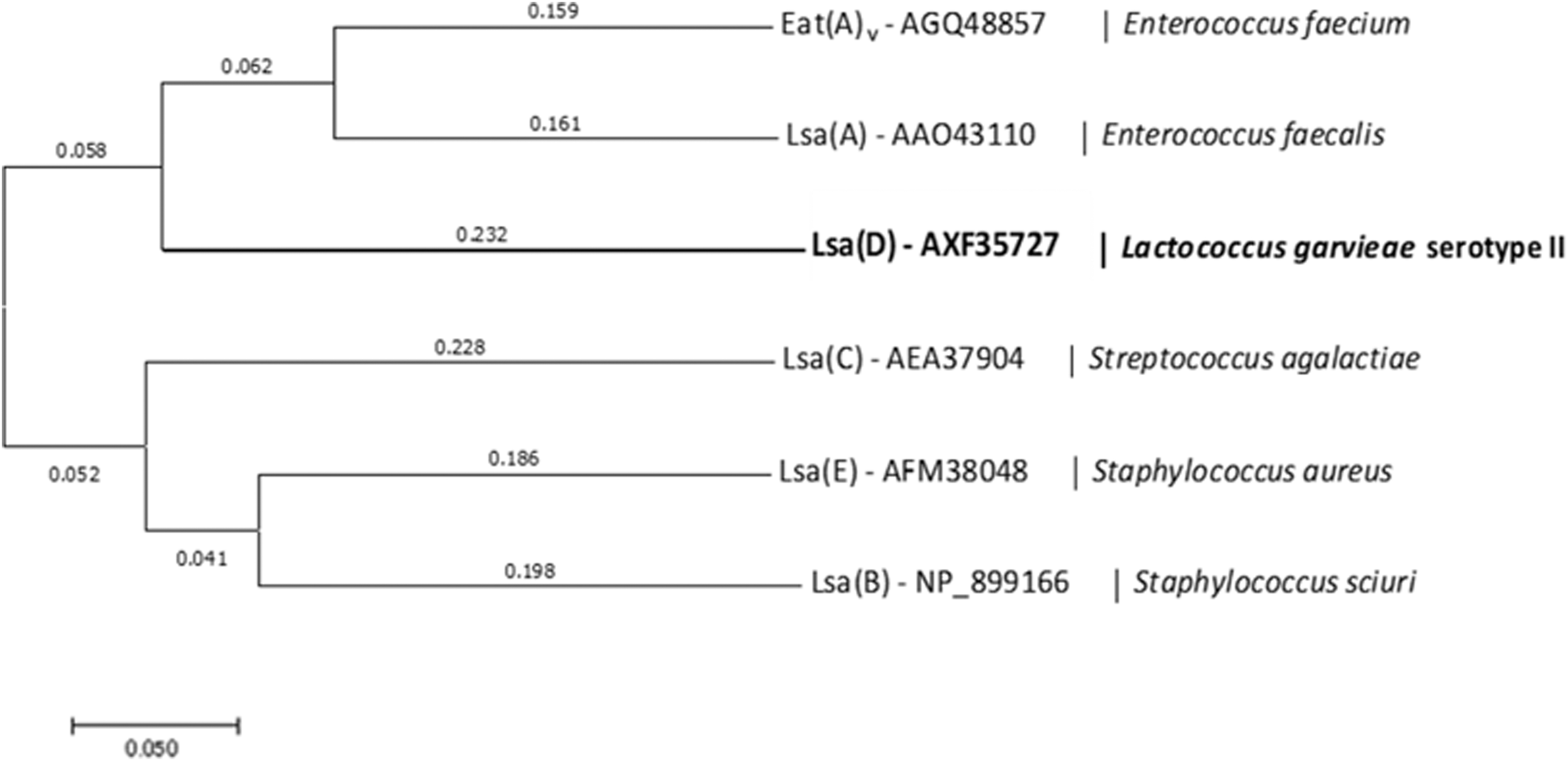
Phylogenetic tree showed relatedness between Lsa(D) (bold) in Lactococcus garvieae serotype II and other Lsa homologous proteins in representative gram-positive pathogens. The dendrogram was constructed by alignment of the deduced amino acid sequences by using the Neighbor-Joining method with the MEGA-7 software package. Lsa(D) (GenBank Accession No. AXF35727), Eat(A)v (AGQ48857), Lsa(A) (AAO43110), Lsa(B) (NP_899166), Lsa(C) (AEA37904), and Lsa(E) (AFM38048). The optimal tree with the sum of branch length = 1.37725302 is shown. The tree is drawn to scale, with branch lengths (next to the branches) in the same units as those of the evolutionary distances used to infer the phylogenetic tree.
MICs of antimicrobials against L. garvieae serotype II strain KGLA1504, disruption mutant, and complementary strains
Table 3 shows the MICs of antimicrobials against the derivatives of a clinically LCM-resistant strain (KGLA1504). The clinical strain carrying the lsa(D) gene simultaneously belonged to the LSAP-resistant phenotype. The lsa(D)-disruption mutant showed a 64-fold decrease in the MIC of LCM (from 25 to 0.39 μg/mL), a ≥250-fold decrease in the MICs of CM (from 12.5 to 0.05 μg/mL) and TIM (from 200 to 0.78 μg/mL), and a 16-fold decrease in the MIC of VGM (from 25 to 1.56 μg/mL). Whereas the MIC of EM against the parental strain (KGLA1504) did not differ. To verify the LSAP phenotype, we performed complementation analysis by introducing pMX1 only, pMX1::lsa(D), and pMX1::allele of lsa(D) into the lsa(D)-disruption mutant, respectively. The lsa(D) complementary strain, Δlsa(D)[pMX1::lsa(D)], acquired the LSAP-resistant phenotype with the restoration of a >64-fold increase in the MICs of LCM (from 0.39 to 25 μg/mL), CM (from 0.05 to 12.5 μg/mL), and TIM (from 0.78 to 100 μg/mL), and a 16-fold increase in the MIC of VGM (from 1.56 to 25 μg/mL). In contrast, the MICs of LCM, CM, TIM, and VGM against the allele of lsa(D) complementary strain, Δlsa(D)[pMX1::allele of lsa(D)], did not differ.
The Minimum Inhibitory Concentrations for Lactococcus garvieae Serotype II KGLA1504, Δlsa(D), and Each Complementary Strain, Δlsa(D)[pMX1], Δlsa(D)[pMX1::lsa(D)], and Δlsa(D)[pMX1::allele of lsa(D)]
Resistance-related genes were detected by PCR amplification with gene-specific primers listed in Supplementary Table S1.
LSAP: L (LCM and CM), SA (VGM), and P (TIM).
PCR, polymerase chain reaction; SPC, spectinomycin.
Reverse transcription–polymerase chain reaction
The expression of lsa(D) allelic variants in LSAP-sensitive and LSAP-resistant phenotype strains was assayed using RT-PCR (Fig. 3c). The RT-PCR amplified a 477 bp fragment in region I using primers RT-f1 and RT-r1, and amplified a 470 bp fragment in region III using primers RT-f3 and RT-r3, in both LSAP-sensitive and LSAP-resistant phenotype strains. However, the RT-PCR using primers RT-f2 and RT-r2 could not detect any products in region II in the LSAP-sensitive phenotype strains. In contrast, a 172-bp fragment in region II was amplified in the LSAP-resistant phenotype strains.

Characterization of lsa(D) alleles between LSAP-resistant and LSAP-sensitive strains of Lactococcus garvieae serotype II. Schematic representation of the deduced 497 aa position.
Artificial mutation sites detected in revertant mutants
Five revertant mutants acquired the LSAP-resistant phenotype after artificially performing LCM-induced mutagenesis (Table 2). The LSAP-resistant mutants were obtained at frequencies roughly equal to 10−8. In the allele analysis of lsa(D) in five revertant mutants, the PTC (TAG) changed to tryptophan (TGG) and glutamine (CAG) in the IJF427-R and KGLA1512-R mutants, respectively. In addition, the PTC (TAG) also changed to tyrosine (TAT) in the 122061-R, KGLA1602-R, and Δlsa(D) [pMX1::allele of lsa(D)]-R mutants. These five mutants exhibited a ≥125-fold increase in the MIC of LCM (from 0.2 to 25–100 μg/mL), >30-fold increase in the MIC of CM (from 0.05 to 1.56–25 μg/mL), ≥8-fold increase in the MIC of TIM (from 0.39–3.13 to 25–200 μg/mL), and ≥2-fold increase in the MIC of VGM (from 0.78–1.56 to 3.13–25 μg/mL).
Discussion
The mechanism for EM and LCM resistance in L. garvieae isolated from marine fish species is usually due to the modification of ribosomal targets mediated by erm(B). A previous study revealed that a transferable R-plasmid containing erm(B) in L. garvieae serotype I was widely distributed in fish farms. 9 Due to the short withdrawal time of LCM, it has often been used to treat lactococcal infections in juveniles to market-size fish. 8 However, resistance to LCM in the absence of EM gradually became high proportion in L. garvieae clinical isolates. 10 Since 2015, clinical strains of emerging L. garvieae serotype II have been found to have resistance to LCM, but all strains were susceptible to EM. 8 Until now, this phenotype of LCM resistance in the absence of EM resistance has not been explained in conjunction with the mechanisms of EM and LCM resistance in L. garvieae.
Cross-resistance to lincosamides (e.g., LCM and CM), streptogramins A (e.g., VGM), or pleuromutilins (e.g., TIM), which is defined as LSA- or LSAP-resistant phenotypes and employed by ABC-F proteins, has been found in pathogenic bacteria. 23 In particular, the ABC-F proteins of lsa-type family genes are distributed throughout various gram-positive pathogens. In E. faecalis, lsa(A) was responsible for the intrinsic resistance of the LSAP phenotype. 12 In Staphylococcus sciuri, lsa(B) encoded by a plasmid-borne gene played a key role in the increase in the MICs of lincosamides. 24 A chromosomal gene, lsa(C), was demonstrated to be responsible for clinical strains of Streptococcus agalactiae acquiring LSAP resistance. 25 Additionally, the lsa(E) gene located in Staphylococcus aureus strains was demonstrated to confer LSAP resistance. 26 In E. faecium, the molecular characteristics of eat(A)v acquired the LSAP-resistant phenotype. 27 In this study, comparative genome analysis of clinically L. garvieae serotype II strains revealed the presence of a novel lsa(D) of ABC-F homologous gene in wild LCM-resistant strains.
The amino acid similarities of this novel Lsa(D) protein with the other Lsa-type ABC-F proteins conferred LSA(P)-resistant phenotype were between 41.25% and 54.73%. Thus, the novel lsa(D) gene was considered with possible involvement in the mechanism for LCM resistance in L. garvieae serotype II. The MICs of antimicrobials against the lsa(D)-disruption mutant and lsa(D) complementary strain confirmed that lsa(D) conferred the LSAP-resistant phenotype in association with a >64-fold increase in the MICs of lincosamides and TIM and a 16-fold increase in the MIC of VGM, suggesting that lsa(D) plays a role in the resistance of L. garvieae serotype II to these drugs. It was revealed that the novel lsa(D) gene was not only resistant to LCM but also cross-resistant to CM, VGM, and TIM (LSAP-resistant phenotype).
In contrast, the allele of lsa(D) with a point mutation producing two possible truncated proteins was found in clinically LCM-sensitive strains. A previous study reported that a nonsense mutation in the lsa(A) gene in E. faecalis isolates (UCN32 and UCN33) conferred susceptibility to lincosamides and streptogramins A in intrinsic resistance strains (LSA-sensitive phenotype) due to the premature termination of lsa before the second Walker A or B motifs. 28 Similar to the nonsense lsa mutation in E. faecalis, the allele of lsa(D) with PTC before second Walker A motif in clinically LCM-sensitive L. garvieae serotype II strains conferred susceptibility to LSAP. The MICs of antimicrobials against the complementary strain, Δlsa(D) [pMX1::allele of lsa(D)], and the RT-PCR assay suggested that two possible truncated proteins might have lost its function.
This study elucidates how L. garvieae serotype II acquired LCM resistance. The lsa(D) in four clinically LSAP-resistant phenotype strains, an A-G mutation at the 698 nt (233 aa) position, changed the TAG (PTC) to TGG (tryptophan) compared with the allele of lsa(D) in four clinically LSAP-sensitive strains. Furthermore, the TAG (PTC) also changed to TGG (tryptophan), TAT (tyrosine), or CAG (glutamine) in artificially LCM-induced mutants. These results confirmed that lsa(D) was responsible for L. garvieae serotype II acquiring the LSAP phenotype. Since revertant mutants resistant to LCM were readily obtained in the presence of LCM, this drug should be used with care to treat the fish pathogen of L. garvieae serotype II.
A previous study indicated that all L. garvieae strains isolated from humans and another L. garvieae strain (ATCC 43921) were resistant to CM. Therefore, CM can be used to differentiate Lactococcus lactis from L. garvieae. 29 This study revealed that the allele of lsa(D) gene in the clinical isolates of L. garvieae serotype II, which was susceptible to CM, contained an amber mutation that was producing a PTC. Revertant mutants, which were resistant to CM, were readily obtained in the presence of LCM. Thus, CM resistance is not always a reliable marker to differentiate between L. lactis and L. garvieae isolated from fish. L. garvieae pathogens cause high mortality rates in the aquaculture industry. 1 This pathogen has also been isolated from bovine with mastitis and has caused infective endocarditis with low virulence in humans.3,30 L. garvieae has also been isolated from various food products. 2 Therefore, a successful antibiotic treatment is urgently required. Antimicrobials are widely used for fish and dairy cows to prevent or treat infectious diseases.
In conclusion, this study revealed that characterization of a novel lsa(D) gene responsible for LSAP-resistant phenotype in fish pathogenic L. garvieae serotype II. Since the lsa(D) alleles are the innate genes in L. garvieae serotype II, we speculate that the lsa(D) homologous genes might not be only intrinsic in LCM-resistant strains isolated from marine species but also present in strains isolated from other hosts. Therefore, further investigations are currently in progress to determine the variations in Lsa(D) proteins that confer the LSAP-resistant phenotype in L. garvieae isolated from different hosts.
Footnotes
Acknowledgments
We are grateful to Dr. Daisuke Takamatsu (Molecular Bacteriology Section, National Institute of Animal Health) for kindly providing the knockout and shuttle cloning vectors with its guidance. We also express our thanks to Professor Marilyn C. Roberts (University of Washington) for providing us the gene name according to the Nomenclature Center for MLS Genes.
Disclosure Statement
No competing financial interests exist.
Funding Information
This study was supported by a Grant-in-Aid for Scientific Research from the Ministry of Education, Culture, Sports, Science and Technology, Japan (18K05825).

References
Supplementary Material
Please find the following supplemental material available below.
For Open Access articles published under a Creative Commons License, all supplemental material carries the same license as the article it is associated with.
For non-Open Access articles published, all supplemental material carries a non-exclusive license, and permission requests for re-use of supplemental material or any part of supplemental material shall be sent directly to the copyright owner as specified in the copyright notice associated with the article.
