




Abstract
This study used whole-genome sequencing to analyze the first case of NDM-1-producing Acinetobacter baumannii belonging to the novel sequence type 1465/CC216 recovered in Brazil. The study identified an unusual plasmid carrying blaNDM-1 gene, in which some genes of the Tn125 transposon were lost. Besides, on the chromosome, the strain reported here presented blaOXA-106 gene, a variant of blaOXA-51 gene, and blaADC-25 with ISAba1 upstream. The isolation of new STs of A. baumannii carrying blaNDM-1 genes elicits our concerns about the possible spread of these genes among clinically relevant bacteria.
Introduction
A
Among the most relevant mechanisms of resistance stands out the acquisition of metallo β-lactamases such as VIM, IMP, SPM, NDM, and carbapenem-hydrolyzing class D β-lactamases, such as OXA-23, OXA-24/40, OXA-58, OXA-51, and OXA-143. NDM is one of the most recently discovered β-lactamases, 3 it is mainly carried on plasmids harboring transposons, such as Tn125, where blaNDM is located nearby another with another metallo β-lactamase and aphA6, a gene encoding aminoglycoside resistance. The spread of these genes happened worldwide, originally among Enterobacteriales, and then to Acinetobacter spp. 2 In Brazil, there are few studies regarding this genotype.4–6
The genetic background of blaNDM-1 used to be conserved in Acinetobacter spp., however, over time the structure of Tn125 has undergone changes causing variability among Acinetobacter species. 7 This study reports the spread of a plasmid carrying blaNDM-1 accountable for carbapenem resistance in A. baumannii from the novel ST1465/CC216 lineage.
Materials and Methods
The strain (Ab17) reported in this study was recovered from a rectal swab of patient hospitalized in a neurological ward from a hospital located in the north of the state of Minas Gerais, Brazil. The identification and antimicrobial susceptibility test were carried out by matrix-assisted laser desorption/ionization time-of-flight mass spectrometry (MALDI-TOF MS, Bruker MALDI Biotyper 4.0) analysis according to the manufacturer's recommendations. The antimicrobial susceptibility test was performed in accordance by Clinical and Laboratory Standards Institute 8 for the following antimicrobials: ciprofloxacin, gentamicin, levofloxacin, tetracycline, tobramycin, sulfamethoxazole/trimethoprim, amikacin, ampicillin/sulbactam, cefepime, ceftriaxone, ceftazidime, imipenem, meropenem, and piperacillin. The Research Ethics Committee of the Federal University of Uberlândia evaluated and approved the study design (Protocol no. 0119/11).
The strain was tested for genes encoding oxacillinases (blaOXA-51, blaOXA-23, blaOXA-24, blaOXA-58, and blaOXA-143) and carbapenemases (blaIMP and blaNDM-1.) by PCR as previously described.3,9 The blaNDM-1 gene was sequenced directly using an automatic ABI-PRISM 3100 Genetic Analyzer sequencer and POP6 polymer (Applied Biosystems, Foster City, CA). The total genomic DNA of the strain was extracted by a PureLinkTM Quick Gel Extraction Kit (Life Technologies, Carlsbad, CA), according to the manufacturer's instructions, and the DNA quality was evaluated using a Qubit 2.0 Fluorometer (Life Technologies). The Nextera XT DNA Library Preparation kit (Illumina, Inc., San Diego, CA) was used for library preparation and paired-ends sequences (150-bp) were obtained on a NextSeq platform (Illumina, Inc.). Subsequently, short reads were trimmed with PHRED 20 median, and de novo assembly were performed using the Unicycler (v.0.5 beta) 10 and Bandage programs. 11
To obtain the pAB17 plasmid sequence, which was generated by nanopore sequencing, paired-end short reads were mapped based on the sequence of the pIEC38057 plasmid (GenBank accession no. MK053934.1). In addition, in silico gap closure and low coverage regions were manually curated. 12 Multilocus sequence typing (MLST) was screened using bioinformatics tools available from the Center for Genomic Epidemiology (CGE) using the Pasteur scheme. Resistance genes were screened using CGE and BacWGSTdb (PMID: 26433226). The plasmid differentiation was assessed by comparisons with plasmids previously published in a database, using Mauve Alignment and BLASTn. Geneious 9.0 was used for the creation of a circular plasmid figure and Easyfig allowed for the creation of comparative images.
Results
The results of antimicrobial susceptibility tests of Ab17 strain showed high minimum inhibitory concentrations for the majority of antimicrobials, including imipenem (>8 μg/mL), meropenem (>8 μg/mL), cefepime (>16 μg/mL), ceftriaxone (>32 μg/mL), ceftazidime (>16 μg/mL), piperacillin (>64 μg/mL), and amikacin (32 μg/mL), but susceptibility to ciprofloxacin (1 μg/mL), gentamicin (≤2 μg/mL), levofloxacin (2 μg/mL), and sulfamethoxazole/trimethoprim (≤2/38 μg/mL).
Through the PCR, it was observed that Ab17 strain presented blaNDM-1, but did not present blaOXA-51 gene. Therefore, the WGS allowed the analysis of Ab 17 genome (GenBank accession no. JAATNE010000000).
The genome had an average length of 3,779,833 bp, GC content of 38.9%, and N50 value of 339,725. The sequencing revealed that Ab17 carried a variant of blaOXA-51-like sequence, blaOXA-106, and other resistance genes as blaADC-25, with ISAba1 upstream of this gene in the chromosome. Moreover, the strain presented blaNDM-1 in a plasmid (pAb17) with 41,087 bp (GenBank accession no. MT002974).
The transposon harbored by pAb17, Tn125, was composed of the aminoglycoside-modifying enzyme-encoding gene aphA6, followed by ISAba125 upstream blaNDM-1, which was followed downstream by bleomycin resistance gene bleMBL, phosphoribosylanthranilate isomerase trpF gene, and type IV secretion system genes (Fig. 1A). It was observed that this Tn125 did not show usual genes (groES-groEL-insE) as well as right-side copy of ISAba125.
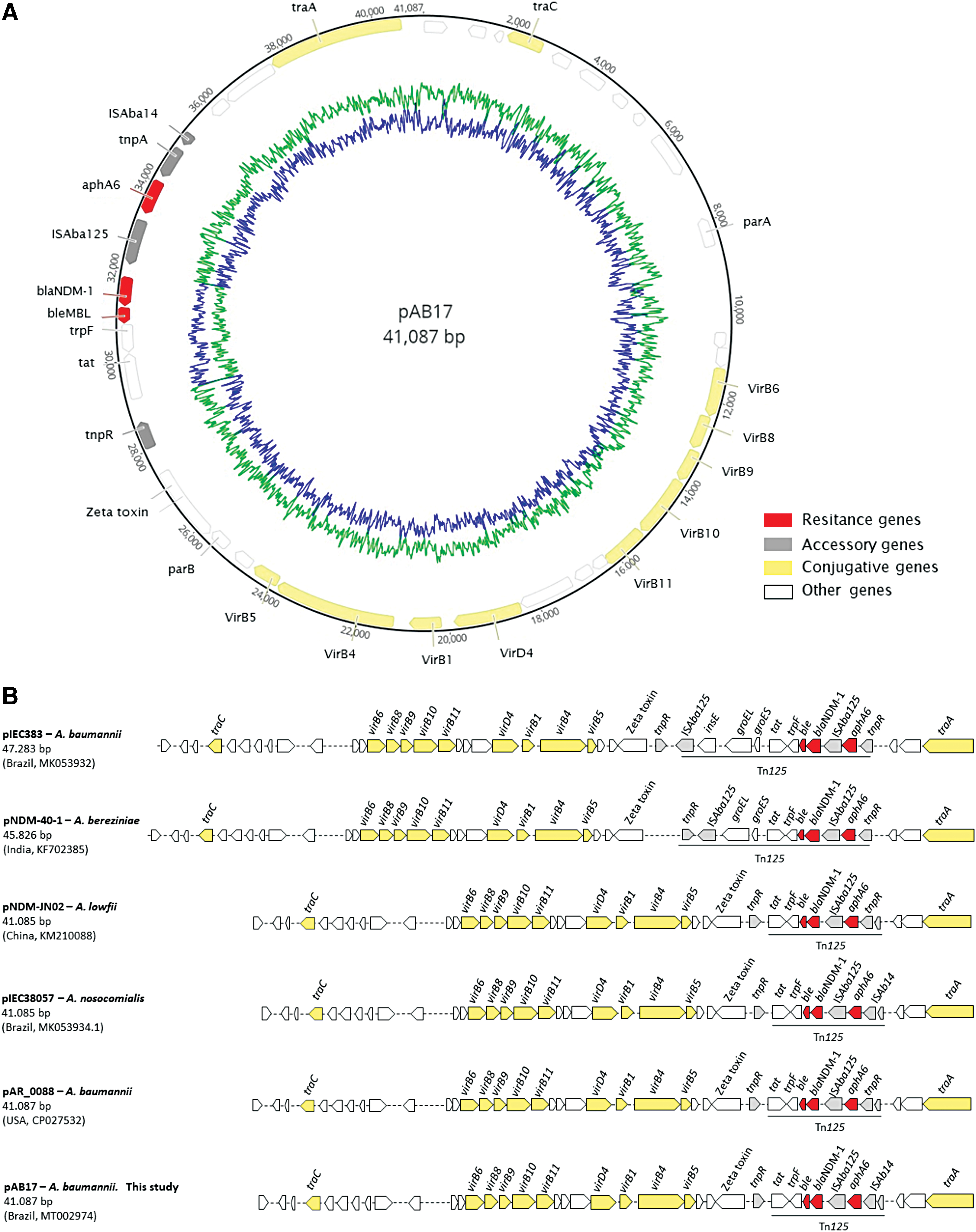
The Figure 1B shows other plasmids that displayed higher similarity with pAb17. The pIEC383 (Brazil), pNDM-40-1 (India), and pNDM-JN02 (China) plasmids displayed 99.9% identity with pAb17; however, they showed the complete Tn125 structure. The pIEC37710 (Brazil) and pAR_0088 (USA) displayed 100% identity with pAB17, and they also showed the deletion of groES-groEL-insE and right-side copy of ISAba125.
Finally, MLST analysis revealed that Ab17 belonged to a novel ST, ST1465/CC216 (https://pubmlst.org/bigsdb?page=profileInfo&db=pubmlst_abaumannii_pasteur_seqdef&scheme_id=2&profile_id=1465).
Discussion
The frequency of carbapenem-resistant A. baumannii strains in Brazil tertiary-care medical centers has increased dramatically.13–15 In this study, we report the genetic characteristics of one clinical carbapenem-resistant A. baumannii, blaNDM-positive, recovered from Minas Gerais, Brazil.
Overall, susceptibility testing showed that antibiotic resistance was higher mainly to carbapenems and 3rd and 4th generation cephalosporins. These results corroborate previous reports, which find that blaNDM-positive strains are also resistant to all β-lactams.16,17
The genetic background of blaNDM usually includes the insertion sequence ISAba125, always upstream of blaNDM, bleMBL always downstream, followed by complete or remnant forms of several genes, including trpF, tat, cutA, groES-groEL, and another ISAba125 element, forming a composite transposon carrying blaNDM, termed Tn125. In Acinetobacter species, blaNDM is usually carried in a highly conserved Tn125 composite transposon on pNDM-BJ01-like plasmids,18,19 but in this study, we describe an unusual plasmid that loses some genes in their Tn125 copy.
pAb17 was identical to another plasmid reported in Acinetobacter nosocomialis in the city of Belém, Brazil (pIEC38057, MK053934.1). Interestingly, both strains were isolated in 2016, and patients also had neurological diseases, however, the strains had been geographically distant by 2,330,4 km (1,448,04 miles). 6 Another identical plasmid was reported in an A. baumannii strain in the USA, in 2018 (pAR_0088, CP027532), suggesting the dissemination of this plasmid containing a Tn125 variant in Acinetobacter sp. of the American continent once it was not found any similar plasmid in the GenBank from Asia or Europe isolates. Besides blaNDM, the plasmid also harbors aphA6 gene in Tn125, a gene that encodes aminoglycoside resistance, 20 which could explain the resistance of amikacin in this strain.
Interestingly, the strain reported herein presented a variant of the gene blaOXA-51, blaOXA-106. This variant differs from blaOXA-51 by one amino acid (His198 → Asp), 21 and to the best our knowledge, this variant has never been reported in Brazil before. The OXA-51-like enzymes are weak carbapenemases, and it has been suggested that they only confer carbapenem resistance if an additional promoter is provided by the insertion of ISAba1 upstream of the structural gene. 22 As previous studies reported, ISAba1 acts as a strong promoter23,24 and, although we did not find this insertion in blaOXA-106, we found it upstream the chromosomal resistance gene blaADC-25, which could justify the higher MIC of Ab17 for cephalosporins. 23
To date, in Brazil, only one NDM-producing A. baumannii had been reported, and it belonged to ST25/CC254. In our study, MLST analysis revealed that Ab17 belongs to a novel ST, ST1465/CC216. Previous studies have shown that this plasmid with a Tn125 variant has spread in Acinetobacter sp., but from different STs: ST71/CC410, ST239, and ST464.6,25,26 Wu et al. 7 showed that NDM-producing Acinetobacter sp. strains are distributed in multiple STs, which suggests that heterogeneity and multiple blaNDM-1 genes exchange among bacterial species. Interestingly, these STs do not belong to the commonly described risk clones (CC1, CC15, and CC79), 27 thus, these new STs deserve further investigation to identify new high-risk clones accountable for the international spread of blaNDM-1 genes.
The availability of online resources, such as BacWGSTdb, for bacterial typing offers rapid classification and source tracing, which is increasingly important in a globalized community. 28 As A. baumannii is an emerging nosocomial pathogen with extended antibiotic resistance, online resources offering rapid typing and phylogenetic relatedness linked to antibiotic resistance genes and clinical data are very useful.
In conclusion, we reported the isolation of NDM-1 in A. baumannii carrying blaOXA-106 variants in Brazil. This study corroborates the literature, which shows the variability of Tn125 among different Acinetobacter species. The continuous isolation of new STs of A. baumannii carrying blaNDM-1 genes elicit our concerns about the dissemination of these genes, since these strains could also act as gene-donors, spreading resistance genes to other bacteria, including Enterobacteriales. Strict control and prevention measures should be taken, once NDM-1-positive A. baumannii has been identified, to prevent transfer of resistance genes to clinically relevant bacteria.
Footnotes
Disclosure Statement
No competing financial interests exist.
Funding Information
This work was supported by the Brazilian Funding Agency FAPEMIG (Fundação de Amparo à Pesquisa de Minas Gerais), CAPES (Coordenação de Aperfeiçoamento de Pessoal de Nível Superior), and CNPq (Conselho Nacional de Desenvolvimento Científico e Tecnológico).