




Abstract
Salmonella is an important foodborne bacterium that has become increasingly resistant to critical antimicrobial and disinfectant agents. The aim of this study was to characterize antimicrobial and disinfectant resistance of Salmonella spp. isolated from ducks raised for meat in Nakhon Pathom province, Thailand. A total of 694 fecal samples from ducks were collected in 2018. Of which, 85 samples were positive for Salmonella (12.2%), and 12 Salmonella serovars were identified from 125 Salmonella isolates. The Altona serovar was the predominant serotype found in this study (36.5%). All isolates showed resistance to at least one class of antimicrobial, and 23.2% displayed multidrug resistance (MDR) phenotype. The blaTEM, aadA2, strA, and dfrA12 genes were detected in antibiotic-resistant strains of Salmonella, whereas the genes within a plasmid-borne qnr family that presented in fluoroquinolone-susceptible Salmonella strains were qnrB (3.8%) and qnrS (1.5%). The minimum inhibitory concentrations of benzalkonium chloride (BKC), cetylpyridium chloride (CPC), and hexadecyltrimethyl ammonium bromide (CTAB) ranged between 128 and 512 μg/mL, while that of didecyldimethylammonium chloride (DDAC) was between 32 and 128 μg/mL. The presences of qacEΔ1, mdfA, sugE(c), sugE(p), and ydgE genes were less prevalent (0.8–1.6%). Taken together, our results indicate that duck is an important source of Salmonella with antimicrobial resistance in food-producing animals. Active surveillance programs for antimicrobial and disinfectant resistance in duck production are needed for an early detection of resistance strains of public health importance.
Introduction
Outbreaks of nontyphoidal Salmonella infection in humans have been reported worldwide. 1 The ability of Salmonella to persist and cause disease in various animal species is one of the key mechanisms that assists in its global dissemination. To get across from animal to human, an ingestion of contaminated food with animal origin, particularly poultry, is considered an important route of transmission of Salmonella infection in humans.2,3
The current demand of duck meat that is regarded as a source of high-quality protein for human consumption is increasing. 4 In consequence, the rate of production of ducks for meat has been growing significantly in many countries, including Thailand. 5 In the past 10 years, Thailand has been ranked among the top 10 countries for duck meat production in Asia and the world market. 6 The export value of duck meat product was estimated at USD 18 million in 2019, an increase of 1% from 2018. 7 Nakhon Pathom province, notable for its livestock production, is located within the main economic area of Central region of Thailand. This province has the highest population of ducks raised for meat in Thailand, where ∼7,000,000 meat-type ducks are raised annually. 8 Due to this intensive duck production, antimicrobials have inevitably been used to treat and control the spread of infectious pathogens among ducks. The extensive or indiscriminate use of antimicrobials on duck farms has led to increased levels of antimicrobial resistance (AMR) in Salmonella and other bacterial pathogens.
Disinfectants are also essential components of disease control programs in hospitals and livestock farms.9,10 Quaternary ammonium compounds (QACs) are widely used on farms for decontamination purpose due to their broad-spectrum antimicrobial efficacy and low toxicity, as well as their low potential to induce corrosion or tissue irritation.11,12 Frequent use of QACs could facilitate bacterial resistance to disinfectants, and several types of bacteria are now resistant to multiple types of antimicrobials by co- or cross-resistance mechanisms. 13 Therefore, QACs may serve as important selective agents for development, selection, and distribution of AMR among bacterial pathogens.
The public health risk from AMR bacteria in humans and animals has been recognized as a critical global health crisis. The responsible use of antimicrobial agents and monitoring programs of AMR in foodborne bacteria along the duck production is a necessary approach to reduce the spread of AMR from farms to consumers through a food chain. Furthermore, the data on AMR will provide useful information for guidelines of effective antimicrobial use, disease control, and prevention program in duck farms. However, there is limited phenotypic and genotypic information concerning antimicrobial and disinfectant resistance of foodborne bacterial pathogens in ducks. In this study, we characterized the antimicrobial and disinfectant resistance of Salmonella isolated from meat-type ducks in Nakhon Pathom province, Thailand.
Materials and Methods
Study sites and sample collection
A total of 694 fecal samples were obtained from three farms (Farm A, B, and C) that raised ducks for meat and consented to participate in this study in 2018. On average, Farms A and C kept ∼4,000 ducks, whereas Farm B owned about 2,000 ducks. All ducks were raised in a conventional open-house system, and each farm had only one flock. During the duck production cycle, 1-day-old ducklings were transported from the same hatchery in Nakhon Pathom province and distributed to each of the studied farms. Ducks were raised from 1-day-old ducklings until they reached around 60–70-day old when they were sent to slaughterhouses for processing. For Farms A and C, ducks were fed commercial feed, whereas ducks on Farm B were fed a home-mixed feed formulation. Water for all farms was from an underground source. During the rearing period, amoxicillin was the most used antibiotic for the treatment of sick birds.
To gauge production cycles, fecal samples from the same flock before slaughter were collected on each farm at three different ages, including 1-day-old ducklings and ducks that were 40–42 days old and 60–70 days old. For 1-day-old ducks, fecal samples were collected from a cardboard delivery container. One cardboard container represented one sample (n = 98). Individual cloacal swabs were taken from randomly selected 40–42 day old (n = 299) and 60–70 day old ducks (n = 297). All samples were maintained on ice and transported to the Faculty of Veterinary medicine on the Kamphaeng Saen campus of Kasetsart University, Nakhon Pathom within 24 hours of sample collection for laboratory analysis.
All sample collection procedures were approved by the Kasetsart University Institutional Animal Care and Use Committee (ACKU61-VET-041).
Isolating and serotyping of Salmonella spp.
Salmonella was isolated from all samples using the standard protocol ISO6579: 2002 (E). 14 Three suspected colonies were collected from each positive sample and confirmed by biochemical testing for Salmonella spp. Serotyping was done using O and H antigen slide agglutination according to the Kauffman–White method using commercially available antiserum (S&A Reagents Lab). One colony for each serotype was obtained from each positive sample. All Salmonella isolates were kept as 20% glycerol stocks at −80°C until further analysis.
Antimicrobial susceptibility testing
Antimicrobial susceptibility of all isolates was tested using a twofold agar dilution method described by the Clinical Laboratory Standards Institute (CLSI) 2013. 15 Eleven antibiotics used in this study and their minimum inhibitory concentration (MIC) breakpoints in blanket were as follows: ampicillin (AMP, 32 μg/mL), cefoperazone (CPZ, 32 μg/mL), ciprofloxacin (CIP, 1 μg/mL), chloramphenicol (CHL, 32 μg/mL), gentamicin (GEN, 16 μg/mL), nalidixic acid (NAL, 32 μg/mL), streptomycin (STR, 32 μg/mL), spectinomycin (SPC, 128 μg/mL), sulfamethoxazole (SUL, 512 μg/mL), tetracycline (TET, 16 μg/mL), and trimethoprim (TRI, 16 μg/mL) (Sigma-Aldrich, St. Loius, MO). Pseudomonas aeruginosa ATCC 27853, Staphylococcus aureus ATCC 25923, and Escherichia coli ATCC 25922 served as reference strains. The Salmonella isolates were considered to be of multidrug resistance (MDR) if they were resistant to at least three different classes of antibiotics.
Disinfectant susceptibility testing
Disinfectant susceptibilities of all isolates were tested by a twofold agar dilution method according to 2013 guidelines from the CLSI. 15 Four disinfectant agents, benzalkonium chloride (BKC), hexadecyltrimethyl ammonium bromide (CTAB), didecyldimethylammonium chloride (DDAC), and cetylpyridium chloride (CPC), were tested (Sigma-Aldrich). The concentration range for all QACs was 0.125–512 μg/mL. 10 E. coli ATCC 10536 was used as a reference strain.
Detection of antimicrobial and QAC resistance genes by PCR amplification
All Salmonella isolates were screened for the presence of antibiotic resistance genes and QAC resistance genes by PCR using specific primers (Table 1). DNA templates were prepared using a boiled whole-cell lysate method. 16 PCR mixtures had a total volume of 25 μL, which contained 12.5 μL of 2 × DreamTaq Green PCR Master Mix (Thermo Scientific), 0.2 μM each of forward and reverse primer, and 10 ng of DNA template. PCR products were visualized on 2% (w/v) agarose gels. Positive-PCR products were purified with a GF-1 PCR Clean-Up Kit (Vivantis, Malaysia) and confirmed by DNA sequencing (Macrogen, Seoul, Korea).
Primers Used in this Study
QAC, quaternary ammonium compound.
The positive control of antibiotic resistance genes was obtained from previous studies.17–19 The positive control of QAC-resistance genes, including qacEΔ1, sugE (c), sugE (p), mdfA, and ydgE genes, was from field isolates of Salmonella that was confirmed by PCR and DNA sequencing (Macrogen). The other QAC-resistance genes were constructed by gBlocksTMGene Fragments (IDT: Integrated DNA Technologies, Inc., Coralville, IA) and used as positive controls.
Statistical analysis
Data analyses were performed with R version 3.6.1. The significance (p < 0.05) of differences in Salmonella spp. isolation rates among farms in the study was evaluated by a chi-squared (χ 2 ) test, as was the association between: (1) MIC values for antibiotics and presence of AMR genes and (2) MIC values of disinfectants and presence of disinfectant resistance genes.
Results
Prevalence and serotypes of Salmonella spp.
Of the 694 fecal samples examined, 85 were positive for Salmonella (12.2%). Among the Salmonella-positive samples, the highest percentage of Salmonella spp. was seen for farm B (30.6%). Significant differences in the percentage of Salmonella-positive isolates recovered from ducks of different ages were seen only for Farm B (p < 0.001) (Table 2). On Farm B, 70-day-old ducks had the highest percentage of Salmonella-positive isolates relative to the other age groups.
Number of Positive-Salmonella Feces Samples Collected from Ducks at Different Ages
Significantly different (p ≤ 0.05).
In Salmonella serotyping, 12 different Salmonella serovars were identified from among 125 Salmonella isolates. The Altona (36.5%) and Orion (33.6%) serovars were the most frequent in samples collected for this study (Table 3).
Salmonella Serovars in 125 Salmonella Isolates from Salmonella-Positive Feces Samples Collected from Ducks
Antibiotic resistance profiles
Of the 125 Salmonella isolates, all isolates (100%) were resistant to at least one type of antibiotic and 23.2% were of MDR. All of the isolates were resistant to SUL (100%), followed by TET (21.6%), STR (19.2%), SPC (15.2%), AMP (13.6%), CHL (10.4%), NAL (8.8%), and TRI (3.2%) (Fig. 1). None of the isolates was resistant to CPZ, CIP, and GEN. We observed 29 different AMR patterns among the samples collected for this study. Resistance to SUL alone (52.8%) was the predominant resistance pattern, followed by SUL-TET (7.2%), STR-SUL (4%), and SPC-SUL (4%) (Table 4).
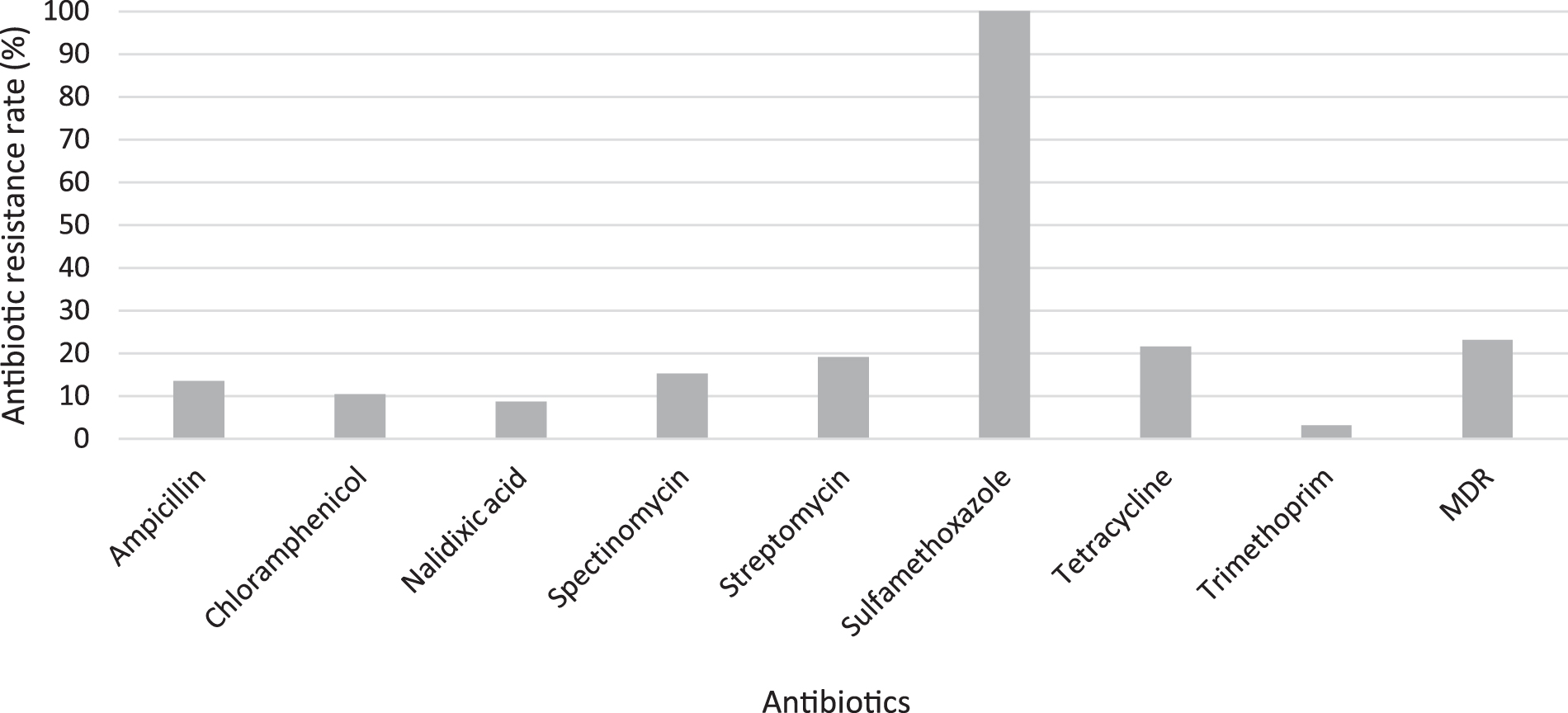
Percentages of antimicrobial resistance rate in Salmonella enterica from meat-type ducks (n = 125).
Antibiotic Resistance Profile of Salmonella Isolates (n = 125)
AMP, ampicillin; CHL, chloramphenicol; NAL, nalidixic acid; SPC, spectinomycin; STR, streptomycin; SUL, sulfamethoxazole; TET, tetracycline; TRI, trimethoprim.
MICs of quaternary ammonium compound
Among the 125 Salmonella isolates, the MICs for BKC, CPC, and CTAB ranged between 128 and 512 μg/mL, and for DDAC, the MIC was between 32 and 128 μg/mL (Table 5). The MIC of E. coli ATCC 10536 used for comparison was 32, 64, 32, and 8 μg/mL for BKC, CPC, CTAB, and DDAC, respectively. All isolates exhibited reduced susceptibility to all of the QACs compared to the reference strain. The MIC50 and MIC90 values for DDAC were the lowest among all the QACs tested. No association between the MIC for antibiotics and disinfectants was observed (p > 0.05).
Minimum Inhibitory Concentration for Quaternary Ammonium Compounds for Salmonella Isolates from Duck Feces (n = 125)
BKC, benzalkonium chloride; CPC, cetylpyridium chloride; CTAB, hexadecyltrimethyl ammonium bromide; DDAC, didecyldimethylammonium chloride; MIC, minimum inhibitory concentration.
Presence of antibiotic and disinfectant resistance genes
Among 125 Salmonella isolates, antibiotic resistance genes were identified with the following frequencies: aadA2 (12.8%), blaTEM (6.4%), strA (4.8%), sul3 (4%), sul2 (2.4%), and dfrA12 genes (0.8%). None of the isolates carried corresponding resistance genes for CHL (catA, catB, cmlA) and TET (tetA, tetB, tetC, tetD). Screening of all Salmonella isolates for qnr (A, B, S) family genes showed that 4 (3.2%) were positive for the qnrB (3.2%) gene, 2 (1.6%) contained the qnrS (1.6%) gene, and none carried the qnrA gene (Table 6).
Presence of Antibiotic Resistance Genes in Salmonella enterica Serovar from Ducks (n = 125)
Among all of 125 Salmonella isolates, the qacEΔ1 and sugE(p) genes were identified in 2 (1.6%) and 2 (1.6%) of isolates, respectively. The mdfA, surE(c), and ydgE genes were identified in one Salmonella Muenster isolate (Table 7).
Salmonella Isolates Carried Quaternary Ammonium Compound Resistance Gene (n = 5)
Discussion
Duck production is an important part of agriculture industries in many countries. AMR monitoring of Salmonella in ducks is expanding to address the growing prevalence of AMR on farms producing ducks for meat. However, to our knowledge, no studies have examined Salmonella AMR in ducks raised for meat in Thailand. In this study, we detected the presence of Salmonella in 12.2% of duck fecal samples. This rate was higher than that reported from previous studies in ducks from Shandong province, China (2.1%, 49/2,342) 20 and Taiwan (4.6%, 91/2,000), 21 but lower than that seen in Korea (20.75%, 83/400). 22
There were significant differences in the prevalence of Salmonella among the three farms in this study. The prevalence of Salmonella increased only for Farm B across production stages as evidenced by the gradual increase in the frequency of Salmonella-positive isolates as the ducks progressed from duckling to 60–70 days old. Multiple risk factors, including animal health, animal age, farm management techniques, and feed and water management, could influence the distribution of Salmonella on each farm. For example, on Farm B the feed was produced by mixing feed ingredients on farm site, whereas the other two farms (A and C) used only commercial feeds (data from personal interviews). Feed and feed ingredients are considered as important sources of Salmonella contamination in poultry farms. 23 A report on comparison of Salmonella contamination between commercial feed and on-farm home mixers revealed that the prevalence of Salmonella contamination in homemade feed was higher than that in commercial feed. 24 This might be associated with several factors, including unhygienic feed preparation, dirty feed storage area, farm environment, and harvesting equipment. In contrast to on-farm home mixers, there are several processing steps; one is heat treatment to reduce Salmonella contamination in feed and their ingredients at commercial feed mills. 25 However, an additional study is required to determine risk factors that are related to the distribution of Salmonella spp. on farms and to develop strategies that could reduce and control Salmonella contamination on duck farms and of products generated from ducks.
Altona and Orion were the main serotypes observed in this study, which is in contrast to findings by other studies. Salmonella Enteritidis and Salmonella Typhimurium were the predominant serotypes isolated from ducks in several Asian countries, including China, South Korea, and Malaysia,4,20,26 whereas Salmonella Potsdam was most prevalent in duck in Taiwan. 21 Another report concerning the prevalence of Salmonella serotype isolated from laying ducks in Thailand revealed that Salmonella Hvittingfoss, Salmonella Mbandaka, and Salmonella I 4,5,12:i:-were the most common serotypes. 27 In comparison to other food-producing animals, Salmonella Typhimurium and Salmonella Rissen were the most frequent serotypes found in pigs and pig products, while the prevalence of Salmonella Enteritidis and Salmonella Corvallis were the predominant serotypes in chicken in Thailand.28–30 As such, differences in the prevalence of Salmonella serotypes may also be affected by factors such as geographic area, sampling time, farm management, and types of animals.
The result of antibiotic susceptibility in our study revealed the low rates of resistance to several types of antibiotics, including AMP, TET, and SPC, compared to previous studies involving ducks, broilers, chicken meat, and pigs.21,29,31,32 This variation in AMR rates seen for individual regions or countries could be related to different use of antibiotics for livestock production in different geographical areas.
All of the Salmonella isolates in our study were resistant to SUL, which was consistent with previous studies with ducks and chickens,33,34 as well as with findings for other livestock products such as pigs and broiler chickens raised in different regions of Thailand.17,29 Notably, a high prevalence of SUL-resistant Salmonella isolates recovered from ducks was seen even though the farms had no history of sulfonamide use across multiple years. Thus, cross-resistance mechanisms or the dissemination of AMR bacterial isolates from the environment or other livestock farms could have been introduced to duck farms through infected animals, humans, or other vectors. 35 Analysis of the relationships of these bacterial strains at a genetic level is necessary to determine the source of these resistant Salmonella isolates.
In this study, the MIC data indicated that the Salmonella isolates were more susceptible to DDAC than the other three QACs. This result is consistent with previous studies for chickens 11 and cattle. 36 Moreover, the MIC value for BKC in our study was similar to that reported by Chuanchuen et al., who found that Salmonella spp. collected from poultry and swine in Thailand had BKC MIC values that ranged between 128 and 256 μg/mL, which indicated reduced susceptibility to BKC. Aarestrup and Hasman (2004) also examined the susceptibility to disinfectants of different bacterial species and found that the MIC range (64–256 μg/mL) for Salmonella spp. was higher than that for other bacterial species. Notably, the MIC ranges for Salmonella isolates reported in other studies18,37 were similar to the ranges found for this study. There could be intrinsic mechanisms that modulate phenotypic levels of BKC susceptibility for Salmonella spp. 13
This study revealed a lower prevalence of antimicrobial genes comparing to the previous reports,19,20 and there was no association between an antimicrobial-resistant phenotype and the presence of AMR genes (p > 0.05). At a phenotypic level, all the isolates were resistant to SUL, but only 5.3% were positive to sul2 and sul3 genes. The absence of sul genes (sul1, sul2, sul3) in sulfonamide-resistance strains was likely due to other sul alleles such as sul4 gene 38 or mutations in the chromosomal flop gene 39 in those isolates. Furthermore, some Salmonella isolates in this study were resistant to several antibiotics such as TET and CHL, but no corresponding antibiotic resistance genes were detected. This outcome could be due to the presence of other resistance genes or resistance mechanisms that were not identified in this study.
Meanwhile, plasmid-mediated quinolone resistance (PMQR) genes associated with quinolone resistance were observed among the quinolone-susceptible Salmonella strains identified in this study. The presence of qnrB (3.2%) and qnrS (1.6%) genes slightly differed from a study conducted in Shandong, China which showed that Salmonella spp. from ducks lacked these genes. 20 Furthermore, the qnrB, qnrS, and aac(6′)-Ib genes were also frequently observed as the predominant genes in CIP-susceptible Salmonella strains isolated from humans and pigs in Northeastern region of Thailand. 17 In addition, the study in Japan revealed a qnrS gene in Salmonella Corvallis with a low MIC value for CIP (0.25–2 μg/mL), and these strains were isolated from patients returning from Thailand. 40 Other research groups found that fluoroquinolone sensitive strains also carried plasmid-mediated fluoroquinolone resistance (PMQR) genes. The finding has raised a concern over the possibility of a lower susceptibility to CIP among pathogens, 41 as these genes can be distributed in different hosts through horizontal gene transfer (HGT) mechanism.
The low prevalence of QAC-resistance genes observed in Salmonella isolated from this study was consistent with reports from layer chickens. 11 Our results showed that the presence of plasmid-encoded QAC genes (qacEΔ1, sugE(p)) and antibiotic resistance genes was found in the same Salmonella isolates (n = 4). The qacEΔ1 and sugE(p) genes are located on mobile genetic elements, which can coselect antibiotic resistance genes and enhance the spread of resistance genes by HGT. It is possible that the use of QAC may facilitate bacterial resistance to disinfectants and coresistance to multiple types of antibiotics. 13 However, further experiments will thus be needed to elucidate the colocalization of AMR and disinfectant resistant genes on the same mobile genetic elements in these isolates.
In conclusion, this study represents a first report on the phenotypic and genotypic characteristics of antimicrobial- and disinfectant-resistant Salmonella strains isolated from meat-type ducks in Thailand. Our results demonstrate that ducks can serve as an important reservoir for MDR Salmonella. Even though the prevalence of AMR observed in this study was low, baseline data for AMR represent an essential tool to achieve a better understanding of AMR trends in foodborne pathogens and can be used to develop national antibiotic guidelines and policies to increase awareness of antimicrobial use on duck farms. Such guidelines can help minimize the spread of AMR from farm animals to humans. To safeguard livestock on farms from bacteria that are resistant to disinfectants, active monitoring of disinfectant resistance should also be performed. To gain a clearer picture of AMR in poultry production, additional research involving larger populations of ducks across several regions is required, as is an expanded knowledge of molecular and genetic resistance mechanisms associated with AMR in food animals and humans.
Footnotes
Disclosure Statement
No competing financial interests exist.
Funding Information
This work was financially supported by a Research Grant for New Scholar, MRG6180057, and was cofunded by the Thailand Science Research and Innovation Fund (TSRI) and the Faculty of Veterinary Medicine at Kasetsart University.