




Abstract
This study was undertaken to assess the prevalence of extended-spectrum β-lactamase (ESBL)-producing Escherichia coli (ESBL-EC) among blow fly (Chrysomya megacephala) populations in Northern Thailand. Of 600 blow flies collected from rural (n = 400) and urban (n = 200) areas, 334 blow flies carried ESBL-EC (55.7%). Prevalence of ESBL-EC in blow flies captured from rural areas was significantly higher than that from urban region (72.5% vs. 22.0%, p < 0.001). Susceptibility tests revealed that 68.6% of ESBL-EC possessed multidrug-resistant phenotypes. Coresistance to gentamicin (85%) was common, while resistance to ciprofloxacin was relatively low (18.0%). Of the 334 isolates, 253 isolates (75.7%) harbored blaCTX-M, in which blaCTX-M group 1 was predominant (56.5%), followed by blaCTX-M group 9 (39.1%). Interestingly, a single isolate was found to carry blaCTX-M-5, which resided on the IncA/C conjugative plasmid. This is the first report of blaCTX-M-5 from Thailand and its first identification in blow fly. Pulsed field gel electrophoresis (PFGE) demonstrated high genetic diversity among ESBL-EC isolates. Nevertheless, identical and closely related PFGE profiles were detected among isolates within the same regions and the regions which are several kilometers apart, suggesting that clonal transmission has occurred. Moreover, epidemiologically related isolates were observed between ESBL-EC from blow flies and human intestinal tract. This study provides evidences that blow flies, C. megacephala, are important reservoirs for ESBL-EC and could potentially act as vectors for the spread of ESBL-EC in a Thai community.
Introduction
Multidrug-resistant (MDR) Enterobacterales, particularly Escherichia coli, are important causes of life-threatening infections in hospital and community. Enterobacterales resistant to various antimicrobial classes have continuously been reported from several countries in different continents, however, in Thailand, resistance to third-generation cephalosporins by the production of extended-spectrum β-lactamase (ESBL) is the major public health concern. 1 According to the National Antimicrobial Resistance Surveillance Center Thailand, data collecting from 92 hospitals during January to December 2019 revealed that resistance rates for cefotaxime, ceftazidime, and ceftriaxone in E. coli (n = 98,720) were 45.0%, 34.3% and 43.9%, respectively. 2 Several ESBL-encoding genes have been discovered, however, blaCTX-M is the most frequently detected gene in Thailand. 1
Reports from several countries, including Thailand, revealed that ESBL-producing E. coli (ESBL-EC) have been isolated from humans, environments, and animals.3–5 In addition, flies have increasingly been documented as an important reservoir for antimicrobial-resistant (AMR) bacteria. 6 This is a growing public health threat because flies are usually in close contact with human, food, and animal and have the ability to travel long distances, thereby transferring AMR bacteria to different environments. Moreover, it has been shown that AMR bacteria could persist in flies throughout their life cycle, therefore, horizontal gene transfer of plasmid carrying AMR genes readily occurs among fly intestinal microbiota. 6 Flies have been demonstrated to act as efficient vectors for the dissemination of various AMR bacteria such as Methicillin-Resistant Staphylococus aureus, ESBL-producing Enterobacterales, carbapenem-resistant Enterobacterales, as well as the highly virulent E. coli ST131, within hospitals and communities.6–9 Furthermore, a study from the Netherlands revealed that ESBL-EC from flies recovered from broiler farm shared identical sequence types with isolates in rinse water and animal manure from the same farm. 7 Similarly, a German study showed that AMR bacteria in flies obtained from rural and urban areas were genetically related to those in patients. 10 These studies support the role of flies as vectors for the spread of AMR bacteria within community.
In this study, the impact of flies as a possible reservoir for ESBL-EC was investigated. Our study focused on blow flies, particularly Chrysomya megacephala (Diptera: Calliphoridae) because they carry a large number of bacteria, ca. 11–12 times greater than those in house flies. 11 C. megacephala (also known as the oriental latrine fly) is distributed globally and is the most abundant blow fly species in Thailand. 12 C. megacephala can be found in various habitats such as urban and rural areas, natural resources, and animal farms, particularly in animal manure. 13 Several studies in Thailand revealed that flies (blow flies and house flies) carried many pathogenic bacteria, including ESBL-EC, colistin-resistant E. coli, and Klebsiella pneumoniae.11,14,15 A recent report from Thailand showed the presence of ESBL-EC from flies collected at five open-fresh markets near Bangkok, however, a limited number of flies were investigated. 16 To gain a better understanding on the role of flies in the dissemination of ESBL-EC, further surveillance is needed. This study was conducted to assess the prevalence of ESBL-EC in blow flies and to investigate the molecular epidemiology of ESBL-EC in a Thai community.
Materials and Methods
Blow fly samplings
Blow fly samplings were conducted in Phitsanulok province, Northern Thailand from February to March 2016. Blow flies were caught at five different locations, including agricultural areas in rural communities (Regions A–D, 100 blow flies/Region) and an open market in an urban community (Region E, 200 blow flies). The locations and distances between these regions are shown in Fig. 1.

Location of blow fly sampling areas in Phitsanulok province, Northern Thailand. Regions (A–D) are rural areas with a high density of agricultural activities, including livestock farms, while Region E is an open market in an urban community. The distances (km) between each region are shown.
A total of 600 blow flies were collected by using sterile nylon sweeping nets. To minimize risks of contamination, after a single use, a net was sterilized by autoclaving and dried in a hot air oven at 50°C for 30 minutes. Four-day tainted pork liver offal was used as bait, which was put in a plastic container and placed on the ground. Individual fly was kept in a sterile plastic tube, sacrificed by placing on ice for 30 minutes, transported to the laboratory and processed immediately. They were identified to the species level by using the taxonomic keys of Kurahashi and Bunchu. 17 Only C. megacephala flies were selected for further analysis.
Isolation and identification of ESBL-producing E. coli
Blow flies were individually pulverized in 10 mL enriched peptone water for 30 minutes and 100 μL of the suspensions were plated on Eosin-Methylene-Blue (EMB)-agar plates supplemented with 1 μg/mL cefotaxime (Sigma Aldrich) and incubated under aerobic condition at 37°C for 24 hours. One presumptive E. coli colony isolated from each sample was subcultured on Tryptic Soy Agar (TSA; Oxoid, Basingstoke, United Kingdom) and incubated as described above for further characterizations. Species identification was performed by standard biochemical testing (Gram stain, growth on EMB agar, oxidase test, and citrate test). Suspected colonies were identified by using RapID™ ONE System (REMEL, Inc.) according to the manufacturer's instruction. Phenotypic detection of ESBL production was performed using combination disk method with cefotaxime and ceftazidime in the presence or absence of clavulanic acid, according to the Clinical and Laboratory Standards Institute (CLSI) guidelines. 18
Antimicrobial susceptibility test
All isolates were tested for susceptibility to 12 antimicrobial agents (ampicillin, cefoxitin, cefotaxime, ceftazidime, cefepime, aztreonam, imipenem, amikacin, gentamicin, trimethoprim/sulfamethoxazole, ciprofloxacin, and doxycycline) by disk diffusion method according to CLSI protocols. 18 Isolates showing intermediate results were considered as susceptible. An isolate was defined as MDR if it was resistant to at least three or more antimicrobial classes. 19
Screening for blaCTX-M by multiplex polymerase chain reaction and sequencing
All ESBL-EC isolates were screened for the presence of blaCTX-M by multiplex polymerase chain reaction (PCR) as previously described. 20 blaCTX-M-positive E. coli from our previous study 5 and sterile dH2O were used as positive and negative controls, respectively. Selected PCR products were purified using a DNA purification kit (RBC Bioscience, New Taipei City, Taiwan) and sequenced by First BASE Laboratories (Selangor, Malaysia). The obtained sequences were compared with those available in the GenBank database using the BLAST algorithm available on the National Center for Biotechnology Information (NCBI) website.
Identification of blaCTX-M alleles of blaCTX-M group 2 was performed using primers (5′-ATGATGACTCAGAGCATTCG-3′ and 5′-TTATTGCATCAGAAACCGTG-3′; 884 bp) and condition as previously described. 21 PCR products were purified, sequenced, and analyzed as described above.
Conjugation and plasmid replicon typing
The transferability of blaCTX-M was investigated by broth mating method using rifampin-resistant E. coli DH5α as a recipient as previously described. 4 Cultures of donor and recipient cells were mixed and incubated overnight at 37°C without shaking. Transconjugants were selected on TSA supplemented with rifampin (16 μg/mL) and cefotaxime (1 μg/mL). Conjugation frequency was expressed as the number of transconjugants divided by the number of donor cells. Transfer of blaCTX-M was confirmed by PCR. Minimum inhibitory concentrations (MICs) of transconjugants were determined by broth microdilution method according to CLSI protocols 18 and plasmid incompatibility groups were determined by PCR-based replicon typing (PBRT). 22
Pulsed field gel electrophoresis
To study the genetic relationship of ESBL-EC isolates, pulsed field gel electrophoresis (PFGE) was performed. Chromosomal DNA of E. coli in agarose plugs was prepared and digested with the restriction enzyme XbaI (Thermo Fisher Scientific, Waltham, MA) as previously described. 23 Plugs were then subjected to PFGE analysis in 1% agarose gel (Pulsed Field Certified™ agarose; Bio-Rad Laboratories, Hercules, CA) and 0.5 × Tris-borate-EDTA buffer using a CHEF Mapper® XA System (Bio-Rad Laboratories). The gels were run at 6.0 V/cm with an angle of 120 at 14°C for 20 hours. Saccharomyces cerevisiae chromosomal DNA (Bio-Rad Laboratories) was used as a molecular size standard. PFGE profiles were visually analyzed and interpreted according to the criteria established by Tenover et al. (Institutional Review Board No. 215/56, Naresuan University). 24
In addition, ESBL-EC isolates from human (n = 43) 3 and chicken meat (n = 14) 4 that shared similar rep-PCR patterns with those from blow flies (unpublished data) were included in PFGE analysis. They were obtained from our previous AMR surveillance surveys in the same study area and stored at −70°C on cryo-bead (biomérieux, Marcy l’ Etoile, France).
Nucleotide sequence accession number
Nucleotide sequences of blaCTX-M-5 gene were deposited in the GenBank database under the accession number MF596171.
Results
Prevalence of ESBL-EC from C. megacephala and antimicrobial susceptibility test
Overall, from a total of 600 blow flies, 334 ESBL-EC isolates from 334 blow flies (55.7%) were recovered. In rural communities (Regions A–D), more than half of C. megacephala carried ESBL-EC. Prevalence of ESBL-EC was significantly higher in rural communities (72.5%) compared with that in an urban area (22.0%; p < 0.001, Two proportion Z-test) (Table 1). All 334 ESBL-EC isolates were resistance to ampicillin and cefotaxime (Table 2). A large number of isolates w
Prevalence of Extended-Spectrum β-Lactamase-Producing Escherichia coli from Blow Flies
ESBL, extended-spectrum β-lactamase.
Antimicrobial-Resistant Rates of Extended-Spectrum β-Lactamase-Producing Escherichia coli Recovered from Blow Flies (n = 334)
Detection of blaCTX-M
Of the 334 ESBL-producers, 253 isolates carried blaCTX-M (75.7%). The most frequently detected gene was blaCTX-M-group 1 (56.5%, 143/253) followed by blaCTX-M- group 9 (39.1%, 99/253). Ten isolates (4.0%, 10/253) simultaneously carried blaCTX-M- group 1 and blaCTX-M-group 9 (Table 1). Interestingly, a single ESBL-EC isolate, F235, from a blow fly in an open market was positive for blaCTX-M- group 2. Full-length amplification was performed and sequence analysis revealed that it was identical to blaCTX-M-5.
Conjugation experiments and plasmid replicon typing
Conjugation experiments were performed with randomly selected E. coli containing blaCTX-M (five blaCTX-M- group 1, five blaCTX-M- group 9, and one blaCTX-M-5) as donors. Four blaCTX-M- group 1- and five blaCTX-M-group 9-carrying isolates were able to transfer their blaCTX-M to the recipient, E. coli DH5α, with the conjugation frequencies of 6.0 × 10⁻⁶ to 1.0 × 10⁻³ and 6.2 × 10⁻⁶ to 3.0 × 10⁻³ for blaCTX-M-group 1 and blaCTX-M- group 9, respectively (Supplementary Table S1). Cefotaxime MICs were 128- to 256-fold increase and 64- to 256-fold increase in transconjugants carrying blaCTX-M-group 1 (MICs = 64–128 μg/mL) and blaCTX-M- group 9 (MICs = 32–128 μg/mL), respectively, compared with that in the recipient E. coli DH5α (MIC = 0.5 μg/mL) (Supplementary Table S1). Plasmids carrying blaCTX-M- group 1 were identified by PBRT, as IncN (n = 1) and IncFIB (n = 1), while those in two transconjugants were untypeable. All five blaCTX-M- group 9 transconjugants were typed as IncFIB (Supplementary Table S1). blaCTX-M-5 was successfully transferred to E. coli DH5α at the frequency of 5.8 × 10⁻⁸. Transconjugant carrying blaCTX-M-5 showed 16-fold increase in cefotaxime MIC (8 μg/mL) compared with that in E. coli DH5α (0.5 μg/mL). Plasmid carrying blaCTX-M-5 was typed as IncA/C (Supplementary Table S1).
Pulsed field gel electrophoresis
Genetic relationship among ESBL-EC isolates was investigated by PFGE. Seventy-seven E. coli isolates were available for analysis and their representative PFGE profiles are presented in Fig. 2. Various PFGE profiles were observed, suggesting the high genetic diversity. However, identical or closely-related PFGE profiles were found among isolates obtaining from the same regions, such as ESBL-EC isolates in the rural areas (Regions A, C, D) and urban area (Region E). In addition, genetic similarities of isolates obtained from different regions were noted, that is, ESBL-EC isolates from Regions A and D (F70 and F581), Regions B and D (F429 and F520), as well as Regions C and E (F175, F184, F306, F307, F309, F313, F340, and F399).
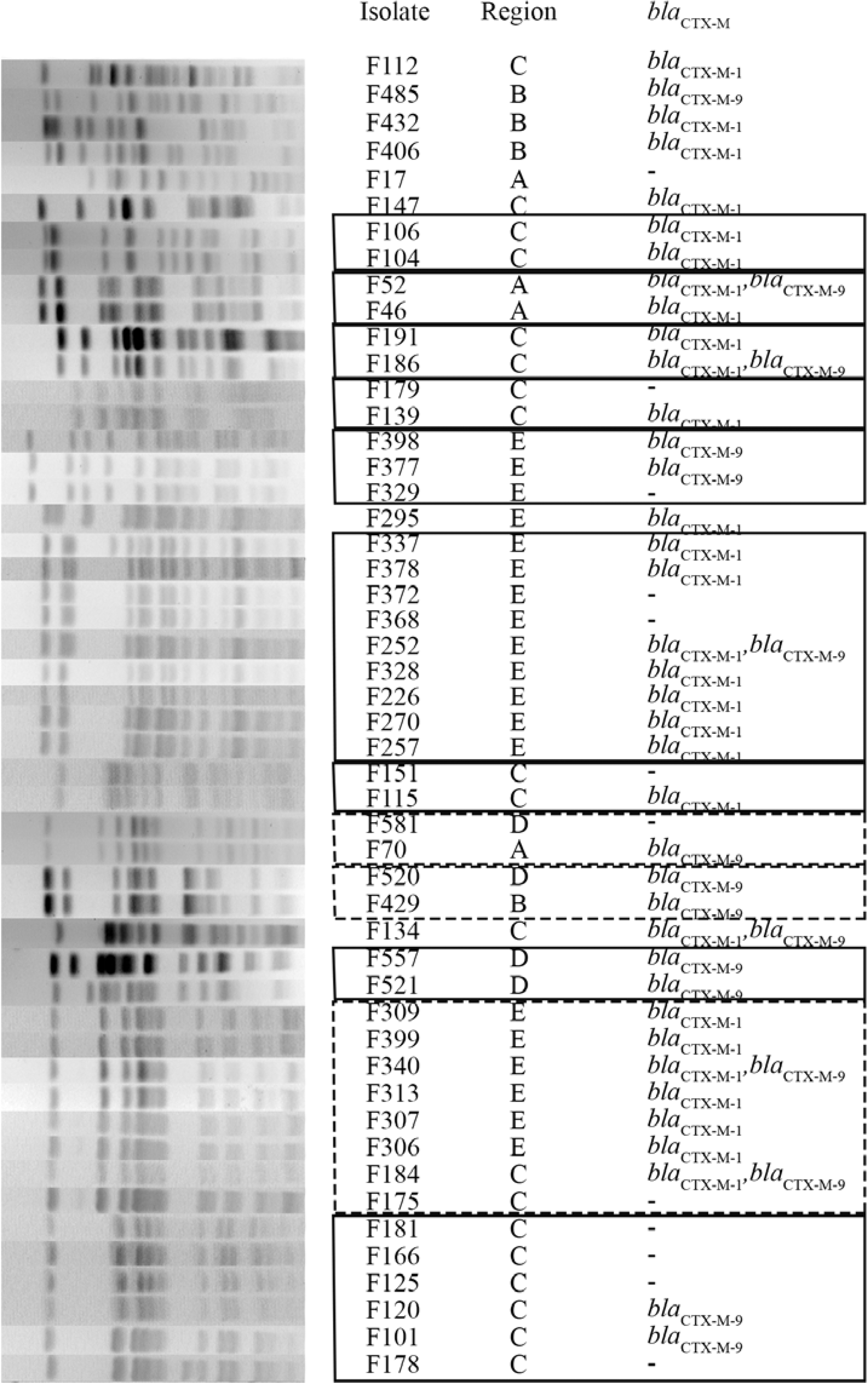
Representative XbaI-PFGE profiles of ESBL-producing Escherichia coli from blow flies. The solid and dashed boxes indicate the genetically related isolates, according to Tenover et al., 24 in the same and different regions, respectively. ESBL, extended-spectrum β-lactamase; PFGE, pulsed field gel electrophoresis.
PFGE profiles of ESBL-EC from blow flies were further compared with those obtained from human intestinal flora (n = 43) and chicken meat (n = 14), which were recovered from the same study area. The majority of isolates showed unique PFGE patterns (results not shown). However, the genotypic similarity was observed in one case, in which PFGE profiles of ESBL-EC from blow flies (F309 and F399) were highly similar to that recovered from human intestinal tract (C323) (Fig. 3).

Representative XbaI-PFGE profiles of ESBL-producing Escherichia coli from blow flies, human and chicken meat. The solid box indicates the genetically related isolates, according to Tenover et al. 24
Discussion
Flies have been suggested to act as potential vectors for the spread of AMR bacteria in different environments. 6 The prevalence of ESBL-EC carried by flies reported, to date, remains below 18%, regardless of types of flies (house flies, blow flies, and flesh flies), sampling sites (livestock farms, residential areas, and open markets), and studied areas (Europe, United States).7,25–27 In our study, the prevalence of ESBL-EC among blow fly populations was notably high (55.7%). In addition, we observed that the prevalence of ESBL-EC in blow flies from rural communities was significantly higher than that from an urban area (72.5% vs. 22.0%, p < 0.001), similar to that reported previously from Germany. 10 This may be due to the fact that in rural communities, there is a high density of agricultural activities, particularly livestock farms, which have extensively been shown to be important reservoirs for ESBL-producing bacteria.5,7,25 Susceptibility tests revealed that almost 70% of ESBL-EC possessed MDR phenotypes and coresistance to gentamicin was common (85%).
Of the 334 ESBL-EC isolates, 75.7% of isolates carried genes for CTX-M β-lactamases, which were classified into 2 groups, including blaCTX-M group 1 and blaCTX-M group 9. The high conjugation frequencies of blaCTX-M (10−6 to 10−3) coincide with the increased in community-acquired CTX-M-positive infections in Thailand.28,29 The most common plasmid replicon type was IncFIB, consistent with the blaCTX-M-carrying plasmids previously reported from Enterobacterales. 30
Interestingly, a single isolate, F235, obtained from a blow fly in an open market in an urban area (Region E), was positive for blaCTX-M-5. To the best of our knowledge, this is the first identification of blaCTX-M-5 in Thailand, suggesting the further geographical distribution of this gene. blaCTX-M-5 was initially found in a clinical isolate of Salmonella Typhimurium in Latvia. 31 Compared to other blaCTX-M genes, which have now been spread worldwide, the occurrence of blaCTX-M-5 is very infrequent. It is mostly detected in S. Typhimurium and, to the lesser extent E. coli, in Eastern Europe that is, Russia, Belarus, and Kazakhstan.32–34 blaCTX-M-5 has occasionally been detected in S. Typhimurium in Greece and the United States35,36 and E. coli in Nicaragua. 37 Moreover, all blaCTX-M-5-positive bacteria, to date, were recovered from human clinical specimens. This study reports, for the first time, that blaCTX-M-5 was found in blow fly, C. megacephala.
Due to the fact that several CTX-M-encoding genes reside on mobile genetic elements, that is, transferable plasmid, it is not unexpected that blaCTX-M is currently seen in numerous bacterial species. In contrast, blaCTX-M-5 has been suggested to be located on the chromosome 36 or a small nonself-transmissible plasmid (7.4–12 kb),31,32,34 which may explain its rare occurrence. However, two studies demonstrated that blaCTX-M-5 in a limited number of isolates was transferrable at low frequencies (10−8 to 10−7), suggesting that blaCTX-M-5 was located on the nonconjugative plasmid, but can be mobilized by another coexisting plasmid.32,34 This may be the case for our blaCTX-M-5 since it was transferable at low frequency (10−8). Nevertheless, the fact that our blaCTX-M-5 resides on the broad host range IncA/C plasmid 30 raises the concern that blaCTX-M-5 may have already spread to many different gram-negative bacteria.
Genotypic characterizations of ESBL-EC among blow flies were investigated. Although, similar PFGE profiles of isolates within the same region were noted, most isolates showed unique PFGE profiles, suggesting that the high prevalence of ESBL-EC among blow flies was not associated with the dissemination of a specific clone (Fig. 2). These results imply that horizontal gene transfer plays an important role in the transmission of blaCTX-M among ESBL-EC in blow fly populations. This is supported by the conjugative transfer of blaCTX-M-carrying plasmid into E. coli DH5α (Supplementary Table S1). In addition, transmissions of ESBL-EC among blow flies between regions has occurred (Fig. 2). For instance, we noted the similar PFGE profiles of isolates between Regions A and D, Regions B and D, and Regions C and E, which are 5.6, 5.9, and 9.1 km, respectively, away from each other (Fig. 1). These results are not unexpected since C. megacephala have the remarkable ability to fly freely and the flight range of C. megacephala has been estimated to be up to 2–3 km/day. 13 Even though blow flies travel only short distances, ESBL-EC may still be disseminated to people living nearby and further dispersal to other areas by transportation. A study in Argentina revealed that C. megacephala could travel 500 km from the known distribution of species. 38 In addition, PFGE profiles of two ESBL-EC isolates from blow flies and one isolate from human intestine were closely-related (Fig. 3), suggesting the clonal expansion of ESBL-EC between blow flies and human.
Our study has some limitations. First, we did not identify whether blow flies carry ESBL-EC on the body surface, that is, legs and mouthparts, or in the alimentary tract, which might be useful to explain the route of ESBL-EC transmission (translocation from the exoskeleton or regurgitation). Second, for the urban community, sampling was conducted in an open-air market, which may not accurately represent the prevalence of ESBL-EC among blow flies in an urban area. Despite these limitations, our study provides insight into the prevalence of ESBL-EC in blow flies in a Thai community.
In conclusion, this study demonstrates a high prevalence of ESBL-EC among blow fly populations, particularly in the rural areas, providing evidences that blow flies, C. megacephala, are important reservoirs for ESBL-EC in Northern Thailand and could potentially act as vectors for the spread of ESBL-EC. The prevalence of blaCTX-M was notably high and the first identification of transferable blaCTX-M-5 in Thailand warrants the need for more epidemiological monitoring of ESBL-EC. Our study suggests that further surveillance of AMR bacteria in flies, and possibly in other insects, is necessary. These data will be useful for developing the prevention and control measures that may lead to the reduction in public health risk of ESBL-EC dissemination in Thailand.
Footnotes
Acknowledgments
The authors thank Ms. Wimonrat Guntang and Ms. Katsarin Tipphet for their excellent help in blow fly samplings.
Disclosure Statement
No competing financial interests exist.
Funding Information
This work was funded by the National Science and Technology Development Agency (NSTDA), Thailand (FDA-CO-2561-6029-TH).

References
Supplementary Material
Please find the following supplemental material available below.
For Open Access articles published under a Creative Commons License, all supplemental material carries the same license as the article it is associated with.
For non-Open Access articles published, all supplemental material carries a non-exclusive license, and permission requests for re-use of supplemental material or any part of supplemental material shall be sent directly to the copyright owner as specified in the copyright notice associated with the article.
