




Abstract
Objective:
To determine the molecular strain typing and drug resistance pattern of Salmonella enterica serovar Typhi prevalent in Northwest Pakistan.
Methodology:
A total of 2,138 blood samples of suspected typhoid patients from Northwest Pakistan were collected followed by identification of Salmonella Typhi through biochemical, serological, and species-specific fliC-d gene amplification. These isolates were typed by variable-number tandem repeat (VNTR) profiling and investigated for drug resistance.
Results:
The overall prevalence of Salmonella Typhi was found to be 8.8% (n = 189). Thirty different VNTR strain types of Salmonella Typhi were detected and the most prevalent strain types were T1 and T4, whereas T27 was less prevalent strain. Among the 189 isolates 175 (92.5%) isolates were multidrug resistant, whereas 12 (5.8%) isolates were extensively drug resistant. Resistance to imipenem in Salmonella Typhi was not observed. Most of the isolates have genes encoding for resistance to fluoroquinolones, including gyrA (n = 164), gyrB (n = 160), parC (n = 164), parE (n = 160), ac(6′)-ib-cr (n = 163), qnrS (n = 15), and qnrB (n = 3). Similarly, chloramphinicol (cat; n = 147), azithromycin (msrA; n = 3), and co-trimoxazole (dfrA7; n = 145) resistance genes were detected among Salmonella Typhi isolates.
Conclusion:
In this study, T1 and T4 type Salmonella Typhi strains were predominantly prevalent in Northwest Pakistan. Antibiotic resistance among Salmonella Typhi isolates were observed. Findings of the study would be helpful to devise an appropriate antibiotic policy to control the emergence of drug-resistant Salmonella Typhi in Pakistan.
Introduction
Salmonella enterica serovar Typhi is the causative agent of typhoid fever and is a major threat to public health in developing countries. Typhoid fever may lead to even the development of gallbladder cancer. 1 Globally about 22 million typhoid fever cases are reported annually, which accounts for approximately half million deaths with increased incidence rate in South Asia. 2 Pakistan is one of the endemic countries with very high typhoid burden and with overall incidence of 451.7 cases per 100,000 populations per year. 3 The molecular mechanism of Salmonella Typhi pathogenesis in enteric fever is ill understood. Disease diagnosis is primarily predicted on the clinical signs and symptoms that are almost overlapping with other bacterial infections. 4
Variable-number tandem repeats (VNTRs) have been widely used as epidemiological markers for bacterial strain typing. 5 It is well reported that bacterial subspecies strains exhibit homologous DNA sequence with altered copy numbers. Such variation in copy number of DNA sequences are often due to mispairing during replication process of DNA.6,7 This method has been used to differentiate the strains of Salmonella Typhi using VNTR loci as molecular markers. 8
The epidemiological studies showed that overprescription and misuse of broad-spectrum antibiotics may lead to the rise of multidrug-resistant (MDR) strains. 9 MDR toward chloramphenicol and ampicillin, quinolones, and third-generation cephalosporins have emerged rapidly in recent years. 10
Current emergence of MDR, extensively drug resistant (XDR) and pan-drug resistant Salmonella Typhi is a major challenge reported globally. 11 MDR strains of Salmonella Typhi were first reported in early 1990s in Pakistan. MDR Salmonella Typhi incidence emerged particularly after reporting of resistance to important antibiotics, including ampicillin, chloramphenicol, and sulfonamides.12,13 Ciprofloxacin is widely in use against Salmonella Typhi; however, resistance has been reported to it in several countries 14 and recently in two cities of Pakistan. 15 Even >300 XDR Salmonella Typhi were reported in Sindh, which were resistant to first-line drugs, fluoroquinolones, and cephalosporins. 11
Limited data are available from Pakistan on the strain typing and prevalence of MDR and XDR. The objectives of this study were to investigate the molecular strain typing and drug resistance pattern of Salmonella Typhi prevalent in Northwest Pakistan. Findings of the study will be helpful to understand the genetic diversity and molecular mechanism of antibiotic resistance in Salmonella Typhi. This study will highlight the evolving resistance threat in the treatment of Salmonella Typhi isolates.
Methodology
Collection of samples
A total of 2,138 blood samples from the suspected typhoid patients in tertiary care hospitals of Kohat, Islamabad, and Rawalpindi were collected and cultured in BHI broth. Duration of the study was from May 2016 to April 2017. The selection criteria for sampling was fever or with symptoms indicating enteric fever. Ethical approval was granted by the IRB KUST.
Identification of Salmonella Typhi
Clinical isolates subcultured on MacConkey broth and Salmonella selective bismuth sulfite agar were then identified through traditional biochemical test, API 20E (Biomerix, Salt Lake, UT) and serological test by Salmonella Typhi-specific H antigen antisera (Oxoid, UK).
All identified isolates were further confirmed by molecular method by using Salmonella Typhi specific gene (fliC-d) amplification (Supplementary Table S1) as described. 16 DNA was extracted by in-house method as described earlier. 17
Molecular typing of Salmonella Typhi by VNTR multiplex amplification
Three VNTR loci, including TR1, TR2, and TR3 (Table 1), were selected by the online link (https://tandem.bu.edu/trf/trf.basic.submit.html) for multiplex PCR. 8 In brief, the multiplex PCR of Salmonella Typhi isolates was done using TR1-TR2-TR3 primers. Total reaction mixtures of 25 μL was used, which include 10 × Taq buffer, 1.5 mM MgCl2, dNTPs (50 nM each) mixture, primers TR1, TR2, TR3 (20 pM each), Taq polymerase (2 U/μL), and template DNA (5 ng/μL). The thermal cycler was set as denaturation at 94°C for 30 seconds, annealing at 55°C for 30 seconds and extension at 72°C for 1 minute. The amplified products were resolved on 1.5% agarose gel.
Variable-Number Tandem Repeat Typing Results of Salmonella Typhi Isolates
Antibiogram assay
The antibiotic susceptibility was analyzed by disk diffusion method using Muller Hinton agar. The antibiotics disk (Oxide, UK) used were ampicillin (AMP, 10 μg), chloramphenicol (C, 10 μg), co-trimoxazole (SXT, 25 μg), ciprofloxacin (CIP, 5 μg), levofloxacin (LEV, 5 μg), azithromycin (AZM, 15 μg), imipenem (IMP, 10 μg), amoxicillin+clavulanic acid (AMC, 20 + 10 μg each), ceftriaxone (CRO, 30 μg), aztreonam (ATM, 15 μg), cefepime (FEP, 30 μg), cefixime (CFM, 5 μg), cefoperazone (CFP, 30 μg), cefoxitin (FOX, 30 μg), and nalidixic acid (NA, 30 μg). Extended spectrum beta lactamase (ESBL) producers were detected using disk synergy method.
Molecular detection of drug resistance genes
Antibiotic resistance gene comprising fluoroquinolone chromosomal-mediated resistant genes (gyr A, gyrB, parC, parA, and parE) and plasmid-mediated resistant genes (qnrS, qnrA, qnrC, qnrB, and aac(6′)-ib-cr), chloramphenicol and cotrimoxazole resistant gene (cat anddfrA7 and dfrA14), ESBLgene (blaTEM, blaCTX15, blaSHV1, and bla OXA ), and azithromycin (mphA, mphB, msrA, mefA, ereA, ermA, and ermB) were screened by using PCR assay. The list of primers used in the study is shown in Supplementary Table S1.
The amplified PCR products were verified by sequencing from Macrogen, Korea. The sequence of resistance genes was analyzed by sequence alignment using JustBio and then using ExPasy tool to translate the sequences.
Results
Detection of fliC-d gene amplification
A total of 2,138 blood samples suspected for typhoid fever, collected from Kohat, Rawalpindi, and Islamabad's tertiary care hospitals were processed among which 206 samples were culture positive for Salmonella Typhi, 50 were of S. Paratyphi A, 1 of S. Paratyphi B, and 5 were other Salmonella spp. Out of these 206 isolates, 189 were identified as Salmonella Typhi fliC-d gene amplification by PCR assay (Supplementary Fig. S1). The frequency of Salmonella Typhi, among female and male were recorded as 7% (n = 71) and 10% (n = 118), respectively (Table 1). The frequency of Salmonella Typhi was varied in different age groups. Patients aged 0–10 years showed high frequency (13%, n = 65) and lowest (5.6%, n = 9) among the age group of 31–40 years. During the evaluating period, Salmonella Typhi presented noticeable seasonal characteristics as most of the cases of enteric fever occurred in summer that is from May to September. Among 189 cases of Salmonella Typhi, 36 cases (17%) were observed in June followed by 34 cases in July, whereas the lowest frequency (0.5%, n = 1) was observed in April as shown in Supplementary Table S2.
VNTR typing of Salmonella Typhi strains
Among the 189 isolates, 30 strain types were detected with different bands in the range of 200, 300–500, >600 bp (Table 1 and Supplementary Fig. S2). In 30 VNTR strain types of Salmonella Typhi, T1 and T4 were most prevalent, whereas T2, T17, T21, T23, T27, and T28 are the less prevalent strains of Salmonella Typhi in Northwest Pakistan region.
Drug resistance pattern
A total of 15 antibiotics were used to evaluate antibiotic resistance among Salmonella Typhi isolates. All the isolates (n = 189, 100%) were resistant to nalidixic acid, followed by ciprofloxacin (n = 182, 96%), chloramphenicol (n = 163, 86%), and levofloxacin (n = 158, 83.5%); however, all the isolates (n = 189, 100%) were susceptible to imipenem (Fig. 1). Further monthwise data showed increased resistance rate in the month of June (19.04%), July (17.98%), and August (16.4%) (Fig. 2).
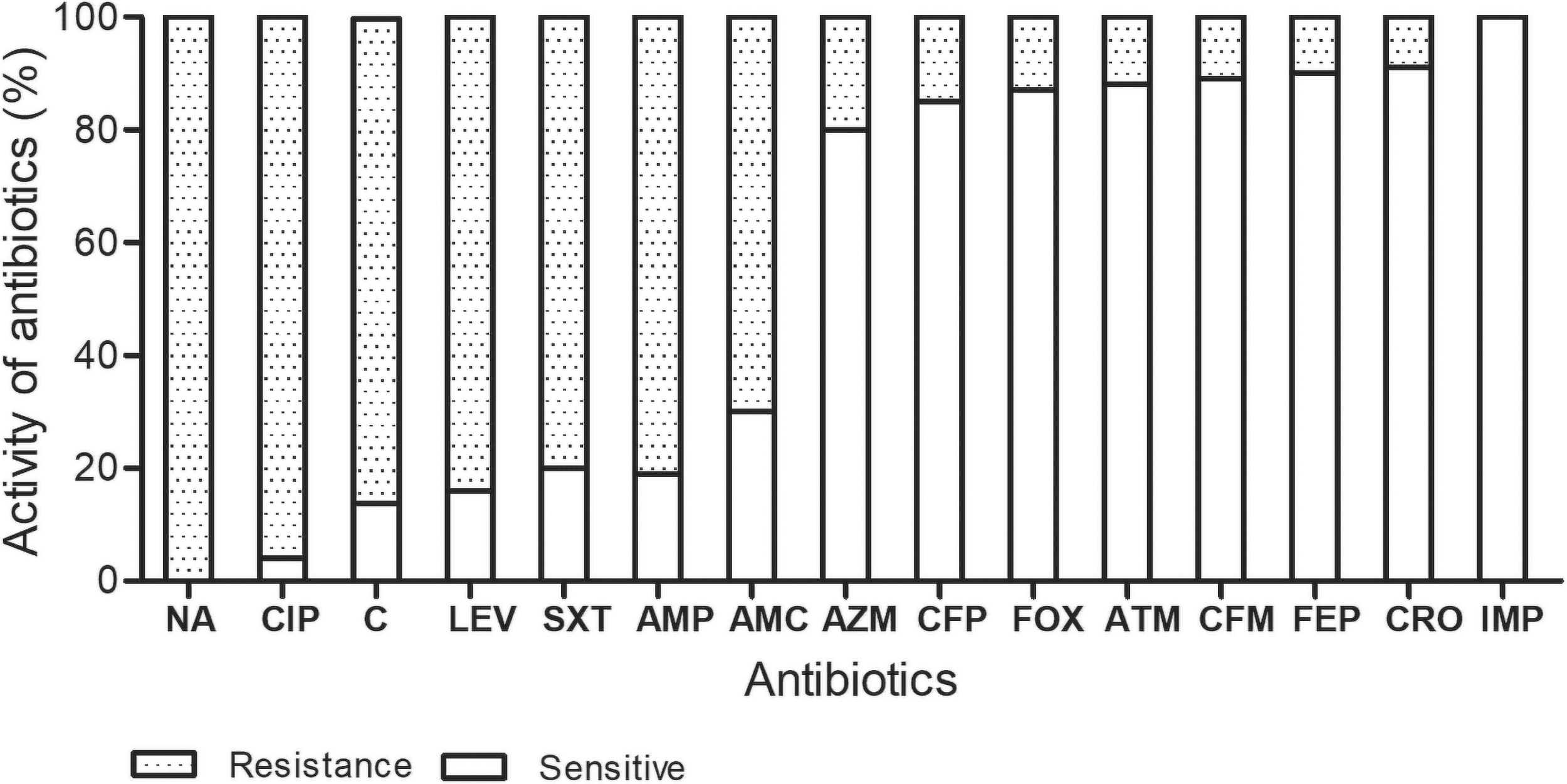
Antibiotic susceptibility pattern of Salmonella Typhi isolates: It was observed that Salmonella Typhi showed resistance to nalidixic acid while showed sensitivity toward imipenem. The abbreviation in the figure are listed as NA (nalidixic acid), CIP (ciprofloxacin), C (chloramphenicol), LEV (levofloxacin), SXT (co-trimoxazole), AMP (ampicillin), AMC (amoxicillin+clavulanic acid), AZM (azithromycin), CFP (cefoperazone), FOX (cefoxitin), ATM (aztreonam), CFM (cefixime), FEP (cefepime), CRO (ceftriaxone), and IMP (imipenem).
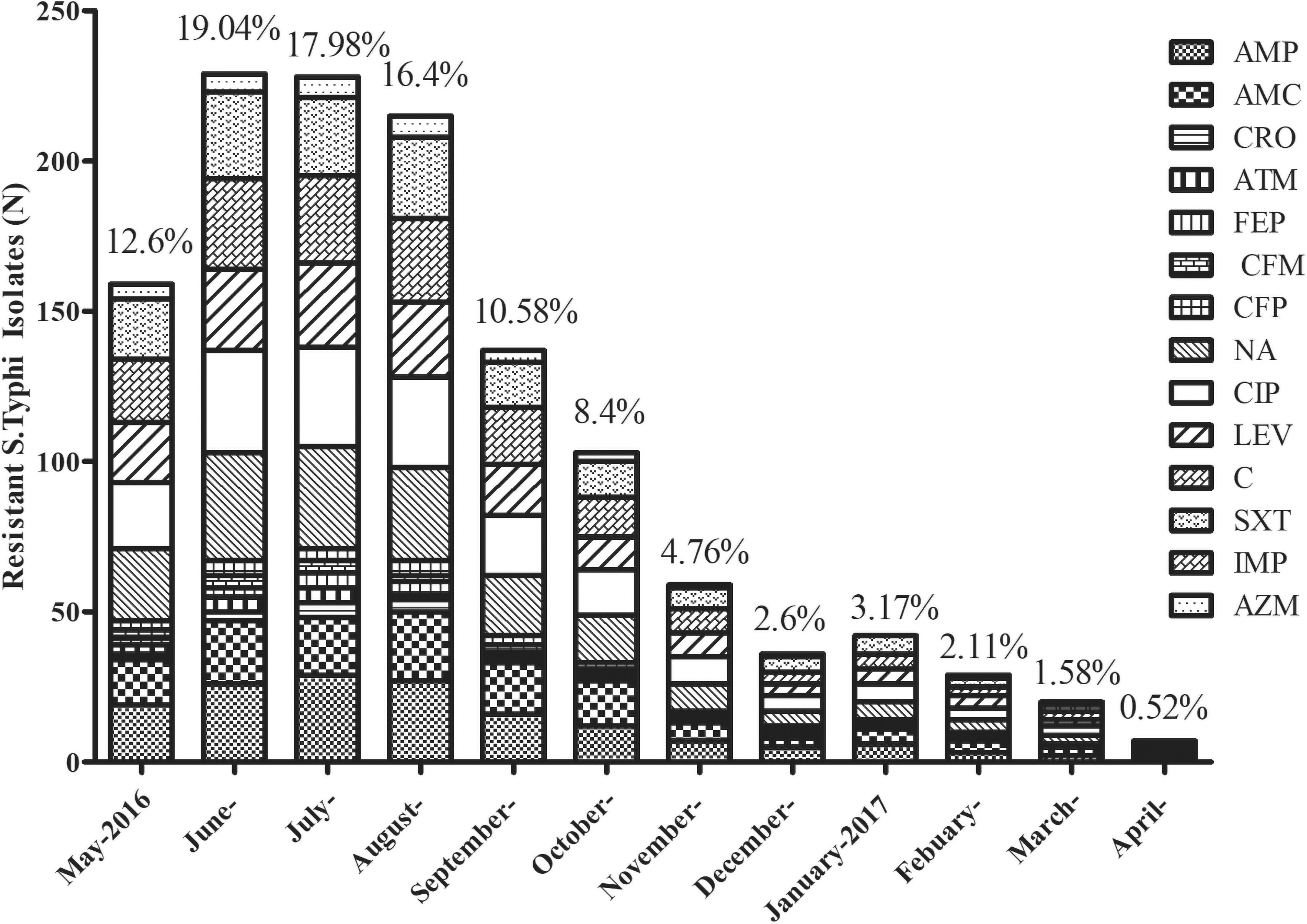
Monthwise distribution of antibiotic-resistant isolates of Salmonella Typhi.
Among the 189 isolates, the MDR were highly prevalent (n = 175, 92.5%) followed by XDR (n = 12, 5.8%) and non-MDR (n = 2, 0.0001%). More than half of the isolates (n = 142, 68%) were resistant to first-line drug used for the treatment of typhoid. Some isolates (n = 12, 5.8%) were resistant to cell wall, protein, and DNA synthesis inhibitors, whereas others (n = 38, 18.4%) exhibited resistance to protein and DNA synthesis and folate metabolism inhibitors. Furthermore, 40 isolates were ESBL producer as they have shown extended zone toward antibiotics (Fig. 3).
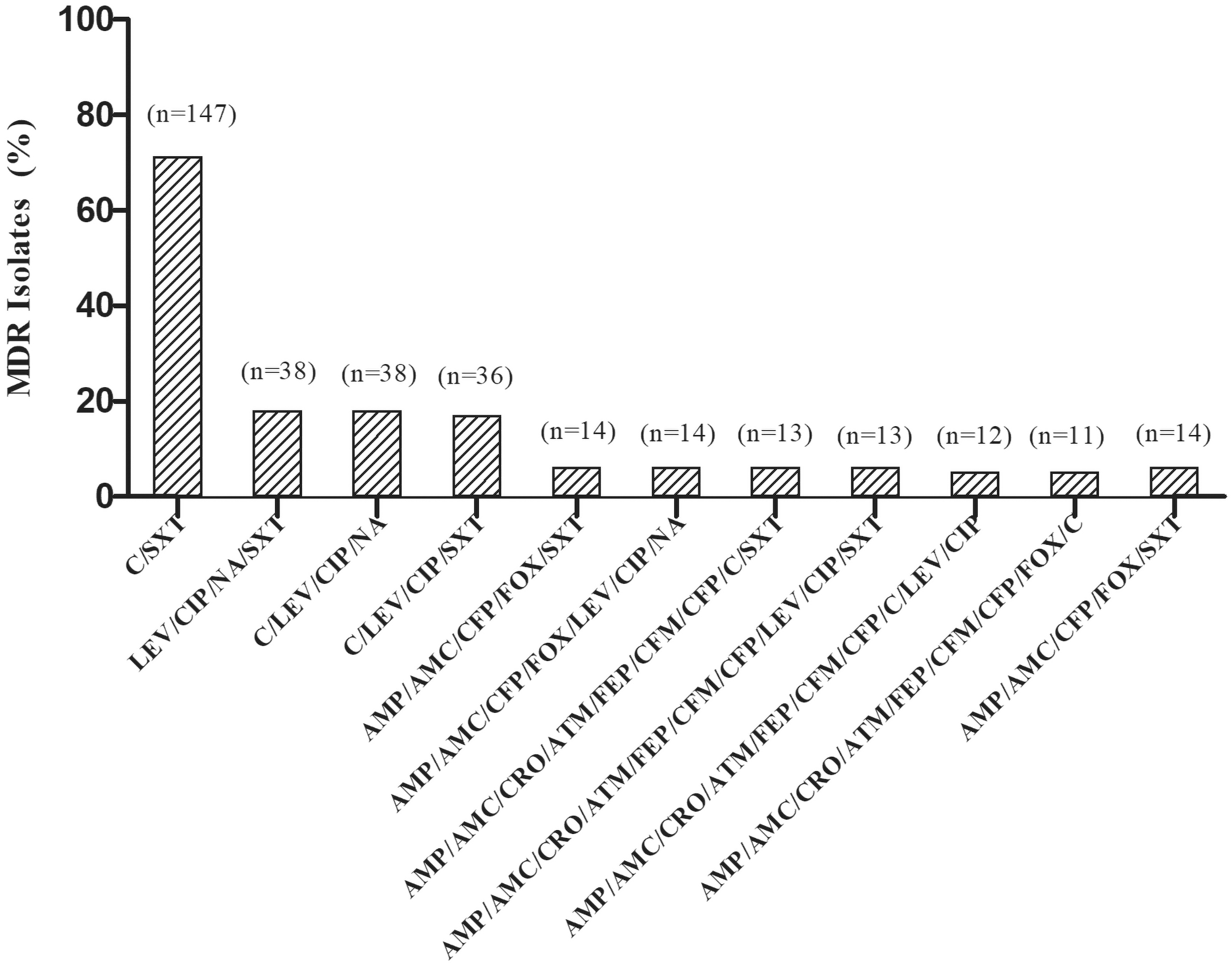
MDR profile of clinical isolates of Salmonella Typhi. MDR, multidrug resistant.
Molecular detection of drug resistance genes among Salmonella Typhi
Among 40 ESBL producer isolates, blaTEM (n = 37, 92.5%), blaCTX15 (n = 11; 27.5%), and blaSHV1 (n = 3; 7.5%) was detected. Fluoroquinolones-resistant genes, including gyrA (n = 164), gyrB (n = 160), parC (n = 164), parE (n = 160), qnrS (n = 15), and qnrB (n = 3), were detected in Salmonella Typhi. In addition, cat gene was detected in 147 isolates, dfrA7 in 145 and ac(6′)-ib-cr gene was detected in 163 isolates; however, qnrA, qnrC, blaOXA, and drfA14 resistance genes were not detected in any isolate. In 37 azithromycin-resistant isolates, 7 genes were checked in which only 1 was positive for mefA, whereas 3 were positive for msrA. In co-trimoxazole resistance isolates only dfrA7 was detected in 145 isolates (Supplementary Figs. S3 and S4). A comparison among the phenotypes and genotypes of drug resistance is shown in Table 2.
Comparison of Phenotypic Drug Resistance with Resistance Genes
Sequencing of resistance genes among the MDR isolates
The PCR amplicons of all detected genes were processed for sequencing (Macrogen). NCBI BLASTX analysis (https://blast.ncbi.nlm.nih.gov/Blast.cgi). Sequence analysis showed that amplicon sequences were identical to already submitted sequences (Supplementary Table S3).
Discussion
This study is addressing the molecular strain typing and drug resistance pattern of Salmonella Typhi prevalence in Northwest Pakistan. In most of the developing countries, such as Pakistan, India, and Bangladesh, typhoid fever is a serious health issue. 3 A total of 189 (8.8%) Salmonella Typhi isolates were identified by Salmonella Typhi-specific gene (fliC-d) amplification from clinical samples. In this study, 30 different VNTR profiles were observed, which is in line with a previous study conducted in Kathmandu valley. 18 A previous study from Pakistan reported 5 groups of VNTR types from 35 Vi positive and Vi negative isolates. 19
Antimicrobial susceptibility tests were performed for all 189 Salmonella Typhi isolates using 15 antibiotics of four major classes of antimicrobials. Resistance to chloramphenicol was observed as 86%, which is consistent to a previous study.20,21 In our study, the resistance against fluoroquinolones that is for ciprofloxacin was 96% and 83.5% for levofloxacin, which is very high and alarming. A study reported drug resistance Salmonella to ciprofloxacin and levofloxacin was 65.6% and 8.9%, respectively. 22 Amoxicillin resistance was observed in 69.8%. The recent studies reported amoxicillin resistance of 96.4% and 74.6%, respectively, which is high in comparison with resistance observed in this study, which is 63% for amoxacillin.21,22 Another report showed a very low resistance that is of 10.4% Salmonella Typhi from Kolkata amoxycillin/clavulanic acid (MIC ≥256 μg/mL), which was reported earlier. 23 Thirty-seven (19.5%) isolates of Salmonella Typhi isolates were found to be resistant to azithromycin, and this finding is in parallel with previous study conducted in Pakistan. 21
In this study, most of the isolates were resistant to first-line drug used for treatment of typhoid. In a study conducted a gradual increase was observed in isolation of MDR Salmonella Typhi from 2009 (13.6%) to 2013 (25%). 23 About 175 (92.5%) isolates were MDR. High resistance with similar MDR pattern was reported previously. 24 In this study, 12 (5%) isolates exhibited resistance to four categories of drugs and reflected as XDR phenotype.
There were 40 isolates found to be ESBL producer in this study. In India, serotype Salmonella Typhi that was positive to, but none of these isolates were positive for SHV or CTX-M-type β-lactamase. 19 One study reported TEM-1-type β-lactamase, whereas another one reported TEM, SHV, and CTX-M-type β-lactamases resistance among Salmonella Typhi.25,26
In this study, most of the isolates have genes encoding for resistance to fluoroquinolones were detected. Similarly in chloramphenicol and co-trimoxazole resistant isolates, cat and dfrA7 genes were detected, respectively. It was observed that resistance phenotypic data are different from genotypic data for several genes. The possible explanation of this discrepancy may be due to other unexplored genes in some other region of the genome responsible for the same type of resistance. Similar studies are also reported for cat1 where cat2, cat3, cmlA, cmlB, and floR genes were involved in chloramphenicol. 27
Sequence analysis of detected genes showed that amplicon sequences were identical to already submitted sequences.
Conclusion
In this study, T1 and T4 strains type were predominantly prevalent. MDR and XDR Salmonella Typhi with harboring resistance genes, including gyrA, gyrB, parC, parE, ac(6′)-ib-cr, blaTEM, cat, and dfrA7 were observed. Findings of the study would be helpful to devise an appropriate antibiotic policy in developing counties such as Pakistan to control the emergence of drug-resistant Salmonella Typhi.
Footnotes
Acknowledgment
We are thankful to Dr. Yasra Sarwar (NIBGE) for technical and scientific support.
Authors' Contributions
H.R., N.Y., Y.S., M.Q., N.K., G.Z., and A.I. conceived and designed the study. N.Y. and Y.S. performed the experiments. N.Y., H.R., M.Q., and Z.H. wrote the article. H.R., N.Y., M.R.M., and A.R.S. analyzed the data. I.N. and K.J.A. reviewed and commented on the article.
Disclosure Statement
No competing financial interests exist.
Funding Information
This study was supported by Taif University Researchers Supporting Program (project number: TURSP-2020/128), Taif University, Saudi Arabia.

References
Supplementary Material
Please find the following supplemental material available below.
For Open Access articles published under a Creative Commons License, all supplemental material carries the same license as the article it is associated with.
For non-Open Access articles published, all supplemental material carries a non-exclusive license, and permission requests for re-use of supplemental material or any part of supplemental material shall be sent directly to the copyright owner as specified in the copyright notice associated with the article.
