




Abstract
In a large-scale dairy farm, it is important to take countermeasure of prevention against mastitis of dairy cows, and it is especially important to establish hygiene and risk management to prevent the emergence and spread of antibiotic-resistant bacteria. In this study, we have performed bacteriological testing of clinical and subclinical mastitis and investigation of antimicrobial resistance bacteria in a large-scale farm for 1 year. The bacteria isolated most frequently from 1,549 samples of 952 cow, including cows with recurring mastitis were Staphylococcus non-aureus (SNA) (27.6%), followed by Escherichia coli (18.9%), Klebsiella pneumoniae (12.3%). Although Staphylococcus aureus was isolated at 7.7% from milk sample, no methicillin-resistant S. aureus was found. The incidence of extended-spectrum β-lactamase (ESBL)-producing E. coli was 1.4% and ESBL-producing K. pneumoniae was 1.4% of all samples, even though third- and fourth-generation cephalosporins were not used for antimicrobial treatment of mastitis in this farm. Although these genotypes of ESBL-producing E. coli and K. pneumoniae were mainly composed of CTX-M-15 and TEM-1 and CTX-M-2 and TEM-116, respectively, there was no spread and persist of predominant clonal type. Appropriate farm management, such as segregation and culling of infected animals and monitors of trends in antimicrobial resistance among mastitis pathogens, may have contributed these results.
Introduction
Bovine mastitis is caused by a variety of microorganisms and is responsible for substantial economic losses in the dairy industry worldwide.1–3 It is important to identify the causative bacterium of mastitis, and the use of the minimum dose of antimicrobial agents is needed to treat and to reduce the risk of emergence of resistant bacterium, including methicillin-resistant Staphylococcus aureus (MRSA) and extended-spectrum β-lactamase (ESBL)-producing bacteria, in a farm. Resistance of MRSA to β-lactams antibiotics, including methicillin, are conferred by a mecA gene encoding a modified penicillin-binding protein (PBP2a). 4 ESBLs are plasmid-mediated enzymes that confer resistance to third- and fourth-generation cephalosporins and monobactams, except for carbapenems and cephamycins.5,6
Since the appearance of MRSA- and ESBL-producing bacteria in livestock is concern to public health and poses problems with treatment, the prevalence of these organisms and associated risk factors need to be clarified.7,8
In Japan, although there are still few large-scale dairy farms housing thousands of cows, their number is increasing. 9 In a large-scale farm, it is important to take countermeasures against mastitis of dairy cows, and it is especially important to establish hygiene and risk management to prevent the emergence and spread of antibiotic-resistant bacteria.10–12 However, it is not clear how often they appear and spread. In this study, we have performed bacteriological testing of clinical and subclinical mastitis and investigation of antimicrobial resistance bacteria in a large-scale farm. Throughout a 1-year investigation, we performed detection of MRSA- and ESBL-producing Escherichia coli and Klebsiella pneumoniae. Furthermore, we identified the genotypes of ESBL-producing E. coli and K. pneumoniae isolates and followed-up on their distribution and spread to investigate the characteristics of them.
Materials and Methods
Clinical and subclinical isolates
The present study was conducted between August 2016 and July 2017 on a large-scale dairy farm in Kyushu, Japan, housing ∼2,000 dairy cows. Cows with clinical mastitis, as indicated by a positive result using P.L tester (Nippon Zenyaku Kogyo Co., Ltd., Hukushima, Japan), which detects an increase in the pH and somatic cell count (SCC) of milk, were subjected to routine microbiological tests, in addition to a few subclinical samples showing a high SCC by monthly testing. Samples of milk from each quarter with clinical and subclinical mastitis were collected in sterilized 15 mL tubes (AS ONE Co., Osaka, Japan) and kept on ice, then transferred to our laboratory at −20°C within 48 hours after sampling. A total of 1,549 samples (1,513 clinical mastitis and 36 subclinical mastitis) were obtained from 952 cows, of which 363 had been shown to have recurring mastitis more than once based on the above method.
Bacterial culture and identification
Bacteriological testing of milk samples was performed by standard microbiology techniques. 13 In brief, 10-fold serial dilutions of the milk were prepared using 10 mM phosphate-buffered saline (pH 7.2) and a 50 μL aliquot of each sample was inoculated directly onto mannitol salt agar (Oxoid) supplemented with 5% egg yolk (AS ONE Co.), CHROMagar orientations (Difco Laboratories), and blood agar base No. 2 (Oxoid) supplemented with 5% defibrinated horse blood (Nippon Biotest Laboratories, Inc., Tokyo, Japan). Based on our preliminary test, Staphylococcus spp., Streptococcus spp., Escherichia spp., Klebsiella spp., Serratia spp., Pseudomonas spp., Pasteurella spp., Enterococcus spp., and Enterobacter spp. were targeted in this study. Plates were incubated aerobically at 37°C for 24 hours. Suspected colonies on each medium from each dilution were subjected to identification by the Microflex LT System, MALDI Biotyper™ (Bruker, Bremen, Germany) in accordance with the manufacturer's instructions.
Detection of bacteria encoding antimicrobial resistance gene
A total of 119 strains of S. aureus isolated from milk samples were analyzed for the presence of the mecA gene by polymerase chain reaction (PCR) in accordance with the method described elsewhere. 14
Antimicrobial susceptibility testing of all E. coli and K. pneumoniae isolates for ampicillin (ABPC) was conducted by using the disk diffusion method according to the guidelines of the Clinical and Laboratory Standards Institute (CLSI). 15 ABPC-resistant strains of E. coli and K. pneumoniae were analyzed for production of ESBLs using a double disk synergy test (DDST) according to the guidelines of the CLSI. 15 DDST-positive strains were then analyzed for their ESBL genotypes. PCR amplification was carried out to amplify the specific ESBL genes blaCTX-M, blaTEM, and blaSHV using primer pair sets as described previously. 16 All PCR amplicons were sequenced from both ends of the strand using a 3130 DNA sequencer (Applied Biosystems, Tokyo, Japan). Comparison of nucleotide sequences and determination of the ESBL genotypes of the isolates were carried out using BLAST (http://blast.ncbi.nlm.nih.gov/Blast.cgi).
Random amplified polymorphic DNA typing
Molecular epidemiological analysis of ESBL-positive strains (21 isolates of E. coli and 22 isolates of K. pneumoniae) was performed using the random amplified polymorphic DNA (RAPD) method. The bacterial DNA was extracted using the cetyltrimethylammonium bromide (CTAB) method. 17 The primers used were OPEC 07 (5′-GTGGCCGATG-3′) and OPEC 11 (5′-CCTGGGTCAG-3′) for E. coli, 18 1290 (5′-GTGGATGCGA-3′) and ERIC2 (5′-AAGTAAGTGACTGGGGTGAGCG-3′) for K. pneumoniae.19,20 The PCR mixtures and PCR protocol used were those described previously. 21 The RAPD amplification profiles were analyzed using the Image Lab Software package (Bio-Rad™, Tokyo, Japan). Unweighted Pair Group Method using Arithmetic Average (UPGMA) phylogenetic trees of the RAPD patterns were created using R software (www.Rproject.org).
Results
Bacteria isolated from milk samples from cows with clinical and subclinical mastitis
The bacteria isolated most frequently from milk samples from cows with clinical and subclinical mastitis were Staphylococcus non-aureus (SNA) (27.6%), followed by E. coli (18.9%), K. pneumoniae (12.3%), Streptococcus dysgalactiae (7.8%), S. aureus (7.7%), and Serratia marcescens (6.3%) (Table 1).
Isolation Rate of Target Bacteria Species from Clinical and Subclinical Mastitis Samples
Each number includes multiple bacteria isolated from one milk sample.
Isolation rate among 1,549 samples examined.
No bacterium was cultivated from milk samples.
SNA, Staphylococcus non-aureus.
Detection of bacteria encoding antimicrobial resistance gene
No strain carrying the mecA gene was detected among the 119 strains of S. aureus screened by PCR.
Twenty-eight ABPC-resistant strains from 293 E. coli isolates and 109 ABPC-resistant strains from 191 K. pneumoniae isolates were detected using the disk diffusion method, respectively. Those strains were analyzed for production of ESBL by DDST, and 21 and 22 strains of E. coli and K. pneumoniae were ESBL-producers, respectively. These detections were 7.2% for ESBL-producing E. coli in the total E. coli isolates and 11.5% for ESBL-producing K. pneumoniae in the total K. pneumoniae isolates, respectively. Table 2 shows the frequency (%) of various ESBL-encoding genes among them. PCR analysis revealed that all E. coli isolates produced CTX-M-15 and TEM-1, and all the K. pneumoniae isolates produced CTX-M-2 and TEM-116. In addition, one E. coli isolate harbored genes encoding SHV-1, and 18 K. pneumoniae isolates also harbored genes encoding SHV-1/11/28/187/193/198.
DNA Sequence Results for β-Lactamase of Escherichia coli and Klebsiella pneumoniae
RAPD typing
Twenty-one bands were amplified using two sets of primers (OPEC 07, OPEC 11) for E. coli. All ESBL-producing E. coli isolates showed various RAPD patterns, and there was no predominant clonal type (Fig. 1). Although two ESBL-producing E. coli strains were isolated from the same udder of cow No. 10147 at different times, and recurred after treatment with antibiotics, they showed slightly different RAPD patterns.
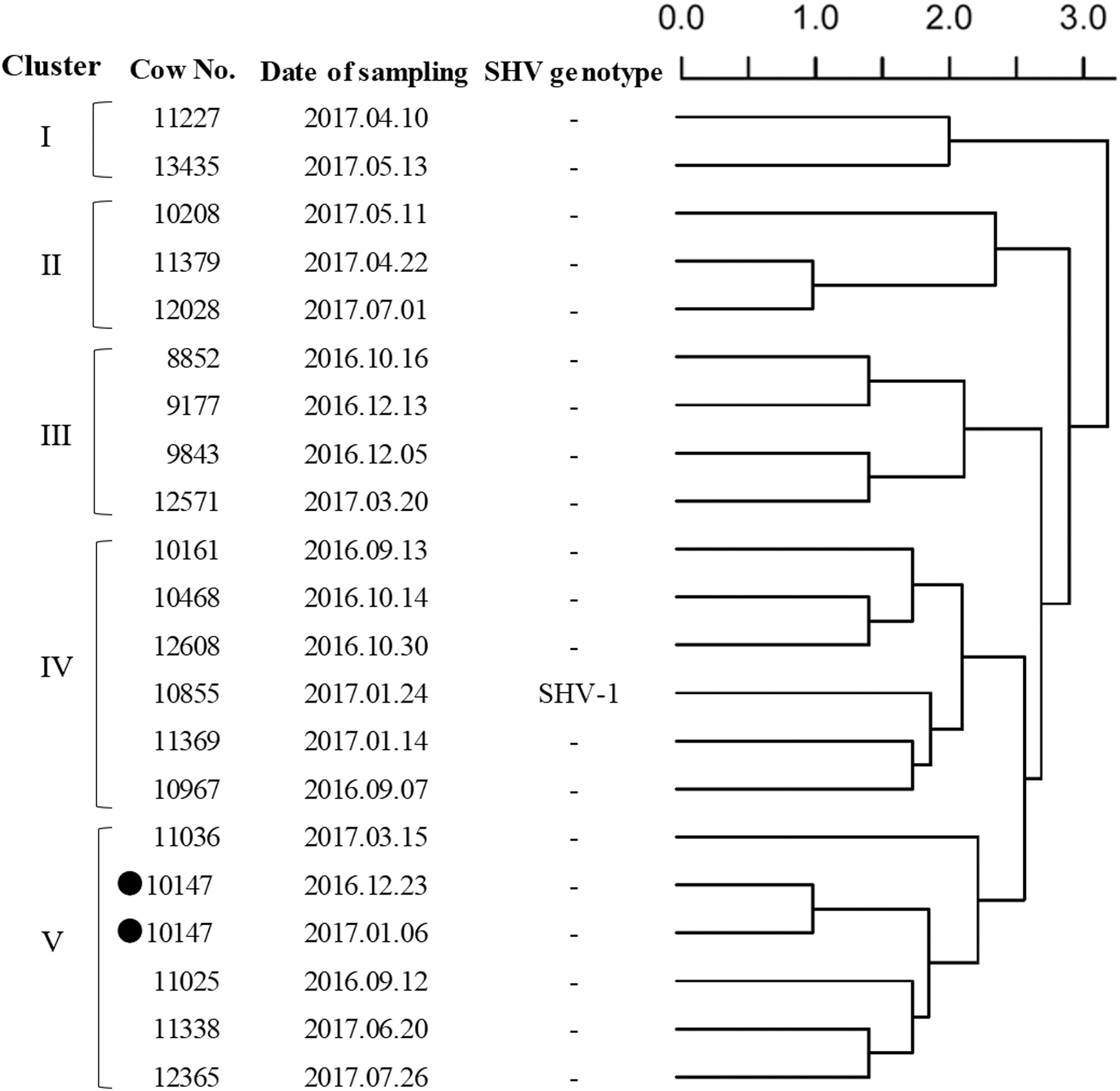
Phylogenetic analysis of 21 Escherichia coli isolates producing CTX-M-15 and TEM-1 based on banding patterns revealed by RAPD typing. •, Strains isolated from milk samples from cow No. 10147. RAPD, random amplified polymorphic DNA.
Twenty bands were amplified using two sets of primers (1290, ERIC2) for K. pneumoniae. Analysis of RAPD patterns revealed some clonal diversity in 22 ESBL-producing K. pneumoniae isolates (Fig. 2). Two strains isolated from milk samples from the same quarter of cow No. 10141 at onset of mastitis belonged to subcluster I and the later strain was isolated after 3 weeks of continuous treatment. In subcluster III, two strains isolated from cow No. 11330 and a strain isolated from cow No. 11379 showed closely related RAPD patterns. Two strains from cow No. 11330 were sampled within an interval of only 5 days and from different quarter. Although two strains isolated from different quarter from cow No. 11337 belonged to subcluster IV, another strain isolated from cow No. 11337 belonged to subcluster I.
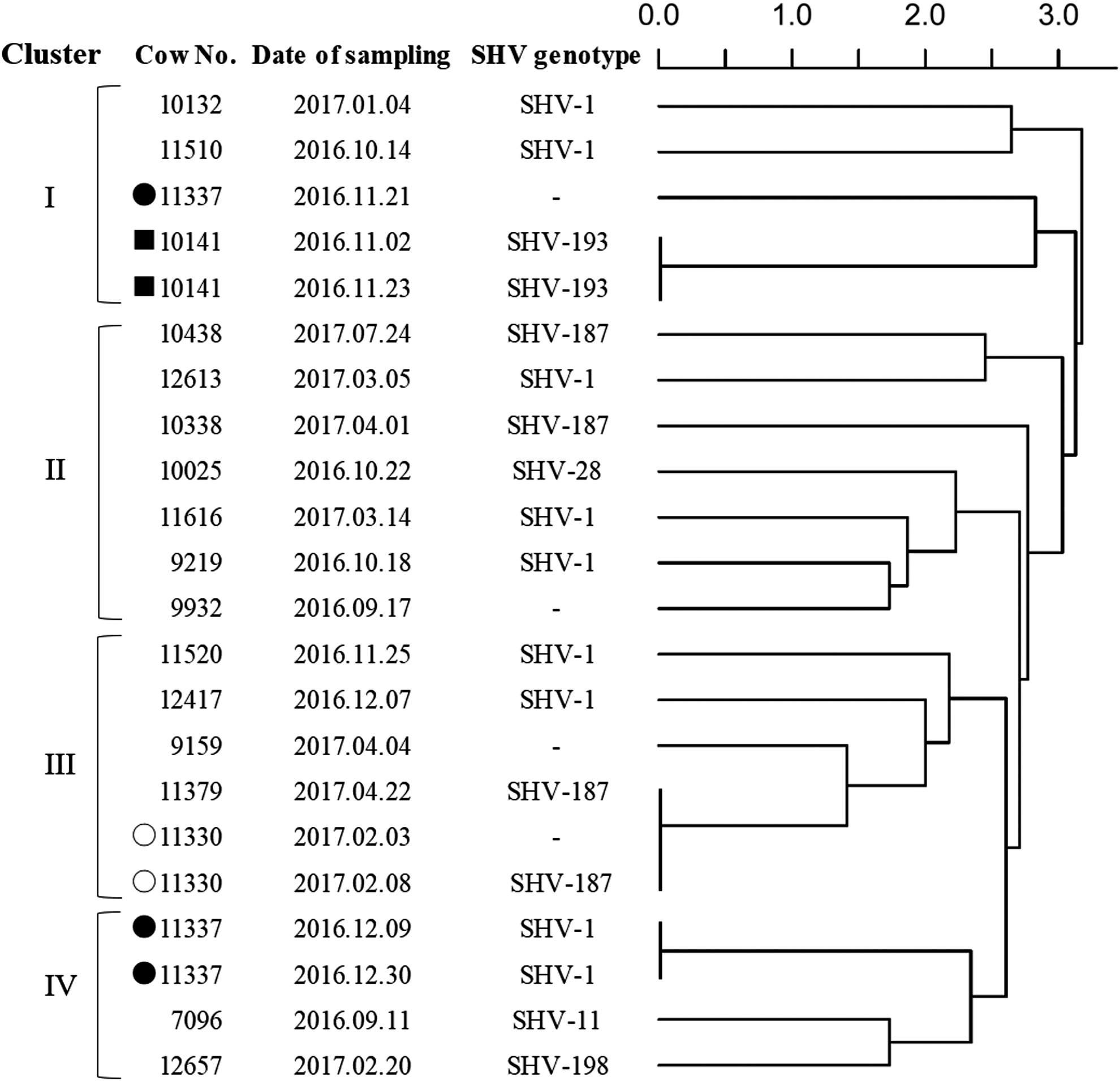
Phylogenetic analysis of 22 Klebsiella pneumoniae isolates producing CTX-M-2 and TEM-116 based on banding patterns revealed by RAPD typing. Strains isolated from milk samples from cow Nos. 11337 (•), 11330 (○), and 10141 (▪), respectively.
Discussion
The spread of MRSA has become a significant concern for animal health. Although we screened all of the 119 S. aureus isolates for MRSA using PCR, none of them harbored mecA gene. This finding supported a previous study showing a low prevalence of bovine MRSA, implying that MRSA was not principally linked to mastitis. 22
On the contrary, even though third- and fourth-generation cephalosporins, which are sometimes used for interdigital phlegmon and pneumonia, were not used for antimicrobial treatment of mastitis on this farm, the ESBL-producing strain of E. coli was detected at a frequency of 1.4% and ESBL-producing K. pneumoniae was detected in 1.4% among 1,549 milk samples in a 1-year investigation. Santman-Berends et al. reported that no association could be found between use of third- and fourth-generation cephalosporins and the prevalence of ESBL in organic dairy herds and suggested that other factors than the use of antimicrobial agents are also associated with ESBL. 23 Although some differences were present between the investigations, environmental and hygiene factors such as the farm location near the pig farm, herd size and movement, and cleaning of equipment have been reported as the risk factors associated with the prevalence of ESBL.23–25 Therefore, not only antimicrobial treatment but also farm management such as hygiene and risk management are important.
We performed molecular epidemiological analysis of those strains, including ESBL-producing K. pneumoniae, to know the characteristics and spread of ESBL in one farm. There have been many reports of ESBL-producing E. coli from bovine mastitis, the CTX-M-15 gene being most prevalent in the United States, China, and Japan, whereas the CTX-M-14 gene and the CTX-M-1 gene are most prevalent in France and Germany, respectively.2,3,6,26,27 On the contrary, there have been some reports of ESBL-producing K. pneumoniae from bovine mastitis. The CTX-M-1 gene in Italy, the CTX-M-14 gene in France, and the CTX-M-15 and -63 genes in India have been reported.2,28,29 In addition, the CTX-M-2 gene has been reported in Japan.30,31 In our study, the ESBL-encoding genes detected in all of the 21 E. coli and 22 K. pneumoniae isolates belonged to CTX-M-15 and CTX-M-2, respectively (Table 2), in line with other reports from Japan.
In addition, the genetic diversity of ESBL-producing E. coli and K. pneumoniae was analyzed by RAPD-PCR to investigate the distribution and spread of ESBL strains (Figs. 1 and 2). This technique is used for molecular typing of bacteria and is useful for distinguishing clonal and nonclonal outbreaks. 30 There was some diversity in the ESBL-producing K. pneumoniae isolates in comparison to E. coli isolates. Each of two strains isolated from milk samples from cows Nos. 10141, 11330, and 11337 in subclusters I, III, and IV were suggested to be the same clone, because these strains were isolated at same time during treatment. In subcluster III, the isolation date differed between the strain from cow No. 11379 and two strains from cow No. 11330, suggesting that it was not contagious transmission, but rather exposure of those cows to a common source. In the United Kingdom, there have been a few reports that some clones of ESBL-producing E. coli were persisted for months in a dairy farm.32,33 The resistant has been persisted due to horizontal gene transfer and clonal spread of the ESBL-producing organisms. 34 Velasova et al. showed that farm management factors may play an important role in impacting ESBL prevalence. 12 In this large-scale farm, cow with mastitis are immediately segregated to other cattle sheds, and milking is also completely separated. Furthermore, trends in antimicrobial resistance among mastitis pathogens have been monitored. Because use of inappropriate antimicrobial agents leads to development of resistant bacteria, these countermeasures have been done continuously for 8 years since this farm was built up. The fact that there were no spread and persist of predominant clonal type of ESBL-producing organisms in this farm suggests that there may be effective farm management to prevent transmission of resistance.
Conclusion
In this large-scale farm, ESBLs-producing E. coli and K. pneumoniae were isolated from cow with clinical and subclinical mastitis over a 1-year period and mainly composed of CTX-M-15 and TEM-1 and CTX-M-2 and TEM-116, respectively. However, there were no spread and persist of predominant clonal type, suggesting that there may be effective farm management to prevent transmission of resistance, such as segregation and culling of infected animals and monitoring of trends in antimicrobial resistance among mastitis pathogens.
Footnotes
Disclosure Statement
No competing financial interests exist.
Funding Information
This work was supported by the grant from Japan Science and Technology Agency (JST) for Science and Technology Research Partnership for Sustainable Development (SATREPS).