




Abstract
We evaluated the β-lactam resistance phenotypes of clinical and environmental strains of the Enterobacter cloacae complex (ECC) isolated from three Algerian hospitals. The first combination of API 20E, matrix-assisted laser desorption/ionization time-of-flight mass spectrometry (MALDI-TOF MS), and hsp60 genetic clustering methodologies were carried out for the identification of ECC strains. Our research showed that API 20E and MALDI TOF MS are satisfactory in genus identification of ECC strains, but sequence-based methods are then necessary to discriminate the species and subspecies levels. Among 36 ECC strains, 94.44% belonged to Enterobacter hormaechei species. Twenty-five isolates clustered with the reference strain of E. hormaechei subsp. xiangfangensis, making it the most frequently isolated subspecies. Enterobacter kobei was found only once (2.77%). All ECC isolates were phenotypically extended-spectrum β-lactamase (ESBL) producers and were resistant to ticarcillin, piperacillin, cefoxitin, cefotaxime, ceftazidime, ceftriaxone, and aztreonam, but susceptible to ertapenem and imipenem. The genetic analyses only allowed the detection of resistance genes of the CTX-M-1 group (32 strains, 88.9%), including CTX-M-15 (30 strains), CTX-M-3 (1 strain), and CTX-M-22 (1 strain). We report for the first time the detection of CTX-M-22 among ECC strains in an Algerian hospital (Tlemcen hospital). None of the isolated strains harbored CTX-M-2, CTX-M-9, or CTX-M-8/25 group genes. In this review, we address recent comparison in the identification methods of multidrug-resistant E. cloacae complex in Algeria, focusing also on the CTX-M ESBLs. This represents a serious public health challenge, which requires the clarification of the current situation and warrants the reinforcement of hygiene measures in the Algerian hospitals.
Introduction
Enterobacter species are important nosocomial and opportunistic human pathogens worldwide. 1 Since the last review on Enterobacter species written in 1997, 2 there have been many changes in the taxonomy of this genus, especially the creation of the Enterobacter cloacae complex (ECC), which includes species that have emerged as nosocomial pathogens. 2 Indeed, what clinical microbiologists identify as E. cloacae based on biochemical properties represents a large complex of at least 13 different species, subspecies, and genotypes. 3
Currently, the sequencing of the heat shock protein 60 gene (hsp60) is the most widely used method for identification purposes 4 and phylogenetic analyses. 5 ECC genotyping based on hsp60 gene sequences has allowed defining 12 genetic clusters (I–XII) and 1 unstable sequence cluster (XIII).4,6
Antibiotic resistance in Enterobacter species is a significant health concern. Notably, the emergence of extended-spectrum β-lactamases (ESBLs) has led to resistance to almost all β-lactams. 7 Plasmid-encoded ESBLs of the CTX-M type are increasingly reported worldwide and now account for most of the ESBL types found in Enterobacter species. Their clinical significance in Algeria, especially over the last 10 years, has been reported in many publications.
This study aimed to identify the CTX-M ESBL-producing ECC at three university hospitals located in the North West of Algeria. A second aim and the most important was to assess the usefulness of the matrix-assisted laser desorption/ionization time-of-flight mass spectrometry (MALDI-TOF MS) methodology for rapid and accurate identification of ECC bacteria, taking hsp60 gene sequencing as a reference.
Materials and Methods
Bacterial strains
We collected ECC strains causing nosocomial infections in the three biggest university hospitals of the North-West of Algeria, located in the Tlemcen, Sidi Bel Abbes, and Oran wilayas, between the period 2008 and 2012. Bacterial strains were isolated from different medical wards and various samples from patients and their environment. Clinical samples included tracheal and urine catheters, urine samples, and postoperative wound suppurations. Edge of bed, door wrist, cart, bathroom sink, wall, ground, sheet, bench, apparatus, bin, keyboard, and tap were the environment samples taken from the three hospitals.
Identification of ECC strains was first performed using the API 20E test system (BioMérieux, Marcy l'Étoîle, France), and further confirmed using MALDI-TOF MS methodology. We used a Microflex™ apparatus with a FLEX control software (Bruker Daltonic, Bremen, Germany). Isolates were plated on Drigalski Agar (BioMerieux) and incubated for 24 hr at 37°C. A single colony per isolate was harvested and deposited on a MALDI-TOF MTP 96 target plate (Bruker Daltonics) in two replicates. One microliter of HCCA matrix solution (50% acetonitrile, 2.5% trifluoroacetic acid, and 47.5% water) was then added and allowed to cocrystallize with the sample. Ions were accelerated in the positive ion mode with an accelerating voltage of 20 kV.
The pulsed extraction of ions was optimized for 1,000 Da. The Biotyper 3.1.2.0 software (Bruker Daltonics) automatically acquired spectra with fuzzy control of the laser intensity and analyzed them by standard pattern matching against the spectra of 2,881 species used as reference data. After comparing the unknown spectra with all reference spectra in the database, the log scores were ranked. Values of 2 or higher were required for accurate identification at the species level, and values between 1.9 and 1.7 were required for accurate identification at the genus level.
Species and subspecies identification of ECC strain through hsp60 gene sequencing
Bacterial suspensions (106 CFU/mL) were prepared in PCR-grade water. Genomic DNA was extracted using the QIAamp DNA mini kit (QIAGEN, Les Ulis, France). An 840 bp fragment of the hsp60 gene was amplified using Premix Ex Taq HS DNA polymerase (Takara Bio), with 500 pmol of each primer (HSP 60 Fwext: 5′-GCTATTCAGGGCCGTGTTG-3′ and HSP 60 Rvext: 5′-ATGGGCGGCATGATGTAAT-3′). After preheating for 10 min at 95°C, samples were subjected to 36 cycles of 30 sec at 95°C, 30 sec at 55°C, and 1 min at 72°C, followed by a final elongation step of 15 min at 72°C. The sequencing of the amplified products was performed at Biofidal (Lyon, France). The sequence types were determined using the open-source software of the le BIBI website (https://umr5558-bibiserv.univ-lyon1.fr/lebibi/lebibi.cgi).
ESBL phenotypic detection
The ECC isolates were first screened for ESBL production using the double-disc synergy test (DDST) according to the CA-SFM (Comité de l'Antibiogramme de la Société Française de Microbiologie) guidelines. Antibiotic disks: ceftazidime, cefepime, cefotaxime, ceftriaxone, aztreonam, and amoxicillin-clavulanic acid (Bio-Rad, Marnes la Coquette, France) were deposited on Mueller-Hinton agar plates, supplemented or not with cloxacillin at a final concentration of 300 g/mL.8,9 The hyperproduction of cephalosporinases is difficult to distinguish from ESBL for some strains in the usual antibiogram. The search for synergies indicating the presence of ESBL was performed on Mueller-Hinton agar supplemented with cloxacilline. 10 A synergistic effect between any cephalosporin or aztreonam and amoxicillin-clavulanate was considered a suspicion of ESBL production.
In addition, accurate minimum inhibitory concentrations (MICs) were determined using the agar dilution method (with Mueller-Hinton medium) for cefotaxime, ceftazidime, cefepime, aztreonam, imipenem, and ertapenem. Pseudomonas aeruginosa ATCC 27853 was used as a wild-type susceptible control strain in each assay.
Characterization of CTX-M genes encoding ESBLs
For ECC strains with a positive DDST, four PCR tests were performed for the detection of ESBLs belonging to the CTX-M-1, CTX-M-2, CTX-M-9, and CTX-M-8/25 groups, respectively (Table 1 and Fig. 1). Amplification reactions were performed in a 25 μL volume, including 12.5 μL of Takara 2 × reaction buffer containing 25 μL (1.25 U) Takara Ex Taq HS DNA polymerase (Takara Biotechnology, Dalian), 4 mM MgCl2, 0.4 mM of each deoxynucleoside triphosphate (dATP, dCTP, dGTP, and dTTP), 1 or 0.5 μL of primers (0.4 and 0.2 pmol/μL of final concentration, respectively), 2.5 μL of DNA extract (10 ng/μL), and PCR-grade water.

The five known groups of CTX-M-type β-lactamases.
Primers Used for the Amplification of the blaCTX-M 1, 2, 9, and 8/25 Groups
DNA amplification was performed using the Professional trio thermal cycler (Biometra, Göttingen, Germany) under the following conditions: denaturation at 98°C for 30 sec; followed by 30 cycles at 98°C for 10 sec, 60°C for 30 sec, and 72°C for 1 min; and a final extension step at 72°C for 10 min. The sequencing of the amplified products was performed at Biofidal. Nucleotide sequence alignments were carried out using the MUSCLE software of the National Center for Biotechnology Information (NCBI) website (www.ncbi.nlm.nih.gov).
Results
Bacterial strains
Fifteen ESBL-ECC strains were isolated in Oran hospital, 11 in Sidi Bel Abbes hospital, and 10 from Tlemcen hospital. These isolates were recovered from intensive care units (ICU) in 72.2% of the cases, and surgery and neurosurgery departments in 11.1% of the cases each. Thirteen strains (36.11%) were isolated from tracheal catheters, 10 (27.8%) from urine samples or urinary catheters, 7 (19.4%) from hospital environments, and 3 (8.3%) each from rectal swabs and wound pus (Table 2).
Characteristics of Enterobacter Species Identified by MALDI-TOF and Hsp60 Gene Sequencing
MALDI-TOF, matrix-assisted laser desorption/ionization time-of-flight.
These 36 ESBL-ECC isolates, among all the 158 strains collected, had API 20E biochemical tests compatible with the E. cloacae complex. The MALDI-TOF MS analyses confirmed that all isolates belonged to one of the Enterobacter species with score values >2. Thirty-two strains (88.9%) were identified as E. cloacae, 3 (8.3%) as Enterobacter hormaechei, and 1 (2.8%) as Enterobacter kobei. No isolate corresponded to the E. ludwigii, E. asburiae, or E. nimipressuralis species (Table 2). When analyzing hsp60 gene sequences, we found 4 of the 13 genotypes so far described for ECC strains. These genotypes corresponded in 94.44% of the cases (34/36 strains) to one of the three E. hormaechei subspecies (xiangfangensis, steigerwaltii, and hoffmannii).
Thus, E. hormaechei was by far the most prominent species among ESBL-ECC strains collected for this study. Twenty-five isolates (including all isolates obtained from the Sidi Bel Abbes hospital) clustered with the reference strain of E. hormaechei subsp. xiangfangensis, making it the most frequent isolated genotype (Fig. 2). One isolate corresponded to the species E. kobei, as previously identified by MALDI TOF MS. The remaining strain could not be identified at the subspecies level. All data are summarized in Tables 2 and 3.

Neighbor-joining tree based on 500 nucleotides analysis of the hsp60 gene sequences. O.EC.5 is an environmental strain recovered from an edge of bed of intensive care unit at Oran university hospital, clustered with the reference strain of Enterobacter hormaechei subsp. xiangfangensis.
Prevalence of the Species, Subspecies, and Genotypes of the Enterobacter cloacae Complex Among Different Hospitals and Their CTX-M Extended-Spectrum β-Lactamase Genes
ECC, Enterobacter cloacae complex.
ESBL phenotypic detection
All the ESBL-ECC strains were resistant to amoxicillin-clavulanic acid, cefotaxime, ceftazidime, ceftriaxone, and aztreonam. About 80.5% of the strains were resistant to cefepime. High MICs were obtained for cefotaxime (≥512 mg/L), ceftazidime (64–512 mg/L), and aztreonam (32–≥512 mg/L). A broader MIC range was observed for cefepime (<0.5–≥512 mg/L).
blaCTX-M genes detected in ESBL-ECC strains
Molecular characterization of the 36 ESBL-ECC strains revealed that only CTX-M-1 group ESBLs were produced by 32 isolates (88.9%), including 30 (93.7%) isolates producing a CTX-M-15 and 1 isolate each (3.1%) producing either a CTX-M-3 or a CTX-M-22. We found for the first time in Algerian hospitals a CTX-M-22 harboring ECC strain (Fig. 3). This strain was recovered from a rectal swab collected in an ICU patient hospitalized in Tlemcen hospital. The remaining three CTX-M groups (CTX-M-2, CTX-M-9, and CTX-M-8/25 groups) were not detected in our ECC strain collection (Table 3).
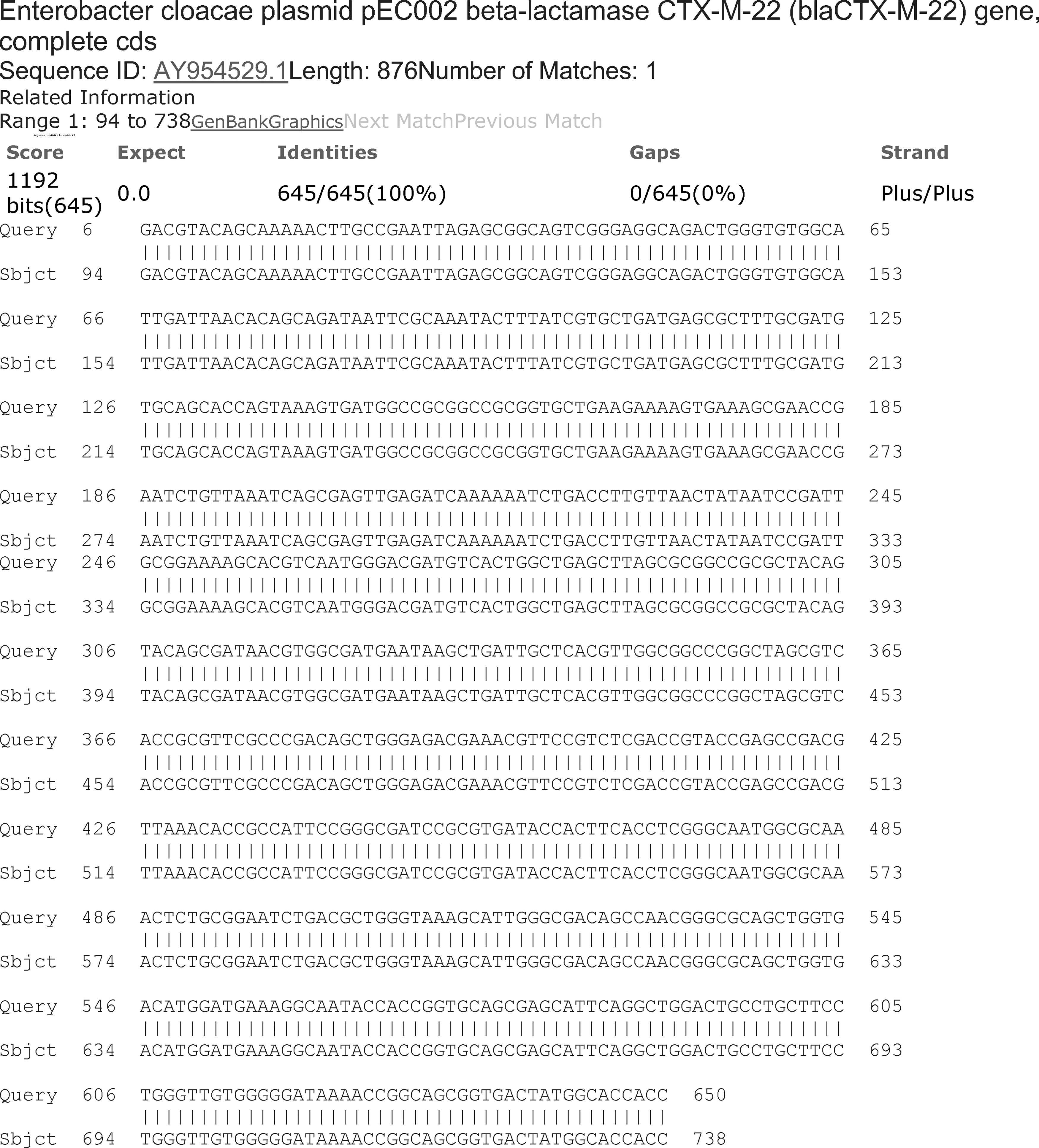
CTX-M-22 gene sequence alignment analyzed using BlastN in the NCBI database (www.ncbi.nlm.nih.gov/blast). NCBI, National Center for Biotechnology Information.
Discussion
The treatment of bacterial infections with antibiotics is one of the fundamental concepts of modern human medicine. However, the effectiveness of this therapeutic approach has become limited owing to a dramatic increase in bacterial antibiotic resistance, which nowadays represents a global health problem with a substantial social and economic burden.11,12 It is, therefore, of tremendous importance to monitor the prevalence of antibiotic resistance in common human and animal pathogens. Although the nomenspecies E. cloacae has considerable clinical relevance, this genetically heterogeneous group of bacteria has not attracted much attention by the scientific and medical communities.
We report the first study in Algeria that specifically determined the carriage of CTX-M groups ESBL in ECC strains. We examined a collection of 36 human and environmental ESBL-producing ECC strains originating from three university hospitals (Tlemcen, Oran, and Sidi Bel Abbes hospitals) located in the northwest of Algeria.
ECC strains were fully identified at the species and subspecies levels using biochemical tests, MALDI-TOF MS technology, and hsp60 genotyping. To the best of our knowledge, this is the first report of the combination of MALDI-TOF MS and hsp60 genetic clustering methodologies for the identification of ECC strains. However, our result demonstrates the low accuracy of the MALDI TOF MS for the identification of ECC at the species and subspecies levels.
Meanwhile, 32 strains displayed identification errors, all were correct genus and wrong species (Table 2). It can be suggested that API 20E and MALDI TOF MS are useful techniques for presumptive identification of the ECC strains, but sequence-based methods are then necessary to discriminate the genotypes and clusters. 3 Therefore, updating the existing information and perfecting the database of difficultly identified organisms are useful to improve the identification accuracy of MALDI-TOF MS. 13
According to the hsp60 genotyping identification, most isolates (34/36 strains) belonged to E. hormaechei subspecies, with a predominance of E. hormaechei subsp. xiangfangensis (25 isolates). Several investigators have reported E. hormaechei to be the predominant species both in the clinical setting and in the environment.14–16
In addition, our study reports the first identification of E. hormaechei subsp. xiangfangensis and E. hormaechei subsp. hoffmannii in Algeria. E. kobei was previously isolated from root nodules of flowering plants of the Hedysarum genus, growing in native stands in different Algerian habitats. 17 E. hormaechei subsp. steigerwaltii was previously detected in the internal root tissues of tomato plants grown in areas infested with FORL in Algiers, Algeria. 18 However, no clinical isolates have been previously identified for these species in Algeria.
Noteworthy, all strains isolated at Sidi Bel Abbes hospital belonged to the E. hormaechei subsp. xiangfangensis subspecies. The dissemination of this subspecies in this study and our previous study 19 suggests the occurrence of an outbreak in this hospital with an unknown source of transmission. Transmission may be direct or indirect; vehicles include hospital food and equipment, intravenous solutions, and the hands of hospital personnel. Nosocomial strains progressively colonize the intestine and pharynx with increasing length of hospital stay, resulting in an increased risk of infection. 20
The ESBL-ECC strains studied remained susceptible to the carbapenem compounds, ertapenem, and imipenem, while most isolates displayed high-level resistance to other β-lactams tested, especially to broad-spectrum cephalosporins. Until now, only two CTX-M enzymes have been detected in Algeria for Enterobacter species: CTX-M-15 and CTX-M-3 (Table 4). We found CTX-M-1group β-lactamase genes in 32 ECC isolates, including the CTX-M-15 in 30 strains and the CTX-M-3 in 1 strain (Table 3).
CTX-M Groups-Producing Enterobacter cloacae Isolates Previously Reported in Algeria
Detection of the CTX-M-15 was not unexpected since this ESBL is widely distributed in humans, animals, and environmental strains of Enterobacteriaceae, worldwide. 34 The massive dissemination of the CTX-M-type 1 ESBLs has been referred to as a “CTX-M pandemic.”35,36 The CTX-M encoding plasmids are often transmissible by conjugation in vitro, which probably explains the easy and rapid dissemination of such genetic determinant. 37
In addition, the presence of ESBL bacteria, specially CTX-M-type 1, in the Algerian Hospital may be related to the fact that cefotaxime is the first-line treatment. 29 In fact, the heavy use of cefotaxime and ceftriaxone is considered a factor supporting the emergence of CTX-M enzymes. 38
On the contrary, animal manure may be a source of antimicrobial-resistant bacteria owing to the intensive use of veterinary antibiotics that are water soluble and cannot be completely absorbed by animals. 39 Approximately 75–90% of veterinary antibiotics are excreted in animal manure, introducing bacteria carrying antimicrobial resistance genes into the soil. Thus, humans may be exposed to antimicrobial-resistant bacteria and antimicrobial resistance genes via consumption of crops grown using wastewater or manure. 40
In contrast, we report for the first time in Algeria the isolation of an ECC strain harboring the CTX-M-22 gene, which indicates that new antibiotic resistance mechanisms are emerging in this country. This strain is an E. hormaechei subsp. xiangfangensis recovered from a rectal swab at ICU at Tlemcen university hospital (Fig. 3).
Several nosocomial outbreaks caused by endemic or epidemic ESBL (CTX-M)-bacteria have been described, particularly in ICUs; This is related to the misuse of broad spectrum antibiotics, invasive procedures, and the immune status of patients in these care units.29,41 Thus, their systematic screening in fecal carriage, with strict adherence to patient hygiene and infection control practices, is mandatory to prevent the spread of these multidrug-resistant bacteria. 42 Although, the CTX-M-22 gene was first described in Escherichia coli and Klebsiella pneumonia strains 43 and E. cloacae strains collected in China. 44
These data complement those of studies conducted in other areas of the country and confirm the increase in the prevalence of antibiotic resistances in enterobacterial species in Algerian hospitals. Routine epidemiological surveillance of these pathogens should be strengthened. The control of the dissemination of these nosocomial pathogens and the prevention of the infections they cause relies on strict adherence to appropriate infection control procedures. 45
Footnotes
Acknowledgments
The authors acknowledge the technical support provided by the members of the Bacteriology Laboratory, Institute of Biology and Pathology, Grenoble Alpes University Hospital, Grenoble, France. They also thank all the staff of the Faculty of Science, University of Hassiba Ben Bouali Chlef, for their financial contribution.
Authors' Contributions
M.D. and M.M. have contributed to the design of the study and have corrected the article. D.S. has designed the study, performed the experiments, and written the article. I.A. helped in the molecular identification of bacterial strains.
Disclosure Statement
No competing financial interests exist.
Funding Information
The study was funded by the Faculty of Science, University of Hassiba Ben Bouali Chlef, Algeria.