




Abstract
A carbapenem-resistant Citrobacter sedlakii strain AA2CS carrying blaNDM-5 was detected in outdoor aerosols of a wastewater treatment plant (WWTP) in China and the whole genome was sequenced subsequently. AA2CS was captured in an aerobic tank with aerosol particles of sizes ranging from 4.7 to 7.0 μm. Besides blaNDM-5, AA2CS also harbored 21 other antibiotic resistance genes and displayed a high level of resistance to ampicillin, cefotaxime, ceftazidime, tetracycline, and meropenem. BlaNDM-5 was located on the IncX3 plasmid (pCSNDM-5) with an IS3000-IS5-blaNDM-5-bleMBL-trpF-dsbD-IS26 structure. pCSNDM-5 was highly homologous to other blaNDM-5-carrying IncX3 plasmids in China and can be transferred to the Escherichia coli recipient J53. To our knowledge, this is the first report of carbapenem-resistant Enterobacteriaceae in outdoor aerosols in WWTPs.
Introduction
Carbapenem-resistant Enterobacteriaceae (CRE)-related infections have caused considerable morbidity and mortality, and are regarded as an emerging health care crisis.1,2 CRE have spread widely around the world, and the environment has become a research hotspot in the field of bacterial drug resistance. 3
Wastewater treatment plants (WWTPs), which are vital social-environment couplers, receive sewage from various sources such as hospitals, communities, public infrastructure, industry, and agriculture, resulting in a large number of CRE being detected in water from different functional areas.4,5 In addition, WWTPs can always generate aerosols and release them into the surrounding environment owing to different wastewater treatment processes. 6 In particular, the aeration process can produce large amounts of bioaerosols because of splash and bubble rupture.7,8 Moreover, the detection of Enterobacteriaceae in sewage as well as aerosols is positively correlated, and wastewater is a main source of intestinal bacteria in bioaerosols from WWTPs.9,10 Thus, it is possible that CRE would be aerosolized from the wastewater.
To date, there are only a few reports of antibiotic-resistant bacteria (ARB) in aerosols in WWTPs. The presence of extended-spectrum β-lactamase (ESBL)-producing Enterobacteriaceae in aerosols was first reported in a WWTP in Poland. 9 Multidrug-resistant Enterobacteriaceae, including Escherichia coli, Enterobacter cloacae, and Citrobacter freundii were identified in indoor aerosols of a WWTP in Portugal. 11 However, to the best of our knowledge, there are no reports on CRE from outdoor aerosols in WWTPs. Therefore, the aim of this study was to examine the existence of CRE in outdoor aerosols of WWTPs.
Materials and Methods
Study site and sample collection
This study was conducted in a WWTP in eastern China in January, 2019. This WWTP is located in the north of Jinan city, with no farms or pharmaceutical factories nearby, and the hospitals are mostly located in the south of the WWTP. The WWTP, mainly receives domestic sewage and hospital wastewater and covers an area with a population of ∼1,500,000 people. It has a treatment capacity of 3 × 10⁵ m3 per day with the anaerobic/anoxic/oxic (A/A/O) process for treating wastewater. Aerosol sampling was performed at 1.5 m above ground level in three different functional areas of anaerobic tank, aerobic tank, and sludge thickener in the WWTP. Anderson six-stage impactor samplers (Tianyue Instrument, Jiangsu, China) with MacConkey agar (Landbridge, Beijing, China) medium supplemented with 2 μg/mL meropenem (Meilun, Dalian, China) were used at a flow rate of 28.3 L/min for 15 min to collect the aerosol samples. After sampling, the plates were transported to the laboratory within 4 hr and incubated at 37°C for 18–24 hr. This study did not require institutional review board (IRB) approval.
Bacteria isolation, identification, antibiotic susceptibility testing
The colonies were repeatedly subcultured on antibiotic-free MacConkey agar plates to obtain pure strains. Then, these strains were screened for carbapenemase-encoding genes, blaKPC, blaIMP, blaNDM, blaOXA-48, and blaVIM, with PCR and Sanger sequencing (Biosune, Shanghai, China). 12 The isolate carrying the carbapenemase-encoding gene was species determined using matrix-assisted laser desorption/ionization-time-of-flight mass spectrometry (bioMérieux, Marcy-l'Étoile, France).
Antibiotic susceptibility of isolates was evaluated using minimal inhibitory concentration (MIC) determination with agar dilution for amikacin, amoxicillin–clavulanic acid, ampicillin, cefotaxime, ceftazidime, ciprofloxacin, imipenem, meropenem, and tetracycline, and broth microdilution for colistin and tigecycline. MICs were evaluated using clinical breakpoints according to the Clinical and Laboratory Standards Institute (CLSI) standards. 13 As no clinical breakpoints of tigecycline are available for Citrobacter sedlakii, the closely related strains of Citrobacter koseri were referred, and their clinical breakpoints of ≤0.5/>0.5 μg/mL for S/R (European Committee on Antimicrobial Susceptibility Testing) were chosen. 14 E. coli ATCC 25922 was used as the control strain.
Conjugation assay, S1 pulsed-field gel electrophoresis, and Southern hybridization
Conjugation assays were performed to test the transferability of the plasmid using E. coli J53 as the recipient, as previously described. 15 Plasmid sizes and the location of carbapenemase-encoding genes were confirmed through S1 nuclease-digested pulsed-field gel electrophoresis (S1-PFGE) and Southern blot hybridization.
Whole genome sequencing and analysis
Bacterial DNA was extracted using the QIAmp DNA Mini Kit (Qiagen, Hilden, Germany), and genome sequencing of the isolate was performed on the Illumina NovaSeq 6000-PE150 platform (Novogene, Tianjin, China). The sequences were assembled and annotated using SPAdes 3.10.1, plasmid SPAdes 3.10.1, and Patric. 15 Antibiotic resistance genes (ARGs) and the incompatibility type of the plasmids were identified using ResFinder 3.2 and Plasmid Finder, respectively. The map and a genomic comparison of the plasmids were generated and visualized using the BLAST Ring Image Generator 0.95. Single nucleotide polymorphism (SNP) analysis between isolated C. sedlakii strains and C. sedlakii strains, Z1, Z2, and Z3, from a previous study was performed using nucleotide difference (ND)-tree tool.16,17
Accession number
The sequences of C. sedlakii AA2CS and plasmid pCSNDM-5 are available at the NCBI Sequence Read Archive (SRR12767580) and GenBank (Accession No.: CP063054), respectively.
Results
Main feature of a CRE isolate from aerosols in WWTP
One C. sedlakii isolate AA2CS was recovered from aerosols around the aerobic tank in the WWTP and was identified as positive for blaNDM-5. The size of the captured aerosol particles ranged from 4.7 to 7.0 μm.
The genome of AA2CS was found to be 5,045,597 bp in length, containing 86 contigs and a GC content of 54.3%; it was annotated in 4,997 CDS, 4,175 proteins with functional assignments, 83 tRNA genes, and 13 rRNA genes. Other ARGs, including blaCTX-M-14, blaOXA-1, blaOXA-10, blaSED-1, aac(3)-IVa, aadA1, aph(3″)-Ib, aph(3′)-Ic, aph(4)-Ia, aph(6)-Id, aac(6′)-Ib-cr, fosA, mph(A), qnrS1, arr-2, sul1, dfrA12, dfrA14, catB3, cmlA1, and floR were also detected in AA2CS. Antimicrobial susceptibility testing revealed that AA2CS exhibited resistance to amoxicillin–clavulanic acid (64 μg/mL), ampicillin (>128 μg/mL), cefotaxime (>128 μg/mL), ceftazidime (>128 μg/mL), ciprofloxacin (1 μg/mL), imipenem (32 μg/mL), meropenem (64 μg/mL), tetracycline (128 μg/mL), and tigecycline (1 μg/mL), whereas it showed susceptibility to amikacin (4 μg/mL) and colistin (1 μg/mL) among the tested antibiotics. SNP analysis showed that AA2CS had ≤7 SNP differences with C. sedlakii isolates Z1, Z2, and Z3 (Supplementary Fig. S1). A distance of ≤10 SNP differences was used to identify clonally related isolates.
Plasmid characterization of AA2CS and genome analysis of the blaNDM-5-carrying plasmid
Two plasmids with sizes of ∼45 and ∼200 kb were identified in AA2CS by S1-PFGE. Southern blot hybridization demonstrated that blaNDM-5 was located on the ∼45 kb plasmid (Fig. 1). Furthermore, conjugation assays showed that the plasmid carrying blaNDM-5 could be successfully transferred to E. coli J53, and the transconjugants were resistant to meropenem and positive for blaNDM-5. Whole genome analysis revealed that AA2CS harbors an IncX3 and IncHI2/IncHI2A plasmids. The 45,403 bp IncX3 plasmid carrying blaNDM-5 (pCSNDM-5) was assembled and verified using pNDM5_020001 (CP032424) as the leading sequence and then submitted to GenBank.
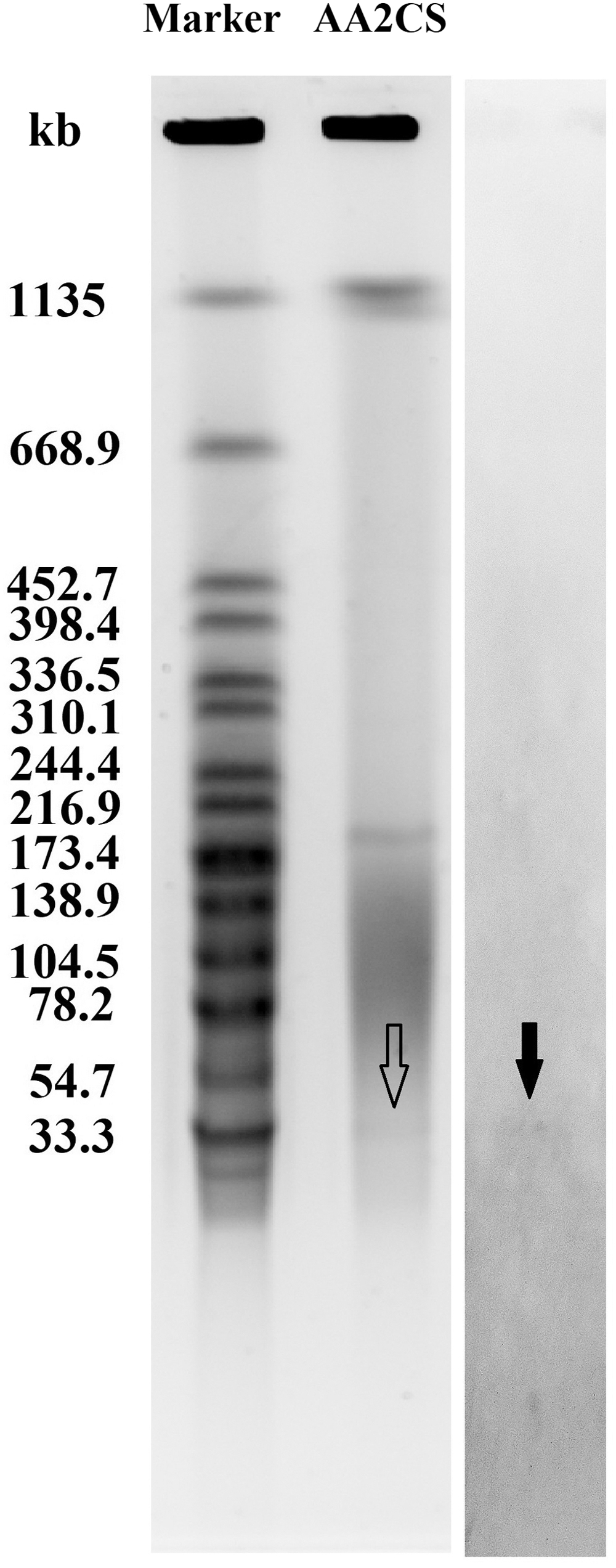
Plasmid DNA from carbapenem-resistant Citrobacter sedlakii AA2CS was S1-nuclease digested and used in pulsed-field gel electrophoresis and Southern blot hybridization using a blaNDM-5-specific probe. M = Using XbaI digested total DNA of Salmonella enterica subsp. enterica serovar Braenderup H9812 as molecular marker. The arrows represent the blaNDM-5 loci on the S1-PFGE fingerprints.
IS5, IS3000, and Tn3 were located upstream of blaNDM-5; bleMBL, trpF, dsbD, IS26, and ISkox3 were located downstream (Fig. 2). BLASTn alignment revealed that pCSNDM-5 shared 98% coverage and 99.99% to 100% identify with IncX3 plasmids previously described from environmental and human Enterobacteriaceae (Fig. 2).
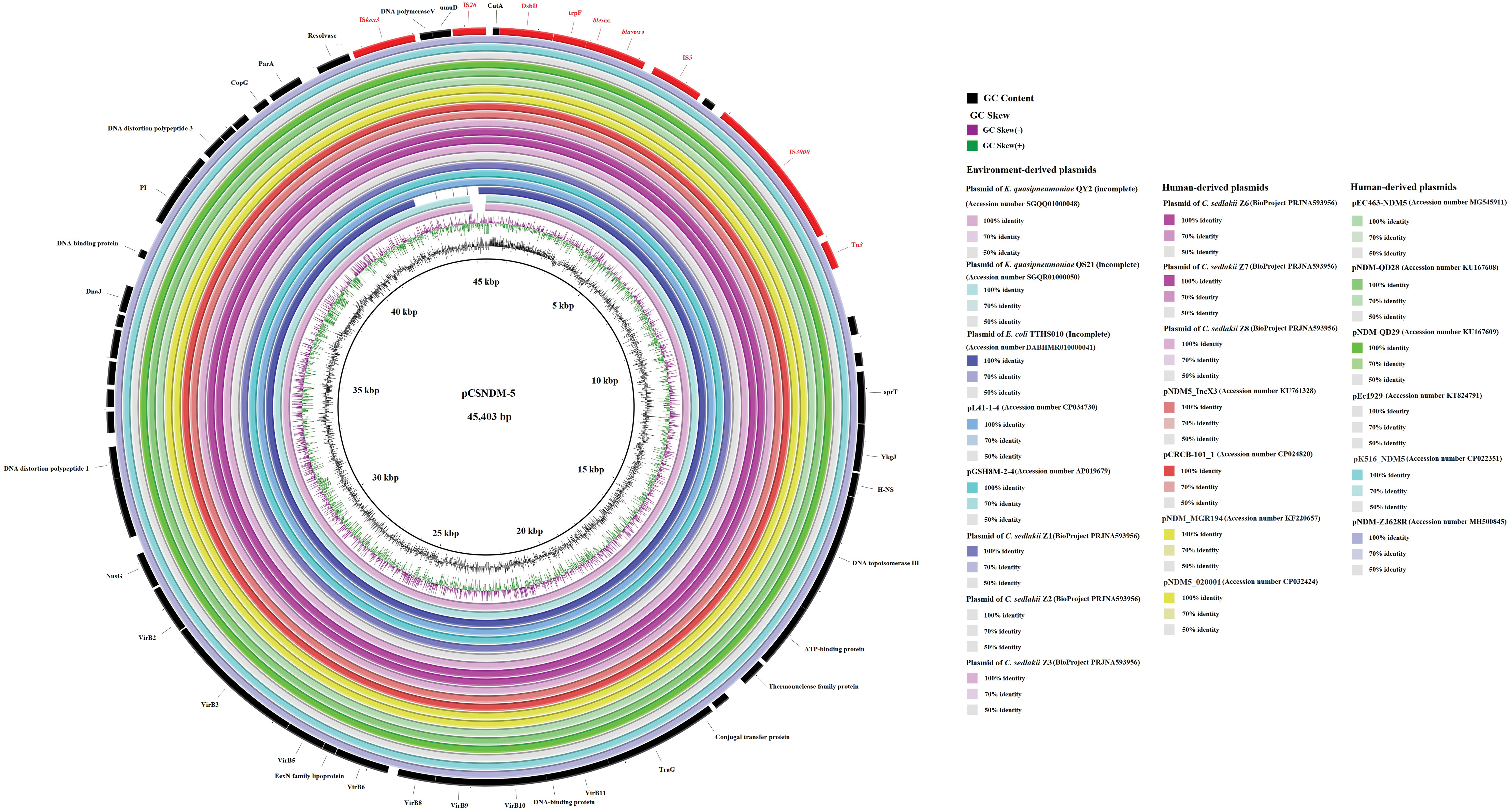
Schematic map of plasmid pCSNDM-5 and comparative circular maps of pCSNDM-5 to other plasmids isolated from environment, patients, and healthy people. The pCSNDM-5 genome is regarded as the reference sequence. Color images are available online.
Discussion
In this study, the emergence of NDM-5-positive C. sedlakii in environmental aerosols was confirmed. To date, ARBs such as CRE, methicillin-resistant Staphylococcus aureus, and ESBL-producing E. coli have been isolated from indoor aerosols in farming areas.18–20 Similarly, ESBL-positive E. coli and Acinetobacter baumannii carrying OXA-type carbapenemase-encoding genes and vancomycin- and gentamicin-resistant bacteria have been isolated from indoor aerosols in urban hospitals.21–23 However, compared with those on urban indoor aerosols, there are very limited reports of ARB in urban outdoor aerosols. This may be related to the stronger airflow and diffusion in outdoor conditions, which can reduce the opportunity for ARB detection. To the best of our knowledge, this is the first report of CRE from urban outdoor aerosols in WWTPs.
The detection of blaNDM-5-positive C. sedlakii in aerosols warrants attention. AA2CS is multidrug resistant to amoxicillin–clavulanic acid, ampicillin (intrinsically resistant), cefotaxime, ceftazidime, ciprofloxacin, imipenem, meropenem, tetracycline and tigecycline. This is not the first report on blaNDM-5-positive C. sedlakii in the environment in Shandong province. In our previous study, C. sedlakii isolates Z1, Z2, and Z3 were detected in the soil of an intensive vegetable cultivation area 200 km away from the WWTP. 17 SNP analysis revealed the clonal transmission of C. sedlakii between urban and rural environments (Supplementary Fig. S1).
Mobile genetic elements, including insertion sequences (IS5, IS3000, IS26, and ISkoX3) and transposons (Tn3), were found in the genetic environment of blaNDM-5 in pCSNDM-5 (Fig. 2). These mobile genetic elements can promote the mobilization of blaNDM-5 between plasmids or chromosomes. 24 The bleomycin resistance gene bleMBL is always located downstream of blaNDM-5, whereas IS5 is located upstream. Currently, blaNDM-5 has been reported in various bacterial genera from healthy people, patients, animals, and the environment, especially those harboring IncX3 plasmids in Enterobacteriaceae.18,25,26 Genomic comparison of plasmids showed that pCSNDM-5 had nucleotide sequences highly identical to those of previously reported animal-derived, environment-derived, and human-derived IncX3 plasmids (Fig. 2). For example, pCSNDM-5 shared 100% nucleotide sequence identity with pNDM5_IncX3 (Accession No. KU761328); animal-derived plasmids from the same province also displayed high sequence similarity to (>99% identity) pNDM5_IncX3. 27 pCSNDM-5 also showed high homology of genomic sequence with human-derived (Z6–Z8) and environment-derived (Z1–Z3) IncX3 plasmids from an intensive vegetable cultivation area. 17 The IncX3 plasmids exhibit high conjugation rates and stability, and exert very low fitness costs on Enterobacteriaceae hosts. 28 Conjugation experiments also confirmed the transferable ability from this study. Thus, the prevalence of IncX3 plasmids among animal–environment–human in the same province provides evidence for the dissemination of blaNDM-5 through these plasmids among different human production activities.
In this study, AA2CS was collected from aerosols with sizes of 4.7 to 7.0 μm, which are mainly deposited in the upper respiratory tract.29,30 Traditionally, Citrobacter spp. with low virulence can persist in immunosuppressed host population for long periods. 31 A likelier risk is that under combination antibiotic therapy, blaNDM-5-carrying C. sedlakii could act as an agent of transfer of the gene, in which the resistance determinants and mobile genetic elements could be accumulated; then, blaNDM-5 may be transferred into other more virulent organisms. 31 The transferability of pCSNDM-5 from AA2CS to E. coli provides further evidence for the occurrence of this risk, and it has been reported that E. coli and C. freundii isolated from the same patient possessed identical plasmids, which exhibited high similarity with pCSNDM-5 (98% coverage and 99.99% identity). 32 Hence, exposure to and colonization with AA2CS could lead to horizontal transfer of pCSNDM-5 to other Enterobacteriaceae co-colonizing the host, for example, opportunistic bacteria, such as E. coli and Klebsiella pneumoniae, which could cause treatment difficulties in the event of infection. 31
In our study, only one CRE isolate was detected in the aerosols; thus, its occurrence may be occasional. Long-term monitoring and investigation of the CRE in aerosols and wastewater in WWTPs is required.
Conclusions
A blaNDM-5-positive C. sedlakii strain was identified in urban outdoor environmental aerosols in a WWTP. The existence of mobile genetic elements in AA2CS could promote the plasmid-mediated horizontal gene transfer of blaNDM-5. The aerosolized isolate must be considered inhalable with the potential to colonize its human host and promote the transfer of pCSNDM-5 to other Enterobacteriaceae strains. Thus, the occurrence and potential risk of CRE in aerosols in WWTPs are of concern and need to be further studied.
Footnotes
Acknowledgments
The authors would like to thank the experimental instrument support from Bacterial Infection Disease Control of Institute, Shandong Center for Disease Control and Prevention, and Bacterial Disease Laboratory, Jinan Center for Disease Control and Prevention, Jinan, China.
Authors' Contributions
X.L. designed the study; Z.Z. performed the experiments, analyzed the data, and wrote the article; B.B. reviewed the article; J.L., L.Z., H.X., and H.Z. contributed to the sampling; Q.Z. performed the experiments; All authors reviewed and revised the article.
Disclosure Statement
No competing financial interests exist.
Funding Information
This study was supported by the National Natural Science Foundation of China (41771499, 81972995), Key R & D Program of Shandong Province (2019GSF111056), the Fundamental Research Funds of Shandong University (2018JC102), and Swedish Research Council for Environment, Agricultural Sciences, and Spatial Planning (Formas) (2016-00640).

References
Supplementary Material
Please find the following supplemental material available below.
For Open Access articles published under a Creative Commons License, all supplemental material carries the same license as the article it is associated with.
For non-Open Access articles published, all supplemental material carries a non-exclusive license, and permission requests for re-use of supplemental material or any part of supplemental material shall be sent directly to the copyright owner as specified in the copyright notice associated with the article.
