




Abstract
Carbapenemase-producing Enterobacterales (CPEs) strains represent a serious threat to public health. The rapid diffusion of CPEs is of particular concern due to the limited effective treatments available against these multidrug resistant microorganisms. In this study, we characterized the complete genome sequence of Klebsiella pneumoniae strain BO714 coproducing KPC and OXA-181 carbapenemase conferring resistance to all β-lactam/β-lactamase inhibitor combinations (βL-βLICs) and siderophore cephalosporin cefiderocol (CFD). The genome of BO714 has a length of 5,876,068 bp with an average G + C content of 56.96% and a total of 5,878 open reading frames. The KPC-Kp strain BO714 was classified as ST512 and contained a circular chromosome of 5,348,787 bp and three different plasmids, respectively, of 363,560, 112,243, and 51,478 bp. Resistome analysis showed that BO714 harbored different β-lactamase genes including blaCMY-16, blaOXA-10, blaTEM-1, blaSHV-11, blaOXA181, and a novel blaKPC-3 variant named blaKPC-125. KPC-125 differed to KPC-3 by Asp to Ala at position 179 within the Ω-loop region. The genomic characterization of a K. pneumoniae cross-resistant to novel βL-βLICs and CFD improves knowledge regarding the emergence of novel traits of multidrug resistance in CPEs.
Introduction
Carbapenemase-producing Enterobacterales (CPEs) represent a major concern for public health. CPEs are often associated with multidrug-resistant (MDR) phenotype, thus maintaining residual in vitro activity against most antimicrobial molecules. 1 In this context, limited antimicrobial options remain for the treatment of complicated infections due to CPEs.
Recently, novel antimicrobial drugs such as ceftazidime/avibactam (CAZ/AVI), meropenem/vaborbactam (MER/VAB), imipenem/relebactam (IMI/REL), and cefiderocol (CFD) have been developed for the treatment of infections due to CPEs. Despite the encouraging in vitro and in vivo results of these novel antimicrobial compounds against MDR Gram-negative micro-organisms, the emergence of resistant CPE strains posed serious limitations to the clinical use of such molecules. 2
In this study, we described the complete genome sequence of BO714, an MDR Klebsiella pneumoniae strain resistant to CAZ/AVI, MER/VAB, IMI/REL, and CFD due to the coproduction of OXA-181 and a novel KPC variant named KPC-125.
Materials and Methods
The strain BO714 was isolated from bronchial aspirate collected from a critically ill patient recovered at Policlinico Sant'Orsola-Malpighi in Bologna, Italy. Initial identification was performed by MALDI-TOF (Bruker Daltonics, Germany) and antimicrobial susceptibility testing was performed by MicroScan Walkaway system. Minimum inhibitory concentrations (MICs) for CAZ/AVI, MER/VAB, and IMI/REL were confirmed by MIC test strips (Liofilchem, Italy), whereas MIC for CFD was determined by broth microdilution assay with iron-depleted Mueller Hinton Broth. MIC values were interpreted according to EUCAST clinical breakpoints v12.0.
Genomic DNA was extracted from pure cell bacterial culture with Dneasy Blood&Tissue Kit (Qiagen, Switzerland) according to manufacturer's instructions. Whole genome sequencing was performed using Illumina iSeq 100 (Illumina) and Oxford Nanopore MinION (Oxford Nanopore Technologies, United Kingdom). For Illumina sequencing, the library was prepared using Nextera DNA Flex Library Preparation Kit. For nanopore sequencing, Rapid Sequencing Kit (SQK-RAD004) was used, and basecalling was carried out locally with MinKNOW v21.02.1 software.
Sequencing quality scores were evaluated with FastQC 0.11.9. 3 The genome was assembled with Unicycler 0.4.8 4 using a hybrid approach, followed up by a polishing step with Pilon 1.24 5 and a quality evaluation phase with Bandage 0.8.1. 6 Genome annotation was performed with Rast 2.0. 7 Sequence type was determined with MLST 2.0, 8 whereas antimicrobial resistance genes were detected using ResFinder 4.1 9 and Resistance Gene Identifier 5.1.1. 10
KPC allele identification was carried out with Diamond 2.0.14 11 by comparing the genome sequence with a local KPC allele database based on the Beta-Lactamase Database. 12 KPC variants were compared by Multiple Sequence Alignment using Clustal Omega 1.2.4. 13 Plasmid sequences were aligned to the NCBI nonredundant database using blastn 2.12.0 14 and illustrated using BLAST Ring Image Generator 0.95. 15 Plasmid incompatibility types were determined using PlasmidFinder 2.1. 16
Virulence genes were detected by searching the genome against the VirulenceFinder 2.0 database with sequence identity setting >80%.
Results
Antimicrobial susceptibility testing revealed that BO714 was resistant to all tested β-lactams including carbapenems and the last resort molecule CFD, as well as aminoglycoside, fluoroquinolone, and trimethoprim/sulfamethoxazole, whereas it remained susceptible only to colistin (Table 1).
List of Antimicrobial Compounds Tested on BO714 and Respective MIC Values
Resistance is shown in bold.
AM-CL, amoxicillin/clavulanic acid; AMK, amikacin; AMP, ampicillin; CAZ, ceftazidime; CAZ/AVI, ceftazidime/avibactam; CEF/TAZ, ceftolozame/tazobactam; CFD, cefiderocol; CFPM, cefepime; CPFX, ciprofloxacin; CST, colistin; CTX, cefotaxime; ETP, ertapenem; GEN, gentamicin; IMI/REL, imipenem/relebactam; MER, meropenem; MER/VAB, meropenem/vaborbactam; MIC, minimum inhibitory concentration; PIP/TAZ, piperacillin/tazobactam; TMP/SMX, trimethoprim/sulfamethoxazole.
Illumina sequencing yielded a total of 1,131,936 paired end reads, whereas nanopore sequencing produced 157,370 reads with size ranging from 121 to 63,266 bp (average length 4,901 bp). Genome assembly resulted in four circular contigs resulting in a circular chromosome of 5,348,787 bp and three different plasmids: BO714_p363Kb (363,560 bp), BO714_p112Kb (112,243 bp), and BO714_p51Kb (51,478 bp). The complete genome was 5,876,068 bp in size, with a GC content of 56.96%. Genome analysis revealed that the strain belonged to ST512, harbored the CPS cluster genes wzi-154 and wzc-916, and carried 5.878 coding sequences in total.
Genetic analysis demonstrated that BO714 chromosome harbored different virulence factors including iron acquisition systems (iutA) and Tellurium ion resistance protein (terC), while p363Kb and in p112Kb plasmids harbored outer membrane protein complement resistance factor (traT).
Deep sequence analysis demonstrated that BO714_p363Kb is a mosaic plasmid containing different replicons belonging to the incompatibility types IncC, IncFIB(K), and IncFII(K). Resistome analysis revealed that BO714_p363Kb plasmid harbored different antimicrobial resistance genes involved in resistance to aminoglycosides [aac(6′)-Ib, aph(3")-Ib, aph(3′)-Ia, aph(6)-Id], β-lactams (blaCMY-16, blaOXA-10), chloramphenicol (catI, cmlA5), rifamycin (arr-2), sulfonamide (sul1, sul2), tetracycline [tet(A)], trimethoprim (dfrA14), and quaternary ammonium compounds (qacE). The nucleotide sequence of BO714_p363Kb plasmid exhibited high similarity (coverage 79%, identity 99.62%) with pCMY2_085072 (Acc. No. CP028804.2), a plasmid of 323,935 bp in size isolated from K. pneumoniae in China.
BO714_p112Kb is a mosaic plasmid containing replicons belonging to the incompatibility types IncFIB(pQil) and IncFII(K). Functional annotation analysis revealed that BO714_p112Kb carried 131 coding sequences including TEM-1 and KPC carbapenemase. Interestingly, alignment of blaKPC gene to the KPC allele database revealed that the BO714_p112Kb plasmid harbored a novel KPC allele, named KPC-125, which exhibited an alanine for aspartic acid substitution at amino acid position 179 in comparison with KPC-3.
In particular, amino acid sequence alignment to Beta-Lactamase Database showed that 12 other KPC variants shared similar substitutions at amino acid position 179 (Table 2). BLAST analysis showed that the BO714_p112Kb plasmid exhibited high nucleotide identity (Coverage 100%, Identity 99.84%) to pRIVM_C015274_1 (Acc. No. MT560075), a blaKPC-3-carrying plasmid described in the Netherlands in the context of a national surveillance program. 17
Molecular and Phenotypic Characteristics of KPC-2 and KPC-3 Variants Sharing a Substitution at Position 179
Resistance is shown in bold.
Lastly, BO714_p51Kb plasmid encoded 67 CDS and contained 2 different replicons belonging to the incompatibility types ColKP3 and IncX3. Sequence analysis of antimicrobial resistance genes demonstrated that BO714_p51Kb harbored blaOXA-181 and the fluoroquinolone resistance gene qnrS1 (Fig. 1). BLAST alignment revealed that BO714_p51Kb plasmid exhibited high sequence homology (coverage 100%, identity 99.97%) with pS253-IncX3-ColKP3 (Acc. No. CP076308), a blaOXA-181-carrying plasmid recently isolated from Escherichia coli in Germany.
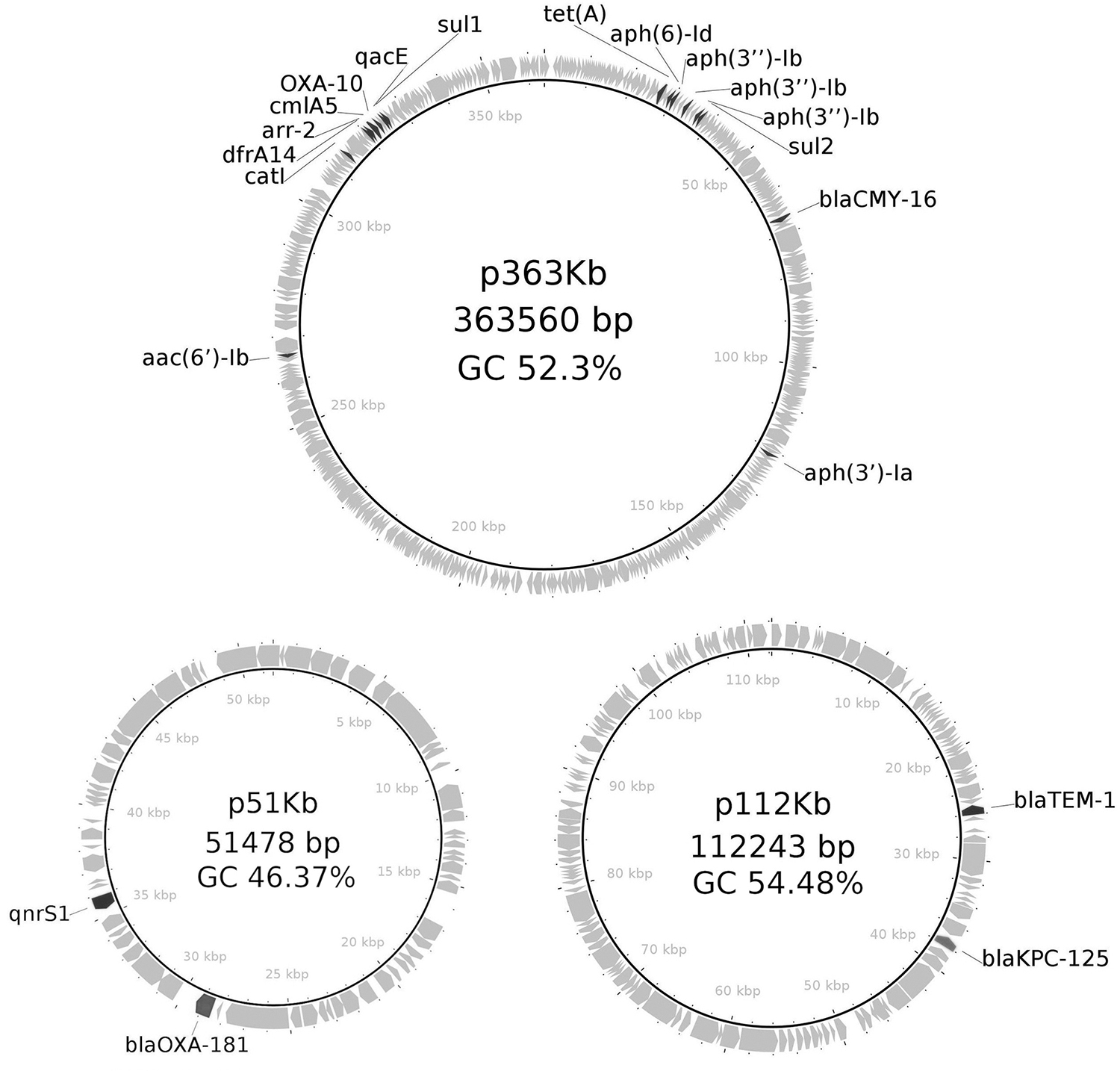
Graphic representation of the three BO714 plasmids. Coding sequences are represented by gray arrows. Antimicrobial resistance genes are shown in teal. blaOXA-181, located in BO714_p51Kb, is shown in purple. blaKPC-125, located in BO714_p112Kb, is shown in orange.
Discussion
In this study, we characterized the genome of K. pneumoniae strain BO714 cross-resistant to CAZ/AVI, MER/VAB, IMI/REL, and also to novel siderophore cephalosporin, CFD. Resistome analysis revealed that strain BO714 coharbored blaOXA-181 and blaKPC-125, a novel KPC-3 variant with an alanine for aspartic acid substitution at position 179 within Ω-loop. Previous studies demonstrated that amino acid substitutions within this region are commonly associated with increased MIC values for CAZ/AVI due to enhanced ceftazidime hydrolysis.18–23
Previous epidemiological studies demonstrated that spreading of CPE coproducing KPC and OXA-48-like is rare in our country.24,25 At the same time, a shift of carbapenemase type (i.e., increasing OXA-48 and VIM carbapenemase and reduction of KPC) has been recently observed in our region due to the recent COVID-19 pandemic. 26 In this context, the discovery of novel antimicrobial resistance traits due to the production of OXA-181 and mutated KPC conferring resistance to CAZ-AVI represents a serious threat for clinicians due to the reduced available options against this MDR phenotype.
The reduced susceptibility to all novel β-lactam/β-lactamase inhibitor combinations observed in BO714 strain poses important limitations for the treatment of difficult-to-treat (DTR) infections sustained by such CPE microorganisms. To solve these limitations, the development of new antimicrobial strategies should be applied against these DTR microorganisms. Recently, we reported the successful treatment of bacteremia and VAP caused by a pandrug-resistant K. pneumoniae coproducing blaKPC-66 and blaOXA-181 carbapenemase. 27 Our previous study demonstrated that that patient was successfully treated with a combination therapy based on fosfomycin in association with meropenem.
In conclusion, the emergence of novel antimicrobial resistance traits represents an urgent threat that needs to be monitored to limit the spreading of DTR pathogens. Further studies are necessary to understanding the evolution and diffusion of such antimicrobial resistance patterns and to develop effective strategies to treat infections due to MDR CPEs.
GenBank Accession Numbers
The whole complete genome sequences of K. pneumoniae strain BO714 were deposited in GenBank (Bioproject No. SAMN27594434).
Footnotes
Authors' Contributions
S.A. performed formal analysis. S.A. and T.L. supervised the study. P.G. wrote the article, conceptualized the study, and acquired funding.
Disclosure Statement
No competing financial interests exist.
Funding Information
This study was supported by the Italian Ministry of Health (Ricerca Finalizzata, Giovani Ricercatori, GR-2018-12367572).