




Abstract

E
Enterococcus hirae and other minor enterococcal species, common in animals and less frequently responsible for human infections, may nevertheless constitute a reservoir of antibiotic resistance genes potentially transferable either to pathogenic bacteria or to other commensal bacteria, representing a global public health concern. 2
Oxazolidinones, including linezolid and tedizolid, are last-resort antibiotics intended exclusively for human use and approved to treat severe human infections due to multidrug-resistant Gram-positive bacteria. Nevertheless, the extensive use of phenicols in veterinary medicine has led to the emergence of mechanisms of linezolid resistance also in enterococci of animal origin due to both ribosomal mutations and coded by cfr, optrA, and poxtA genes often plasmid located. 3
During a routine surveillance aimed to assess the oxazolidinone resistance in enterococci of pig origin, pooled fecal samples were collected from a swine farm in central Italy. Enterococcal strains were isolated on Slanetz Bartley agar plates supplemented with florfenicol (10 mg/L), and florfenicol-resistant isolates were tested by PCR for the presence of cfr, optrA, and poxtA genes as previously described. 4
A poxtA-positive isolate (named R1) was identified as E. hirae by Matrix Assisted Laser Desorption Ionization-Time of Flight (Vitek-MS; bioMérieux).
Susceptibility testing, carried out and interpreted according to the EUCAST guidelines (version 12.0), revealed that E. hirae R1 was resistant to tedizolid (minimum inhibitory concentration [MIC], 1 mg/L); gentamicin (MIC, 16 mg/L); florfenicol, chloramphenicol, and kanamycin (MIC, 32 mg/L); and erythromycin, tetracycline, clindamycin, and amikacin (MIC, >128 mg/L). It had reduced susceptibility to linezolid (MIC, 4 mg/L) and was susceptible to vancomycin (MIC, 0.25 mg/L), ciprofloxacin, and levofloxacin (MIC, 2 mg/L).
Conjugation and transformation assays, 5 using 10 mg/L of florfenicol for selection, failed to demonstrate the transferability of poxtA to E. faecium 64/3 and E. faecalis JH2-2 recipients.
To characterize the poxtA genetic element, whole genome sequencing of E. hirae R1 (BioProject ID PRJNA850894 [accession no: JANASY000000000]) was carried out by Illumina HiSeq platform (MicrobesNG, Birmingham, United Kingdom) using a 2 × 250 paired end approach and a long-read sequencing using MinION (Oxford Nanopore Technologies, Oxford, United Kingdom). Hybrid assembly was performed with Unicycler v. 0.4.8.
Resistome analysis performed using ResFinder 4.1 revealed the presence of nine acquired resistance genes besides poxtA, including fexB (phenicol resistance), erm(B) (macrolide, lincosamide, and streptogramin group B resistance), tet(M)/tet(L) (tetracycline resistance), lnu(B) (lincosamide resistance), lsa(E) (lincosamide, streptogramin A, and pleuromutilin resistance), and aac(6′)-aph(2"), ant(6)-Ia (aminoglycoside resistance).
Bioinformatics analysis revealed a chromosome consisting of 2,730,433 bp and two plasmids of 62.3 and 17.4 kb.
BLASTN showed that poxtA gene was located on a 17,446-bp plasmid (belonging to the Rep29 replicon type) (Supplementary Fig. S1), named pEh-R1 (G + C content, 33.0%) (accession no. ON887286) that was 99% identical to the p1818-c plasmid of E. faecium 1818 from human feces in Switzerland (accession no. CP091209). The plasmids shared the same scaffold (8,498 bp) where the Tn6657 transposon—first described in the Methicillin-resistant Staphylococcus aureus strain AOUC-0915 (accession no MH746818) 6 —was integrated. However, pEh-R1 was smaller than p1818-c (17.4 kb vs. 23.8 kb) due to the presence of a truncated Tn6657 lacking of a 6-kb region.
In pEh-R1, the poxtA gene, flanked by two IS1216, was in fact inserted in a defective Tn6657, also containing fexB, where two IS1216, an IS1252 and open reading frames encoding a cell filamentation protein, a bifunctional lysozyme/peptidase, and a recombinase were missing (Fig. 1 and Supplementary Table S1).
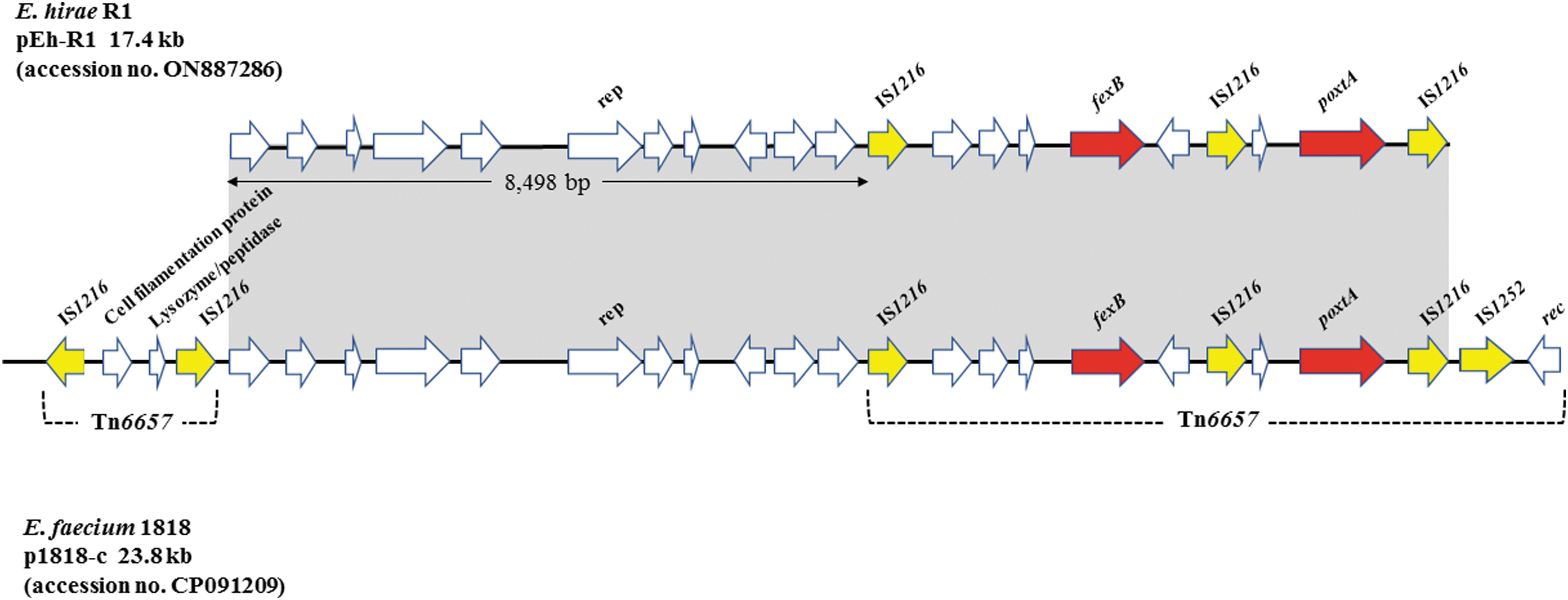
Genetic map of pEh-R1 plasmid (accession no. ON887286) of Enterococcus hirae R1 and p1818-c plasmid (accession no. CP091209) of Enterococcus faecium1818. Similar ORFs of two genetic elements are represented by white arrows pointing in the direction of transcription. Antibiotic resistance genes are in red and IS1216 are in yellow. The light gray areas between ORFs denote DNA identities ≥99%.
The occurrence of oxazolidinone resistance genes in enterococci of animal origin and their localization on plasmids previously identified in human E. faecium isolates not only confirms that minor enterococci, such as E. hirae, can represent a reservoir of antibiotic resistance genes for clinically relevant species but also that the same genetic elements could circulate in the enterococcal population posing a risk for public health.
Footnotes
Authors' Contributions
M.C. contributed to conceptualization, investigation, and methodology (equal). S.N.C. was involved in conceptualization, investigation, and methodology (equal). S.S. carried out software and methodology (equal). C.G. took charge of sampling and methodology (equal). C.C. contributed to sampling and methodology (equal). C.V. was involved in validation (lead). A.B. was in charge of conceptualization (lead), writing—original draft (lead), and writing—review and editing (equal). E.G. was involved in validation (lead).
Disclosure Statement
No competing financial interests exist.
Funding Information
This study was supported by PRIN 2017 grant protocol 20177J5Y3P from MIUR-Italy.

References
Supplementary Material
Please find the following supplemental material available below.
For Open Access articles published under a Creative Commons License, all supplemental material carries the same license as the article it is associated with.
For non-Open Access articles published, all supplemental material carries a non-exclusive license, and permission requests for re-use of supplemental material or any part of supplemental material shall be sent directly to the copyright owner as specified in the copyright notice associated with the article.
