




Abstract
Raoultella planticola harboring genes that confer resistance to antimicrobials, such as carbapenems, have been associated with severe infections in immunocompromised patients. In this study, we reported the first whole genome sequence of a Brazilian isolate of R. planticola and the genomic context of antibiotic resistance markers. By whole-genome sequencing (WGS) of a carbapenem-resistant R. planticola isolate, RpHUM1, we found 23 resistance-encoding genes belonging to 9 classes of antibiotics (aminoglycosides, β-lactams, fluoroquinolones, fosfomycin, macrolides, phenicols, sulfonamides, tetracycline, and diaminopyrimidine derivatives) and 3 plasmids (RpHUM1pEaer-4382s, RpHUM1_pFDAARGOS_440, and RpHUM1pRSF1010). This isolate coharbored the genes blaKPC-2, which is carried by the plasmid RpHUM1pEaer-4382s, and blaNDM-1 and blaCTX-M-15 all located in the accessory genome. In addition, these genes were associated with, at least, one mobile genetic element. This comprehensive knowledge is of great importance for implementation of control measures to prevent the rapid dissemination of this neglected microorganism and their genetic resistance background.
Introduction
R
R. planticola is showing an increase of isolation associated with resistance genes such as blaKPC, blaNDM, and blaCTX-M, but still has no further investigations in genomic level.9,11,12 The whole-genome sequencing (WGS) proved to be an efficient tool for bacteria genetic background evaluation and comprehension to emerging of resistance genes, and antibiotic neutralization enzymes elucidation. 10 Therefore, the aim of this study was to sequence the whole genome of a carbapenem-resistant R. planticola isolate, an emerging pathogen, being the first report in Brazil.
Materials and Methods
Characterization of RpHUM1 and RpHUM2 isolates
The University Hospital of Maringá is a tertiary public teaching hospital located in Maringá city, Paraná state, Brazil, that provides medical and diagnostic services for a population of ∼845,000 city residents and 26 surrounding municipalities. Since 2011, an active surveillance program of multidrug-resistant (MDR) pathogens has been carried out. 13 The identification and the antimicrobial susceptibility profile of all bacteria are determined by the BD Phoenix™ automated system (BD Diagnostic, Sparks, MD). The carbapenem-resistant isolates are screened for carbapenemase production by the modified Hodge test (MHT), and metallo-β-lactamase production is determined by the EDTA disk synergy test according to the Brazilian National Health Surveillance Agency. 14 This study was approved by the “Permanent Committee of Ethics in Research Involving Human Beings” of the Maringá State University number 2093342.
Positive isolates in both tests were further sent to the Laboratory of Medical Microbiology (LMM) of the University State of Maringá for detection of clinically important carbapenemase genes, such as blaKPC, blaNDM, and blaOXA-48;15,16 and to the Central Laboratory of Paraná State (LACEN-PR) for epidemiological monitoring.
Among these pathogens, two isolates (RpHUM1 and RpHUM2) initially identified as Klebsiella oxytoca were recovered from surveillance rectal swabs of different patients hospitalized in distinct periods during 2017. Both isolates exhibited an extensively drug-resistant phenotype (Table 1). 17 Minimum inhibitory concentrations (MICs) of imipenem, meropenem, and polymyxin B were confirmed by agar dilution method, and for both isolates the results were 8, 8, and 2 mg/L, respectively. 18 The MIC results were interpreted according to the breakpoints established by the EUCAST and CLSI guidelines for Enterobacteriales strains.19,20 Multiplex polymerase chain reaction (PCR) detected the presence of blaKPC, blaNDM, and blaCTX-M-15 genes in both isolates.15,16
Susceptibility Profile of Raoultella planticola RpHUM1: Minimum Inhibitory Concentration and Interpretation
Interpretation is based on the Clinical & Laboratory Standards Institute (CLSI M10019), except for tigecycline that is interpreted according to European Committee on Antimicrobial Susceptibility Testing (EUCAST, v. 12.020).
i, intermediary, MIC, minimum inhibitory concentration; r, resistant; s, sensitive.
Molecular typing using enterobacterial repetitive intergenic consensus-polymerase chain reaction (ERIC-PCR) assays followed by an analysis of the fingerprinting patterns by Bionumerics® v.6.5 (Applied Maths, Sint-Martens-Latem, Belgium) 21 showed 100% of similarity between the isolates. The species identification using matrix-assisted laser desorption/ionization-time of flight (MALDI-TOF) mass spectrometry (MS)-based Vitek® MS (bioMérieux) and 16S ribosomal RNA (rRNA) sequence analysis revealed that these isolates were actually R. planticola.
Genome sequencing
The total genomic DNA of R. planticola RpHUM1 was extracted using DNeasy blood and tissue kit (Qiagen Bioinformatics) according to the manufacturer's recommendations. Genomic DNA was sequenced on the MiSeq platform (Illumina, Inc.) using MiSeq reagent Kit v3 (300 × 2 [Illumina, Inc.]) with a paired-end strategy (2 × 300 pb paired end) in partnership with the Brazilian Agricultural Research Corporation (Embrapa Soja, Londrina, Brazil).
Reads were assembled using CLC Genomics Workbench v12.0 software (Qiagen Bioinformatics) and annotated with Rapid Annotation using Subsystem Technology (RAST) v2.0 using FIGfams technology release 70 according to the default software recommendations. 22
Comparative genomic analysis
R. planticola genome sequences with different assembled levels were obtained from Reference Sequence Database (RefSeq; https://www.ncbi.nlm.nih.gov/assembly) until October 14, 2022, which included 6 complete genomes, 2 chromosomes, 16 scaffolds, and 22 contigs. Isolates metadata were retrieved from the Biosample database, such as country, host, and isolation date. Occasionally, a total of 46 publicly available sequences of R. planticola were included in this study and compared with the RpHUM1 isolate. Comparison between genomes and plasmids was based on BlastN analysis using BLAST Ring Image Generator (BRIG), according to Edwards and Holt.23,24 The presence of genes encoding antimicrobial resistance was investigated using ResFinder v4.0. 25 Plasmid replicons were identified using PlasmidFinder 2.0. 26
All 44 assembled sequences of R. planticola were annotated by Prokka v1.14.6 using default parameters. 27 Pan-genome analysis of the isolates was performed using Roary 28 with a 95% of blastp identity and the core genes were defined as those present in 99% of strains.
The IQ-TREE v2.2.0 software 29 was used to construct a phylogeny by maximum-likelihood (ML) model inferred from the core genes alignment to obtain R. planticola population structure. ModelFinder 30 was performed to determine the best-fit model based in our data, which was (GTR+F+I+I+R5). Nonparametric bootstrapping was realized (n = 1,000 replicates). Visual analysis of the phylogenetic tree was made using iTOL. 31
Results
The shotgun sequencing with the paired-end sequence strategy resulted in a genome coverage of ∼323,38-fold, and the assembly of the genome of RpHUM1 generated a total of 6,277,903 reads (300 bp each) organized into 427 contigs with an average size of 14,702.3 bp and an average GC content of 55% with N50 and L50 values of 136,000 bp and 11contigs, respectively. The annotation of the genome generated a total of 6,434 coding sequences, 61 rRNAs and 21 transporter RNAs.
The genome of RpHUM1 was compared with the previously published complete genomes of R. planticola strains (FDAARGOS_64, S25, HH15, Rp_CZ180511, JBIWA001, and A2-F21) and the analyses showed high similarity of nucleotide sequences among them (Fig. 1A).
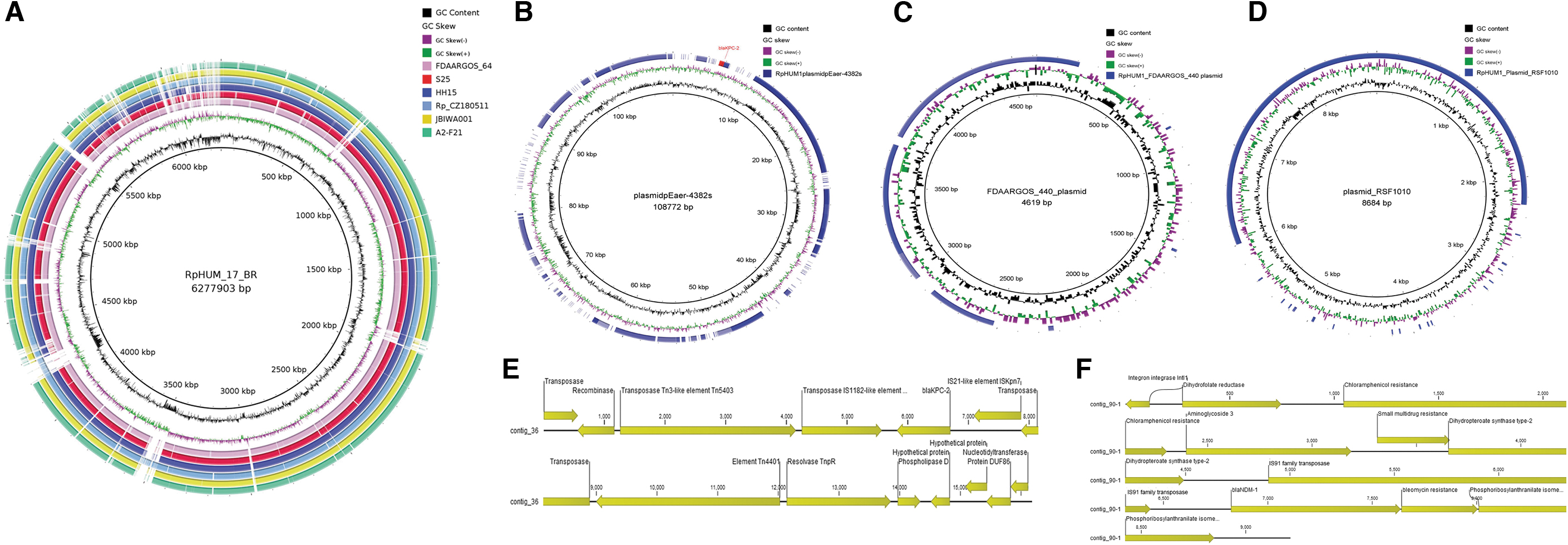
Genomic characteristics of Raoultella planticola isolate.
The resistome of RpHUM1 isolate was analyzed by using the Resfinder and a total of 23 different genes encoding resistance to 9 classes of antibiotics (aminoglycosides, β-lactams, fluoroquinolones, fosfomycin, macrolides, phenicols, sulfonamides, tetracycline, and trimethoprim) were identified (Table 2).
Chromosomal and Plasmidial Genes Encoding Antimicrobial Resistance of Raoultella planticola RpHUM1: Putative Function, Location, and Flanking Mobile Genetic Elements
TnpR, transposase and resolvase.
PlasmidFinder analysis showed the presence of two replicons associated with RpHUM1 genome, namely: Col440I and IncQ1, associated with plasmid FDAARGOS_440 (GenBank: CP023920.1) and plasmid RSF1010 (GenBank: M28829.1). The plasmid pEaer-4382s was found by blast search using the contig containing blaKPC-2 gene as query sequence. Based on that, three plasmids were detected RpHUM1pEaer-4382s, RpHUM1_pFDAARGOS_440, and RpHUM1pRSF1010, respectively, homologs to pEaer-4382s (first reported in Enterobacter aerogenes), pFDAARGOS_440 (first reported in Klebsiella pneumoniae), and pRSF1010 (first reported in Escherichia coli) (Fig. 1B–D).
The blaKPC-2 gene was located into the RpHUM1pEaer-4382s plasmid (highlighted in red in Fig. 1B) and was flanked upstream by Tn4401b isoform, which carried mobile genetic structures such as Tn3, IS1182, and ISKn7, and downstream by transposase and resolvase (TnpR) as showed in plasmid organization (Fig. 1E). No gene encoding antimicrobial resistance was found in RpHUM1_pFDAARGOS_440. Notwithstanding, the plasmid RpHUM1pRSF1010 carried the genes aph(3")-Ib, aph(6)-Id, and sul2.
The blaNDM-1 gene was located into the accessory genome of RpHUM1, with the mobile genetic structure IS91 family transposase in the upstream region and near to other resistance genes (Fig. 1F). Other genes in chromosome associated with mobile genetics elements (MGEs) were blaCTX-M-15, blaTEM-1B, aac(3)-IIa, sul1, dfrA14, cmlA1, catA1, and mph(A) (Table 2).
The model-based phylogenetic tree (ML) constructed from the alignment of the core genome revealed the recognition of two big clades totalizing a coverage of 85.10% (40/47) of genomes. Clade 1, highlighted in blue, is constituted by isolates from the United States (n = 7), United Kingdom (n = 2), Germany (n = 1), China (n = 1), and unknown (n = 3). Whereas clade 2 (n = 26), highlighted in red, has grouped RpHUM1 isolate reported in this study, being similar to a Japanese isolate from 2020 (Fig. 2).
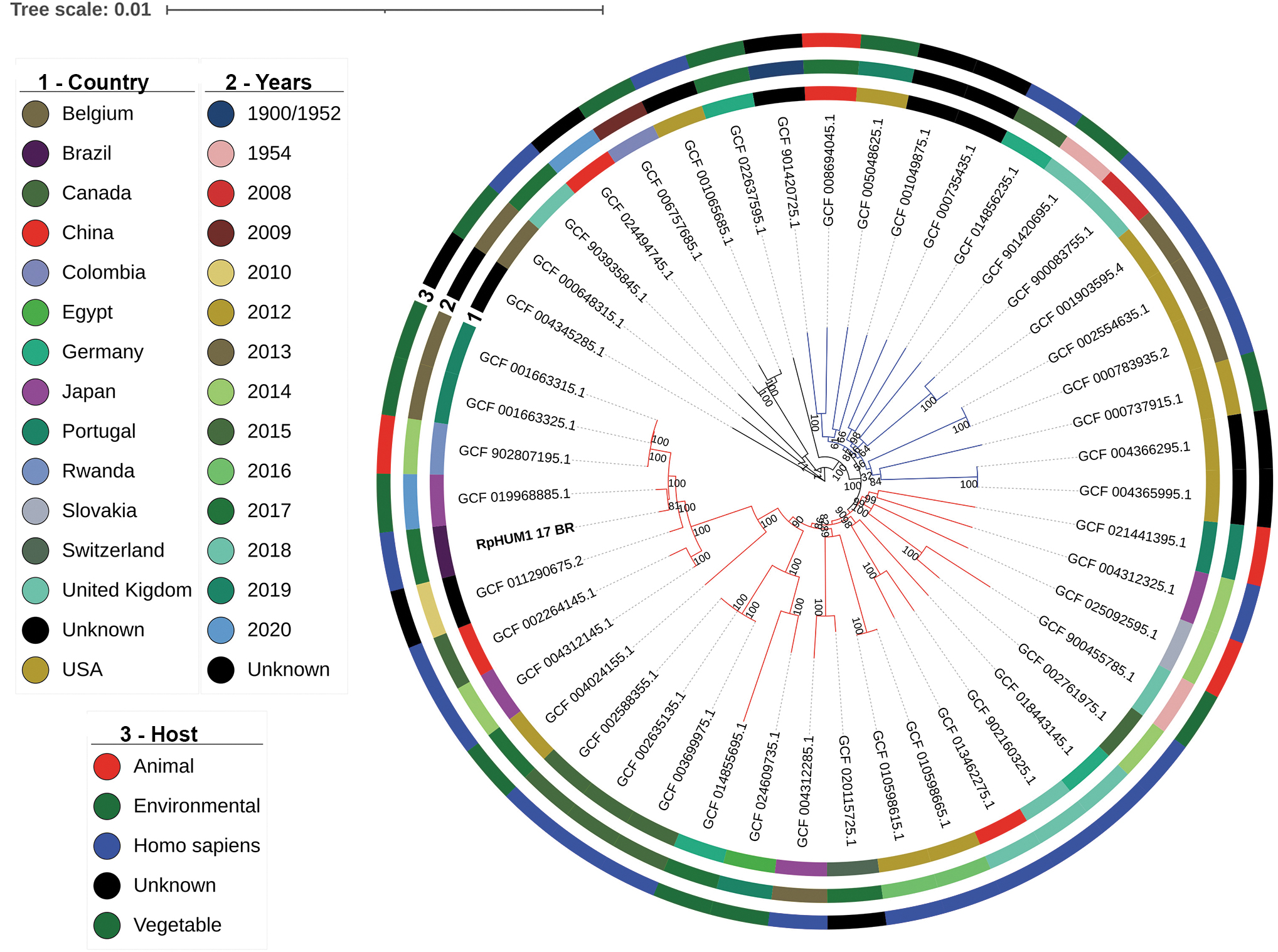
Phylogenomic analyses of all Raoultella planticola strains available in RefSeq. The phylogenomic analyses are performed based on core genome alignments of 46 R. planticola genome sequences publicly available in RefSeq along with RpHUM1 isolate. The R. planticola strain evaluated in this study is highlighted in bold. RefSeq, Reference Sequence Database.
Overall, the RpHUM1 and strain from Japan (GCF_019968885.1) shared the highest phylogenetic relationship (81%). Other seven genome sequences were not included in clade 1 or 2, being three of which composed individual branches.
Discussion
At the time of these analyses, only 46 R. planticola genomes were available on RefSeq database and to the best of our knowledge this is the first WGS report of R. planticola in Brazil.
The surveillance of RpHUM1 in the nosocomial environment is a danger by itself. After months, an isolate in the same care unit presenting 100% of similarity in ERIC-PCR profile and the same resistance genes (RpHUM2) was recovered. This could also be an alert to the ability of this isolate being a reservoir to resistance genes and MGEs (Table 2). It is important to reinforce that RpHUM1 and RpHUM2 are carbapenem-resistant Enterobacteriaceae (CRE) and this group of bacteria are in the alerts on drug-resistant microorganisms and priority for the development of new drugs of Centers for Disease Control and Prevention (CDC) 32 and World Health Organization (WHO). 33
Most Gram-negative bacteria recovered from nosocomial environment have a high capacity to harbor genetic recombination processes, as well as MGEs such as transposons, insertion sequences (IS), and recombinases. 34 In our isolate, we detected 14 different MGEs associated with 9 antimicrobial resistance genes to 5 different classes. The presence of MGEs such as Tn4401b is of great importance to dissemination of resistance genes since it is usually reported as active transposon capable of efficiently mobilizing the blaKPC gene that confers resistance to carbapenems.35,36
In addition, other β-lactamases have been frequently relating as being spread by MGEs.35,37 Of these β-lactamases, we highlight the KPC, NDM, and CTX-M that are very important for global epidemiology, since these genes are constantly associated with infections worldwide in several bacterial species, including R. planticola isolates.
The presence of blaKPC gene in R. planticola was described in countries such as the United States,4,9 China,7,10,38 and even in Brazil. 12 Ribeiro et al. isolates, as much as ours, contained the KPC-2 and were recovered from surveillance data. Moreover, this gene was frequently reported as associated with other β-lactamases as CTX-M and NDM.
The blaCTX-M genes are a large family of resistance genes with >200 alleles registered in National Database of Antibiotic Resistant Organisms (NDARO) from U.S. National Library of Medicine, 39 which the alleles of blaCTX-M-3, blaCTX-M-9, blaCTX-M-14, and blaCTX-M-15 were already found in R. planticola in Switzerland, 40 China,5,7 and the United States.9,41 Two isolates have already been identified with the presence of genes blaCTX-M and blaKPC, one from China 7 and the other in the United States. 9
In contrast, our isolate contained blaCTX-M genes encoding CTX-M group 15 enzymes (CTX-M-15), one of the main cefotaximases isolated in Enterobacteriaceae species, and was also detected in R. planticola isolates obtained from the environment in Switzerland's lakes. 11 The permanence of resistant microorganisms in aquatic environments may represent an important vehicle to disseminate these genes with other species, including potential pathogens, reinforcing the ability of R. planticola to act as a reservoir of resistance genes. 42 Up to now, RpHUM1 was the only one reported to be recovered from a human host presenting blaCTX-M-15.
Nevertheless, the gene with highest association described in R. planticola was the blaNDM gene, with many cases in China.5,6,10,43,44 This gene was already associated with CTX-M enzime, as well as other β-lactamases from SHV and TEM family by Chen et al. through sequencing an isolate recovered from a human host. 5
Zhao et al. already found an isolate of R. planticola highly resistant harboring blaKPC and blaNDM genes in distinct plasmids, which KPC plasmid contained 2 MDR regions with 14 resistance genes, and blaNDM gene was flanked by ISs. 10 Here we reported the presence of blaKPC-2, blaNDM-1, and blaCTX-M-15 genes in a single isolate of R. planticola, which was only found in one isolate described by Li et al. in China. 38 In this research, the authors also reported the presence of blaKPC-2 and blaNDM-1 genes, as our findings, being both genes in different plasmids. The gene blaCTX-M was also found in the chromosome, but differently from RpHUM1 that had the allele blaCTX-M-15, the discovered allele was blaCTX-M-14.
Studies with a similar methodology based on PCR detection and sequencing already reported the presence of several other genes in R. planticola, encoding the following families of β-lactamases IMP-8, 45 OXA-48,8,41,46 TEM,4,5,11,42,47 and SHV.5,42 The similarity of these isolates to those described here occurs in the high resistance including, apart from β-lactams, the aminoglycosides, fluoroquinolones, fosfomycins, macrolides, sulfonamides, and tetracyclines.5,41,47,48
Even we could not affirm the presence of all resistance genes in plasmids, it was possible to verify through the phylogenetic analysis that the complete genomes available in RefSeq showed a high similarity to each other, mainly in the RpHUM1 cluster (red line branch shown in Fig. 2) with a score between 81% and 100%. In addition, R. planticola RpHUM1 showed a large resistome and mobilome, which is worrisome since it reveals the potential of this microorganism to become a reservoir of antimicrobial resistance genes or, even further, a successful pathogen.
Conclusions
In this study, we reported the first whole genome sequence of a Brazilian isolate of R. planticola and the genomic context of antibiotic resistance markers. This comprehensive knowledge is of great importance for implementation of control measures to prevent the rapid dissemination of this neglected microorganism and their genetic resistance background.
Footnotes
Data Availability
The whole genome shotgun sequence of RpHUM1 was deposited at DDBJ/ENA/GenBank under the accession number [not available yet] (BioProject PRJNA832272, BioSample SAMN27782876).
Acknowledgments
We thank Laboratory of Molecular Biology of Microorganisms at the State University of Londrina and the Soy Biotechnology Laboratory at Embrapa Soja of Londrina for the partnership in carrying out this study.
Authors' Contributions
P.V.B.M. contributed to conceptualization, methodology, investigation, and writing—original draft. E.R.T. was involved in methodology, software, formal analysis, and writing—review and editing. C.W.M. carried out methodology. L.B.M. was involved in formal analysis and writing—original draft. R.O.S. was in charge of software, formal analysis, and writing—original draft. N.H.F. carried out methodology and writing—review and editing. D.R.S. was in charge of methodology. M.H. carried out resources, supervision, and writing—review and editing. S.F.Y.-O. carried out resources, supervision, and writing—review and editing. M.C.B.T. was in charge of conceptualization, resources, writing—review and editing, project administration, and funding acquisition.
Disclosure Statement
No competing financial interests exist.
Funding Information
This study was financed in part by the Coordenação de Aperfeiçoamento de Pessoal de Nível Superior—Brasil (CAPES), Financial Code 001. As this government fund is designed to encourage higher education training in Brazil, it only covers the cost of laboratory materials and grant.