




Abstract
Escherichia coli sequence type 69 (ST69) are common causative agents of extraintestinal infections occurring in the bloodstream, cerebrospinal fluid, surgical sites, and, most frequently, the urinary tract. The objective of this study was to analyze the genomic characteristics of 45 antimicrobial-resistant Escherichia coli ST69 strains that were isolated from 28 calves on eight dairy farms in Pennsylvania, USA. The genomes were sequenced and the antimicrobial resistance genes (ARGs), virulence factors (VFs), and plasmid replicons were identified in silico. A phylogenetic analysis was conducted to compare these calf isolate genomes with poultry and human clinical E. coli ST69 genomes. In total, 23 ARGs, 45 VFs, and 15 plasmid replicons were identified. The majority of genomes (n = 36, 80%) had a multidrug-resistant (MDR) genotype and carried genes conferring resistance to antibiotics of human health significance. Phylogenetic analysis based on the core genomes revealed that calf isolates were nested within clades that included human and poultry isolates, indicating that they are not phylogenetically distinct. Results suggest that dairy calves are a reservoir of MDR E. coli ST69 strains with diverse ARG and VF profiles. This information will be helpful in assessing public health risks associated with E. coli ST69 in commercial dairy production systems.
Introduction
E
Extraintestinal pathogenic Escherichia coli (ExPEC) are a group of pathogenic strains that may cause severe infections at nonintestinal sites, including the bloodstream, cerebrospinal fluid, and surgical sites, but the most frequent ExPEC-associated infections are urinary tract infections (UTIs), causing ∼10 million medical visits and over $2 billion in health care costs annually in the United States. 2 ExPEC isolates recovered from human clinical cases typically belong to several sequence types (STs), but the presence of ExPEC-associated VFs is more indicative of virulence potential than ST assignment. 3 Interestingly, these strains can reside in the human gut where they do not cause disease unless their genomes encode and express VFs that cause an adverse immune response in that environment. 4
E. coli ST69 is a major causative agent of human extraintestinal infections globally. 3 Poultry is considered a reservoir ST69 and other ExPEC strains,5,6 and in a recent study focusing on the presence of VFs in ExPEC strains, more than half of the ST69 strains isolated from food animals, including poultry, in the United States were identified as “high risk” for causing human infections. 7 Cattle are known to shed ExPEC strains, and a recent study has demonstrated a high level of such strains from commercial veal calf feces in the United States. 8 However, genome-level studies on such bovine-associated strains are lacking, particularly those focused on ST69. In this study, the genomes of 45 ST69 isolates recovered from dairy calves were analyzed. These genomes were also compared to ST69 isolated from poultry and human clinical cases in the United States to investigate the phylogenetic relationship between strains from different sources.
Materials and Methods
The 45 E. coli ST69 genomes were identified from a collection of E. coli previously isolated from the feces of preweaned and postweaned dairy calves in commercial dairy herds (milking at least 100 cows) in Pennsylvania, USA. The E. coli isolates were cultured overnight at 37°C in Luria-Bertani broth (BD Diagnostics, Sparks, MD), followed by DNA extraction using the QIAmp DNA Mini kit with a QIACube HT (Qiagen, Hilden, Germany). DNA libraries were prepared with a Nextera XT DNA Library Preparation Kit (Illumina, La Jolla, CA) and these libraries were sequenced on a NextSeq 500 with a 2 × 150 high-output flow cell (Illumina). The ST69 isolates were recovered from 28 dairy calves on eight farms.
For sequencing data analyses, default parameters were used for all software unless otherwise specified. Sequences were demultiplexed using the BCL2FastQ v2.15.0.4 (Illumina). Reads were curated using Trimmomatic v0.36 (LEADING:20 TRAILING:20 SLIDINGWINDOW:4:20 MINLEN:36), 9 and assembled using SPAdes v3.15.0. 10 Curated reads were investigated for ST with MLST v2.0, 11 acquired virulence genes with VirulenceFinder v2.0, 12 antimicrobial resistance genes (ARGs) with ResFinder v4.1, 13 and plasmid replicons with PlasmidFinder v2.1. 14 Core genome single nucleotide polymorphisms (SNPs) were identified by aligning the 45 E. coli ST69 genomes from this study with 346 publicly available E. coli ST69 genomes isolated from humans and poultry in the EnteroBase Escherichia/Shigella database using ParSNP.15,16 A maximum likelihood tree was generated with 1,000 bootstrap replicates using these SNPs with RAxML v8.2.3. 17 Subclades within the phylogeny were labeled numerically based on visual inspection for ease of interpretation and discussion. Sequencing data as well as the metadata have been deposited at NCBI under BioProject ID PRJNA881312.
Results and Discussion
Forty-four E. coli ST69 isolates were from preweaned calves and only one was isolated from a postweaned calf (Table 1). The age of preweaned calves carrying E. coli ST69 at sampling ranged from less than 1 day to 13 days, indicating that within 24 hr after birth, calves can become colonized with E. coli ST69. At this early age, the primary sources of gut bacteria are the dam and the environment of the maternity pen and calf housing. Early exposure can occur during parturition or shortly after, during the initial dam-calf interactions. E. coli ST69 has been isolated from dairy cow feces, indicating that adult cows can be a potential source of these organisms for young calves. 18
Source Location, Calf ID, Animal Weaning Status, Age (in Days), and Number of Classes to Which Antimicrobial Resistance Genes Confer Resistance
ARG profile, and plasmid replicon profiles.
Indicates <100% similarity or <100% coverage with ARG in the Resfinder 4.1 database.
ARG, antimicrobial resistance gene.
The only E. coli ST69 isolate from a postweaned calf was isolated from the feces of a calf at 59 days of age. The pool of genomes from which the E. coli ST69 genomes were identified contained approximately equal numbers of genomes from preweaned as from postweaned calves. Although we did not aim to identify age-related trends in ST carriage, results from this study suggest that E. coli ST69 acquired before weaning may not persist beyond weaning. This may be confounded with antibiotic resistance since the prevalence of resistant E. coli is lower in the feces of calves that have been weaned than in the feces of preweaned calves. Further investigation into age-related carriage of STs, particularly those that cause human infections such as ST69, is warranted.
In total, 23 ARG types conferring resistance to seven classes of antibiotics were identified in the E. coli ST69 genomes (Table 1). The identified antibiotic classes were aminoglycosides, β-lactams, trimethoprim, macrolide-lincosamide-streptogramin B (MLS), quinolones, sulfonamides, and tetracyclines. The most common genes were those that confer resistance to β-lactams (nine total ARGs), aminoglycosides (five), and tetracyclines (three).
ARGs that were found in >50% of the genomes included aph(3'')-Ib (aminoglycoside phosphotransferase), aph(6)-Id (aminoglycoside phosphotransferase), blaTEM-1B (β-lactamase), qnrS1 (fluoroquinolone resistance protein), and sul2 (sulfonamide-resistant dihydropteroate synthase). Most genomes (n = 36, 80%) harbored ARGs known to confer resistance to three or more classes of antimicrobials and were denoted as genotypically MDR. Thirteen genomes carried ARGs conferring resistance to six classes of antimicrobials. Of particular interest are the extended spectrum cephalosporinases, blaCMY-2, and blaCTX-M, which confer resistance to ceftriaxone; dfrA and sul, which confer resistance to trimethoprim/sulfamethoxazole (TMP-SMX); and the plasmid-mediated quinolone resistance (PMQR) gene, qnrS1, which confers low to intermediate resistance to ciprofloxacin, all of which are indicated for treatment of human UTIs.
Another significant ARG was mph(A), which confers resistance to macrolides of human health significance such as erythromycin and azithromycin, both of which are not typically used to treat Enterobacteriaceae infections, although the latter has been suggested as an option for such infections in some countries. 19 Two genes conferring resistance to the disinfecting quaternary ammonium compounds (QACs), qacEΔ1 and sugE1, were identified among the genomes. Only one genome encoded qacEΔ1 (ARS-CC16195), while seven encoded sugE1 (ARS-CC16196, ARS-CC16152, ARS-CC16151, ARS-CC16083, ARS-CC16059, ARS-CC15922, and ARS-CC15863).
The VFs that were detected among the genomes grouped into 45 VF types and sitA, chuA, iss, kpsE, lpfA, ompT, and terC were detected most frequently (Fig. 1). Each genome encoded multiple VFs, including those that are integral in the colonization and infection of humans outside the intestine. The presence of VFs in these genomes indicates that these E. coli ST69 strains are potentially virulent, although further analysis would be needed to determine actual virulence potential. Several ExPEC adhesins were detected, including afa (afimbrial adhesin), pap (P fimbriae), and iha (iron-regulated gene homolog adhesin). The iron uptake genes iuc (aerobactin), irp (yersiniabactin synthesis), fyuA (yersiniabactin receptor), chu (heme binding protein), sit (iron and magnesium transport), and iroN (salmochelin) were also detected. The detected protectins/serum resistance genes included traT (transfer protein), kps (capsular antigens), and iss (increased serum survival).
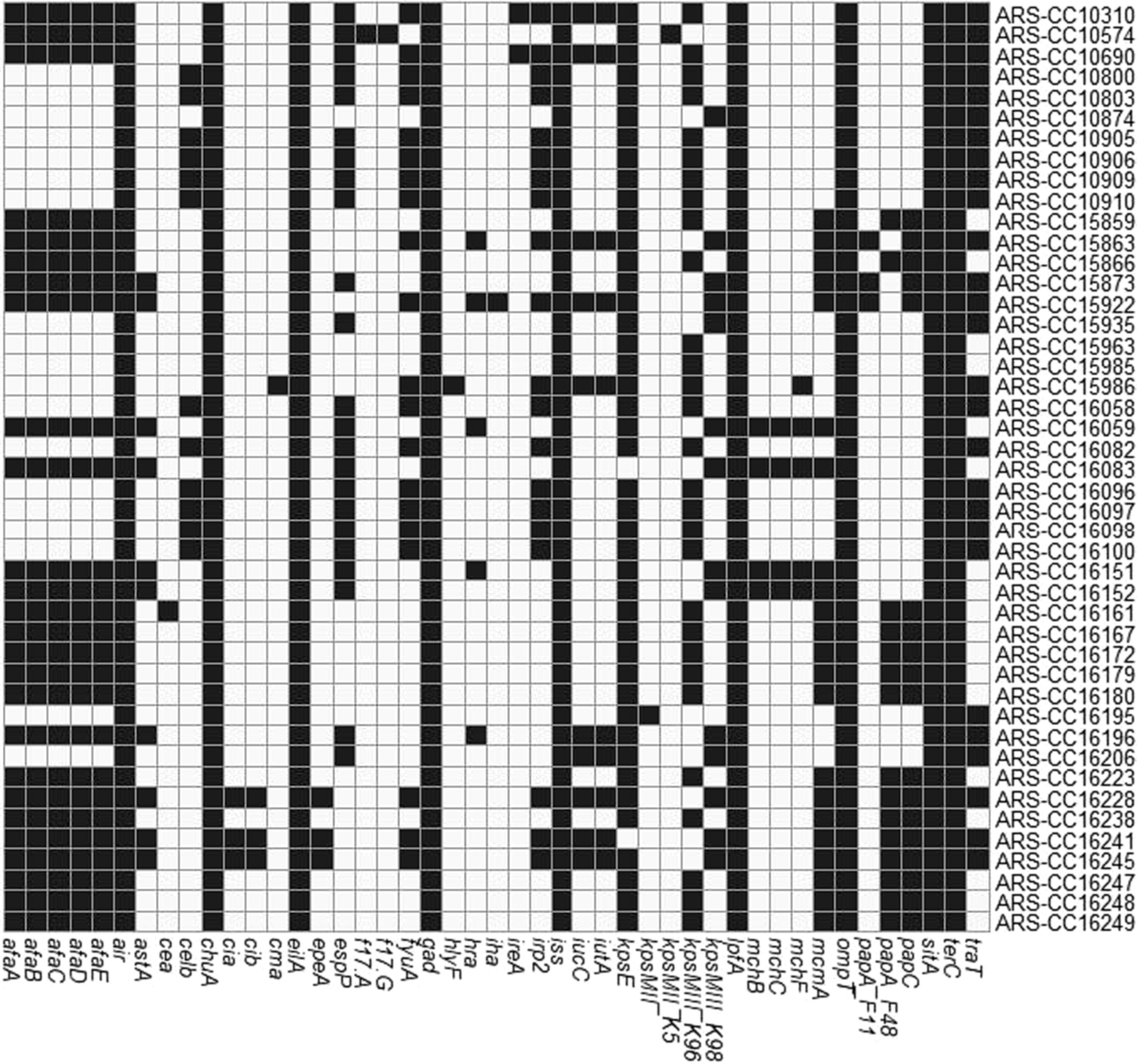
Virulence factors identified in the dairy calf Escherichia coli ST69 isolates. Black box = present. White box = absent.
Homologs of ETT2 island were identified in 42 genomes. This island encodes a Type III Secretion System (T3SS) and associated effector proteins, but its involvement in the infection process has not been definitively demonstrated. 20 However, ETT2 is highly conserved in human pathogenic ST69 strains, suggesting that it may play an important role in human infections. 20 Interestingly, other major toxins involved in ExPEC infections caused by other ExPEC STs such as pic (serine protease), sat (secreted autotransporter toxin), vat (vacuolating autotransporter toxin), hlyA I (hemolysin A), cnf (cytotoxic necrotizing factor), and cdt (cytolethal distending toxin) were not detected in these strains. These results are consistent with previous reports of ST69 from human clinical infections.21,22
Dairy calves are known to shed a higher proportion of MDR:Susceptible E. coli in their feces than older cows, 23 yet the mechanisms driving this phenomenon are not known. A recent study on antimicrobial-resistant E. coli from the feces of veal calves identified a significant association between the MDR genotype and several VFs involved in survival within the host, including sit and iuc-iutA genes involved in iron scavenging along with the pap P fimbriae, 8 all of which are highly represented among the calf isolate genomes.
Iron-scavenging genes have been hypothesized to confer a selective advantage on those strains in a low iron environment such as the preweaned calf gut where the major source of nutrition is milk, which has a relatively low iron content. 8 However, on-farm usage of antibiotics, both for treating calves and lactating cows where residues may end up in waste milk that is fed to calves, cannot be disregarded as a potential selecting factor. 24 It is likely that multiple factors (management and physiological) impact the enrichment of E. coli strains that encode these VFs and ARGs, such as is consistent with ST69.
Based on the phylogenetic analyses, it appears that the dairy and poultry isolates are, for the most part, closely related to each other (Fig. 2 and Supplementary Fig. S1). A pattern of isolates from both animal groups was interspersed within multiple smaller subclades (2.1 to 2.6, 3.1, and 4.1). Poultry isolates were more phylogenetically diverse, but this is most likely because the poultry isolates were from a broad geographic and temporal range, while the dairy calf isolates were collected within one state during a single year. Overall, two major ST69 lineages were identified among the larger set of human, poultry, and dairy calf isolates.
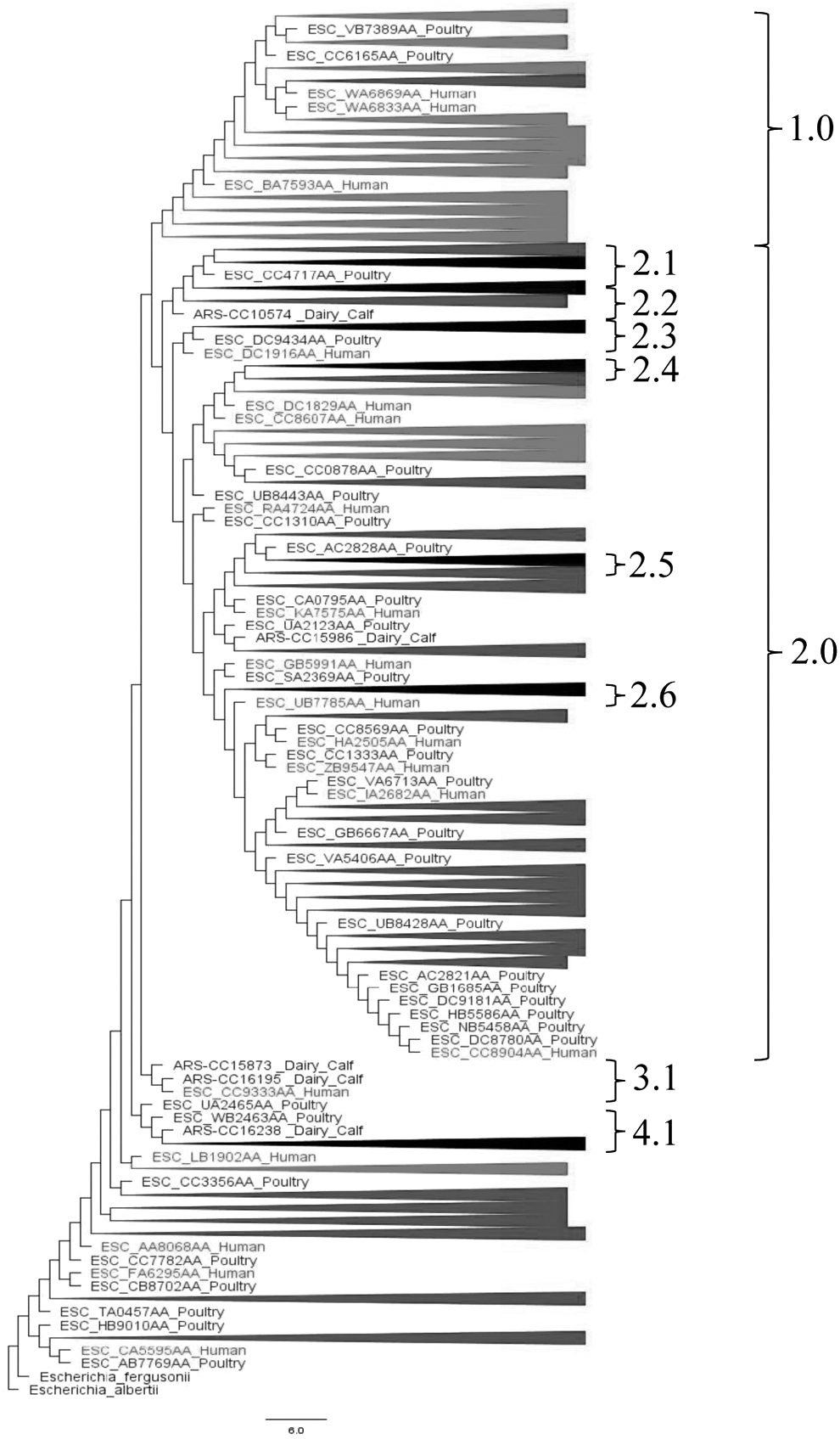
Maximum likelihood phylogenetic tree of ST69 genomes from dairy calves, poultry, and humans, rooted in Escherichia albertii. Two major clades were identified within the tree (labeled 1.0 and 2.0) with several subclades consisting of more than one dairy calf isolates (subclades 2.1 to 2.6, 3.1, and 4.1). The tree was inferred with 1,000 bootstrap replicates. Bar = substitutions per site.
Clade 1.0 comprised primarily human clinical isolates (n = 144) with four poultry isolates nested within this clade. Clade 2.0 included most dairy calf isolates from this study (66%), 115 poultry isolates, and 20 human clinical isolates. Within this clade, three calf isolates (ARS-CC16195, ARS-CC15963, and ARS-CC15985) were phylogenetically closely related to several human isolates and seven calf isolates (ARS-CC10874, ARS-CC15935, ARS-CC16206, ARS-CC15985, ARS-CC15963, ARS-CC10690, and ARS-CC10310) were closely related to poultry isolates. Although we did not aim to identify directionality of E. coli ST69 transmission between dairy calves, poultry, and humans, these results indicate that there are recent common ancestors among some poultry, human, and dairy calf strains, and that strains from these three sources are, in some cases, more closely related to each other than they are to ST69 strains of the same source.
Of further interest is the high level of relatedness among isolates from different calves on the same farm, and more interestingly, calves from different farms. Circulation of strains among animals on the same farm is not unexpected, as these animals are exposed to the same environment and, depending on the farm, to each other. Isolation of phylogenetically related strains on multiple farms indicates that there has also been regional transmission of E. coli. Transmission of bacteria between farms may occur through many routes, including service vehicles and people, animal movement, or through wildlife.
Results of this study demonstrate the presence of E. coli ST69 strains that harbor VFs known to play a role in human infections and genes conferring resistance to antibiotics of human health significance, in dairy calves. Furthermore, these strains are phylogenetically interspersed with poultry and human clinical isolates, suggesting a close evolutionary relationship among strains from these sources. Future work should investigate the role of dairy calves in the ecology of ST69 and the factors that may influence the survival of E. coli ST69, and other ExPEC, in the dairy calf gut.
Footnotes
Acknowledgments
The authors wish to express their gratitude to Jakeitha Sonnier and Laura Del Collo for technical assistance. Mention of trade names or commercial products in this article is solely for providing specific information and does not imply recommendation or endorsement by the U.S. Department of Agriculture.
Authors' Contributions
J.V.K., B.J.H., E.P.H., and H.R.S.: designed and coordinated the study; S.W.K.: carried out sequencing; S.S.: analyzed data and prepared the article; J.V.K., B.J.H., and H.R.S.: edited and critically revised the article; and all authors read and approved the submitted article.
Disclosure Statement
No competing financial interests exist.
Funding Information
This project was supported by internal USDA, ARS research funding.

References
Supplementary Material
Please find the following supplemental material available below.
For Open Access articles published under a Creative Commons License, all supplemental material carries the same license as the article it is associated with.
For non-Open Access articles published, all supplemental material carries a non-exclusive license, and permission requests for re-use of supplemental material or any part of supplemental material shall be sent directly to the copyright owner as specified in the copyright notice associated with the article.
