




Abstract
Porcine contagious pleuropneumonia, caused by Actinobacillus pleuropneumoniae, has resulted in significant economic losses to the swine industry. Although antibiotics are commonly employed to control this disease, their widespread use or misuse can lead to the development of antibiotic resistance in A. pleuropneumoniae. Consequently, it is crucial to conduct antimicrobial susceptibility testing on clinical isolates. In our study, we identified one strain of A. pleuropneumoniae with resistance to florfenicol and extracted a 5919 bp plasmid named pAPPJY, which confers florfenicol resistance. Sequence analysis revealed that the plasmid contains four open reading frames, namely rep, antioxin vbha family protein, floR, and a partial copy of lysr. Although a few variations in gene position were observed, the plasmid sequence exhibits a high degree of similarity to other florfenicol-resistant plasmids found in Glaesserella parasuis and A. pleuropneumoniae. Therefore, it is possible that the pAPPJY plasmid functions as a shuttle, facilitating the spread of florfenicol resistance between G. parasuis and A. pleuropneumoniae. In addition, partial recombination may occur during bacterial propagation. In conclusion, this study highlights the horizontal transmission of antibiotic resistance among different bacterial species through plasmids, underscoring the need for increased attention to antibiotic usage.
Introduction
Porcine contagious pleuropneumonia is a respiratory disease caused by Actinobacillus pleuropneumoniae, which has resulted in significant mortality and substantial economic losses within the global swine industry. 1 Antibiotics, such as florfenicol, cephalosporins, and doxycycline, are commonly utilized for disease control. However, the excessive use of antibiotics can lead to the preservation and transmission of drug-resistant genes in A. pleuropneumoniae. Studies have revealed that A. pleuropneumoniae strains have developed resistance to aminoglycosides, sulfonamides, tetracyclines, and chloramphenicols.2,3
Of particular concern is the resistance of A. pleuropneumoniae to florfenicol, a third-generation chloramphenicol derivative widely employed in China due to its efficacy. Five florfenicol resistance genes (floR, fexA, fexB, cfr, and optrA) have been identified in bacteria of animal origin. 4 One common mechanism of florfenicol resistance in Gram-negative bacteria, including swine-associated strains, involves the specific efflux pump protein encoded by the floR gene, which mediates active efflux of florfenicol. 5
The floR gene is widely present in porcine bacteria, such as Escherichia coli, Glaesserella parasuis, and A. pleuropneumoniae, and can undergo horizontal transmission among these species.6–8 Plasmids serve as transfer vectors for the spread of antibiotic resistance, enabling new hosts to acquire resistance to specific antibiotics. 6 A plasmid named pHPSGC, containing the floR gene and conferring florfenicol resistance, was discovered in G. parasuis. Sequence analysis suggested that pHPSGC may have resulted from recombination events between pHPS1019 and pCCK381. 9
In 2015, a florfenicol-resistant A. pleuropneumoniae strain was identified in the United Kingdom, and a mobile florfenicol-resistant plasmid was found in A. pleuropneumoniae for the first time. Sequencing analysis revealed the presence of the florfenicol resistance gene floR within the plasmid, and mating experiments confirmed its ability to spread between species. 3 This indicates that A. pleuropneumoniae can acquire antibiotic resistance through the transfer of resistant plasmids among bacterial species, posing challenges for the future treatment of porcine pleuropneumonia with antibiotics.
In our study, we successfully isolated a 5119 bp plasmid, named pAPPJY, from an A. pleuropneumoniae strain, which carries the floR gene associated with florfenicol resistance. Although a few variations in gene position were observed, the plasmid sequence exhibited significant similarity to plasmids encoding the florfenicol resistance gene found in G. parasuis and A. pleuropneumoniae. These findings suggest a potential common origin for these plasmids within the Pasteurellaceae family, indicating the ability of certain resistant plasmids to mobilize between different bacterial species.
Material and Methods
Bacterial isolation and antimicrobial susceptibility test
In 2021, a strain of A. pleuropneumoniae type 7 was isolated from the pulmonary tissues of pigs affected by the disease in Jiangyin, Jiangsu Province. The antimicrobial susceptibility of this A. pleuropneumoniae strain was assessed using the disk diffusion method, revealing minimum inhibitory concentrations (MICs) of 16 μg/mL for florfenicol and 8 μg/mL for chloramphenicol, as determined through the microdilution method.
PCR identification of florfenicol resistance gene and plasmid extraction
Specific primers, namely floR, fexA, fexB, crf, and optrA, associated with the florfenicol resistance gene, were designed for the amplification of bacterial-resistant genes. 3 Among these primers, the floR primers (floRF: 5′-acgtttatgccaaccgtcct-3′, floRR: 5′-catacaagcgcgacagtgg-3′) successfully amplified the target fragment. Subsequently, a plasmid was extracted from A. pleuropneumoniae and designated as pAPPJY.
Conjugation and transformation assays
To verify that plasmid pAPPJY confers florfenicol resistance, it was introduced into the E. coli strain DH5α through the calcium salt method. Subsequently, we observed an increase in the MIC for florfenicol from 8 to 16 μg/mL in the recipient DH5α strain. Notably, DH5α cells transformed with the florfenicol-resistant plasmid were able to grow on Luria Bertani (LB) solid medium containing 16 μg/mL of florfenicol, whereas untransformed DH5α cells did not exhibit any growth.
Single colonies were selected from the transformed DH5α culture and cultured in LB liquid medium supplemented with 16 μg/mL florfenicol, which allowed for the successful extraction of pAPPJY from these cultures. After 20 generations, the DH5α cells transformed with pAPPJY maintained their ability to grow in the presence of florfenicol, and the plasmid remained present (data not shown). However, we were unable to transfer pAPPJY to G. parasuis using the same transformation method.
Plasmid sequencing
The plasmid extracted from A. pleuropneumoniae was sent to general biology limited company for complete sequencing. FloR downstream primers were used for leader sequencing and then primers walking strategy was used to complete full sequencing. The complete sequence of pAPPJY has been deposited to Genbank (accession no. OP122556), and we performed a comparative analysis by conducting a BLAST search in the NCBI database.
Results and Discussion
In 2021, we isolated a strain of A. pleuropneumoniae type 7, designated as APPJY, from the pulmonary tissues of pigs affected by disease in Jiangyin, Jiangsu Province. To evaluate its antimicrobial susceptibility, we performed the disk diffusion method using various antibiotics. The results revealed that APPJY exhibited high resistance to chloramphenicol (Table 1). Subsequently, we successfully extracted a plasmid, named pAPPJY, from this APPJY strain using a plasmid extraction kit.
The Drug Sensitivity Test Result of the Actinobacillus pleuropneumoniae
Inhibitory zone diameter (d) <15 mm, resistance (R) 15 mm ≤ d < 20 mm, insensitivity (I) d ≥ 20 mm, susceptibility (S).
The plasmid's sequence was determined through sequencing, confirming a length of 5119 bp and the presence of the floR gene. To assess the functional impact of the plasmid, we conducted a transformation experiment in which pAPPJY was introduced into the DH5α strain. This transformation resulted in an increased resistance to florfenicol in DH5α.
To investigate its similarity with other drug-resistant plasmids, we performed a comparative analysis by conducting a BLAST search against four highly homologous plasmids in the NCBI database. The results revealed significant homology between specific regions of pAPPJY and the plasmid from G. parasuis strain GHP1807. Specifically, positions 1–1438, 1439–3315, 3526–4351, and 4988–5199 bp of pAPPJY exhibited >99% homology with positions 1–1438, 1975–3853, 3854–4679, and 5084–5315 bp, respectively, of the GHP1807 plasmid (Fig. 1).
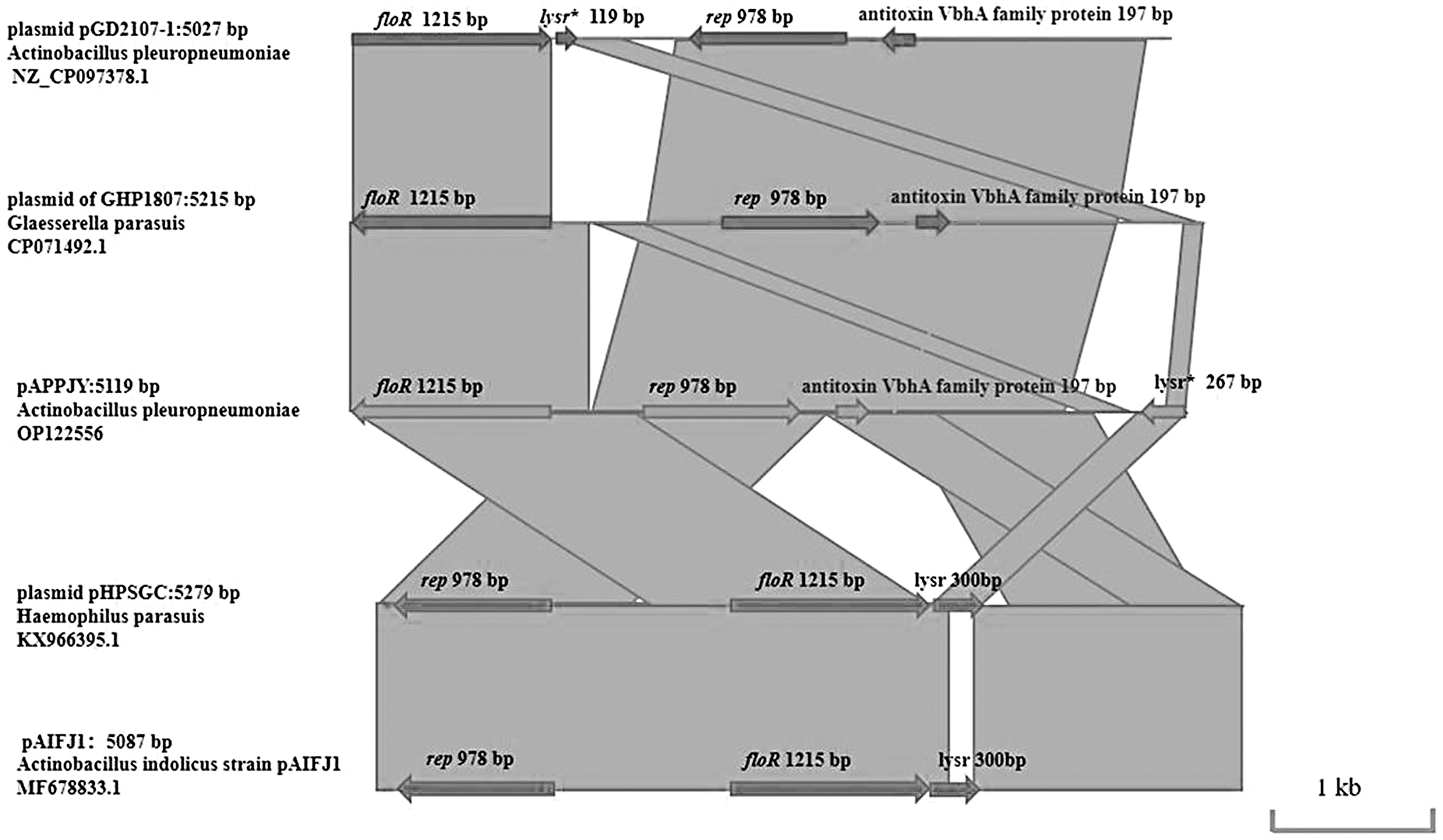
Comparison of pAPPJY and other plasmids from Glaesserella parasuis and Actinobacillus pleuropneumoniae. Arrows indicate gene positions and transcriptional orientation. Regions with extensive similarity are marked by gray shading, which indicate >98% nucleotide sequence identity. A distance scale with 1 kb is shown. floR, florfenicol resistance gene; rep, plasmid replication protein; lysr, a transcription regulatory factor; lysr*, a partial transcription regulatory factor.
Both plasmids contain the floR gene, with a similarity rate of 99.84%. The rep gene and the gene encoding the antitoxin VBHA family protein in both plasmids are identical, although pAPPJY has an additional partial copy of the lysr gene. Furthermore, downstream position 4527–4783 bp of pAPPJY perfectly matches with upstream position 1437–1697 bp of the GHP1807 plasmid (Fig. 1), indicating changes in the relative positions of certain genes.
When comparing pAPPJY with the plasmid pHPSGC from G. parasuis, we observed >99% homology between positions 1–1390, 1927–3364, 3365–3506, 3965–4979, and 4791–4351 bp of pHPSGC and between positions 1437–2826, 1–1438, 4977–5119, 2827–3315, and 3337–5199 bp of pAPPJY, respectively. Notably, both plasmids share the same rep and floR genes, but the pHPSGC plasmid contains a complete lysr gene.
In addition, the plasmid pAIFJ1 from Actinobacillus indolicus strain pAIFJ1 exhibits a similar gene structure to pHPSGC, resulting in almost identical sequence comparison results with pAPPJY as observed for pHPSGC. Among the A. pleuropneumoniae plasmids, the plasmid pGD2107-1 demonstrated the highest homology with pAPPJY, with ∼80% similarity. Both plasmids share the same rep and floR genes, and their lysr genes exhibit partial similarity (Fig. 1).
Based on the findings, it is plausible that pAPPJY represents a previously identified florfenicol-resistant plasmid present in both G. parasuis and A. pleuropneumoniae. These plasmids share a similar simple structural composition, primarily consisting of rep, floR, and lysr genes. However, partial recombination of these genetic elements may have occurred during the transfer process, leading to some variations in their overall structure.
In summary, our study successfully extracted a florfenicol-resistant plasmid, pAPPJY, from A. pleuropneumoniae. Through gene sequence analysis, we observed a high degree of similarity in gene structure and composition between pAPPJY and other florfenicol-resistant plasmids found in G. parasuis and A. pleuropneumoniae. This suggests a potential common origin for these plasmids within the Pasteurellaceae family, indicating the possibility of plasmid mobilization between different species. These findings contribute to the theoretical understanding of the widespread distribution of the floR gene and emphasize the importance of monitoring florfenicol resistance in A. pleuropneumoniae. It also underscores the need to focus on small plasmids harboring resistance genes in Pasteurellaceae bacteria.
Footnotes
Authors' Contributions
C.Z. contributed to design of the study and draft of the article; Y.L. was tutor for the research and revised the article; and J.A., J.C., and B.Z. gave technical support.
Disclosure Statement
No competing financial interests exist.
Funding Information
This study was supported by the National Key Research and Development Program of China (2022YFD1800900), National Natural Science Foundation (31672565), and the Priority Academic Program for Development at Jiangsu Higher Education Institutions (PAPD).