




Abstract
There is an emerging fluconazole resistance in Candida parapsilosis in recent years. The leading mechanism causing azole resistance in C. parapsilosis is the Y132F codon alteration in the ERG11 gene which encodes the target enzyme of azole drugs. In this study, we evaluated the sensitivity, compatibility, and specificity of a novel tetra-primer amplification refractory mutation system-polymerase chain reaction (T-ARMS-PCR) method for rapid detection of the Y132F mutation in fluconazole nonsusceptible C. parapsilosis. Antifungal susceptibility tests for detection of fluconazole resistance were performed by broth microdilution according to the CLSI guidelines. All susceptible and nonsusceptible C. parapsilosis isolates were analyzed for ERG11 mutations with Sanger sequencing. T-ARMS-PCR was fully concordant with the Sanger sequencing (100% of sensitivity and specificity) for detection of Y132F mutations. T-ARMS-PCR method could be a rapid, simple, accurate, and economical assay in the early detection of the most common cause of fluconazole resistance in C. parapsilosis isolates. In routine laboratories with high C. parapsilosis isolation rates, performing the T-ARMS-PCR for early detection of the most common reason of fluconazole resistance in C. parapsilosis, could be a life-saving approach for directing antifungal therapy before obtaining the definitive antifungal susceptibility tests results.
Introduction
Candida parapsilosis is an opportunistic non-albicans Candida species that causes highly mortal infections in immunocompromised patients. Currently, C. parapsilosis is the second most common cause of candidemia and emerging fluconazole resistance has been reported in Southern Europe and Turkey.1–3 The most common underlying mechanism that leads to fluconazole resistance is the point mutations in the ERG11 gene which synthesizes the target enzyme of azole drugs, and the most frequent mutation is the Y132F (A395T) alteration. 4 Regardless of the different approaches to identifying point mutations, targeted (Sanger) sequencing remains the gold standard for mutation analysis. 5 Although sequencing is the gold standard method, it is expensive, time-consuming, and requires sophisticated instruments.
Currently, both fluconazole and echinocandins are recommended for the first-line therapy of candidemia; however, inappropriate and delayed initial antifungal choice is related to higher mortality.3,6 In addition, Y132F mutation positivity in C. parapsilosis is also associated with higher mortality rates.7,8 So rapid and accurate approaches for early detection of the Y132F mutation in C. parapsilosis will help clinicians for leading the early and appropriate antifungal drug therapy.9,10
For this purpose, here we propose tetra-primer amplification refractory mutation system-polymerase chain reaction (T-ARMS-PCR) method for rapid detection of Y132F mutation in the ERG11 gene which is the most common mutation in C. parapsilosis that causes fluconazole resistance. In T-ARMS-PCR, both wild-type and mutant alleles can be detected together in one single PCR which can be implicated in either conventional or real-time PCR platforms. 11
Materials and Methods
C. parapsilosis isolates were obtained from candidemia patients between 2016 and 2020 from four different medical centers in Istanbul, Turkey. Identification was verified with matrix-assisted laser desorption ionization-time of flight mass spectrometry (MALDI-TOF MS). C. parapsilosis ATCC 22019 strain is used as a reference strain in all the experiments. Antifungal susceptibility tests for fluconazole were performed by broth microdilution method according to the CLSI reference guidelines.12,13 All fluconazole nonsusceptible (FNS) and susceptible C. parapsilosis isolates were analyzed for ERG11 mutations with Sanger sequencing by using specific primers. 14 Trizol-based DNA extraction was done for DNA isolation. 15 PCR products were sequenced by using ABI 3500 genetic analyzer platform (Applied Biosystems) and analyzed with the BioEdit 7.2.5 software.
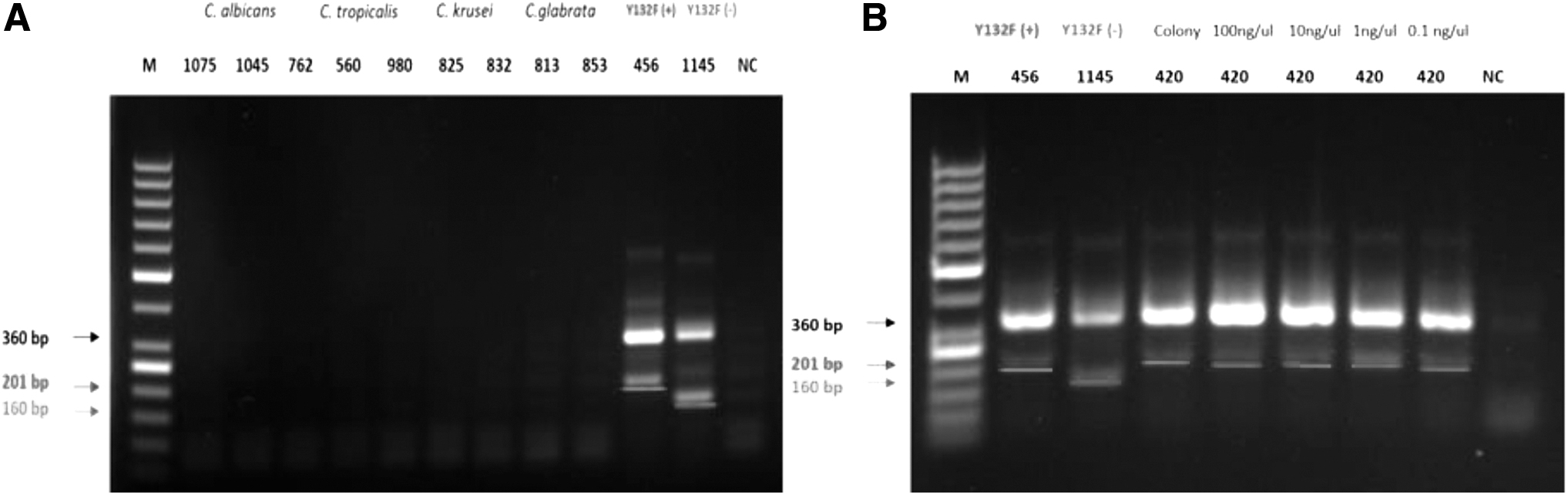
T-ARMS-PCR includes four different primers designed by Primer1 tool (Table 1). Primers were designed where the two inner amplicons (FwinT and RvinA) would have different lengths and easily be separated, and the outer amplicons (Fwout and Rvout) could serve as an internal control. 16 The outer amplicon (360 bp) obtained by outer primers should be observed in every T-ARMS-PCR. The T allele-mutant amplicon (201 bp) represents Y132F mutants of the ERG11 gene, and the A allele-wild type (160 bp) indicates nonmutant for Y132F alterations in C. parapsilosis.
Tetra-Primer Amplification Refractory Mutation System-Polymerase Chain Reaction Primers Details
Results
A total of eight FNS (MIC range: 4–32 μg/mL) Y132F mutation (+), six FNS (MIC range: 4–32 μg/mL) Y132F mutation (−), and seven fluconazole susceptible (MIC range: 0.25–0.5 μg/mL) isolates were included in this study. Direct colony PCR method was used in the study from 48-hour-old C. parapsilosis colonies. 17 The PCR mix contains 10 × Dreamtaq Buffer, 10 mM dNTPs, 25 μM of each outer and allele-specific primers, and 1 U Taq polymerase. The PCR conditions were 5 minutes of initial denaturation at 95°C, 40 cycles of 95°C for 10 seconds, 55°C for 30 seconds, 72°C for 10 seconds, and a final extension at 72°C for 1 minute.
When we compared the T-ARMS-PCR results with the Sanger sequencing, the agreement was found to be 100% for all fluconazole-resistant Y132F mutant (n: 8), nonmutant (n: 6) and fluconazole-susceptible (n: 7) isolates (Fig. 1). Conventional T-ARMS-PCR results were confirmed by high-resolution melting curve analysis by using selective isolates.

Agarose gel electrophoresis results. Y132F (+): FNS with Y132F mutation; Y132F (−): FNS without Y132F mutation. FLU, fluconazole; FNS, fluconazole non-susceptible; M, marker (100 bp).
For specificity analyses, we evaluated the rapid T-ARMS primers with the most common Candida species that cause candidemia other than C. parapsilosis. As a result, any primer binding was not observed with Candida albicans, Candida tropicalis, Candida krusei, and Candida glabrata (Fig. 2A). The accuracy and replicability of the T-ARMS-PCR method were verified by using 10-fold dilutions of input DNA (100–0.1 ng/μL) (Fig. 2B).
Discussion
In this study, we presented an applicable, easy-to-use, and cost-effective alternative approach for the detection of Y132F mutation in FNS C. parapsilosis isolates. The most outstanding advantage of this novel T-ARMS-PCR method is by using direct colony-PCR, from beginning to end the total protocol takes ∼2 hours (Fig. 3). The concordance of T-ARMS-PCR was 100% with high specificity and accuracy when compared with the gold standard Sanger sequencing method which can take up to 24 hours duration.

The Y132F mutation analysis workflow in Candida parapsilosis for clinical microbiology laboratories.
The T-ARMS-PCR primers were designed as species-specific for C. parapsilosis. Therefore, the outer primers are incapable of binding and reacting in other Candida species that may harbor the Y132F mutation in the ERG11 gene. Consequently, even if a Candida species other than C. parapsilosis possesses the Y132F mutation, no bands or amplification reaction will occur. This test also serves as a confirmation assay for species-level identification of C. parapsilosis. This feature represents an additional advantage of the test, particularly in routine laboratories with high C. parapsilosis isolation rates. For laboratories with high C. parapsilosis isolation rates, we recommended considering the application of T-ARMS-PCR immediately after obtaining yeast colonies. This approach eliminates the need to wait for 1 day for species-level identification, especially in cases where MALDI-TOF or other rapid diagnostic methods are unavailable.
The primary limitation of the T-ARMS-PCR assay in our study lies in the specificity of the designed primers, intended solely for detecting the Y132F mutation in C. parapsilosis. Nevertheless, to address this limitation, new primer sets can be designed using the methodology outlined in this study, specifically targeted other Candida species and mutations associated with fluconazole resistance. Consequently, this study introduces a novel technique for mutation detection in mycology, showcasing its potential applicability across various domains. Additionally, it is essential to note that this pilot study is performed with a limited number of isolates, and further evaluation with a larger sample size is warranted before considering routine application of the assay.
In routine laboratories with high C. parapsilosis isolation rates, performing the T-ARMS-PCR for early detection of the most common reason of fluconazole resistance could be a life-saving approach before obtaining the definitive antifungal susceptibility tests results. This assay will provide accurate and rapid results for directing empiric antifungal therapy and could help clinicians with the drug of choice in the first-line therapy in invasive C. parapsilosis infections.
Footnotes
Authors' Contributions
Conceptualization: M.K., Ö.D. Data Curation: S.Ö., K.Ç., G.B., U.A.Ö., S.A. Formal Analysis: S.Ö., K.Ç., Ö.D. Investigation: S.Ö., K.Ç., Ö.D., M.K. Methodology: M.K., Ö.D. Project Administration: K.Ç., Ö.D. Software: M.K. Supervision: M.K., Ö.D. Validation: S.Ö., K.Ç., Ö.D. Writing—Original Draft: S.Ö., K.Ç., Ö.D. Writing—Review and Editing: M.K., Ö.D.
Disclosure Statement
No competing financial interests exist.
Funding Information
No funding was received for this study.