




Abstract
Background:
We estimated the prevalence of metabolic syndrome among urban Indian young adults (18–25 years) as defined by the National Cholesterol Education Program Adult Treatment Panel III (NCEP ATP III), Internation Diabetes Federation (IDF), and Indian consensus statement criteria.
Method:
We included 473 urban young adults through simple random sampling methodology to estimate the prevalence and associated risk factors for metabolic syndrome.
Results:
Prevalence of metabolic syndrome was estimated to be 3.6 [95% confidence interval (CI) 2.2–5.8], 6.6% (95% CI 4.6–9.1), and 8.7% (95% CI 6.4–11.6) using the NCEP ATP III, IDF, and Indian consensus statement criteria, respectively. Men had significantly higher waist circumference, systolic blood pressure, fasting blood glucose, and triglycerides, whereas mean concentrations of both high-density lipoprotein cholesterol (HDL-C) and total cholesterol were significantly higher among women. Low HDL-C (38.9%), high blood pressure (26%), and central obesity (16.1%) were the most common component risk factors. Although less than 4% of normal weight adults met the criteria for metabolic syndrome, rates increased in overweight individuals and reached a prevalence of 87% in the obese participants. In all, 61.3% of the total population had one or more risk factors for metabolic syndrome.
Conclusion:
The prevalence of metabolic syndrome is high among urban young adults in India, and it increased with increase in body mass index (BMI). Each component risk factor in isolated form—increased BMI, smoking, and history of hypertension—is an associated risk factor for metabolic syndrome. Although it is unclear whether metabolic syndrome screening in young Indians as a means to prevent adverse cardiovascular health outcomes is appropriate, healthy lifestyles should nevertheless be encouraged, and young adults should be considered as an important group for cardiovascular risk reduction programs.
Introduction
M
South Asians in particular have high rates of diabetes and CVD compared with other ethnic groups in association with an insulin-resistant phenotype, which is characterized by low muscle mass, upper body adiposity, and a high percentage of body fat. 4 Metabolic syndrome is strongly associated with this phenotype and is common among South Asians. 5 Studies have shown that the prevalence of cardiometabolic risk factors is higher in South Asians and manifest at an earlier age (childhood) in South Asians than in Europeans. 6 India, with its rapid economic progress, urbanization, and the consequent dietary changes, has shown a steady rise in obesity, diabetes, and metabolic syndrome over the last decade. 7,8 Recent studies on metabolic syndrome from India have estimated an overall adult prevalence of 32% 8 –41%, 9 and a prevalence of 0% 10 –6.1% 11 in young adults aged 18–29 years.
The prevalence of metabolic syndrome varies with age, ethnicity, and the criteria used for diagnosis. There are several criteria for diagnosis of metabolic syndrome, but the two most widely used criteria globally are those given by the National Cholesterol Education Program Adult Treatment Panel III (NCEP ATP III), 12 and the International Diabetes Federation (IDF) Consensus Statement. 13 Although, the IDF definition with its ethnic-specific values for waist circumference (WC) makes it more specific for the diagnosis of metabolic syndrome among Asian Indians, researchers have constantly debated its applicability for Asian Indian setting. Because Asian Indians develop metabolic abnormalities at a lower body mass index (BMI) and WC than other groups, conventional WC criteria underestimate the prevalence of metabolic syndrome by nearly 25%–50% compared to ethnic specific WC criteria, hence may not optimally predict cardiovascular risk. 14 –16 In the light of this, the Indian government in 2009 issued a “consensus statement” to be used by physicians for defining and treating obesity and metabolic syndrome. 7 However, there are limited data describing the effect of the new criteria on the prevalence of metabolic syndrome.
Until recently, T2DM and metabolic syndrome were regarded as diseases of adults. 17 Urbanization, unhealthy diet, and increasing sedentary lifestyles have contributed to increased prevalence of obesity among young adults across the world, particularly in developing countries. 18 With increasing rates of obesity among the young, it is becoming clear that T2DM and metabolic syndrome can develop at younger age and track into adulthood. 11 As the risk factors of this syndrome begin at an early age, it becomes imperative to study the prevalence of metabolic syndrome in a much younger population.
Metabolic syndrome in the younger population has been studied in different parts of the world. However, these studies have been mainly confined to the high-income countries of North America, Europe, and Australia. All of these studies have reported that the atherosclertic factors start early in childhood and youth, and the risk factors tend to track and magnify with age. To our knowledge there are no studies in India that have estimated the prevalence of metabolic syndrome in young adults aged 18–25 years using the IDF and the Indian consensus statement criteria. Increasing amounts of research have been performed in Asian Indian adults, but no data exist on the clustering, association, and relative importance of metabolic syndrome components in youth. There is an exceptional need for health care practitioners to recognize the importance of metabolic syndrome and CVD among young adults, especially given the population's rapid growth and increased prevalence of obesity. Because metabolic syndrome can be reversed, studies such as this provide a foundation for CVD prevention initiatives starting at a younger age. With this background, we conducted the MESSIAH study (Metabolic Syndrome Study In and Around Hyderabad). The aim of the study was to estimate the prevalence of metabolic syndrome (as defined by NCEP ATP III, IDF, and the Indian government's consensus statement criteria) and determine its associated risk factors among young adults aged 18–25 years.
Methods and Procedures
The MESSIAH study is a cross-sectional study directed at estimating the prevalence of metabolic syndrome in an urban Indian young adult population. The protocol of the study was approved by the institutional ethical committee prior to the start of the study, and written informed consent was obtained from all study participants. Demographic, physical, and biochemical risk factors for metabolic syndrome were determined using standardized methodologies prescribed by the World Health Organization (WHO). 19
Sampling
Simple random sampling was performed to enroll participants from both government and private colleges across five zones of Hyderabad city, Andhra Pradesh. A list of all colleges in the city with students aged 18–25 years was obtained from the state education department. The city was divided into five zones, and one college from each zone was randomly picked using random numbers from Microsoft Excel. A sample size of 384 was derived at, assuming a maximum metabolic syndrome prevalence of 50% at 95% confidence interval (CI), with an absolute precision of 0.05. Considering a 30% nonresponse rate, as reported in previous studies, 20,21 the sample estimate was 499. We intended to recruit 100 participants from each of the five colleges. Participants from each institution were randomly selected using roll numbers generated from Microsoft Excel. The survey was preceded by a health talk discussing “lifestyle disorders” for students of the participating college to encourage good participation in the study. Subjects were invited to come in the fasting state to the Field Examination Centre (FEC) setup at the college the day following the health talk. Participants with abnormal values were provided free consultation by the study physician.
Measurements
The research staff administered a structured questionnaire, which included questions on demography, smoking, diet, physical activity, and health history to all eligible participants. Details about smoking were obtained for type (cigarettes, bidis, and hookah), frequency (number of days), and years of smoking. Details on diet included questions on frequency (number of days) of consumption of junk food [bakery products (cakes, pastries, etc.), and fried food (samosa, kachori, etc.)], sweetened or aerated drinks, butter/ghee, and nonvegetarian food (mutton, beef, chicken, fish, and egg). Fruit and vegetable intake was assessed by questions on frequency (number of days) and number of servings (one teacup) of fruits and vegetables. Details on physical activity were assessed by questions on frequency (number of days) and duration (minutes) of vigorous intensity sports/fitness and/or recreational/leisure time physical activities.
Anthropometric measurements (height, weight, and WC) and blood pressure were measured using standardized techniques 19 and calibrated equipment by trained research staff. Height and weight were measured using a stadiometer and a calibrated spring weighing machine. WC was measured using a nonexpandable measuring tape. Resting blood pressure with 5-min interval between each measurement was recorded using an automatic sphygmomanometer (Omron Healthcare). An average of up to two brachial systolic (SBP) and diastolic blood pressure (DBP) readings was used for the SBP and DBP values. A certified phlebotomist drew fasting (at least 10 hr overnight) morning blood samples from the examinee's arm for the lipid (total cholesterol, HDL-C, and TGs) and glucose assays. The samples were tested at a laboratory certified by the National Accreditation Board for testing and calibration Laboratories (NABL).
Laboratory assays
Venous blood was collected in evacuated tubes after an overnight fast of 8–12 hr (Vacuette®, Greiner Bio-One GmbH, Vienna, Austria). Serum, EDTA, and plasma samples were separated by centrifugation within 1 hr of sampling. Fasting venous plasma glucose was assayed using Dimension RXL Automated Clinical Chemistry Auto Analyzer (Dade Behring Inc., Newark, DE). Serum TGs were estimated using reagents and standards from Siemens and controls from Bio-Rad Laboratories, Ltd. Estimation of HDL-C levels was carried out by the homogenous direct HDL-C method using reagents from Siemens and controls from Bio-Rad Laboratories, Ltd. All lipid assays were carried out on Dimension RXL Clinical Chemistry Auto Analyzer (Dade Behring Inc., Newark, DE).
Metabolic syndrome criteria
We used the following definitions proposed by NCEP ATP III, 12 IDF, 13 and the Indian government's consensus statement 7 to define metabolic syndrome in our study:
NCEP ATP III guidelines
Presence of any three of the following traits in the same individual: 1. Central obesity as defined by WC >102 cm (40 in) in men and >88 cm (35 in) in women. 2. TGs ≥150 mg/dL (1.7 mml/L). 3. HDL-C <40 mg/dL in men (1.03 mmol/L) and <50 mg/dL (1.29 mmol/L) in women. 4. Blood pressure of >130/85 mmHg 5. Fasting blood glucose level of ≥110 mg/dL (6.1 mmol/L).
IDF guidelines
Abdominal obesity as defined by WC of ≥94 cm for men and ≥80 cm for women is a mandatory feature of this definition specific to Asians. In addition, any of the two features as defined in NCEP ATP III with a fasting glucose cutoff of ≥100 constitute metabolic syndrome by this criterion.
Indian government's consensus statement
Presence of any three of the five features mentioned in the IDF definition without WC being a mandatory feature constituted the consensus statement criteria.
In addition, individuals who reported to currently taking antihypertensive or statins or other-lipid lowering medications were classified as having high blood pressure and individuals currently taking insulin or oral hypoglycemic medication were classified as having diabetes. Individuals with a prior physician's diagnosis of hypertension or T2DM who did not report medication use were not classified as having high blood pressure or diabetes but were screened for high blood pressure and diabetes.
BMI was calculated by dividing weight by height squared (kg/m2). Weight categories were created based on the Indian governments consensus guidelines, 7 which have reduced the diagnostic cutoffs for BMI for the Asian Indian population. The recommended categories used in this analysis were: Normal weight (BMI 18–22.9), overweight (BMI 23–24.9), and obese (BMI 25 or greater). Generalized obesity is defined as BMI greater than or equal to 25 kg/m2, and central obesity was defined as WC greater or equal to 90 cm for males and 80 cm for females.
Statistical analysis
All statistical tests were computed using SPSS version 17.0 software. The prevalence rates of metabolic syndrome using NCEP ATP III, IDF, and the consensus statement criteria were estimated by calculating simple percentages with 95% CIs. Mean and standard deviations (SD) for continuous variables were calculated, and bivariate analysis for categorical variables was performed. The Student t-test was employed to evaluate the difference in mean levels of various component risk factors between those with and without metabolic syndrome. Odds ratios (ORs) with 95% CI and P values are reported for the association of metabolic syndrome with demographic, physical, biochemical, and component risk factors. All P values presented are two-tailed. We used the IDF definition for all further analysis and discussion because it is more specific for diagnosing metabolic syndrome among Asian Indians.
Results
Of the total 500 targeted individuals, 15 subjects did not consent to the study, whereas 12 did not observe overnight fasting. The study thus included a total sample of 473 young adults aged 18–25 years (males 322, females 151). A significant difference was observed in select physical and biochemical characteristics among males and females (Table 1). Men had significantly higher WC (P=0.001), high blood pressure (P=0.001), fasting blood glucose (P=0.031), TGs (P=0.015), and very-low-density lipoprotein cholesterol (VLDL-C) (P=0.020), whereas mean concentrations of both HDL-C (P=0.001) and total cholesterol (P=0.010) were significantly higher among women. Women exercised less (P=0.010) but consumed more fruits (P=0.026) and less nonvegetarian food (P=0.006) than men.
Values are expressed as mean±standard deviation (SD) and percentages in parentheses using International Diabetes Federation (IDF) definition for cutoffs.
P<0.01.
P<0.05.
Central obesity (WC males ≥90 cm and females ≥80 cm) was present in 16.1% (males, 15.5%; females, 17.2%) and high blood pressure (≥130/≥85 mmHg) in 26% (males, 34.2%; females, 8.6%) of the study population. Impaired fasting blood sugar (≥100 mg/dL) was present in 9% (males, 11.2%; females, 4%), whereas history of diabetes and hypertension (diabetics, 0.42%; hypertension, 1.5%) was present in a small proportion of the study population. Among the dyslipidemias, hypercholesterolemia (≥200 mg/dL) was present in 10% (males, 10.2%; females, 10.9%), Low HDL-C (males, <40 mg/dL; females, <50 mg/dL) in 39% (males, 39.4%; females, 37.7%), and high lwo-density lipoprotein cholesterol (LDL-C) (≥130 mg/dL) in 10.6% (males 12.4%, females 6.6%). Dietary habits among males and females were comparable; 90.3% of the study population was nonvegetarians, 78.6% consumed butter/ghee, 96.6% consumed junk food, and 92.8% consumed aerated/sweetened drinks at least once in a month. Smoking was prevalent in 13% of the study subjects and was higher in males (17%).
Prevalence of metabolic syndrome was estimated to be 3.6% (95% CI 1.9–5.3), 6.6% (95% CI 4.3–8.8), and 8.7% (95% CI 6.1–11.2) using the NCEP ATP III, IDF, and consensus statement criteria, respectively (Fig. 1). Diagnosis of metabolic syndrome with the IDF definition was significantly higher (P=0.03) and nearly double when compared to the NCEP ATP III definition. Using the Indian consensus statement criteria affected prevalence of metabolic syndrome in men and had no effect on the prevalence in women.
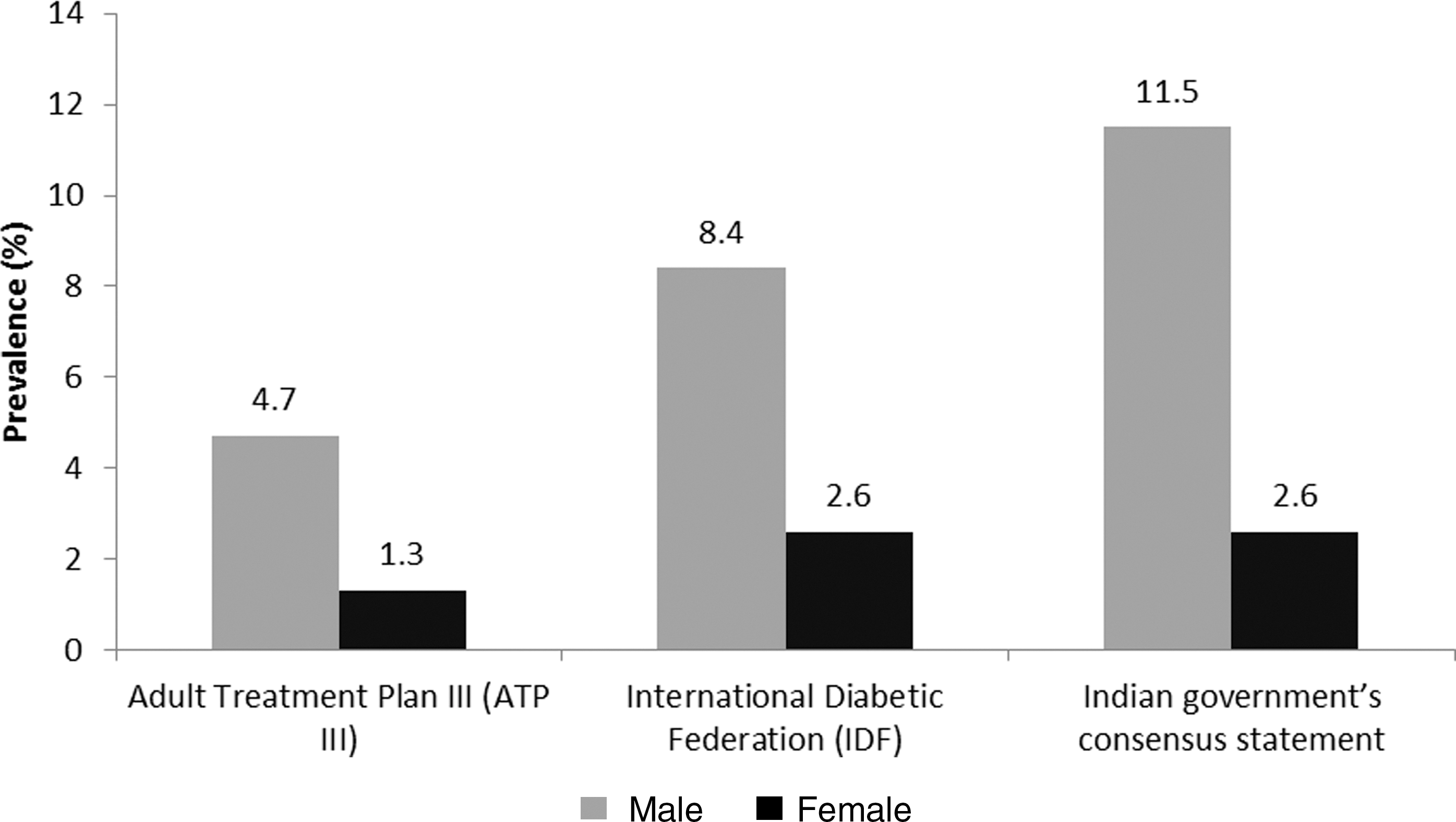
Prevalence of metaobic syndrome using Adult Treatment Panel III, International Diabetes Federation, and Indian consensus statemetn criteria. (gray) male; (black) female.
A comparison of subjects with and without metabolic syndrome showed a significant difference in component risk factors (Table 2) as expected. In addition to all the component risk factors, BMI (P=0.0001), LDL-C (P=0.0090), VLDL-C (P=0.0010), known hypertension (P=0.0177), and smoking (P=0.0302) were significantly higher in metabolic syndrome group than the nonmetabolic syndrome group. The proportion of metabolic syndrome cases increased with increase in BMI. A steep rise in the prevalence of metabolic syndrome was observed in overweight individuals. Overall, 3.2%, 9.7%, and 87.1% of normal weight, overweight, and obese individuals, respectively, met the metabolic syndrome diagnostic criteria.
SD, standard deviation.
The percentage of participants with each component of the metabolic syndrome who presented with the abnormality in isolated form is summarized in Table 3. Although 61.3% of the study population had one or more components risk factors, 10% had three or more components risk factors for metabolic syndrome. Frequency of component risk factors increased with increase in BMI; 57.4% of obese individuals had two or more component risk factors. Males, when compared to females, had a greater number of component risk factors for metabolic syndrome in our study.
Discussion
The present study estimated an overall metabolic syndrome prevalence of 6.6% among Indian college students aged 18–25 years using the conventional IDF definition. The prevalence increased to 8.7% using the Indian consensus statement criteria. However, it showed no effect on the prevalence in women, despite women having significantly high mean WC values than men. Although we had no studies to directly compare the results among young adults (18–25 years) in India, our findings nonetheless were consistent with those reported by Gupta et al. 9 and Prasad et al., 22 who reported an overall prevalence of 6.1% and 6.7%, respectively, in the age group of 20–29 years. Our findings support and extend the findings of earlier studies, suggesting that metabolic syndrome is not uncommon among young adults. Further longitudinal studies are needed to critically test the validity of the Indian consensus statement criteria for metabolic syndrome when applied across different sex and ethnic groups.
Men (8.4%; P=0.0188) had significantly higher rates of metabolic syndrome than women (2.6%). Besides the increased rates of smoking among men in our study population, a significant association of male gender with cardiovascular risk and cardiovascular protective effects of endogenous estrogens in women could partly explain this difference. 23 –25 Our findings are consistent with those of earlier studies in India and worldwide, 10,26 indicating that young men are at greater risk for metabolic syndrome than women. These results, however, markedly varied with that of Prasad et al. (2012), 22 who reported higher prevalence of metabolic syndrome and central obesity in women (metabolic syndrome, 9.9%; central obesity, 56%) than men (metabolic syndrome, 2.9%; central obesity, 41.9%). Although methodological differences exist between the studies, these observations underscore the importance of further research in younger age groups to enhance the understanding of the association of gender with metabolic syndrome and its component risk factors.
Among the component risk factors of metabolic syndrome, low HDL-C concentration (38.9%), high blood pressure (26%), and central obesity (16.1%) were the most prevalent component risk factors. Low HDL-C is a novel lipid phenotype observed to be more prevalent among Asian populations, in which it is associated with increased coronary risk. 27 Our results are consistent with the INTERHEART 28 study involving south Asians and with other Indian studies reporting a high prevalence of low HDL-C concentration. 9,10,29 Prevalence of high blood pressure in the present study was comparable to that previously reported in India. 19,10 Population-based studies have reported an association of high blood pressure with unhealthy diet, sedentary lifestyle, smoking, and central and generalized obesity. 19,30,31 The high prevalence of the sedentary lifestyle, consumption of junk food, sweetened and aerated drinks, and central and generalized obesity in our study population may partly explain the high prevalence. However, such a high prevalence of high blood pressure raises important questions on its genetic predisposition and its cutoff values included in the definition of metabolic syndrome that needs further investigation.
Although less than 4% of normal weight adults met the criteria for the metabolic syndrome, rates increased in overweight individuals and reached a prevalence of 87% in the obese participants. Generalized obesity was prevalent in 23% of the total study population, and 57.4% of them had two or more component risk factors for metabolic syndrome. The number of component risk factors and the prevalence of metabolic syndrome increased with increase in BMI, clearly indicating that, with rising prevalence of obesity among young adults, metabolic syndrome is expected to increase exponentially that might have important implications for further patterns of CVD and their complication in India.
The American Heart Association has described metrics for ideal cardiovascular health. 32 The seven components of this are having normal cholesterol levels, normal blood pressure, normal blood glucose, normal weight; being a nonsmoker and physically active; and eating a healthy diet. 33 High prevalence of these component risk factors in our study could be due to increased prevalence of obesity, sedentary lifestyles, smoking, and diet high in refined carbohydrates. This suggests evolving epidemiologic increase in the prevalence of CVD in young adults, which is similar to studies previously reported in India. 10,19,34
A limitations relevant to the interpretation of the study results is the use of a cross-sectional study design. Thus, causal pathways underlying the observed relationship cannot be inferred. Potential residual confounding factors such as ethnicity, socioeconomic status, and difficulty in measuring physical activity and diet in this population may have affected the study results. However, many of the limitations of the present study are inherent in cross-sectional epidemiological studies, and the study data are similar to those in previous Indian studies. Strengths of the present study include a robust sampling methodology and the use of standardized techniques and calibrated equipment that provide greater scope for generalizability. Our study demonstrated that surveys involving overnight fasting samples yield good response rates if screening is preceded by a health awareness program.
In conclusion, our results demonstrate that metabolic syndrome is not uncommon and that its prevalence increased with an increase in BMI among urban Indian young adults. Men had a significantly higher risk for metabolic syndrome than women. Each component risk factor of metabolic syndrome in isolated form, in addition to increased BMI, smoking, and history of hypertension, are all associated risk factors for metabolic syndrome among young adults in India. The relatively high prevalence of metabolic syndrome in younger age groups is of particular concern, because it implies prolonged exposure to cardiovascular risk factors and increased risk of diabetes and CVD affecting the population in the most productive years of life. Although risk is already evident for many obese individuals, our findings reveal that the risk of developing metabolic syndrome increases even within the overweight group, with nearly 10% of individuals affected. Detecting these overweight and normal weight individuals that have metabolic syndrome and implementing early preventive lifestyle modification programs is warranted. Integrated primordial and primary prevention programs involving effective public health education interventions promoting cardiovascular health through healthy diet, weight control, and smoking cessation among young adults should be considered.
Although it is unclear whether obesity and metabolic syndrome screening programs in young Indians as a means to prevent adverse cardiovascular health outcomes are appropriate, healthy lifestyles should nevertheless be encouraged, and young adults should be considered as an important target group for any cardiovascular risk reduction program. Intervening early in life (i.e., in the period of transition from adolescence to young adulthood) may be a vital and fruitful period for prevention of obesity and the consequent risk of developing adverse cardiovascular outcomes.
Footnotes
Acknowledgments
We extend our gratitude to all the participants and the research staff for their cooperation and contribution toward this study. We thank Professor Sarah Wild, University of Edinburgh, UK, Dr. Vijaya Ragavan, SHARE-India, Hyderabad, and Dr. Manoj V. Murhekar, National Institute of Epidemiology, Chennai, India, for commenting on the draft manuscript.
D.M. and O.G. conceived the research, C.K. and S.R. carried out the research, and C.K., R.R., and N.C. analyzed the data. All authors were involved in writing the paper and had final approval of the submitted and published versions.
Author Disclosure Statement
No competing financial interests exist