




Abstract
Objective:
Metabolic syndrome (MetS) is a global disease burden that has resulted in 10 million people being affected by it, yet no new drugs have been approved for clinical treatment. Isoflavone may be able to stop the development of MetS or enhance its treatment. Therefore, we investigated the relationship between dietary intake of isoflavone and prevalence of MetS to find potentially effective treatments.
Methods:
We conducted a cross-sectional study using data from 8512 National Health and Nutrition Examination Survey (NHANES) participants from 2007 to 2010 and 2017 to 2018 and their associated isoflavone intake from the flavonoid database in the USDA Food and Nutrient Database for Dietary Studies (FNDDS). We investigated the relationship between MetS status and isoflavone intake by adjusting for confounding variables using multivariable logistic regression models.
Results:
In a multivariable-adjusted model, there was a negative association between isoflavone intake and the incidence of MetS (odds ratio for Q4 vs. Q1 was 0.66, 95% confidence interval = 0.51–0.86, P = 0.003, p for trend was <0.001). This inverse association remained robust across most subgroups, while nonsignificant interactions were tested between isoflavone intake and age, sex, ethnicity, economic status, body mass index, smoking status, alcohol consumption, and physical activity level (P values for interaction >0.05).
Conclusions:
We found that MetS prevalence decreased with increased isoflavone intake, suggesting that dietary patterns of soy food or supplement consumption may be a valuable strategy to reduce the disease burden and the prevalence of MetS.
Introduction
Metabolic syndrome (MetS), characterized by elevated waist circumference (WC), elevated triglycerides (TG), reduced high-density lipoprotein cholesterol (HDL-C), elevated blood pressure, and elevated fasting glucose, is recognized as a risk factor for high-mortality cardiovascular disease, type 2 diabetes mellitus, and cerebrovascular diseases. 1,2 The estimated prevalence of MetS varies from 24.3% to 45.5% because different criteria have been used to define MetS, and at least a billion people in the world are now affected by MetS, considering that it is about three times more common than diabetes, and the cost of treating MetS is up to trillions of dollars. 3
The prevention and treatment principle of MetS is to start the lifestyle intervention first, including appropriate exercise, change of diet structure, smoking cessation, reducing excessive drinking, and maintaining a good mood. Based on this, if the treatment goal cannot be achieved, each component takes a corresponding drug treatment. Therefore, the lifestyle intervention is particularly significant.
Taking in wholesome food is one of the interventions to improve MetS. 4 The Mediterranean diet is a plant-based dietary style that includes fruits and vegetables, whole grains, beans, fish, and olive oil and is widely known to reduce the risk of cardiovascular disease, improve blood sugar and lipid levels, prevent cancer, and extend the life span. In the PREDIMED trial, the traditional Mediterranean diet is shown to be beneficial in preventing MetS. 5 As the main component of this diet, soy also has important nutritional value as it is rich in protein, unsaturated fatty acids, trace elements, vitamins, dietary fiber, soy isoflavones, soy lecithin, and other nutritional ingredients. In addition, several reviews have demonstrated that flavonoids are involved in the salutary effect of the intervention on MetS status. 6,7
Isoflavone is a subclass of flavonoids that are natural polyphenolic compounds widely found in plants and can be classified into several subtypes based on the degree of oxidation, mainly including isoflavones, flavonoids, flavanones, flavanols, flavonols, and flavan-3-ols. 8 Most of them possess anti-inflammatory, antioxidant, and hypoglycemic pharmacological activities. 9 Isoflavones are mainly obtained from soybean and soybean products, containing mainly daidzein and genistein. 10
In several animal studies and clinical studies, researchers have shown that soybean could potentially prevent obesity, 11 dyslipidemia, 11 hyperglycemia, 12 and hypertension, 13 which interact and lead to the onset and progression of MetS. A cross-sectional study found that among Chinese adults, higher total isoflavone intake was inversely associated with nonalcoholic fatty liver disease (NAFLD), 14 which is considered to be the liver manifestation of MetS. As a result, it is proposed that isoflavone has the potential to prevent the occurrence of MetS or improve management of MetS.
In this study, we surveyed the relationship between dietary isoflavone intake and the incidence of MetS in participants in the National Health and Nutrition Examination Survey (NHANES) to find a potentially effective treatment for MetS.
Materials and Methods
Study population
The NHANES is a continuous cross-sectional sample survey conducted since 1999 by the National Center for Health Statistics of the U.S. Centers for Disease Control and Prevention, every 2 years representing a survey cycle. The project is a complex, nationally representative, stratified, multistage, probabilistic health survey of the noninstitutionalized civilian population of the United States.
The specific data collection procedures and detailed methodology for NHANES have been described by the National Center for Health Statistics. 15 NHANES data are obtained from interviews, laboratory tests, and physical examinations conducted by trained staff. In our study, we specifically used data from three cycles of NHANES 2007–2010 and NHANES 2017–2018. Flavonoid intake data for patients in this study are derived from the 2007 to 2010 and 2017 to 2018 Food and Beverage Survey flavonoid values in the NHANES-associated USDA Food and Nutrient Database for Dietary Studies (FNDDS).
Foods/beverages have flavonoid values, which can be used to calculate the estimated value of flavonoid intake representing the U.S. population of all ages. Linking these estimates to laboratory data, physical examination, and interview data in NHANES can better investigate the relationship between flavonoid intake and human health. The data and documents used in this study are unidentified data frames that are publicly available on the National Center for Health Statistics and Agricultural Research Service websites.
Ethics approval has been granted by the NCHS Ethics Review Committee, and protocol descriptions are available through the designated source. * Written informed consent is required for participants aged 12 years and older, and parental consent is also required for participants younger than 18 years.
A total of 29,940 participants were recruited into the study during the 2007–2010 and 2017–2018 NHANES cycles. After excluding 12218 participants who were younger than 20 years, 182 participants who could not tell if they have MetS, 3834 participants with no isoflavone value, and 5194 participants with an isoflavone value of 0, a total of 8512 participants were finally enrolled in the analysis (Fig. 1).
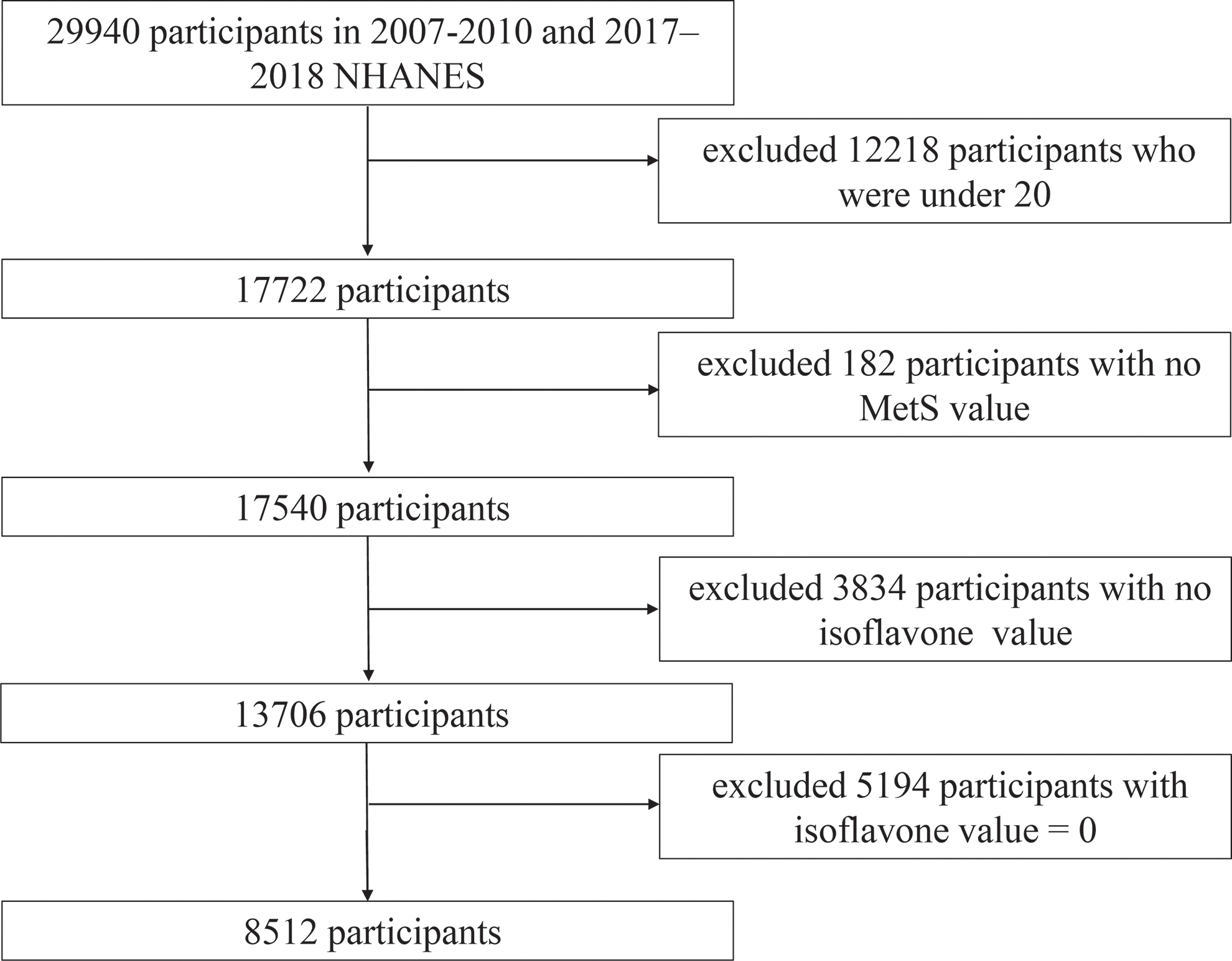
Flowchart of the selection process of participants involved in this study. The study recruited a total of 29,940 participants during the NHANES cycles from 2007 to 2010 and 2017 to 2018. Exclusions were made for various reasons, including participants who were younger than 20 years (n = 12,218), participants who were unable to determine if they had MetS (n = 18,182), participants with missing isoflavone values (n = 3834), and participants with an isoflavone value of 0 (n = 5194). Consequently, a final analytical cohort of 8512 participants was established. MetS, metabolic syndrome; NHANES, National Health and Nutrition Examination Survey.
Evaluation of isoflavone intake
The flavonoid database in the FNDDS provides the total intake of 29 individual flavonoids, the total of the 6 major flavonoids, and the total intake of all flavonoids consumed by each participant on days 1 and 2. The 2007–2010 and 2017–2018 FNDDS nutrient values were calculated for each food/beverage based on the ingredient data in FoodData Central.
In this study, we selected the mean of isoflavone intake on days 1 and 2 for each participant in the flavonoid database to investigate its association with MetS.
Definition of MetS
The presence of three or more of the following conditions defines MetS: (1) elevated WC: ≥94 cm in males and ≥80 cm in females; (2) elevated TG (drug treatment for elevated TG is an alternate indicator): ≥150 mg/dL (1.7 mM); (3) reduced HDL-C (drug treatment for reduced HDL-C is an alternate indicator): ≤40 mg/dL (1.0 mM) in males and ≤50 mg/dL (1.3 mM) in females; (4) elevated blood pressure (antihypertensive drug treatment in a patient with a history of hypertension is an alternate indicator): systolic ≥130 and/or diastolic ≥85 mmHg; and (5) elevated fasting glucose (drug treatment for elevated glucose is an alternate indicator): 100 mg/dL. 1
Covariates
Demographic, physical examination, and laboratory test data in this study are available from the NHANES database, which mainly include age, sex, race, education level, economic status, smoking, alcohol drinking, blood pressure (BP), body mass index (BMI), and WC.
BMI = weight [kg]/height [m2] (classified as <25, 25–30, and ≥30). 16 We defined current smokers as individuals who have smoked more than 100 cigarettes in their lives and currently smoke on some days or every day; never smokers as people who have smoked less than 100 cigarettes in their lives; and former smokers as people who have smoked more than 100 cigarettes in their lives and now do not smoke at all. 17
We assessed drinking status according to the drinks and frequency of alcohol consumption in participants' self-report questionnaires. 18 Race was classified as non-Hispanic White, non-Hispanic Black, Mexican American, and other races. Education level was classified as below high school, high school or equivalent, and more than high school.
Economic status was evaluated by the family income-to-poverty ratio, which indicates how many times the household income is above the poverty line and is categorized as <1.0, 1.0–3.0, and >3.0. We used the dietary inflammatory index (DII) to assess the inflammatory potential of the diet of each participant 19 and the healthy eating index (HEI-2015) to calculate the total calorie intake (kal) and total HEI scores, which are supposed to measure compliance with the Dietary Guidelines for Americans (DGA). 20
The physical activity of participants was assessed by the metabolic equivalent of task (MET) scores, which is based on the Global Physical Activity Questionnaire and NHANES guidelines; a high level of physical activity (PA) was defined as ≥600 MET·min/week and a low level of PA was defined as <600 MET·min/week based on the U.S. PA guidelines. 21,22 Trained professionals collected information on medications consumed in the past 30 days by cross-referencing the products provided by participants with the drug and dietary supplement database.
Laboratory tests in this study included glucose, glycated hemoglobin (HbA1c), TG, and HDL-C. All routine biochemical tests were performed according to the NHANES laboratory/medical technician procedure manual.
Statistical analyses
All statistical analyses in this study were performed using R software (version 4.2.2). The level of significance of the reported statistical results for all analyses was two-tailed, and P < 0.05 was considered statistically significant. In the analysis of participant baseline characteristics, we divided the exposure factor, isoflavone intake, into quartiles and compared statistical differences between quartile groups.
We investigated the relationship between MetS status and isoflavone intake by multivariable logistic regression models. In this study, we constructed three models: the crude model: no adjustment for any covariates; model I: adjusted for age, gender, and ethnicity; and model II: adjusted for covariates of age, gender, ethnicity, education level, alcohol consumption, smoking status, economic status, dietary inflammatory index, HEI scores, and physical activity.
In addition, we performed a sensitivity analysis by using a subgroup analysis stratified by variables of interest and further analysis after processing the missing values of confounders by random forest interpolation using the missRanger R package.
Results
The baseline characteristics of participants by isoflavone-level quartiles are shown (Table 1). A total of 8512 participants were included in this study, with a weighted mean age of 48.07 (0.33) years and a weighted ratio of 51.28% for males. The average level of isoflavone intake in our study was 3.26 mg (0.18), and the ranges of isoflavone intake for quartiles 1–4 were 0.002–0.015, 0.015–0.045, 0.45–0.521, and 0.521–390.6, respectively.
Baseline Characteristics of Participants by Isoflavone Intake Among U.S. Adults
BMI, body mass index; DBP, diastolic blood pressure; DII, dietary inflammatory index; HbA1c, glycated hemoglobin; HDL-C, high-density lipoprotein cholesterol; HEI, healthy eating index; MetS, metabolic syndrome; SBP, systolic blood pressure; TG, triglycerides; WC, waist circumference.
A weighted ratio of 36.39% was calculated for participants who meet the criteria for MetS, and participants in the higher isoflavone intake quartile tended to have lower rates of MetS (39.16% in Q1 vs. 28.75% in Q4, P < 0.01). According to our study, participants with more isoflavone intake may be younger; have higher household income, higher education, and lower DII and higher HEI scores; and engage in more physical activity compared with those in other quartiles of isoflavone intake levels.
Our analysis revealed a substantial disparity in medication usage, which includes antihypertensive, antihyperlipidemic, and antidiabetic medications, across individuals with varying levels of isoflavone intake. In addition, the difference in WC, BMI, systolic blood pressure, glucose, HbA1c, and energy intake has statistical significance in different isoflavone intake levels.
The study evaluates the relationship between MetS incidence and isoflavone intake using three logistic regression models (Table 2). The crude model demonstrates that compared with the lowest isoflavone intake level (Q1), a decrease of 37% in MetS incidence is significant [odds ratio (OR): 0.63, 95% confidence interval (CI): (0.52–0.76), P for trend: <0.0001]. In addition, in the fully adjusted model (model II), the relationship between MetS incidence and isoflavone intake is stable [OR: 0.66, 95% CI: (0.51–0.86), P for trend: <0.001].
Associations Between Isoflavone Intake and Metabolic Syndrome
Bold values means statistically significant (P < 0.05).
Crude model: no covariates are adjusted.
Model I: age, gender, and ethnicity are adjusted.
Model II: age, gender, ethnicity, education level, alcohol consumption, smoking status, economic status, dietary inflammatory index, HEI scores, and physical activity are adjusted.
95% CI, 95% confidence interval.
A subgroup analysis was performed to evaluate the robustness of the association between isoflavone intake and MetS incidence (Table 3). We tested the interactions with age, gender, ethnicity, economic status, BMI, alcohol consumption, smoking status, and physical activity level. However, no correlation with the P value for interaction reaching statistical significance was detected, indicating that there was no dependence on age, gender, ethnicity, economic status, BMI, alcohol consumption, smoking status, and physical activity level for this association (all P values for interaction >0.05).
Subgroup Analysis Between Isoflavone Intake and Metabolic Syndrome
PA, physical activity.
Our results showed that this negative association of isoflavone intake and MetS was similar in different populations. We also explore the relationship between isoflavone intake and prevalence of MetS after processing the missing data of covariates using the missRanger algorithm, which shows a stable correlation between isoflavone intake and prevalenc of MetS (Table 4), even though the OR is relatively decreased in fully adjusted model II [OR: 0.73, 95% CI: (0.60–0.90)].
Associations Between Flavonoid Intake and Metabolic Syndrome After Multiple Imputations
Bold values means statistically significant (P < 0.05).
Crude model: no covariates are adjusted.
Model I: age, gender, and ethnicity are adjusted.
Model II: age, gender, ethnicity, education level, alcohol consumption, smoking status, economic status, dietary inflammatory index, HEI scores, and physical activity are adjusted.
Discussion
In this cross-sectional study with 8512 participants, we observed a negative association between the incidence of MetS and levels of isoflavone intake, and the group analysis shows no effect of the interaction between isoflavone and age, gender, ethnicity, education level, alcohol consumption, smoking status, economic status, dietary inflammatory index, HEI scores, and physical activity on MetS. According to the current findings, a high intake of isoflavones is associated with a decreased incidence of MetS.
A previous randomized control trial (RCT), which focused on women aged between 60 and 70 years, shows the beneficial effect of soy in people with borderline parameters of MetS. 23 Another RCT, which included males and postmenopausal females aged between 45 and 75 years, also demonstrated the effect of soybean-based food intake on MetS. 24 Both the studies reported significant improvement in multiple lipid profile parameters.
In addition, improvements in blood glucose, fasting insulin, and HOMA-IR levels were observed in a study evaluating the effect of genistein, a type of isoflavone, on postmenopausal women with MetS. 25 Another meta-analysis that included seven randomized controlled trials with a total study population of 670 individuals shows the same results. 26 The effect of soy isoflavones on blood pressure is controversial.
One RCT 27 showed that dietary supplementation with soy containing isoflavones had no effect on arterial stiffness, arterial compliance, endothelial function, or mean 24-hr ambulatory blood pressure. However, a study from China observed that total isoflavone, daidzein, and genistein intake levels were negatively associated with NAFLD, hypertension, and hyperlipidemia. 14
In terms of WC, a meta-analysis showed that soy supplements helped reduce weight, BMI, body fat percentage, fat mass, and WC in overweight or obese Asians, possibly with soy protein, soy isoflavones, and soy fiber, but the respective effects were not analyzed. 28
The benefits of soy isoflavones on hyperlipidemia, diabetes, obesity, and hypertension, which are components of MetS, are well known, but the mechanisms by which they affect the development of MetS are not completely understood. Chronic inflammation is one of the pathological characteristics of MetS. The anti-inflammatory properties of isoflavones play an important role in inhibiting the occurrence and development of MetS. 7
In addition, the interaction of visceral steatosis, insulin resistance, dyslipidemia, and hypertension leads to the progression of MetS. 29 Previous studies have shown that soy isoflavones can reduce fat accumulation by inhibiting lipogenesis and increasing fatty acid oxidation. 30 Genistein shows abilities to reduce intracellular fat volume, decrease characteristic molecules presenting in white adipocytes, and increase the expression of mRNAs (CD-137 and UCP1) that are characteristics of brown/beige adipocytes, 31 suggesting that genistein may stimulate adipocyte differentiation into beige/brown adipocytes.
Genistein increases the mRNA and protein expression levels of HDL-C, low-density lipoprotein receptor, liver X receptor α, and adenosine triphosphate-binding cassette transporter G1 and is involved in regulation of cholesterol homeostasis. 32 Isoflavones are a type of phytoestrogen, which can bind to estrogen receptors and play an antiobesity role. 33 Oral soy isoflavones can improve insulin resistance, 34,35 and obese people taking genistein capsules can also improve insulin resistance, 36 which is closely related to obesity and diabetes.
A study of obese and diabetic mouse models showed that genistein prevents elevated blood sugar levels, improves glucose tolerance, and reduces insulin levels, and also promotes pancreatic β cell survival by increasing the number of pancreatic β cells and preventing their apoptosis, preventing type 2 diabetes. 37 Recent studies have shown that isoflavones may act on vascular endothelial cells through a variety of signaling pathways to induce vasodilation and thus improve hypertension. 38
Genistein may induce endothelium-dependent vasodilation in postmenopausal women by regulating the release of nitric oxide (NO) and endothelin-1 from vascular endothelial cells. 39 Genistein can promote production of NO through the protein kinase A (PKA)/cAMP response element-binding protein (CREB)/endothelial nitric oxide synthase (eNOS)/nitric oxide (NO) signaling pathway, 40 thereby dilating blood vessels to play an antihypertensive role. Animal studies have shown that isoflavones increase sodium excretion and renal blood flow and interact with estrogen receptors to inhibit angiotensin-converting enzyme activity in the renin–angiotensin–aldosterone system. 41
In conclusion, the effects of isoflavone on MetS are related to its effects on the respective induction mechanisms of obesity, adipogenesis, vascular dysfunction, diabetes, and hyperlipidemia.
The strengths of our study are the use of nationally representative NHANES data, multistage stratified sampling and collection of relevant information by trained technical staff, relatively large size of the sample in included studies, and adjustment for multiple potential confounders to improve the reliability of findings.
However, our study also has some limitations. First, the cross-sectional design of the study could not conclude whether there was a causal association between isoflavone intake and MetS; therefore, further validation in a prospective cohort study is necessary.
Second, in our study, we tried to incorporate as many confounding factors as possible that were relevant to the study results, but we still could not completely rule out the possibility of other confounding factors causing bias in the conclusions.
Third, the 24-hr recollection did not accurately reflect a person's long-term dietary intake, and MetS might have happened before they supplied the interview data, suggesting that bias in isoflavone intake estimates was inevitable.
Conclusions
In conclusion, our study showed that consuming more isoflavone is linked to a decreased risk of MetS in the adult population of the United States. It is necessary to conduct more research to clarify our findings and validate the mechanism.
Footnotes
Authors' Contributions
F.Y. contributed to data collection, data analysis, and drafting of the article. Y.Z. and N.H. contributed to the study design, data collection, and critical revision. J.L. contributed to the study design and critical revision and submitted the report for publication. All authors read and approved the final article.
Author Disclosure Statement
The authors declare that they have no known competing financial interests or personal relationships that could have appeared to influence the work reported in this article.
Funding Information
This study was funded by the National Natural Science Foundation of China (No. 2020J011081).