




Abstract
Background:
The prevalence of metabolic syndrome (MetS) in Kazakhstan reaches 40%. The presence of an association between certain genetic markers and the development of MetS will allow more accurately determining the cardiovascular risk for patients with hypertension and personalizing preventive recommendations.
Methods:
The purpose of the study was to investigate the presence of an associative relationship between various polymorphisms of the α-synuclein gene and the development of MetS in Kazakh people with high blood pressure. Four hundred twenty-six patients were examined [age 49.5 (interquartile range 42.5–56), men 209 (49.1%), women 217 (50.9%)]. Standard clinical and laboratory methods were used. AutoMate Express™ and OpenArray technologies were used for DNA extraction and further genotyping. Patients with MetS made up the ms+ group, those without MetS—the ms− group.
Results:
In the examined patients, four polymorphisms of the α-synuclein gene were identified: rs356219, rs2736990, rs11931074, and rs2737029. According to the results of statistical analysis, the frequency and risk of developing MetS did not depend on different alleles and inheritance types of polymorphisms rs356219 and rs11931074. The minor allele of polymorphism rs2737029 exhibits a higher frequency in patients with arterial hypertension accompanied by MetS, although the specific model of inheritance remains to be conclusively determined.
Conclusions:
In carriers of the minor allele of polymorphism rs2736990, the risk of MetS increases 1.3 times, regardless of age and gender [odds ratio (95% confidence interval) = 1.36 (1.01–1.82), P < 0.05], the inheritance model is log-additive.
Introduction
According to the definition of the International Diabetes Federation (IDF), metabolic syndrome (MetS) is a combination of factors that most significantly increase the risk of cardiovascular pathology: hyperglycemia, high blood pressure, abdominal obesity, and cholesterol metabolism disorders. MetS is observed in 20%–25% of the world's population. 1 Tursynbekova et al. estimated the prevalence of MetS among the population of Kazakhstan aged 35–70 years at 32.8%. 2 At the same time, for civil servants of Kazakhstan of the same age, the prevalence of MetS reaches 40%. The presence of MetS increases the risk of cardiovascular complications by up to 2.5 times. 3,4 According to Wang and Lloyd-Jones, such elements of MetS as obesity and dyslipidemia significantly increase cardiovascular risk in patients with arterial hypertension. 5 Thus, the comorbidity of MetS and hypertension in the Kazakh population is an extremely relevant area for research.
According to Sadykova et al., one of the main reasons for the development of MetS is the nature of nutrition of the population of Kazakhstan. 6 The Mediterranean diet, characterized by a high intake of vegetable fats, vegetables, and seafood, is less prevalent compared to diets rich in red meat and animal fats, contributing to the onset of dyslipidemia, obesity, and insulin resistance. Benberin et al. described MetS as a multifactorial disease in which genetic predisposition, environmental factors, and lifestyle play an equal role. 7 The role of genetic predisposition in different populations may differ significantly. 8 The development of MetS leads to the development of oxidative stress, chronic persistent inflammation, and endothelial dysfunction. 9
Aitkulova et al. identified a number of triggers of the neurodegenerative process: mitochondrial dysfunction, changes in the processes of protein assembly and degradation, including α-synuclein, impaired calcium metabolism, apoptosis of neurons, oxidative stress, and persistent neuroinflammation. 10 However, the association of various polymorphisms of the α-synuclein gene with MetS in the population of Kazakhstan has not yet been investigated. In this study, the α-synuclein gene was selected for its potential link to MetS in hypertensive patients, a choice driven by the gene's known implications in both neurological and metabolic processes. Investigating polymorphisms such as rs356219, rs2736990, rs11931074, and rs2737029 within this gene could unveil crucial insights into metabolic regulation and pathology, especially considering the complex interplay of genetic factors in MetS. This approach may lead to more personalized health care strategies for managing hypertension and associated metabolic disorders, underscoring the importance of genetic factors in disease development and progression. The purpose of the study was to investigate the effect of various polymorphisms of the α-synuclein gene on the development of MetS among the population of Kazakhstan with hypertension.
Methods
The study included 426 patients, all diagnosed with hypertension, who were under dispensary observation at the Hospital of the Medical Centre of the Presidential Administration of the Republic of Kazakhstan. These participants were categorized into two distinct groups based on the presence or absence of MetS. The first group, referred to as the ms+ group, consisted of 264 patients (62% of the total participants) who had hypertension along with concomitant MetS. The second group, known as the ms− group, comprised 162 patients (38% of the total participants) who had hypertension but without any accompanying MetS. The age of the study participants was 49.5 (IQR 42.5–56). Two hundred nine (49.1%) of study participants were men, respectively, 217 (50.9%) were women.
Participation in the study was based on the voluntary informed consent of patients. The Republic of Kazakhstan's clinical protocols dictated that all medical examinations must adhere to certain standards of care. The design of the study complies with the generally accepted ethical standards of medical research and was agreed upon by the local bioethics commission of the Hospital of the Medical Centre of the Presidential Administration of the Republic of Kazakhstan (Protocol No. 5 of September 27, 2017).
The criteria of the IDF 2006 were used for the diagnosis of MetS. MetS was diagnosed when a patient with abdominal obesity was combined with at least two of the following factors: a decrease in the level of triglycerides (TG) >1.7 mM, a decrease in the level of high-density lipoproteins (HDL) <1.03 mM for men or <1.29 mM for women, an increase in systolic blood pressure >135 mmHg or diastolic blood pressure >85 mmHg, regular intake of hypolipidemic or hypotensive drugs, fasting glycemia >5.6 mM or diagnosed type 2 diabetes mellitus. 1 The body mass index (BMI) was assessed additionally. Abdominal obesity was diagnosed based on measurements of waist circumference. To assess the relationship between genotypic and phenotypic manifestations, the following types of inheritance of traits were analyzed: dominant, codominant, recessive, overdominant, and log-additive. The venous blood of patients was used for laboratory studies, collected after a 12-hr fasting interval. Total cholesterol (TC), low-density lipoproteins (LDL) and HDL, respectively, TG, and blood glucose were determined by enzyme immunoassay using an automatic biochemical anaylzer (Abbott Laboratories).
DNA extraction was automated and carried out by the AutoMate Express™ equipment using the iPrep™ Purelink™ gDNA Blood Kit diagnostic tools. OpenArray technology of working with small-volume liquids was used for genotyping. The experiment was conducted using the QuantStudio™ 12K Flex software suite. The analysis of the obtained data was carried out using the online tools of the Termo Fisher Cloud service, as a result of which the main and minor alleles were allocated for each polymorphism, and the carriers of these polymorphisms were classified either as homozygotes for the main or minor alleles, or as heterozygotes. Statistical analysis of the obtained results was carried out using the SPSS program, version 27, developed by IBM, based in the United States. The Shapiro–Wilk test for normality was used to evaluate the distribution of the data. Since the data distribution was found to be different from normal, the Mann–Whitney and chi-squared test (χ 2 ) criteria were later used to assess the reliability of the differences between the groups, the result was evaluated as statistically significant at P < 0.05. The odds ratio (OR) was also calculated with a 95% confidence interval (95% CI). Visualization of the obtained results was carried out in the Microsoft Excel software suite.
Results
The study participants were divided into two groups: the group of ms+—264 (62%) patients with hypertension with concomitant MetS, the group of ms−—162 (38%) patients with hypertension without comorbidity. The ms+ and ms− groups were paired in age and gender category. The median and interquartile range (IQR) of age in the ms+ group was 49 (IQR 42–55.5) years, in the ms− group—50 (IQR 44.0–56) years; the number of men and women in the ms+ group was 134 (49.1%) and 130 (50.9%), respectively, in the ms− group—75 (46.3%) and 87 (53.7%). The clinical characteristics of the ms+ and ms− groups were compared. Waist circumference in patients of the ms+ group was 100.5 (IQR 94.25–110) cm, in the ms− group—90.0 (IQR 80.5–99.5) cm (P < 0.05). The BMI of patients in the ms+ group was also significantly higher compared to the ms− group and amounted to 30.9 (IQR 27.8–33.2), while in patients in the ms− group—26.2 (IQR 25.5–29.5) (P < 0.05). The results of the laboratory examination of patients of the ms+ and ms− groups are shown in Fig. 1.
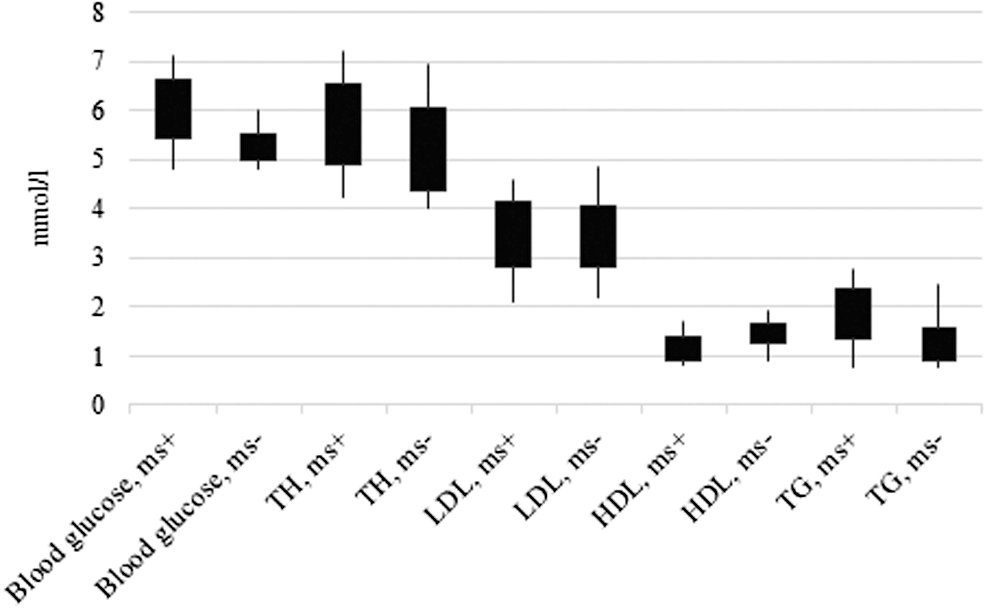
Laboratory characteristics of ms+ and ms− patients. Source: compiled by the authors.
Based on the visualization of the data and the results of statistical analysis, statistically significant differences in glucose levels were revealed between the ms+ and ms− groups, the concentrations of which were 5.81 (IQR 5.4–6.44) and 5.3 (IQR 5–5.49) mmol/mL, respectively (P < 0.001). TC levels in the ms+ and ms− groups differed significantly and amounted to 5.6 (IQR 4.91–6.34) and 5.22 (IQR 4.68–6.1) mM, respectively (P = 0.014). LDL levels in the ms+ and ms− groups, on the contrary, were paired and amounted to 3.5 (IQR 2.88–4.11) and 3.3 (IQR 2.83–4.02) mM, respectively (P = 0.356). Statistically significant differences were also revealed between HDL and TG concentrations in patients of the ms+ and ms− groups: HDL levels were 1.13 (IQR 0.98–1.25) and 1.36 (IQR 1.22–1.56) (P < 0.001), TG levels were 1.79 (IQR 1.3–2.27), and 1.11 (IQR 0.82–1.48) (P < 0.001) mM, respectively. As a result of the genotyping, four polymorphisms of the α-synuclein gene were identified in the study participants: rs356219, rs2736990, rs11931074, and rs2737029. All of them reliably comply with Hardy–Weinberg proportions (P > 0.05). For each identified polymorphism, major and minor alleles were determined, and the frequency of the minor allele was calculated, which was evaluated as a risk factor. The prevalence of each polymorphism in the ms+ and ms− groups was estimated, and the OR (95% CI) of the presence of MetS was calculated depending on one or another polymorphism. The main characteristics of polymorphisms are presented in Table 1.
Main Characteristics of the Polymorphisms of the α-Synuclein Gene
HWE, Hardy-Weinberg Equilibrium; SNP, single nucleotide polymorphism.
For rs356219 polymorphism, the prevalence of minor alley in the ms+ and ms− groups was 49.8 and 47.6%, OR (95% CI) = 1.09 (IQR 0.8–1.47), P = 0.6; for rs11931074 polymorphism—38.2% and 41.5%, OR (95% CI) = 0.87 (IQR 0.64–1.19), P = 0.41. For rs2737029 polymorphism, the prevalence of the minor allele in the ms+ and ms− groups was 45.7% and 38.1%, OR (95% CI) = 1.37 (IQR 1.01–1.86), P = 0.046; for rs2736990 polymorphism—44.8 and 37.4%, OR (95% CI) = 1.36 (IQR 1–1.85), P = 0.05. For each of the four polymorphisms of the α-synuclein gene, various inheritance mechanisms were analyzed: dominant, codominant, overdominant, recessive, and log-additive. The distribution of alleles into the ms+ and ms− groups was determined for each inheritance mechanism. As a result of the analysis of the data obtained, an assessment was made of the presence of statistically significant differences in the prevalence of each allele in the ms+ and ms− groups, separately for each inheritance mechanism for each of the four polymorphisms of the gene. OR (95% CI) was calculated for the same indicators. The data are presented in Table 2.
Association of Polymorphisms of the α-Synuclein Gene with Metabolic Syndrome, Considering Various Inheritance Mechanisms
Indicates a borderline or marginal statistical significance.
CI, confidence interval; CODOM, codominant; DOM, dominant; LOG, log-additive; OR, odds ratio; OVER: Overdominant; REC, recessive.
Based on the table data, when evaluating the polymorphisms rs11931074, rs356219, and rs2737029, no significant differences were found between the ms+ and ms− groups for any inheritance variants.
Discussion
According to the results of the calculation of OR for the above three polymorphisms, a statistically significant result was also not obtained. Consequently, there is no connection between the presence of these polymorphisms of the α-synuclein gene and the probability of developing MetS in the Kazakh population of patients with hypertension. For the rs2736990 polymorphism, statistically significant differences were revealed between the ms+ and ms− groups according to the log-additive inheritance model. The prevalence of the minor allele in the ms+ group was estimated at 62.2%, for the ms− group—37.8%, the level of statistical significance—P < 0.05. The OR index (95% CI) for this polymorphism was 1.35 (IQR 1.00–1.81), P < 0.05, adjusted for age and sex OR (95% CI) = 1.36 (IQR 1.01–1.82), P < 0.05. Thus, the presence of the rs2736990 variant of the α-synuclein gene in residents of Kazakhstan with high blood pressure increases the likelihood of developing MetS by 1.3 times according to the log-additive inheritance model.
According to the results of this study, the presence of excess weight was more characteristic of patients with hypertension with concomitant MetS. They were also characterized by a lower degree of glycemic control and more pronounced disorders of cholesterol metabolism, although the most important indicator for reducing cardiovascular risk—LDL—did not differ in these patients compared to patients with hypertension without MetS. MetS is a multifactorial disease, since its development is caused not only by genetic predisposition but also by environmental factors, including the lifestyle and diet of patients. 11 –13 Unlike monogenic diseases, MetS is determined by a number of different genes, as well as their interactions with each other and epigenetic factors regulating their activity. 14
The association of α-synuclein gene polymorphisms with MetS in hypertensive patients is a complex and multifaceted topic. This gene, primarily known for its association with neurodegenerative diseases, has garnered interest for its potential role in metabolic processes. 15,16 The polymorphisms, namely rs356219, rs2736990, rs11931074, and rs2737029, could provide insights into the genetic underpinnings of MetS. Notably, the minor allele of the rs2736990 polymorphism was found to increase the risk of MetS in the presence of hypertension. This finding aligns with the broader understanding of MetS as a multifactorial condition with both genetic and environmental influences. The significance of this polymorphism in a log-additive inheritance model suggests that genetic factors may play a more nuanced role in the development of MetS than previously understood. 17 –19 The implications of these findings are far-reaching. MetS, characterized by a cluster of conditions such as insulin resistance, obesity, dyslipidemia, and hypertension, significantly increases the risk of cardiovascular diseases. The study's focus on hypertensive patients is particularly relevant, as hypertension is a common comorbidity in MetS and a major risk factor for cardiovascular complications. Understanding the genetic components, especially the role of α-synuclein, could lead to more targeted interventions for individuals with hypertension and a predisposition to MetS.
The discussion of α-synuclein gene polymorphisms and their association with MetS in hypertensive patients must consider the intricate interplay of genetic and environmental factors. The study's focus on polymorphisms such as rs356219, rs2736990, rs11931074, and rs2737029 in the α-synuclein gene aligns with the growing recognition of genetic influences on metabolic health. Fahed et al. 20 highlight the expanding research on MetS and emphasize the complexity of this condition. Romero-Nava et al. 21 underscore the significance of gene expression in MetS etiology, suggesting a potential role for receptors like GPR21 and GPR82. De Jesus et al. 22 demonstrate how parental MetS can epigenetically reprogram offspring's lipid metabolism. Zhou et al. 23 identify immune-associated genes in MetS, linking immune regulation with metabolic disorders. Drozdz et al. 24 discuss obesity and cardiometabolic risk factors from childhood to adulthood, emphasizing the lifelong impact of these factors. Lee et al. 25 explore the relationship between homocysteine and MetS through a Mendelian randomization study. Seral-Cortes et al. 26 address the interplay between the Mediterranean diet, genetics, and metabolic health in European children and adolescents. Finally, Barabash et al. 27 discuss the TCF7L2 rs7903146 polymorphism and its modulation by diet in gestational diabetes mellitus, highlighting the importance of genetic factors in metabolic diseases.
The research conducted on these polymorphisms contributes to a growing body of knowledge that seeks to unravel the complex interactions between genes and metabolic disorders. It underscores the importance of personalized medicine, where genetic screening could aid in identifying individuals at higher risk of developing MetS, thereby enabling early interventions. This approach is especially pertinent given the rising prevalence of MetS globally and its associated health care challenges. In summary, the study contributes significantly to the understanding of the genetic aspects of MetS, particularly in the context of hypertension. It paves the way for future research that could have substantial implications for managing and treating this complex syndrome.
Conclusions
Based on the conducted research, it can be concluded that a genetically determined violation of the function of the α-synuclein protein also occurs in patients with comorbidities of hypertension and MetS. At least, this is typical for residents of Kazakhstan, although this feature can also be observed in people of other nationalities. One of the areas of further research is to conduct similar studies on patients of other nationalities. No reliable patterns were found for polymorphisms rs356219 and rs11931074 of the gene encoding α-synuclein. The minor polymorphism allele rs2737029 is more common among patients with MetS, its carrier increases the risk of developing MetS with already diagnosed hypertension by 1.36 times [OR (95% CI) = 1.36 (1–1.85), P < 0.05]. However, a more detailed analysis of the mechanisms of heredity for this polymorphism did not establish a statistically significant relationship. For rs2736990, while the statistical significance was minimal, the log-additive model revealed a notable association, indicating a 1.3-fold increased risk of MetS [OR (95% CI) = 1.36 (1.01–1.82), P < 0.05]. Nevertheless, the analysis of inheritance patterns revealed a statistically significant effect of this polymorphism on the development of MetS according to the log-additive inheritance model, with an increased risk of MetS by 1.3 times [OR (95% CI) = 1.36 (1.01–1.82), P < 0.05].
Footnotes
Author Disclosure Statement
No conflicting financial interests exist.
Funding Information
This research is funded by the Ministry of Health of the Republic of Kazakhstan in the framework of the National Program for the Implementation of Personalized and Preventive Medicine in the Republic of Kazakhstan (2021–2023), grant number OR12165486.