




Abstract
Targeting bacterial essential genes using antisense phosphorodiamidate morpholino oligomers (PMOs) represents an important strategy in the development of novel antibacterial therapeutics. PMOs are neutral DNA analogues that inhibit gene expression in a sequence-specific manner. In this study, several cationic, membrane-penetrating peptides were conjugated to PMOs (PPMOs) that target 2 bacterial essential genes: acyl carrier protein (acpP) and gyrase A (gyrA). These were tested for their ability to inhibit growth of Bacillus anthracis, a gram-positive spore-forming bacterium and causative agent of anthrax. PPMOs targeted upstream of both target gene start codons and conjugated with the bacterium-permeating peptide (RFF)3R were found to be most effective in inhibiting bacterial growth in vitro. Both of the gene-targeted PPMOs protected macrophages from B. anthracis induced cell death. Subsequent, in vivo testing of the PPMOs resulted in increased survival of mice challenged with the virulent Ames strain of B. anthracis. Together, these studies suggest that PPMOs targeting essential genes have the potential of being used as antisense antibiotics to treat B. anthracis infections.
Introduction
Antisense phosphorodiamidate morpholino oligomers (PMOs) and their derivatives downregulate target gene expression in a sequence-dependent manner by interfering with the binding of ribosome to mRNA and thereby inhibiting protein translation (IVERSEN, 2001). The PMO backbone is made of morpholino rings with phosphorodiamidate linkage, which protects them from nuclease degradation while still maintaining the complementary base pairing. Covalent conjugation of the PMO with membrane-penetrating peptides has enhanced their cellular uptake by mammalian cells (Moulton et al., 2004) as well as bacteria (Tilley et al., 2006).
The potential application of PMO-based antisense technology targeting bacterial pathogens is being explored for the development of a new class of antibacterial drugs. Phosphorodiamidate morpholino oligomers (Geller et al., 2003; Greenberg et al., 2010) have been shown to silence expression of bacterial genes. Gene-silencing oligomers decrease expression of reporter genes such as luciferase, activate endogenous genes such as β-galactosidase, and inhibit growth by targeting essential genes (Geller et al., 2005). Some of the attractive targets for antisense antibacterial therapy include essential genes such as acyl carrier protein (acpP) encoding the fatty acid biosynthesis protein (Geller et al., 2005; Greenberg et al., 2010), bacterial RNA polymerases (Bai et al., 2011), fabI-encoding enoyl-acyl carrier protein reductase and 16S rRNA (NIELSEN, 2010). Prior studies have shown that PMO targeting the acpP gene was able to inhibit E. coli viability in vitro and in vivo in mice (Geller et al., 2005). To further improve the uptake of the PMOs by the bacteria, PMOs conjugated with various peptides (PPMOs) and targeting the acpP gene were shown to enhance bacterial growth inhibition and viability of E. coli and Salmonella enterica Serovar Typhimurium (Tilley et al., 2006). More recently PPMOs targeting the acpP gene inhibited Burkholderia cepacia complex (Bcc) in vitro and increased survival of mice challenged with a clinical isolate of Bcc (Greenberg et al., 2010).
In the present study, several PPMOs targeting 2 bacterial essential genes acpP and gyrase A (gyrA) (Christen et al. 2011; Gil et al., 2004) were tested for their ability to in vitro inhibit growth of B. anthracis, a gram-positive spore-forming bacterium. Our studies revealed that their ability to inhibit bacterial growth was dependent on the base position of the PMO relative to the start codon of the targeted mRNA and the nature of the peptide sequence. In a cell-based assay, select PPMOs increased viability of macrophages infected with B. anthracis. In vivo, PPMOs improved the survival of mice challenged with the highly virulent Ames strain of B. anthracis.
Materials and Methods
Antisense peptide tagged phosphorodiamidate morpholino oligomers (PPMOs)
The peptide-tagged neutral or charged PMOs were synthesized by AVI Biopharma Inc. (Corvalis, OR) as described previously (Summerton and Weller, 1993; Tilley et al., 2006; Weller and Hassinger, 2008; Fox M.J. et al., 2009). PMOs targeting the 2 essential genes acyl carrier protein (acpP; gene id. No. 2849363) and gyrase A (gyrA; gene id. No. 2851434) with sequence complementarities at various base positions relative to the start codon of the targeted mRNA were designed and are listed in Table 1. Neutral PMOs were tagged through an XB linker with peptide RFFRFFRFFR [(RFF)3R] or RXRRXRRXRRXR [(RXR)4)] where R=arginine; F=phenylalanine; X=6-aminohexanoic acid; and B=β-alanine. The peptides were attached at either the 5′ or 3′ end of the PMOs.
Numbering from first base of start codon.
MIC, minimum inhibitory concentration.
Bacterial strains
The Sterne strain of Bacillus anthracis was used to test all the PPMOs in the bacterial growth inhibition studies. Select PPMOs were then tested in vitro and in vivo in mice using the virulent Ames strain of B. anthracis.
Minimum inhibitory concentration studies
In vitro inhibition of bacterial growth and subsequent minimum inhibitory concentrations (MICs) were determined by the broth microdilution methods (NCCLS, 2003). Briefly, B. anthracis cultures (5×10⁵ CFU/mL) in log-phase growth were resuspended in Mueller-Hinton broth. Absorbance at 600 nm was measured and concentration calculated. Bacterial cultures (100 μL, 5×10⁵ CFU/mL) were grown aerobically in 96-well plates with various concentrations of PPMOs and scrambled control PPMOs ranging from 0 to 80 μM. Plates were incubated at 37°C for 16–20 hours and cell growth was determined by measuring the absorbance at 600 nm. All experiments were done in duplicate and repeated 3 times.
Cell based infection assays
J774A.1 macrophages (6×10⁵) were infected with Sterne strain of B. anthracis at a multiplicity of infection of 5 in the presence of indicated concentrations of test or scrambled control PMOs. After 4-hour incubation at 37°C, bacterial growth was inhibited by adding antibiotics penicillin (100 IU) and streptomycin (100 μg/mL). Cell viability was determined by adding Sytox green, a dye impermeant to live cells. After 15 minutes at 37°C, cells were washed twice with phosphatase buffered saline and analyzed by flow cytometry. All experiments were repeated 3 times.
PPMO resistance
Strains of spontaneous resistant mutants were selected in liquid broth cultures. Each day for 10 days, an overnight culture of B. anthracis Sterne 34F2 was diluted 1:50 in Mueller-Hinton 2 broth supplemented with 20 μM (RFF)3R-AcpP (06-0760) and grown aerobically at 37°C for 15–18 hours. After 10 days, the culture was diluted and spread on lysogeny broth (LB) agar plates. Ten colonies were selected at random and characterized for their resistance by measuring the MIC of (RFF)3R-AcpP. The MIC of (RFF)3R-AcpP PPMO in one of the isolates (named BAPR1) was 4 times higher than in the parent strain.
Ciprofloxacin-resistant mutant
One hundred microliters of a 15-hour LB broth culture of B. anthracis Sterne 34F2 was spread and grown for 15 hours at 37°C on an LB agar plate that included 0.05 μg/mL ciprofloxacin. Colonies were picked and grown for 15 hours at 37°C in liquid LB broth with 0.1 μg/mL ciprofloxacin. This cycle of alternate growth on agar and liquid broth was repeated twice with increasing concentrations of ciprofloxacin up to 4 μg/mL. One colony was isolated on 2 μg/mL ciprofloxacin and further characterized.
B. anthracis mice challenge studies
Mice (8–10 weeks old C57BL/6 strain, 10 mice/group) were treated via the intraperitoneal (i.p.) route with the PPMOs (100 μg/mouse/day or 5 mg/kg). After 1 hour, mice were infected via the i.p. route with ∼500 CFU of Ames B. anthracis spores. Subsequent treatment with the PPMOs was continued at times +1 hour, +6 hours and +24 hours post infection. Mice survival was observed for 10 days. The experiments were repeated 2 independent times. To evaluate the statistical significance, the samples were subjected to Kaplan Meier survival analysis and log rank tests to compare survival curves among groups. The procedures involving the manipulation of infectious material were conducted within biological safety cabinets by personnel wearing appropriate protective clothing and equipment in the BSL3 containment suite.
All research was conducted under an approved protocol and in compliance with the Animal Welfare Act and other federal statutes and regulations related to animals and experiments involving animals, and adhered to principles stated in the Guide for the Care and Use of Laboratory Animals (National Research Council, 1996). The facility at which this research was conducted is fully accredited by the Association for Assessment and Accreditation of Laboratory Animal Care International.
Results
In vitro bacterial growth inhibition
Peptide conjugated phosphorodiamidate morpholino oligomers (PPMOs) targeting the 2 bacterial essential genes acpP and gyrA were tested for their ability to in vitro inhibit growth of B. anthracis. As shown in Table 1, inhibition of growth was dependent on the base position of the PMO relative to the start codon of the targeted mRNA. PPMO base sequences targeting the nontranslated upstream regions of both genes, which often include the ribosome binding site, inhibited growth. (RFF)3R-AcpP (06-0760), which is complementary to the region upstream of the start codon (−17 to −7) had an MIC=1.25 μM. This was more effective than either of the other AcpP PPMOs (05-0544 and 06-0759) that target regions of acpP farther downstream (MIC=80 μM each). Similarly, (RFF)3R-GyrA (07-1087), which targets the region upstream of the start codon, was more effective than (RFF)3R-GyrA (05-0546), which targets a downstream region. (RFF)3R-AcpP (06-0760) was more effective in reducing bacterial growth than was (RFF)3R-GyrA (07-1087).
A comparison of the 2 peptides that were conjugated to the AcpP PPMOs showed that (RFF)3R-AcpP (06-0760) was more effective than (RXR)4-AcpP (07-1032). Furthermore, changing the (RFF)3R peptide from the 5′ to 3′ end of the AcpP PPMO had no effect on the MIC (compare 06-0760 with 08-0971).
Thus, overall these studies suggest that PPMOs that are targeted upstream of the start codon near the ribosome binding site and tagged with (RFF)3R peptide inhibit growth of B. anthracis in vitro.
Cell-based infection assays
B. anthracis produces lethal toxin that in vitro causes the lysis and death of susceptible macrophages (Friedlander et al., 1993). To determine if the PPMOs could prevent B. anthracis-induced cell death, macrophages were treated with PPMOs and infected with B. anthracis. Cell viability was determined by measuring the uptake of the membrane impermeant Sytox green dye using flow cytometry. As shown in Fig. 1, macrophages infected with B. anthracis in the presence of the (RFF)3R-AcpP (06-0760) or (RFF)3R-GyrA (07-1087) showed increased cell viability compared with the scrambled control or infection alone. At a concentration of as little as 1 μM (RFF)3R-AcpP was efficient in protecting infected macrophages. In contrast, a higher concentration (10–20 μM) of the (RFF)3R-GyrA was required to achieve similar protection of infected macrophages. Thus, these studies show that PPMOs protected macrophages from the lethal effects of infection with B. anthracis.
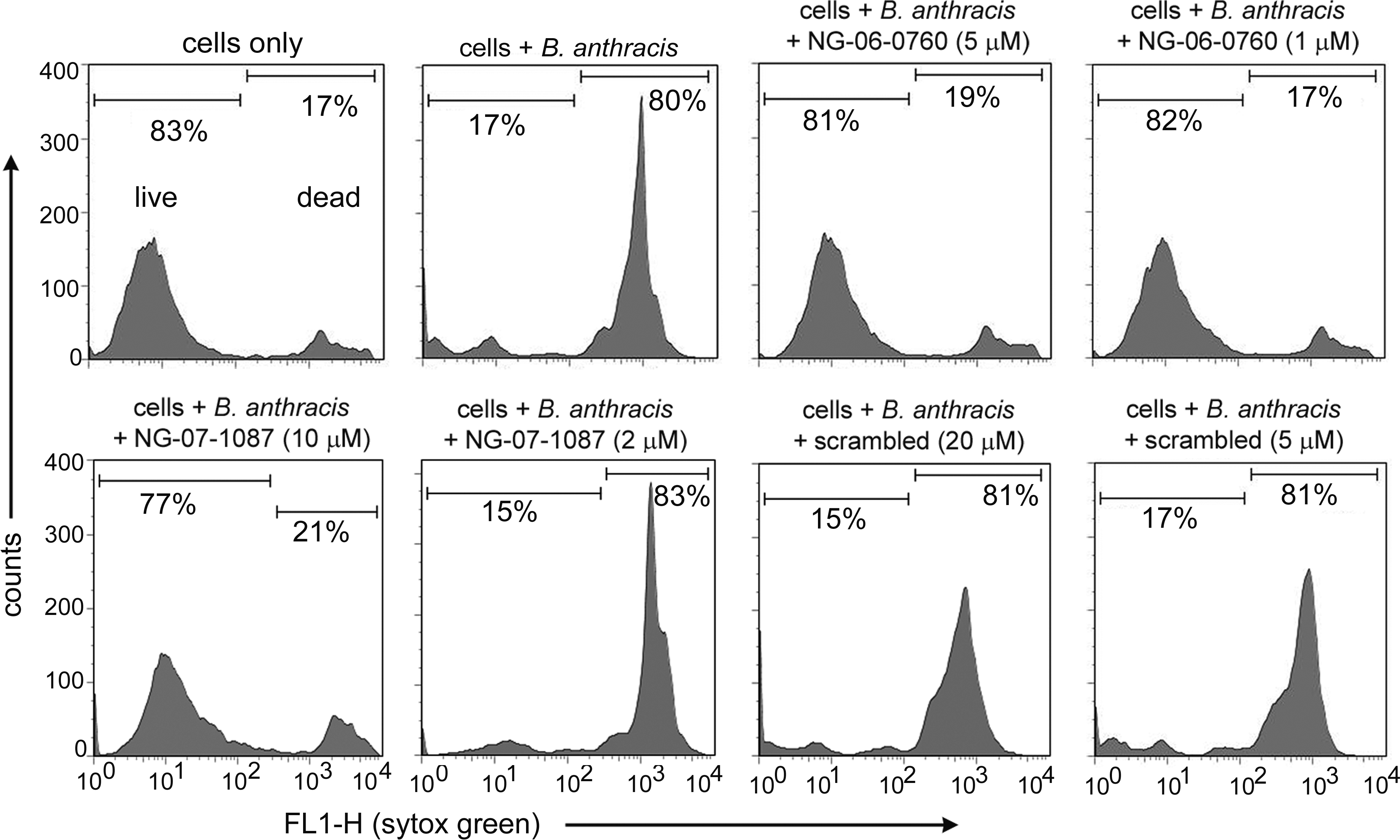
Cell viability of Bacillus anthracis–infected macrophages. Cell viability of macrophages treated with indicated concentrations of targeted peptide-conjugated phosphorodiamidate morpholino oligomers (PPMOs) and infected with B. anthracis was measured by uptake of Sytox green dye using flow cytometry. The percentage of live and dead cells are indicated.
Resistance to PPMOs
A spontaneous PPMO-resistant strain (BAPR1) was isolated by growing B. anthracis Sterne in broth supplemented with 20 μM (RFF)3R-AcpP. BAPR1 was further characterized for its susceptibility to ciprofloxacin and PPMOs. As depicted in Table 2, the MIC results show that BAPR1 was fully susceptible to ciprofloxacin but was mildly resistant (4-fold) to the PPMO (06-0760) used for selection. Furthermore, BAPR1 was 8- fold more resistant to (RFF)3R-FtsZ (07-1161) compared with the parental Sterne strain. (RFF)3R-FtsZ is targeted to a noncoding region upstream of the start codon of ftsZ, which is an essential gene required for bacterial cell division. These results suggest that the mechanism of resistance to PPMOs in BAPR1 is not specific for acpP. In contrast, BAPR1 was fully susceptible to (RFF)3R-GyrA (NG-07-1087). Apparently the mechanism of resistance is not linked to the peptide, but appears to be linked to the sequence of the PMO.
MIC, minimum inhibitory concentration; N.D., not determined; PMO, phosphorodiamidate morpholino oligomer.
A ciprofloxacin-resistant strain of B. anthracis was characterized for its susceptibility to (RFF)3R-AcpP. Results indicate that the susceptibility of ciprofloxacin-resistant B. anthracis to (RFF)3R-AcpP (NG-06-0760) was similar to the ciprofloxacin-sensitive parental strain of B. anthracis (Table 2). Thus, together these studies suggest that that resistance to PPMOs does not cause a change in the resistance to antibiotics and resistance to antibiotics does not result in resistance to PPMOs.
In vivo efficacy studies
The in vivo efficacy of the PPMOs targeting acpP (NG-06-0760) or the gyrA (NG-07-1087) was tested in the virulent Ames B. anthracis infection model. Mice were pretreated with the PPMOs (5 mg/kg) and after 1 hr infected with the virulent Ames strain of B. anthracis. Additional treatments were given at +1 hour, +6 hours and +24 hours post infection. As shown in Fig. 2, mice treated with the gene-targeted PPMOs showed a statistically significant increase in the survival rate (P=0.0003) compared with scramble or phosphate buffered saline controls that succumbed to the pathogen as early as 48 hours post challenge. A statically significant increase in survival was observed in mice treated with acpP (P=0.0008) or gyrA (P<0.0001) PPMOs compared to scrambled treated controls. Thus these studies confirm that PPMOs targeting bacterial essential genes are capable of protecting mice in a lethal challenge model of B. anthracis.
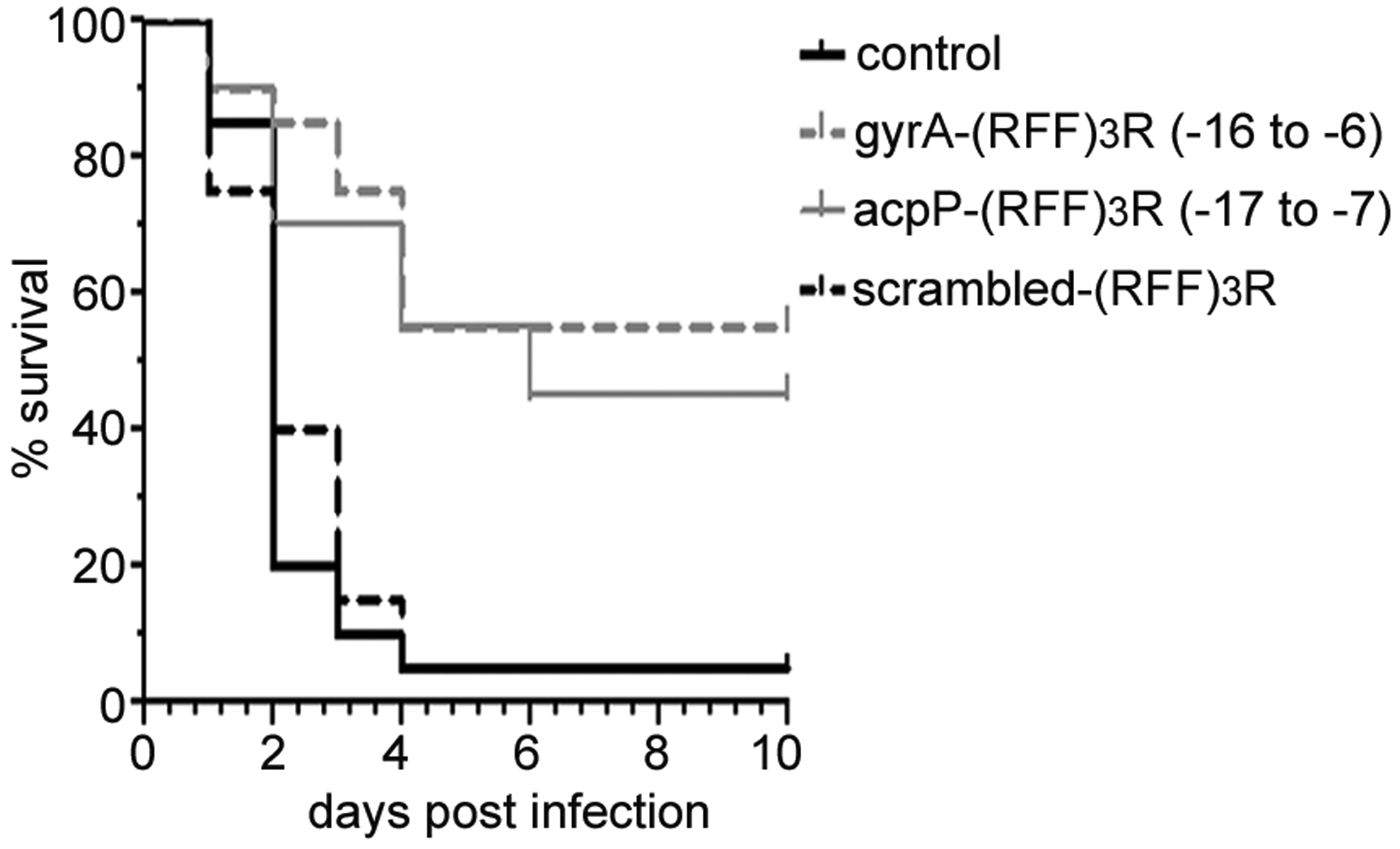
In vivo testing of PPMOs in the virulent Ames B. anthracis infection model. C57BL/6 mice (n=20) pretreated for 1 hr with targeted PPMOs (5 mg/kg) were infected with the virulent Ames strain of B. anthracis. Subsequent treatment was continued at +1 hour, +6 hours and +24 hours. The percentage of mice that survived the challenge was plotted. Statistical analysis revealed a significant increase in survival rates in B. anthracis infected mice that were treated with acpP (P=0.0008) or gyrA (P<0.0001) PPMOs compared with scrambled treated controls.
Discussion
In this study, antisense technology was tested for efficacy against B. anthracis, a proven agent of bioterrorism. Two bacterial essential genes acpP and gyrA were targeted, and variations in the target position were investigated. Previous studies in E. coli have revealed that an optimal targeting strategy for PMOs is to position the oligomers immediately upstream of the start codon (Deere et al., 2005). In B. anthracis, our results showed a similar effect. Targeting positions immediately upstream of the start codons of either acpP or gyrA was more effective than targeting positions downstream. A likely explanation for this effect is an overlap with the apparent ribosome binding site, which is separated 7–9 bases upstream from the start codon (Vellanoweth and Rabinowitz, 1992). Although these results show a correlation between MIC and position of the PPMO targeting upstream of the start codon, the sample size is too small to make a generalized statement. There is a possibility that the high G/C rich content of these PPMO sequences may have contributed to the lower MIC values. However, analysis of a large number of PPMO sequences in E. coli has shown no correlation between G/C content and MIC (Geller et al., unpublished results).
PMOs by themselves are not efficiently taken up by bacteria. However, the sequence-specific effects of the PMO on bacterial gene expression have been significantly improved by attaching a membrane-penetrating peptide to the end of the PMO (Geller et al., 2003; Tilley et al., 2006; Mellbye et al., 2009; Tilley et al., 2007). The peptides themselves are known to traverse through the lipid bilayer, often without causing lysis of the bacterial cell, or without killing the bacteria (Vaara and Porro, 1996). Presumably, the movement of the peptide through the bilayer delivers the PMO to the intracellular compartment. Importantly, mixtures of PMOs and membrane-penetrating peptides are ineffective, which indicates that the peptide must be covalently attached to the PMO for entry into the cell (Geller and Iversen, unpublished data). Peptides with various patterns of alternating cationic and hydrophobic amino acids have been shown to penetrate bacterial membranes without bactericidal effect (Vaara and Porro, 1996). The strategy of using membrane-penetrating peptides to carry synthetic antisense oligomers into bacterial cells was first shown by Good et al. (Good et al., 2001). In the present study, 2 peptides (RFF)3R and (RXR)4 (R=arginine; F=phenylalanine; X=6-aminohexanoic acid) covalently conjugated to PMOs targeting acpP or gyrA gene were tested for their ability to in vitro inhibit growth of B. anthracis. PMOs conjugated with the (RFF)3R peptide were most effective in inhibiting bacterial growth compared to those tagged with the (RXR)4 peptide. The antibacterial effect was not modulated by moving the peptide from the 5′ to the 3′ end.
Our resistance results suggest that PPMO-resistance in one particular isolate, BAPR1, was not linked to the peptide or a specific target, but rather appeared to be dependent on the PMO sequence. Although the mechanism of resistance to the PPMOs is unknown, our observed results do not necessarily suggest a nonspecific effect. Cell growth may be more tolerant to changes in concentration of GyrA than AcpP or FtsZA. It has been shown that a small decrease in the concentration of some proteins (such as AcpP) may cause growth defects, whereas similar decreases in other proteins have little or no observable effects (Goh et al., 2009). It is also possible that a mutation in BAPR1 may somehow reduce, but not entirely eliminate the uptake of PPMOs. If PPMO resistance were linked to uptake of PPMOs, perhaps changes in PPMO uptake could have little effect on the threshold concentration of GyrA but a higher effect on AcpP or FtsZ that is required to maintain growth. Furthermore, a sequence-biased degradation of AcpP or FtsZ PPMO more than GyrA PPMO could conceivably contribute to the observed results. However, to test these hypotheses, assays will need to be developed to quantify PPMOs in biological samples.
An important challenge in antibacterial discovery is to successfully tackle antibacterial resistance. Our results show that a ciprofloxacin-resistant B. anthracis was susceptible to the (RFF)3R-AcpP to the same extent as the parental strain. This suggests that PPMOs may be effective against antibiotic-resistant strains of B. anthracis because they have a completely different structure and mechanism of action than standard antibiotics.
The antibacterial activity of the antisense PPMOs was demonstrated in cell-based infection assays. Macrophages treated with the acpP PPMO and infected with B. anthracis showed much-reduced cell death compared to scrambled or infected control alone. A higher concentration of the (RFF)3R-GyrA compared with (RFF)3R-AcpP was required for the same effect.
The in vivo efficacy studies revealed that AcpP and GyrA PPMOs protected mice after lethal challenge with the highly virulent Ames strain of B. anthracis. Although the (RFF)3R-AcpP was more effective than the (RFF)3R-GyrA in the MIC assays, the results of the lethal challenge showed the opposite trend. The inverted trend is not surprising because growth conditions are quite different in vivo compared to in vitro. Bacterial growth rate, gene expression, mRNA abundance, and PPMO pharmaco-kinetics and -dynamics may all play roles in determining the efficacy of PPMOs in vivo.
The 2 scrambled PPMOs with the same base sequence but different peptides (06-0078 and 05-0655) had different MIC values (see Table 1). This suggests that the efficacy of PPMOs may not be entirely gene specific. Off target or nonspecific effects of PPMOs have also been observed in vitro with E. coli (Wesolowski et al., 2011) and Acinetobacter lwoffii (Geller, unpublished data), and in vivo with Burkholderia multivorans (Greenberg et al., 2010). Some of this nonspecific effect may be due to partial complementarity of scrambled sequence controls to other genes (Wesolowski et al., 2011). Our data suggests that the nonspecific effect is dependent on the amino acid composition of the peptide. To further improve the antibacterial efficacy of the PPMOs while at the same time reducing the non-specific effects of the peptide, it would be useful to test the new generation of the cationic PMOs (Mellbye et al., 2010), and vary the composition of the peptide.
In summary, these studies show that PPMOs reduced growth of B. anthracis in vitro and in vivo. Furthermore, PPMOs were effective against ciprofloxacin-resistant B. anthracis. This suggests that antisense technology is a feasible approach for developing novel antibacterials for B. anthracis.
Footnotes
Acknowledgments
We thank Brett Eaton for technical support. This project was partially funded by the Department of Defense Chemical Biological Defense Program through the Defense Threat Reduction Agency. This project has been funded in whole or in part with federal funds from the National Cancer Institute, National Institutes of Health, under contract HHSN261200800001E. The content of this publication does not necessarily reflect the views or policies of the Department of Health and Human Services, nor does mention of trade names, commercial products, or organizations imply endorsement by the U.S. Government. This research was supported, in part, by the Developmental Therapeutics Program in the Division of Cancer Treatment and Diagnosis of the National Cancer Institute. Opinions, interpretations, conclusions, and recommendations are those of the authors and are not necessarily endorsed by the U.S. Army.
Author Disclosure Statement
Drs. Bruce Geller and Patrick Iversen were employed at AVI Biopharma and Oregon State University during these studies.