




Abstract
IMT504 is a non-CpG 24-mer oligodeoxynucleotide (ODN) with immunomodulatory as well as tissue repair activity. IMT504 has been previously proven to be effective in animal models of vaccine potency, chronic lymphocytic leukemia, tissue regeneration, and sepsis. Here, we assessed the safety, including pharmacokinetics and toxicity studies in rats and monkeys, of IMT504 in a single- or repeated-dose administration by the subcutaneous (SC) or intravenous (IV) routes. In rats, the maximum tolerated dose was determined to be 50 mg/kg when administered SC. Adverse effects at 50 mg/kg were mild and reversible liver injury, revealed as lobular inflammation, focal necrosis, and small changes in the transaminase profile. Dose-dependent splenomegaly and lymphoid hyperplasia, most probably associated with immune stimulation, were commonly observed. Rats and monkeys were also IV injected with a single dose of 10 or 3.5 mg/kg, and no adverse effects were observed. Rats injected IV with 10 mg/kg showed a transient increase in spleen weight, together with a slight increase in the marginal zone of the white pulp and in leukocyte count 2 days post-administration. In monkeys, this dosage caused slight changes in total serum complement and leukocyte count on day 14. No adverse effects were observed at 3.5 mg/kg IV in rats or monkeys. Therefore, this dose was defined as the “no observed adverse effect level” for this route. Furthermore, repeated-dose toxicity studies were performed in these species using 3.5 or 0.35 mg/kg/day IV for 6 weeks. A transient increase in the spleen and liver weight was observed at 3.5 mg/kg/day only in female rats. No changes in clotting time and activation of the alternative complement pathway were observed. The toxicity profile of IMT504 herein reported suggests a dose range in which IMT504 can be used safely in clinical trials.
Introduction
I
Animal studies and clinical trials support the potential therapeutic use of CpG ODNs in some immunological conditions (KRIEG, 2006; Vollmer and Krieg, 2009; Halperin et al., 2012a, 2012b; Heyward et al., 2013; Janssen et al., 2013). Likewise, IMT504 stimulates the immune system of some laboratory animals (mainly rats and monkeys), acting as an adjuvant in combination with vaccines for hepatitis B (Elías et al., 2005), influenza (Montaner et al., 2011), rabies (Montaner et al., 2012) and foot and mouth disease virus (Gan et al., 2009). Also, IMT504, but not CpG ODNs, increases the number of adult mesenchymal stromal cells with multipotent differentiation capacity in vitro and in vivo (Hernando-Insúa et al., 2007). We have also found that treatment with IMT504 causes significant improvements in animal models of bone injury (Hernando-Insúa et al., 2007), neuropathic pain (Coronel et al., 2008), and type 1 diabetes (Bianchi et al., 2010). Furthermore, in human B cells from patients with chronic lymphocytic leukemia, IMT504 induces an immunogenic phenotype (up-regulation of CD25, CD40, CD80, and CD86 surface molecules) and stimulates apoptosis in vitro (Rodriguez et al., 2006b). Additionally, a recent study has shown that treatment with IMT504 confers substantial survival advantage in a neutropenic rat model of sepsis due to Pseudomonas aeruginosa infection (S. Opal, personal communication). Also, in a multiple organ dysfunction syndrome rat model induced by Escherichia coli bacteremia, IMT504 lowers proinflammatory cytokines and protects from massive intravascular coagulation and lung or liver necrosis (Montaner et al., 2007). Altogether, these studies clearly show that IMT504 may serve as a therapeutic agent for many severe diseases, including sepsis, which currently has no licensed specific treatment.
CpG ODNs have been widely used as agonists for the toll-like receptor 9 (TLR-9) (Hemmi et al., 2000). Although the mechanism of activation of the immune response elicited by the PyNTTTGT prototype IMT504 is not fully understood, Gan et al. (2009) proposed that when combined with a DNA vaccine, it might be recognized by a TLR-independent pathway named DNA-dependent activator of IFN regulatory factors (DAI), also referred to as DLM-1/ZBP1 (Takaoka et al., 2007). This DAI pathway has been demonstrated as an alternative pathway for the non-CpG sequence to activate IFN regulatory factors and nuclear factor kappa B in antigen-presenting cells and subsequently stimulate the adaptive immune response (Takaoka et al., 2008).
In this report, we present a toxicity profile of IMT504 and suggest the dose range in which IMT504 can be safely used in human clinical trials.
Materials and Methods
Test substance: oligodeoxynucleotide IMT504
ODN IMT504 (5′-TCATCATTTTGTCATTTTGTCATT-3′) with PS internucleotide linkages was purchased from Oligos ETC. The ODN was suspended in depyrogenated water, assayed for lipopolysaccharide (LPS) contamination using the Limulus test and kept at −20°C until used. IMT504 preparations were used if LPS levels were undetectable. Purity was assessed by High-performance liquid chromatography and Polyacrylamide gel electrophoresis assays.
Animals
Rats: 4- to 8-week-old male and female Sprague Dawley rats (300–500 g and 200–300 g respectively) were obtained from FUCAL Laboratories and housed at the animal facility at the Facultad de Ciencias Exactas y Naturales, University of Buenos Aires.
Monkeys: 8- to 20-year-old male and female monkeys of the species Cebus apella (1.9–3.3 kg) from the colony of Centro de Educación Médica e Investigaciones Clínicas (CEMIC) were used. Life expectancy of animals from this colony is estimated to be 40 years. Animals naïve to previous treatment were housed in individual cages at 23.5–26.5°C, 60%–80% relative humidity, and a light schedule of 14 hours of light and 10 of hours darkness. The animals had free access to water and were fed with a balanced diet of fresh fruit, eggs, and sweet biscuits.
All animals were clinically examined daily and weight, general state, attitude, response to food and water, and any sign of reaction to the treatment, like skin color change, presence of hematomas, bleeding, occurrence of secretions, and autonomic activity (lacrimation, pupil size, unusual respiratory pattern, etc.) were recorded for each individual. Changes in gait, posture, and response to handling as well as the presence of tonic movements, stereotypies (e.g., excessive grooming, repetitive circling), or bizarre behavior (e.g., self-mutilation, walking backwards) were also recorded. All experimental protocols were approved by the Institutional Ethics Committee of the CEMIC, and the studies were carried out in accordance with the principles and procedures described in the Guide for the Care and Use of Laboratory Animals (National Research Council, 2011). The animal facilities are accredited by the Wisconsin Regional Primate Research Center International Directory of Primatology, University of Wisconsin –Madison. None of the monkeys were euthanized. After the studies, they were released back to the colony.
Pharmacological effect
The biochemical effect of IMT504 and the relationship between IMT504 concentration and effect was evaluated in rats. Rats were separated in three experimental groups (three females each) and injected SC with10, 20, or 50 mg/kg/day of IMT504 dissolved in 0.25 mL of phosphate buffer solution (PBS), respectively. Controls (three females) were inoculated with PBS. Forty-eight hours post-injection, animals were anesthetized, euthanized and the spleen was removed. Briefly, the spleen was mashed and rinsed repeatedly in a petri dish. Cells were transferred to a conical tube, centrifuged and resuspended in RPMI 1640 medium (PAA Laboratories) supplemented with 2.0 mM
Pharmacokinetics
Pharmacokinetics, biodistribution, and excretion studies were performed in rats after either subcutaneous (SC) or tail intravenous (IV) administration of a single dose of 10 mg/kg/day [32Pγ]-labeled IMT504 (specific activity 7 μCi/mg).
Radiolabeling was performed by transferring 32P from the gamma position of the [32Pγ] adenosine triphosphate ([32Pγ]ATP) with T4 polynucleotide kinase (PNK) in our lab. Briefly, 5 pmol/μL IMT504 were mixed with 3 U/μL T4 PNK enzyme (Affymetrix USB), 1M magnesium chloride, and [32Pγ]ATP (6,000 Ci/mmol, 10 mCi/mL, 1.67 pmol/μL) in the reaction buffer provided by the manufacturer and incubated for 3 hours at 24°C. After enzyme inactivation at 65°C, samples were aliquoted at 4°C and treated with ammonium acetate and glycogen. After a gentle mix, absolute ethanol (–20°C) was added and incubated for 30 minutes at −65°C. Then, test tubes were centrifuged at 14,000 g for 30 minutes. Pellets were washed with 70% ethanol (–20°C), dried at room temperature and resuspended in TE buffer (Tris-HCl 1 mM pH 8.0; EDTA 1 mM pH 8.0).
At 30, 60, 120, 240, 360, 540, and 720 minutes following administration, two females and two males were sacrificed and blood and organs (liver, spleen, kidneys, thymus, bowel, heart, bone marrow, bone, muscle, bladder, mesentery, stomach, pancreas, adrenals, lungs, trachea, brain, ovaries, oviducts, uterus, testicles, and prostate) were removed to determine radioactivity. Gastric and intestinal contents were also extracted.
Extraction of [32Pγ]IMT504 from tissue homogenates
Small pieces of tissue were weighed, placed in 0.5 mL LysisOptisolv (Kyzen) and incubated overnight at 65°C. Homogenized tissue was treated with 6% acetic acid in water and 200 μL were taken and placed in 1.5 mL of scintillation aqueous solution OptiPhaseHisafe 3 (Perkin Elmer) for scintillation counting.
Extraction of [32Pγ]IMT504 for qualitative evaluation
Samples (400 μL) of urine, feces, and plasma were used to evaluate the integrity of the ODN. Each sample was incubated with proteinase K at 37°C. The samples were then extracted with chloroform/isoamylalcohol (24/1 v/v), precipitated with glycogen to 2% in water, 7.5 M ammonium acetate pH 7.5 and absolute ethanol and resuspended in TE buffer. ODNs were developed in 19% acrylamide/bis-acrylamide gels containing 7M urea. Gels were fixed with 10% acetic acid/10% methanol/water solution before autoradiography.
Methods for safety assessment
The experimental design (dosing route and regimen) was performed taking into consideration the intended clinical use: (1) single-dose toxicity studies—local and systemic toxicity were evaluated by injecting rats and monkeys by the SC and/or IV route; and (2) repeated-dose toxicity studies—toxicity was evaluated by injecting rats and monkeys by the IV route for six weeks. Table 1 summarizes dosages, regimen, and animal species in the protocols performed.
Not sacrificed.
IV, intravenous; MTD, maximum tolerated dose; NOAEL, no observed adverse effect level; SC, subcutaneous.
Single-dose toxicity studies
Subcutaneous route
In order to find the range from no adverse effect to highest toxicity (life-threatening), a dosage screening was performed in rats by administering the ODN SC. Experimental groups containing five males and five females each were injected with 10, 50, 100, or 300 mg/kg of IMT504 dissolved in 0.25 mL of PBS pH 7.4. Controls were inoculated with PBS. Animals that survived after inoculation were sacrificed on day 14. Organs and gross pathology were examined.
Taking into consideration the dosages that proved to be well tolerated in the first experimental design, an extended experiment was performed. Rats were distributed in three experimental groups containing five males and five females each and sacrificed on days 2, 7, and 14 post-inoculation. Rats were SC injected with a single dose of 3.5, 10, or 50 mg/kg of IMT504 dissolved in 0.25 mL PBS. Controls were injected with PBS. Organ weight, gross pathology and a set of laboratory markers were studied.
Intravenous route
Taking into consideration the dosages well tolerated by the SC route, the acute toxicological effect of IMT504 was studied in rats and monkeys inoculated by the IV route. Rats were distributed in three experimental groups (each group subdivided in three groups of five males and five females) and sacrificed on days 2, 7, and 14 post-inoculation. Rats in treated groups were injected with a single dose of 3.5 or 10 mg/kg IMT504 dissolved in 0.25 mL PBS. Control rats were inoculated with PBS.
Monkeys were housed in individual cages and distributed in three experimental groups. Monkeys in treated groups were injected with a single IV dose of 3.5 mg/kg IMT504 (three males: 2.49±0.72 kg and three females: 2.57±0.56 kg) or 10 mg/kg IMT504 (three males: 3.2±0.24 kg and three females: 2.13±0.27 g) dissolved in PBS. Control monkeys (one male: 3.46 kg and one female: 1.90 kg) were inoculated with PBS. The IV administration was performed by a femoral slow bolus injection in a total volume of 3 mL. Monkeys were weighed and examined on days 0, 2, 7, and 14 post-inoculation. Also, blood samples and abdominal ultrasounds to estimate the size of the different organs were obtained at these times. All experimental manipulations were done with monkeys that had been anesthetized with ketamine/HCl (13 mg/kg) and that had received food no less than17 hours before the procedure. All animals were released back to the colony after the studies.
Repeated-dose toxicity studies
A repeated dose toxicity study by the IV route was performed in rats and monkeys. Rats were injected by the tail vein once a day for a total of 6 weeks, with 0.35 or 3.50 mg/kg/day of IMT504 dissolved in 0.25 mL of PBS or PBS as control. Animals were distributed in control or treated groups and subdivided in two subgroups (10 males and 10 females each) and sacrificed at weeks 6 and 12.
Monkeys were distributed in control or treated groups containing three animals each and injected three times per week (Monday, Wednesday, and Friday) for a total of 6 weeks, by a femoral vein slow bolus injection containing 0.35 or 3.50 mg/kg/day of IMT504 dissolved in 3 mL of PBS. Animal weights within experimental groups were as follows: 0.35 mg/kg/day: one male, 3.10 kg, and two females, 2.03±0.75 kg; 3.50 mg/kg/day: one male, 2.95 kg, and two females, 2.30±0.25 kg. Control monkeys (one male, 3.10 kg, and two females, 2.05±0.15 kg) were injected with PBS. Blood samples and trans-abdominal ultrasounds were obtained on day 0, and at 6 and 12 weeks after the first dose administration. All monkeys were released back to the colony after the studies.
Hematology, serum chemistry and coagulation
Blood specimens were collected from all experimental groups. Blood was extracted under xylazine/ketamine anesthesia by cardiac puncture (rats) or femoral vein puncture (monkeys). In all animals, hemogram, prothrombin time (PT), kaolin partial thromboplastin time, glucose, creatinine, and hepatogram [including total cholesterol, serum glutamic oxaloacetic transaminase (SGOT), serum glutamic-pyruvic transaminase (SGPT), protein, albumin, globulins and gamma-glutamyl transferase (GT), complement (CH50), and C3 and C4 conventional tests] were examined.
Gross pathology and organ weights
Rats were anesthetized with a combination of ketamine HCL 30mg/kg and xylazine 4 mg/kg, exsanguinated by cardiac puncture, and immediately euthanized in a carbon dioxide atmosphere. Complete gross postmortem examinations, including examination of the external features of the carcass, external body orifices, thoracic, abdominal, and cranial cavities, organs, and tissues, were conducted. The brain, spinal cord, stomach, small and large intestines, liver, kidneys, adrenals, spleen, heart, thymus, thyroid, trachea and lungs, urinary bladder, mesenteric ganglions, and gonads and accessory sex organs such as testes and prostate gland in males and uterus and ovaries in females were examined and weighed. All organs were macroscopically examined, and absolute and relative weights were calculated. Representative samples of every tissue were collected and preserved in 10% buffered formalin 0.1 M phosphate fixation buffer, pH 7.4, and included in paraffin blocks for histopathological analysis. In monkeys, the size of each organ was estimated by transabdominal ultrasound.
Examination of target organs
Taking into consideration the pharmacological effect described in tissue regeneration models (Hernando-Insúa et al., 2007; Coronel et al., 2008; Bianchi et al., 2010), the femoral bone, peripheral sciatic nerve, and pancreas of rats from the repeated-dose IV toxicity assay (0.35 and 3.5 mg/kg/day) were studied. Organ weight and gross pathology from samples taken at weeks 6 and 12were examined. Also, bone marrow was extracted from the left femur as previously described (Hernando-Insúa et al., 2007), and differential cell count was performed after May Grunwald-Giemsa staining.
Local tolerance
Tissue damage and subsequent granulomatous reaction at the site of injection were evaluated in rats SC injected with a single dose of 10 and 50 mg/kg/day IMT504. After administration, rats were observed daily for macroscopic changes. Stained sections from subcutaneous cellular tissue and muscle were analyzed on days 2, 7, and 14 post-injection.
Genotoxic potential assays
Ames test
The mutagenic potential of IMT504 was studied in the presence or absence of metabolic activation by rat liver S9 fraction, using the Salmonella typhimurium TA98 and TA100 strains as previously described (Gatehouse et al., 1994). Three plates were tested for each strain. The assay was performed using five different concentrations of IMT504 (10, 100, 500, 1,000, and 5,000 μg/plate). Aflatoxin B1 (1 μg/plate) was used as a positive control.
Chromosomal aberrations and sister chromatid exchange assays
Assays were performed using human lymphocytes cultured from peripheral blood (Tucker et al., 1996). Briefly, 1 mL of blood from a healthy donor was mixed with 7.5 mL of RPMI medium supplemented with fetal bovine serum (15%), 100 μL phytohemagglutinin, and 100 μL 5-bromodeoxyuridine B (10 μg/mL) and incubated at 37°C for 72 hours in the dark. Four concentrations of IMT504 (1, 2.5, 25, and 250 μg/mL) were studied. Mitomycin C (0.5 μM) was used as a positive control. The culture was treated with colcemid for the last 2 hours and the cells were then harvested, treated with hypotonic solution (0.075M KCl) for 20 minutes, and fixed three times with methanol-glacial acetic acid. Microscopic slides were prepared from the fixed cells by air-drying, and the slides were stained by the fluorescence-plus-Giemsa procedure. Fifty metaphases were analyzed. These results were statistically analyzed using repeated measures analysis of variance (InStat-GraphPad).
Statistics
Statistical significance in single- and repeated-dose toxicity assays was evaluated using the Student-Gosset test (p<0.05).
Results
Pharmacological effect
Pharmacological effects of IMT504 have been demonstrated in previous studies. These effects include in vitro activation, proliferation, and expression of costimulatory molecules on B cells (Elías et al., 2003; Rodriguez et al., 2006a); immune modulatory effect on mice, rats, and primates when combined with a variety of antigens (Elías et al., 2005; Montaner et al., 2011, 2012; Gan et al., 2009); and improvement of tissue damage or disease in animal models (Rodriguez et al., 2006b; Hernando-Insúa et al., 2007; Montaner et al., 2007; Coronel et al., 2008; Bianchi et al., 2010). All of these studies contributed to the dose selection for the present non-clinical studies.
IMT504 induced the expression of CD40 on CD19 cells from spleens of rats inoculated SC (Fig. 1A). A dose-response effect was observed from 0 to 20 mg/kg/day. On the other hand, IMT504 also increased the number of CD19 activated cells (expressing CD40) expressed as percentage (Fig. 1B).

Pharmacokinetics
The bioavailability of IMT504 was determined after a single-dose injection either SC or IV. When administered SC, the IMT504 levels in plasma increased quickly and showed a maximum level at 60 minutes. Then, a progressive decrease was observed through 240 minutes. This decrease in plasma levels concurred with an increase in IMT504 levels in tissues, especially in the liver, spleen, and bladder (Fig. 2A).Concurrently, when administered IV, IMT504 levels increased in plasma at 60 minutes but decreased quickly at 120 minutes (Fig. 2B).

Tissue levels of ODN in rats after
Figure 2A shows organs in which IMT504 levels were significant when IMT504 was administered SC. In the liver, IMT504 showed a peak at 60 minutes then decreased slightly to begin a gradual increase after 120 minutes to reach higher level at 360 minutes, where it remained steady for the time period analyzed. In the spleen, which has been recognized as a potential target organ in view of IMT504 activity on B lymphocytes, IMT504 increased gradually, showing a steady rise from 60 to 240 minutes and then decreased slightly toward the end of the study. In the thymus, IMT504 uptake was low shortly after administration, but after 120 minutes, it increased quickly up to 240 minutes and remained at this level until the end of the experiment. In kidneys, IMT504 uptake showed a peak at 60 min, then decreased slightly, then increased at 240 min and finally remained constant for up to 720 minutes. The presence of IMT504 in the intestines was progressive from the beginning up to the end of the study, increasing more quickly before 360 minutes. The passage of IMT504 through the blood–brain barrier was slow and minimal (not shown).
Excretion of IMT504 in urine increased progressively, with a maximum at 360 minutes. The urinary route was found to be the main route of elimination when IMT504 was administered SC. In the bladder, [32Pγ]IMT504 was found from the 240-minute time point, which is consistent with the excretion pattern. Excretion in feces was negligible during the first 12 hours.
After IV injection of a single dose of [32Pγ]IMT504, high levels of the ODN were found in the liver, spleen, intestine and heart (Fig. 2B). As expected, the maximum level as well as the subsequent drop in the IMT504 level was reached earlier than after administration by the SC route. In the spleen, the level was maximal at 120 minutes, remaining fairly constant until 240 minutes, when a marked decrease that lasted until 360 minutes was observed. In the liver, IMT504 level increased from the 60 to the 120 minutes time points, slowly decreasing until the end of the study. In the heart, the level of IMT504 was maximal at 120 minutes, remaining constant until the 360-minute time point, when a decrease was observed. IMT504 appeared in the intestines at 60 minutes and then increased slowly until 120 minutes. The thymus showed a constant low level up to 240 minutes, then a rise up to the 360-minute time point, and then a small, sustained increase until the end of the study. The kidneys showed a constant low level until the 240-minute time point and a small constant increase until the end of the study.
The excretion pattern when IMT504 was administered by the IV route was similar to that of IMT504 administered SC, although urinary excretion was observed earlier (from 120 to 240 minutes), with an abrupt decrease at 360 minutes. Excretion in feces was almost undetectable during the time period analyzed. Plasma and urine samples from animals injected IV or SC were analyzed by gel electrophoresis to test IMT504 degradation. In agreement with others (Agrawal et al., 1991), intact ODN was revealed at the time points analyzed (not shown).
Single-dose toxicity studies
Subcutaneous route: Rats
The aim of this first assay was to identify the single -dose range in which IMT504 can be used without causing major toxicity. To evaluate this range, IMT504 was SC injected in rats with a single dose of 10, 50, 100, or 300 mg/kg. This dosage range was selected taking into account our previous assays on the activation threshold of target cells. Animal deaths, body weight, food and water consumption and any sign of reaction to the treatment (skin change, presence of hematomas, bleeding, secretions, etc.) were recorded daily for 14 days. At this endpoint, rats were sacrificed and histopathologically examined.
Four out of ten rats injected with 300 mg/kg survived. However, these surviving animals showed serious liver damage. Deaths in this group were between days 3 and 5 after inoculation. On the other hand, in the group inoculated with 100 mg/kg, one female died on day 5 and nine out of ten animals survived. Animals within this group showed a transient decrease in the mean weight between days 2 and 4, with recovery between days 7 and 14. No deaths were observed in rats injected with 50 or 10 mg/kg.
The main histopathological alterations attributable to the injection of 100 mg/kg/day were mild microvesicular steatosis, mild lobular inflammation, and focal necrosis in the liver; vascular congestion, emphysema focal, focal atelectasis, and mild edema in the lungs; mild glyosis and perivascular edema in the central nervous system (Fig. 3 A–I); vascular congestion in the kidneys; and focal autolysis in the heart (not shown). No damage was found in the liver spleen, pancreas, spinal cord, femur, and mesenteric ganglions when IMT504 was injected in the 10 to 50 mg/kg range. Therefore, 50 mg/kg was tentatively defined as the “maximum tolerated dose” for IMT504 subcutaneously administered in rats.
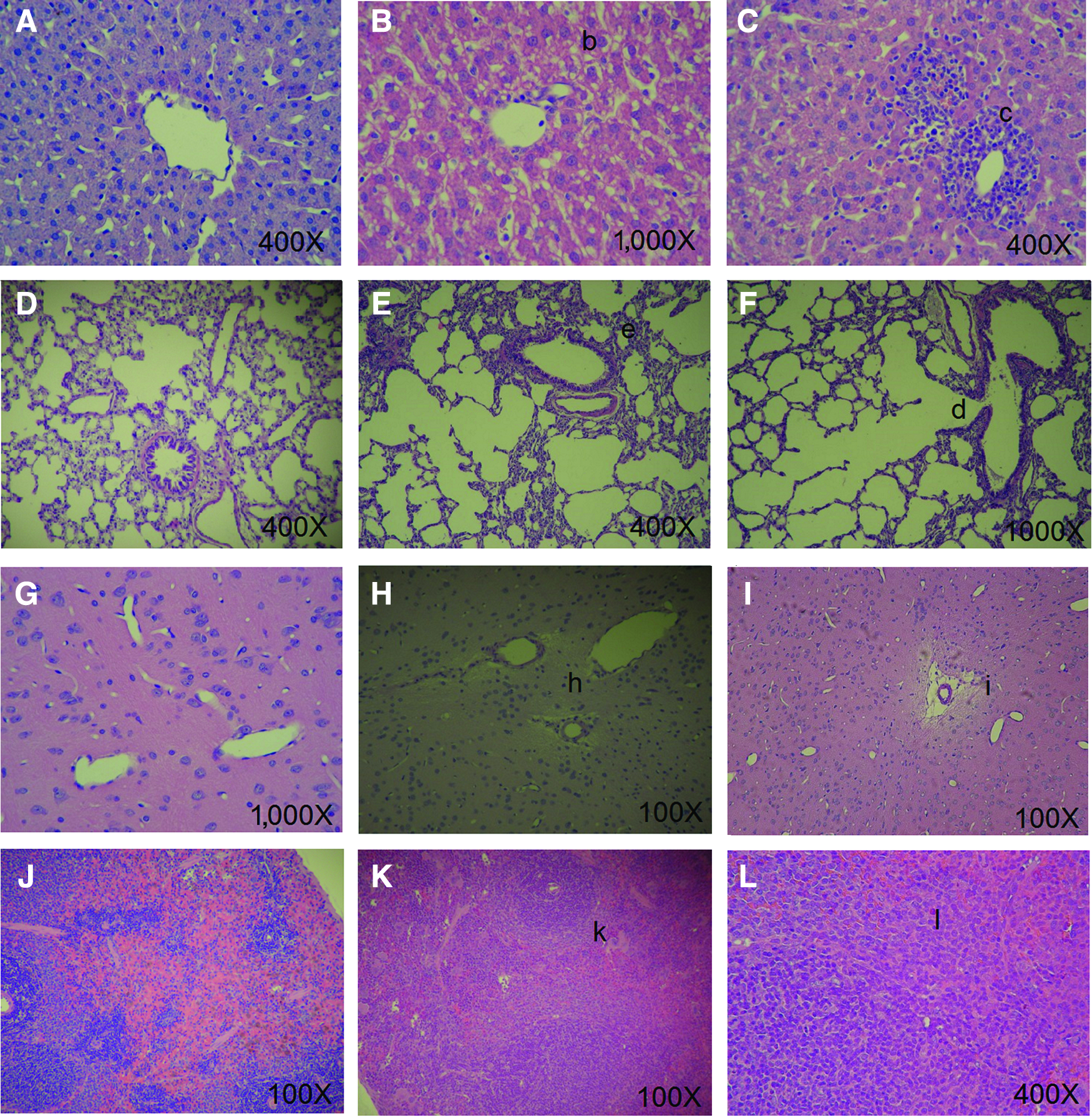
Histopathological alterations induced by single dose administration of IMT504 100 mg/Kg SC
Taking these results into consideration, an extended assay was performed in rats with 10 and 50 mg/kg single doses injected by the SC route. Rats were sacrificed on days 2, 7, and 14 and their organs histopathological evaluated. All rats survived until the end of the study (day 14). Food and water intake was not significantly modified by the treatment. Although a slight decrease in body weight was observed shortly after the beginning of the treatment, the intra-group variation in every group was less than 10% and was not statistically significant (Fig. 4).

Change in body weight in rats injected SC with a single dose of 10 or 50 mg/kg of IMT504. No statistically significant differences (p<0.05) were observed in treated animals as compared with controls.
Organ weight changes at the 50 mg/kg dose were limited to a significant increase in the spleen weight both in males and females on day 2 post-injection (Fig. 5). However, the increase in spleen weight was transient, since no significant differences were observed in rats sacrificed on days 7 or 14 post-injection. On the other hand, there were no significant changes in organ weights or necropsy findings attributed to the administration of 10 mg/kg IMT504 in any of the treated animals on days 7 and 14 post-injection (not shown).

Spleen weigh in male (M) and female (F) rats injected with a single dose of 50 mg/kg IMT504. Animals were sacrificed at day 2, 7, or 14. Statistically significant differences (*p<0.05) were observed in treated animals as compared with controls.
In addition, minor changes in some of the laboratory markers assayed were observed shortly after the single SC administration of IMT504 at the 50 mg/kg dose. These changes were a statistically significant decrease in cholesterol serum level (control, 76±5.2 vs. IMT504, 54±9.2 mg/dL; p=0.032) and a transient increase in total lymphocyte counts (control: 13.5±0.6 vs. IMT504: 21.2±4.6 103/mm3; p=0.026) in males on day 2. Changes in SGOT both in males (control, 228±96 vs. IMT504, 154±49 UI/L) and females (control, 159±77 vs. IMT504, 91±15 UI/L) were also observed on day 2, although these changes were not statistically significant (p>0.05). All these parameters were normalized on day 7.
Local tolerance studies in rats SC injected with a single dose of 10 or 50 mg/kg/day showed no macroscopic reaction or tissue damage at the site of injection on days 2, 7, or 14 post-injection. Based on these results, we defined 10 mg/kg as the highest dose where no adverse treatment-related effects are observed (NOAEL: “no observed adverse effect level”) in rats SC injected with IMT504.
Intravenous route: Rats
Taking into consideration the NOAEL determined by the SC route, we performed acute toxicity assays using a single-dose scheme by the IV route (another route expected to be used for some of the likely IMT504 applications). For this, rats were inoculated with a single dose of 3.5 or 10 mg/kg. Neither deaths nor observable clinical signs attributed to the administration of IMT504 were observed. In addition, neither food or water intake nor body weight were significantly modified by the treatment.
Changes in the laboratory profile of rats injected with a single IV dose of 10 mg/kg are summarized in Table 2. These changes were minor and limited to a decrease in cholesterol level [see (1) in Table 2; p=0.032] and serum complement (CH50) [Table 2 (3); p=0.05] and an increase in glycemia (2); p=0.049] and leukocyte count [Table 2 (4); p=0.041] on day 2. These markers were normalized on day 7. Other non-statistically significant changes (p>0.05) included decreases in alkaline phosphatase (ALP), SGOT, and SGPT [Table 2 (5), (6)]; decreases in C3 and C4 [Table 2 (7), (8)]; and increases in platelet counts [Table 2 (9), (10)]. No statistically significant changes were observed in animals injected with the 3.5 mg/kg IMT504 dose (not shown).
Changes in laboratory markers are cited in the table.
ALP, alkaline phosphatase; GT, glutamyl transferase; KPTT, kaolin partial thromboplastin time; N/D: Not determined; RBC, red blood cell; SGOT, serum glutamic oxaloacetic transaminase; SGPT, serum glutamic-pyruvic transaminase; TP, prothrombin time.
The administration of 3.5 mg/kg/day IMT504 caused no significant changes in organ weights or histology in any of the treated rats. In contrast, the administration of 10 mg/kg/day IMT504 caused a significant and transient increase in spleen weight both in males (control, 0.69±0.02 vs. IMT504, 1.13±0.04 g; p=0.006) and females (0.45±0.05 vs. IMT504, 0.80±0.01 g; p=0.004) 2 days post-injection. These changes were concomitant with a slight increase in the marginal zone of the white pulp (Fig. 3 J–L). Also, an increase in female liver weight, although not statistically significant (control, 28.60±2.01 vs. IMT504, 34.40±2.86 g; p=0.062) and not associated with any morphological changes in the histology, was observed on day 7 post-injection. No further changes were observed in any of the tissues examined.
Intravenous route: Monkeys
Acute toxicity assays after a single-dose injection of IMT504 by the IV route were also performed in monkeys. No deaths or clinical signs were attributed to the administration of IMT504 at 3.5 or 10 mg/kg. Food and water intake were not significantly modified by the treatment, and the intragroup variation in body weight in every group was less than 10% (not shown). Slight changes were observed in laboratory markers for the 10 mg/kg dose (Table 3). No changes in organ weights were observed by ultrasound analysis at this dosage. Furthermore, no statistically significant changes in laboratory markers were observed for the 3.5 mg/kg dose (not shown).
Combined data from animals in control (3 males and 3 females) or treated (3 males and 3 females) groups.
The potential for transient inhibition of clotting time, complement activation, and hemodynamic changes are the most common markers found to be modified in toxicological studies using other PS ODNs (Younis et al., 2013). Therefore, specific attention was paid to them in the study in monkeys. However, no significant changes were observed using the 3.5 or 10 mg/kg dosages.
Slight changes were observed in laboratory markers at 10 mg/kg/day (Table 3). Statistically significant differences as compared to control animals were found in globulin [Table 3 (1); p=0.043], total serum complement (CH50) [Table 3 (2); p=0.039] and leukocyte count [Table 3 (3); p=0.029] on day 14. Although not statistically significant (p>0.05), a decrease in glycemia was observed on days 2, 7, and 14 post-injection. Taken together, the results from rats and monkeys injected with a single dose of 3.5 mg/kg/day IMT504 defines the NOAEL for the IV route of administration.
Repeated-dose toxicity studies
Subsequently, repeated-dose toxicity studies were conducted in rats and monkeys. As suggested by others [GUPTA, 2012 and Center for Drug Evaluation and Research (CDER), 2010], dose levels were selected taking into account acute toxicity assays and pharmacokinetic data for the test compound. Dosages that proved to be well tolerated in the single-dose toxicity IV study were administered repeatedly by the same route.
Intravenous route: Rats
Rats were IV injected daily with IMT504 in doses of 0.35 or 3.5 mg/kg/day for a total of 6 weeks. No deaths were observed during the study. At 3.5 mg/kg/day, the intake of food and water was noted to be slightly different, but total body weight showed no significant changes (Fig. 6). Statistically significant differences were found in liver and spleen weight on day 42. The increase in spleen weight, an expected effect of the drug due to its immunostimulatory effect, was more evident in females (100%) than in males (28%) (Fig. 7A). Likewise, the increase in liver weight was also more significant in females (43%) than in males (12%) (Fig. 7B). Although these increases in both organs were reduced by day 87, the spleen was more refractory than the liver (Fig. 7). No weight variation was observed throughout the study in the heart and kidneys. There were no laboratory abnormalities attributed to the administration of IMT504 in any of the treated rats.
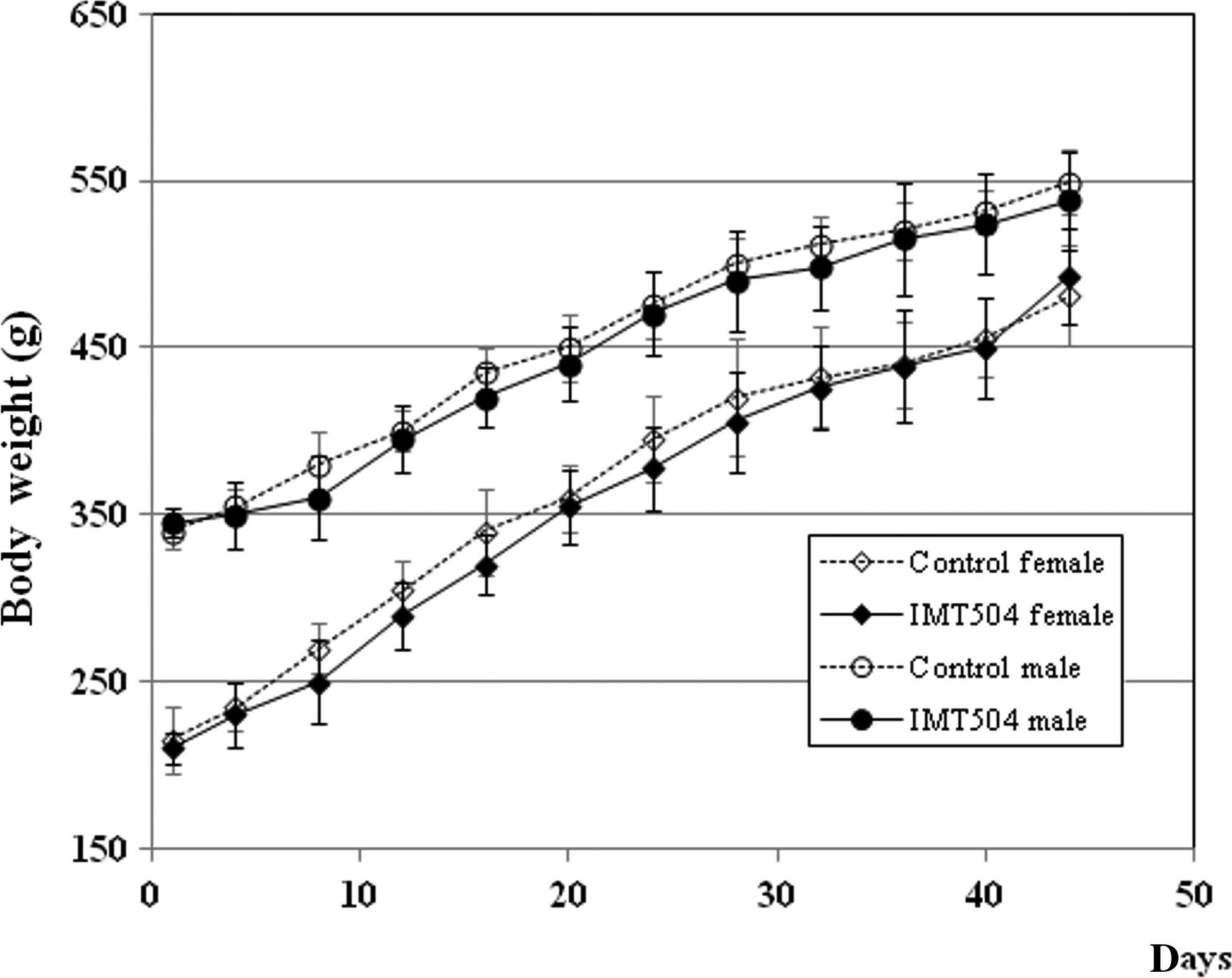
Change in body weight in rats injected daily for a total of 6 weeks with 3.5 mg/kg of IMT504 IV. No statistically significant differences (p<0.05) were observed in treated animals as compared with controls.
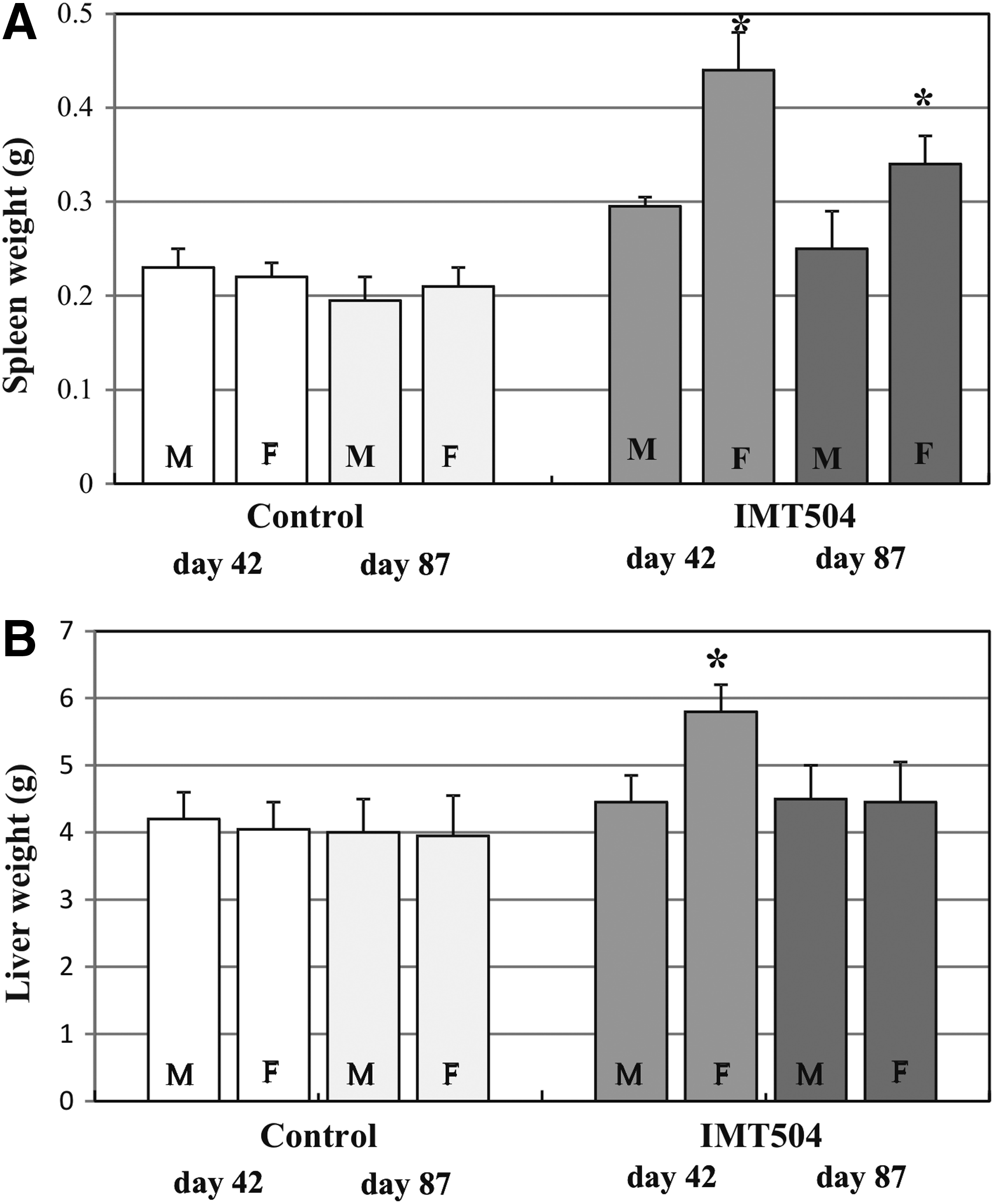
Spleen
Examinations of other potential target organs such as femoral bone, peripheral sciatic nerve, and pancreas revealed no alterations at either 0.35 or 3.5 mg/kg/day dosages at weeks 6 and 12. No signs of alteration were observed in bone marrow tissues. Laboratory markers at 3.5 mg/kg/day are summarized in Table 3. No statistically significant changes in these parameters were observed with 0.35 mg/kg/day (not shown).
Changes in rat laboratory markers at multiple dosages of 3.5 mg/kg/day IMT504 were found shortly after the onset of the administration (Table 4). Statistically significant differences as compared to control animals were found in total bilirubin [Table 4 (1); p=0.040], SGOT [Table 4 (2); p=0.036], ALP [Table 4 (3); p=0.024], creatinine [Table 4 (4); p=0.039] and urea [Table 4 (5); p=0.05] in females and in monocyte count in both males and females [Table 4 (6); p=0.045].
Ig, immunoglobin; MCV, mean corpuscular volume; MCH, mean corpuscular hemoglobin; MCHC, mean corpuscular hemoglobin concentration.
Intravenous route: Monkeys
Monkeys were IV injected three times a week for a total of 6 weeks, with 0.35 or 3.5 mg/kg/day of IMT504 in 0.25 mL of PBS. No deaths were observed during the study. Minor laboratory abnormalities attributed to the administration of IMT504 were found at 3.5 mg/kg/day (Table 4), which were undetectable at 0.35 m/kg/day (not shown). No behavioral changes or abnormal clinical signs were recorded during the study in any of the treated animals. Food intake and water consumption were not significantly modified by the treatment, and the intragroup variation in weight in every group was less than 10%. Furthermore, there were no significant changes in the size of the organs according to the ultrasound studies (not shown).
Minor changes were observed in laboratory markers of monkeys injected with 3.5 mg/kg/day of IMT504 for 6 weeks (Table 5). A statistically significant increase occurred in immunoglobin M level after the 6-week treatment as compared with controls [Table 5 (1); p=0.033]. This was also observed with gamma-GT [Table 5 (2); p=0.029]. Surprisingly, an increase in leukocyte count was found shortly after the beginning of the treatment [Table 5 (3); p=0.022]. This phenomenon was also detected on day 90, but probably not associated with IMT504 treatment, since a large dispersion of data was observed. Finally, statistically significant differences were observed in neutrophil [Table 5 (4); p=0.020] and lymphocyte counts [Table 5 (5); p=0.02] on day 42, which is consistent with an inversion of the leukocyte formula as compared to controls. This inversion was also manifested on day 90, although it was not statistically significant.
Combined data from animals in control (1 male and 2 females) or treated (1 male and 2 females) groups.
Genotoxic potential of IMT504
The genotoxic potential of IMT504 was assayed using the bacterial Ames assay, the chromosomal aberrations assay and the sister chromatid exchanges assay. IMT504 was not mutagenic under any of the conditions assayed.
Discussion
In general, therapeutic ODNs within a class share similar physicochemical and pharmacokinetic properties (e.g., solubility, charge-to-mass ratio, hydrophilicity, tissue distribution, metabolism, and protein binding, among others). Preclinical and clinical experience gained with various classes of ODNs suggest that these molecules have sufficient tolerability to be safely evaluated in their specific therapeutic indications (Cornish et al., 1993; Galbraith et al., 1994; Henry et al., 1997; Monteith et al., 1997; Iversen et al., 1999; Wallace et al., 2000; Prater et al., 2007; Bode et al., 2011; Younis et al., 2013). According to these studies, major concerns when using PS ODNs are related to the alterations in blood pressure and clotting times as observed in primates. For example, in a study performed in rhesus monkeys, Cornish et al. (1993) reported that when administered rapidly by IV injection with a dose of 8.3 mg/kg, a p53 antisense ODN caused a severe drop in blood pressure followed by death. Furthermore, hypotension and eventually death caused by another PS ODN administered at 10 mg/kg by bolus IV injection was interpreted to be caused by the ODN acting as an alpha(1)-adrenergic receptor antagonist (Iversen et al., 1999). A brief increase followed by a prolonged decrease in blood pressure was also reported by Galbraith et al. (1994) using a 25-mer PS ODN GEM91, complementary to the gag site of HIV, when administered to monkeys by rapid IV infusion (20 mg/kg in 10 minutes). The effect was transient and avoided by administration of the ODN in a slow IV infusion. Wallace et al. (1996) reported that AR177, a partial PS ODN with anti-HIV activity, did not cause any mortality or changes in blood pressure if given in a 10-minute IV infusion with single doses of 5, 20, or 50 mg/kg to monkeys. Other toxic effects observed during these studies were mainly alterations in blood counts and clotting times. These effects were not observed or greatly reduced if the ODN was administered in slow IV injection. On the other hand, preclinical studies showed that in rodents, severe toxic effects and deaths have been reported for PS ODNs administered intraperitoneally at doses of 100 mg/kg or greater (Sarmiento et al., 1994; MONTEITH, 1997; PRATER, 2007).
Some synthetic CpG ODNs have moved into clinical studies based on their immune stimulatory properties (KRIEG, 2006; Bode et al., 2011). Emerging clinical evidence indicates that, in some cases, large quantities of CpG ODN may be required to modulate the immune response in humans. For example, Hofmann et al. (2008) reported that repeated doses of up to 10 mg of a CpG ODN injected intralesionally were required to induce regression of melanomas and basal cell carcinomas in human patients. Therefore, knowledge of the dose range at which a given ODN can be safely used is of paramount importance. In the present study, we report that IMT504 has serious toxic effects in rats when SC administered in a single injection containing a dose greater than 100 mg/kg. In contrast, no serious toxic effects were observed when the ODN was administered as a single injection containing a dose of 10 mg/kg by either the SC or IV route. However, at this dose, and as expected due to the immunostimulatory effect of IMT504, a significant and transient increase in splenic size was observed. Mild changes restricted to the first days after IMT504 treatment, mainly a slight increase in white cells, SGOT, and SGPT and a slight decrease in platelets, albumin, and cholesterol, were also observed in some laboratory markers. All of these markers went back to normal by day 14 after treatment.
In one of the studies where IMT504 was IV administered daily to rats at a dose of 3.5 mg/kg/day for 6 consecutive weeks, the only observed difference was an increase in the size of the spleen (28% in males and 100% in females) and liver (12% in males and 43% in females), which was less marked but still significant 45 days after the end of the treatment, indicating strong and lasting stimulation of the immune system.
In monkeys, IMT504 administered at a dose of 10 mg/kg by slow single IV bolus injection resulted in no evident toxicity. Furthermore, in a study where IMT504 was intravenously administered to monkeys three times a week in a dose of 3.5 mg/kg/day for 6 consecutive weeks, no changes in clinical parameters or laboratory markers were observed.
Additionally, IMT504 was not mutagenic according to three different assays and standard conditions. Furthermore, we have previously reported that when administered SC in a single 20 mg/kg/day dose, IMT504 does not alter the embryonic development in rats (Hernando-Insúa et al., 2010).
In conclusion, a toxicity profile for IMT504 was established within the limits of the concentrations and schedules assayed using rats and monkeys. Taken together, these preclinical safety studies suggest that a 10 mg/kg/day dose is the NOAEL, as proposed by the Center for drug Evaluation and Research (CDER) guidelines (CDER, 2010), and is the most important information for estimating the clinical starting dose. This NOAEL dosage is significantly higher than doses used in efficacy studies, including IMT504 as adjuvant of hepatitis B, influenza or rabies vaccines in rats (0.2 mg/kg), hepatitis B vaccine in monkeys (0.05 mg/kg), and rabies vaccine in humans (0.0125 mg/kg) (Elías et al., 2005; Montaner et al., 2011, 2012). The toxicity profile of IMT504 reported herein suggests a therapeutic dose range in which IMT504 can be safely used in human clinical trials.
Footnotes
Acknowledgments
We thank Virginia Pelagatti, Veronica Medina, and Claudio Mirabelli for their technical assistance. This work was supported by Immunotech S.A. and additionally by the Agencia Nacional de Promoción Científica y Tecnológica (ANPCyT-MinCyT) (grant number PICT 2008-0970 to ADM) and the National Research Council (CONICET) from Argentina.
Author Disclosure Statement
DH is the founder of David Horn, LLC, which owns the IMT504 patent estate.