




Abstract
Triantennary N-acetyl galactosamine (GalNAc3)-conjugated antisense oligonucleotides (ASOs) have greatly improved potency due to receptor-mediated uptake into hepatocyte. The disposition and pharmacokinetics of ISIS 681257, a GalNAc3-conjugated ASO, were studied in monkeys. Following subcutaneous (SC) injection, ISIS 681257 was rapidly absorbed into the systemic circulation, with peak plasma levels observed within hours after dosing. After reaching Cmax, plasma concentrations rapidly declined in a multiexponential manner and were characterized by a dominant initial rapid distribution phase in which drug transferred to tissues from circulation, followed by a much slower terminal elimination phase (half-life of 4 weeks). Intact ISIS 681257 is the major full-length oligonucleotide species in plasma (≥70%). In tissues, the conjugated-GalNAc sugar moiety was rapidly metabolized, leaving the fully unconjugated form as the only full-length oligonucleotide detected at 48 h after dosing. Unconjugated ISIS 681257 cleared slowly from tissues with a half-life of 4 weeks. ISIS 681257 was highly bound to plasma proteins (>97% bound), which limited its urinary excretion. Disposition of ISIS 681257 in plasma and liver appeared nonlinear over the 1–40 mg/kg dose range studied. The plasma and liver tissue concentration data were well described by a population based mixed-effects modeling approach with Michaelis–Menten uptake from plasma to liver. Safety data from the study and the good exposure, as well as the extended half-life of the unconjugated ASO in the liver, support further development and less frequent dosing in Phase I clinical study.
Introduction
A
Currently, 2′-MOE ASO therapeutics are mostly delivered subcutaneously or intravenously and rely on the bulk cellular uptake into specific tissues to target selected mRNA. As a result, the field has primarily focused over the last 15 years on cells that inherently take up the 2′-MOE ASO, such as hepatocytes. Improving the efficiency of uptake into hepatocytes or gaining the ability to target cells that do not naturally take up the 2′-MOE ASO would greatly improve their therapeutic utility. Recent studies have shown that conjugation with GalNAc3 (triantennary N-acetyl galactosamine), a high-affinity ligand for the hepatocyte-specific asialoglycoprotein receptor (ASGPR), can substantially improve drug distribution to target cells; thus, it greatly enhances the targeted distribution of these molecules to hepatocytes and resulted in significant improvements in potency [9–11].
ISIS 681257 [IONIS-APO(a)-LRx] is a GalNAc3-conjugated 2′-MOE-modified ASO, targeting to apolipoprotein (a) [apo(a)], a protein produced in hepatocytes. The hybridization of ISIS 681257 to apo(a) mRNA results in RNase H-mediated degradation of the cognate mRNA; thus, inhibiting the translation of the apo(a) protein, a distinct protein component of lipoprotein(a) [Lp(a)], which is a genetic variant of LDL. Elevated Lp(a) levels in humans are associated with increased risk of cardiac death, myocardial infarction, stroke, and peripheral arterial disease [12,13]. The goal of treatment with ISIS 681257 is to reduce the production of apo(a) in the liver and as a consequence, the level of Lp(a) lipoprotein in blood, potentially slowing down or reversing cardiovascular disease by reducing thrombotic, atherogenic, or inflammatory events in patients with elevated Lp(a) levels. The mechanism of action has been confirmed in LPA transgenic (Tg) mice, which express the entire human apo(a) genomic sequence [14] and nonhuman primates.
There has been an abundance of information published regarding the pharmacokinetic properties of second generation ASOs [15–18]. Pharmacokinetics in monkeys for unconjugated ASOs typically well predict the observed plasma (and expected tissue) exposure levels in humans on the basis of mg/kg equivalent doses [15,17–19]. GalNAc3-conjugated ASOs recently advanced to preclinical and clinical development. This is the first report showing the in vivo toxicokinetics, disposition and metabolism, and pharmacokinetics of a GalNAc3-conjugated ASO in monkeys. The results obtained in this study will help to guide dose selection in the FIH study for ISIS 681257 and will be useful information for the development of future GalNAc3-conjugated oligonucleotides in the chemical class.
Materials and Methods
Test compounds
ISIS 681257 is a synthetic antisense oligomer of 20 nucleotides (ie, a 20-mer) (ASO) that are connected sequentially by phosphorothioate and phosphodiester linkages (mixed backbone design), with a total of ten 2′-O-methoxyethyl modified ribofuranosyl nucleotides, five on each end of the oligonucleotide, and conjugated covalently with a triantennary cluster of N-acetyl galactosamine (GalNAc3) sugars through trishexylamino-(THA)-C6 linker at the 5′ end using a phosphodiester linkage (GalNAc3-THA-ASO) (Fig. 1). The comprehensive structure–activity relationship of the nonradiolabeled N-Acetylgalactosamine-conjugated ASO has been described previously [20].

Chemical Structure of ISIS 681257.
The purity of ISIS 681257 determined by LC-MS (MW 8635.9 ± 1.3 amu) is 88.0%, with the full-length test compound (LC/UV) purity of 97.9%. Dosing was performed based on the quantity of full-length 20-mer oligonucleotide.
Animal experiments
Male and female cynomolgus monkeys were obtained from Orient Bio Inc., Republic of Korea. All animal procedures were conducted utilizing protocols and methods approved by the Institutional Animal Care and Use Committee (IACUC) and were in compliance with Animal Welfare Act and Guide for the Care and Use of Laboratory Animals (by ILAR publication).
Non-GLP investigational pharmacodynamic/pharmacokinetic and tolerability study of GalNAc3-Apo(a) ASOs in cynomolgus monkeys
As part of the non-GLP investigational pharmacodynamic/pharmacokinetic and tolerability study of GalNAc3-Apo(a) ASOs, three groups of cynomolgus monkeys (2M/2F per group) received subcutaneous (SC) injection of ISIS 681257 at dose levels of 1, 3, and 12 mg/kg/dose, respectively, on days 1, 3, 5, and 7 (loading doses) and then once weekly thereafter for a total duration of 4 weeks. Blood samples were collected for ISIS 681257 (total full-length ASOs) quantitation in plasma in tubes containing EDTA at predose 0.5, 1, 2, 4, 8, 24, and 48 h following the first dose (Day 1) and last dose (Day 28). Drug concentrations were measured in liver and kidney samples collected at approximately 48 h after the last dose (Day 30). Urine samples were collected at 0–24 h and 24–48 h following the last dose in monkeys receiving the 1 and 12 mg/kg ISIS 681257 to assess urinary elimination of ISIS 681257 and its associated full-length oligonucleotide metabolites.
GLP toxicology and toxicokinetic study of ISIS 681257 in cynomolgus monkeys
Monkeys received either SC injection of saline (vehicle control) or ISIS 681257 at dose levels of 3, 12, and 40 mg/kg/dose on days 1, 3, 5, and 7 (loading doses) and then once weekly for a total duration of 4 weeks, with a 12-week recovery period (saline control and 40 mg/kg groups only). Blood samples were collected for ISIS 681257 (total full-length ASOs) quantitation in plasma in tubes containing EDTA at predose 1, 2, 4, 6, 10, 24, and 48 h following the first dose (Day 1) and last dose (Day 28). Drug concentrations were measured in liver and kidney samples collected at approximately 48 h after the last dose (Day 30) and at the end of recovery period (Day 112) (recovery animals only). In addition, a single group of animals received ISIS 681257 at a dose level of 12 mg/kg on days 1, 3, 5, and 7 only with extensive PK sampling at predose 0.5, 1, 2, 4, 8, 12, 24, and 48 h following the first dose (Day 1) and last dose (Day 7) and were then sacrificed on days 3, 9, 16, 23, 30, 44, and 58 for collection of plasma and tissue samples. Finally, concentrations were also measured in plasma (at 7, 14, 42, and 84 days after last dose) and tissues of monkeys receiving the 40 mg/kg sacrificed 12 weeks after completion of the 4-week treatment regimen (on Day 112) to assess clearance during the 3-month recovery phase.
Analytical methods
Hybridization ELISA for quantitation of full-length ASOs in plasma
All plasma samples were analyzed using a quantitative, sensitive hybridization ELISA method, a variation on the method reported previously [21]. The assay was validated for precision, accuracy, selectivity, sensitivity, and stability of ISIS 681257 quantitation before analysis of the monkey plasma samples. The assay quantitated full-length ASOs (including fully conjugated, partially conjugated with 1, 2, or 3-sugar deletions, and unconjugated ISIS 681257) using ISIS 681257 standard curves. Therefore, total full-length ASOs were reported as ISIS 681257-equivalent mass concentrations (μg eq./mL) in plasma.
Plasma sample analyses were conducted at the Korea Institute of Toxicology (KIT) and were performed based on the principles and requirements described in 21 CFR Part 58. The assay conducted with synthesized putative shortened oligonucleotide metabolite standards showed no measurable cross-reactivity, confirming the assay's specificity for the parent full-length oligonucleotides. The quantitation range was 1.00–100 ng/mL, with the low and high ends of the range defining the lower (LLOQ) and upper (ULOQ) limit of quantitation, respectively.
Ion-pairing UPLC-UV for quantitation of unconjugated ISIS 681257 in tissues and profiling of shortmer oligonucleotide metabolites in plasma and tissues
Tissue samples (50 mg) were weighed, minced, homogenized, and extracted first using a liquid–liquid extraction (LLE) of phenol:chloroform:isoamyl alcohol (25:24:1), followed by a solid phase extraction (SPE) consisting of a 96-well Strata X packed plate (Phenomenex, Torrance, CA). Samples were then analyzed by IP-UPLC with ultraviolet (UV) detection. A 27-mer oligonucleotide was added before extraction as an internal standard. Chromatographic separation was performed with a gradient system at a flow rate of 1.0–0.8 mL/min on a Waters Acquity UPLC system, using an ACQUITY UPLC® OST C18 column heated to 60°C, with 10 mM TBAA in 32.5% acetonitrile and 10 mM TBAA in 90.7% acetonitrile as the mobile phase with a 10-μL injection volume. Oligonucleotide peaks were detected by UV absorbance at 260 nm. Tissue sample analyses were conducted at CMIC, Inc. (Hoffman Estates, IL) and were performed based on the principles and requirements described in 21 CFR Part 58. The quantitation range was 10.00–1500 μg/g (1.405–210.8 μM), with the low and high ends of the range defining the LLOQ and ULOQ, respectively. Samples were stored at −80°C before sample extraction and analysis.
A subset of extracted plasma and tissue samples from the high-dose group (40 mg/kg) were subjected to qualitative analysis for metabolite profiling to determine the relative proportions (percent of total peak area) of full-length oligonucleotides (primarily conjugated ISIS 681257 in plasma and unconjugated ISIS 681257 in tissues) and shortmer metabolites using IP-UPLC with UV detection using the method described above. The chromatograms were monitored for full-length oligonucleotides (N) and metabolites with one to fifteen nucleotide deletions (N-1 to N-15). Each metabolite observed was provisionally identified based on the comparison of their relative retention times with the relative retention times of the putative N-1, N-5, and N-15 metabolite reference materials.
Ion-pairing HPLC-MS/MS method for quantitation of fully conjugated, partially conjugated, and unconjugated ISIS 681257 in plasma, urine, and tissues
Plasma and urine samples at selected dose groups were analyzed for quantitation of each full-length oligonucleotide species (ie, fully conjugated, partially conjugated with 1, 2, or 3-sugar deletions, and unconjugated ISIS 681257) using an ion-pairing (IP) HPLC-MS/MS method. The presence of fully conjugated ISIS 681257, its metabolites with sugar deletions, that is, ISIS 681257-1GalNAc, ISIS 681257-2GalNAc, and ISIS 681257-3GalNAc were examined in a subset of tissue samples.
Plasma (50 μL), urine (50 μL), or tissue (50 mg) samples were extracted in the same manner as the (IP) UPLC-UV samples listed above. Separation of the extracted plasma samples was accomplished on a Waters Acquity UPLC system, using an ACQUITY UPLC® OST C18 column heated to 60°C (Waters, Milford, MA). The column was maintained at 60°C and flow rate on the column was 0.3–0.5 mL/min. The column was equilibrated with 400 mM HFIP/15 mM TEA in water. A gradient from 20% to 40% methanol over 9 min was used to elute ISIS 681257 and its various metabolites with one or more sugar deletions. Mass measurements were made on-line using an API5500 mass spectrometer. Peaks on the MRM chromatogram were identified based on their eluting position. Concentrations were determined by the internal standard (IS) method based on the peak area ratios of analyte to IS. MRM transitions of m/z 1079, 1016, 936, 913, 891, and 1050, all with a product ion of 94.8 for ISIS 681257, ISIS 681257-1GalNAc, ISIS 681257-2GalNAc, ISIS 681257-3GalNAc, unconjugated ISIS 681257, and IS, were respectively monitored. Mass spectra were obtained in the negative mode with an ion spray voltage of −4.5 kV, a nebulizer and turbo gas flow of 50 psi, a curtain gas flow of 12 psi, and heater gas temperature of 650°C. The LLOQ for plasma, urine, and tissue was 1.00, 10.0, and 50 nM, respectively.
Protein binding assay
An ultrafiltration method [22] was used to assess whole plasma protein binding characteristics of ISIS 681257. Briefly, Millipore (Bedford, MA) Ultrafree-MC filters with low-binding regenerated cellulose membrane (MW cutoff of 30 kDa) were used. Whole monkey plasma protein binding was evaluated at two concentrations (5–150 μg/mL) to bracket the Cmax expected over the dose range evaluated in the study. Aliquots (50 μL per aliquot) of ultrafiltrates (containing unbound ISIS 681257) and initial plasma samples [containing total (bound and unbound) ISIS 681257] were assayed using nuclease-dependent hybridization ELISA to obtain the drug concentration in each sample. Three replicates at each concentration were run to determine% unbound means and standard deviations throughout this study, using the following equation:
Noncompartmental pharmacokinetic analysis
Noncompartmental analysis methods (spare sampling module) were used for pharmacokinetic characterization of the plasma and tissue concentration data (Phoenix WinNonlin 6.3; Pharsight Corporation, Cary, NC). Plasma PK parameters for total full-length ASOs (ISIS 681257-equivalent) from the hybridization ELISA method included peak plasma concentration (Cmax) and time to Cmax (Tmax), AUC0-48 h using the linear trapezoidal method, clearance (CL/F), and mean residence time (MRT).
Population pharmacokinetic analysis
All the plasma and liver concentration data collected from the non-GLP investigational pharmacokinetic/pharmacodynamic (PK/PD) and tolerability study and the GLP toxicology and toxicokinetic study were used for the nonlinear compartmental pharmacokinetic analysis. A population modeling approach using nonlinear mixed-effects modeling software, NONMEM® (version 7.2; ICON Plc, Hanover, MD), was applied to describe monkey data by a three-compartment pharmacokinetic model with first order absorption from SC injection site to plasma (central), first order distribution between central and peripheral compartment (Q3), Michaelis–Menten uptake to liver from plasma (Q4), first order elimination from plasma (CLp) and liver (CLliv) compartment, and body weight as scaling factor as follows:
where A(1), A(2), A(3), and A(4) are the ASO amount (μg/kg) in the SC, plasma (central), peripheral, and liver compartment; V2, V3, and V4 are the distribution volume (L) in the plasma, peripheral, and liver compartment; Ka is the first-order rate constant for absorption; CLp and CLliv are the clearance (L/h) from the plasma and liver compartment; Q3 is the intercompartmental clearance (L/h) between plasma and peripheral; and Q4 is the uptake rate (L/h) from plasma to liver compartment.
The first-order conditional estimation method (FOCE) with interaction was used for the estimation of pharmacokinetic parameters. Perl speaks NONMEM (PsN) 3.3.2 and Xpose (version 4.3.2) were used for model diagnostics [11,12]. Different model structures and features were evaluated, such as first order clearance or Michaelis–Menten (MM) clearance or a combination of both. Model development was guided by the objective function value provided by NONMEM, assumed to be χ2 distributed, precision in parameter estimates, and scientific plausibility. Goodness-of-fit plots and visual predictive checks were used during model building. To extrapolate to the human exposure, an allometric scaling, using body weight with exponents fixed to 1.0, was applied to clearances (CLp, Q3, and Vmax) and volumes of distribution (V2, V3, and V4). The predicted ISIS 681257 half-life in plasma and liver was calculated from the simulated plasma and liver profile, respectively, by simple log-linear regression analysis of the terminal phase in Phoenix WinNonlin 6.3, Pharsight Corporation (Cary, NC).
Results
Toxicokinetics and metabolism in plasma
ISIS 681257 was rapidly absorbed following SC injection in monkeys, with the median Tmax observed at 1–4 h post dose (Table 1). Following a single SC dose, mean peak exposure (Cmax) and total plasma exposure (AUC0-48 h) were dose dependent and increased greater than dose proportionally between 1–40 mg/kg. The nonlinearity in dose-exposure relationship was also reflected in the dose-dependent apparent plasma clearance. After attaining Cmax, plasma concentrations decreased in an apparent multiexponential manner with time (Fig. 2). Compared to the single dose, mean Cmax and AUC0-48 h appeared to be generally similar after repeated doses on day 28 (7 SC doses).
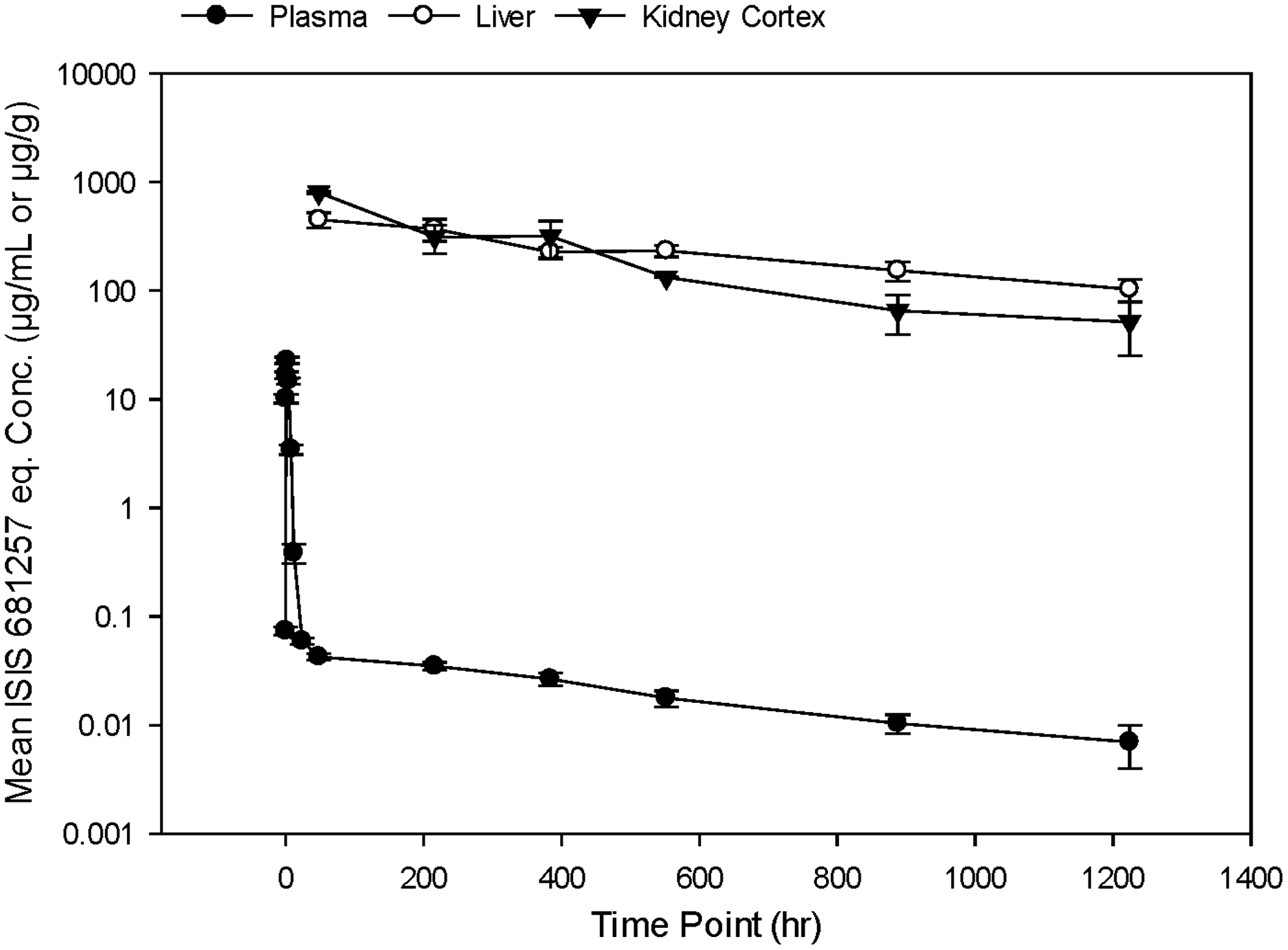
Concentration-Time Profiles of ISIS 681257 eq. after last dose in plasma, liver, and kidneys following Multiple Subcutaneous Administrations of ISIS 681257 at 12 mg/kg (on days 1, 3, 5, and 7) in monkeys.
Values are presented as mean ± standard deviation, except Tmax, which is presented as median (min, max) (N = 4–14).
The study day when profile samples were collected. Animals were dosed by SC administration on days 1, 3, 5, and 7 in monkeys and then once weekly thereafter.
MRT0-48 h was calculated from plasma concentrations ranging from time 0 to 48 h.
ASO, antisense oligonucleotide; SC, subcutaneous.
Total full-length ASO in monkeys was cleared within hours from plasma. This initial rapid clearance with an MRT0-48 h approximately 3–6 h is related to distribution to tissues. The initial rapid distribution phase from plasma was followed by a much slower elimination phase, determined after 4 SC doses of 12 mg/kg ISIS 681257 administered over the first week (Fig. 2). Compared with Cmax, plasma concentrations in the postdistribution phase were several magnitudes less, but were in parallel with elimination phase in tissues (Fig. 2). The terminal elimination half-life in plasma and liver was approximately 30 days based on compartmental analysis using population approach (see Nonlinear Compartmental Pharmacokinetic Analysis Using Population Approach).
Intact ISIS 681257 was the most abundant oligonucleotide species in plasma, which accounted for ≥70% of total full-length ASOs detected (Fig. 3). Lower abundance of ISIS 681257 metabolites with 1, 2, and/or 3 GalNAc sugar deletions or unconjugated ISIS 681257 was also detected and total exposure (AUClast) of each of its full-length oligonucleotide metabolite accounted for less than 13% of total full-length oligonucleotides. Although AUClast for unconjugated ISIS 681257 accounted for ≤5% of total full-length oligonucleotide, it was the major oligonucleotide species at later time points (24 h and later), reflecting an equilibrium established between plasma and tissue. Following repeated treatment on day 28, there were no shortmer oligonucleotides associated with nuclease-mediated metabolism detected in plasma (data not shown).
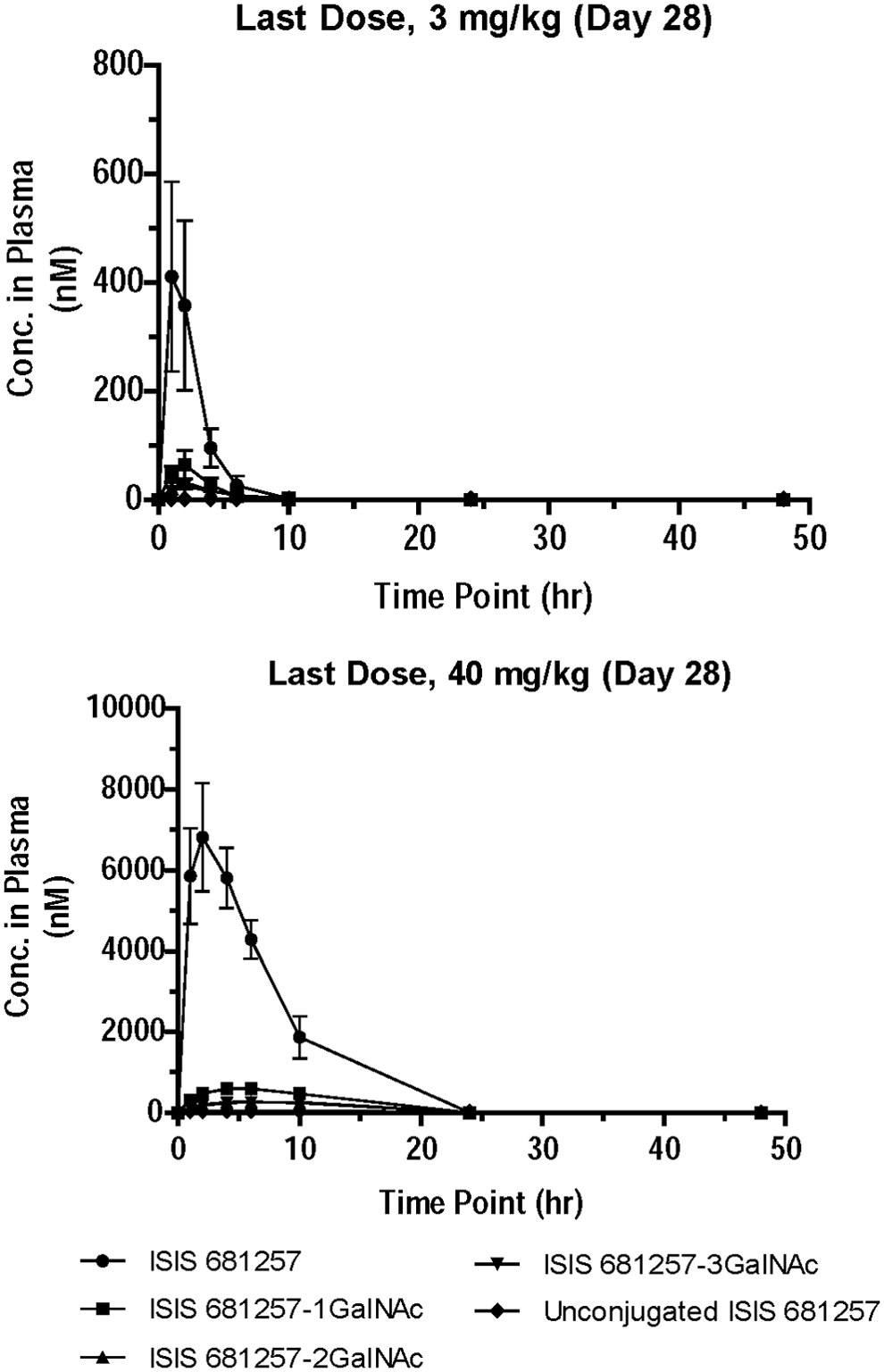
Plasma Concentration-Time Profiles of Fully Conjugated, Partially Conjugated (with 1, 2, or 3 Sugar Deletions), and Unconjugated ISIS 681257 following Repeated Subcutaneous Injections of 3 and 40 mg/kg ISIS 681257 in monkeys.
Toxicokinetics and metabolism in tissues
Following SC administrations, ISIS 681257 distributed extensively to kidney cortex and liver in monkeys (Table 2). No gender difference in tissue exposure was observed in monkeys, and thus, tissue concentrations were summarized with gender combined in monkeys. Mean total full-length ASO concentrations in monkey kidney cortex and liver were dose dependent throughout the administered dose range after SC administration. However, ASO concentrations in liver increased less than dose proportionally over the entire 40-fold dose range studied, reflecting saturation of liver uptake at higher dose levels. Nonetheless, ASO concentrations in kidney cortex increased near dose proportionally over the 40-fold dose range (Table 2). After a 12-week recovery period, 9% to16% of oligonucleotide remained in tissues, consistent with tissue half-life of approximately 30 days (Table 2).
Values are presented as mean ± standard deviation (N = 4–6).
BLQ = below the lower limit of quantitation (LLOQ = 10 μg/g).
The only full-length oligonucleotide species observed in monkey tissues (kidney cortex and liver) at 48 h post dose or at the end of recovery is the unconjugated ISIS 681257, which accounted for nearly 100% of total full-length oligonucleotide. Concentrations of fully and partially conjugated ISIS 681257 were below the lower limit of quantitation in all the samples examined (< 50 nM). No ISIS 681257 metabolites associated with 1, 2, or 3 sugar deletions were detected in all the tissue samples examined. These data suggested that the 5'-trishexylamino-(THA)-C6-GalNAc3 conjugate on ISIS 681257 was rapidly metabolized once distributed to tissues, releasing the unconjugated ASO to exhibit its pharmacologic effect. Indeed, greater than 95% of administered dose associated with THA-C6-GalNAc3 was recovered in excreta (feces and urine) within 24 h in a rat mass balance study with 14 metabolites identified, and the same metabolite series were also found in fecal samples from monkeys treated with 12 mg/kg ISIS 681257 [23].
Finally, full-length oligonucleotides (primarily unconjugated ISIS 681257) were detected at 48 h after repeated administrations and accounted for >80% total detected oligonucleotide. A low abundance of shortmer oligonucleotides associated with nuclease-mediated metabolism was detected in tissues following repeated administrations for over 4 weeks (Fig. 4).
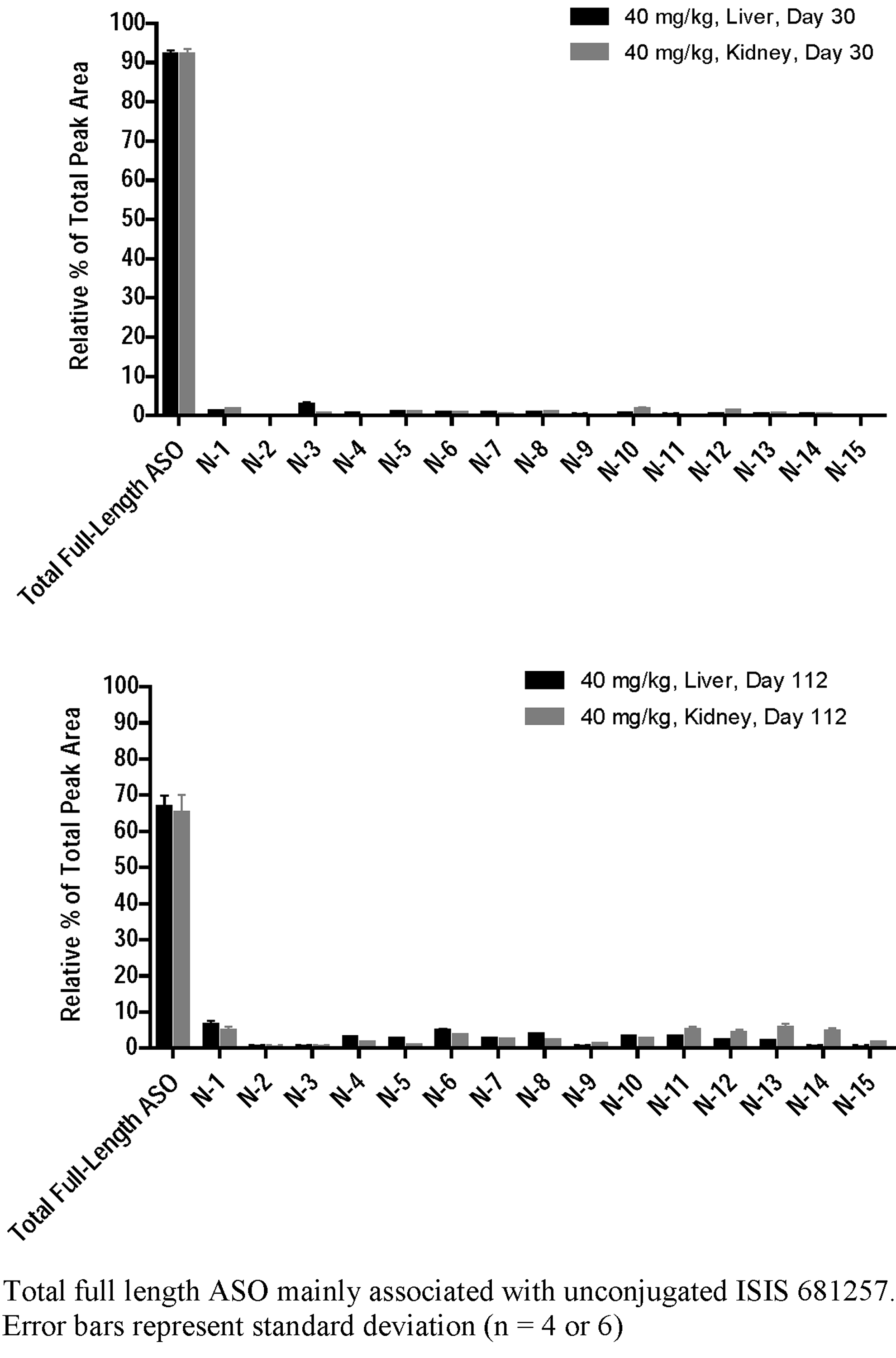
Mean Relative Percent of Unconjugated ISIS 681257 (Full-Length) and Shortmer Metabolites in Liver and Kidney Cortex at 48 h (day 30) and 84 days (day 112) following 4 weeks of treatment of 40 mg/kg/week ISIS 681257 in monkeys.
Urinary elimination
Urinary excretion of total full-length ASO accounted for only a small percentage of the administered dose, with ≤1.5% excreted in urine within each of the 24 h collection periods following the SC administration of 1 mg/kg ISIS 681257 for 4 weeks (Table 3). Urinary excretion increased to 10% for the 0–24 h collection and 3.5% for the 24–48 h collection following 12 mg/kg dose, indicative of increased glomerular filtration and/or reduced reabsorption. Consistent with this, the most abundant species excreted in urine was the unconjugated ISIS 681257 following 1 mg/kg dose, while the intact ISIS 681257 was the major full-length oligonucleotide species in urine following the 12 mg/kg dose.
Values are presented as mean ± standard deviation (N = 4).
Concentrations that were used to calculate % Dose Excreted were treated as “0” if the value was below the LLOQ of the HPLC-MS/MS method (LLOQ = 0.01 μM).
Plasma protein binding
The extent of in vitro protein binding of ISIS 681257 in whole monkey plasma was 98.34% ± 0.10% and 97.21% ± 0.06%, when evaluated at 5 and 150 μg/mL ISIS 681257, respectively.
Population pharmacokinetic modeling
Due to the lack of data during the absorption phase and the first sampled data were around Tmax, Ka was fixed at 5.0 h−1. A three-compartment pharmacokinetic model with Michaelis–Menten uptake from plasma to liver (Q4), first order elimination from plasma (CLp) and liver (CLliv) compartment, and body weight as a scaling factor for the pharmacokinetic parameters best described the monkey drug distribution profile (Table 4). An interindividual variability (IIV) was implemented on the plasma volume. Additional IIV did not improve the model fit. Since the range of plasma concentration was more than four orders of magnitude, both the plasma and the liver concentration data were log transformed and an additive error model was used. The goodness-of-fit plots for plasma and liver data are shown in Supplementary Figs. S1 and S2 (Supplementary Data are available online at www.liebertpub.com/nat).
RSE, relative standard error of estimate; NA, not applicable; IIV, interindividual variability.
Model evaluation
The robustness and precision of the final model parameter estimates were confirmed by the 95% confidence intervals from the bootstrap results (Supplementary Table S1). The final model parameter estimates were consistent with the median of the nonparametric bootstrap result. Visual predictive check plots (1000 simulations), stratified by the dose administered, for the different sampling occasions are shown in Supplementary Fig. S3. The 5th, 50th, and 95th percentiles of the simulations (black) were consistent with the 5th, 50th, and 95th percentiles of the observed data (red). In addition, the observed data (blue circles) were well within 90% of the prediction interval. This supports the adequacy of the model and its suitability to investigate alternative dosing regimens using simulation.
Discussion
ISIS 681257 is a 2′-MOE mixed backbone ASO conjugated through a trishexylamino-C6 (THA) cluster with GalNAc3, a high affinity ligand to a receptor in hepatocytes (16). The GalNAc3-THA cluster has a molecular weight of approximately 1520 Da, which is approximately 21.4% of the unconjugated ASO (7117 Da). Oligonucleotides detected in monkey plasma were mostly in intact conjugated form (GalNAc3-THA-ASO), which facilitated the ASGPR-mediated uptake into hepatocytes. Once internalized, the GalNAc sugars and the THA cluster were rapidly cleaved from GalNAc3-conjugated ASOs within minutes to a few hours. Thus, the unconjugated ASOs were almost exclusively full-length oligonucleotide within the liver by 48 h after dosing. Furthermore, it is believed that only the unconjugated ASOs exhibit the pharmacological effects. Therefore, it was hypothesized that ISIS 681257 acted as a prodrug to facilitate uptake into hepatocytes and rapidly converted to active drug (unconjugated ASO) once internalized. Unconjugated ASO, the MOE-modified second-generation ASO, was free to interact with the target mRNA and then be slowly metabolized using nuclease-mediated metabolic pathway with elimination over several weeks [1,17,18].
Following SC administration, ISIS 681257 was rapidly cleared from plasma with MRT in 3–6 h. This rapid plasma clearance was attributed to efficient uptake into tissues, primarily within hepatocytes. ISIS 681257 was highly bound to plasma proteins, which limited glomerular filtration and urinary excretion. Plasma clearance was dose dependent and was more rapid at the low clinically relevant doses, suggesting a more rapid and greater distribution/uptake to liver, which was supported by the higher percentage of the administered dose observed in liver at lower dose levels. These results were consistent with the high affinity, but saturable ASGPR-mediated hepatocyte uptake [11]. This nonlinear kinetics in observed plasma and liver was adequately described using a nonlinear population pharmacokinetic model, with saturable Michaelis–Menten uptake from plasma to liver.
No significant metabolism of the conjugate or the naked ASO in plasma was observed because of rapid distribution to tissue (primarily liver), supporting the intended ASGPR receptor-mediated hepatic uptake mechanism. Once in tissues, GalNAc sugars were rapidly removed from the molecule with half-life in minutes, releasing unconjugated ISIS 681257, which binds to target mRNA to exhibit its pharmacological effect. While fully conjugated ASOs represented the primary circulating component in plasma at the first 2 days following SC dosing, the unconjugated ISIS 681257 appeared to be the major circulating species at later times, although several orders of magnitude lower than the parent ISIS 681257 peak concentrations in plasma. The parallel elimination phase and similar terminal elimination half-lives of unconjugated ASOs in plasma and tissues (liver and kidney) suggested that there was equilibrium between plasma and tissues for unconjugated ASOs; thus, plasma elimination could be used as a surrogate for tissue elimination of the active unconjugated ASO species, and postdistribution plasma concentrations could be used to estimate target tissue liver concentrations.
The low urinary excretion rate of ISIS 681257 was consistent with tissue uptake being the primary mechanism of plasma clearance. The primary route of elimination of this chemical class is through nuclease-mediated metabolism in tissues. Once generated, these chain-shortened metabolites were rapidly eliminated in urine due to reduced binding to tissue and plasma proteins [1]. As with other 2′-MOE ASOs, unconjugated ISIS 681257 was slowly metabolized through nuclease-mediated metabolism to shortened metabolites. Because nuclease metabolism was the rate limiting step, no shortmer metabolites accumulated within tissues or plasma. Due to being less bound to plasma proteins, the shortened endonucleolytic products were rapidly eliminated in urine [5,17].
The use of population mixed-effects modeling allowed the inclusion of body size as a covariate, which would enable simulations of FIH PK profiles and exposures if needed. The final model parameters were consistent with the nonparametric bootstrap results, demonstrating that the population pharmacokinetic model was sufficiently robust. The model estimated half-life in plasma and liver tissue was approximately 30 days, which was consistent with the estimates obtained from noncompartmental analysis. The model also predicted a high liver uptake from plasma (Vmax/Km ∼1.17 L/h), which was greater than 10-fold higher than plasma clearance (0.142 L/h). This finding was consistent with the known pharmacokinetics and mode of disposition of ISIS 681257.
In summary, ISIS 681257, a GalNAc3-conjugated ASO, demonstrated unique and favorable prodrug-like pharmacokinetic and disposition profiles following SC administration in monkeys. The pharmacokinetics of ISIS 681257 was characterized by rapid distribution of the fully conjugated ASO into tissues, resulting in the highest concentrations in liver, the target organ for pharmacology, and the kidney. Once distributed within tissues, the GalNAc sugars and THA cluster on ISIS 681257 were rapidly cleaved within minutes to hours, leaving the fully unconjugated form as the only full-length oligonucleotide detected in tissues at 48 h after dosing. Unconjugated ISIS 681257 was cleared slowly from tissues with a half-life of approximately 30 days, consistent with the long elimination half-life in plasma. These favorable pharmacokinetic properties for ISIS 681257 support further development in humans and serve as model compound for development of other drug candidates in this chemical class.
Footnotes
Acknowledgments
The authors thank Drs. Brenda Baker, Dan Norris, and Ken Luu for their scientific discussion and critical review of the article. Finally, this article would not be possible without the administrative support provided by Robert Saunders, for whom we are grateful.
Author Disclosure Statement
All the authors are employees and/or stockholders in Ionis Pharmaceuticals, Inc.
References
Supplementary Material
Please find the following supplemental material available below.
For Open Access articles published under a Creative Commons License, all supplemental material carries the same license as the article it is associated with.
For non-Open Access articles published, all supplemental material carries a non-exclusive license, and permission requests for re-use of supplemental material or any part of supplemental material shall be sent directly to the copyright owner as specified in the copyright notice associated with the article.
