




Abstract
It is well documented and generally accepted that human clearance (CL) of unconjugated single-strand antisense oligonucleotides (ASOs) can be directly predicted from monkeys by body weight (BW) on a mg/kg dose basis. However, the scaling for triantennary N-acetyl galactosamine (GalNAc3)-conjugated ASOs has not been fully established. In this study, we retrospectively analyzed pharmacokinetic data from 9 GalNAc3-conjugated and 12 unconjugated single-stranded ASOs (ten 2′-methoxyethyl and two 2′, 4′-constrained ethyl ASOs) to identify an appropriate allometric scaling factor between the two species. In addition, we compared the trough plasma concentrations (Ctrough, a surrogate for tissue exposure) between monkeys and humans at comparable dose levels, aiming at predicting tissue distribution in humans from monkeys. Overall, the median plasma CL ratios (monkey CL/human CL) were 1.05 and 0.94 when CL was normalized by BW, as compared with 0.33 and 0.29 when CL was normalized by body surface area (BSA) for the 12 unconjugated and 9 GalNAc3-conjugated ASOs, respectively. Similarly, the median Ctrough ratios (Ctrough in monkeys/Ctrough in humans) were 0.96 and 1.71, respectively, when Ctrough was normalized by mg/kg dose as compared with 3.10 and 5.50 when Ctrough was normalized by mg/m2 dose for the same unconjugated and conjugated ASOs, respectively. Equivalent CL and dose-normalized plasma Ctrough between monkeys and humans suggest similar pharmacokinetic profiles and tissue distribution between the two species on a per kilogram BW basis. In conclusion, human CL and plasma Ctrough (a surrogate of tissue distribution) can be directly predicted (1:1 or within twofold) from monkeys by BW on a mg/kg dose basis but these parameters can be under- or over-predicted by BSA on a mg/m2 dose basis. These results provide evidence for single species scaling from monkeys to humans directly and, thus, they can facilitate early human dose prediction in ASO drug development.
Introduction
Single-strand antisense oligonucleotides (ssASOs or referred as ASOs) are a rapidly expanding class of novel RNA-based therapeutics that are generally 16–20 nucleotides in length designed to hybridize and bind to a specific region of RNA. They can be used to target disease-related RNA and eventually modulate expression of the corresponding protein of interest [1]. In comparison to small molecules and therapeutic biologics, ASOs have unique chemical structure and properties, lending them distinctive pharmacokinetic (PK) characteristics. They are well absorbed into the systemic circulation after subcutaneous (SC) administration, are extensively distributed into tissues (especially liver and kidney), have a relatively long half-life (2–4 weeks), and are eliminated via endonucleases and exonucleases mediated degradation [2–5]. Given their distinguishing PK behavior, translational approaches used for small molecules and biologics may not be directly applicable. Early studies have shown that human dose and plasma exposure (area under the curve [AUC]) can be reasonably predicted from body weight (BW) based scaling from either mouse or monkey for unconjugated ASOs [6]. A detailed cross-species comparison of PK properties across mouse, rat, monkey, dog, and human for two 2′-O-methoxyethyl (2′-MOE) ASOs, ISIS 301012, an ASO targeting Human Apolipoprotein B-100 [7], and ISIS 104838, an ASO targeting Tumor Necrosis Factor-α [8], also exhibited that PK of ASOs followed an allometric relationship based on BW and can be predicted for humans from nonclinical species. All the reports cited earlier found monkeys to be a more reliable species to predict human PK for unconjugated ASOs.
Given the number of ASOs in late clinical stage development, especially the increasing number of triantennary N-acetyl galactosamine (GalNAc3) conjugated ASOs, a careful evaluation and comparison of their behavior to unconjugated ASOs in terms of interspecies scaling is warranted. Hence, in this study, we retrospectively analyzed PK data from 9 GalNAc3-conjugated ASOs, together with 12 unconjugated ASOs to identify an appropriate allometric scaling method or scaling factor for prediction of human plasma clearance (CL) or exposure from monkeys. In addition, we also compared trough plasma levels (Ctrough) between monkeys and humans at equivalent dose levels, aiming at understanding the similarity of tissue distribution between monkeys and humans since Ctrough is considered as a surrogate for tissue exposure [3]. Comparing both CL and plasma trough exposure between monkeys and humans would shed light on tissue distribution in humans and help to evaluate (indirectly) whether human tissue exposure can be scaled from monkeys.
Materials and Methods
Test compounds
The length and structure of the ASOs included in this retrospective analysis was similar, with all of them being 16–20 nucleotides in length and single strand in structure (Table 1). The primary difference was the addition of a 5′-trishexylamino-C6GalNAc3 conjugate for 9 of the ASOs whereas the other 12 ASOs were unconjugated ASOs. Although most ASOs evaluated contained 2′-MOE sugar modifications; two of the unconjugated ASOs (ISIS 481464 and ISIS 560131) also contained 2′, 4′-constrained ethyl (cEt) sugar modifications on both the 3′- and 5′-ends referred to as the “wings” of the molecule flanking a central DNA-like region known as the “gap.” A majority of ASOs contained a full phosphorothioate (PS) backbone, whereas six conjugated ASOs (ISIS 681257, ISIS 703802, ISIS 957943, ISIS 766720, ISIS 721744, and ISIS 702843) utilized a mixed backbone with both PS and phosphodiester (PO) linkages on the wings. Table 1 summarizes the target, chemistry, and sequence details of both unconjugated and conjugated ASOs.
Target, Chemistry, and Sequence Summary of Antisense Oligonucleotides Evaluated in This Study
Underline denotes nucleotide with 2′-sugar modification.
All unconjugated ASOs have a full PS backbone whereas conjugated ASOs with * designation have a mixed backbone with PO at a corresponding location in the sequence.
ASO, antisense oligonucleotide; GalNAc3, triantennary N-acetyl galactosamine; MOE, methoxyethyl; cEt, constrained ethyl; PO, phosphodiester; PS, phosphorothioate.
Nonclinical data
Single and multiple dose toxicology/toxicokinetic studies were conducted in male and female cynomolgus monkeys in accordance with good laboratory practice and relevant the International Council for Harmonisation of Technical Requirements for Pharmaceuticals for Human Use and Food and Drug Administration (FDA) guidelines. Typically, a low, mid, and high dose (generally ranging from 1–2 to 40 mg/kg) were tested for each ASO per study and were administered systemically either as a 1-h intravenous (IV) infusion (ASOs ISIS 301012, ISIS 416858, ISIS 505358) or as an SC injection. The lowest doses administered (ie, clinically relevant), ranging from 1 to 4 mg/kg across all studies, were selected and included in this retrospective analysis. The ASOs were typically administered in a loading fashion of four doses given every other day for the first week [except for ASO 416858 that was administered on days 1, 3, and 5 (loading doses) via IV infusion during the first week, followed by additional loading doses on days 7, 9, 11, and 14 via SC injection], followed by once every fourth day (for ASO ISIS 301012 only) or once weekly for the remainder of the treatment spanning up to either 4 (ASOs ISIS 404173 and ISIS 681257), 6 (ASOs ISIS 481464 and ISIS 560131), 13 (ASOs ISIS 301012, ISIS 304801, ISIS 416858, ISIS 420915, ISIS 449884, ISIS 463588, ISIS 484137, ISIS 505358, ISIS 696844, and ISIS 957943), 16 (ASOs ISIS 546254, ISIS 703802, and ISIS 766720), 39 (ASOs ISIS 678354, ISIS 702843, ISIS 721744, and ISIS 757456), or 52 (ASO ISIS 301012) weeks. Blood was generally collected up to 48 h after the first and last dose administration, with additional samples collected before dosing (troughs) as well as during follow-up and it was analyzed for determination of ASO concentration for unconjugated compounds and total ASO (fully, partially, and unconjugated) concentration for conjugated compounds in plasma. All monkey studies were conducted by utilizing protocols and methods approved by the Institutional Animal Care and Use Committee and were carried out in accordance with the Guide for the Care and Use of Laboratory Animals adopted and promulgated by the United States National Institutes of Health.
Clinical data
Phase 1 clinical studies including single ascending dose and multiple ascending dose (MAD) regimens were conducted in healthy volunteers for the majority of ASOs evaluated. Only the two unconjugated ASOs with cEt modifications were administered to patients with relapsed or refractory tumors (ISIS 481464) or advanced solid tumors where the androgen receptor pathway is a potential factor (ISIS 56013). The ASOs (without cEt modifications) were typically administered systemically via SC injection (except ASO ISIS 301012 that was administered via both 1-h IV infusion and SC injection) at dose levels ranging from 50 to 400 mg for unconjugated ASOs and 5–120 mg for conjugated ASOs. The MAD regimens in studies for which unconjugated ASOs were administered typically included a loading dose in the first week on days 1, 3, and 5, followed by once weekly doses thereafter starting on day 8 through day 22 to attain steady state or near-steady state (ISIS 301012, ISIS 304801, ISIS 449884, ISIS 505358, ISIS 546254, ISIS 404173, and ISIS 420915) or day 36 (ISIS 484137, ISIS 416858, and ISIS 463588). The dosing regimen for the two unconjugated ASOs with cEt modifications (ISIS 481464 and ISIS 560131) consisted of 28 day cycles, in which ASO was administered via 1-h IV infusion during a loading period (days 1, 3, and 5 for ISIS 481464 and on days 1, 4, 8, and 11 for ISIS 560131, followed by weekly doses thereafter), at dose levels ranging from 2 to 4 mg/kg (ISIS 481464) and 150–1,150 mg (ISIS 560131). For studies in which conjugated ASOs were administered, MAD regimens varied. One included loading doses in the first week (ISIS 681257), whereas others were spread out over 2 weeks (ISIS 696844 and ISIS 766720). In general, the loading doses were followed by weekly maintenance dosing for up to 4 (ISIS 681257) or 6 (ISIS 696844) weeks. Study designs with no loading period utilized either six weekly (ISIS 678354 (two cohorts), ISIS 703802, ISIS 757456, and ISIS 957943-), four bi-weekly (ISIS 703802), or four monthly (ISIS 678354 (one cohort) and ISIS 721744) dose regimens. Blood was generally collected for up to 24 h after first and last dose administrations, with additional samples collected before dosing (troughs) as well as during follow-up to characterize terminal elimination. Once the blood was processed for plasma, plasma was assayed for ASO concentration for total full-length ASOs (including fully, partially, and unconjugated ASOs). All studies were performed according to the amended Declaration of Helsinki, and all patients provided written informed consent. The protocols for the clinical Phase 1 studies were approved by the relevant independent ethics committees or institutional review boards.
Bioanalytical methods
Plasma samples were analyzed for ASO concentrations by using validated quantitative assays with sufficient sensitivity to measure samples collected later during follow-up (ie, terminal elimination period). In general, monkey samples from unconjugated and conjugated ASO administration as well as human samples from unconjugated ASO administration were analyzed by using a hybridization enzyme-linked immunosorbent assay (ELISA), whereas all human samples from conjugated ASO administration were analyzed by using a hybridization electrochemiluminescence (ECL) method that afforded increased sensitivity at the lower limit of quantitation. Some monkey samples (ASOs ISIS 678354, ISIS 696844, ISIS 703802, and ISIS 721744) for conjugated ASOs were analyzed by using the ECL method. Both monkey and human plasma analyses were conducted based on the principles and requirements described in 21 CRF, part 58. The lower limit of quantitation typically ranged from 1.00 to 2.00 ng/mL for ELISA methods and from 0.0863 to 0.261 ng/mL for ECL methods, whereas the upper limit of quantitation ranged from 75.0 to 200 ng/mL for ELISA methods and from 86.3 to 261 ng/mL for ECL methods.
PK analysis
Non-compartmental analysis (NCA) was conducted to estimate plasma CL values for both monkeys and humans by using WinNonLin Professional 4.0 or higher for the older unconjugated compounds, and Phoenix WinNonLin 6.0 or higher in the newer conjugated compounds (Pharsight, Mountain View, CA). CL and Ctrough were summarized by using descriptive statistics.
Interspecies scaling from monkeys to humans for CL prediction
The CL values used in this analysis for both monkeys and humans were obtained from the NCA analysis of plasma concentration data after single as well as multiple doses as described earlier. Human CL values were averaged across the dose level and regimens to obtain a single value for comparative purposes. To maintain consistency across the different ASOs (including both unconjugated and GalNAc3 conjugated ASOs), CL values at 24 or 48 h post the first dose were used for monkeys and CL values at 24 h post the first dose or at steady state (after multiple doses) were used for humans. It is known from the plasma disposition of ASOs that there is no accumulation post multiple doses (between the first and last dose) and the AUC is similar for 24- and 48-h post-dose due to rapid and near complete distribution in the first 24 h post-dose for both monkeys and humans [4,6]. Hence, the use of NCA-based CL values (CL = dose/AUC) at either 24 or 48 h for the purpose of this analysis was considered appropriate. For scaling of CL from monkeys to humans, a single-species allometric approach was adopted as detailed by Equation (1):
Conventionally, the allometric exponent “b” is generally assumed to be 0.75 or 0.67 for interspecies extrapolation of CL or human mg/m2 equivalent dose [human equivalent dose (HED)] prediction for small-molecule drugs [9]. For ASOs, however, it has been previously reported that the allometric exponent b is close to 1 for unconjugated ASOs [2,4]. Thus, when human and monkey CL values are normalized by their respective BW and b = 1, the human CL will be equal to monkey CL n, that is, their ratio will be equal to 1.
The CL normalized by body surface area (BSA) (L/h/m2) was also compared between monkeys and humans. In addition, correction factors using liver blood flow [10] and maximum life-span potential [11] were also tested for scaling of CL from monkeys to humans and for comparison to the rest of the approaches described earlier.
Comparison of plasma Ctrough between monkeys and humans
For monkeys, it has been previously reported that plasma and tissue concentrations profiles are in equilibrium in the post-distribution phase (including plasma Ctrough); thus, plasma concentrations can be used as a surrogate for tissue exposure [3]. In this study, plasma trough concentrations were available from multiple dose studies in both monkeys and humans, and thus compared directly at relevant or equivalent dose levels. For both humans and monkeys, the Ctrough values were the predose concentrations before the last dose or approximately one dosing interval post the last dose of the multiple dose study. Given the half-life of ASOs (2–4 weeks in both monkeys and humans [4,6]) and the loading doses administered in clinical and some nonclinical studies as well as a longer duration of treatments in the monkey studies (13 weeks mostly), steady-state Ctrough concentrations were likely attained in all clinical and monkey studies. For an appropriate comparison, all Ctrough values for humans and monkeys were dose-normalized with their respective doses (mg/kg and mg/m2) and then averaged to obtain a single value. In monkeys, only the low doses (1–4 mg/kg) were included, which are more clinically relevant and, to minimize effects, if any, due to PK non-linearity.
Data analysis and prediction evaluation
In monkeys, the CL is reported as L/h/kg since the ASOs were administered based on the BW of the animals, whereas in humans the CL is reported as L/h since a flat dose was used in all clinical studies. For monkeys and humans, typical BW and BSA values of 3 and 70 kg and 0.25 and 1.8 m2, respectively, were used to align CL units for appropriate comparison Similarly, plasma trough concentrations (Ctrough) were normalized by using mg/kg and mg/m2 doses for appropriate comparison between monkeys and humans.
The prediction of human CL and exposure (Ctrough) from monkeys was evaluated in terms of ratio, as defined next:
where [Predicted] is the predicted human CL from single-species allometric scaling, observed monkey CL normalized by mg/m2 or average dose-normalized monkey Ctrough and [Observed] is the observed and reported human CL, observed human CL normalized by mg/m2 or average dose-normalized Ctrough respectively. A prediction ratio of 1 would indicate exact 1:1 prediction whereas a ratio of 0.5 and 2.00 would indicate twofold under- and over-prediction, respectively. Values in the range of 0.5–2.00 would be considered generally acceptable for interspecies scaling predictive purposes.
Results
A total of 9 GalNAc-conjugated 2′-MOE modified ASOs and 12 unconjugated ASOs, including ten 2′-MOE and two cEt modified ASOs that had both monkey and human PK data available, were included in the analysis (Table 1). Only ASOs administered systemically (ie, SC and IV administration) were included in this analysis; intrathecal and locally administered ASOs were not included to maintain consistency of observed PK characteristics. In addition, most ASOs had liver targets except for the two cEt ASOs that target extrahepatic organs. Three targets (APOCIII, FXI, and PKK) overlapped between the unconjugated and conjugated ASOs, with the conjugated ASOs (ASOs ISIS 678354, ISIS 957943, and ISIS 721744) being the GalNAc3 conjugated versions of their respective parent unconjugated ASOs (ie, having the same sequence as ASOs ISIS 304801, ISIS 416858, and ISIS 546254).
The range of dose levels was similar for the unconjugated ASOs, ∼1–4 mg/kg in monkeys and 100–400 mg (∼1–5 mg/kg) in humans (Tables 2 and 4). This is a consequence of lower effective clinical doses for the GalNAc3-conjugated ASOs than the unconjugated ASOs because of the improved hepatocyte uptake [4,12]. Also as summarized in Tables 3 and 5, for the conjugated ASOs, the range of dose levels was slightly higher in monkeys, ∼2–4 mg/kg compared with doses in humans that ranged from 10 to 80 mg (∼0.15–1 mg/kg assuming average human BW of 70 kg).
Summary of Observed Clearance in Monkeys and Humans for Unconjugated Antisense Oligonucleotides with Prediction Ratios for Clearance Normalized by Body Weight (Per kg) and Body Surface Area (Per m2)
Monkey CL is expressed as L/h/kg and human CL as L/h, as reported in the original studies.
Monkey data are from a low-dose group in Tox studies (3–4 mg/kg except for one at 1 mg/kg).
Average human and monkey body weight was assumed to be 70 and 3 kg, respectively, and body surface area was assumed to be 1.8 and 0.25 m2, respectively.
CL, clearance; CV%, coefficient of variation; SD, standard deviation; NA, not applicable.
Summary of Observed Clearance in Monkeys and Humans Triantennary N-Acetyl Galactosamine Conjugated Antisense Oligonucleotides with Prediction Ratios for Clearance Normalized by Body Weight (Per kg) and Body Surface Area (Per m2)
Monkey CL is expressed as L/h/kg and human CL as L/h, as reported in the original studies.
Average human and monkey body weight was assumed to be 70 and 3 kg, respectively, and body surface area was assumed to be 1.8 and 0.25 m2, respectively.
Summary of Dose-Normalized Trough Concentrations in Monkeys and Humans for Unconjugated Antisense Oligonucleotides with Monkey/Human Trough Ratios for Troughs Normalized by mg/kg Dose and mg/m2 Dose
Average human and monkey body weight was assumed to be 70 and 3 kg, respectively, and body surface area was assumed to be 1.8 and 0.25 m2, respectively.
Summary of Dose-Normalized Trough Concentrations in Monkeys and Humans for Triantennary N-Acetyl Galactosamine Conjugated Antisense Oligonucleotides with Monkey/Human Trough Ratios for Troughs Normalized by mg/kg Dose and mg/m2 Dose
Average human and monkey body weight was assumed to be 70 and 3 kg, respectively, and body surface area was assumed to be 1.8 and 0.25 m2, respectively.
NC, not calculated.
Prediction of human CL from monkeys
As summarized in Tables 2 and 3 and Fig. 1A and B, for the dose range tested, the 12 unconjugated ASOs had comparable CL values ranging from 0.040 to 0.115 L/h/kg in monkeys and from 2.74 to 6.27 L/h (0.039–0.090 L/h/kg assuming average human BW of 70 kg) in humans. No apparent difference in CL was observed between unconjugated 2′-MOE (mean CL values of 0.075 L/h/kg for monkeys and 4.63 L/h for humans [0.066 L/h/kg assuming average human BW of 70 kg]) and cEt ASOs (mean CL values of 0.048 L/h/kg for monkeys and 3.44 L/h for humans [0.049 L/h/kg assuming average human BW of 70 kg]), though the sample size was smaller for cEt ASOs. Similarly, the 9 conjugated 2′-MOE ASOs had comparable CL values ranging from 0.243 to 0.433 L/h/kg in monkeys and 11.3 to 32.4 L/h (0.161–0.463 L/h/kg assuming an average BW of 70 kg) in humans (Table 3). Overall, GalNAc3-conjugated ASOs had ∼5-fold higher CL than unconjugated ASOs in both monkeys and humans, which was most likely due to their more rapid uptake into hepatocytes via Asialoglycoprotein receptor-mediated endocytosis. The median monkey to human CL ratio for all ASOs was close to 1, 1.05, and 0.94 for unconjugated and conjugated ASOs, respectively. These results support BW-based scaling with an allometric exponent of 1 for both GalNAc3-conjugated and unconjugated ASOs. A plot of human CL versus monkey CL normalized by BW combining both unconjugated and GalNAc3-conjugated ASOs (Fig. 3) also exhibited good correlation (R2 = 0.89). The slope of the regression was also close to 1 (0.916), suggesting the direct prediction of human CL from monkey CL on an mg/kg basis. None of the unconjugated ASOs had a prediction ratio outside the twofold error range of 0.5–2.00, whereas only one conjugated ASO (ISIS 957943) had a slightly higher estimated prediction ratio of 2.09.

Monkey/human CL ratios for unconjugated
However, BSA-based comparison of monkey and human CL led to systematic under-prediction of human CL, with the median prediction ratios being 0.33 and 0.29 for unconjugated and conjugated ASOs, respectively. All ASOs had predicted ratios <0.5, except for two conjugated (ISIS 957943 and ISIS 721744) and one unconjugated (ISIS 301012) ASOs. The coefficient of variation (CV%) for the prediction ratios across the conjugated and unconjugated ASOs for all three methods evaluated was around 30%–40%, suggesting that though some variation is seen across ASOs, overall, they have similar scaling behavior.
Comparison of monkey and human Ctrough
Ctrough was directly compared between humans and monkeys by using dose normalization based on BW as well as BSA. The summary of results for unconjugated and conjugated ASOs is summarized in Tables 4 and 5, respectively, and Fig. 2A and B, respectively. The findings indicated that comparing monkey and human Ctrough values that had been dose normalized by weight (mg/kg) was a better approach (monkey to human Ctrough ratio closer to 1) than comparing values that had been dose normalized by using BSA (mg/mg2) for both unconjugated and conjugated ASOs. The median ratio was 0.96 and 1.71 for unconjugated and conjugated ASOs, respectively, when using BW to dose normalize Ctrough. Only one unconjugated ASO (ISIS 416858) had a slightly higher comparison ratio of 2.06, and three conjugated ASOs (ISIS 703802, ISIS 766720, and ISIS 721744) had ratios of 2.18, 2.50, and 2.58, respectively, which were slightly higher than the upper limit of the twofold error range of 0.5–2.00. A plot of human Ctrough versus monkey Ctrough normalized by mg/kg dose combining both unconjugated and GalNAc3-conjugated ASOs (Fig. 4) also exhibited good correlation (R2 = 0.64). The slope of the regression was close to 1 (1.01), thus also supporting direct prediction of human Ctrough from monkey Ctrough on an mg/kg basis. On the contrary, when comparing monkey and human Ctrough values dose normalized by BSA, the median ratio was 3.10 and 5.54 for unconjugated and conjugated ASOs, respectively, with ratios for all but three unconjugated ASOs (ISIS 304801, ISIS 463588, and ISIS 505358) being above the acceptable twofold error range. The CV% for the comparison ratios across the unconjugated and conjugated ASOs was ∼35%–45%, suggesting that though some variation is seen across ASOs, overall, similar values were observed.

Monkey/human Ctrough ratios for unconjugated
Discussion
The prediction of human CL and exposure from preclinical studies a priori is valuable for human dose prediction during early drug development. Historically, the prediction of human PK parameters with species scaling using body-weight-based allometry has been applied for small molecules [13] and more recently for antibodies [14] and antibody–drug conjugates [15] with varying degrees of success [16]. The scaling exponent has been generally close to 0.75 for small-molecule drugs and close to 1 for large protein drugs. Typically, interspecies scaling can provide reliable human CL prediction for compounds that are renally excreted, or compounds without major differences in metabolism. The ASOs are metabolized by nucleases in tissues, which are similar and highly conserved across species; however, the tissue exposure could vary across species, which may affect the scaling factor. For example, mice often have a much lower (more than 10-fold) exposure in both plasma and tissues than monkeys at equivalent doses (mg/kg), which is likely due to a higher CL and larger volume of distribution (due to their larger organ size relative to their BW) [2–4]. The FDA generally recommends a scaling factor of 12.3 to convert mouse dose in mg/kg to HED in mg/kg [17]. However, it has been shown that, for unconjugated ASOs, a median scaling factor of 7 (mouse:man CL ratio ranging between 5- and 11-fold) for mouse to human scaling works better [6]. On the other hand, monkeys have demonstrated similar plasma CL to humans on an mg/kg basis [6]. This suggests that scaling factors can be species-dependent, and predictions can be performed based on single-species data. However, there is limited information published on how PK parameters for GalNAc3 conjugated ASOs scale across species [4]. Hence in this study, we systematically examined and compared a key PK parameter (CL) and exposure measure (plasma Ctrough) across monkeys and humans for 9 GalNAc-conjugated ASOs and also extended the dataset to include 12 unconjugated ASOs currently in clinical development. Though GalNAc3-conjugated ASOs have higher plasma CL than unconjugated ASOs because of their efficient uptake and distribution to liver (Tables 2 and 3), the scaling for CL from monkeys to humans was the same as unconjugated ASOs, on a 1:1 mg/kg BW basis. In addition, when the two datasets were combined covering the wide CL range, the 1:1 mg/kg scaling relationship was still evident (Fig. 3). The BSA-based scaling led to under-prediction of CL with monkey:human CL ratios of 0.33 and 0.37 for unconjugated and conjugated ASOs, respectively. Other scaling approaches of using an allometric exponent of 0.75 (Supplementary Tables S1 and S2) liver blood flow or maximum life span corrections (Ionis internal data not shown) did not perform better than BW-based scaling with an allometric exponent of 1. The predicted human CL using an allometric equation of 0.75 did show a good correlation (R2 = 0.88) with the observed human CL when all the CL values for unconjugated and GalNAc3-conjugated ASOs were combined (Supplementary Fig. S1). However, there was a systemic under-prediction bias, with the median prediction ratios being 0.48 and 0.43 for unconjugated and conjugated ASOs, respectively (Supplementary Tables S1 and S2). This suggests that though an allometric exponent of 0.75 could potentially provide for a reasonable human CL prediction from monkey with an error slightly >2-fold, a direct 1:1 scaling on an mg/kg basis (ie, an allometric exponent of 1) leads to a more accurate prediction (median prediction ratios of 1.05 and 0.94 for unconjugated and GalNAc3-conjugated ASOs, respectively). Thus, using an exponent of 1 instead of the conventional 0.75 will, consequently, allow for more accurate first-in-human or therapeutic dose projections for ASOs of similar chemistry. A similar scaling relationship with exponents deviating from 0.75 has also been observed for large molecules such as antibodies [14] and antibody–drug conjugates [15] (with scaling exponents being 0.85 and 1, respectively). Although ASOs have a smaller molecular size than these biomolecules, their molecular weight (MW, 7,000–9,000 Da) is much greater than small molecules (<500 Da). Hence, it is not surprising that ASOs that have distinct molecular and PK properties from small molecules have a different inter-species scaling relationship. Similar mechanisms of metabolism in tissues via nucleases, which are well conserved across species, would support BW-based scaling from animals to humans.
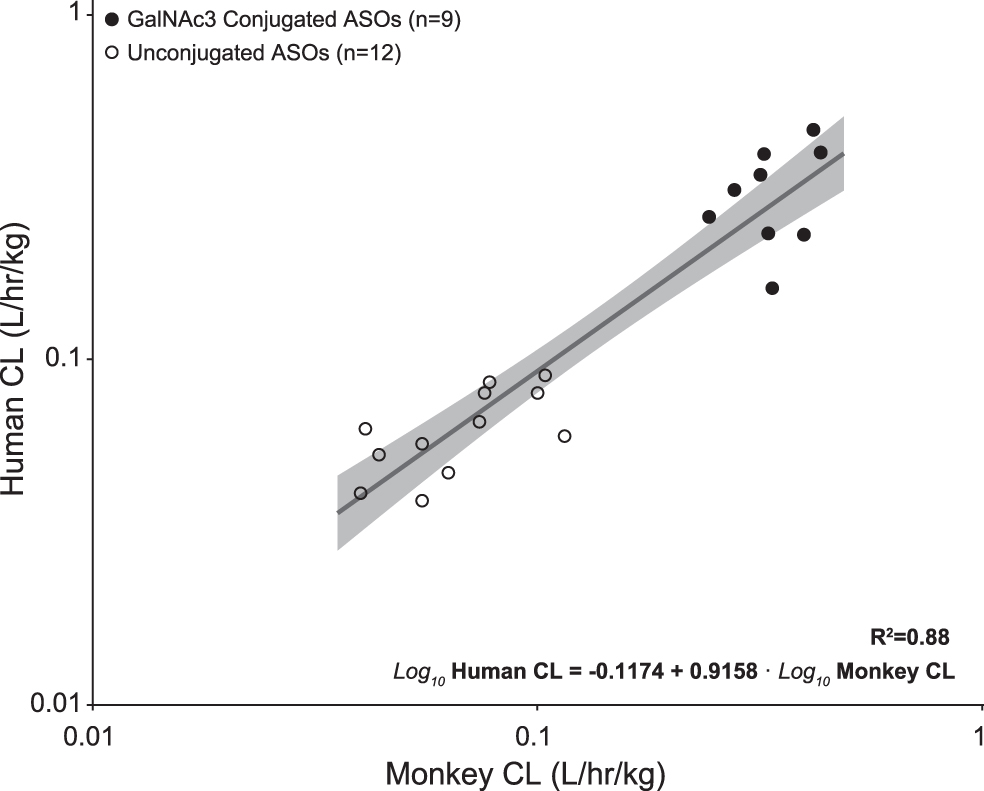
Correlation between body weight normalized monkey and human CL for unconjugated and conjugated ASOs combined. Open and closed symbols represent individual CL values on a per-kilogram basis for unconjugated and GalNAc3 conjugated ASOs, respectively; line represents the linear regression (R2 = 0.88) of them combined; and the shaded gray band represents 95% confidence intervals of the regression fit.
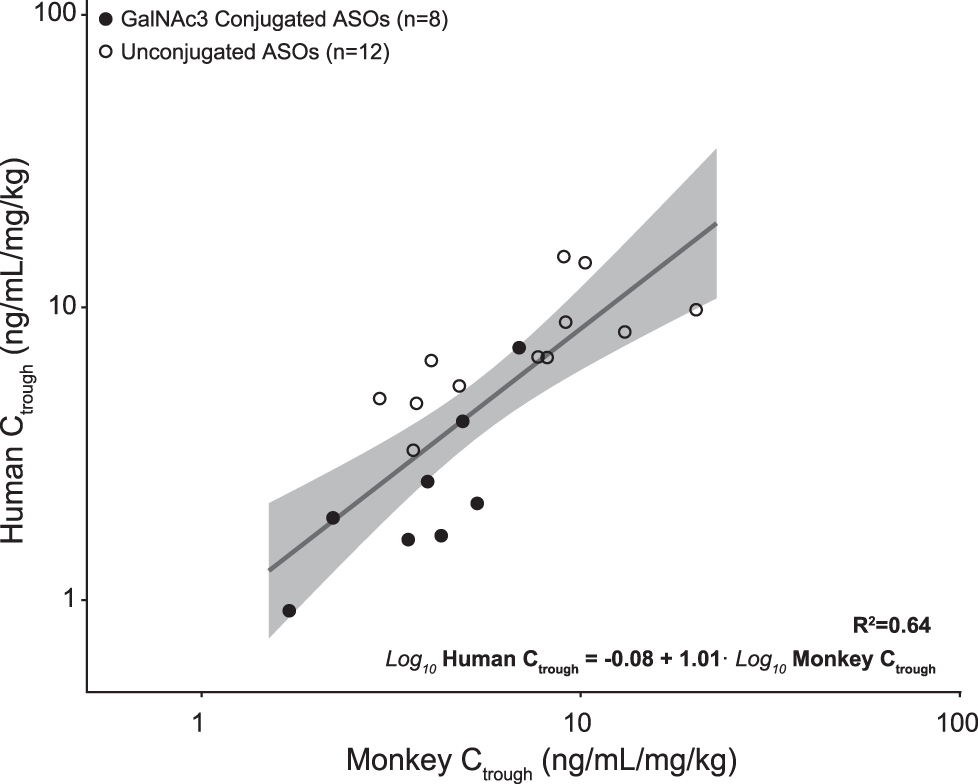
Correlation between milligram/kilogram dose normalized monkey and human Ctrough for unconjugated and conjugated ASOs combined. Open and closed symbols represent individual Ctrough values on a milligram/kilogram basis for unconjugated and GalNAc3 conjugated ASOs, respectively; line represents the linear regression (R2 = 0.64) of them combined; and the shaded gray band represents 95% confidence intervals of the regression fit.
Although the scaling factors are similar between large protein drugs and ASOs, their distribution characteristics are very different, in that large biomolecules (MW generally >150 kDa) have limited tissue distribution, whereas ASOs distribute extensively to tissues warranting scaling at the tissue concentration level. The translation of tissue exposure between animals and humans is important in the context of both efficacy and several safety considerations, such as accumulation in the kidney. Scaling of tissue exposure is not always feasible because of the inability or challenges in measuring tissue concentrations in humans. It has been shown in mice and monkeys for both GalNAc3-conjugated and unconjugated ASOs that plasma concentrations in the post-distribution phase are in equilibrium with tissue exposure [3,4]. Cumulative data suggest that the liver/plasma ratio is similar between mice and monkeys and across multiple ASOs (∼5,000-fold for unconjugated ASOs) [3]. Because of the more efficient receptor mediated uptake in hepatocytes, the liver/plasma exposure ratio can be as high as 32,000-fold for GalNAc3-conjugated ASOs [4]. Thus, human tissue concentration can be estimated based on plasma trough level, assuming the same tissue/plasma distribution ratio between monkeys and humans. This assumption cannot be directly validated without human tissue data. However, due to the observed similar CL and plasma trough concentrations between monkeys and humans, and with CL (or terminal half-life) and tissue distribution being the two main determinants of the trough concentrations, a similar tissue exposure or tissue/plasma ratio between monkeys and humans can be expected. The exposure–response correlation analysis for mipomersen, a second-generation unconjugated ASO targeting apolipoprotein B-100, across species also indicates that ASOs generally have similar tissue/plasma concentration ratios across species. Mipomersen showed a reduction in liver ApoB mRNA (target) levels in mice and monkeys and serum ApoB (plasma biomarker) in mice, monkeys, and humans, which were well correlated with both ASO liver concentrations and plasma trough concentrations, respectively [18]. A consistent rank order between liver EC50 and plasma EC50 values was also observed, further supporting the use of plasma trough exposures as a surrogate for tissue exposures and their subsequent application in deriving PK/pharmacodynamic relationships with tissue targets.
Since Ctrough level is a surrogate for tissue exposure, the interspecies scaling relationships for tissue concentrations can be estimated based on trough levels. When comparing plasma trough concentrations between monkeys and humans for unconjugated ASOs, the dose range was similar (1–4 mg/kg in monkeys vs. 1–5 mg/kg in humans) and the dose normalized monkey/human Ctrough ratio was closer to 1 (median 0.96, range 0.61–2.06). It was noted that for GalNAc3-conjugated ASOs, the monkey/human Ctrough ratio seemed to be slightly higher than 1 (median 1.71, range 0.95–2.58). This could likely be due to nonlinear PK [4] and 4- to 13-fold differences in doses evaluated between monkey (2–4 mg/kg) and human studies (0.15–1 mg/kg). Nonetheless, the monkey to human Ctrough ratio was still within a twofold error after mg/kg dose-normalization, suggesting a good prediction of trough plasma exposure and tissue exposure in humans for both unconjugated and GalNAc3-conjugated ASOs. In contrast, BSA-normalized human trough exposure and tissue exposure would be over-predicted from monkey data. The median monkey to human Ctrough ratios were 3.10 and 5.54, respectively, being well above the acceptable 2.00 prediction ratio for both unconjugated and GalNAc3-conjugated ASOs (Tables 4 and 5). These data indicate that using BSA scaling could potentially result in over-estimation of tissue exposure.
Although this study provides meaningful insights into the translation of ASO CL from monkeys to humans, there are certain limitations with the dataset, for example, different dose levels, dose schedules, and study duration, which could introduce some inter-ASO/inter-study variability into the findings. We addressed this, in part, by dose-normalizing concentrations for Ctrough comparisons and using the CL value at a similar timepoint for all the ASOs. Another source of variability is the use of average BW and BSA for both monkeys and humans instead of their individual values across different studies. In addition, we did average human CL values across dose levels under the assumption of linear PK; however, there could be some non-linearity in human PK at high doses though the impact of nonlinear PK on CL estimate was considered to be small considering the relatively narrow dose range tested in most of the clinical studies. In monkeys, only PK data from the lowest dose group were used due to saturation of distributional CL to tissues in high doses [4]. However, for GalNAc3-ASOs the doses used in monkeys were still 4- to 13-fold higher than those used in clinical studies, which was probably the main reason for slightly over-estimated monkey/human trough concentration ratios as discussed earlier. Nonetheless, the averaged CL values do reflect the CL values at or close to clinically relevant dose levels and exposures for unconjugated ASOs. In addition, caution should be exercised in using plasma trough concentration as a surrogate for tissue exposure as values could be influenced or elevated in the presence of antidrug antibodies that could emerge over 2–3 months of treatment in both monkeys and humans [4,19]. Lastly, instead of the traditional three species scaling, we only examined one species scaling for the prediction of human PK parameters. Nevertheless, our results indicate that the monkey is a good species for the prediction of human CL and tissue distribution, and hence it can be used for the prediction of first-in-human doses at early stages of ASO development.
In summary, the analysis based on this study of 12 unconjugated and 9 conjugated ASOs demonstrates that allometric scaling using monkey as a single species and an exponent of 1 is appropriate for the prediction of human ASO CL and tissue distribution. Human CL can be well predicted from monkey CL by using BW for both GalNAc3-conjugated and unconjugated 2′-MOE or cEt ASOs. In addition, similar plasma trough (Ctrough) concentrations between monkeys and humans after an mg/kg dose-normalization suggest that comparable tissue distribution would be achieved between monkeys and humans for both GalNAc3-conjugated and unconjugated ASOs. The ASO human PK can, thus, be well predicted from monkey data alone based on a 1:1 mg/kg basis.
Footnotes
Acknowledgments
The authors wish to thank Ms. Angela Colabucci for her administrative support and Ms. Tracy Reigle and Ms. Wanda Sullivan for their graphic and art support.
Author Disclosure Statement
All authors are employees of Ionis Pharmaceuticals, Inc., and hold stock in the company.
Funding Information
This work was supported by Ionis Pharmaceuticals; no funding was received.

References
Supplementary Material
Please find the following supplemental material available below.
For Open Access articles published under a Creative Commons License, all supplemental material carries the same license as the article it is associated with.
For non-Open Access articles published, all supplemental material carries a non-exclusive license, and permission requests for re-use of supplemental material or any part of supplemental material shall be sent directly to the copyright owner as specified in the copyright notice associated with the article.
