




Abstract
Most experimental models of spinal cord injury (SCI) in rodents induce damage in the thoracic cord and subsequently examine hindlimb function as an indicator of recovery. In these models, functional recovery is most attributable to white-matter preservation and is less influenced by grey-matter sparing. In contrast, most clinical cases of SCI occur at the lower cervical levels, a region in which both grey-matter and white-matter sparing contribute to functional motor recovery. Thus experimental cervical SCI models are beginning to be developed and used to assess protective and pharmacological interventions following SCI. The objective of this study was to characterize a model of graded cervical hemicontusion SCI with regard to several histological and behavioral outcome measures, including novel forelimb behavioral tasks. Using a commercially available rodent spinal cord impactor, adult male rats received hemicontusion SCI at vertebral level C5 at 100, 200, or 300 kdyn force, to produce mild, moderate, or severe injury severities. Tests of skilled and unskilled forelimb and locomotor function were employed to assess functional recovery, and spinal cord tissue was collected to assess lesion severity. Deficits in skilled and unskilled forelimb function and locomotion relating to injury severity were observed, as well as decreases in neuronal numbers, white-matter area, and white-matter gliosis. Significant correlations were observed between behavioral and histological data. Taken together, these data suggest that the forelimb functional and locomotor assessments employed here are sensitive enough to measure functional changes, and that this hemicontusion model can be used to evaluate potential protective and regenerative therapeutic strategies.
Introduction
In an effort to better model lower cervical SCI, there has been a recent increase in the development of new experimental cervical SCI models (Anderson et al., 2005; Gensel et al., 2006; Pearse et al., 2005). An advantage to using lower cervical SCI models is that these models enable the evaluation of novel therapeutic interventions in highly skilled behavioral tasks such as grasping and reaching that are assessable only in the forelimbs. Rats have prehensile forepaws and can make independent digit movements when reaching and grasping that are similar to those used by primates (Whishaw and Gorny, 1994;Whishaw et al., 1992;). Indeed, motor circuitry is highly conserved across mammalian species, and detailed maps of motor neuron pools in the gray matter, as well as the specific white-matter tracts involved in control of forelimb muscles have been elegantly detailed in rats (Anderson et al., 2005, 2007; Liang et al., 1991; McKenna et al., 2000; Rouiller et al., 1993), making the relationship between tissue preservation and reaching/grasping behaviors after cervical SCI more easily interpreted. Moreover, functional analysis of skilled forelimb movements in rats has been widely used as a model system for several neurological diseases (Muir and Webb, 2000; Webb and Muir, 2005), and many studies have shown that analysis of reaching/grasping relates to tissue damage in rodent models of cervical SCI (Muir et al., 2007; Schrimsher and Reier, 1992, 1993). Analysis of unskilled (spontaneous) forelimb use such as forelimb grip strength and forepaw placement tasks are also highly correlated with tissue preservation in both the gray and white matter after cervical SCI (Muir et al., 2007). Locomotion can also be skilled (i.e., over a rope or ladder), or unskilled (over flat ground), and cervical SCI produces distinct deficits in both types of locomotion (Collazos-Castro et al., 2005; Muir et al., 2007; Rouiller et al., 1993; Webb and Muir, 2005). Since both skilled and unskilled forelimb tasks and locomotion relate to tissue damage in the gray and white matter after cervical SCI, the goal of this study was to evaluate and characterize behavioral assessments of skilled and unskilled forepaw use and locomotion that were highly sensitive to unilateral contusion severity and that correlate with both white- and gray-matter damage in adult male rats.
Methods
Animals
Adult male Sprague-Dawley rats (275–300 g; Harlan Co., Indianapolis, IN) were used in all experiments. The animals were group-housed in a temperature- and light-controlled (12/12-h light/dark cycle) vivarium with standard rat chow and water available ad libitum. All procedures were in accordance with National Institutes of Health guidelines, and were approved by the Institutional Animal Care and Use Committee of the University of Alabama at Birmingham. The dominant paw of each animal was determined prior to surgery, and all animals received hemicontusion injury on the side of the spinal cord ipsilateral to the dominant paw. Sixty-nine rats were used to evaluate the effect of contusion injury severity on corresponding changes in behavioral and histological outcomes. The animals were divided into four groups: (1) uninjured laminectomy control (Lam, n = 17); (2) mild 100-kdyn SCI (100, n = 17); (3) moderate 200-kdyn SCI (200, n = 17); and (4) severe 300-kdyn SCI (300, n = 18). Behavioral assessments were performed prior to injury and weekly thereafter for 5 weeks. The animals were euthanized on post-SCI day 35, and tissue was extracted for subsequent histological assessments.
Induction of C5 hemicontusion SCI
Hemicontusion SCI was induced using the Infinite Horizon (IH) SCI device (Precision Systems and Instrumentation, Lexington, KY) as previously described (Scheff et al., 2003). Briefly, the IH impactor is a force-driven system composed of a stepping motor that drives a flat impactor tip with a precision of 1/1200th of an inch. Superfast microcontrollers and force transducers sample the force applied to the impactor tip at each step downward until the force on the impactor tip is equal to or greater than the preselected contusion force, after which the impactor tip is withdrawn vertically from the spinal cord. Injury parameters including contusion force, tissue displacement, and velocity are available immediately following the impact.
The rats were anesthetized using 4% isoflurane in oxygen, followed by a ketamine/xylazine cocktail (100/10 mg/kg IP). The neck region was shaved and aseptically prepared for surgery. During surgery and for 24 h thereafter body temperature was maintained with a heating pad. A midline dorsal skin incision was made between the spinous processes of C2 and T2, the trapezius was incised at the midline, and the underlying paravertebral muscles of C4–C6 were removed. A bilateral laminectomy was performed at the fifth cervical vertebra (C5) to expose the dorsal aspect of the spinal cord. The spinal column was stabilized by clamping the vertebral body of C2 and the spinous process of T2 using toothed Adson forceps connected to supporting arms and a platform. The spinal cord was aligned under the 0.8-mm impactor tip so that the tip was entirely confined to the side ipsilateral to the dominant paw. Cervical hemicontusion injury was induced with an intended force of 100, 200, or 300 kdyn, and animals receiving laminectomy only served as surgical controls. Following contusion, the musculature was sutured in layers with Vicryl® absorbable suture (Vedco Inc., St. Joseph, MO), and the skin was sutured using nylon nonabsorbable suture (C.P. Medical, Portland, OR). Immediately after surgery and twice daily (
Behavioral assessments
Unskilled forelimb function: Paw preference test
Forelimb preference was assessed as previously described (Jones and Schallert, 1994) with slight modification. Briefly, the rats were placed in a clear acrylic glass cylinder (30 cm in diameter × 40 cm high), and allowed to freely explore for 5 min. Asymmetrical paw placements were defined as instances in which one paw supported the body against the wall of the cylinder without contact of the other paw, or when the other paw contacted the wall more than 0.5 sec after initial paw contact. Symmetrical paw placements were defined as instances in which both paws contacted the cylinder within 0.5 sec of each other. Data are reported as percentage of contralateral paw placements: [(contra use/(contra + ipsi +both)) × 100]. This test was used to determine paw dominance prior to injury, as well as serving as a behavioral assessment post-injury, thus it was administered 1 day prior to injury, and once per week thereafter. Ipsilateral forepaw functional recovery was calculated as the difference between the percent change from days 0–7 and days 0–35.
Unskilled locomotor function: CatWalk gait analysis
Static and dynamic locomotor parameters were assessed using the CatWalk gait analysis system (CatWalk® 7.1; Noldus Information Technology, Leesburg, VA), as previously described by Hamers and colleagues (Hamers et al., 2006; Koopmans et al., 2005). Briefly, the animals traversed a glass walkway (109 × 15 × 0.6 cm) with dark plastic walls spaced 15 cm apart in a darkened room. Light from an encased fluorescent bulb was internally reflected within the glass walkway and scattered when the plantar surface of the paw contacted the walkway floor, thereby producing pawprints. The pawprints were recorded by a high-speed CCD camera mounted below the walkway, and 50 half-frames per second were stored on a computer by the associated CatWalk 7.1 acquisition software. The animals were habituated to the walkway prior to surgical manipulation. An acrylic glass housing tube from the home cage was placed at the end of the walkway to encourage uninterrupted walkway crossings, and trials in which the animal stopped or changed direction were excluded from subsequent analysis. Pawprint designations were assigned and data were analyzed using the CatWalk analysis software (version 7.1.6). The parameters analyzed have been previously described in detail (Gabriel et al., 2007; Hamers et al., 2006), and included the following: (1) maximum area: the area of the ipsilateral forepaw at maximal contact; (2) duty factor: the percentage of the step-cycle spent in stance; and (3) regularity index: a measure of interlimb coordination. Three trials per day were analyzed and averaged to obtain a daily value. The animals were tested prior to injury and once weekly thereafter.
Skilled forelimb function: Vermicelli handling test
Skilled forelimb function was assessed using a modified version of the vermicelli handling test as described by Allred and colleagues (Allred et al., 2008). Briefly, the animals were individually placed in their home cages and given three pieces of 7-cm-long uncooked vermicelli (Skinner; New World Pasta Co., Harrisburg, PA) to eat for each trial. The animals were given 10 min to finish three pieces, and each trial was recorded with a Sony Handycam DCR-DRV280 to allow slow motion playback and evaluation of paw adjustments. Prior to injury, the animals were habituated to the task by exposure to vermicelli and the camcorder. Pre-SCI assessment was conducted to obtain baseline values for skilled forelimb function. Any animals that failed to eat three pieces of vermicelli in 10 min under testing conditions were excluded from the study prior to surgical manipulation; therefore all animals included in this study met the criteria of eating three pieces of vermicelli in 10 min. The animals were then assessed once weekly until termination of the study. Data were recorded as the number of ipsilateral paw adjustments per vermicelli piece averaged over three trials, with adjustments defined as any grasp-regrasp motion or movement of the digits.
Skilled locomotor function: Horizontal ladder test
Skilled locomotor function was assessed using the horizontal ladder test as previously described (Gensel et al., 2006; Soblosky et al., 2001). The horizontal ladder was 129 cm long and 16.5 cm wide, with rungs inserted 2.5, 3.2, or 5.7 cm apart. Rung positioning was varied weekly to prevent animals from learning the rung-spacing pattern. The animal was positioned such that as it crossed the ladder, the ipsilateral side could be recorded with a Casio Exilim EX-F1 camcorder at 1200 frames per second to determine forepaw and hindpaw placements. Three uninterrupted runs were collected per animal. The animals' paw placements were analyzed and categorized as: correct placement, touch, slip, or miss, as previously described (Gensel et al., 2006). For error scoring, a correct placement was defined as weight-supported placement of the paw on a rung with subsequent lift-off, and was assigned a score of zero. A touch was defined as placement of the paw with no apparent weight support, and was assigned a score of 1. A slip was defined as initial contact with the rung and subsequent movement of the wrist or ankle below the level of the rung, and was assigned a score of 2. A miss was defined as movement of the wrist or ankle below the level of the rung without initial paw contact, and was assigned a score of 3. Scores from three runs per day were averaged independently for the forepaw and hindpaw of each animal, and are referred to as the error score. Also, the percentage of total rungs used [((#correct + touch + slip + miss)/# total rungs) × 100], and the percentage of correct placements [(#correct/(#correct +slip + miss)) × 100] were analyzed as previously described (Gensel et al., 2006). Note that touches were not included in calculating the percentage of correct placements, in accordance with the report by Gensel and associates (Gensel et al., 2006).
Histological analysis
Tissue preparation
On day 35 post-SCI the animals were euthanized by an overdose of sodium pentobarbital euthanasia solution (50 mg/kg IP Fatal Plus; Vortech Pharmaceuticals, Dearborn, MI), and then perfused intracardially with cold 0.1 M phosphate-buffered saline (PBS, pH 7.4) for 5 min, followed by 4% paraformaldehyde/0.1 M phosphate buffer (PFA/PB, pH 7.4) for 20 min. The injury epicenter was marked with tissue marking dye (Triangle Biomedical Sciences, Inc., Durham, NC), and the spinal cord from segments C2–T2 was removed by gentle dissection. Spinal cord tissue was post-fixed in PFA/PB for 24 h at 4°C, and cryoprotected with 10% sucrose/0.1 M PB for 1 h at 4°C, followed by 30% sucrose/0.1 M PB for 48 h at 4°C. A 3-mm tissue section was taken at the lesion epicenter, and blocked, embedded in tissue embedding medium, and stored at −80°C until sectioning. Serial 30-μm transverse sections were collected on a cryostat (Leica Microsystems, Inc., Bannockburn, IL), and thaw-mounted onto 1% gelatin-coated slides. Every section was collected such that 10 sets of adjacent (“sister”) sections, each representing 2100 μm of tissue centered at the lesion epicenter with a 300-μm intersection interval, were obtained. From these 10 sets of similarly-spaced sections, one set was randomly selected for each histological assessment.
Neuronal numbers: Cresyl violet
Tissue sections were stained for Nissl substance using cresyl violet acetate (Sigma-Aldrich, St. Louis, MO). Slide-affixed tissue sections were dehydrated through ascending ethanol concentrations (70–100%), cleared with xylene, rehydrated in ethanol, and stained in 0.1% cresyl violet acetate (Sigma-Aldrich) for 5 min. The tissue was rinsed in double-distilled water and differentiated in 95% ethanol with acetic acid for 2 min, dehydrated with alcohol, washed in xylene, and cover-slipped with slide mounting medium.
White-matter integrity: Myelin basic protein immunohistochemistry
Tissue sections similar to those used for cresyl violet histology were processed to evaluate the white-matter integrity using immunohistochemistry for myelin basic protein (MBP). Slide-affixed tissue sections were encircled with a hydrophobic barrier (ImmEdge™; Vector Laboratories, Burlingame, CA), dehydrated through ascending ethanol concentrations, and endogenous peroxidase activity was blocked in 0.5%, 1.0%, and 0.5% hydrogen peroxide soaks for 30 min each. Nonspecific binding was blocked in a solution of 3% horse serum, 0.3% Triton-X, and 3% bovine serum albumin in PBS for 1 h at 37°C. The sections were next incubated in mouse monoclonal anti-MBP antibody (1:1000 ab24567; Abcam, Cambridge, MA) for 48 h at 4°C and rinsed with PBS. Next, the mouse IgG VectaStain Elite ABC Kit (Vector Laboratories) was used according to the manufacturer's instructions, and the tissue sections were incubated in biotinylated anti-mouse IgG antibody for 2 h at room temperature, and visualized with an avidin and biotinylated peroxidase system. The tissue sections were then rinsed in PBS and PB, dried overnight, and cover-slipped with slide mounting medium.
Glial response: Glial fibrillary acidic protein (GFAP) immunohistochemistry
Tissue sections similar to those used for MBP histology were rinsed in 0.1 M PB and endogenous peroxidase activity was blocked for 30 min. The sections were rinsed in PB followed by PBS. Background activity was blocked in a solution of 3% normal goat serum, 3% bovine serum albumin, and 0.3% Triton-X in PBS for 1 h at 37°C. The sections were rinsed in PBS and incubated in polyclonal rabbit anti-GFAP antibody (1:4000 Z0334; Dako, Carpenteria, CA) for 48 h at 4°C. The sections were then rinsed in PBS and incubated in AlexaFluor® 488 goat anti-rabbit secondary antibody (1:400 A11008; Invitrogen, Carlsbad, CA) for 24 h at 4°C. The slides were then rinsed in PBS followed by PB and air-dried for 1 h. The slides were then cover-slipped with DPX (Sigma-Aldrich).
Quantification of histological markers
Quantification of stereological probes
Estimates of the numbers of neurons in the ventral horn of spinal cords were determined using unbiased stereology as previously described (West et al., 1991). This analysis was conducted with an Olympus BX-51 microscope linked to a MicroFire® true color CCD digital camera (Optronics, Goleta, CA) at 400× magnification. The optical fractionator probe in StereoInvestigator software (Microbrightfield, Inc., Williston, VT) was used to determine the total number of neurons in the ventral horn at the lesion epicenter as previously described (Chaovipoch et al., 2006; Kachadroka et al., 2010). The formula employed by StereoInvestigator software for the estimation of cell populations is: [N = ΣQ × t/h × 1/asf × 1/ssf], where N is the estimated number of cells, ΣQ is the number of cells counted in a given region of interest, t is the thickness of the section, h is the height of the optical dissector relative to t, asf is the area sampling fraction, determined by the area of the counting frame and the stage stepping distance, and ssf is the slice interval. Cells were counted from random serial sections in every 10th section throughout the rostral-caudal extent of the lesion (3 mm total tissue), with a minimum of five sections counted per spinal cord. The outlines of the ipsilateral or contralateral ventral horn were traced, and a counting frame (75 × 75 μm2) was superimposed on the tissue image. The counting frame was then successively shifted along the x and y axes. For analysis of cresyl violet histochemistry, only neurons with an ovoid, spherical, triangular, or multipolar profile, and a soma diameter larger than 10 μm with an intact cell membrane and a clearly defined nucleus were counted. All assessments were performed by an investigator blinded to the treatment of the animal. Estimates of surviving neurons in the contralateral and ipsilateral spinal cord ventral horns were determined independently of each other and were analyzed separately. For quantitative analysis of spared myelin, digital images of tissue processed with immunohistochemistry for MBP were captured as described above. Stereological contours and the Cavalieri probe were used to estimate the area of intact white matter at the epicenter of the lesion. Intact white matter is reported here as a percentage of white matter in the total area to standardize values to differences in transverse spinal cord area. The percentage of white matter was calculated as: [total hemicord area − (gray matter + damaged white matter area)]/total hemicord area. The percentages of white matter in the ipsilateral and contralateral hemicords were determined independently of each other.
Quantitative analysis of fluorescence intensity
GFAP fluorescence intensity was used to determine the extent of gliosis. Digital images of tissue processed with immunohistochemistry for GFAP were captured as described above. Using the Cavalieri probe, four 100 × 200-μm rectangular contours were drawn: one each in the ipsilateral ventral white matter and gray matter, and the contralateral ventral white matter and gray matter, in serial transverse sections throughout the rostral-caudal extent of the lesion. The fluorescence intensity per contour was collected and the fold increase in fluorescence intensity was calculated by dividing the ipsilateral by the contralateral intensity. All intensity values shown in the figures represent raw data, with their pixel intensities within the camera's dynamic range (0–4095) without pixel saturation. All imaging parameters including gain, offset, and exposure time, were set such that intensity values fell within the middle of the dynamic range to avoid pixel saturation. All images were captured with identical settings. The section with the highest ipsilateral fluorescence was designated as the lesion epicenter, and the fluorescence of that section and the serial sections immediately rostral and caudal were averaged to obtain the fold increase in relative fluorescence at the epicenter for each animal. All assessments were conducted by an investigator blinded to treatment group.
Statistical analysis
All data were analyzed using SigmaStat Advisory Statistical Software v3.5 (Systat, San Jose, CA) on a personal computer, and significance was set at p < 0.05. All data are presented as mean ± SEM. Paw preference, CatWalk, vermicelli, and horizontal ladder percentage correct and percentage of total rungs data were analyzed using a two-way ANOVA, followed by Fisher's least significant difference (LSD) post-hoc analysis. The main effect of injury is reported in the figures, while the main effect of day was used to determine the statistical significance of recovery between days 7 and 35, and is reported in the text. A Kruskal-Wallis one-way ANOVA on ranks, followed by a Dunn's post-hoc analysis was used to analyze horizontal ladder error scores. A one-way ANOVA followed by Fisher LSD post-hoc analysis was used to analyze cresyl violet, MBP, and GFAP data. Behavioral and histological correlation coefficients were calculated with a Pearson product moment correlation, and significance was set at p < 0.01.
Results
General animal health
Immediately following surgery functional deficits in the unilateral forepaw could be observed without any apparent respiratory impairments. Stress responses to surgery were observed acutely post-SCI, which included porphyrin deposits around the eyes and nose, piloerection, and decreases in body weight. These resolved within 3 days post-injury. Acute disruption of bladder function was observed in 7% of the animals (5 animals), but resolved within 3 days post-injury.
Injury severity
The impact forces measured by the force transducer of the IH impactor were recorded immediately following injury (Fig. 1A). The forces delivered were significantly different between animals in the 100, 200, and 300 groups (103.4 ± 1.0, 213.6 ± 2.8, and 312.6 ± 3.0 kdyn, respectively). Additionally, tissue displacement at the time of impact was recorded, and it was found that there was a significant increase in displacement with increasing force of injury (679.3 ± 19.0, 1226.2 ± 25.5, and 1614.6 ± 23.9 μm; Fig. 1B). These displacement values correspond with those reported elsewhere (Engessar-Cesar et al., 2005; Nishi et al., 2007; Rabchevsky et al., 2003). Velocity at the time of impact onto a standard with a modulus of elasticity representative of rodent spinal cord was recorded as well, and the values for the 100, 200, and 300 groups were found to be 118.5 ± 1.1, 124.5 ± 1.5, and 118.7 ± 1.0 mm/sec, respectively (data not shown).

Impactor device injury parameters. Delivered contusion force (
Effects of injury severity on unskilled forelimb function
Data from the paw preference test (Jones and Schallert, 1994), an indicator of unskilled forelimb function, including the percentage of contralateral, ipsilateral, and simultaneous paw placement, are shown for days 0 (Fig. 2A), 7 (Fig. 2B), and 35 (Fig. 2C). Contralateral paw placement for all groups over the duration of the study is shown in Figure 2D. Prior to injury, the rats placed the contralateral (non-dominant) paw in approximately 20% of the total usage (Fig. 2D), which was significantly increased after induction of SCI at either 100, 200, or 300 kdyn. We also found that the animals in the severe (300) injury group exhibited a significant increase in contralateral paw use compared to animals in the mild (100) injury group on days 14–35, and the moderate (200) injury group on days 14–28. However, no significant differences in contralateral paw placement were observed between the 100 and 200 groups throughout the study (Fig. 2D). To assess the degree of recovery in this task over the duration of the experiment, a two-way ANOVA was performed for contralateral paw placement values, and the effect of day for days 7 and 35 was determined. We found that the percent change between days 7 and 35 was 18.7%, 11.8%, and 7.9%, for the 100, 200, and 300 groups, respectively, which was a significant change in the 100 group only. These data suggest that forepaw placement, particularly as measured by contralateral paw placement, is increased in a graded fashion following C5 hemicontusion injury, and exhibits modest recovery that is dependent on injury severity.
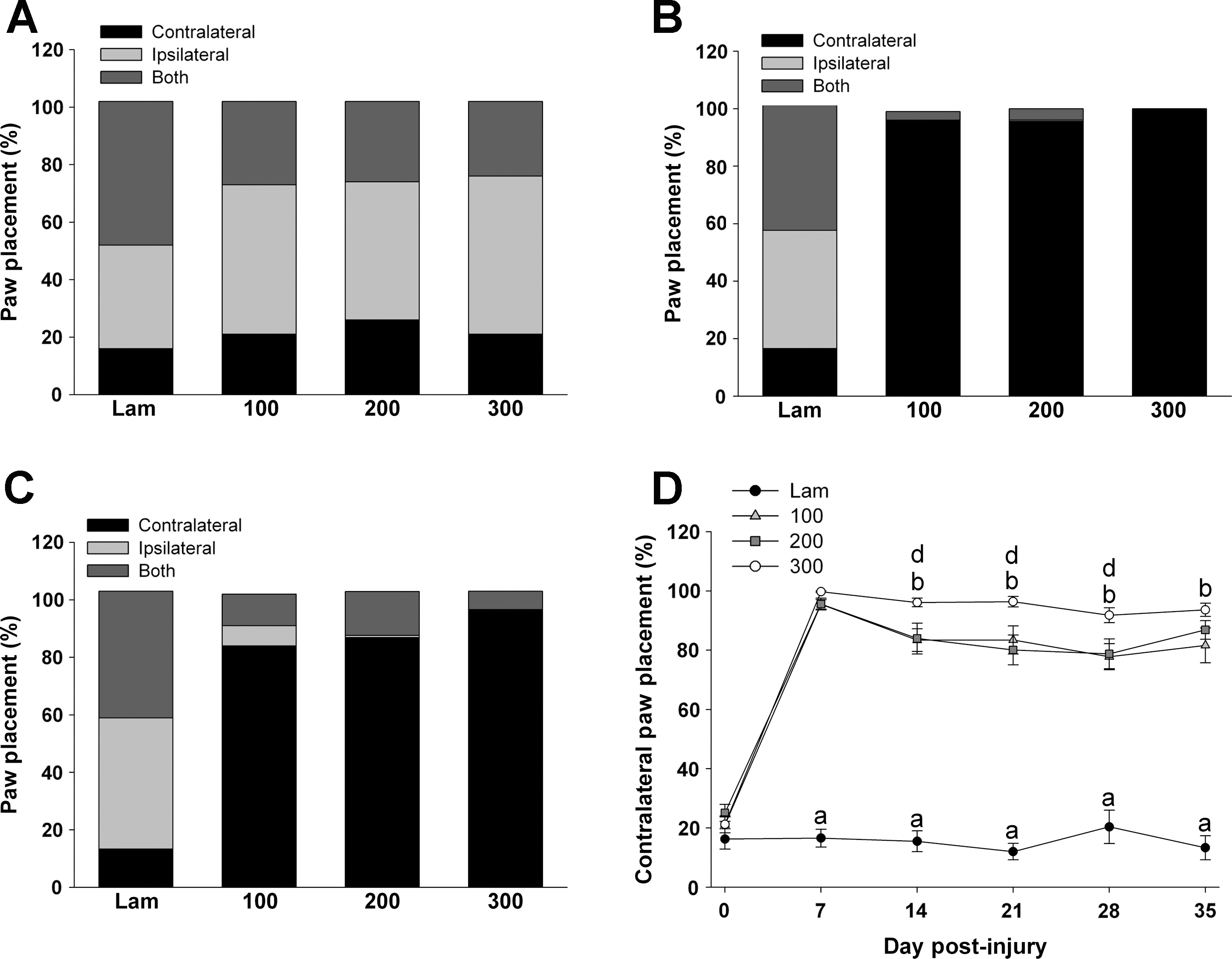
Effect of injury severity on unskilled forelimb function. Unskilled forelimb function was assessed by the paw preference test. Percentages of contralateral, ipsilateral, and simultaneous paw placements are shown for days 0 (
Effects of injury severity on skilled forelimb function
The vermicelli handling test was employed to evaluate the effect of injury severity on skilled forelimb function (Allred et al., 2008). When eating a piece of vermicelli, rats use one paw to grasp the pasta and the other paw to guide it into their mouth (Fig. 3A), a motor behavior which is disrupted following cervical SCI (Fig. 3B). We found that prior to injury, animals made approximately 10–12 ipsilateral adjustments per pasta piece, and that mild (100), moderate (200), and severe (300) SCI induced a significant decrease in ipsilateral forepaw adjustments per pasta piece compared to the uninjured (Lam) group on all post-SCI days evaluated. We also found that rats in the 300 group made significantly fewer ipsilateral forepaw adjustments than the 100 group on post-SCI days 21–35. The 200 group fell consistently between the 100 and 300 groups, but did not differ significantly from either group (Fig. 3C). The amount of recovery between injury severity groups was evaluated and found to be 12.0% for the 100 group, 10.2% for the 200 group, and 5.5% for the 300 group, none of which reached statistical significance. This indicates that the recovery of ipsilateral forepaw function may be moderately related to injury severity. Contralateral paw adjustments and time to eat were also recorded; however, no significant differences were seen between any groups (data not shown). Taken together, these data suggest that the vermicelli handling test is a powerful assessment of skilled forepaw deficits and recovery following SCI, and is dependent on injury severity.
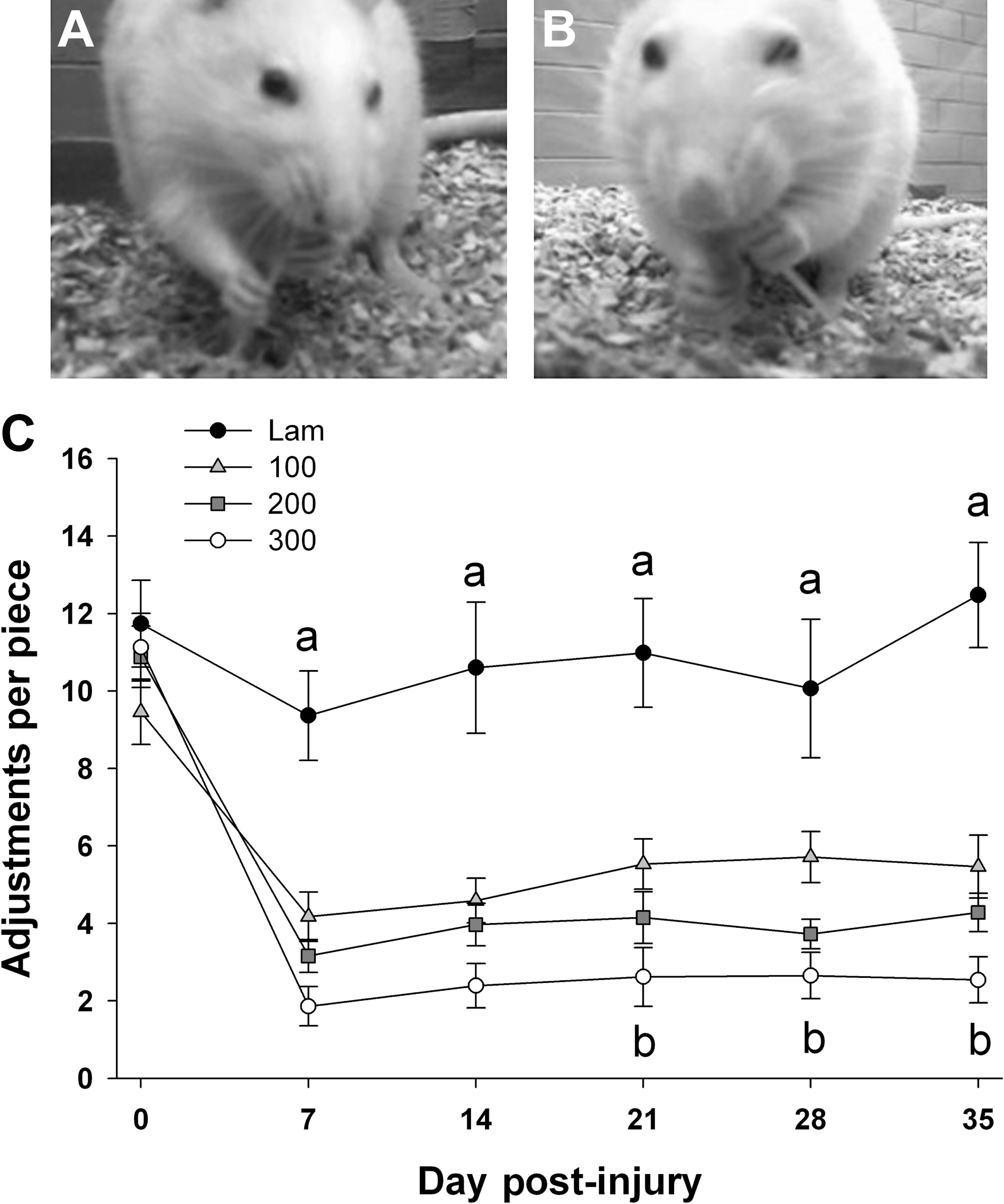
Effect of injury severity on skilled forelimb function. Skilled forelimb function was assessed by the vermicelli handling test. Images showing representative handling behaviors are shown for uninjured (
Effect of injury severity on unskilled locomotor function
To evaluate the effect of injury on overground locomotion, the CatWalk gait analysis system was utilized as previously described (Gensel et al., 2006; Hamers et al., 2006). The maximum pawprint area, duty factor, and regularity index are reported, and data correspond to the ipsilateral forepaw. A representative set of pawprints is shown in Figure 4. Uninjured laminectomy control animals display a normal, regular stepping pattern, and plantar placement of individual paws can be observed (Fig. 4A), whereas C5 hemicontusion SCI results in alterations in the step pattern and paw placement, particularly of the ipsilateral forepaw (Fig. 4B). The maximum pawprint area for the uninjured group (Lam) was significantly larger than the 200 and 300 groups for all days post-SCI (Fig. 4C). The 300 group had significantly smaller pawprint areas than the 100 group on days 14–35, and significantly smaller pawprint areas than the 200 group on days 14, 21, and 35. The 200 group had significantly smaller pawprint areas than the 100 group on days 14 and 28. The amount of recovery in pawprint area between days 7 and 35 for the 100, 200, and 300 groups were calculated as described above, and found to be 63.8%, 38.3%, and 30.4%, respectively, and found to be statistically significant for all injury groups. These data indicate that SCI hemicontusion induces a reduction in ipsilateral forepaw contact in overground locomotion compared to uninjured controls, and that the reduction in ipsilateral pawprint area increases with increasing injury severity.
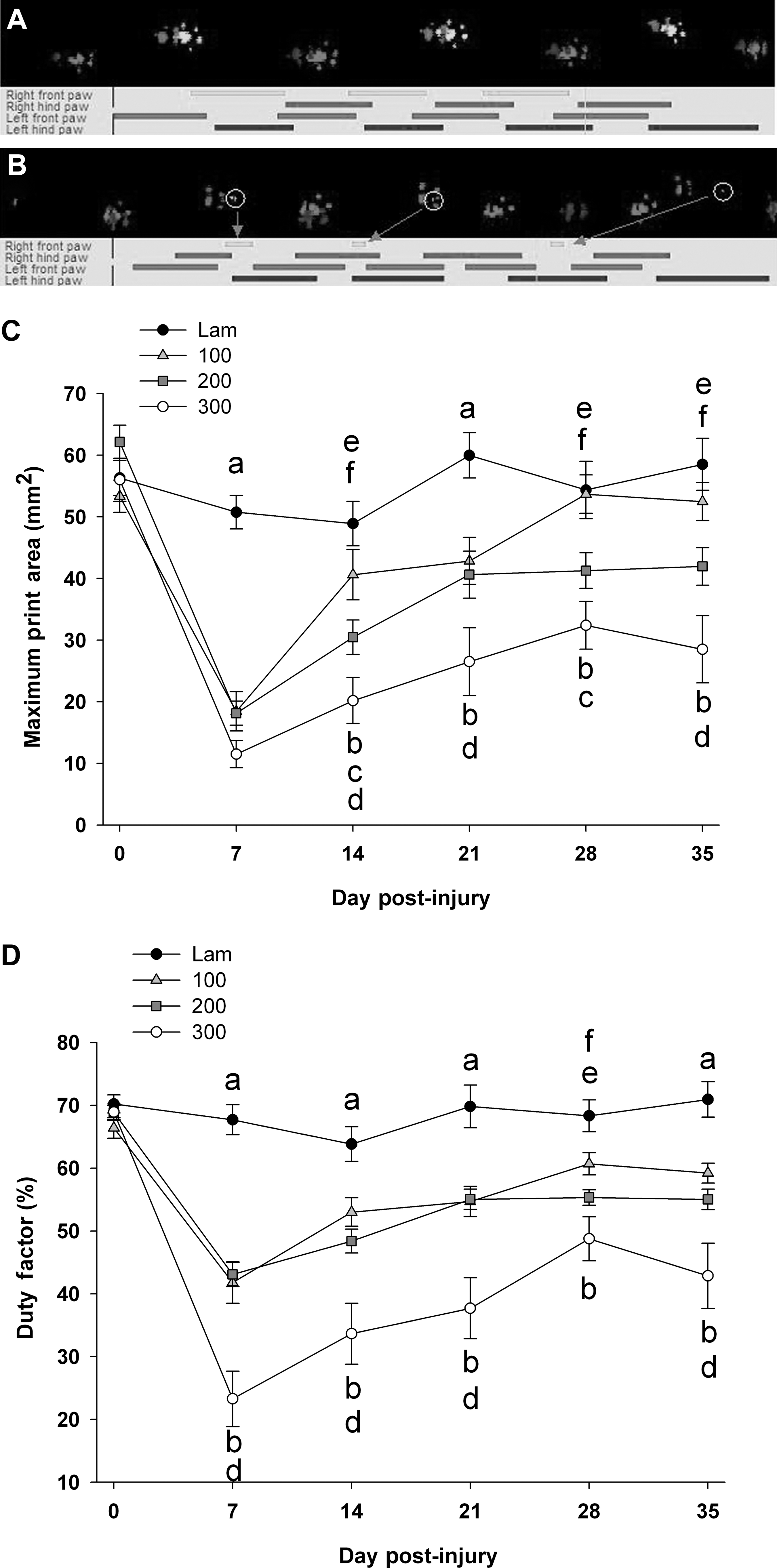
Effect of injury severity on unskilled locomotion. Unskilled locomotion was assessed with the CatWalk gait analysis system. Computer representations of pawprint patterns for uninjured (
Duty factor (Fig. 4D) was also evaluated, and we found that controls spent significantly more of the step cycle in stance (higher duty factor) than the 200 and 300 groups on all days post-injury. The 300 group showed a significantly lower duty factor than the 100 group on all days post-injury, and a significantly lower duty factor than the 200 group on days 7, 14, 21, and 35. The 100 and 200 groups showed very similar duty factor values throughout the course of the experiment. The percentages of recovery seen between days 7 and 35 for the 100, 200, and 300 groups were calculated to be 26.3%, 17.3%, and 28.4%, respectively, and found to be statistically significant for all injury groups as described above. These data indicate that SCI animals spend decreasing proportions of time in stance compared to uninjured controls, and that the time in stance decreases with increasing injury severity. Thus taken together, the data for maximum pawprint area and duty cycle indicate that C5 hemicontusion SCI causes animals to make less ground contact, with a corresponding reduction in time in stance with the ipsilateral forepaw than uninjured controls.
An additional parameter that is often reported for CatWalk gait analysis of spinal cord injury is the regularity index, an indicator of forelimb-hindlimb coordination that calculates the percentage of regular step patterns without missteps (Hamers et al., 2006). We report here that no significant deficit was observable in the control, 100, and 200 groups over the course of the study (Table 1). Animals in the 300 group exhibited an initial decrease in regularity index that was significant on day 7 post-injury, but had recovered by post-SCI day 35. Since a failure to place a paw in the correct pattern, and not the pawprint area or duty factor, alter the regularity index, the only animals with a significantly reduced regularity index were those in the severe (300) injury group, which failed to place the ipsilateral forepaw at least once during the trial.
Interlimb coordination was evaluated with the regularity index by using the CatWalk gait analysis system. Mean scores (±standard error of the mean) are reported according to group. *Statistically significant decrease in regularity index in the 300 group compared to the Lam, 100, and 200 groups. This occurred on post-injury day 7 only.
Lam, laminectomy control animals.
Effect of injury severity on skilled locomotor function
The horizontal ladder test was utilized to evaluate the effect of injury severity on skilled locomotor behavior (Gensel et al., 2006; Soblosky et al., 2001). As described previously (Gensel et al., 2006), the percentage of total rungs used by the animal and the percentage of correct paw placements were calculated, and it was found that injured animals typically contact more rungs and make fewer correct (or more incorrect) paw placements than uninjured controls. We found that prior to SCI, all rats were similar in the percentage of total rungs used, error score, and the percentage of correct forelimb placements (Fig. 5D–F). We found that all SCI injury groups used a significantly higher percentage of the rungs than uninjured controls (Lam), and that animals in the 200 group used a significantly higher percentage of the rungs than the 100 group on post-SCI day 7 (Fig. 5D); however, no significant differences were seen between injury severity groups in the percentage of total rungs used for the remainder of the study. The amount of recovery was calculated to be 24.6%, 36.9%, and 21.6%, for the 100, 200, and 300 groups, respectively.

Effect of injury severity on skilled locomotion. Skilled locomotion was assessed by the horizontal ladder test. Representation of correct paw placements, (
In addition to reporting the percentage of rungs used, a novel scoring system was employed based on the perceived deficit according to each type of paw placement. This system is described in detail in the methods section, and is referred to here as the error score. Characteristic paw placements made on the overground ladder are shown in Figure 5A, B, and C. The severe (300) and moderate (200) injury groups showed significant increases in ipsilateral forepaw error scores immediately following injury compared to uninjured controls on all days post-injury, and a graded decrease was observed with injury severity over the course of the study (Fig. 5E). A significant increase in error score was observed in the 300 group compared to the 100 group on days 7–21, and in the 200 group compared to the 100 group on day 14. There was a trend toward an increased error score with increasing injury severity seen throughout the course of the study. The amount of recovery was calculated as described above to be 504%, 642%, and 744% for the 100, 200, and 300 groups, respectively. These data indicate substantial functional recovery following the large deficit at the earliest time point post-injury.
The percentage of correct paw placements made by animals while traversing the overground ladder is shown in Figure 5F. The uninjured controls (Lam) made significantly more correct placements than the 300 group on all days post-injury (Fig. 5F). Additionally, animals in the 300 group made significantly fewer correct placements than the 200 group on all days post-injury, and fewer correct placements than the 100 group on all days post-injury except day 28. The 200 group generally fell between the 100 and 300 groups. Following an initially large deficit on day 7, all animals showed recovery over the time course of the study, that was calculated to be 24.7%, 32.6%, and 30.8%, for the 100, 200, and 300 groups, respectively. These recovery data are similar to those observed in other behavioral tasks.
Effect of injury severity on surviving ventral horn neurons
To assess the neuronal survival in the ventral horns, cresyl violet histochemistry was performed on spinal cord tissue extracted following the behavioral assessments. Laminectomy controls showed normal spinal cord anatomical structure (Fig. 6A and B), and had similar numbers of ipsilateral and contralateral ventral horn motor neurons (Fig. 6I and J). Injured animals showed damage to the spinal cord anatomical structure, fewer neurons, and occasionally cystic cavities (particularly with more severe injury) confined to the ipsilateral side (Fig. 6C–H). The number of clearly differentiated, morphologically-identifiable neurons was especially low in the ventrolateral gray matter, and spared neurons typically were observed medially, near the central canal. Upon quantification, control animals (Lam) had significantly more surviving neurons in the ipsilateral ventral horn than all injury groups (Fig. 6I). We also found that animals from the severe SCI group (300) had significantly fewer surviving neurons than animals in the mild SCI (100) group, while the moderate SCI group (200) fell between these two groups, but this difference did not reach statistical significance. Neuronal numbers from the contralateral ventral horn were also evaluated, and as expected, no significant differences were observed between any animal groups (Fig. 6J). These histological findings suggest that motor neuron loss in the ventral horn is related to injury severity.
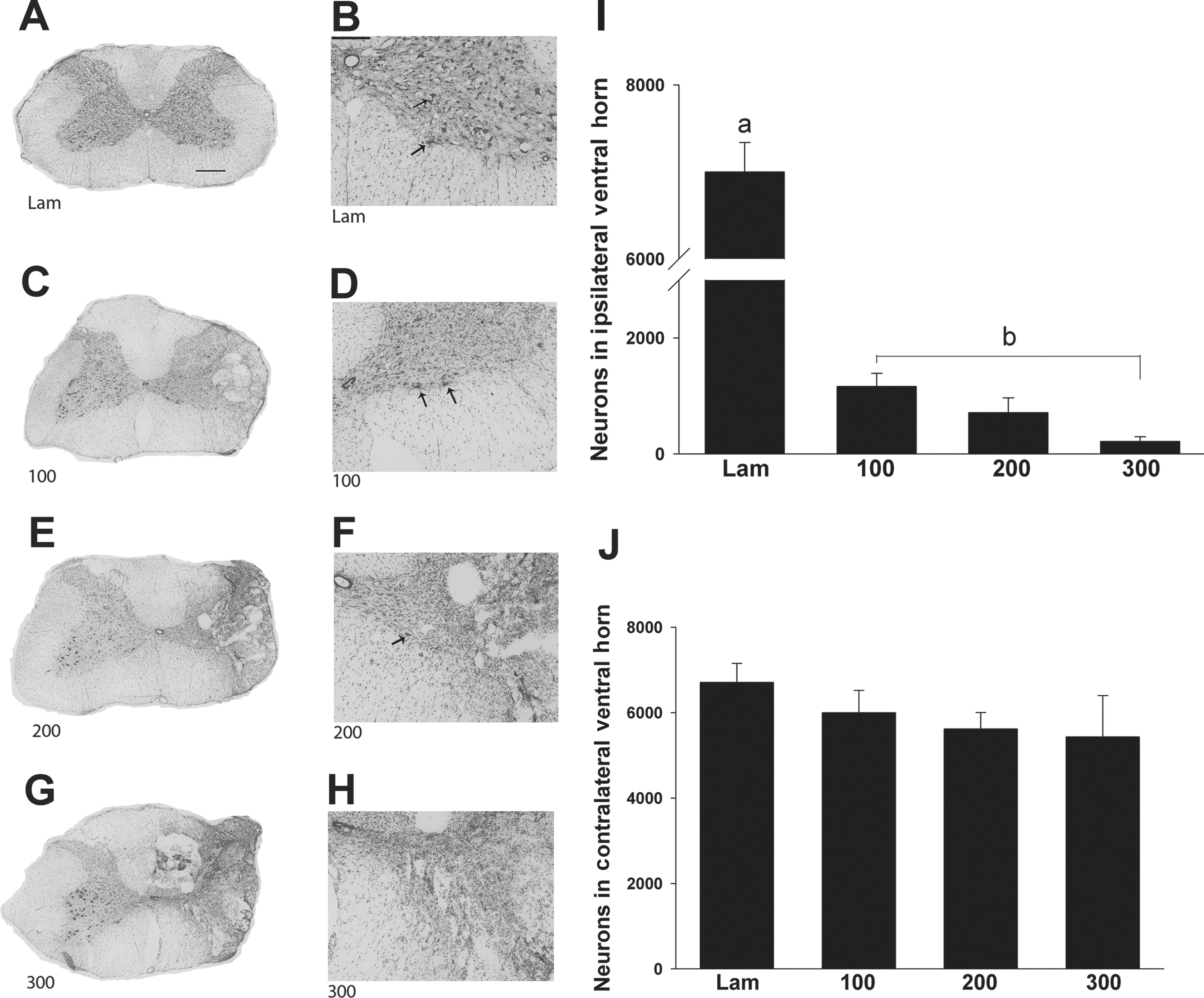
Effect of injury severity on neuron numbers in the ventral horn. Nissl substance was identified by cresyl violet histochemistry, and neurons were identified by morphology. Neurons in the ventral horn were then quantified by unbiased stereology. Representative micrographs are presented at 40× (scale bar = 400 μm in
Effect of injury severity on white-matter sparing
To evaluate changes in spared white-matter area as a result of differing injury severities, immunohistochemistry for MBP was performed (Fig. 7), and the percentage of intact myelin (white-matter area) was calculated. The white-matter area in the uninjured ipsilateral spinal cord was found to be nearly 65–70% (Fig. 7A and B), which decreased following SCI (Fig. 7C–H). White-matter disruption was characterized by a loss of immunoreactivity and the presence of adjacent darkly-stained myelin deposits (denoted by the arrows in Fig. 7D, F, and H). This loss and disruption of myelin was most apparent laterally, and the extent of damaged myelin increased with increasing injury. Upon quantification, all injury groups had significantly smaller white-matter areas in the ipsilateral cord than the uninjured control (Lam) group (Fig. 7I). There was also a significant decrease in white-matter area in the severe SCI (300) group compared to the mild SCI (100) animals (Fig. 7I). The 200 group fell between the 100 and 300 groups, but did not differ significantly from them. The contralateral white-matter area was quantified and no significant differences between groups were seen (Fig. 7J). Taken together, these data suggest that white-matter sparing is inversely related to severity of injury, and that even with the most severe hemicontusion SCI evaluated (300), the damaged white matter is contained within the ipsilateral side.

Effect of injury severity on white-matter area. Myelin was identified by myelin basic protein (MBP) immunohistochemistry. Representative micrographs are shown at 40× (scale bar = 400 μm in
Effect of injury severity on reactive astrogliosis
To evaluate the effect of differing injury severities on reactive astrogliosis, GFAP fluorescent immunohistochemistry was conducted. In all injury groups a robust increase in ipsilateral GFAP relative immunofluorescence (GFAPir) was observed along the cystic cavity and within areas adjacent to the lesion in both gray and white matter (Fig. 8C–F), which was not seen in laminectomy controls (Fig. 8A and B). When gray-matter GFAPir values were averaged and quantified, all injury groups showed a significant increase in GFAPir compared to uninjured control (Lam) animals, but no significant differences between injury severity groups were seen (Fig. 8G). However, when white-matter GFAPir was quantified, all injury groups showed a significant increase in GFAPir compared to uninjured controls, and a significant increase in GFAPir was observed in the severe SCI (300) group compared to the mild SCI (100) group (Fig. 8H).

Effect of injury severity on reactive gliosis in the ipsilateral spinal cord. Reactive gliosis was quantified by glial fibrillary acidic protein relative immunofluorescence (GFAPir), and representative micrographs are shown at 100× (scale bar = 200 μm in
Correlations between white-matter sparing, motor neuron survival, and behavioral testing
To determine if there was a linear relationship between the behavioral tasks and histological outcome measures, data from the characterization study were evaluated by calculating a Pearson product moment correlation coefficient for the data from the behavioral and histological assessments (Table 2). We found that in the paw preference test the percentage of contralateral paw placement was strongly and negatively correlated with white-matter sparing and neuronal survival, which suggests that contralateral paw use increases with tissue damage to both the white and gray matter. Contralateral paw placement was also strongly and positively correlated with astrogliosis in both the gray and white matter, suggesting that contralateral paw placement increases with increasing astrogliosis. Additionally, we found that the number of adjustments per piece in the vermicelli handling test was strongly correlated with white- and gray-matter tissue sparing, as well as white-matter astrogliosis. The horizontal ladder test was significantly but less robustly correlated with white-matter sparing; however, it was not significantly correlated with survival of ventral horn neurons or gray- or white-matter astrogliosis, suggesting that this test is more affected by ascending and descending tracts. Taken together these data suggest that the performance on the paw preference and vermicelli handling tests are linearly related to the degree of damage quantified in the white and gray matter.
The Pearson product moment correlation coefficient (r) was used to evaluate the linear dependence between the behavioral tasks of paw preference, vermicelli handling, and horizontal ladder, and the histological outcome measures of white-matter sparing, ventral horn motor neuron survival, and white- and gray-matter astrogliosis. Pairs with positive correlation coefficients tend to increase together, and those with negative correlation coefficients tend to show an increase in one variable as the other variable decreases.
p < 0.01 for linear relationship between variables; ns, not significant.
Discussion
The development and evaluation of rodent models of cervical SCI is increasing, largely due to their high clinical relevance and improved potential for evaluating protective and reparative strategies that target both gray and white matter post-injury. Bilateral cervical injury models have been previously characterized (Anderson et al., 2009b; Pearse et al., 2005), and are utilized to evaluate potential therapeutic approaches (de Rivero et al., 2009; Lo et al., 2009); however, bilateral cervical SCI models are often associated with high levels morbidity and mortality, and thus can pose particular challenges in the assessment of functional recovery after SCI (Pearse et al., 2005). Consequently, the central goal of this research was to evaluate the effects of a graded hemicontusion model of SCI at the C5 level on several behavioral and histological outcome measures. We found that a mild, moderate, or severe C5 hemicontusion SCI induced quantifiable and statistically significant differences in unskilled and skilled forepaw use, and unskilled and skilled locomotion, compared to uninjured control rats. We also showed that mild and severe contusion injury intensities induced graded behavioral deficits in these forepaw use and locomotor tasks, and that the moderate contusion injury generally fell between the mild and severe deficits, but did not significantly differ from them. In addition to behavioral deficits, we observed that the amount of white- and gray-matter damage in the ipsilateral spinal cord was dependent on injury severity. Importantly, we showed that gray- and white-matter damage is strongly correlated with the degree of deficits seen in the paw preference test and the vermicelli handling test, suggesting that these tasks are sensitive outcome measures.
Assessment of skilled and unskilled behavioral tasks
We employed four behavioral tests, including (1) the paw preference test to evaluate unskilled forepaw function, (2) the vermicelli handling test to evaluate skilled forepaw function, (3) the CatWalk gait analysis to evaluate unskilled locomotor function, and (4) the horizontal ladder test to evaluate skilled locomotor function. This distinction between skilled and unskilled tasks was made to determine the relative contributions of supraspinal motor pathways on forelimb function following cervical hemicontusion. The corticospinal and rubrospinal tracts have been implicated in initiating and modulating voluntary and goal-directed skilled movements (Anderson et al., 2005; Hermer-Vazquez et al., 2004; Muir and Webb, 2000). Similarly, the vestibulospinal and reticulospinal tracts are associated with maintaining tone in extensor muscles, and therefore play a prominent role in automated, unskilled behaviors (Soblosky et al., 2001). However, redundancy and overlap in the contributions of these supraspinal inputs also exists (Muir and Webb, 2000).
The paw preference test assesses unskilled forelimb function and has been widely used to evaluate functional recovery after several unilateral CNS insults, including SCI (Gensel et al., 2006; Smith et al., 2007; Webb and Muir, 2004). In this study, we induced SCI at the C5 vertebral level, causing damage at the C5–C6 spinal level. Based on the retrograde labeling results of McKenna and colleagues (McKenna et al., 2000), injury at this level induces flaccid paralysis of the musculature directly affecting the following movements: (1) flexion/extension/abduction of the shoulder, (2) flexion of the elbow, and (3) flexion/extension of the wrist. When these movements are impaired, the animals are not able to adequately place the forepaw against the cylinder wall, which results in the increased use of the contralateral forelimb, as we show in this study. These observations are in agreement with previous studies that used this test in several models of cervical SCI, including partial hemisection (Liu et al., 1999), over-hemisection (Lynskey et al., 2006), ventrolateral SCI (Webb and Muir, 2005), and hemicontusion injury (Gensel et al., 2006; Soblosky et al., 2001).
The vermicelli handling test assesses skilled forepaw function, in that the test appraises the ability of animals to manipulate food with the forepaws, including fine digit movement. These skillful voluntary forepaw movements require training prior to injury, and involve more supraspinal descending inputs than unskilled movement such as reflex or postural support movements (Alaverdashvili and Whishaw, 2008; Anderson et al., 2007; McKenna and Whishaw, 1999; Zai et al., 2009). The supraspinal descending tracts involved in skilled forepaw movement include the corticospinal (Anderson et al., 2005; Piecharka et al., 2005; Starkey et al., 2005), and rubrospinal tracts (McKenna and Whishaw, 1999;Whishaw et al., 1998), with the latter being more important for digit movements in rats (Kuchler et al., 2002). In this study we report that SCI significantly reduced the number of ipsilateral forepaw adjustments made per piece of vermicelli, a result consistent with previous literature in which this test was used to assess functional recovery after unilateral middle cerebral artery occlusion, an electrolytic somatosensory cortex lesion, or a striatal dopamine-depleting lesion (Allred et al., 2008).
CatWalk gait analysis was employed to assess unskilled overground locomotor function, with our analysis focusing on three parameters: pawprint area, duty factor, and regularity index. Both pawprint area and duty factor relate to weight-bearing plantar paw placement during the stance phase of the step cycle. We report that the C5 hemicontusion SCI significantly reduced ipsilateral forepawprint area and ipsilateral duty factor, a finding in agreement with a previous report (Gensel et al., 2006). This deficit may be attributable to direct damage to motor neuron pools innervating the extensor muscles of the wrist, or damage to white-matter tracts. Using ground reaction force determination, Webb and Muir reported that animals bore significantly less weight on the ipsilateral forepaw and hindpaw after unilateral ventrolateral SCI (Webb and Muir, 2004), as well as after unilateral rubrospinal tract or dorsal column damage at the cervical level (Webb and Muir, 2005), implicating these white-matter tracts in weight bearing.
The horizontal ladder test is widely used to assess skilled locomotor functional recovery in several different SCI models (Ghosh et al., 2009; Gensel et al., 2006; Soblosky et al., 2001; Webb and Muir, 2003, 2004). Our results show that SCI animals exhibit a significant decrease in the percentage of correct placements of the ipsilateral forelimb, a finding consistent with other reports in the literature (Gensel et al., 2006; Soblosky et al., 2001). In this study we used uneven rung-spacing patterns, which required precise adjustment of paw position, stride length, and interlimb coordination for each step. Three sequences of movements were required to perform this test: (1) aiming of the limb to the rung, (2) placement of the paw on the rung, and (3) grasping the rung (Metz and Whishaw, 2002). The aiming movement requires proximal muscle contraction to swing the limb to the appropriate rung. The placing response, such as placing the paw on the rung, is a reflex to tactile stimulation, and may be associated with dorsal horn or dorsal column damage. Webb and Muir reported that cervical hemisection in animals decreases tactile placing of the ipsilateral forepaw (Webb and Muir, 2002). The last step of ladder walking is digit flexion to stabilize the limb on the rung. This action requires appropriate use of the forepaw, with coordinated use of paw flexors and extensors. As mentioned above, the lower motor neuron pools associated with digit use are selectively damaged in this model, which is in accordance with a deficit in rung grasping.
Tissue sparing and functional recovery
We report strong, significant correlations between the amounts of white- and gray-matter sparing, astrogliosis, and the performance on the paw preference task and the vermicelli handling test, and a more moderate, but significant, correlation between white-matter sparing and horizontal ladder performance. Thus our data indicate that the degree of gray- and white-matter damage in a cervical hemicontusion SCI model is related to injury severity, and is predictive of functional outcome measures, a finding similar to the findings of other groups. For example, induction of a dorsolateral hemicontusion lesion, or a hemisection in the upper cervical spinal cord (C2), was found to induce reproducible and quantifiable unilateral deficits in diaphragm or respiratory motor activity that were associated with contusion volume and tissue loss in the white and gray matter (Baussart et al., 2006; Fuller et al., 2008, 2009). With regard to lower cervical lesions, Soblosky and colleagues (Soblosky et al., 2001) described a cervical hemicontusion injury using a modified weight-drop device, wherein SCI severity was manipulated by dropping a weight from differing heights (1.25, 2.5, or 5 cm), and reported that the associated behavioral deficits seen in forepaw function were related to white- and gray-matter tissue damage. Similarly, Gensel and associates evaluated graded C5 hemicontusion lesions induced by the MASCIS/NYU impactor, and measured the effect of injury severity on several behavioral measures of forelimb use. This group reported that functional deficits and graded ipsilateral tissue sparing, which included gray- and white-matter components, were proportionally related to injury severity (Gensel et al., 2006). Similarly to our data correlating tissue sparing and behavioral outcome, other groups have quantified this relationship. Martinez and colleagues induced C4 hemisections that encompassed varying degrees of white- and gray-matter damage, and described a 20-point scale to evaluate forelimb and hindlimb function in an open field test (Martinez et al., 2009). This group reported that lesions associated with the most gray- and white-matter sparing induced less severe deficits in the open field, and that complete hemisection lesions result in severe forelimb deficits with little functional recovery. Similarly, Anderson and associates developed a forelimb locomotor assessment scale and evaluated two severities of hemicontusion SCI at different spinal levels between C5 and C8 (Anderson et al., 2009a). They reported that rats with mild contusions displayed greater locomotor recovery than those receiving moderate contusions, and that recovery was related to contusion force and spared tissue. This scale has recently been used to evaluate therapeutic strategies to promote functional recovery, including forced exercise and post-SCI administration of interferon-β (Sandrow-Feinberg et al., 2010), but only modest effects of the treatments were observed.
Summary and significance
In this study we developed and characterized a graded model of C5 hemicontusion in adult male rats using a widely used rodent spinal cord impactor. This model more closely mimics the majority of clinical SCI, by including both gray- and white-matter pathophysiology, which contributes significantly to functional deficits and is dependent on injury severity. Deficits in skilled and unskilled forelimb function and locomotion relating to injury severity were observed, as were decreases in neuronal numbers, white-matter area, and white-matter gliosis. Significant correlations were observed between behavioral and histological data. The importance of this work is that it establishes a new cervical SCI model in adult male rats, which utilizes a commercially-available impact device without modification, meaning that this model could be readily applied by investigative teams without the development of new equipment or instrumentation. Therefore, this model could readily be used for the investigation of protective and regenerative strategies for SCI.
Footnotes
Acknowledgment
This research was supported by National Institutes of Health grant NS052559 (to C.L.F. and K.A.D.), the Civitan Emerging Scholar Award (to K.A.D.), The Thailand Commission on Higher Education Staff Development Project (to A.S.), and the Siriraj Graduate Thesis Scholarship (to A.S.). The authors also acknowledge the work of Nicole Day in the initial behavioral evaluations.
Author Disclosure Statement
No competing financial interests exist.