




Abstract
W
In our study, we used arteriovenous difference of lactate (AVlac) as an indicator of whether there was net uptake or export of lactate by the brain at the time of sampling. Both arterial and venous blood samples were drawn at the same time. We also compared the arterial concentration of lactate with that of brain microdialysate lactate concentration.
AVlac was calculated as arterial minus venous concentration, which can yield positive values indicating net uptake by brain, negative values indicating net export by brain, and zero value indicating neutrality (i.e., no net uptake or export by brain). We set a margin of 0.05 mM above zero and 0.05 mM below zero in an effort to avoid misinterpreting the sign of the difference where AVlac was close to zero.
We appreciate that the issue of numerical margin is open to debate in any study that takes such an approach. Therefore, it is important to provide an adequate basis for the value of the margin adopted. As explained in our article, we used information provided by M Dialysis/CMA in their technical manual for the ISCUS Flex analyzer, which we cite as reference 17.
The Precision Table in the technical manual (reference 17) that we used as a source of the precision values expressed as relative standard deviation (RSD) of 1.6–2.7% is reproduced in Figure 1. We based our calculations on these “within run” values (outlined with a box and asterisk in Fig. 1) because each arterial and venous pair of blood plasma samples was analyzed within the same run. Assuming a precision equal to RSD of 1.6–2.7% for each analysis, and based on a mean lactate concentration of 1.36 mM, we estimated that an appropriate error margin for the difference in lactate concentration between a pair of samples (arteriovenous difference; AVlac) would be±4% (i.e.,±0.05 mM).
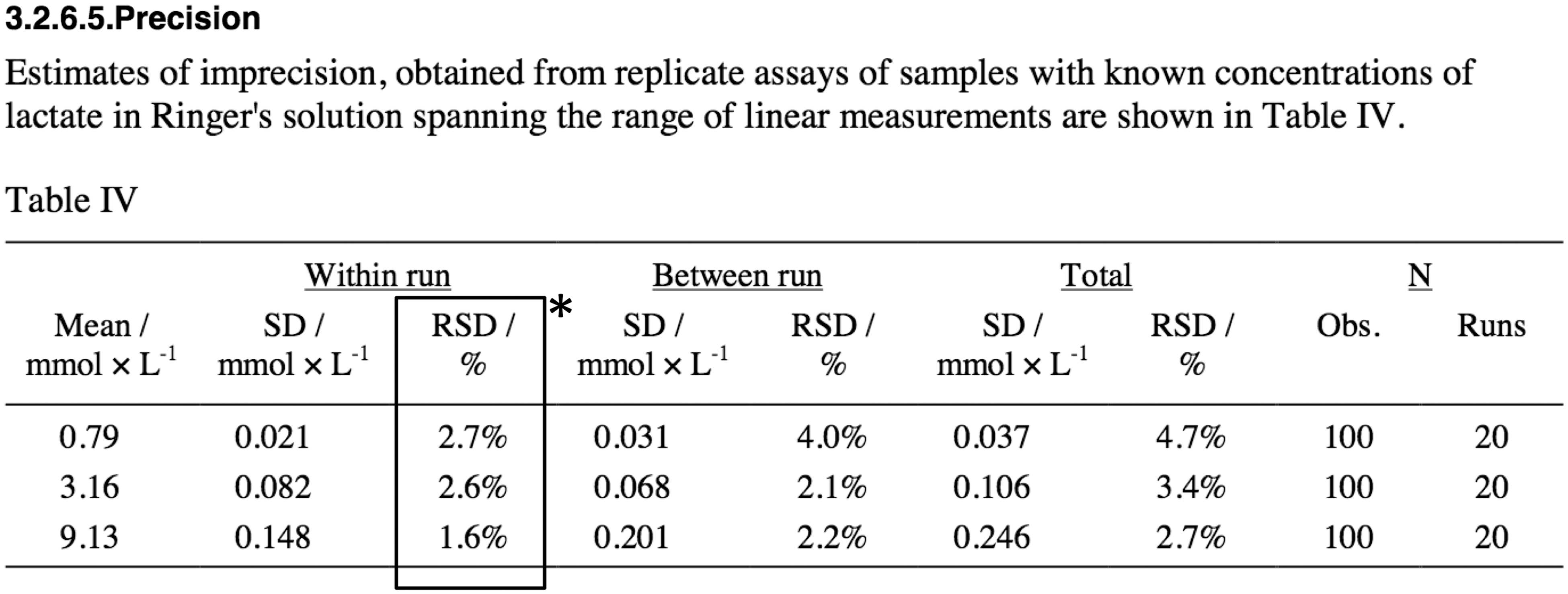
Precision table from the technical manual for ISCUSflex Microdialysis Analyzer with the “within run” relative standard deviation (RSD) values highlighted by a box and asterisk. Table reproduced from the technical manual for ISCUSflex Microdialysis Analyzer, with courtesy of M Dialysis.
To work out the combined standard deviation (Sc) for the difference between two concentrations each with a standard deviation (SD) of So, Nordström and colleagues quote an established formula:
Assuming M Dialysis' “Precision” value for ISCUS analysis (“within run” values highlighted in Fig. 1) for RSD of 2.7% (i.e., 0.027) and applying this to our mean lactate concentration of 1.36 mM equates to an SD of 0.0367 mM, and, using the above formula, a combined SD of 0.05 mM. These figures are thus consistent with the margins for difference stated in our article (±0.05 mM).
In contrast, Nordström and colleagues based their calculations on a precision value for RSD of 4% for ISCUS analysis. In the “Precision” table from the ISCUS Flex manual, 4% appears to correspond to a “between run” or “total” RSD figure (rather than the within run RSD of 2.7% that we used). When the 4% RSD is applied to our mean lactate concentration of 1.36 mM and put through the calculation using the above formula, it yields a combined SD of±0.08 mM, which, as Nordström and colleagues have pointed out, is higher than our margin value (±0.05 mM).
We wish to emphasize the following: • We do select an error margin (based on the precision value for the ISCUS analyzer provided by the manufacturer), albeit different from the value proposed by Nordström and colleagues. • The fact that the difference between arterial and venous lactate increases with arterial lactate concentration suggests that the effect is real.
Although we have justified the margin we have used, we acknowledge that some readers' views may differ on the choice of margin. However, the values of AVlac depicted in the box-and-whisker plot in Figure 1 of our article show that even if the margin is increased from±0.05 mM to a higher value, such as±0.08 mM, there are still periods of net uptake of lactate by brain, which, as mentioned above, become more pronounced as the arterial lactate concentration increases. Because brain lactate concentration is higher than arterial lactate concentration, we conclude that uptake can take place against a concentration gradient.