




Abstract
Dear Editor:
W
The diagnostic tools proposed are indeed highly valuable to standardize findings from different structures and medical staffs. These tools, developed for an adult population, also could be adapted for pediatric use. As published data on pediatric PSH may not be sufficient to allow the production of a consensus document, useful information may come from the clinical practice of a number of centers that regularly treat patients with PSH.
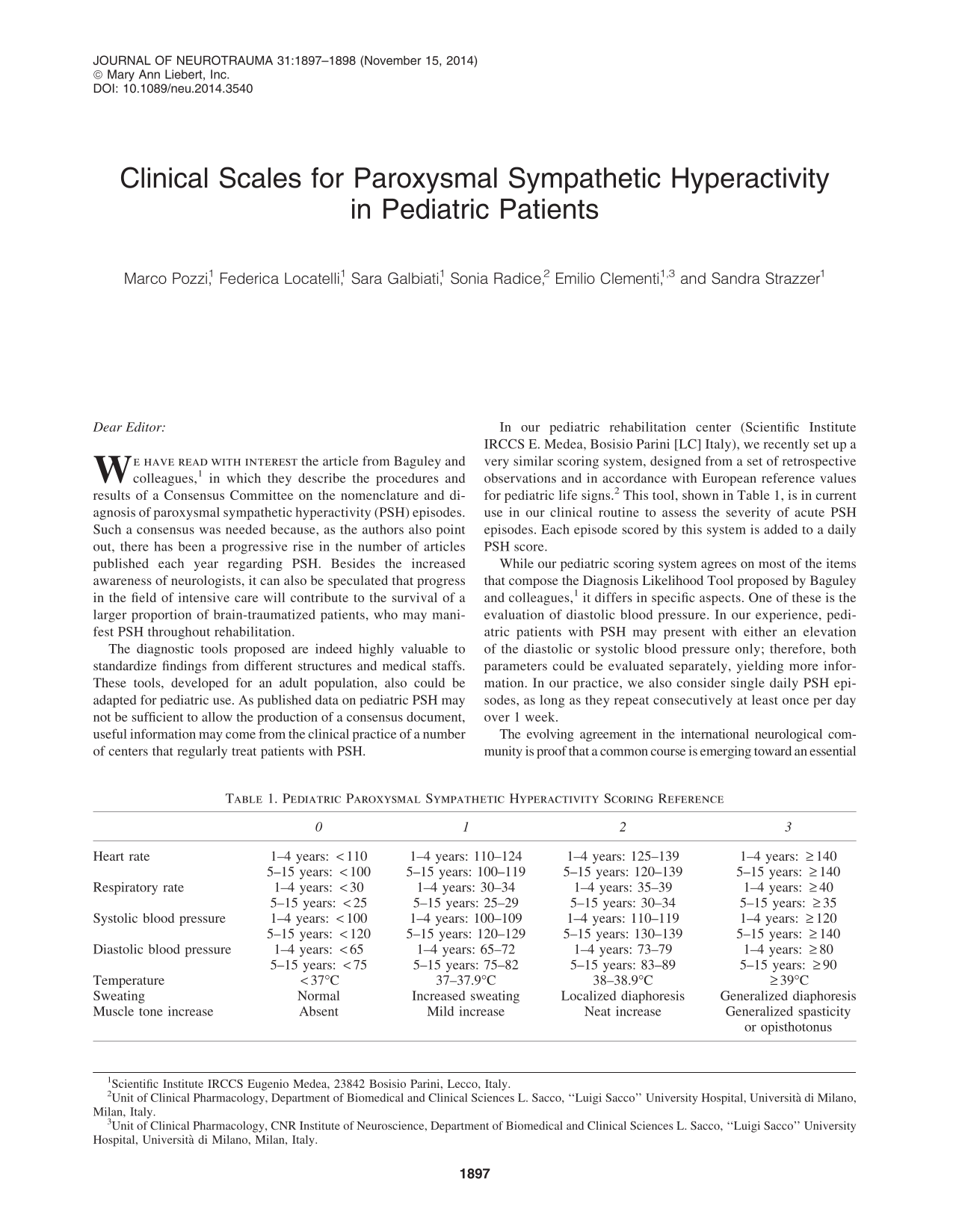
In our pediatric rehabilitation center (Scientific Institute IRCCS E. Medea, Bosisio Parini [LC] Italy), we recently set up a very similar scoring system, designed from a set of retrospective observations and in accordance with European reference values for pediatric life signs. 2 This tool, shown in Table 1, is in current use in our clinical routine to assess the severity of acute PSH episodes. Each episode scored by this system is added to a daily PSH score.
While our pediatric scoring system agrees on most of the items that compose the Diagnosis Likelihood Tool proposed by Baguley and colleagues, 1 it differs in specific aspects. One of these is the evaluation of diastolic blood pressure. In our experience, pediatric patients with PSH may present with either an elevation of the diastolic or systolic blood pressure only; therefore, both parameters could be evaluated separately, yielding more information. In our practice, we also consider single daily PSH episodes, as long as they repeat consecutively at least once per day over 1 week.
The evolving agreement in the international neurological community is proof that a common course is emerging toward an essential and correct interpretation of PSH. This systematization will hopefully lead to a rationalization of drug therapies that, in the field of PSH, are currently carried out based on isolated observations. 3 –5 Ideally, a large multicentric study should be performed.
Footnotes
Acknowledgment
The financial support by Agenzia Italiana del Farmaco (AIFA) and Regione Lombardia (MEAP Project, Monitoraggio degli Eventi Avversi in Pediatria, to EC) and by the Italian Ministry of Health (Ricerca Corrente 2014, to EC and SS) is gratefully acknowledged.