




Abstract
Several behavioral factors such as violence, impulsivity, and alcohol-related problems are associated with traumatic spinal cord injury (TSCI). Such factors have been associated with inherently low neuronal serotonergic capacity that in turn is reflected in low activity of monoamine oxidase (MAO) as measured in platelets. The aim of the study was to characterize platelet MAO activity and impulsivity in persons with TSCI. Data were collected from 93 patients with TSCI and compared with 93 age- and gender-matched control subjects. Platelet MAO activity was measured radioenzymatically and expressed as nanomoles of beta-phenylethylamine oxidized per 10 to the tenth power platelets per minute. Facets of impulsivity were self-reported using Barratt Impulsiveness Scale (BIS-11). Most of the patients were men (87%). The mean time from TSCI was 4.3 ± 3.7 years. Twenty-one (24%) patients reported social problems associated with alcohol, and 30 (39%) patients had consumed alcohol before the trauma. Platelet MAO activity was significantly lower among the patients with TSCI (6.4 ± 3.2 vs.10.8 ± 5.2, p < 0.0001). This difference was not affected by consideration of their smoking status. The patients with TSCI had significantly higher BIS-11 impulsivity compared with the controls (62.8 ± 10.0 vs. 55.4 ± 8.6, p = 0.0001). The patients with TSCI have lower platelet MAO activity, and they are more impulsive compared with the healthy controls. Our results indicate that both low platelet MAO activity and high impulsivity are important risk factors for TSCI that can have predictive value and aid in undertaking preventive measures.
Introduction
T
Some previous work has focused on the causes of TSCI, as well as risk behaviors leading to injury. 4,5 A number of TSCIs are caused by high-risk behaviors such as sensation seeking, heavy drinking, drinking and driving, or acts of violence. Because persons who have had TSCI are more likely to receive new injuries thereafter, examining risk factors after TSCI is a necessary step for prevention. 6
Personality traits affect attitudes, estimations, and behavioral decisions. In particular, one trait, impulsivity, is associated with risk taking and other alcohol-related problems. 7 –10 Impulsivity has been related to injury in the general population and in trauma patients. 9,10 Impulsivity has also been associated with inherently low neuronal serotonergic capacity. 11 Low serotonergic neuronal capacity is, in turn, reflected in low activity of monoamine oxidase (MAO) as measured in platelets. 12
Nevertheless, platelet MAO activity and impulsivity have not been studied in patients with TSCI. Because traumatic injuries are often caused by careless behavior among the younger victims, these patients represent an excellent opportunity to examine the behavioral validity of the association between low serotonergic capacity and impulsiveness. Hence, we decided to characterize platelet MAO activity and impulsivity in persons with TSCI.
Methods
The patients with TSCI were identified from the Estonian TSCI database from 1997 to 2007 and, in addition, from the list of patients with TSCI in Haapsalu Neurological Rehabilitation Centre from 2008 to 2011. The data of the patients were collected from 2011 to 2013.
Healthy controls matching patients' sex, age, education, and smoking were selected at random from two large population-derived sample databases, mainly from the Estonian Psychobiological Study of Traffic Behaviour, 13 but to match by age, also from the Estonian Children Personality Behaviour and Health Study. 14 –16 All subjects gave informed consent. Impulsivity was measured by the Barratt Impulsiveness Scale (BIS-11). 13,17,18 Age, education, the year of TSCI and etiology, alcohol and smoking behavior were self-reported. Smoking status was assessed because smoking dose-dependently reduces platelet MAO activity. 19 –22
Venous blood samples were collected using K3EDTA as anticoagulant. In platelet-rich plasma, platelet MAO activity was measured radioenzymatically as described previously, and expressed as nanomoles of beta-phenylethylamine oxidized per 10 to the tenth power platelets per minute. 14
The study was approved by the Research Ethics Committee of the University of Tartu, Estonia. The data were analyzed using SAS software (version 9.2; SAS Institute Inc., Cary, NC). Descriptive data are presented as percentage, mean, and standard error (SE). Categorical variables were compared by chi-square test. Analysis of variance (ANOVA) was used to compare continuous variables, and analysis of variance and covariance (ANCOVA) was used to detect covariation effects. A statistical level of significance was set up at 5% (p < 0.05).
Results
There were 93 patients in the study, most of whom were men (Table 1). The age of the patients ranged from 16 to 67 years. The mean age for women was statistically significantly higher compared with that of men (p = 0.001). The mean time since TSCI was 4.3 ± 3.7 years (range 0–13 years).
TSCI, traumatic spinal cord injury
Platelet MAO activity
Mean platelet MAO activity was 6.4 ± 0.3 nanomoles oxidized substrate/1010 platelets per minute in patients and 10.8 ± 0.5 in controls (F(1,183) = 48.83, p < 0.0001). The difference remained significant (p < 0.0001) when the number of smoked cigarettes was taken into account. This difference between patients and matched controls was present in both males and females.
Platelet MAO activity in males was significantly lower among the patients with TSCI (6.2 ± 0.4 vs. 10.7 ± 0.6, F(1,159) = 42.88, p < 0.0001), and this difference remained significant (p < 0.0001) when adjusting for smoking status. Platelet MAO activity was also lower in the small subsample of women with TSCI (7.3 ± 1.2 vs. 11.6 ± 1.1, F(1,23) = 5.71, p = 0.026), while there were no smokers among the females. All subgroups by cause of TSCI had lower platelet MAO activity than controls (F(5,178) = 10,14; p < 0,0001) (Fig. 1). Platelet MAO activity of the patients did not depend on the time since injury (p = 0.322).
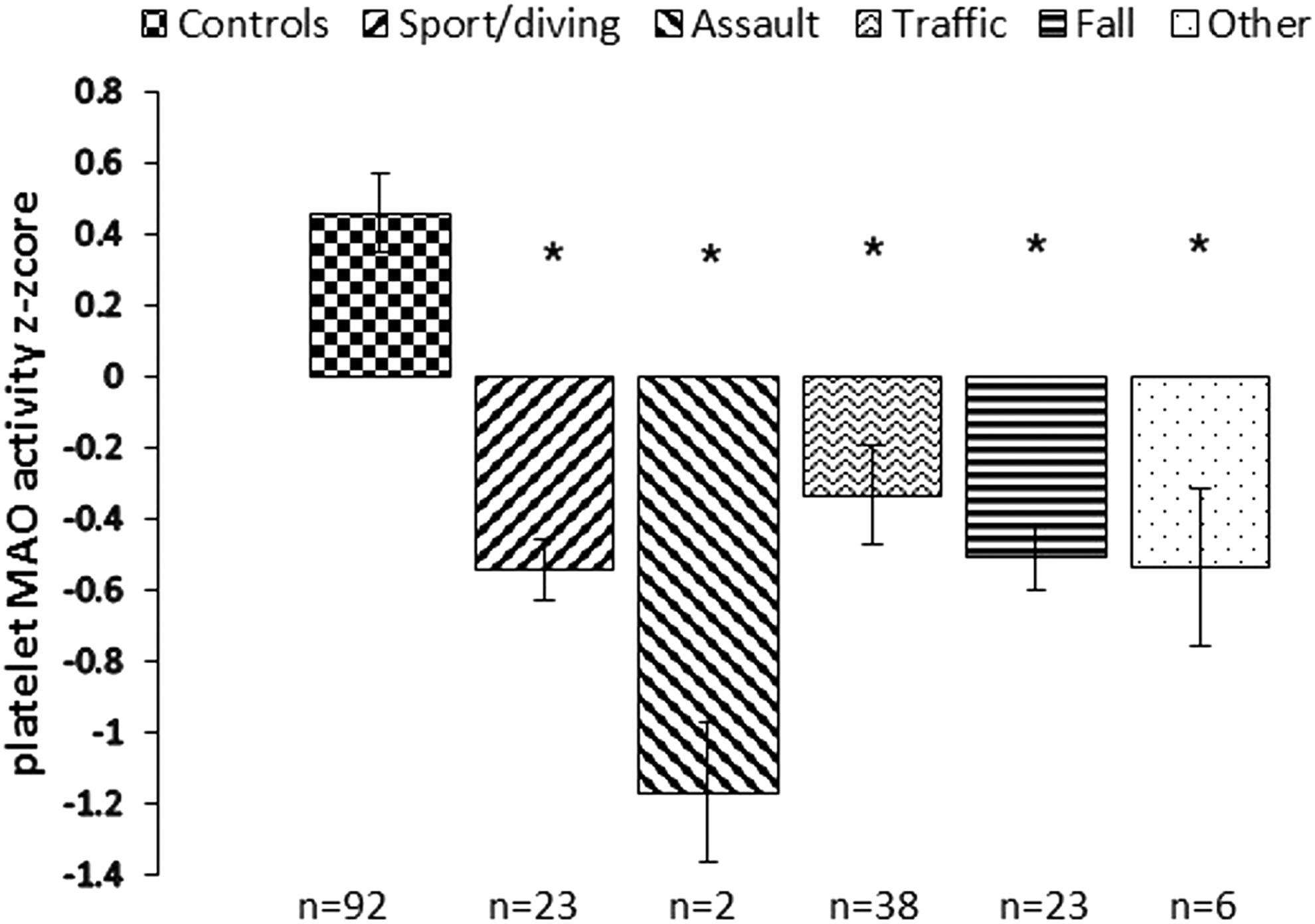
Platelet monoamine oxidase (MAO) activity by cause of traumatic spinal cord injury and controls. Fisher Least Significant Difference post hoc: Asterisks show significant difference (p < 0.05) from controls. Whiskers represent standard error of the mean values.
Impulsivity
The BIS-11 score was significantly higher in patients (62.8 ± 1.1 vs. 55.4 ± 0.9, F(1,77) = 28.57, p < 0.0001). This difference was also significant in both sexes independently: in males (63.0 ± 1.4 vs. 55.8 ± 0.9, F(1,153) = 22.8, p < 0.0001) and in females (61.6 ± 2.5 vs. 52.3 ± 2.7, F(1,23) = 6.36, p = 0.019). We also found significant differences with controls in the BIS-11 score when analyzing by the causes of injury (F(5,1742) = 6.37; p < 0.0001). The patients who had had a traffic accident, sport accident, or fall had all higher BIS-11 scores, while this was also the case for assaulted patients, but their number was too small (n = 2) for meaningful statistical comparison (Fig. 2). There was no correlation between the BIS-11 score of the patients and the time since injury (p = 0.345).
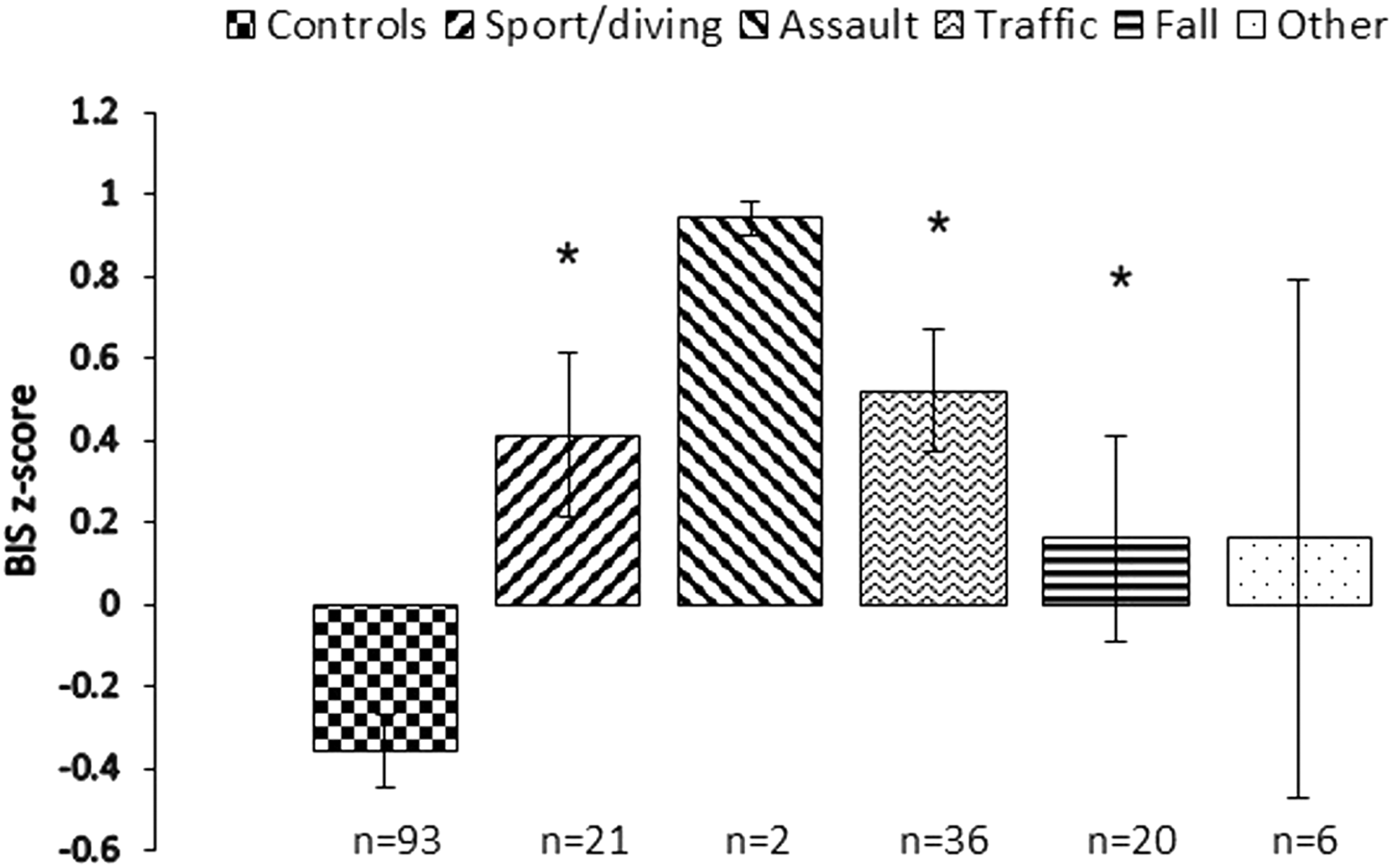
Scores in Barratt Impulsiveness Scale (BIS-11) by cause of traumatic spinal cord injury and controls. Fisher Least Significant Difference post hoc: Asterisks show significant difference (p < 0.05) from controls. Whiskers represent standard error of the mean values.
Discussion
We report that the patients with TSCI, both males and females, have significantly lower platelet MAO activity and higher impulsivity when compared with well-matched controls. The sample of patients with TSCI was demographically similar to what we have shown previously for Estonia. 2 Several authors have studied the risk factors for injury and found excessive risk-taking as an important contributor to traumatic injury. 6,9,10,22 –24 Males, younger and unmarried persons, uninsured, unemployed, or currently alcohol dependent persons have a higher inclination toward risky behavior leading to severe injuries. 24
The behavioral patterns and physiological characteristics of trauma patients are different in comparison with uninjured persons. Trauma patients characterize themselves as on the higher side in sensation seeking and impulsivity, and their risk perception is low. 9,24 Although trauma often causes irreversible disability and severe motor dysfunction, the personality type should not change after the trauma. 6 It has been shown that interests remain stable post-injury, although the patients could have major limitations to move or participate in their favorite activities. 23
Platelet MAO activity is rather stable throughout life. 25 Therefore, studying personality even after TSCI could enable us to indicate the risk factors that promoted the injury. We also considered the possible dependence of platelet MAO activity and BIS-11 score on the time since injury, but no correlation was found. In addition, we can predict future injuries from the past behaviors and personality: For example, Krause 23 noted that more than 23% of patients with TSCI reported at least one injury within the past year.
Low capacity of the central serotonergic system has been associated with the impulsive behavior. 11,12,25,26 Impulsivity also leads to higher use of alcohol. Alcohol consumption is one of the strongest predictors of injury 9 but is independent of impulsivity and sensation-seeking as a predictor of injury. 10 We have found previously that police-referred drunk drivers had lower platelet MAO activity 21 and that impulsive personality is a reliable predictor of different aspects of risky driving. 22 Platelet MAO activity is lower in alcohol-dependent and alcohol abusing persons. 7,22,25,26 According to our epidemiological study, alcohol consumption preceded TSCI in almost half of the patients, 2 and the current data are consistent with this.
It is worthwhile noting that because low serotonergic activity is associated with suicidal behavior and major depression, the patients with TSCI have a higher suicide risk. 27 –29 More comprehensive assessment, including that of suicide risk, is required at outpatient clinics in patients with TSCI. In our study, the questionnaire was self-administered, and this should be considered a limitation because behavioral measures and clinical interview can be more reliable.
Conclusion
This is a unique study for the first time specifically testing the concept of low platelet MAO as a predictor of risk proneness that could lead to severe accidents. 26 Persons with TSCI were found highly impulsive, and their platelet MAO activity was much lower compared with healthy controls. Our results indicate that low platelet MAO activity is an important risk factor for TSCI that can have predictive value and aid in undertaking preventive measures.
Footnotes
Acknowledgment
The study was supported by the Estonian Institutional Research grants IUT2-4 and IUT20-40.
Author Disclosure Statement
No competing financial interests exist.