




Abstract
Our aim was to describe current approaches and to quantify variability between European intensive care units (ICUs) in patients with traumatic brain injury (TBI). Therefore, we conducted a provider profiling survey as part of the Collaborative European NeuroTrauma Effectiveness Research in Traumatic Brain Injury (CENTER-TBI) study. The ICU Questionnaire was sent to 68 centers from 20 countries across Europe and Israel. For this study, we used ICU questions focused on 1) hemoglobin target level (Hb-TL), 2) coagulation management, and 3) deep venous thromboembolism (DVT) prophylaxis. Seventy-eight participants, mostly intensivists and neurosurgeons of 66 centers, completed the ICU questionnaire. For ICU-patients, half of the centers (N = 34; 52%) had a defined Hb-TL in their protocol. For patients with TBI, 26 centers (41%) indicated an Hb-TL between 70 and 90 g/L and 38 centers (59%) above 90 g/L. To treat trauma-related hemostatic abnormalities, the use of fresh frozen plasma (N = 48; 73%) or platelets (N = 34; 52%) was most often reported, followed by the supplementation of vitamin K (N = 26; 39%). Most centers reported using DVT prophylaxis with anticoagulants frequently or always (N = 62; 94%). In the absence of hemorrhagic brain lesions, 14 centers (21%) delayed DVT prophylaxis until 72 h after trauma. If hemorrhagic brain lesions were present, the number of centers delaying DVT prophylaxis for 72 h increased to 29 (46%). Overall, a lack of consensus exists between European ICUs on blood transfusion and coagulation management. The results provide a baseline for the CENTER-TBI study, and the large between-center variation indicates multiple opportunities for comparative effectiveness research.
Introduction
T
Transfusion thresholds for anemia are a particularly controversial area in TBI. According to the guidelines, 1,2 transfusion in general critically ill patients is recommended at a restrictive hemoglobin target level (Hb-TL) of 70 g/L rather than a liberal Hb-TL of 90 or 100 g/L. Whether such target levels also apply to patients with TBI is unclear. 3,4 Inappropriate use of blood products exposes patients to a number of systemic risks and may even lead to progressive hemorrhagic injury post-TBI. 3 However, cerebral oxygenation may be improved with higher hemoglobin concentrations, 5,6 whereas restrictive transfusion thresholds may predispose to brain tissue hypoxia and may increase the risk of early mortality. 7 On the other hand, a recent large retrospective cohort study indicated that a restrictive blood transfusion policy was not associated with increased mortality and can be cost-effective in patients with TBI. 8 An additional challenge for the management of both blood and coagulation status is the presence of coagulopathy. 9 Both pro- and anticoagulatory abnormalities can be observed after TBI in around 1 of 3 patients. 10 –12 Coagulopathy at admission is associated with increased mortality and poor neurological outcome. 12 –14 Coagulopathy may result from defective clot initiation, poor clot formation, or hyperfibrinolysis. Acidosis, hypothermia, coagulation factor consumption or dilution, and the more recently described acute coagulopathy of trauma-shock, which results from widespread endothelial activation after hypoperfusion, may contribute to coagulopathy. 15 Finally, patients with TBI are at increased risk of venous thromboembolism (VTE; around 20%) 16 compared with general intensive care unit (ICU) patients (around 6–8%). 17 Here, the balance between the prevention of VTE and the risk of (progressive) hemorrhage of the brain depends largely on the timing of thromboprophylaxis with anticoagulants. However, current Brain Trauma Foundation (BTF) guidelines do not make clear recommendations on coagulation management. 18
In summary, no definitive evidence exists to guide physicians in determining the transfusion and coagulation management in patients with (severe) TBI. This will likely lead to variations in management. Our aim was to describe and quantify variability in European ICUs for blood transfusion and coagulation management in patients with TBI, using a survey among European neurotrauma centers participating in the Collaborative European Neurotrauma Effectiveness Research in TBI (CENTER-TBI) study. 19,20
Methods
Participating centers
This study is part of the prospective, longitudinal CENTER-TBI study in 68 centers from 20 countries across Europe and Israel. The CENTER-TBI investigators and participants are listed in Supplementary Data 1 (see online supplementary material at
Provider Profiling Questionnaire
The Provider Profiling Questionnaire was developed in a systematic manner. The literature (including guidelines and available surveys) was reviewed and experts of various disciplines (neurosurgeons, [neuro]intensivists, neurologists, emergency department physicians, rehabilitation physicians, medical ethicists, health care economists, and epidemiologists) were consulted throughout the different phases in the development process. Preliminary questionnaires were pilot-tested in 16 of the participating centers for unexpected or missing values and ambiguity, and received feedback was incorporated. For more information about the development, administration, and content of the total set of provider profiling questionnaires, see Cnossen and colleagues.
19
In this study, we focus on 10 questions (with additional subquestions) on hemoglobin target levels, trauma-related coagulation management, and use and timing of thromboprophylaxis (see online supplementary material at
Hemoglobin target level and coagulation management
Participants were explicitly asked for their general policy rather than for individual treatment preferences. General policy was defined as “the way the large majority of patients (>75%) with a certain indication would be treated.” The ICU questionnaire consisted mostly of multiple-choice questions and one open question; the Hb-TL in the protocol at the ICU for the general ICU population. For the hemoglobin unit conversion from mmol/L toward g/L, we multiplied with the factor 1.6 and then rounded up to tens.
Statistical analysis
Descriptive statistics (frequencies and percentages) were used to describe the treatment policies reported by the participating centers. For some questions, in which centers had to indicate how often a certain approach was taken by choosing never (in 0–10% of cases), rarely (in 10–30% of cases), sometimes (in 30–70% of cases), frequently (in 70–90% of cases), and always (90–100% of cases), categories were combined (e.g., combining always and frequently) because of low numbers in these categories.
To gain more insight into characteristics that determine treatment policies, we divided centers in relatively high- and middle-income countries versus lower-income countries, and in countries from different geographical locations (North and West Europe vs. South and East Europe and Israel). The designation into relatively lower-income countries was based on a 2007 report by the European Commission, 21 and the designation into geographic location was based on the classification by the United Nations. Analyses were performed using the Statistical Package for Social Sciences (version 21; SPSS, Inc., Chicago, IL. 22
Results
Participating centers
Sixty-six centers of the 68 centers completed the ICU questionnaire (response rate = 97%). The questionnaire was completed by intensivists (N = 33; 50%), neurosurgeons (N = 23; 35%), administrative staff (N = 11; 17%), neurologists (N = 5; 8%), anesthetists (N = 5; 8%), and a trauma surgeon (N = 1; 2%). Almost all the centers had an academic affiliation (N = 60; 91%), and most centers were designated as a level I trauma center (N = 44; 67%). Centers had a median of 33 (interquartile range [IQR], 22–44) beds for general ICU patients and treated a median of 92 (IQR, 52–160) patients with TBI, of all severities, annually. An extensive overview of all the center characteristics is described in a previous publication. 19
For the management of TBI at the ICU, most centers indicated to follow the 2007 BTF guidelines (N = 28; 42%) or institutional guidelines (N = 21; 32%), which were broadly based on BTF. Some centers indicated they did not have specific guidelines for management of TBI (N = 11; 17%) or that they developed a guideline independently from available guidelines (N = 2; 3%).
Hemoglobin target level
Half of the centers (N = 34; 52%) reported to have Hb-TLs described in their protocol for general/non-TBI ICU patients. The reported Hb-TL varied (open question): 110 (N = 1; 3%), 100 (N = 8; 28%), 90 (N = 4; 14%), 80 (N = 9; 31%), 70 (N = 5; 18%), 80–100 (N = 1; 3%), and 70–80 g/L (N = 1, 3%). In non-neurological critically ill patients, 35 of the centers (56%) reported an Hb-TL between 70 and 80 g/L. In patients with TBI, 10 of the centers (16%) indicated to use an Hb-TL between 70 and 80 g/L. The remainder of the centers used higher Hb-TL: between 80 and 90 g/L (N = 16; 25%), between 90 and 100 g/L (N = 20; 31%), and above 100 g/L (N = 18; 28%; Table 1).
Frequencies and percentage of centers with corresponding answers.
General policy: the way the large majority of patients (>75%) with a certain indication would be treated at the intensive care.
Policy in the acute phase.
ICU, Intensive Care Unit; Hb-TL, hemoglobin target levels; TBI, traumatic brain injury; g/L, grams per liter.
Coagulation management
Transfusion with fresh frozen plasma was most often reported for correction of trauma-related coagulopathy (N = 48; 73%), followed by the use of platelets (N = 34; 52%). Coagulopathy was most often managed with vitamin K (N = 26; 39%), fibrinogen (N = 19; 29%), prothrombin complex concentrate (PCC; N = 17; 26%), tranexamic acid (N = 7; 11%), or recombinant factor VIIa (N = 3; 5%). One center reported to use desmopressin, in addition to tranexamic acid (Fig. 1).
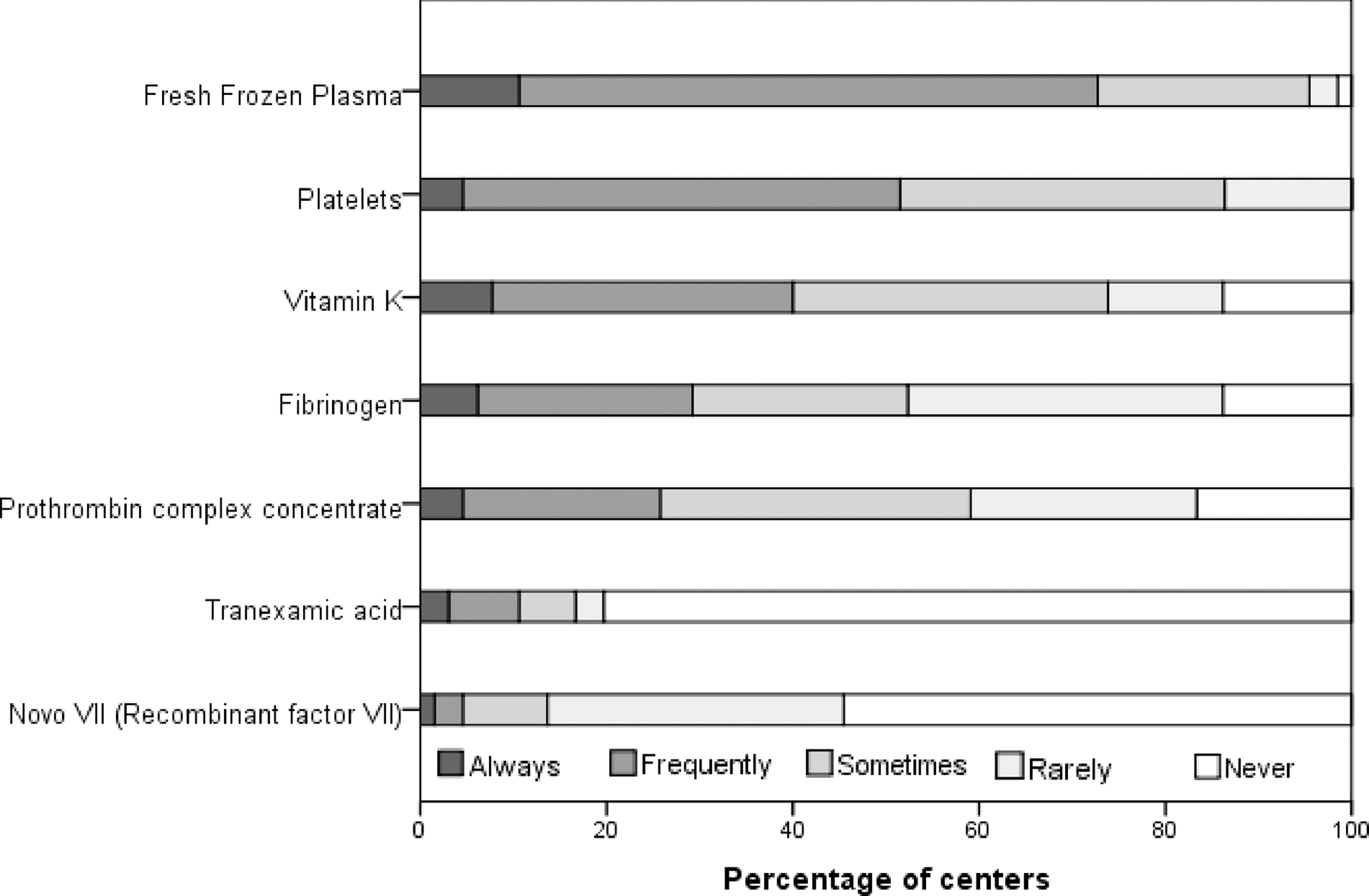
Trauma-related coagulopathy treatment. Bars represent the percentage of centers that indicated to use this treatment as general policy (the way the large majority of patients >75% with a certain indication would be treated). In order of always and frequently summed. Always: in 90–100% of cases; Frequently: in 70–90% of cases; Sometimes: in 30–70% of cases; Rarely: in 10–30% of cases; Never: in 0–10% of cases.
Most centers indicated that they use DVT prophylaxis with anticoagulants frequently (N = 18; 27%) or always (N = 44; 67%) in patients with TBI. Fourteen centers (21%) indicated they generally wait 72 h after trauma before commencing DVT prophylaxis in the absence of hemorrhagic brain lesions. However, twice that number of centers (N = 29; 46%) indicated to wait 72 h after trauma in the presence of hemorrhagic brain lesions. Low-molecular-weight heparin was most commonly indicated as the prophylactic drug of choice (N = 54; 82%), followed by subcutaneous unfractioned heparin (N = 7; 11%) and intravenous heparin (N = 1; 2%; Table 2).
Frequencies and percentage of centers with corresponding answers.
General policy: the way the large majority of patients >75% with a certain indication would be treated at the intensive care.
DVT, deep venous thrombosis.
Most centers indicated that they would always test a coagulation panel before the insertion of a parenchymal sensor (N = 45; 69%) or a ventricular catheter (N = 46; 71%). The reported minimum platelet count for the insertion of a ventricular catheter was variable: >100 × 109/L (N = 30; 46%), >80 × 109/L (N = 9; 14%) or >50 × 109/L (N = 9; 14%). In most of the remaining centers, the minimum platelet count depended on the surgeon (N = 13; 20%). Also, the reported minimum international normalized ratio (INR) considered safe for placement of a ventricular catheter was variable: <1.4 (N = 21; 33%), <1.3 (N = 17; 26%), or <1.2 (N = 8; 12%). Again, in most of the remaining centers the minimum INR was indicated to depend on surgeon's individual preferences (N = 15; 23%) (Table 3).
Frequencies and percentage of centers with corresponding answers.
General policy: the way the large majority of patients >75% with a certain indication would be treated at the intensive care.
Centers that did not have this technique.
DVT, deep venous thrombosis; ICP, intracranial pressure; INR, international normalized ratio; L, liter.
Twenty-nine centers indicated identical policies for coagulation management (always using DVT prophylaxis, and always obtaining a coagulation panel before insertion of a parenchymal or ventricular catheter). The majority of these centers are located in South and East Europe and Israel (N = 13; 56%) versus (N = 16; 37%) in North and West Europe and the majority are located in high-income countries (N = 26; 47%) versus (N = 3; 27%) in lower-income countries.
Discussion
This study shows large between-center variation in blood transfusion and coagulation-directed policies in critically ill patients with TBI. More centers indicated a restrictive Hb-TL (between 70 and 80 g/L) in general ICU patients compared to patients with TBI. Reported coagulation management was variable regarding timing of DVT prophylaxis with anticoagulants, minimum platelet count and INR values before intracranial pressure (ICP) probe insertion, and correction of trauma-related coagulopathy.
The large between-center differences are likely, in part, explained by a lack of evidence on optimal management of patients with TBI. A majority of centers in our study reported to adhere to the 2007 BTF guidelines for the treatment of patients with TBI, but this guideline does not provide specific recommendations on red blood cell transfusion or coagulopathy management. Equally, some trauma guidelines have stated policies on blood transfusion and coagulation in trauma patients, of which some pertain to patients with TBI, but recommendations are still scarce. 1,2,23 A recent update of the Cochrane Review of all Red Cell Transfusion trials reported on 12,587 patients identified in 31 randomized trials and suggested that a restrictive, rather than liberal, transfusion practice improves outcomes, but noted the data were very limited for neurocritical care. 24 Regarding patients with TBI, several trials have been conducted on blood transfusion management, 25,26 and the reversal of coagulopathy, 27,28 but these all had a limited power. A recent large, retrospective, single-center study in TBI patients admitted to the intensive care 8 found that transfusion guided by a restrictive Hb-TL was associated with significantly less time with fever, higher cost-effectiveness, and had the same risk of mortality compared with a liberal Hb-TL. Another explanation for the variation in management would be the between-center variation in the content of available protocols. For example, we found that even between centers that do have a protocol on red blood cell transfusion policy, the reported Hb-TL still varied substantially. Overall, in patients with TBI, there is no conclusive evidence or clear guidance in guidelines and protocols on blood transfusion and coagulopathy treatment. Still, with an aging TBI demographic with an increased prevalence of comorbidity, coagulation management might even become more complex. Concurrent use of anticoagulant and -platelet medication is a growing concern; previous warfarin treatment, for example, is associated with an increased risk of poor outcome. 29 In addition, coagulation management in TBI is further complicated by the recent introduction of newer anticoagulants, such as direct thrombin inhibitors (dabigatran, argatroban). 30
For DVT prophylaxis, the BTF guidelines do provide a recommendation, which was formulated quite broadly: DVT prophylaxis with anticoagulants can be started if the brain injury is stable and the benefit is considered to outweigh the risk of increased intracranial hemorrhage. Recommendations on the preferred agent, dose, or timing are lacking. 18 In our study, only 65% of centers indicated that they always would implement DVT prophylaxis. A review including 15 studies and 4491 patients on DVT occurrence in TBI published in 2015 showed that DVT incidence is significantly increased (18% vs. approximately 2%) when pharmaceutical prophylaxis is not given in the first 8 days. 31 For the timing issue in DVT prophylaxis, a novel theoretical prophylaxis protocol, “the Parkland Protocol,” has been recently described. 32 The protocol takes into account the likelihood of natural progression of brain hemorrhage and in that way determines the timing of anticoagulation. The risk classification is based on the stability of the brain hemorrhage at a computed tomography (CT) scan, the modified Berne Norwood criteria (subdural hematoma >8 mm, epidural hematoma >8 mm, contusion or intraventricular hemorrhage >2 cm, multiple contusions per lobe, and subarachnoid hemorrhage with abnormal CT angiography), and the presence of an ICP monitor or craniectomy. A randomized, controlled trial including 62 low risk patients showed the safety of this protocol for this group: no progression of brain hemorrhage with the use of low-molecular-weight heparin at 24 h post-injury and one DVT with the use of placebo at 24 h post-injury. 33 However, more evidence is needed before this protocol can be widely accepted for the guidelines.
The large between-center variation we found is in line with previous studies. For critically ill trauma patients, several surveys have been conducted to study the management of trauma-related hemorrhage and coagulopathy. 34 –36 These studies also found large differences in clinical practices, even among level I trauma centers, for example, in the use of viscoelastic testing. In the survey of Hamada and colleagues, the reported Hb-TLs in critically ill trauma patients were compared with patients with TBI and were significantly higher in patients with TBI, like in our study. 37 In addition, two previous surveys were conducted that report the percentage of respondents that chose specific Hb-TLs and the rationale for blood transfusion in patients with TBI (coagulation management was not assessed). In the study of Sena and colleagues, a newly developed multiple-choice survey was completed by 312 physicians of the trauma surgery, neurosurgery, and ICU department of level I trauma centers in the United States. 38 In the study of Badenes and colleagues, a newly developed multiple-choice survey was used as well, but was completed by 868 respondents, mostly specialists in anesthesiology and intensive care, worldwide. 39 In the study of Sena and colleagues, 55% of respondents chose a restrictive policy of 70 g/L or less. Likewise, in the study of Badenes and colleagues, 50% of respondents chose a low Hb-TL of 70 or 80 g/L, whereas in our study 16% chose a Hb-TL between 70 and 80 g/L. The difference could either be explained by a difference in patient population (severely injured patients with TBI in the study of Sena and colleagues), by a difference in answer options (we did not have an answer option below 70 g/L), or by a difference in policy between Europe and other continents.
Strengths of our study include the comprehensive development process of the questionnaires and the high response rate of 97%. Limitations include the survey design, resulting in perceived practices rather than actual practices. Although we explicitly asked for general policy and data were anonymously collected, we cannot exclude differences between current findings and actual treatment in the participating centers. In addition, questions were aimed to assess general policy and contained no specific details on patient characteristics. This is not representative for clinical practice (possibly making the questions more difficult to answer). In addition, we could not make a distinction between pharmaceutical versus mechanical DVT prophylaxis. A further limitation comprises the representativeness of our sample. The majority of centers were academic level I trauma centers with a special interest in neurotrauma. Findings are therefore not generalizable to nonspecialized centers. In addition, differences between centers could represent differences in case mix instead of true practice.
The practice variability we report supports that evidence on optimal treatment approaches is needed. Such evidence can potentially be obtained in a nonrandomized design by comparing outcomes between centers with different treatment policies. Such a comparative effectiveness research approach exploits the existing between-center variation. Data on real-time patient management and clinically relevant outcomes in the CENTER-TBI study are now being collected. 20 Future research on blood transfusion and coagulation management in patients with TBI could lead to prevention of progressive brain hemorrhage and secondary problems like coagulopathy and VTE. For now, the optimal transfusion strategies to correct coagulopathy in terms of the ratio of packed blood cells, fresh frozen plasma (or similar products), and platelets are still being debated. 40 This debate pertains both to optimal strategies with regard to reversal of trauma-related coagulopathy and management of coagulopathy induced by conventional agents (such as vitamin K antagonists) and newer ones such as direct thrombin inhibitors. 9,30,41 Still, others warn for the use of transfusion considering the possibility of complications of transfusion and unknown effects on (functional) outcome. 42 Also, for coagulation (enhancing) products, larger studies are needed to prove a positive balance between the beneficial effects in terms of patient outcome and adverse effects on (thromboembolic) complications. 27,28,42 –45 New evidence is clearly needed on these topics, given that control of blood and coagulation status could have a large impact on patient outcome, especially in patients with TBI.
Conclusions
In conclusion, we showed substantial variation in blood and coagulation management of patients with TBI at the ICUs in 66 centers in Europe and Israel participating in the CENTER-TBI study. This variation may be largely attributable to the lack of guidelines and high-quality evidence on these topics. The large practice variation provides an opportunity to study the effectiveness of different policies in comparative effectiveness research.
Footnotes
Acknowledgments
The authors thank all clinical and research staff at the CENTER-TBI sites for completing the provider profiling questionnaires.
This work was supported by European Commission FP7 Framework Program 602150.
Data used in preparation of this manuscript were obtained in the context of CENTER-TBI, a large collaborative project with the support of the European Commission 7th Framework program (602150). The funder had no role in the design of the study and collection, analysis, and interpretation of data and in writing the manuscript.
Center-TBI Investigators and Participants
Adams Hadie1 Alessandro Masala2 Allanson Judith3 Amrein Krisztina4 Andaluz Norberto5 Andelic Nada6 Andrea Nanni2 Andreassen Lasse7 Anke Audny8 Antoni Anna9 Ardon Hilko10 Audibert Gérard,11 Auslands Kaspars,12 Azouvi Philippe,13 Baciu Camelia,14 Bacon Andrew,15 Badenes Rafael,16 Baglin Trevor,17 Bartels Ronald,18 Barzó Pál,19 Bauerfeind Ursula,20 Beer Ronny,21 Belda Francisco Javier,16 Bellander Bo-Michael,22 Belli Antonio,23 Bellier Rémy,24 Benali Habib,25 Benard Thierry,24 Berardino Maurizio,26 Beretta Luigi,27 Beynon Christopher,28 Bilotta Federico,16 Binder Harald,9 Biqiri Erta,14 Blaabjerg Morten,29 Borgen Lund Stine,30 Bouzat Pierre,31 Bragge Peter,32 Brazinova Alexandra,33 Brehar Felix,34 Brorsson Camilla,35 Buki Andras,36 Bullinger Monika,37 Bučková Veronika,33 Calappi Emiliana,38 Cameron Peter,39 Carbayo Lozano Guillermo,40 Carise Elsa,24 Carpenter K.,41 Castaño-León Ana M.,42 Causin Francesco,43 Chevallard Giorgio,14 Chieregato Arturo,14 Citerio Giuseppe,44,45 Cnossen Maryse,46 Coburn Mark Coburn,47 Coles Jonathan,48 Cooper Jamie D.,49 Correia Marta,50 Covic Amra,51 Curry Nicola,52 Czeiter Endre,53 Czosnyka Marek,54 Dahyot-Fizelier Claire,24 Damas François,55 Damas Pierre,56 Dawes Helen,57 De Keyser Véronique,58 Della Corte Francesco,59 Depreitere Bart,60 Ding Shenghao,61 Dippel Diederik,62 Dizdarevic Kemal,63 Dulière Guy-Loup,55 Dzeko Adelaida,64 Eapen George,15 Engemann Heiko,51 Ercole Ari,65 Esser Patrick,57 Ezer Erzsébet,66 Fabricius Martin,67 Feigin Valery L.,68 Feng Junfeng,61 Foks Kelly,62 Fossi Francesca,14 Francony Gilles,31 Frantzén Janek,69 Freo Ulderico,70 Frisvold Shirin,71 Furmanov Alex,72 Gagliardo Pablo,73 Galanaud Damien,25 Gao Guoyi,74 Geleijns Karin,41 Ghuysen Alexandre,75 Giraud Benoit,24 Glocker Ben,76 Gomez Pedro A.,42 Grossi Francesca,59 Gruen Russell L.,77 Gupta Deepak,78 Haagsma Juanita A.,46 Hadzic Ermin,64 Haitsma Iain,79 Hartings Jed A.,80 Helbok Raimund,21 Helseth Eirik,81 Hertle Daniel,28 Hill Sean,82 Hoedemaekers Astrid,83 Hoefer Stefan,51 Hutchinson Peter J.,1 Håberg Asta Kristine,84 Jacobs Bram,85 Janciak Ivan,86 Janssens Koen,58 Jiang Ji-yao,74 Jones Kelly,87 Kalala Jean-Pierre,88 Kamnitsas Konstantinos,76 Karan Mladen,89 Karau Jana,20 Katila Ari,69 Kaukonen Maija,90 Keeling David,52 Kerforne Thomas,24 Ketharanathan Naomi,41 Kettunen Johannes,91 Kivisaari Riku,90 Kolias Angelos G.,1 Kolumbán Bálint,92 Kompanje Erwin,93 Kondziella Daniel,67 Koskinen Lars-Owe,35 Kovács Noémi,92 Kálovits Ferenc,94 Lagares Alfonso,42 Lanyon Linda,82 Laureys Steven,95 Lauritzen Martin,67 Lecky Fiona,96 Ledig Christian,76 Lefering Rolf,97 Legrand Valerie,98 Lei Jin,61 Levi Leon,99 Lightfoot Roger,100 Lingsma Hester,46 Loeckx Dirk,101 Lozano Angels,16 Luddington Roger,17 Luijten-Arts Chantal,83 Maas Andrew I.R.,58 MacDonald Stephen,17 MacFayden Charles,65 Maegele Marc,102 Majdan Marek,33 Major Sebastian,103 Manara Alex,104 Manhes Pauline,31 Manley Geoffrey,105 Martin Didier,106 Martino Costanza,2 Maruenda Armando,16 Maréchal Hugues,55 Mastelova Dagmara,86 Mattern Julia,28 McMahon Catherine,107 Melegh Béla,108 Menon David,65 Menovsky Tomas,58 Morganti-Kossmann Cristina,109 Mulazzi Davide,38 Mutschler Manuel,102 Mühlan Holger,110 Negru Ancuta,111 Nelson David,82 Neugebauer Eddy,102 Newcombe Virginia,65 Noirhomme Quentin,95 Nyirádi József,4 Oddo Mauro,112 Oldenbeuving Annemarie,113 Oresic Matej,114 Ortolano Fabrizio,38 Palotie Aarno,91,115,116 Parizel Paul M.,117 Patruno Adriana,118 Payen Jean-François,31 Perera Natascha,119 Perlbarg Vincent,25 Persona Paolo,120 Peul Wilco,121 Pichon Nicolas,122 Piilgaard Henning,67 Piippo Anna,90 Pili Floury Sébastien,123 Pirinen Matti,91 Ples Horia,111 Polinder Suzanne,46 Pomposo Inigo,40 Psota Marek,33 Pullens Pim,117 Puybasset Louis,124 Ragauskas Arminas,125 Raj Rahul,90 Rambadagalla Malinka,126 Rehorčíková Veronika,33 Rhodes Jonathan,127 Richardson Sylvia,128 Ripatti Samuli,91 Rocka Saulius,125 Rodier Nicolas,122 Roe Cecilie,129 Roise Olav,130 Roks Gerwin,131 Romegoux Pauline,31 Rosand Jonathan,132 Rosenfeld Jeffrey,109 Rosenlund Christina,133 Rosenthal Guy,72 Rossaint Rolf,47 Rossi Sandra,120 Rostalski Tim,110 Rueckert Daniel,76 Ruiz de Arcaute Felix,101 Rusnák Martin,86 Sacchi Marco,14 Sahakian Barbara,65 Sahuquillo Juan,134 Sakowitz Oliver,135,136 Sala Francesca,118 Sanchez-Pena Paola,25 Sanchez-Porras Renan,28,135 Sandor Janos,137 Santos Edgar,28 Sasse Nadine,51 Sasu Luminita,59 Savo Davide,118 Schipper Inger,138 Schlößer Barbara,20 Schmidt Silke,110 Schneider Annette,97 Schoechl Herbert,139 Schoonman Guus,131 Schou Rico Frederik,140 Schwendenwein Elisabeth,9 Schöll Michael,28 Sir Özcan,141 Skandsen Toril,142 Smakman Lidwien,143 Smeets Dirk,101 Smielewski Peter,54 Sorinola Abayomi,144 Stamatakis Emmanuel,65 Stanworth Simon,52 Stegemann Katrin,110 Steinbüchel Nicole,145 Stevens Robert,146 Stewart William,147 Steyerberg Ewout W.,46 Stocchetti Nino,148 Sundström Nina,35 Synnot Anneliese,149,150 Szabó József,94 Söderberg Jeannette,82 Taccone Fabio Silvio,16 Tamás Viktória,144 Tanskanen Päivi,90 Tascu Alexandru,34 Taylor Mark Steven,33 Te Ao Braden,68 Tenovuo Olli,69 Teodorani Guido,151 Theadom Alice,68 Thomas Matt,104 Tibboel Dick,41 Tolias Christos,152 Tshibanda Jean-Flory Luaba,153 Tudora Cristina Maria,111 Vajkoczy Peter,154 Valeinis Egils,155 Van Hecke Wim,101 Van Praag Dominique,58 Van Roost Dirk,88 Van Vlierberghe Eline,101 Vande Vyvere Thijs,101 Vanhaudenhuyse Audrey,25,95 Vargiolu Alessia,118 Vega Emmanuel,156 Verheyden Jan,101 Vespa Paul M.,157 Vik Anne,158 Vilcinis Rimantas,159 Vizzino Giacinta,14 Vleggeert-Lankamp Carmen,143 Volovici Victor,79 Vulekovic Peter,89 Vámos Zoltán,66 Wade Derick,57 Wang Kevin K.W.,160 Wang Lei,61 Wildschut Eno,41 Williams Guy,65 Willumsen Lisette,67 Wilson Adam,5 Wilson Lindsay,161 Winkler Maren K.L.,103 Ylén Peter,162 Younsi Alexander,28 Zaaroor Menashe,99 Zhang Zhiqun,163 Zheng Zelong,28 Zumbo Fabrizio,2 de Lange Stefanie,97 de Ruiter Godard C.W.,143 den Boogert Hugo,18 van Dijck Jeroen,164 van Essen Thomas A.,121 van Heugten Caroline,57 van der Jagt Mathieu,165 van der Naalt Joukje85
1Division of Neurosurgery, Department of Clinical Neurosciences, Addenbrooke's Hospital & University of Cambridge, Cambridge, United Kingdom.
2Department of Anesthesia & Intensive Care, M. Bufalini Hospital, Cesena, Italy.
3Department of Clinical Neurosciences, Addenbrooke's Hospital & University of Cambridge, Cambridge, United Kingdom.
4János Szentágothai Research Centre, University of Pécs, Pécs, Hungary.
5University of Cincinnati, Cincinnati, Ohio.
6Division of Surgery and Clinical Neuroscience, Department of Physical Medicine and Rehabilitation, Oslo University Hospital and University of Oslo, Oslo, Norway.
7Department of Neurosurgery, University Hospital Northern Norway, Tromso, Norway.
8Department of Physical Medicine and Rehabilitation, University Hospital Northern Norway, Tromso, Norway.
9Trauma Surgery, Medical University Vienna, Vienna, Austria.
10Department of Neurosurgery, Elisabeth-Tweesteden Ziekenhuis, Tilburg, The Netherlands.
11Department of Anesthesiology & Intensive Care, University Hospital Nancy, Nancy, France.
12Riga Eastern Clinical University Hospital, Riga, Latvia.
13Raymond Poincare Hospital, Assistance Publique–Hopitaux de Paris, Paris, France.
14NeuroIntensive Care, Niguarda Hospital, Milano, Italy.
15Neurointensive Care, Sheffield Teaching Hospitals NHS Foundation Trust, Sheffield, United Kingdom.
16Department Anesthesiology and Surgical-Trauma Intensive Care, Hospital Clinic Universitari de Valencia, Valencia, Spain.
17Cambridge University Hospitals, Cambridge, United Kingdom.
18Department of Neurosurgery, Radboud University Medical Center, Nijmegen, The Netherlands.
19Department of Neurosurgery, University of Szeged, Szeged, Hungary.
20Institute for Transfusion Medicine (ITM), Witten/Herdecke University, Cologne, Germany.
21Department of Neurocritical care, Innsbruck Medical University, Innsbruck, Austria.
22Deparment of Neurosurgery & Anesthesia & Intensive Care Medicine, Karolinska University Hospital, Stockholm, Sweden.
23NIHR Surgical Reconstruction and Microbiology Research Centre, Birmingham, United Kingdom.
24Intensive care Unit, CHU Poitiers, Poitiers, France.
25Anesthesie-Réanimation, Assistance Publique – Hopitaux de Paris, Paris, France
26Department of Anesthesia & ICU, AOU Città della Salute e della Scienza di Torino–Orthopedic and Trauma Center, Torino, Italy.
27Department of Anesthesiology & Intensive Care, S Raffaele University Hospital, Milan, Italy.
28Department of Neurosurgery, University Hospital Heidelberg, Heidelberg, Germany.
29Department of Neurology, Odense University Hospital, Odense, Denmark.
30Departments of Neuroscience and Nursing Science, Norwegian University of Science and Technology, Trondheim, Norway.
31Department of Anesthesiology & Intensive Care, University Hospital of Grenoble, Grenoble, France.
32BehaviourWorks Australia, Monash Sustainability Institute, Monash University, Clayton, Victoria, Australia.
33Department of Public Health, Faculty of Health Sciences and Social Work, Trnava University, Trnava, Slovakia.
34Department of Neurosurgery, Bagdasar-Arseni Emergency Clinical Hospital, Bucharest, Romania.
35Department of Neurosurgery, Umea University Hospital, Umea, Sweden.
36Department of Neurosurgery, University of Pecs and MTA-PTE Clinical Neuroscience MR Research Group and Janos Szentagothai Research Center, University of Pecs, Hungarian Brain Research Program, Pecs, Hungary.
37Department of Medical Psychology, Universitätsklinikum Hamburg-Eppendorf, Hamburg, Germany.
38Neuro ICU, Fondazione IRCCS Cà Granda Ospedale Maggiore Policlinico, Milan, Italy.
39Department of Epidemiology and Preventive Medicine, Monash University, Melbourne, Victoria, Australia.
40Department of Neurosurgery, Hospital of Cruces, Bilbao, Spain.
41Intensive Care and Department of Pediatric Surgery, Erasmus Medical Center, Sophia Children's Hospital, Rotterdam, The Netherlands.
42Department of Neurosurgery, Hospital Universitario 12 de Octubre, Madrid, Spain.
43Department of Neuroscience, Azienda Ospedaliera Università di Padova, Padova, Italy.
44NeuroIntensive Care, Azienda Ospedaliera San Gerardo di Monza, Monza, Italy.
45School of Medicine and Surgery, Università Milano Bicocca, Milano, Italy.
46Department of Public Health, Erasmus Medical Center–University Medical Center, Rotterdam, The Netherlands.
47Department of Anesthesiology, University Hospital of Aachen, Aachen, Germany.
48Department of Anesthesia & Neurointensive Care, Cambridge University Hospital NHS Foundation Trust, Cambridge, United Kingdom.
49School of Public Health & PM, Monash University and The Alfred Hospital, Melbourne, Victoria, Australia.
50Radiology/MRI department, MRC Cognition and Brain Sciences Unit, Cambridge, United Kingdom.
51Institute of Medical Psycholology and Medical Sociology, Universitätsmedizin Göttingen, Göttingen, Germany.
52Oxford University Hospitals NHS Trust, Oxford, United Kingdom.
53Department of Neurosurgery, University of Pecs and MTA-PTE Clinical Neuroscience MR Research Group and Janos Szentagothai Research Center, University of Pecs, Hungarian Brain Research Program (Grant No. KTIA 13 NAP-A-II/8), Pecs, Hungary.
54Brain Physics Lab, Division of Neurosurgery, Department of Clinical Neurosciences, University of Cambridge, Addenbrooke's Hospital, Cambridge, United Kingdom
55Intensive Care Unit, CHR Citadelle, Liège, Belgium.
56Intensive Care Unit, CHU, Liège, Belgium.
57Movement Science Group, Faculty of Health and Life Sciences, Oxford Brookes University, Oxford, United Kingdom.
58Department of Neurosurgery, Antwerp University Hospital and University of Antwerp, Edegem, Belgium.
59Department of Anesthesia & Intensive Care, Maggiore Della Carità Hospital, Novara, Italy.
60Department of Neurosurgery, University Hospitals Leuven, Leuven, Belgium.
61Department of Neurosurgery, Renji Hospital, Shanghai Jiaotong University School of Medicine, Shanghai, China.
62Department of Neurology, Erasmus MC, Rotterdam, The Netherlands.
63Department of Neurosurgery, Medical Faculty and clinical center University of Sarajevo, Sarajevo, Bosnia Herzegovina.
64Department of Neurosurgery, Regional Medical Center dr Safet Mujić, Mostar, Bosnia, Herzegovina.
65Division of Anaesthesia, University of Cambridge, Addenbrooke's Hospital, Cambridge, United Kingdom.
66Department of Anaesthesiology and Intensive Therapy, University of Pécs, Pécs, Hungary.
67Departments of Neurology, Clinical Neurophysiology and Neuroanesthesiology, Region Hovedstaden Rigshospitalet, Copenhagen, Denmark.
68National Institute for Stroke and Applied Neurosciences, Faculty of Health and Environmental Studies, Auckland University of Technology, Auckland, New Zealand.
69Rehabilitation and Brain Trauma, Turku University Central Hospital and University of Turku, Turku, Finland.
70Department of Medicine, Azienda Ospedaliera Università di Padova, Padova, Italy.
71Department of Anesthesiology and Intensive care, University Hospital Northern Norway, Tromso, Norway.
72Department of Neurosurgery, Hadassah-Hebrew University Medical Center, Jerusalem, Israel.
73Fundación Instituto Valenciano de Neurorrehabilitación (FIVAN), Valencia, Spain.
74Department of Neurosurgery, Shanghai Renji hospital, Shanghai Jiaotong University/School of Medicine, Shanghai, China.
75Emergency Department, CHU, Liège, Belgium.
76Department of Computing, Imperial College London, London, United Kingdom.
77Lee Kong Chian School of Medicine, Nanyang Technological University, Singapore; and Monash University, Clayton, Victoria, Australia.
78Department of Neurosurgery, Neurosciences Centre & JPN Apex Trauma Center, All India Institute of Medical Sciences, New Delhi, India.
79Department of Neurosurgery, Erasmus MC, Rotterdam, The Netherlands.
80Department of Neurosurgery, University of Cincinnati, Cincinnati, Ohio.
81Department of Neurosurgery, Oslo University Hospital, Oslo, Norway.
82Department of Physiology and Pharmacology, Section of Perioperative Medicine and Intensive Care, Karolinska Institutet, Stockholm, Sweden.
83Department of Intensive Care Medicine, Radboud University Medical Center, Nijmegen, The Netherlands.
84Department of Medical Imaging, St. Olavs Hospital and Department of Neuroscience, Norwegian University of Science and Technology, Trondheim, Norway.
85Department of Neurology, University Medical Center Groningen, Groningen, The Netherlands.
86International Neurotrauma Research Organization, Vienna, Austria.
87National Institute for Stroke & Applied Neurosciences of the AUT University, Auckland, New Zealand.
88Department of Neurosurgery, UZ Gent, Gent, Belgium.
89Department of Neurosurgery, Clinical Center of Vojvodina, Novi Sad, Serbia.
90Helsinki University Central Hospital, Helsinki, Finland.
91Institute for Molecular Medicine Finland, University of Helsinki, Helsinki, Finland.
92Hungarian Brain Research Program–Grant No. KTIA 13 NAP-A-II/8, University of Pécs, Pécs, Hungary.
93Department of Intensive Care and Department of Ethics and Philosophy of Medicine, Erasmus Medical Center, Rotterdam, The Netherlands
94Department of Neurological & Spinal Surgery, Markusovszky University Teaching Hospital, Szombathely, Hungary.
95Cyclotron Research Center, University of Liège, Liège, Belgium.
96Emergency Medicine Research in Sheffield, Health Services Research Section, School of Health and Related Research (ScHARR), University of Sheffield, Sheffield, United Kingdom.
97Institute of Research in Operative Medicine (IFOM), Witten/Herdecke University, Cologne, Germany.
98VP Global Project Management CNS, ICON, Paris, France.
99Department of Neurosurgery, Rambam Medical Center, Haifa, Israel.
100Department of Anesthesiology & Intensive Care, University Hospitals Southhampton NHS Trust, Southhampton, United Kingdom.
101icoMetrix NV, Leuven, Belgium.
102Cologne-Merheim Medical Center (CMMC), Department of Traumatology, Orthopedic Surgery and Sportmedicine, Witten/Herdecke University, Cologne, Germany.
103Centrum für Schlaganfallforschung, Charité–Universitätsmedizin Berlin, Berlin, Germany.
104Intensive Care Unit, Southmead Hospital, Bristol, Bristol, United Kingdom.
105Department of Neurological Surgery, University of California, San Francisco, California.
106Department of Neurosurgery, CHU, Liège, Belgium.
107Department of Neurosurgery, The Walton Center NHS Foundation Trust, Liverpool, United Kingdom.
108Department of Medical Genetics, University of Pécs, Pécs, Hungary.
109National Trauma Research Institute, The Alfred Hospital, Monash University, Melbourne, Victoria, Australia.
110Department Health and Prevention, University Greifswald, Greifswald, Germany.
111Department of Neurosurgery, Emergency County Hospital Timisoara, Timisoara, Romania.
112Center Hospitalier Universitaire Vaudois, Lausanne, Switzerland.
113Department of Intensive Care, Elisabeth-Tweesteden Ziekenhuis, Tilburg, The Netherlands.
114Department of Systems Medicine, Steno Diabetes Center, Gentofte, Denmark.
115Analytic and Translational Genetics Unit, Department of Medicine; Psychiatric & Neurodevelopmental Genetics Unit, Department of Psychiatry; Department of Neurology, Massachusetts General Hospital, Boston, Massachusetts.
116Program in Medical and Population Genetics; The Stanley Center for Psychiatric Research, The Broad Institute of MIT and Harvard, Cambridge, Massachusetts.
117Department of Radiology, Antwerp University Hospital and University of Antwerp, Edegem, Belgium.
118NeuroIntenisve Care Unit, Department of Anesthesia & Intensive Care Azienda Ospedaliera San Gerardo di Monza, Monza, Italy.
119International Projects Management, ARTTIC, Munchen, Germany.
120Department of Anesthesia & Intensive Care, Azienda Ospedaliera Università di Padova, Padova, Italy.
121Department of Neurosurgery, Leiden University Medical Center, Leiden, The Netherlands and Department of Neurosurgery, Medical Center Haaglanden, The Hague, The Netherlands.
122Intensive Care Unit, CHU Dupuytren, Limoges, France.
123Intensive Care Unit, CHRU de Besançon, Besançon, France.
124Department of Anesthesiology and Critical Care, Pitié-Salpêtrière Teaching Hospital, Assistance Publique, Hôpitaux de Paris and University Pierre et Marie Curie, Paris, France.
125Department of Neurosurgery, Kaunas University of technology and Vilnius University, Vilnius, Lithuania.
126Rezekne Hospital, Rēzekne, Latvia.
127Department of Anesthesia, Critical Care & Pain Medicine, NHS Lothian & University of Edinburg, Edinburgh, United Kingdom.
128Director, MRC Biostatistics Unit, Cambridge Institute of Public Health, Cambridge, United Kingdom.
129Department of Physical Medicine and Rehabilitation, Oslo University Hospital/University of Oslo, Oslo, Norway.
130Division of Surgery and Clinical Neuroscience, Oslo University Hospital, Oslo, Norway.
131Department of Neurology, Elisabeth-TweeSteden Ziekenhuis, Tilburg, The Netherlands.
132Broad Institute, Cambridge, Massachusetts; Harvard Medical School, Boston, Massachusetts; Massachusetts General Hospital, Boston, Massachusetts.
133Department of Neurosurgery, Odense University Hospital, Odense, Denmark.
134Department of Neurosurgery, Vall d'Hebron University Hospital, Barcelona, Spain.
135Klinik für Neurochirurgie, Klinikum Ludwigsburg, Ludwigsburg, Germany.
136University Hospital Heidelberg, Heidelberg, Germany.
137Division of Biostatistics and Epidemiology, Department of Preventive Medicine, University of Debrecen, Debrecen, Hungary.
138Department of Traumasurgery, Leiden University Medical Center, Leiden, The Netherlands.
139Department of Anaesthesiology and Intensive Care, AUVA Trauma Hospital, Salzburg, Austria.
140Department of Neuroanesthesia and Neurointensive Care, Odense University Hospital, Odense, Denmark.
141Department of Emergency Care Medicine, Radboud University Medical Center, Nijmegen, The Netherlands.
142Department of Physical Medicine and Rehabilitation, St. Olavs Hospital and Department of Neuroscience, Norwegian University of Science and Technology, Trondheim, Norway.
143Neurosurgical Cooperative Holland, Department of Neurosurgery, Leiden University Medical Center and Medical Center Haaglanden, Leiden and The Hague, The Netherlands.
144Department of Neurosurgery, University of Pécs, Pécs, Hungary.
145Universitätsmedizin Göttingen, Göttingen, Germany.
146Division of Neuroscience Critical Care, John Hopkins University School of Medicine, Baltimore, Maryland.
147Department of Neuropathology, Queen Elizabeth University Hospital and University of Glasgow, Glasgow, United Kingdom.
148Department of Pathophysiology and Transplantation, Milan University, and Neuroscience ICU, Fondazione IRCCS Cà Granda Ospedale Maggiore Policlinico, Milano, Italy.
149Australian & New Zealand Intensive Care Research Center, Department of Epidemiology and Preventive Medicine, School of Public Health and Preventive Medicine, Monash University, Melbourne, Australia.
150Cochrane Consumers and Communication Review Group, Center for Health Communication and Participation, School of Psychology and Public Health, La Trobe University, Melbourne, Australia.
151Department of Reahabilitation, M. Bufalini Hospital, Cesena, Italy.
152Department of Neurosurgery, Kings College London, London, United Kingdom.
153Radiology/MRI Department, CHU, Liège, Belgium.
154Neurologie, Neurochirurgie und Psychiatrie, Charité–Universitätsmedizin Berlin, Berlin, Germany.
155Pauls Stradins Clinical University Hospital, Riga, Latvia.
156Department of Anesthesiology-Intensive Care, Lille University Hospital, Lille, France.
157Director of Neurocritical Care, University of California, Los Angeles, California.
158Department of Neurosurgery, St. Olavs Hospital and Department of Neuroscience, Norwegian University of Science and Technology, Trondheim, Norway.
159Department of Neurosurgery, Kaunas University of Health Sciences, Kaunas, Lithuania.
160Department of Psychiatry, University of Florida, Gainesville, Florida.
161Division of Psychology, University of Stirling, Stirling, United Kingdom.
162VTT Technical Research Center, Tampere, Finland.
163University of Florida, Gainesville, Florida.
164Department of Neurosurgery, The HAGA Hospital, The Hague, The Netherlands.
165Department of Intensive Care, Erasmus MC, Rotterdam, The Netherlands.
Author Disclosure Statement
No competing financial interests exist
References
Supplementary Material
Please find the following supplemental material available below.
For Open Access articles published under a Creative Commons License, all supplemental material carries the same license as the article it is associated with.
For non-Open Access articles published, all supplemental material carries a non-exclusive license, and permission requests for re-use of supplemental material or any part of supplemental material shall be sent directly to the copyright owner as specified in the copyright notice associated with the article.
