




Abstract
It has been reported that female rats have a sex-related advantage in functional recovery and neuroprotection after spinal cord injury (SCI). However, the association between anxiety and neurological function after SCI in female and male rats remains unclear. The aim of this study was to examine sex-related differences in anxiety and neurological dysfunction after SCI in adult C57/BL6 male and female mice. After laminectomy at the 10th thoracic level, a contusive SCI was induced. The sham group received only a T10 laminectomy. Behavior testing (anxiety, motor/sensory function) was performed for 6 weeks after SCI. The spinal cord and preserved myelinated areas at the epicenter were histologically evaluated. Correlations between anxiety and motor/sensory function or histological parameters were analyzed using the Spearman correlation coefficient. Female and male mice showed significantly higher anxiety-like behaviors after SCI than before SCI. Anxiousness was significantly higher in female mice than in male mice after SCI. There was no significant difference in motor/sensory functions and histological features between the two groups. Anxiety-like behaviors were significantly correlated with sensory function at 2 weeks after SCI in female mice and with motor function at 2, 4, and 6 weeks after SCI in male mice. Anxiety-like behaviors were not significantly correlated with the spinal cord area at the epicenter in female and male mice. Our results revealed that female mice became more anxious than male mice after SCI. Anxiety-like behavior after SCI may be associated with functional recovery, and improving anxiety may affect functional recovery after injury.
Introduction
Spinal cord injury (SCI) usually results in pain, disability, and neurological dysfunction, causing impaired mobility and loss of functional independence. Besides, after SCI, injured persons have a Hospital Anxiety and Depression Scale score that is consistent with probable anxiety. 1 Some studies have performed meta-analyses or systematic reviews on anxiety or depression after SCI. 2,3 Reportedly, prevalence of anxiety based on self-reported measures is 15–32%, 4 and prevalence of depression is ∼19–26%. 5
A previous study examined the relationships between inflammation, depression, and anxiety after SCI, using a rat model of SCI. 6 It revealed that locomotor function is not related to psychological well-being by using the sucrose preference test, open field test (OFT), and forced swim test; however, it revealed a relationship between pain and anxiety. We previously reported that SCI causes anxiety and that anxiety-model mice with phospholipase C–related catalytically inactive protein type 1 knockout show poorer motor function recovery after SCI than do wild-type mice. 7 Further, it was reported that female adult rats have a sex-related and possibly even neuroprotective advantage in functional recovery after thoracic contusive SCI. 8 Although some studies describe that SCI causes anxiety, there are no reports on sex-related differences in anxiety and functional recovery after SCI in mice. This study examined the sex-related differences in anxiety and motor/sensory recovery between adult C57BL/6J female and male mice after SCI.
Methods
Animals
We used 8-week-old male and female adult C57BL/6J mice weighing 18–20 g in this study. We randomly divided female and male mice into three groups (SCI group, sham group, and naïve group), each with 11 animals. Animals were habituated to housing conditions for 5 days before experimental procedures. Estradiol cycles of all female mice were regulated. Well-trained investigators, blinded to the treatments, performed the behavioral analysis at the same time each day. All procedures involving animals were conducted according to the guidelines of the Institutional Animal Care and Research Advisory Committee of Hirosaki University (Hirosaki, Japan).
Surgical and injury procedures
Female and male mice were anesthetized with 1% isoflurane mixed with 30% oxygen. After shaving the skin, a scalpel blade was used to make a longitudinal incision along the surface of the skin on the dorsal side. After laminectomy at the 10th thoracic spinal vertebra (T10) and exposure of the spinal cord, SCI was induced using a commercially available device (IH impactor; Precision Systems and Instrumentation, Lexington, KY), as described previously, 9 by clamping the transverse processes of the vertebrae T9 and T11. This impactor uses a 2-mm impact rod tip to contuse the spinal cord, and the user determines the force of the impact, the latter being defined by the duration of the compression or “dwell-time.” For SCI groups, a force of 60 kilodynes (kdyn) was applied. After the impact, animals were removed from the device, muscles and fasciae were sutured with a 5-0 polypropylene suture, and the skin incision was closed with autoclips. The sham group received only a surgical procedure without damage, and the naïve group received only anesthesia without a surgical procedure.
Assessment of anxiety-like behavior
Assessment of anxiety-like behavior was measured before surgery and on days 14 (2 weeks), 28 (4 weeks), and 42 (6 weeks) after surgery.
The OFT is one of the most commonly used procedures to assess anxiety-like behavior and motor function in animal psychology and SCI studies. 7,10 Spontaneous exploratory behavior was evaluated with an OFT apparatus (24 × 24 cm) placed in a quiet room illuminated with white light. 11 The floor of the apparatus was divided equally into nine squares (8 × 8 cm). Each mouse was placed individually into the open field on the central square, and its spontaneous behavior was recorded by a video tracking system (Capture Star; CleverSys, Inc., Reston, VA) for 10 min before being scored by an observer blinded to the experimental conditions.
An animal's very first exposure to the OFT can be used to assess changes in emotionality induced by exposure to a novel environment. 11 Rodents tend to stay in close contact with the walls of the open field apparatus in which they are placed. Mice with emotional disorders make fewer entries into the central part of the arena than do normal mice. We calculated the total distance traveled by the mouse, average velocity, and percentage of walking distance that fell within the central 25% of the open field using an analysis software (TopScan; CleverSys, Inc.). The percentage of distance covered in the central 25% of the field (IC-25) was calculated by dividing the walking distance covered in the central 25% area by the total walking distance. 7 A decrease in the IC-25 value indicates increased anxiety (Fig. 1A). In addition, the total walking distance and average acceleration were measured to evaluate motor functions.
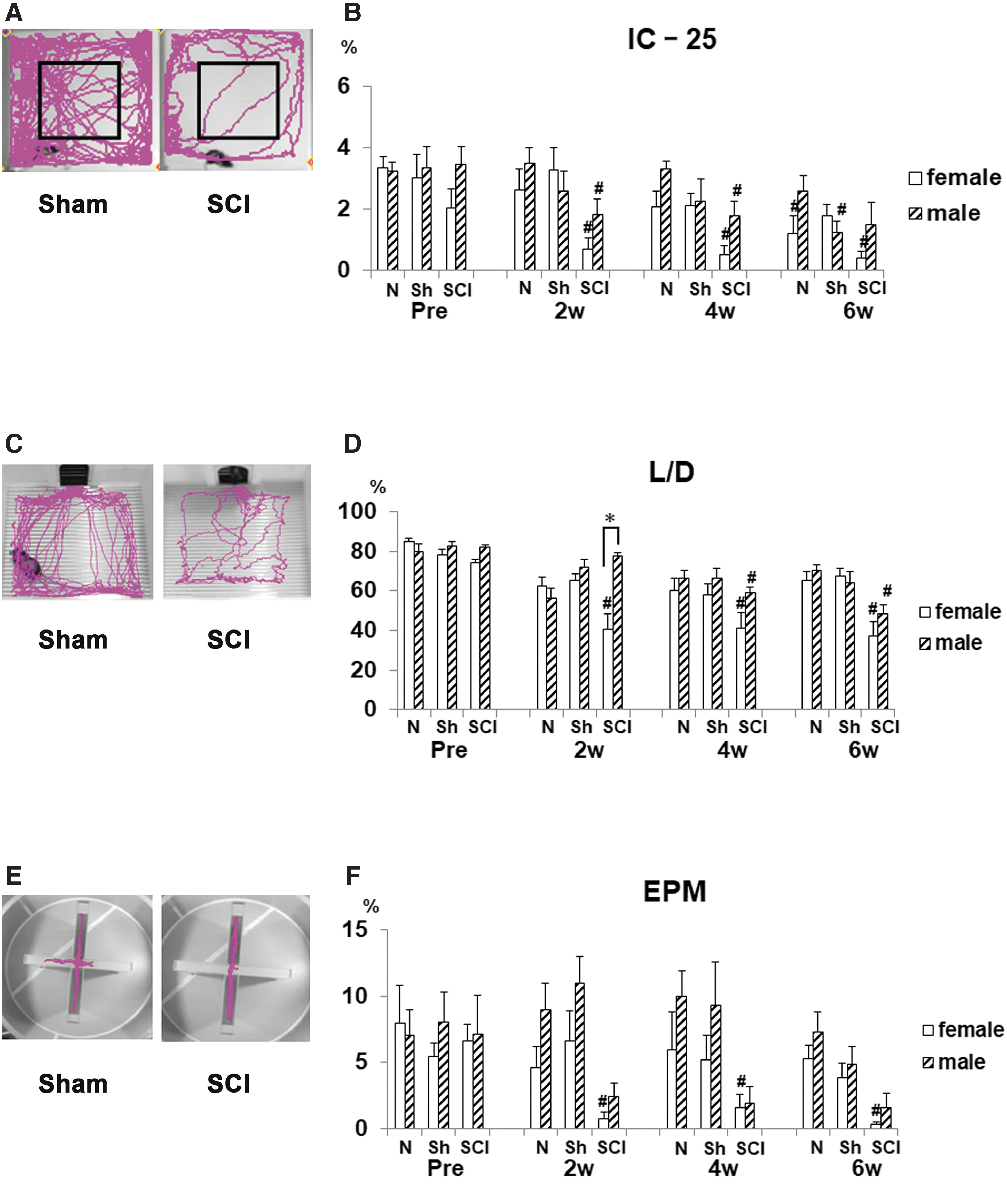
Assessment of mice in anxiety tests. (
The use of the Light-Dark box test (L/D) is popular in pharmacological studies to evaluate unconditioned anxiety responses in rodents. 12 The test setup is constituted by two adjacent boxes, 24 × 24 cm (Light box) and 13 cm × 7 cm (Dark box). These boxes are connected at floor level. Light intensity in the center of the Light box was set at 100 lx, whereas that in the dark box was maintained at 0 lx. For this test, mice were habituated to the Dark box for 5 min. Mice appeared at the Light box after opening the connection door, and their behaviors were recorded for a 5-min period. The analyzed parameters were the percentages of time spent in the Light box using an analysis software (TopScan; CleverSys, Inc.).
The elevated plus maze (EPM) is one of the commonly used tests to measure anxiety-like behavior in mice. The test is based on the natural aversion of mice for open and elevated areas, as well as on their natural spontaneous exploratory behavior in novel environments. 13 There is a cruciform platform (75 × 75 cm) composed of two closed arms and two open arms elevated 50 cm above the ground. The two closed arms are opposite to each other with opaque walls on the sides. The remaining two arms (open arms) have no walls. All arms are connected by a central zone, allowing animals to move freely into each arm of the EPM. Their movements in the EPM were monitored for 5 min with an overhead camera. The percentage of time spent in open arms (time in open arms/5 min × 100) was analyzed using an analysis software (TopScan; CleverSys, Inc.). A decrease in the percentage of time spent in open arms indicated an increase in anxiety-like behaviors.
Assessment of locomotor function
Locomotor function was assessed throughout the 42-day recovery period with the Basso Mouse Scale (BMS), the rotarod test, and total distance and velocity in the OFT.
The BMS is a sensitive, valid, and reliable tool for measuring locomotor function in SCI mice. 14 Two non-biased observers analyzed hindlimb performance using the BMS locomotor rating scale. This was evaluated on a 10-point scale (0–9 points) based on the paw position and trunk instability of the mouse. BMS scores were recorded in mice by trained observers on the pre-surgery day and on days 1, 7, 14, 28, and 42 after surgery.
The rotarod (Rotarod; Ugo Basile, Varese, Italy) evaluates the balance and coordination of mice. 15,16 This test involves placing a mouse on a rotating rod to measure the time until the mouse falls. The rotation was electronically set at a constant speed (10 rpm). We set a run time of 2 min as the maximum time. Three trials were conducted for each mouse.
Assessment of sensory function
We also evaluated cutaneous sensitivity to mechanical and thermal stimulation. In the Mechanical test, mice were placed in Plexiglass containers resting on an elevated wire mesh. Mechanical nociceptive thresholds for paw withdrawal were assessed by pressing filaments in the sole of the hind paw using a commercially available device set to automatic strength. Duration of time and the amount of pressure required to lift its hindlimb by mechanical stimulation were measured (The Dynamic Plantar Aesthesiometer; Ugo Basile). The mouse was acclimatized to the testing area for 30 min before testing. Each test involved five trials on each hind paw, with at least 1 min between trials, and a randomized order of testing to minimize avoidance behaviors. 17,18
After the latency measurement, the Plantar Test Apparatus (Ugo Basile) was used to assess reactions to thermal stimulation. In this test, the mouse was placed in a Plexiglass container resting on an elevated glass surface. When the mouse was stationary and not attending to the tester or stimulus, a mobile infrared emitter (25 W) was placed under the center of the mouse's plantar hind paw from below the glass; the activation of the emitter started a timer. A photocell automatically stopped the heat source and the timer when the mouse lifted its paw. The maximum period of stimulation with heat was 20 sec, at which point the heat cut off automatically to prevent tissue damage. If the mouse could not stand normally, it was held gently to assist paw placement. Each test involved five trials on each hind paw, with at least 1 min between trials, and a randomized order of testing to minimize avoidance behaviors. Latency (in seconds) of withdrawal from the heat source was recorded. 19
Histological assessment
At 6 weeks after SCI, subjects were anesthetized with isoflurane and transcardially perfused first with saline and then with 4% paraformaldehyde (0.1 M, pH 7.4). Spinal cords were removed, embedded in Optimal Cutting Temperature compound (Sakura FineTechnical Co., Ltd., Tokyo, Japan), and frozen. Frozen samples of embedded spinal cord segments were cut into 20-μm-thick axial sections using a cryostat (Leica CM3050 S; Leica, Wetzlar, Germany). Spinal cords were histologically evaluated by hematoxylin-eosin (HE) staining, Luxol fast blue (LFB) staining, and immunohistochemistry.
To quantify HE- and LFB-stained areas, images were analyzed using the BZ-X700 software (BZ-X700; Keyence, Osaka, Japan). HE-stained images were captured at the lesion epicenter in axial sections at 40 × magnification (n = 5, each). Areas of spinal cord sections stained with HE were measured using the BZ-X700 software. To analyze the LFB-positive area, we captured regions in axial sections at the lesion epicenter at 40 × magnification. The measured area in axial sections was quantified using the BZ-Analysis application (BZ-X700; Keyence).
Statistical analysis
Behavioral-test data were analyzed using repeated-measures analysis of variance (ANOVA). All data are expressed as the mean ± standard error of the mean (SEM). Analyses were performed with SPSS software (Version 22; IBM Corporation, Armonk, NY). Tukey's honestly significant difference test in an imbalanced one-way ANOVA model was applied to compare the means of various groups. The Spearman correlation coefficient was determined to describe the relationships between anxiety and motor/sensory functions, as well as histological analyses. A p value <0.05 was considered statistically significant. Any statistically significant differences between female and male mice are denoted by an asterisk (“*”).
Results
Assessment of anxiety-like behavior
In the anxiety tests (OFT, L/D, and EPM), there were no significant differences between female and male mice before SCI (Fig. 1B,D,F). In the OFT, the average IC-25 value was significantly lower at 2, 4, and 6 weeks in female mice (p = 0.02, p = 0.01, and p = 0.02, respectively), as well as at 2 and 4 weeks in male mice (p = 0.02 and p = 0.04, respectively) after SCI than before SCI. Female mice of the sham and naïve groups showed no significant differences in IC-25 for 6 weeks. Further, no significant differences in IC-25 values were observed for the 6 post-operative weeks between female and male mice in the OFT (Fig. 1B).
In the L/D, the percentage of time spent in the Light box was significantly lower at 2 and 4 weeks in female mice (both p < 0.01), as well as at 4 and 6 weeks in male mice (both p < 0.01), after SCI than before SCI. The female mice of the SCI group spent significantly less time in the Light box than those of the sham group at 2 weeks after SCI (p < 0.01). There was no significant difference in percentage of time spent in the Light box between the sham and naïve groups. The percentage of time in the Light box at 2 weeks was significantly lower in the female than in the male SCI group (p < 0.01; Fig. 1D).
In the EPM, the percentage of time spent in open arms was significantly lower at 2, 4, and 6 weeks in female mice (p < 0.01, p = 0.01, and p < 0.01, respectively) after SCI than before SCI. Mice of the male SCI group spent significantly less time in the open arms than those of the male sham group at 2 weeks after SCI (p = 0.02). Among female mice, there were no significant differences in time between the sham and naïve groups. There was also no significant difference in time spent in the open arms between female and male mice in the EPM (Fig. 1F).
Assessment of locomotor function
In the BMS, average scores at days 1, 14, 28, and 42 after SCI were significantly lower than those before SCI in the female and male SCI groups (p < 0.01, p < 0.01, and p < 0.01, respectively). In female and male mice, there was no significant difference in BMS score between the sham and naïve groups. Moreover, there was no significant difference in the BMS score between female and male mice after SCI (Fig. 2A).
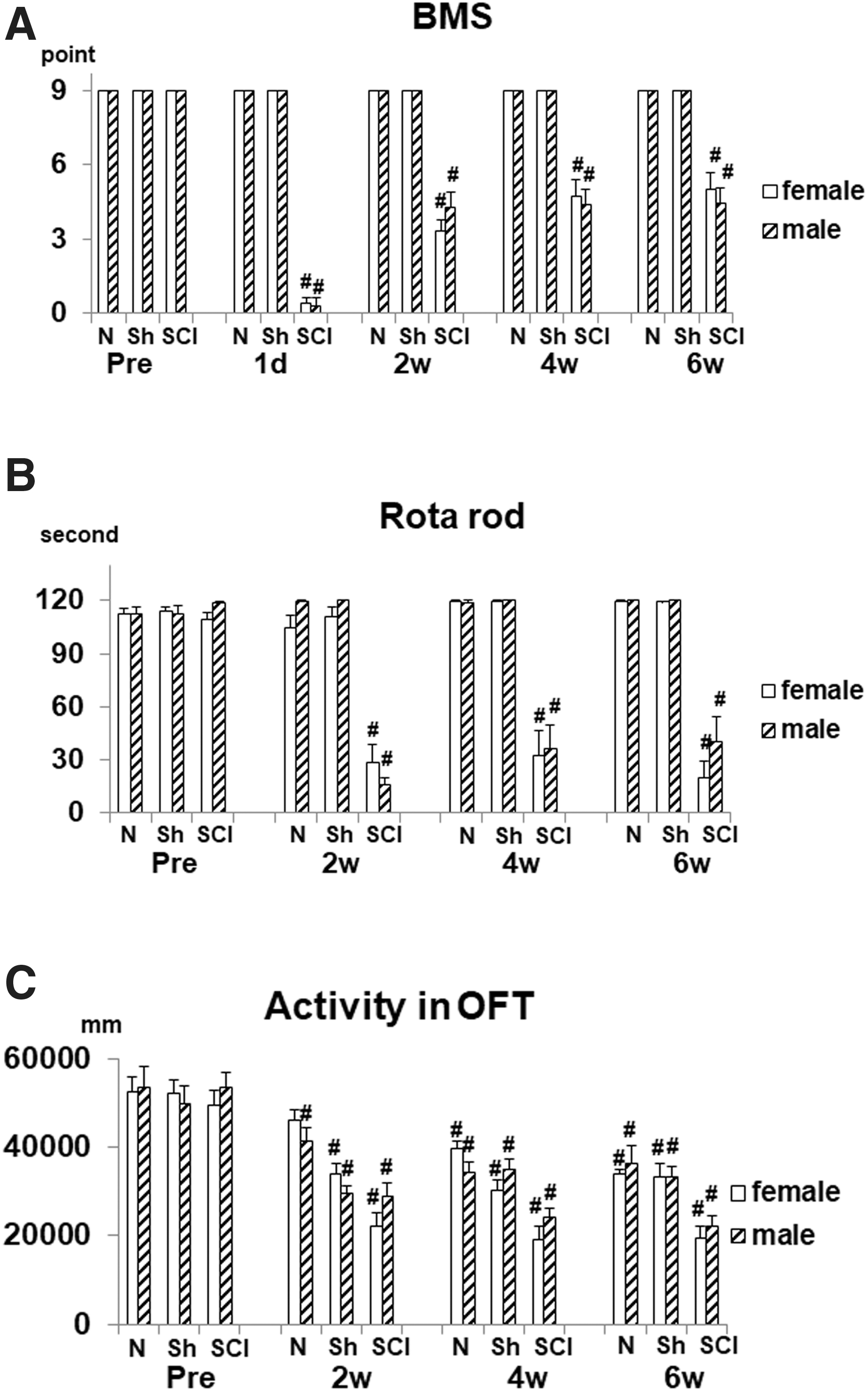
Assessment of motor functions. (
In the rotarod test, average riding times at 2, 4, and 6 weeks were significantly shorter than those at pre-injury in both the female and male SCI groups (all p < 0.01). Further, there was no significant difference in average riding times between the sham and naïve groups. Additionally, there were no significant differences in average riding times between female and male mice after SCI (Fig. 2B).
‘In the OFT, total travel distance at 2, 4, and 6 weeks after SCI was lower than that before SCI in both the female and male SCI groups (all p < 0.01). Further, total distance at 2, 4, and 6 weeks after SCI was lower than that before SCI in the female and male sham groups (female, all p < 0.01; male, p < 0.01, p = 0.03, and p < 0.01, respectively). The female SCI group covered a significantly shorter distance than the female sham group at 4 and 6 weeks after SCI (p = 0.04 and p < 0.01, respectively). Further, there was no significant difference in total distance between female and male mice after SCI (Fig. 2C).
Assessment of sensory function
In the Mechanical test, the average reaction time at 2, 4, and 6 weeks after SCI was almost the same as the reaction time before SCI in the female and male SCI groups. Further, there was no significant difference in time between the sham and naïve groups. Additionally, there was no significant difference in time between female and male mice after SCI (Fig. 3A).
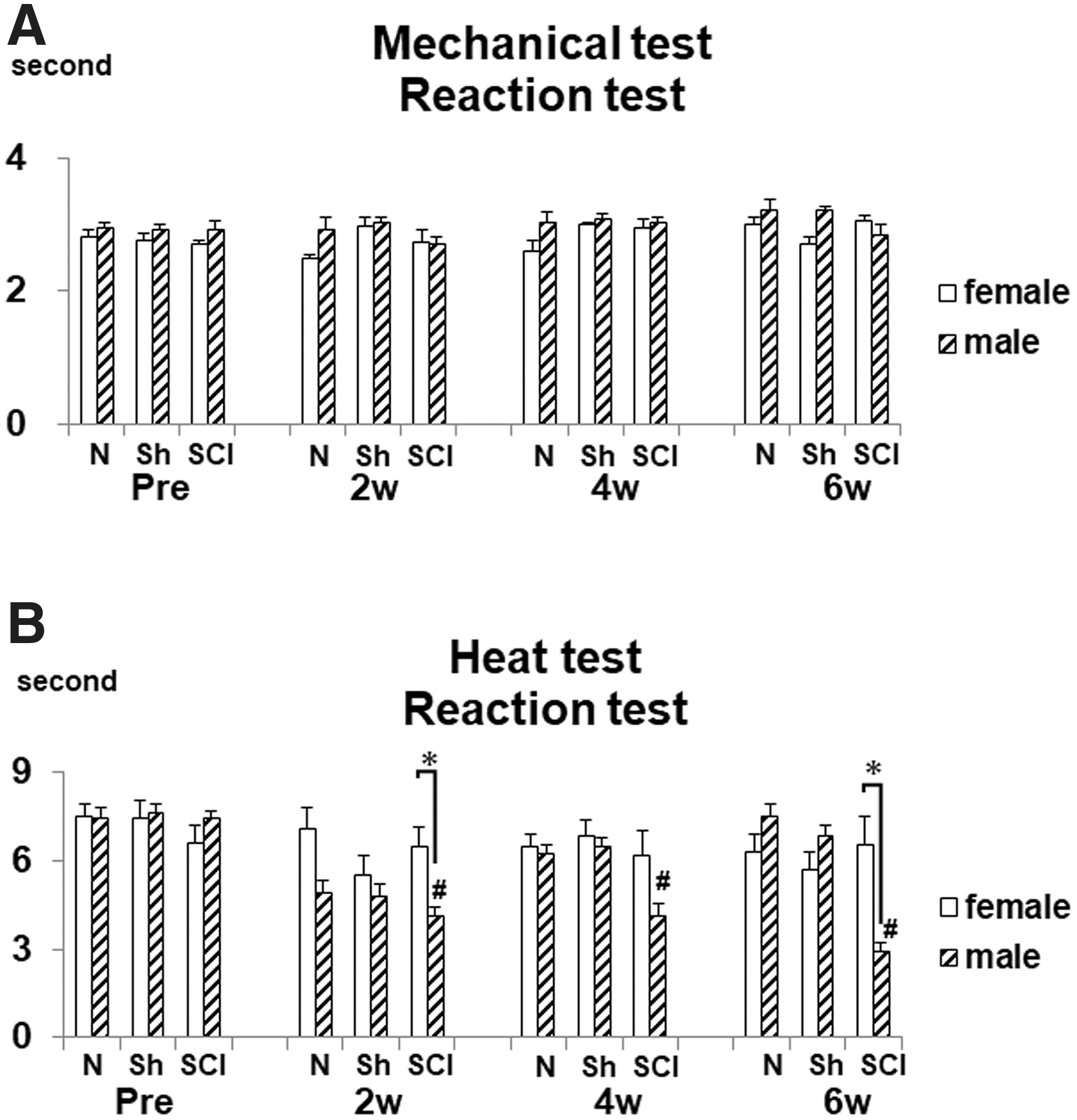
Assessment of sensory functions. (
In the Heat test, the average reaction time at 2, 4, and 6 weeks after SCI was significantly shorter than that before SCI in the male mice (SCI group; all p < 0.01). Further, mean values at 2 and 6 weeks in the female SCI group were significantly higher than those in the male SCI group (p = 0.04 and p < 0.01, respectively; Fig. 3B).
Correlation between anxiety-like behavior and locomotor/sensory function
We also assessed the correlation between IC-25 values and locomotor/sensory functions before and 2, 4, and 6 weeks after SCI. IC-25 values were significantly correlated with those in the Heat test at 2 weeks after SCI among female mice, those in the BMS at 2, 4, and 6 weeks after SCI among male mice, and those in the rotarod test at 2 and 4 weeks after SCI among male mice (Tables 1 and 2). Single-correlation analyses revealed significant positive correlations between anxiety and sensory functions in female mice, as well as between anxiety and motor functions in male mice.
Correlation between IC-25 Values and Locomotor/Sensory Functions in Female Mice after SCI
A significant correlation with an adjusted p value <0.05.
R, correlation coefficient (R > 0 means a perfect positive correlation, and R < 0 means a perfect negative correlation); IC-25, percentage of distance spent in the center 25% of the open field; SCI, spinal cord injury; BMS, Basso Mouse Scale.
Correlation between IC-25 Values and Locomotor/Sensory Functions in Male Mice after SCI
A significant correlation with an adjusted p value <0.05.
R, correlation coefficient (R > 0 means a perfect positive correlation, and R < 0 means a perfect negative correlation); IC-25, percentage of distance spent in the center 25% of the open field; SCI, spinal cord injury; BMS, Basso Mouse Scale.
Histological assessment and correlation between anxiety-like behavior and spinal cord area
Atrophic changes and demyelination of the injured spinal cord were examined 6 weeks after SCI by HE and LFB staining (Fig. 4A–H). There was no significant difference in the transverse area of the spinal cord at the lesion epicenter between female and male SCI mice (Fig. 4I,J). Anxiety-like behaviors were not significantly correlated with spinal cord areas (Table 3).
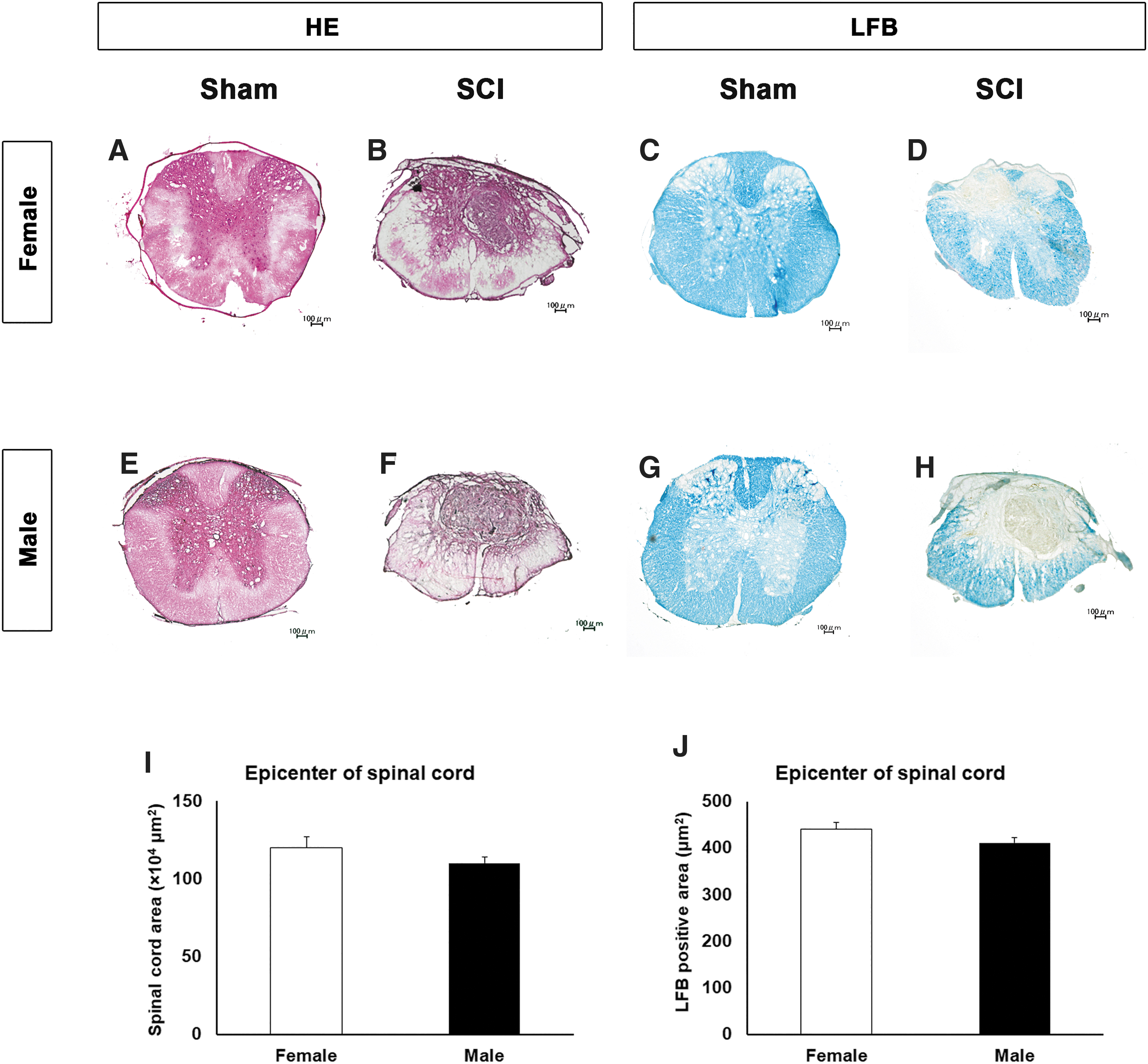
Spinal cord atrophy and demyelination 6 weeks after injury. Representative HE- (
Correlation between IC-25 Values and Spinal Cord Areas (Epicenter) after SCI
R, correlation coefficient (R > 0 means a perfect positive correlation, and R < 0 means a perfect negative correlation); IC-25, percentage of distance spent in the center 25% of the open field; SCI, spinal cord injury.
Discussion
To our knowledge, this is the first study to investigate sex-related differences in anxiety and functional recovery after SCI in mice. Our results revealed that, after the procedure (SCI/sham), both female and male mice of the SCI group exhibited higher anxiety-like behaviors than did those of the sham group. However, 2 weeks after the injury, L/D revealed that female mice became more anxious than did male mice, whereas it revealed that male mice became more hypersensitive than female mice. In female mice, anxiety-like behavior was correlated with mechanical hypersensitivity in the subacute phase after SCI, whereas it was correlated with lack of motor function recovery in the subacute phase after SCI in male mice.
In this study, we assessed anxiety-like behaviors of mice by using the OFT, EPM, and L/D. All of these tests revealed anxiety-like behavior in mice after SCI; among them, the OFT was the most conclusive test. In previous reports, anxiety was evaluated in rodents after SCI using the OFT 7 and EPM. 6,20,21 These studies used the OFT to compare anxiety-like behavior after SCI to that before SCI 6,7 and used EPM to assess anxiety-like behaviors in a rat model of SCI. 6,20,21 In the OFT, mice were evaluated for anxiety-like behavior based on search behavior in a novel environment. However, search behavior in a novel environment decreases when rodents get used to the environment; therefore, multiple assessments are important for the evaluation of anxiety-like behavior in mice. Accordingly, our multiple assessments using the OFT, EPM, and LD can be useful for the evaluation of anxiety-like behavior in mice after SCI.
Anxiety after spinal cord injury is likely to be related to inflammation. SCI results in increased inflammation both peripherally and centrally in male rats. 6 do Espirito Santo and colleagues suggested that SCI by clip compression in female rats promotes a neuropsychiatric-like profile associated with an imbalance in the production/release of pro- and anti-inflammatory cytokines. 20 Further, female mice with an abnormality of GABAA-receptor function showed increased inflammation after SCI, and the increased inflammation resulted in anxiety and motor functional disability. 7 Similarly, the current study showed that both male and female mice became anxious after SCI. Further, female mice became significantly more anxious than male mice did in the SCI groups. Female sex hormones, such as estrogens and progesterone, affect emotions and cognition, contributing to sex differences in behavior. 22 A previous study in rats demonstrated that age, sex, and gonadal hormones differently influence anxiety- and depression-related behaviors during puberty in mice. 23 Therefore, our findings indicate that sex hormones, such as estrogens and progesterone, affected the difference in anxiety-like behavior between female and male mice.
In this study, there was no significant difference in motor function between the sexes. It has been reported that adult female rats have a sex-related and possibly even neuroprotective advantage in functional recovery after thoracic, contusive SCI. 8 However, it has also been reported that there is no significant difference in locomotor recovery between male and female mice, which were assessed under open field and treadmill conditions. 24 Further, Swartz and colleagues 25 found a similar improvement in Basso-Beattie-Bresnahan scores of adult male and female rats. Our results corroborate the result of this study, that is, there are no sex differences in locomotor function in mice after SCI. Datto and colleagues showed that female rats with moderate thoracic spinal cord contusion injury induced by dropping a 10.0-g rod from a height of 12.5 mm showed improvement in locomotor function and that the functional improvement is because of a possible neuroprotective effect. 8 In their histological analysis at 13 weeks post-SCI, area of the rat thoracic spinal cord at the injury epicenter was significantly larger in female rats than in male rats.
By contrast, our study revealed no significant difference in the histological analysis between female and male mice after SCI. Thus, we could not identify sex differences in locomotor function. The difference in results between our histological analysis and their histological analysis may have been because of the severity of the injury, the timing of the assessment, and differences between mice and rats.
In the Heat test, but not Mechanical test, male mice were more hypersensitive to thermal stimuli than the male sham group after SCI. On the contrary, female mice did not become hypersensitive after SCI. It was reported that female rats develop hypersensitivity more rapidly and to a greater extent than male rats do after SCI. 26 Besides, it was shown that estrogen protects Schwann cells and has a neuroprotective effect on the peripheral nervous system. 27 Therefore, we suggest that sensory functions recovered earlier in female mice than in male mice after SCI. The protective effect of estrogen on Schwann cells was more effective on sensory functions of peripheral nerves; therefore, the discrepancy between motor and sensory recovery may have occurred.
Anxiety-like behavior after SCI was correlated with mechanical hypersensitivity in female mice, as well as with the loss of motor function in male mice. There was no significant difference in anxiety-like behavior between the sham and naïve groups; this suggests that anxiety-like behavior was unrelated to stress caused by operation and anesthesia. There have been a few reports describing the correlation between anxiety and motor function, and previous reports demonstrated a positive correlation between anxiety-like behavior and hypersensitivity in female 21 and male 6,28 rats. Fujita showed that in female SCI model mice, the IC-25 value is correlated with motor-sensory functions. 7 The reason may be that pain hypersensitivity in female mice is affected by cells of the adaptive immune system. 29 Our results showed that there was a correlation between anxiety-like behavior and motor function in male mice, as well as anxiety-like behavior and sensory function in female mice.
There are some limitations to this study that should be acknowledged. First, all mice did not perform the behavioral tests at the same time, and their performance may have been affected by environmental factors such as temperature or humidity. A parallel-group comparison study may reduce bias when observing differences between mice. Second, hormonal imbalances attributed to the female reproductive cycle may affect anxiety-like behavior, but we did not determine whether sex hormone levels were constant. Third, although anxiety was examined using established evaluation methods, there have been few studies that measured anxiety in mice after SCI. Thus, the correct evaluation of anxiety in mice may have been altered by the SCI-induced paralysis. Although this study had some limitations, it will contribute to the elucidation of the relationship between anxiety and locomotor dysfunction after SCI. Prescribing anxiolytics for patients with SCI may help improve the affected motor/sensory function, thereby improving the quality of life of patients affected by SCI.
Conclusion
Our results revealed that both female and male mice after SCI showed increased anxiety-like behaviors, with female mice becoming more anxious than male mice and male mice becoming more hypersensitive than female mice. Anxiety-like behavior was correlated with mechanical hypersensitivity in a subacute phase after SCI in female mice, whereas it was correlated with the loss of motor function in a subacute phase after SCI in male mice.
Footnotes
Acknowledgments
We thank the members of the Graduate School of Medicine, Department of Orthopedic Surgery, for their excellent guidance and advice. We thank Editage for English-language editing.
Authors' Contributions
T.F. and G.K. conducted the surgical experiments, behavioral observations, and immunohistochemical analyses. T.F. and X.L. participated in the surgical experiments and in the behavioral and immunohistochemical analyses. K.W. and T.T. provided study materials and supported this study. Y.I. supervised the whole project and wrote the manuscript with T.F. and G.K.
Funding Information
This study was funded by the Karoji Memorial Fund for Medical Research at Hirosaki University, a grant-in-aid for scientific research from the Japan Society for the Promotion of Science (17K10917), and a Hirosaki University Grant for Distinguished Researchers (FY2017–2018). We would like to thank Editage for English language editing.
Author Disclosure Statement
No competing financial interests exist.