




Abstract
Research on chronic subdural hematoma (cSDH) management has primarily focused on potential recurrence after surgical evacuation. Herein, we present a novel postoperative/non-invasive treatment that includes a supervised Valsalva maneuver (SVM), which may serve to reduce SDH recurrence. Accordingly, the aims of the study were to investigate the effects of SVM on SDH recurrence rates and functional outcomes. A prospective study was conducted from December 2016 until December 2019 at the Goethe University Hospital Frankfurt. Of the 204 adult patients with surgically treated cSDH who had subdural drains placed, 94 patients were assigned to the SVM group and 82 patients were assigned to the control group. The SVM was performed by having patients blow into a self-made SVM device at least two times/h for 12 h/day. The primary end-point was SDH recurrence rate, while secondary outcomes were morbidity and functional outcomes at 3 months of follow-up. SDH recurrence was observed in 16 of 94 patients (17%) in the SVM group, which was a significant reduction as compared with the control group, which had 24 of 82 patients (29.3%; p = 0.05) develop recurrent SDHs. Further, the infection rate (e.g., pneumonia) was significantly lower in the SVM group (1.1%) than in the control group (13.4%; p < 0.001; odds ratio [OR] 0.1). At the 3-month follow-up, 85 of 94 patients (90.4%) achieved favorable outcomes in the SVM group compared with 62 of 82 patients (75.6%) in the control group (p = 0.008; OR 3.0). Independent predictors for favorable outcome at follow-up were age (OR 0.9) and infection (OR 0.2). SVM appears to be safe and effective in the post-operative management of cSDHs, reducing both recurrence rates and infections after surgical evacuation, thereby resulting in favorable outcomes at follow-up.
Introduction
Chronic subdural hematomas (cSDH) are a common neurosurgical disorder that continues to increase in incidence in part because of an aging population and the prevalence of anticoagulant regimens. 1,2 Although cSDH are well known in neurosurgery, there is a lack of class I evidence, which complicates treatment decisions thereby resulting in inter-clinical discrepancies with regard to both surgical and post-operative management. 3
The standard treatment of cSDH involves surgical evacuation in cases that are not able to be managed conservatively. Weigel and coworkers summarized three principal techniques – twist drill craniotomy, burr hole trepanation and craniotomy – and reported that burr hole trepanation appeared to be the most effective treatment option given a lower morbidity of 3.8% and rate of recurrence of 12.1%. 4 Therefore, burr hole trepanation is performed most frequently worldwide for the treatment of cSDHs. 4 –7 Further work has gone on to confirm that subdural drain insertion significantly reduces rates of recurrence. 5 Current evidence has also demonstrated the utility of placing a subperiosteal drain, which results in even lower recurrence rates. 8
It is of note that recurrence rates after the initial treatment of cSDH range between 5% and 30%. 5,9,10 Recently, Edlmann and coworkers reported on 26 randomized controlled trials in cSDH covering medical treatment with steroids, tranexamic acid, different surgical techniques, and middle meningeal artery embolization. 11 Notably, there is a dearth of studies examining post-operative management, which may also influence recurrence rates.
Interestingly, one of the predictors related to the recurrence of SDH is post-operative hematoma volume, which may perpetuate a chronic inflammatory process. 9,12,13 Accordingly, one of the main goals of cSDH treatment must be the maximum evacuation of the hematoma. In line with such thinking, a supervised Valsalva maneuver (SVM) has been part of the post-operative management at the Goethe University Hospital Frankfurt for >20 years. The physiology driving the idea is centered on a desire to increase intracranial pressure and in so doing, provoke brain expansion, thereby promoting drainage of blood product(s).
Herein, our aim was to formally analyze the effects of post-operative SVM-centered management on the recurrence rates of cSDH after burr hole evacuation in an effort to standardize the most appropriate/effective methods of post-operative management.
Methods
Standard protocol approvals, registrations, and patient consents
The study is registered at
Study Design
Via a prospective cohort study, all patients presenting with cSDH who were surgically treated between December 2016 and December 2019 were included within the study. Patients with acute SDH, subacute SDH, acute-on-chronic SDH, unable to give consent, and/or in whom a subdural drain had not been placed were excluded from the study. Further, we excluded all patients with Glasgow Coma Scale (GCS) <15 after operation to rule out selection bias between the interventional and control arms. By doing so, both groups were well matched.
Procedures
At time of admission, the neurosurgeon on call determined clinical status, pertinent medical history, and the use of anticoagulants/antiplatelet agents. Thereafter, all patients included in the study underwent surgery during which a single burr hole (14 mm in maximum diameter) was placed overlying the hematoma. The hematoma was subsequently washed out using lactated Ringer's solution as irrigation via a 10 mL syringe. Outer membranes were opened and inner membranes were opened in selected cases. Ultimately, a subdural drain was placed with a suction bulb, and the patients were transferred to the neurosurgical wards for monitoring/recovery.
After consent or assent, patients were divided into two groups in a non-randomized fashion: (1) an SVM group and (2) a control group.
Given that the Goethe University Hospital Frankfurt has two different wards, the assignment of each patient was ward dependent. As mentioned, patients who were post-operatively disoriented (GCS <15) were excluded because they were unable to perform an SVM adequately, which would result in a selection bias. Therefore, the study was performed in a “semi-randomized” fashion.
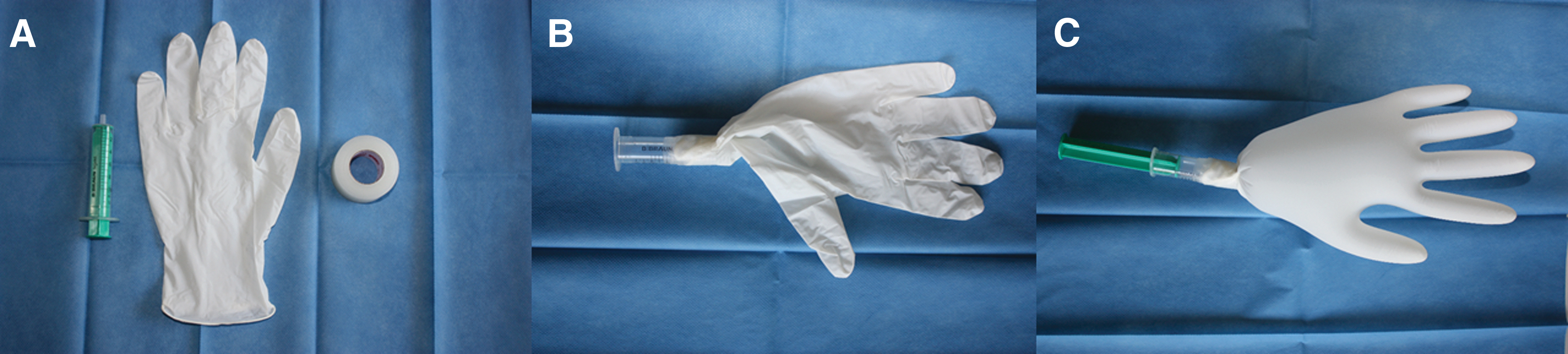
The instructions for SVM-device production are shown in Figure 1. All patients in the SVM group received one SVM device and were asked to blow into the syringe, resulting in inflation of the attached rubber glove. After reaching maximal tension of the glove, the patient stopped and the air was released. This maneuver was performed at least two times per h for 12 h/day for 2 days (Fig. 2). The patients were supervised by our study physicians and received stepwise instructions.

After surgery, one group performed SVM for 2 days as per the previously described protocol. The subdural drain was removed between post-operative days 1 and 3, at which point a post-operative computed tomography (CT) scan was performed. Patients were subsequently discharged home or to a local rehabilitation center and followed for at least 3 months. At discharge as well as at follow-up, neurological outcomes were assessed via a modified Rankin Scale (mRS), and hematomas surveilled with CT scans. Volumetric measurement of the hematomas was conducted as has been previously defined. 14 Measurements of maximal deviation of the midline structures at the level of the foramen of Monroe were used to calculate midline shift.
The primary study outcome was the recurrence rate. Recurrent hematoma was defined as reoperation in patients with previously surgically treated cSDH via burr hole trepanation. Critically, surgeons assessing the need for reoperation were blinded to control or SVM treatment status of the initial cSDH. Secondary outcomes were morbidity and functional outcomes at 3 months of follow-up.
The data sets generated and/or analyzed during the current study are included in this article.
Statistical analysis
Chi-square test was used to compare categorical variables. Median and interquartile range (IQR) were calculated for numerical data. Normality was confirmed with the Kolmogorov–Smirnov test and in cases of normal distribution, a t test was employed. For data that did not fall into a normal distribution, the Mann–Whitney U test was applied.
We employed logistical regression to investigate the effects of SVM and other previously described independent variables on the following measures: recurrence rate and favorable outcome (mRS 0–2) at discharge and at follow-up. For all variables, odds ratios (OR) with 95% confidence interval (CI) were calculated. All tests were two sided; p values <0.05 were considered to be statistically significant in both the univariate and multivariate analysis.
Results
The overall study design is illustrated in Figure 3. A total of 272 patients with surgically treated cSDH were eligible, with 68 patients having been excluded from the final analysis (i.e., exclusion criteria vs. lost to follow-up), resulting in a total enrollment of 176 patients. Of these, 94 patients were assigned to the interventional SVM group and 82 patients were assigned to the control group. Patient characteristics are presented in Table 1; no clinical and radiological differences were noted among the SVM and controls groups (i.e., parameters including GCS at admission, comorbidities, hematoma volume, midline shift, hematoma side or uni-/bilateral hematoma) resulting in a well matched pair. In the majority of cases, the duration of the subdural drain placement was 2 days (86.9%).

Supervised Valsalva maneuver (SVM) study structure. Color image is available online.
Patient Characteristics, Medical History, Admission Status and Surgical Treatment
Chi-square test was used for parametric statistical analysis. Mann–Whitney U test was used for non-parametric statistical analysis.
IQR, interquartile range; TIA, transient ischemic attack; GCS, Glasgow Coma Scale.
Symptoms upon admission are displayed in Table 2. The most common symptoms were headache (37.5%), followed by gait impairment (35.2%), hemiparesis (25%), speech arrest (20.5%), confusion (17%), nausea (14.2%), and impaired consciousness (9.1%). In eight patients (4.5%), the hematoma was diagnosed incidentally. The majority of patients had a total of two symptoms (37.5%), followed by one (27.3%), and three symptoms (23.3%), whereas four patients (2.3%) had five or more symptoms at admission.
Symptoms at Admission of cSDH Patients
cSDH, chronic subdural hematoma
The recurrence rate of hematomas was significantly lower in the SVM group than in the control group (17% vs. 29.3%; p = 0.05; OR 0.5 Cl 95% 0.2–1.0) at 3 month follow-up (Table 3). After adjusting for potentially confounding variables such as age, GCS at admission, neurological deficit (defined as the presence of paralysis, gait impairment, or aphasia), infection during the clinical course, and uni- or bilateral hematoma, a logistical regression analysis revealed SVM as the single significant parameter associated with a reduction in recurrence rate (OR 0.5 Cl 95% 0.2–1.0) (Table 4).
Primary and Secondary Outcome Analysis in Supervised Valsalva Maneuver and Control Group
Fisher exact test and t test were used for primary and secondary outcome analysis.
Infection includes pneumonia, urinary tract infection, and sepsis.
OR, odds ratio; Cl, confidence interval; mRS, modified Rankin Scale; IQR, interquartile range; NA, not applicable.
Adjusted Logistical Regression Outcome Analysis by Variables with Potential Influence on the Relationship between Supervised Valsalva Maneuver and Recurrence/Outcome at Discharge as Well as at Follow-Up
Neurological deficit was defined as paresis, gait impairment or aphasia at admission.
GCS, Glasgow Coma scale; OR, odds ratio; CI, confidence interval.
At discharge, favorable outcome was achieved in 137 patients (77.8%). Of these, 81 patients (86.2%) were in the SVM group and 56 patients (68.3%) were in the control group (p = 0.004; OR 2.9 Cl 95% 1.4–6.1). At 3 month follow-up, patients in the SVM group were significantly more likely to have reached favorable outcomes than patients in the control group (p = 0.008; OR 3.0 Cl 95% 1.3–7.1). The median length of hospital stay was 6 days (IQR 4–8) without significant difference between both groups. Via logistical regression analysis, there were several independent predictors shown to be associated with outcomes at discharge: age (OR 0.9 [0.9–1.0]), GCS at admission (OR 1.6 [1.2–2.3], and infection during hospitalization (OR 0.0 [0–0.3]). At follow-up, age (OR 0.9) and infection (OR 0.2) remained as independent predictors for favorable outcome.
With regard to patient safety/the non-invasive nature of the SVM intervention, it is prudent to highlight that there were no episodes of syncope or hemodynamic instability noted throughout the course of our study. One intracerebral hematoma was detected in each group, whereas additional one epidural hematoma (1.2%) and one acute SDH (1.2%) requiring surgical treatment were diagnosed in the control group. Further, the infection rates were significant lower in the SVM interventional group (1.1%) than in the control group (13.4%) (p < 0.001; OR 0.1 [0.0–0.4]) (Table 3).
Discussion
This is the first study investigating the effects of SVM after surgical evacuation of cSDH. Here, we show that SVM proved to be an effective tool capable of reducing the recurrence rate of SDH as compared with controls. Further, patients in the SVM arm of our study had fewer infections and better neurological outcomes at follow-up than patients in the control group. No adverse effects related to SVM were detected during the course of our study, again highlighting the favorable safety profile of this non-invasive intervention.
Several studies have reported multiple predictors related to recurrence after evacuation of cSDH including age, large pre-operative hematoma volume, anticoagulation/platelet status, seizures, bilateral cSDH, radiological findings reflective of hematoma type (laminar type, different densities), and large post-operative residual hematoma. 9,10,15 –17 In an effort to reduce the burden of recurrent hematomas, most studies thus far have investigated different surgical techniques, such as craniotomy or burr hole, number of burr holes, different positions of the burr holes (frontal or parietal), direction of drainage, subdural or subperiosteal drainage, intraoperative irrigation, and, in the case of irrigation, the question of fluid temperature. 4,8,18 –20 In addition, medical treatments with agents such as dexamethasone or atorvastatin and endovascular interventions (i.e., middle meningeal artery occlusion) have recently been investigated as potential modalities for the reduction of SDH recurrence; such interventions aim to perturb the neuroinflammatory axis. 13,21,22 Post-operative residual hematoma has been demonstrated to trigger continuous inflammation via a litany of interleukins/chemokines and inflammatory cells. 13 Accordingly, surgical interventions and post-operative regimens should attempt to maximize evacuation of the hematoma. In line with such thinking, our SVM intervention was designed to facilitate the drainage of the residual hematoma via an intraoperatively placed subdural drain. A Valsalva maneuver, consisting of a voluntary expiratory effort against a closed airway, leads to an increase in intrathoracic and intra-abdominal pressure. 23 As a result, intracranial pressure increases and the residual hematoma is displaced from the subdural space via brain expansion. 24 (Fig. 2) It is of note that post-operative CT scans often reveal subdural air collections, which are also a risk factors for recurrence. 10,25 In our view, such patients with subdural air collection would also benefit from SVM, as this maneuver can reduce air pockets within the subdural cavity.
One concern associated with SVM was a possibility of hemodynamic instability, as it is known that such maneuvers may alter blood pressure/heart rate via the activation of baroreceptors. 23 Importantly, canonical teaching would suggest that patients may be at risk of re-bleeding, as SVM induces an increase in intracranial pressure. Despite such hypothetical risks, our study did not identify any cardiovascular complications and/or bleeding secondary to SVM.
In contrast, there were additional benefits related to SVM such as lower rates of infection (e.g., pneumonia). This may in part be because SVM also has a positive effect on the lungs via the prevention of post-operative atelectasis. Boden and coworkers investigated the effect of physiotherapy/breathing exercises in a large cohort of patients after abdominal surgery and showed an absolute risk reduction of pulmonary complications, including pneumonia, in up to 15% of patients. 26 Further, it is known that respiratory physiotherapy and mobilization are key factors in improving functional status and reducing the sequalae of pneumonia. 27 In accordance with this the SVM group displayed significantly better outcome than the control group at discharge as well as at follow-up.
In our study, the recurrence rate of cSDH after initial treatment was 23.8%; 17% in the SVM group and 29.3% in the control group. A similar recurrence rate was reported in the recently published Randomized Trial of Follow-Up CT after Evacuation of Chronic Subdural Hematoma (TOSCAN) study (i.e., 23%). 28 In patients with bilateral cSDH, an even higher recurrence rate of 28.7% has been described. 29 On the other hand, other studies have reported lower rates of recurrence (i.e., between 9% and 18%). 7,8,17 As has been discussed in detail, several factors have been identified that play a role in the recurrence rates; however, an additional explanation for the high recurrence rate might be simply the fact that there is no common post-operative management strategy among several clinics. Some of them suggest regular radiological follow-up whereas others do not perform follow-up at all except in cases of clinical deterioration. In our study, we performed regular radiological follow-ups in all patients, which might be the simple explanation for the high recurrence rate, because clinical unapparent progressive recurrent hematoma was diagnosed as well.
To date, there are several studies investigating pre-operative and perioperative therapeutic regimes to reduce recurrence rate, yet the postoperative treatment of patients with cSDH is often overlooked. Based on this study, we believe that SVM might be a simple, effective, and safe post-operative treatment to reduce recurrent hematoma after surgical treatment of cSDH.
Limitations
This is a non-randomized study, which may have led to unintentional selection bias. However, as noted, the groups were well matched in clinical traits/presentation. We feel that it is also important to highlight a challenge that is often encountered in medicine, the need for individual effort, which is required to perform SVM. Clearly, some patients were more persistent about performing SVM, whereas others appeared less motivated; future work will seek to clarify how best to engage all parties in their care.
Conclusion
SVM appears to be safe and effective in the post-operative management of cSDHs, reducing both recurrence rates and infections after surgical evacuation, thereby resulting in favorable outcomes at follow-up. Given its reproducible and safety profile, such a non-invasive post-operative intervention may indeed have clinical utility in both high and low resource settings, and may positively impact the care of neurosurgical patients.
Footnotes
Acknowledgments
We thank Haemin Jang for the design/construction of our figures.
Funding Information
This work received no funding.
Data Availability Statement
The authors confirm that the data supporting the findings of this study are available in the article and its supplementary materials.
Author Disclosure Statement
J.D.B has positions and equity in CITC Ltd. and Avidea Technologies, and is on the Scientific Board of Advisors for POCKiT Diagnostics. The other authors have nothing to disclose.
References
Supplementary Material
Please find the following supplemental material available below.
For Open Access articles published under a Creative Commons License, all supplemental material carries the same license as the article it is associated with.
For non-Open Access articles published, all supplemental material carries a non-exclusive license, and permission requests for re-use of supplemental material or any part of supplemental material shall be sent directly to the copyright owner as specified in the copyright notice associated with the article.
