




Abstract
The purpose of this study is to examine the effects of the COVID-19 pandemic on patients presenting with concussion at a specialty clinic. This study used a retrospective cohort design to compare participants (n = 3021) with a suspected concussion, including a Pandemic cohort (n = 1139; March 2020-February 2021) and a Pre-Pandemic cohort (n = 1882; March 2019-February 2020). Concussions and patient characteristics including age, sex, days since injury, and injury mechanism were extracted from an electronic health record. There were 39.5% (n = 743) fewer concussions in Pandemic. Pandemic presented to the clinic 25.8 days later (p < 0.001) and were 1.9 years older (p < 0.001) than Pre-Pandemic. Sport-related concussions decreased 59.6% overall for Pandemic. Pandemic was associated with proportional increases of concussions involving recreational activities (odds ratio [OR] = 6.11; p < 0.001), motor vehicle collisions (OR = 1.39; p < 0.001), and falls/assaults (OR = 1.33; p < 0.001). A total of 9.4% (107/1139) of all Pandemic concussion initial clinical visits were performed using telehealth (0% in Pre-Pandemic). Concussion visit volume to a sub-specialty clinic decreased by approximately 40% during the COVID-19 pandemic and patients presented to the clinic nearly 1 month later. The increase in telehealth highlights the potential to expand clinical care outreach during the current and future pandemics or similar restrictive time periods.
Introduction
On March 11th, the WHO declared the 2019 SARS-CoV-2 virus (COVID-19) a pandemic, which went on to have significant impacts on healthcare in the United States and across the world. 1,2 The pandemic prompted public health measures to limit the spread of the virus, including mask wearing, social distancing, and restrictions on activities including work, school, and sport. 3 As a result, many patients with non-urgent injuries and health conditions have been unable or hesitant to seek healthcare. 4 Concussions represent a non-urgent injury that is likely to have been affected by this trend in a reduction of care-seeking during the COVID-19 pandemic.
It is estimated that 1.5 to 2.0 million concussions occur each year in the U.S. 5 A concussion involves direct or indirect forces impacting the brain that result in symptoms (e.g., headache,) and/or impairment (e.g., cognitive). 6 Patients who delay care-seeking beyond the first week following a concussion are at greater risk for worse symptoms and impairment than those who receive earlier care. 7,8 During the pandemic, it is possible that when concussions did occur, patients waited longer to seek specialty care due to exposure concerns. However, to date, researchers have not examined the effects of the COVID-19 pandemic on concussion incidence to a subspecialty clinic.
The purpose of this study was to examine the effects of the COVID-19 pandemic restrictions on the incidence and characteristics of participants with a potential concussion (e.g., age, sex, mechanism, time since injury, telehealth) presenting to a concussion specialty clinic between March 2020 and March 2021 in comparison to a pre-COVID-19 cohort presenting between March 2019 and March 2020. We expected that the COVID-19 cohort would demonstrate lower concussion incidence, especially in sport-related concussions (SRC) and among older patients, have greater utilization of telehealth services, and present with longer time since injury.
Methods
Participants and design
This study was a retrospective chart review of all electronic health record (EHR) data from the primary of six (one primary, five satellite) clinics that comprise a concussion program in Pittsburgh, Pennsylvania, from March 15, 2019 to March 16, 2021 (n = 3021). The primary clinic data was selected due to feasibility for EHR access and it represents the largest patient pool of all six sites. Participants were separated into cohorts based on if they presented to the clinic prior to the COVID-19 pandemic between March 15, 2019 and March 15, 2020 (Pre-Pandemic) or during the COVID-19 pandemic between March 16, 2020 and March 16, 2021 (Pandemic).
Procedures
A query of de-identified EHRs was conducted based on primary diagnosis of a concussion by licensed healthcare professionals trained in concussion (e.g., neuropsychologists, physicians), per current diagnostic consensus criteria. 9 Data were identified in the EHR database after attending the concussion clinic and abstracted by a member of the research team and verified by a second member of the team. Participants with missing data were included and missing data were reported after analysis. Participants self-reported age, sex, days since injury, and injury mechanism. Injury mechanism was divided into sport-related, recreation related, motor vehicle collision, falls, and other categories. These procedures were approved by the University of Pittsburgh institutional review board for human subjects research and exempt from patient consent due to the de-identified nature of the EHR data.
Statistical analysis
Means, standard deviations, medians, percentages, and interquartile range (IQR) were used to describe the overall sample, as well as Pandemic and Pre-Pandemic cohorts. Subgroups for age (< 12 years, 12-17, 18-20, 21-29, 30-39, 40-49, 50-59, and 60+), mechanism (SRC, recreational, fall/accident, motor vehicle collision, other, unknown), and days until clinic presentation (0-7 days, 8-14, 15-21, and 22+) were compared, as has been reported previously. 8 Chi-squares with odds ratios (OR) and 95% confidence intervals (CIs) were used to evaluate associations between clinical variables (i.e., age, sex, days since injury, month injury occurred, mechanism) and cohort group. Continuous variables were compared using Mann-Whitney U tests. Data were analyzed using Statistical Package for the Social Sciences (SPSS) version 27.
Results
Comparison of Pandemic and Pre-Pandemic Cohorts
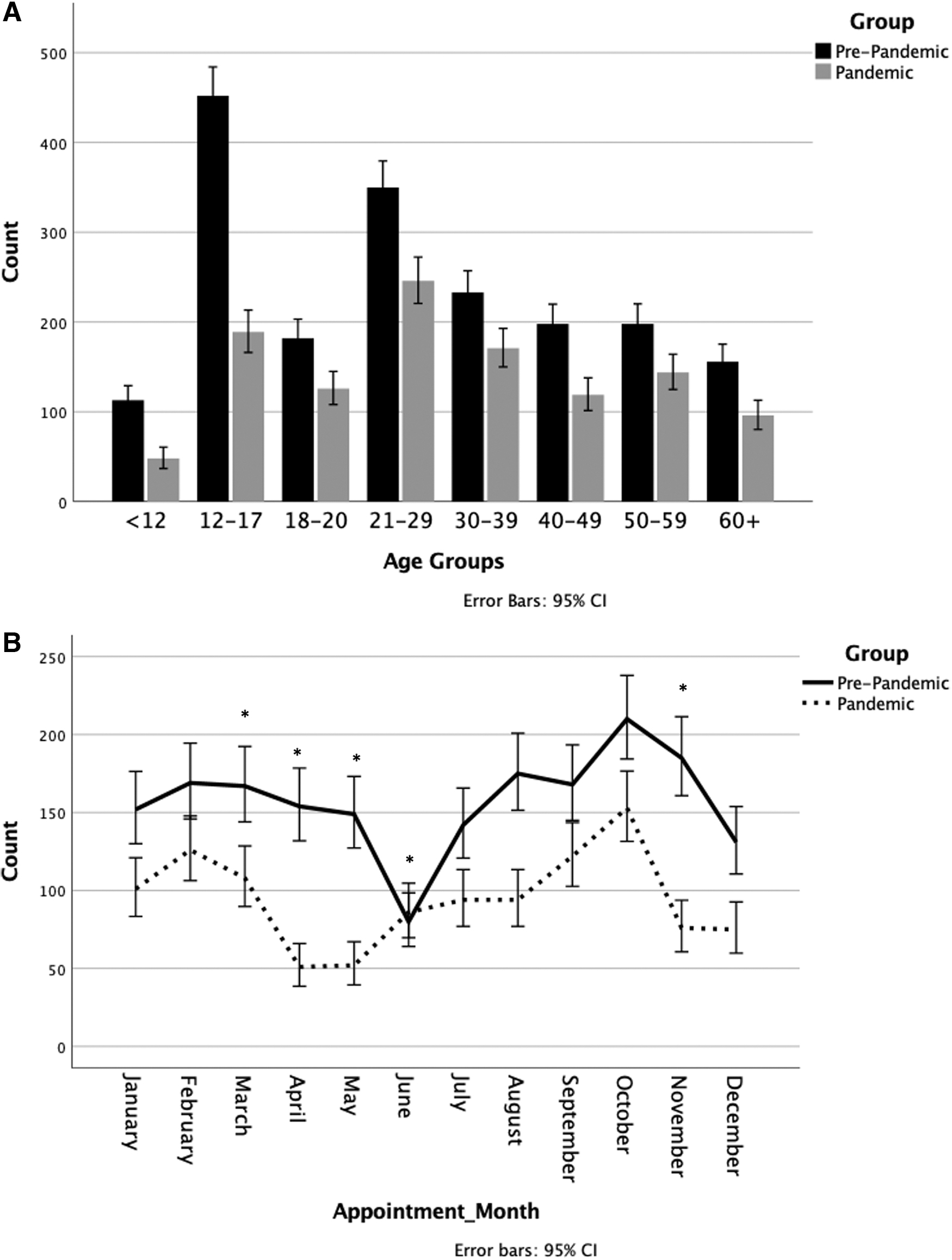
The clinic observed a 39.5% reduction in total concussion-related visits seen during the Pandemic (n = 1139) compared with Pre-Pandemic (n = 1882; Table 1). Pandemic patients were significantly older (median: 28 years, interquartile range [IQR] = 28) and more likely to complete a visit via telehealth (n = 107; 9.4%) than Pre-Pandemic patients (median: 23 years, IQR = 26). There was no difference in proportion of female sex between groups. During the pandemic, patients with concussion sought care on average 26 days later (median: 16 days, IQR = 38) than prior to the pandemic (mean = 73.3; median: 13 days; IQR = 30). Patients were 1.4 times more likely to present within 7 days of injury prior to the pandemic than during the pandemic. Figure 1A shows a comparison of visits by age group. Pandemic also was associated with lower odds of being age <12 or 12-17 years (OR = 0.63 and 0.69 respectively) or 40-49 years (OR = 0.58) and associated with higher odds of being 30-39 years (OR = 1.25). Pandemic was associated with lower odds of presenting within 0-7 days of injury (OR = 0.71) or 15-21 days (OR = 0.76). Pandemic was also associated with lower odds of a “sport” mechanism, as well as “other” (OR = 0.59-0.72), and higher odds of “recreational,” fall/accident, and motor vehicle collision mechanisms of injury (OR = 1.33-6.11).
(
Demographic Comparison of Patients who Presented to a Concussion Specialty Clinic Pre-Pandemic (3/15/19-3/15/20) and during the Pandemic (3/16/20-3/16/21)
Analyzed with Mann-Whitney U tests
Statistical significance at p < 0.05
Percentages calculated without missing data.
OR, odds ratio; CI, confidence interval.
Figure 1B shows a month-by-month comparison of concussion visits by cohort. Pandemic was associated with lower odds of presenting to the clinic in March (OR = 0.58), April (OR = 0.53), May (OR = 0.56), and November (OR = 0.66). Pandemic was associated with higher odds of presenting to the clinic in June (OR = 1.84).
Discussion
The present study documented a 39.5% decrease in concussion visits to a specialty clinic during the COVID-19 pandemic compared with the previous 12-months. This finding is not surprising given the restrictions associated with COVID-19. The pandemic-related restrictions on school attendance and organized sport played an outsized role in reducing overall concussion visits, as well as restrictions to primary care physician visits, with significant decrease in school aged patients and a 59.6% reduction in SRCs. In contrast, there were proportional increases during the pandemic with concussion visits stemming from injuries sustained during recreational (non-sport; +258%), motor vehicle collisions (+39%), and falls/accidents (+33%). Monthly trends in concussion visits also changed, with the typical summer decrease and autumn increase in concussion visits prior to the pandemic being replaced by an earlier spring decrease (coinciding with “lockdown” restrictions in March through May 2020), summer increase (coinciding with the lifting of restrictions), and less robust autumn increase.
Patients presented to sub-specialty care at this concussion clinic later during the pandemic. These findings likely reflect the hesitance of patients to seek care due to apprehensions about COVID-19. This delayed presentation is concerning, as it has been reported to be associated with longer recovery times and more pronounced symptoms and impairment. 7,8,10,11 Patients with concussion during the pandemic were 2 years older on average and less likely to be <18 years old. These results may reflect the drop in SRCs, which typically affect younger patients, during the pandemic. On a positive note, 10% of patients with concussion used telehealth during the pandemic, compared with none before the pandemic. Telehealth presents significant advantages to the general population such as increasing access to specialists, limiting transportation issues, and potentially increasing rates for follow-up virtual visits given the easier access to higher-level care. Future research should examine the reliability of concussion assessments and quality of care between virtual and in-person visits.
Limitations
The current data represent one of six concussion specialty clinic sites located in a mid-size metropolitan area in the mid-Atlantic, thereby decreasing the generalizability of the findings to other regions and the general population. It is possible that patients who sustained a concussion opted not to seek care at all, or rather to present to a specialty clinic but rather a primary care physician or emergency department. Inconsistencies in data recording across patient schedulers resulted in missing data for days to clinic (17.6%) and mechanism (1.2%), with the Pandemic cohort being more likely to have these data missing.
Conclusion
Concussion presentation to a sub-specialty clinic changed considerably during the COVID-19 pandemic, with approximately a 40% reduction in overall new concussion volume, with a nearly 60% decrease in sport-related concussions. Patients with concussions who presented to this sub-specialty clinic were on average almost 2 years older and presented to the clinic 26 days later during the pandemic. Nearly 10% of patients utilized telehealth for their initial concussion evaluation during the pandemic, whereas, prior to the pandemic, telehealth was not used with any patients. These findings highlight the challenges (i.e., later presentation to clinic) as well as the opportunities, (e.g., accelerated growth of telehealth) to public health related to patients with concussion associated with the COVID-19 pandemic.
Footnotes
Authors' Contributions
All authors reviewed and approved the final version of this manuscript. AK and SE contributed to study design, analyses, writing, and reviewing the manuscript. MC, RH, DT contributed to study conceptualization, design, interpretation, and reviewing the manuscript. CH and CS contributed to data management, data extraction, data quality control, and reviewing the manuscript.
Funding Information
This project is supported by the Centers for Disease Control and Prevention of the U.S. Department of Health and Human Services (HHS) as part of a financial assistance award totaling $2,200,000 with 100 percent funded by CDC/HHS. The contents are those of the author(s) and do not necessarily represent the official views of, nor an endorsement, by CDC/HHS, or the U.S. Government.
Author Disclosure Statement
Dr. Kontos and Dr. Collins have received funding from the National Football League and royalties from APA books.
For the other authors, no conflicting financial interests exist.