




Abstract
Alcohol use disorder (AUD) is highly comorbid with traumatic brain injury (TBI). Previously, using a lateral fluid percussion model (LFP) (an open-head injury model) to generate a single mild to moderate traumatic brain injury (TBI) we showed that TBI produces escalation in alcohol drinking, that alcohol exposure negatively impacts TBI outcomes, and that the endocannabinoid degradation inhibitor (JZL184) confers significant protection from behavioral and neuropathological outcomes in male rodents. In the present study, we used a weight drop model (a closed-head injury model) to produce repeated mild TBI (rmTBI; three TBIs separated by 24 hours) in male and female rats to examine the sex-specific effects on anxiety-like behavior and alcohol consumption, and whether systemic treatment with JZL184 would reverse TBI effects on those behaviors. In two separate studies, adult male and female Wistar rats were subjected to rmTBI or sham procedure using the weight drop model. Physiological measures of injury severity were collected from all animals. Animals in both studies were allowed to consume alcohol using an intermittent 2-bottle choice procedure (12 pre-TBI sessions and 12 post-TBI sessions). Neurological severity and neurobehavioral scores (NSS and NBS, respectively) were tested 24 hours after the final injury. Anxiety-like behavior was tested at 37–38 days post-injury in Study 1-, and 6-8-days post-injury in Study 2. Our results show that females exhibited reduced respiratory rates relative to males with no significant differences between Sham and rmTBI, no effect of rmTBI or sex on righting reflex, and increased neurological deficits in rmTBI groups in both studies. In Study 1, rmTBI increased alcohol consumption in female but not male rats. Male rats consistently exhibited higher levels of anxiety-like behavior than females. The rmTBI did not affect anxiety-like behavior 37–38 days post-injury. In Study 2, rmTBI once again increased alcohol consumption in female but not male rats, and repeated systemic treatment with JZL184 did not affect alcohol consumption. Also in Study 2, rmTBI increased anxiety-like behavior in males but not females and repeated systemic treatment with JZL184 produced an unexpected increase in anxiety-like behavior 6-8 days post-injury. In summary, rmTBI increased alcohol consumption in female rats, systemic JZL184 treatment did not alter alcohol consumption, and both rmTBI and systemic JZL184 treatment increased anxiety-like behavior 6-8 days post-injury in males but not females, highlighting robust sex differences in rmTBI effects.
Introduction
Traumatic brain injury (TBI) is a heterogeneous disorder defined as an impairment in brain function resulting from an external force to the head. It is estimated that 69 million individuals will sustain a TBI worldwide each year, with 81% of all cases being of mild severity. 1 Repeated mild TBIs (rmTBI) and repeated subconcussive head impacts are particularly relevant in those who play contact sports and in military veterans. 2 Repeated TBI leads to more severe symptoms and more prolonged recovery because of the cumulative effect of multiple injuries. 3 After TBI, cognitive dysfunction and psychiatric disorders are common and major contributors to long-term disability. 4,5
The prevalence of TBI tends to be higher in men than in women, but in certain subpopulations such as those participating in gender comparable sports, females have higher incidence of reported concussion than males. 6 –8 There are sex differences in the quantity and severity of symptoms after repeated TBI. For example, one study reported that soccer players with a history of previous concussions performed worse than those who had not sustained a previous TBI, and also females soccer players performed worse on neurocognitive testing and reported more symptomatology compared with males. 9 Results from pre-clinical studies have also shown sex-dependent responses to repeated injury. 10
Alcohol use disorder (AUD) is a major societal problem in the United States, with more than 15 million AUD diagnoses in 2019. 11 A TBI and alcohol use are highly comorbid, with studies showing up to 51% of TBIs are alcohol-related. 12 AUD is the third most common psychiatric disorder in persons who have incurred a TBI. 13 Clinical studies suggest that alcohol consumption decreases in the first year after TBI, 14,15 but a subset of patients return to pre-injury levels by two years post-TBI. 15 Others report that patients with mild TBI return to alcohol use sooner post-injury than patients with moderate or severe TBI, possibly because of an earlier recovery of physical function. 16 It should also be acknowledged that many mild TBIs are not diagnosed, 17 and it is likely that individuals with undiagnosed mild TBIs consume alcohol acutely in the post-injury window.
Men have higher risk of post-TBI alcohol misuse compared with women. 15 Pre-clinical studies are mixed in terms of alcohol consumption patterns in male animals after TBI, with some studies showing that TBI increases consumption, sensitivity, or motivation for alcohol 18 –22 while others report no increase or reduced alcohol intake after experimental TBI. 20,23 One pre-clinical study from our group tested operant alcohol self-administration in female rats after TBI and reported no effects of injury on that behavior. 24 A separate study showed that female mice (but not male mice) injured during adolescence self-administered more alcohol and showed increased conditioned place preference (CPP) for alcohol during adulthood. 22
There is a need for studies examining sex differences in post-TBI alcohol drinking in pre-clinical models because there are sex differences in post-TBI alcohol use/misuse in humans, 25 and because pre- and post-TBI alcohol use can worsen TBI outcomes (e.g., increased risk of seizures, neuropsychiatric disorders, and subsequent TBIs). 26 –31
TBI and alcohol consumption each dysregulate endocannabinoid (eCB) function in the brain. eCBs are retrograde signaling molecules that exert biological effects via activation of CB1 and CB2 type receptors—the two major eCBs are 2-arachidonoyl glycerol (2-AG) and N-arachidonoylethanolamine (anandamide, AEA).
These molecules are synthesized “on demand,” enhancing eCB tone in a site- and event-specific manner. 32,33 The 2-AG is hydrolyzed mainly by monoacylglycerol lipase (MAGL, 85%) a serine-hydrolase enzyme found mainly in pre-synaptic terminals, and by α/β-hydrolase domain 6 and 12 (ABHD6, ABHD12, 15%), while AEA is hydrolyzed by fatty acid amide hydrolase (FAAH). 34
Brain eCB dysregulation has been linked to various pathological conditions and therapeutic strategies, one of which is modulation of eCB signaling via manipulation of degradative enzymes such as MAGL and FAAH. JZL184 is a selective MAGL inhibitor and there is mounting evidence regarding the potential therapeutic effects of MAGL inhibition on post-TBI outcomes. 18,35
Other work has shown that treatment with MAGL inhibitors leads to attenuation of neurodegeneration, blood brain barrier (BBB) breakdown, lesion volume, 33 LTP impairments in the hippocampus, 36 and astrocyte and microglia activation 37 after injury.
The purpose of this study was to test the effects of repeated mild TBI on alcohol consumption and anxiety-like behavior, and to test the effects of repeated post-injury JZL184 treatment on post-TBI alcohol consumption and anxiety-like behavior in male and female rats.
Methods
Animals
A total of 112 Wistar rats, four months old at the time of TBIs (Charles Rivers Laboratories, Raleigh, NC) were used (Study 1: males [n = 16] and females [n = 17]; Study 2: males [n = 32] and females [n = 47]). Animals were housed under conditions of controlled temperature (70–71°F) and humidity (50%) and exposed to a 12h reverse light-dark cycle. Standard rat chow food and water were provided ad libitum. On arrival, animals were allowed to acclimate to the colony room for one week.
All procedures were approved by the Institutional Animal Care Use Committee of the Louisiana State University Health Sciences Center (LSUHSC; New Orleans, LA) and were conducted in accordance with the National Institute of Health (NIH) guidelines.
TBI
The weight drop model consists of a U shape stage made with clear plastic (38 × 27 × 27 cm3) that contains a collection chamber containing a landing sponge. A clamp stand holds a plastic guide tube in place. Injury is produced by dropping a weight of specified characteristics through a guide tube from a pre-determined height onto the head of the animal. 38
Animals were anesthetized with isoflurane (4% induction and 2–3% maintenance). Bupivacaine, 0.25% was injected subcutaneously at a dose of 7 mg/kg at the impact site to minimize pain during recovery. After being anesthetized, animals were placed in tin foil in a prone position, with their head directly beneath the bottom of the guide tube.
A 400-g weight was released from a height of 100 cm directly onto the center of the head with the skin and skull remaining completely intact. Three TBIs were produced 24h apart. Immediately after each TBI, righting reflex and respiratory rate were measured. Sham animals underwent an identical procedure, but the weight was not dropped. Animals were allowed to recover in their home cage. Animals were assigned to Sham and TBI groups based on alcohol baseline in a counterbalanced fashion.
Drugs
In previous studies, we showed that systemic JZL184 administration 30 min post-TBI reduced neuroinflammation, improved neurobehavioral outcomes, and attenuated motivation for alcohol drinking in male rats. 18,35,37 Systemic injection of JZL184 results in MAGL inhibition and elevations of 2-AG in the brain up to nine-fold. 39 The maximal inhibition is achieved at 0.5h post-treatment, persisting for at least 24h, with 85% inhibition of 2-AG hydrolysis activity. 39
For this study, JZL184 (Item 13158, Cayman Chemical, Ann Arbor, MI,) or vehicle was injected intraperitoneally (ip) 30 min after each TBI in two doses (16 mg/kg, after the first TBI, and 8 mg/kg, after the second and third TBI).
Intermittent Two-Bottle Choice (I2BCH)
After arrival in the laboratory and an acclimatization period, animals were single-housed and provided access to ethanol (20% v/v) without sweeteners. Each rat was provided access to one bottle of 20% v/v ethanol and one bottle of water for 24h on Mondays, Wednesdays, and Fridays followed by 24–48h with two water bottles on the home cage (Tuesdays, Thursdays, Saturdays, and Sundays).
The placement of the ethanol bottle was alternated in each ethanol drinking session to control for potential side preferences. Bottles were weighed before and after 24h access sessions. A bottle of water and alcohol placed in a cage without an animal was also weighed in each session to control for bottle leaks.
Animals were weighed after each alcohol session to calculate the grams of ethanol intake per kilogram of body weight. Ethanol solutions were prepared from autoclaved water and 95% ethanol solution. After completing the 12 alcohol sessions pre-TBI, animals spent nine continuous days without alcohol, a time during which animals were subjected to Sham or TBI procedure, followed by Neurological Severity Score (NSS)/Neurological Behavior Score (NBS) testing and a recovery period. On the tenth day after the last pre-TBI alcohol session, animals resumed alcohol consumption for 12 more sessions.
NBS
Twenty-four hours after the last TBI (Fig. 1), we tested neurological and neurobehavioral deficits using NSS and NBS, Fig. 1. The NSS evaluates somatomotor and somatosensory functions through a series of tasks involving motor, sensory reflexes, balancing, and motor coordination, with total scores ranging from 0 to 25. NBS was tested immediately after NSS; this test measures exploratory and motor behavior, lateral pulsion, and object recognition (see 40 ), with total scores ranging from 0 to 12. Higher scores indicate more performance deficits in both tests.
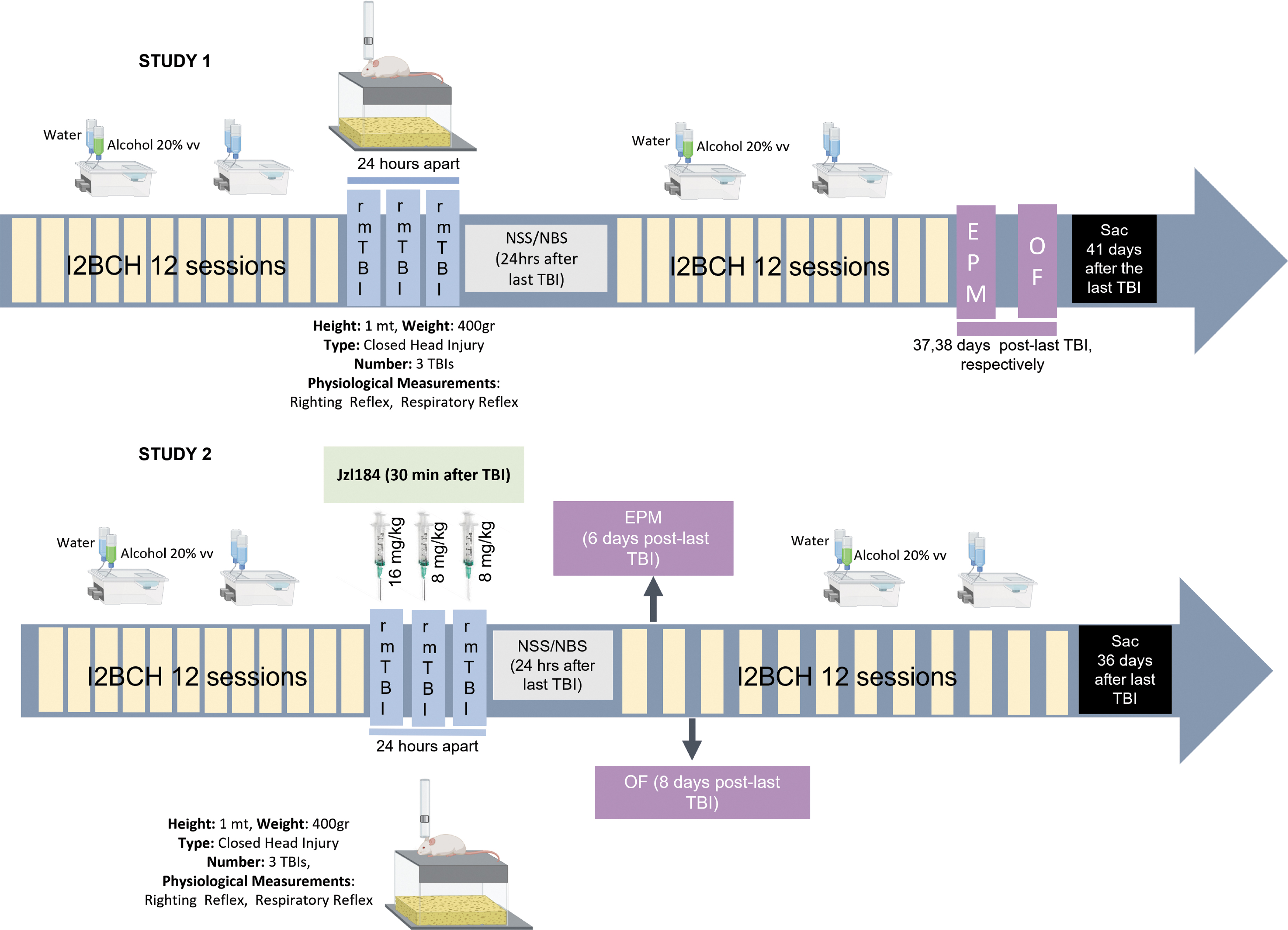
Timeline for Study 1 and 2.
Blood Alcohol Levels (BAL)
Blood samples were collected by tail snip 30 min after the commencement of the last alcohol session. The tip of the tail (∼1 mm) was cut with a disposable scalpel, and blood was collected into a microcentrifuge tube. Topical bupivacaine was used to avoid pain after bleeding. The BAL was analyzed using an ANALOX machine according to the manufacturer's instructions (Analox Instruments Limited, London, England).
Elevated Plus Maze (EPM)
In Study 1, animals were tested for anxiety-like behavior in the EPM three days after the last alcohol session, approximately 37 days after the last TBI, and 3–4h into the dark cycle. In Study 2, animals were tested in the EPM six days after the last TBI, and testing occurred 8h into the dark cycle, on a day when the animals did not consume alcohol.
Rats were placed individually in the center of the EPM facing one of the open arms and allowed 5 min to explore the maze. Sessions were recorded by a video camera placed directly above the apparatus. The apparatus was cleaned with quatricide between animals to avoid olfactory cues. The percentage of total time spent in the open arms was calculated as (open arms time [sec]/open arms time + closed arms time [sec]) × 100. Open arm entries (another index of anxiety-like behavior), closed arm entries, and total arms entries were recorded when all four paws were placed in the arm. An arm exit was recorded when at least two paws were out of the arm.
Open Field (OF)
The OF consists of a square-shaped methacrylate chamber (78 × 78 cm) with the bottom divided into 25 squares (each of them 15 × 15 cm). In Study 1, animals were tested 38 days after the last TBI, and 3–4h into the dark cycle. In Study 2, animals were tested eight days after the last TBI, and 8h into the dark cycle on a day when animals did not consume alcohol.
Animals were placed in the arena for 5 min, and a ceiling-mounted video camera recorded the session. The amount of time each rat spent exploring the center (defined by exploring boxes that do not border the walls of the apparatus) and periphery (defined by exploring boxes that border the walls of the apparatus) was quantified. The percentage time spent in the center was calculated as (seconds in the center/300 × 100), and lower scores in this measure were interpreted as higher anxiety-like behavior. The number of lines crossed was calculated and interpreted to reflect non-specific locomotor activity. The apparatus was cleaned with quatricide between animals.
Statistical Analysis
Statistical analyses were performed with SPSS (IBM Corp., Armonk, NY). Outliers were identified using quartiles (Q) and interquartile range (IQR), and those animals with values lower than Q1-1.5*IQR or higher than Q3 + 1.5*IQR were excluded from the corresponding analysis.
One male from the TBI vehicle-treated and one male from the Sham JZL184-treated group were removed from the analysis of EPM. One female from the Sham vehicle-treated group was removed from the analysis of the OF. In Study 1, respiratory rate and righting reflex were analyzed with three-way repeated measure analysis of variance (RM ANOVAs) (between-subject factors: injury and sex; within-subject factor: time). The NSS and NBS data were analyzed with two-way ANOVAs (between-subjects factors: injury and sex).
Alcohol consumption per day and total alcohol consumption per week were analyzed using three-way RM ANOVAs (between-subject factors: injury and sex; within-subject factor: time). Cumulative alcohol consumption, BAL, EPM, and OF were analyzed with two-way ANOVAs (between-subjects factors: injury and sex).
In Study 2, respiratory rate and righting reflex were analyzed with three-way RM ANOVAs (between-subject factors: injury and sex; within-subject factor: time). NSS/NBS, EPM, and OF, were analyzed with three-way ANOVAs (between-subjects factors: injury, sex, and JZL184 treatment). Alcohol consumption per day and alcohol consumption per week were analyzed with three-way RM ANOVAs (between-subject factors: injury and JZL184; within-subject factor: time). Cumulative alcohol consumption was analyzed with 2-way ANOVA (between-subject factors: injury and JZL184 treatment).
Post hoc comparison between pairs of groups was performed with Sidak when indicated by omnibus ANOVA results. Statistical significance was set as p = 0.05. All data are expressed as mean ± standard error of the mean (SEM).
Results
rmTBI does not produce measurable physiological responses
Immediately after each TBI, respiratory rate and righting reflex were measured to determine the effect of rmTBI on the physiological parameters. In Study 1, a three-way RM ANOVA revealed that females exhibited lower respiratory rate than males (F(1,29) = 31.61, p = < 0.001), but there were no other main effects or interactions effects (Fig. 2A). A separate three-way RM ANOVA revealed a main effect of time on righting reflex such that time to recover righting reflex decreased over time (F(2,58) = 4.77, p = 0.012), but there were no other main effects or interactions effects (Fig. 2B).

Repeated mild traumatic brain injury does not produce measurable physiological responses. Respiratory rate and righting reflex in Study 1 (
In Study 2, a three-way RM ANOVA also revealed lower respiratory rate in females relative to males (F(1,75) = 42.57, p = < 0.001), but there were no other main effects or interactions effects (Fig. 2C). A separate three-way RM ANOVA revealed a time
rmTBI produces neurological deficits
To determine the effects of rmTBI on NSS and NBS, we tested animals 24h after the last TBI. In Study 1, a two-way ANOVA revealed higher NSS scores in TBI rats relative to Sham Controls (F(1,29) = 11.05, p = 0.002), but there was no effect of sex nor an injury

Repeated mild traumatic brain injury produces neurological deficits. In Study 1, neurological severity (NSS) and neurobehavioral scores (NBS) were tested 24h after the last Sham or TBI procedures (
A separate two-way ANOVA revealed no main effects or interaction effects of injury and sex on NBS scores (Fig. 3B). In Study 2, a three-way ANOVA again revealed higher NSS scores in TBI rats relative to Sham Controls (F(1,71) = 28.75, p = < 0.001), and males also exhibited higher NSS scores than females (F(1,71) = 4.61, p = 0.035). There were no other main effects or interaction effects of any factor on NSS scores in Study 2 (Fig. 3C). A separate three-way ANOVA revealed higher NBS scores in TBI rats relative to Sham Controls (F(1,71) = 6.96, p = 0.010), but no other main effects or interaction effects (Fig. 3D).
rmTBI increases alcohol consumption in female but not male rats
Animals were allowed to drink alcohol using an I2BCH procedure (described above and in Fig. 1) to test rmTBI effects on alcohol consumption in males and females. Alcohol consumption pre-TBI in males and females is shown in Fig. 4A. A three-way RM ANOVA of post-TBI daily alcohol drinking data revealed a main effect of sex (F(1,29) = 18.06, p = < 0.001) and an injury
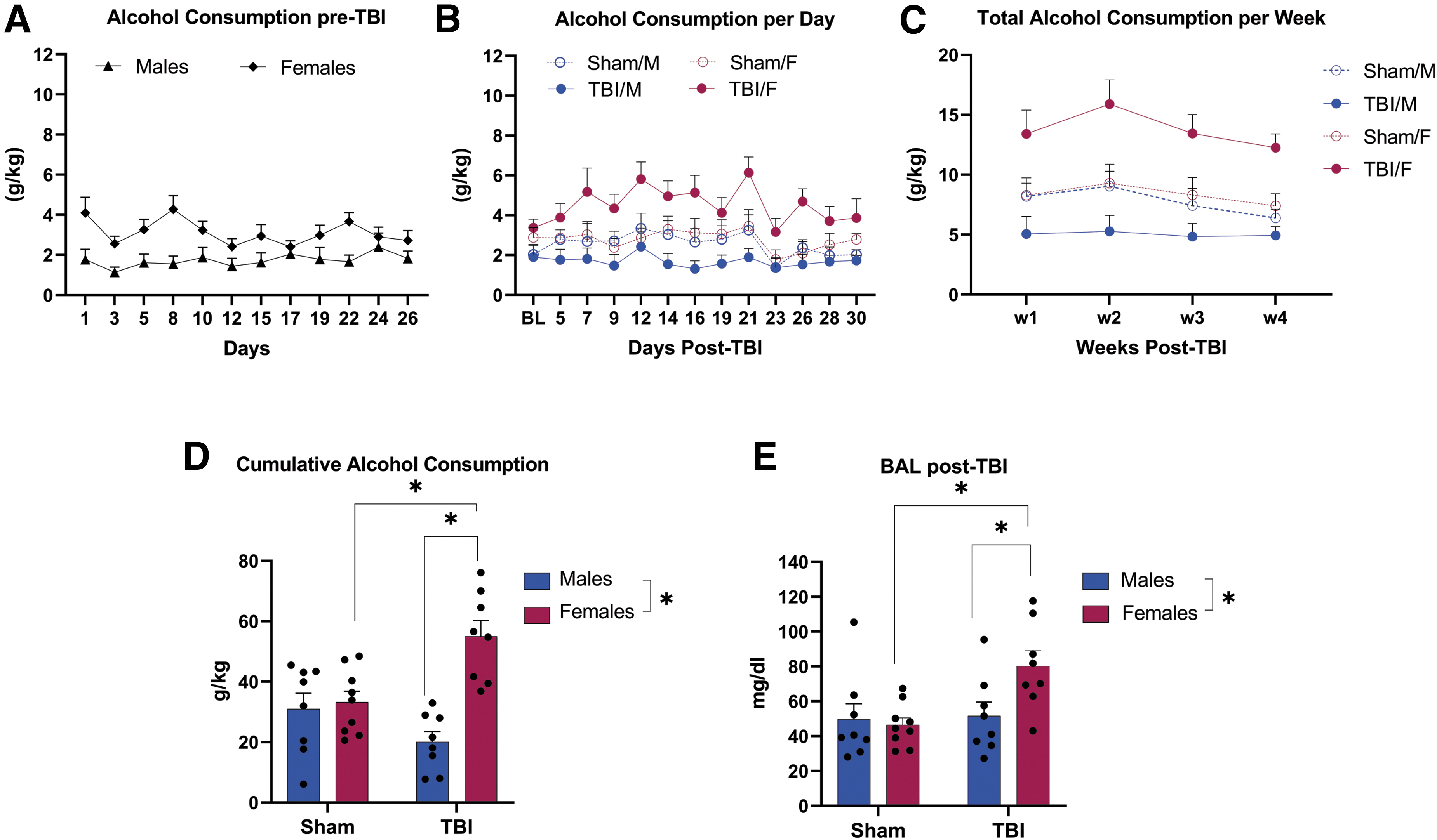
Repeated mild traumatic brain injury increases alcohol consumption in female but not male rats. Alcohol consumption pre-rmTBI, per day (g/kg) in males and females, using intermittent two-bottle choice (
There was a main effect of time on daily alcohol consumption (F(12,348) = 3.12 p = < 0.001) (Fig. 4B). There were no other main effects or interaction effects on daily alcohol drinking in Study 1. When analyzed by total consumption per week, a three-way RM ANOVA revealed significantly higher alcohol consumption in females relative to males (F(1,29) = 18.07, p = < 0.001), and an injury
There was also a main effect of time (F(3,87) = 3.25, p = 0.025) such that animals consumed less alcohol over time. There were no other main effects or interaction effects on weekly alcohol drinking in Study 1.
Finally, we analyzed cumulative alcohol consumption during the 12 post-TBI I2BCH sessions, and a two-way ANOVA revealed once again that females consumed more alcohol than males (F(1,29) = 18.09, p = < 0.001), as well as an injury
We measured BALs 30 min after the commencement of the last alcohol session and two-way ANOVA revealed higher BALs in TBI animals (F(1,29) = 5.70, p = 0.024), and an injury
rmTBI does not increase long-term anxiety-like behavior in either sex
To determine whether rmTBI increases long-term anxiety-like behavior, we tested animals in the EPM 37 days post-last TBI. A two-way ANOVA revealed a main effect of sex on the percentage of time exploring the open arms of the EPM (F(1,29) = 25.91, p = < 0.001). There were no other main effects or interaction effects (Fig. 5A). Analysis of the number of entries in the open arms by two-way ANOVA revealed a main effect of sex (F(1,27) = 17.43, p = < 0.001) on the number of entries in the open arms of EPM. There were no other main or interaction effects (Fig. 5B).
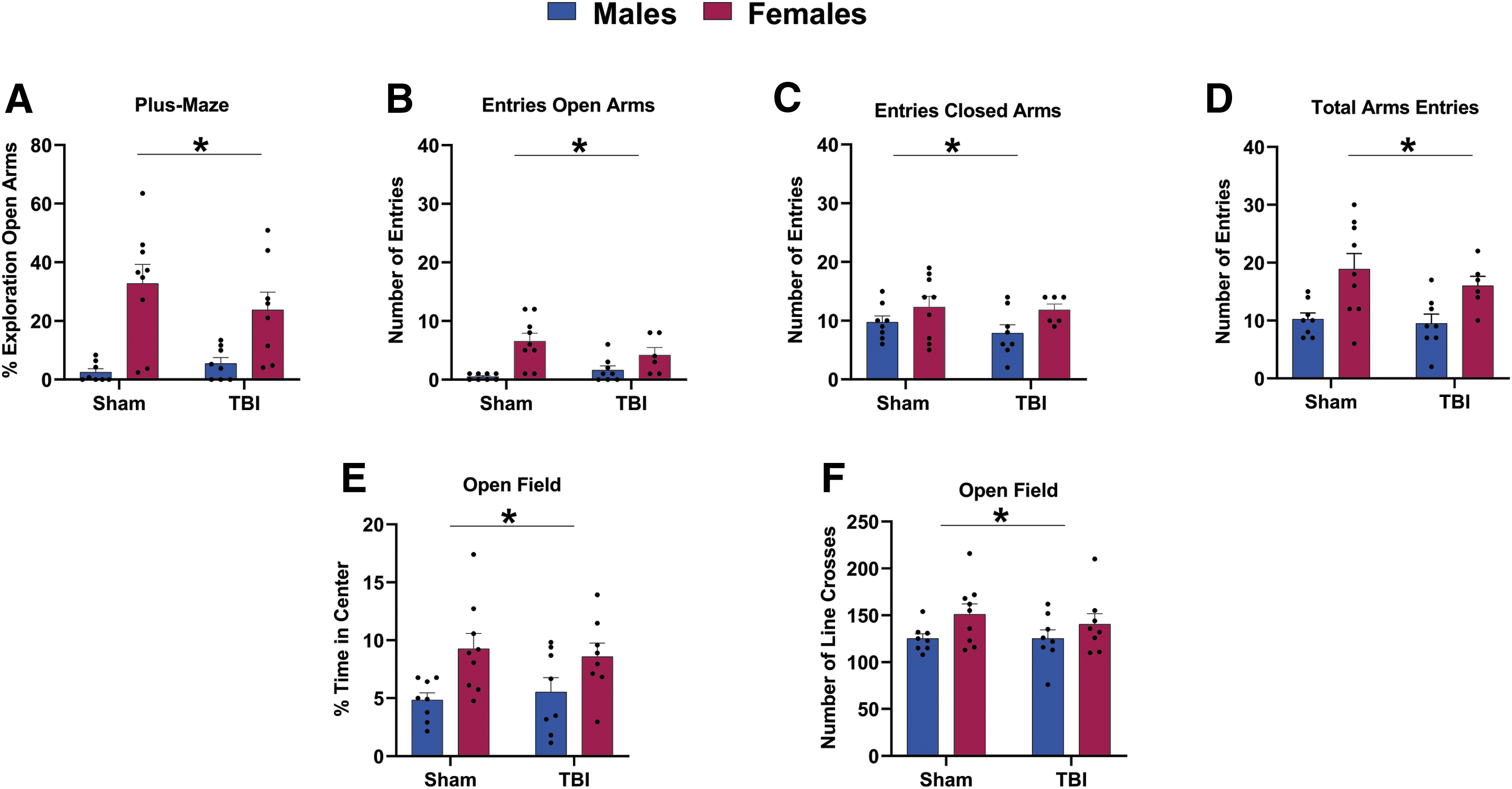
Repeated mild traumatic brain injury does not increase long-term anxiety-like behavior in either sex
A two-way ANOVA revealed a main effect of sex (F(1,27) = 5.03, p = 0.033) on the number of entries in the closed arms. There were no other main or interaction effects (Fig. 5C). A two-way ANOVA for summated entries into all arms of the EPM showed a main effect of sex (F(1,27) = 14.32, p = < 0.001), but no other main effects or interaction effects (Fig. 5D).
Animals were tested in the OF at 38 days post-last TBI. A two-way ANOVA showed a main effect of sex on the percentage of time spent in the center of the OF (F(1,29) = 10.91, p = 0.003). There were no other main effects or interaction effects on the percentage of time spent in the center of the OF (Fig. 5E). A two-way ANOVA showed a main effect of sex (F(1,29) = 4.54, p = 0.042) in the number of lines crossed. There were no other main effects or interaction effects (Fig. 5F).
Repeated systemic JZL184 treatment induces short-term anxiety-like behavior in male rats
In Study 2, to determine the effect of rmTBI and repeated systemic JZL184 treatment on anxiety-like behavior, male and female rats were tested on the EPM six days after the last TBI. Each of the three systemic JZL184 treatments occurred acutely post-injury on the three TBI days.
A three-way ANOVA showed a main effect of TBI to reduce time exploring the open arms of the EPM (F(1,69) = 6.02, p = 0.017), as well as a surprising main effect of JZL184 to reduce time exploring the open arms of the EPM (F(1,69) = 5.19, p = 0.026), and finally a main effect of sex such that males spent less time in the open arms of the EPM (F(1,69) = 12.82, p = < 0.001). There were no interaction effects on time spent in open arms of the EPM (Fig. 6A).

Repeated systemic JZL184 treatment induces short-term anxiety-like behavior in male rats. Anxiety-like behavior in the elevated plus maze (EPM) and the open field (OF) six and eight days post-traumatic brain injury. Percentage of time exploring the open arms in the EPM six days post-rmTBI, in males and females subjected to Sham or rmTBI and treated with three systemic injections of JZL184, 30 min after each TBI (
A separate three-way ANOVA revealed that TBI animals entered the open arms of the EPM fewer times than Sham Control (F(1,69) = 5.85, p = 0.018), and male rats entered the open arms of the EPM fewer times than female rats (F(1,69) = 16.46, p = < 0.001). There were no other main effects or interaction effects on open arm entries (Fig. 6B).
A separate 3-way ANOVA revealed an injury
When summated total entries into all arms of the EPM were analyzed, a three-way ANOVA showed a main effect of sex (F(1,69) = 12.31, p = < 0.001), but no other main effects. There was an injury
In the OF test, a three-way ANOVA revealed that male rats spent less time in the center of the OF than female rats (F(1,70) = 9.00, p = 0.004), and there were no other main effects or interaction effects on this outcome measure (Fig. 6E). A separate three-way ANOVA showed male rats crossed fewer lines than female rats during the 5-min test (F(1,70) = 36.73, p = < 0.001). There was an injury
Post-hoc analyses showed that in the vehicle groups, number of line crosses in Sham Control males differed from TBI males. In the Sham Control group, number of line crosses in vehicle-treated males were significantly different from JZL184-treated males, and JZL184-treated males were different from JZL184-treated females. In the TBI group, number of line crosses by JZL184-treated males differed from JZL184-treated females and vehicle-treated males differed from vehicle-treated females. There were no other main effects or interaction effects on this outcome measure (Fig. 6F).
Repeated systemic JZL184 treatment does not prevent TBI-induced rise in alcohol consumption in females
In Study 2, we tested the effect of repeated systemic JZL184 treatment (acutely post-injury on the three mTBI days) on post-TBI alcohol consumption using the I2BCH procedure. Pre-TBI alcohol consumption by male rats is shown in Fig. 7A. A three-way RM ANOVA revealed a main effect of time on alcohol consumption (F(12,336) = 3.54, p = < 0.001), but no other main effects or interaction effects on this outcome measure (Fig. 7B).

Repeated systemic JZL184 treatment does not prevent rmTBI-induced rise in alcohol consumption in females. Alcohol consumption pre-rmTBI, per day (g/kg) in males (
When we analyzed weekly alcohol consumption data, we again observed a main effect of time (F(3,84) = 6.56, p = < 0.001), but no other main effects or interaction effects (Fig. 7C). When we used a two-way ANOVA to analyze cumulative alcohol consumption during the 12 post-TBI sessions, we observed no effect of TBI or JZL184 treatment, nor an interaction effect (Fig. 7D).
Pre-TBI alcohol consumption by female rats is shown in Fig 7E. A three-way RM ANOVA revealed a main effect of time on alcohol consumption (F(12,516) = 3.33, p < 0.001), and a main effect of TBI to increase alcohol consumption in females (F(1,43) = 7.83, p = 0.008), but no other main effects or interaction effects on this outcome measure (Fig. 7F).
When we analyzed weekly alcohol consumption data, we again observed a main effect of time (F(3,129) = 4.44, p = 0.005) and higher alcohol consumption in TBI females (F(1,43) = 8.68, p = 0.005), but no other main effects or interaction effects (Fig. 7G). When we used a two-way ANOVA to analyze cumulative alcohol consumption during the 12 post-TBI sessions, we again observed higher alcohol consumption in TBI females (F(1,43) = 8.69, p = 0.005), but no main effect of JZL184 treatment and no interaction effect (Fig. 7H).
Discussion
The purpose of the present study was to test the effect of rmTBI (using a weight drop model) on alcohol consumption and anxiety-like behavior in male and female rats (Study 1) and to determine the role of repeated systemic JZL184 treatment on post-TBI alcohol consumption and anxiety-like behavior in male and female rats (Study 2). We spaced repeated injuries by 24h because injuries that occur close together in time produce greater cognitive, histological, and behavioral impairment than injuries separated by longer periods and single injuries. 41 -47
In Study 1 and Study 2, we did not observe a significant alteration in physiological responses after rmTBI. One of the clinical signs to classify the severity of TBI is the duration of loss of consciousness. An mTBI is characterized by absent or transient loss of consciousness (0–30 min). 48
Time to regain righting reflex in rats is used as a surrogate for loss of consciousness in humans and is an indicator of injury severity. 49 An injury associated with time to regain righting reflex that is less than 10-15 min is often classified as mTBI in rodents (e.g., 49 ). Time to regain righting reflex after injury in our studies was under 10 min, suggesting that the parameters used in our experiments generate a mTBI.
We did observe sex differences in respiratory rate (but no effect of rmTBI), with females having fewer breaths per minute compared with males, which may suggest increased sensitivity to the effect of anesthesia in females.
When we tested animals in NSS and NBS assays 24h after the last injury, we found neurological deficits in animals subjected to rmTBI. In Study 2, animals were treated with systemic JZL184 or vehicle, 30 min after each Sham or mTBI procedure, and the drug did not affect post-TBI neurological outcomes.
These findings contrast with those from our previous studies in which systemic JZL184 treatment 30 min after LFP injury reduced post-TBI neurological deficits. 35,37 This discrepancy could be attributed to the different model used for TBI in those studies (LFP) or the frequency of TBI (single vs. repeated). In the LFP model, rats undergo a craniotomy followed by direct injury on the brain that is produced by the application of a fluid pressure pulse. 50 After a single LFP TBI, we found that systemic JZL184 treatment attenuates neurological deficits up to two weeks post-injury in male rats. 35
Here, we used the closed-head weight drop model in which a lesion is produced by dropping a weight on the animal's head from a specific height, and we administered three weight drop mTBIs, which is important because it is known that repeated TBIs have cumulative effect on the brain and are related with persistent symptoms after injury. 51,52 It is possible that responses to eCB degradation inhibitors differ in animals that receive one mild to moderate TBI (e.g., LFP), one mTBI (e.g., weight drop) or rmTBIs, and it is also possible that single versus repeated administration of eCB degradation inhibitors has different effects irrespective of TBI condition.
The I2BCH is a voluntary model of alcohol consumption that provides the animal with the opportunity to choose when and how much alcohol to drink. 53,54 Some studies have shown that rats consume high levels (5–6 g/kg/24h) of 20% v/v alcohol, in this procedure, with approximately 30% of animals reaching 90–100 mg/dL. 53 In the I2BCH procedure used here, animals exhibit increases in alcohol consumption and preference across sessions. 53,55,56
Based on previous literature and the quantities of alcohol consumed by animals in these experiments, it is unlikely that animals consuming alcohol in a I2BCH procedure achieve physical dependence on alcohol, as they do with some other procedures (e.g., vapor chambers; see for example 57 ). For that reason, it is unlikely animals in this study underwent withdrawal, but because we did not explicitly test it here, we cannot rule out the possibility that the periods of forced alcohol abstinence contribute to our measured outcomes.
Most pre-clinical studies on post-TBI alcohol consumption have used male animals and have yielded mixed results, with some showing that experimental TBI does not increase alcohol consumption, 20,23,24 and others showing increased alcohol consumption, preference, or motivation after TBI. 18,19,21 Similarly, previous work using repeated TBI in animal models have reported increases in “front-loading” of alcohol consumption 58 or no change in alcohol consumption. 59
Sex differences in outcomes after TBI have been reported in humans and rodents (reviewed by 60,61 ), but studies on sex differences in alcohol consumption after TBI are sparse. Here, in Study 1, we showed that rmTBI increases two-bottle choice alcohol consumption in females but not males, and blood-alcohol levels were accordingly higher in female rmTBI rats. Previous work from our group reported that a single LFP TBI increases operant alcohol self-administration in adult male Wistar rats, 21 but not in adult female Wistar rats. 24
In Study 1, we did not detect rmTBI effects on anxiety-like behavior 37–38 days later in males or females. Previous work in male mice has reported increases in anxiety-like behavior at one year after repeated TBI (30 impacts, once per day, five days per week) induced by a diffuse TBI model. 62 One study in male mice reported increases in anxiety-like behavior 14 days but not 1–6 months after rmTBI (42 impacts, six per day, each hit separated by 2h) induced by a controlled cortical impact. 63 It is possible that our test time point in Study 1 was too late to detect TBI-induced increases in anxiety-like behavior.
In Study 2, we observed rmTBI-induced increases in anxiety-like behavior in the EPM (tested six days after the last TBI), but not in the OF test (tested eight days after the last TBI). Similar to Study 1, we observed higher anxiety-like behavior in males compared with females. All rats in our studies consumed alcohol for 12 sessions pre-rmTBI and 12 sessions post-rmTBI.
One study reported that young adult alcohol-drinking (pre-TBI, or pre- and post-TBI consumption) female rats exhibited less post-TBI anxiety-like behavior in the EPM compared with alcohol-naïve females. 64 Another study reported that male mice subjected to weight drop TBI and treated with a high dose of alcohol (5 g/kg) 30 min before injury exhibited less anxiety-like behavior in the open field test relative to saline-injected mice. 65
In our study, females consumed significantly more alcohol than males and exhibited less anxiety-like behavior than males, which may be interpreted as a protective effect of alcohol.
Another consideration in our data is that animals were single-housed to measure home cage alcohol consumption; therefore it is possible that males were more susceptible to the effect of this housing condition on anxiety-like behavior, although previous work reported that social isolation is more stressful for females while crowding is more stressful for males. 66
Considerable data exist on the involvement of eCBs in regulating anxiety-like behavior in rodents. For example, acute pharmacological inhibition of the degradative enzymes FAAH or MAGL reduces anxiety-like behavior both in rats and in mice, 67 –69 especially under aversive conditions. 70,71 Conversely, genetic deletion or pharmacological blockade of CB1 receptors increases anxiety-like behavior. 72 –74 Previous studies in our laboratory reported that systemic treatment with JZL184 (16 mg/kg) 30 min after a single LFP TBI reduces anxiety-like behavior in the open field test seven days later. 18
In Study 2, we systemically treated animals with JZL184 30 min after each of three rmTBI injuries, and we tested rats for alcohol consumption over days after the last injury/treatment combination. We did not observe systemic JZL184 effects on post-TBI two-bottle choice alcohol consumption.
Previous studies reported that synthetic cannabinoid receptor agonists increase alcohol consumption in Sardinian alcohol preferring rats, 75 increases the motivation for alcohol consumption, 76 increases alcohol seeking and alcohol self-administration during relapse, 77 and increases relapse-like alcohol drinking in rats. 78
Conversely, systemic treatment with the cannabinoid receptor antagonist reduces operant alcohol responding and two bottle choice drinking in outbred rats 79 –81 and inbred mice, 82 reduces operant alcohol responding, two-bottle choice alcohol drinking, and relapse like alcohol-seeking behavior in rats selectively bred for high alcohol preference, 83 –85 reduces operant alcohol self-administration and free-choice drinking in alcohol dependent rats, 86,87 and CB1 receptor knockout mice experience less rewarding effects of ethanol. 88,89
In our study, rats were treated acutely post-TBI with JZL184, and alcohol consumption testing occurred days later. Recently, our laboratory showed that systemic JZL184 treatment reduces the progressive-ratio breakpoint for alcohol in adult male rats subjected to a single LFP TBI. 18 Future work should test other parameters of eCB degradation enzyme inhibitors (drug, dose, repeated dosing, dosing time point, etc.) to fully characterize the effects of this drug class on alcohol-related behaviors.
We also tested rats for anxiety-like behavior six and eight days after the last injury/treatment combination. It is noteworthy that most studies that report anxiolytic effects of MAGL inhibition tested animals acutely (10–120 min) after single 67,69,90,91 or repeated drug treatment. 71
Here, we hypothesized that repeated systemic JZL184 treatment would rescue TBI-induced increases in anxiety-like behavior, but in fact we observed the opposite: repeated systemic treatment with JZL184 increased anxiety-like behavior in Sham animals that resembled and occluded rmTBI effects. We speculate that this may reflect a sort of “withdrawal syndrome” from repeated boosting of eCB levels via repeated MAGL inhibition, similar to what has been previously shown after prolonged pharmacological inhibition or genetic inactivation of MAGL, 92,93 but this hypothesis requires further testing.
Further, it is known that low doses of CB1 receptor agonists produce anxiolytic-like effects whereas high doses produce anxiogenic-like effects. 69,92 It is possible that our dosing regimen mimicked the effects of a high dose of CB1 receptor agonists, but previous work showed anxiolytic-like effects of high JZL184 dose (40 mg/kg ip) during withdrawal from methamphetamine self-administration in rats. 94
Again, it must be remembered that we administered the drug days before anxiety-like behavior testing, which differs from most previous work. Follow-up studies should measure eCB levels because chronic treatment with JZL184 (40 mg/kg) increases not only levels of 2-AG but also AEA, 93 and other studies reported that simultaneous inhibition of MAGL and FAAH does not prevent stress-induced anxiety-like behavior. 92
Conclusion
These studies demonstrate that rmTBI increases alcohol consumption in adult females and increases anxiety-like behavior in males one week post-TBI. Repeated systemic JZL184 treatments 30 min post-injury did not reduce post-TBI alcohol consumption in female rats and did not rescue post-TBI increases in anxiety-like behavior in male rats. In fact, repeated systemic JZL184 treatment mimicked and occluded TBI-induced increases in anxiety-like behavior in male rats.
Future work will expand on this work by exploring other cannabinoid drugs and dosing regimens on these outcome measures after single or repeated TBIs of varying types and intensities.
Transparency, Rigor, and Reproducibility Summary
The sample size in study 1 was 16 males and 17 females (8-9 per group) and in study 2, there were 32 males and 47 females (8-12 per group). A total of 112 Wistar rats, 4 months old at the time of injury, were subjected to experimental TBI or Sham procedure and were assigned to experimental groups according to alcohol baseline. In study 1, anxiety-like behavior was tested for 3-4 hours into the dark cycle. In study 2, anxiety-like behavior was tested for 8 hours into the dark cycle. All testing sessions were recorded by a video camera. In study 1, the number of entries in the open and closed arms was not scored because of technical problems. Statistical analysis was performed using SPSS. Outliers were identified using the interquartile range, such that animals with values lower than Q1- 1.5 IQR or higher than Q3 + 1.5 IQR were excluded from the corresponding analysis. Two animals were removed from the statistical analysis of the elevated plus maze and one was removed from the analysis of the open field.
Footnotes
Acknowledgments
This manuscript was deposited to a preprint server (BioRxiv). Doi:
Authors' Contributions
AJ-S was responsible for study design, performing experiments and collecting data, data analysis, writing/editing the manuscript. PEM was responsible for conceptualization, study design, writing/reviewing/editing the manuscript, and providing funding for the work. NWG was responsible for conceptualization, study design, writing/reviewing/editing the manuscript, and providing funding for the work.
Funding Information
Support for this study was provided by the National Institute on Alcohol Abuse and Alcoholism, NIH/NIAAA research grant 1R01AA025792-01A1. This work was also supported in part by a Merit Review Award #I01 BX003451 (to NWG) from the United States Department of Veterans Affair, Biomedical Laboratory Research and Development Service.
Author Disclosure Statement
NWG holds shares in Glauser Life Sciences, Inc. These activities have no relation to any of the work presented in this article. No competing financial interests exist for AJ-S, and PEM.