




Abstract
Concussion is a common injury in the adolescent and young adult populations. Although branched chain amino acid (BCAA) supplementation has shown improvements in neurocognitive and sleep function in pre-clinical animal models of mild-to-moderate traumatic brain injury (TBI), to date, no studies have been performed evaluating the efficacy of BCAAs in concussed adolescents and young adults. The goal of this pilot trial was to determine the efficacy, tolerability, and safety of varied doses of oral BCAA supplementation in a group of concussed adolescents and young adults. The study was conducted as a pilot, double-blind, randomized controlled trial of participants ages 11–34 presenting with concussion to outpatient clinics (sports medicine and primary care), urgent care, and emergency departments of a tertiary care pediatric children's hospital and an urban tertiary care adult hospital, between June 24, 2014 and December 5, 2020. Participants were randomized to one of five study arms (placebo and 15 g, 30 g, 45 g, and 54 g BCAA treatment daily) and followed for 21 days after enrollment. Outcome measures included daily computerized neurocognitive tests (processing speed, the a priori primary outcome; and attention, visual learning, and working memory), symptom score, physical and cognitive activity, sleep/wake alterations, treatment compliance, and adverse events. In total, 42 participants were randomized, 38 of whom provided analyzable data. We found no difference in our primary outcome of processing speed between the arms; however, there was a significant reduction in total symptom score (decrease of 4.4 points on a 0–54 scale for every 500 g of study drug consumed, p value for trend = 0.0036, [uncorrected]) and return to physical activity (increase of 0.503 points on a 0–5 scale for every 500 g of study drug consumed, p value for trend = 0.005 [uncorrected]). There were no serious adverse events. Eight of 38 participants reported a mild (not interfering with daily activity) or moderate (limitation of daily activity) adverse event; there were no differences in adverse events by arm, with only two reported mild adverse events (both gastrointestinal) in the highest (45 g and 54 g) BCAA arms. Although limited by slow enrollment, small sample size, and missing data, this study provides the first demonstration of efficacy, as well as safety and tolerability, of BCAAs in concussed adolescents and young adults; specifically, a dose-response effect in reducing concussion symptoms and a return to baseline physical activity in those treated with higher total doses of BCAAs. These findings provide important preliminary data to inform a larger trial of BCAA therapy to expedite concussion recovery.
Introduction
Mild traumatic brain injuries (mTBI), including concussion, are common injuries experienced by adolescents and young adults. 1 Over the past decade, significant advances in the knowledge and care of concussed adolescents and young adults have occurred. Although traditionally, a passive strategy of cognitive and physical rest has been recommended as the sole treatment modality for concussion, 2 several active rehabilitation strategies have shown efficacy, including aerobic exercise therapy 3,4 and visio-vestibular rehabilitation. 5,6 However, these therapeutics are time and labor intensive, require specialized monitoring and for most, require a prescription from a concussion specialist. In spite of these advances, a pharmacological intervention to hasten recovery has yet to be identified. Medications commonly prescribed (such as over-the-counter analgesics and anti-emetics 7 ) focus on symptom management without targeting the underlying pathophysiology that leads to concussion symptoms. 8
Pre-clinical studies in animal models have demonstrated that the three branched chain amino acids (BCAAs)–valine, leucine, and isoleucine–are reduced following TBI, with their depletion possibly the result of their role in both the production of neurotransmitters and in cellular metabolism, which is transiently elevated after injury followed by protracted duration of reduction. 9 Following BCAA supplementation, injured mice demonstrate improvement in cognitive activity and mitigation of persistent sleep–wake deficits, thought to be mediated through restoration of excitatory/inhibitory balance in the hippocampus. 10,11 In humans, BCAA levels after severe TBI in adults correlate with measures of clinical severity (such as intracranial pressure 12 ). BCAA supplementation in this population led to moderate improvement in disability and cognitive function. 13,14 A single study of 18 patients (primarily adults) with mTBI demonstrated decreased concentrations of BCAAs and their metabolites compared with healthy controls. 15 BCAA supplementation improved actigraphy metrics and self-reported sleep quality in veterans who were recovering from mTBI. 16 It is unknown whether BCAA supplementation will accelerate the rate of neurocognitive or clinical symptom recovery from concussion in adolescents and young adults.
Therefore, the goal of this pilot, double-blinded, randomized controlled trial was to (1) evaluate whether BCAA supplementation will accelerate the cognitive and symptom recovery of concussed participants in a dose-dependent manner and (2) determine the safety and tolerability of varying concentrations of oral BCAA supplementation. We hypothesized a dose-response improvement in processing speed, symptom burden, physical activity level, and sleep integrity in those receiving BCAA supplementation compared with placebo, with BCAAs being well tolerated at all doses. 17,18
Methods
Study design and participant population
Study description is reported in line with the Consolidated Standards of Reporting Trials (CONSORT) statement extension to randomized pilot and feasibility trials (see Supplementary Table S1 for complete checklist). 19 The trial was registered on ClinicalTrials.gov (identifier NCT01860404) prior to participant enrollment. The study was United States Food and Drug Administration (FDA) regulated (FDA IND 117570). Participants were enrolled as a convenience sample, based on availability of research team members. Recruitment occurred in outpatient clinics (sports medicine and primary care), urgent care centers, and emergency departments of a tertiary care pediatric children's hospital and an urban tertiary care adult hospital, both with a level I trauma designation, from June 25, 2014, through December 5, 2020. It is of note that in October 2016, after the enrollment of 12 analyzable subjects, the study was paused because of slow enrollment, and eligibility criteria were modified to broaden the age limit, lengthen the time from injury to presentation, and include non-sports injury mechanisms. During the pause, we experienced turnover of multiple research staff members; this, in combination with changes in study recruitment policies for acute care locations, extended the enrollment pause while study procedures were being modified. Study enrollment resumed in 2018, but slowed significantly again during the novel coronavirus pandemic in early 2020. Therefore, in late 2020, after randomizing 42 participants (fewer than our target of 50; see subsequent power analysis), given the ongoing length of the study to date and concurrent advances in concussion care, we decided to halt enrollment to assess the efficacy of the pilot data.
Participants were eligible if they were between 11 and 34 years of age (initial lower age limit was 16 years, lowered following initial enrollment phase) and diagnosed with a concussion by the treating provider in alignment with the most recent International Consensus Concussion guidelines at the time. 20 Additional inclusion criteria included injury within the prior 72 h (initial criteria was injury within 24 h, broadened following the initial study phase), weight of at least 40 kg (given dosing considerations 21 ), and a negative pregnancy test and acceptable contraception for study duration for post-menarchal females (because of animal models showing possible harmful effects of BCAA supplementation in utero 22 ). Initial injury mechanism was limited to sport- and recreation-related injuries; however, after the initial enrollment phase, this was broadened to include all injury mechanisms. Exclusion criteria included signs of a moderate or severe TBI (including witnessed seizure or admission to an intensive care unit), prior concussion within the preceding 90 days, history of maple syrup urine disease or family history of maple syrup urine disease, active prescription of neurological or psychoactive medications, and allergy to red dye #40 or sucralose. Following screening, all participants (for those ≥18 years of age) or parents/guardians (for those <18 years) provided written informed consent; child assent was also obtained for participants <18 years of age. The study was approved by our institution's institution review board under IRB#13-010227.
Randomization and blinding
Following enrollment and completion of informed consent, participants were randomized into one of five groups (placebo and four BCAA dosing groups, as will be noted), in a schema of equal allocation, stratified by sex, which was generated a priori by the study biostatistician. A randomization module was programmed to generate a unique kit number for each participant. The scheme was provided to the Investigational Drug Service (IDS) at the University of Pennsylvania prior to study initiation, where study kits were prepared. Participants and study investigators were blinded to treatment assignment; only the database administrator and the University of Pennsylvania pharmacist had access to the link between kit number and treatment arm. Color and opacity of kits were prepared by the IDS to be as closely matched as possible to ensure adequate blinding between placebo and BCAA dosages.
Treatment
The three BCAAs, valine, isoleucine, and leucine, were combined together in a 1:1:1 ratio for the four treatment doses. Dose levels were determined both by animal models and by prior clinical work in humans in other conditions. In brain-injured mice, the equivalent of 60 g per day of BCAAs mitigated cognitive impairment, without there being additional benefit at higher doses. 9,10 In prior human trials, doses between 15 g/day and 57 g/day were utilized for treatment of neurologic conditions, such as tardive dyskinesia and hepatic encephalopathy. 23,24 The “no observable adverse effect level” of BCAA intake is likely considerably higher than 60 g, with no evidence of toxicity in animal models up to 100 g/day and in humans of up to 90 g/day. 25 Given the unknown optimal dose of BCAA supplementation for concussion, we initially chose doses of 15 g, 30 g, 45 g, and 60 g divided twice daily as our treatment doses. However, during initial study preparation, precipitation issues were noted at the highest dose because of leucine precipitating at a lower concentration than expected. After further testing, it was determined that the product remained in solution at a concentration of 27 g/591 mL and therefore, the highest dose level was reduced to 54 g/day.
Each treatment dose was divided into twice daily dosing (7.5 g, 15 g, 22.5 g, and 27 g, respectively). For each dose, the BCAAs were combined and dissolved in water, with additives to improve palatability. The placebo solution contained sucrose octaacetate and microcrystalline cellulose dissolved in water, with identical additives, to ensure that the placebo solution had a similar taste, texture, consistency, and appearance as the BCAA solution. The BCAA and placebo solutions were compounded by the University of Pennsylvania IDS laboratory. Prior to any study drug distribution, the stability and durability testing, including bioburden and colony count, were performed by the IDS laboratory in line with organizational and institutional policies.
Monitoring and outcomes
Participants were monitored for 21 days following enrollment. Participant baseline characteristics, including demographic data, were collected via self-report upon enrollment. Participants were monitored with daily electronic surveys and cognitive testing, as well as continuous actigraphy. Each survey included questions about concussion symptoms, physical activity, cognitive activity, drug compliance, and adverse events. In-person visits were conducted at three time points during study enrollment, between study days 5 and 9, 12 and 16, and 22 and 24, to assess symptom burden and side effects in person.
The primary outcome was to determine if, compared with placebo treatment, BCAAs accelerated neurocognitive recovery. Neurocognitive testing was performed using the CogSport/Axon Sports Computerized Cognitive Assessment Tool (CCAT). 26,27 The CCAT includes four computerized tests measuring processing speed (via a simple reaction time task), attention (via a choice reaction time task), visual learning (via a one-card learning task), and working memory (via a one-back task). In line with prior studies and manufacturer recommendations, average log mean reaction time was chosen as the outcome for the processing speed, attention, and working memory subtests; accuracy was used for the visual memory subtest. 26 –28 Symptoms were assessed via self-report utilizing a nine-item symptom instrument, shown to have excellent factorial and construct validity by Piland and colleagues. 29 Included in the instrument are the following: headache, nausea, balance problems, sleeping more than normal, drowsiness, fatigue, feeling slowed down, feeling mentally foggy, and difficulty concentrating. Each symptom is rated on a seven-point Likert scale (0 = no symptoms; 6 = very severe symptoms), generating a total symptom score ranging from 0 to 54. Physical activity was rated on a six-point Likert scale of return to baseline physical activity (0 = no physical activity; 5 = return to full physical activity, including full game play for athletes). Cognitive activity was rated on a five-point Likert scale of return to baseline cognitive activity at school or work (0 = complete cognitive rest; 4 = full unrestricted participation in school or work).
Participant sleep was assessed using actigraphy (ActiSleep+ Monitor, ActiGraph, Pensacola, FL) worn 24/7 during study participation on the participant's non-dominant wrist. Data were collected in 60 sec epochs and analyzed using ActiLife software version 6.13.4 with a 90-min non-wear threshold. 30,31 Each study day was analyzed individually for bedtime, wake time, total sleep time (TST), sleep efficiency, wake after sleep onset (WASO), number and length of awakenings, activity, and proprietary indices of movement/sleep fragmentation. These respective metrics were averaged across the entire study duration, with daytime sleep periods excluded.
Participant compliance with taking BCAA supplementation was assessed by self-report. Participants reported the number of bottles of study medication (0, 1, or 2, as each daily dose was divided into twice daily increments) consumed. For days in which participants did not answer the survey, it was assumed that no drink was consumed. Potential adverse events, in accordance with the CONSORT harm guidelines for pilot randomized trials, 19 were collected from daily self-report surveys in addition to assessment at scheduled study visits. All adverse events were characterized with descriptions of the event, assessment of severity, indication of whether the event was serious (death, a life-threatening event, hospitalization or prolongation of existing hospitalization, or persistent or significant disability/incapacity), and start and end date.
Statistical considerations and power analysis
Standard descriptive statistics were used to summarize demographic data. Our initial analytical plan was to adjust for age and repeated measures among the five treatment arms using a mixed-effects model by prescribed dose. Given both our inability to reach our enrollment goal, as well as varying response rates (see Table 1), we were unable to fit a model using this approach. Instead, to account for individual characteristics, such as age and varying amounts of follow-up time with unbalanced numbers of repeated measures, in addition to capturing efficacy as opposed to effectiveness (given varying adherence to treatment protocol, see Table 2), we used linear regression to conduct a dose-response analysis. The linear regression model included total cumulative study dose received (study dose prescribed multiplied by number of days consuming said dose) as the independent variable and change in outcome (average of each participant's first three measures compared with the participant's last three measures over the course of the study) as the dependent variable among participants with at least seven reported measurements. This dose-response model was fitted separately for each of the four CCAT subtests, total symptom score, physical activity, and cognitive activity; the intercept and slope parameter (with 95% confidence interval and p value) were obtained from models with each outcome. Although both physical and cognitive activity were assessed on ordinal scales, the outcome measure used in the model was the change in these activity levels, leading to a continuous variable from which a linear regression model could be fitted. Compliance (average reported drink consumed over study period) and adverse events (average per arm and percent in each arm experiencing adverse events) were compared across arms using Kruskal–Wallis rank test and Fisher's exact test, where appropriate. Analyses were performed using SAS software, version 9.4 (SAS Institute Inc, Cary, NC), Stata software, release 14.2 (StataCorp LLC, College Station, TX), and GraphPad Prism version 8 (GraphPad Software, San Diego, CA).
Participant Demographics
BCAA, branched chain amino acid; IQR, interquartile range.
Compliance and Adverse Events
BCAA, branched chain amino acid; IQR, interquartile range.
Prior to study initiation, we estimated an enrollment goal of 50 subjects, or 10 subjects per arm, which would have given us 80% power to detect differences in the processing speed subtest between the BCAA arms and the placebo arm of 0.122 sec (log mean -0.914), or a 5% difference based on healthy control data (including a standard deviation of 0.08 sec in healthy individuals, inflated to 0.10 for injured subjects). 28 As noted, because of significant slowing of enrollment during the novel coronavirus pandemic in early 2020, in late 2020, after randomizing 42 participants, we decided to halt study enrollment to assess efficacy of pilot data in order to inform a larger, more definitive, full-powered trial.
Results
In total, 42 participants were randomized (see Fig. 1 for flow diagram). Of those, four participants withdrew prior to providing any follow-up data (all in the 30 g BCAA arm), and therefore were withdrawn from further analysis. Demographics and initial injury characteristics for the 38 analyzed participants are provided in Table 1. Of the 38 participants analyzed, 26 provided at least seven reported measures in symptoms, physical and cognitive activity, and 18 provided at least seven reported measures for neurocognitive testing; 20 provided data through the full 21 days of the study period. The average number of days for which the survey questions and CCAT battery were completed across the study period by arm is displayed in Table 1. Overall, the median total study dose consumed was 360 g (range 0–2052 g; see Table 1 for breakdown by arm).

Flow diagram of allocation and follow-up. BCAA, branched chain amino acid; f/u, follow-up.
In terms of neurocognitive testing, we did not find a change in outcome with increased total study dose consumed using linear regression analysis (Table 3, Fig. 2). It is of note that not all patients who completed follow-up completed the neurocognitive testing elements (Table 1). We found a significant reduction in total symptom score by total dose consumed using linear regression analysis (a decrease of 4.4 points [standard error 1.4] for each 500 g of study drug consumed, p value for trend line = 0.0036; Table 3 and Fig. 3a), as well as a significant improvement in return to baseline physical activity by total dose consumed in our adjusted analysis (an increase of 0.503 points [standard error 0.164] for each 500 g of study drug consumed, p value for trend = 0.0053). We found no change in cognitive score in our linear regression (Table 3, Fig. 3c).
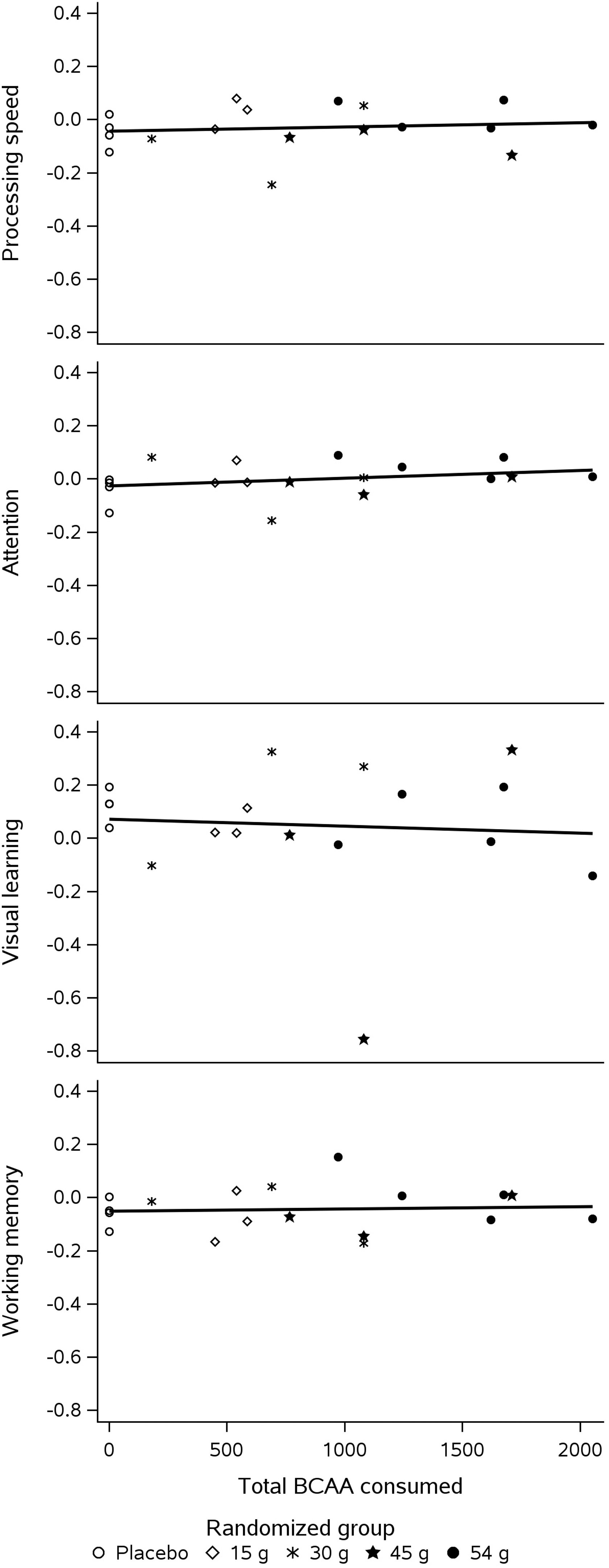
Comparison (scatter plot and linear regression) of total BCCA consumed and change in neurocognitive testing battery outcomes, calculated as the difference between the average of each participant's first three measures during the course of the study for each outcome compared with the average of that participant's last three measures during the course of the study in patients with at least seven battery measurements (n = 18), by randomized BCAA arm. BCAA, branched chain amino acid.
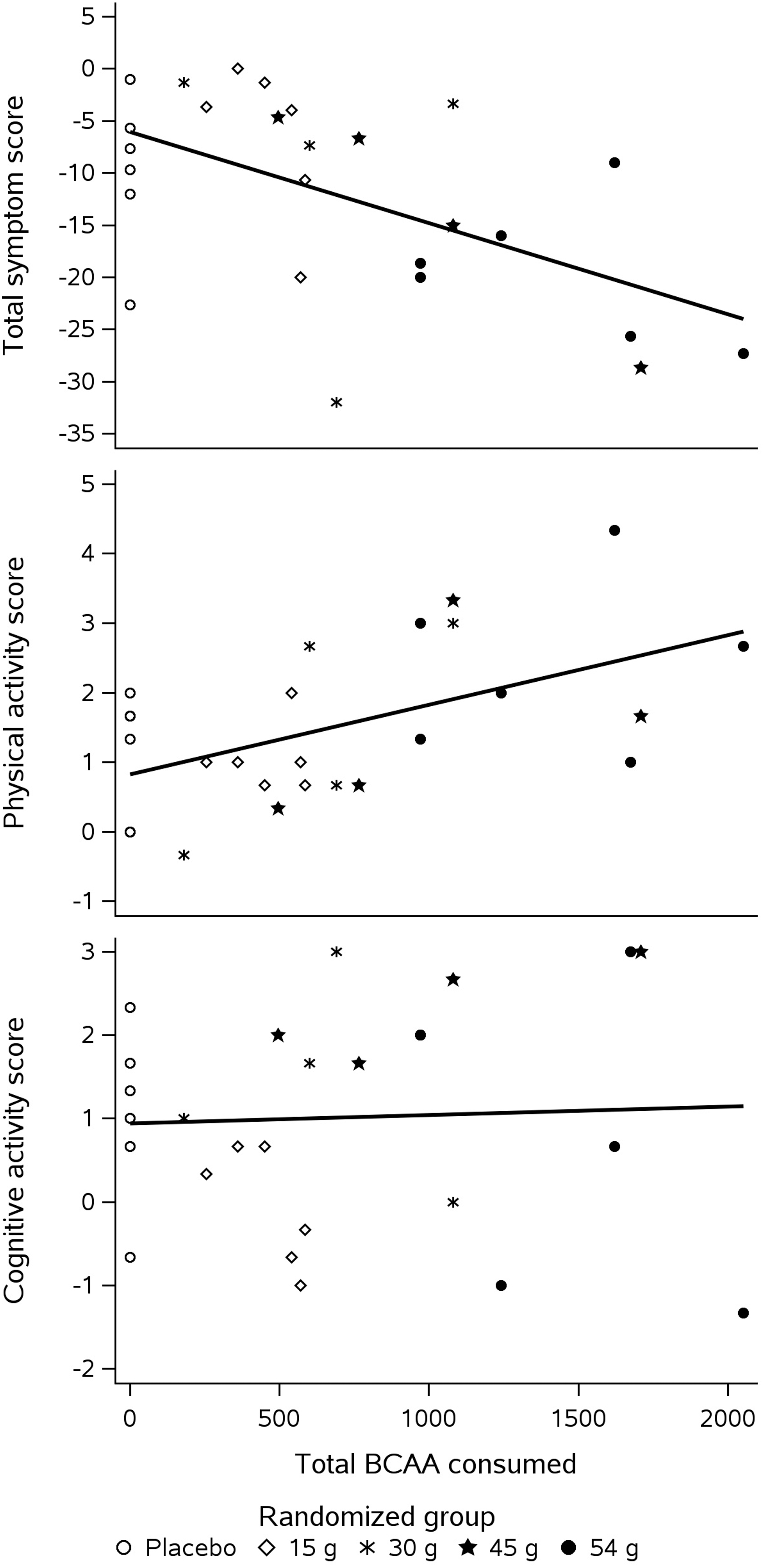
Comparison (scatter plot and linear regression) of total BCCA consumed and change in self-reported symptom and activity outcomes, calculated as the difference between the average of each participant's first three measures during the course of the study for each outcome compared with the average of that participant's last three measures during the course of the study in patient's with at least 7 self-reported measurements (n = 26), by randomized BCAA arm. BCAA, branched chain amino acid.
Distribution of Measures of Change in Outcomes (Calculated as the Difference of the Average of the First Three Measurements and Last Three Measurements Among Participants With Seven or More Measurements), the Change and Standard Error of Change, and the Correlation With Total Cumulative Study Dose
Actigraphy data are presented in Supplementary Table S2. Because of a limited number of participants with complete actigraphy data, no statistical testing was performed based on this data; however, the raw values for sleep efficiency (93.2% vs. 91.4%) and total sleep time (536.7 min vs. 468.1 min) were higher in the highest BCAA dose group (54 g/day) versus the placebo group.
In analyzing our compliance, we found lower average reported total drink consumed by arm (81% reported compliance in the placebo arm compared with 49% compliance in the 54 g BCAA arm; Table 2, although the trend was non-significant [p = 0.581] via Kruskal–Wallis testing). We did not find any difference in adverse events by arm (Table 2) via Kruskal–Wallis testing. Across the study, in total, 13 adverse events were reported among the 38 participants, the majority (10) occurred in either the placebo or lowest BCAA dose groups. No adverse events were severe, and the majority (10 out of 13, including all three adverse events in the 30 g, 45 g, and 54 g BCAA arms) were reported as mild. The majority (12 of the 13) were gastrointestinal side effects (abdominal pain, diarrhea, or bloating).
Discussion
This pilot, double-blinded, randomized controlled trial is the first evaluation of BCAA supplementation in the treatment of concussion in adolescents and young adults, and it demonstrated the efficacy, high tolerability, and safety of BCAAs. Specifically, we found a significant dose-response effect in reduction of concussion symptoms and a return to baseline physical activity in those who consumed higher total doses of BCAAs across the study period, with high tolerability of treatment doses without serious adverse events. These data provide important preliminary work to inform a larger, definitive randomized controlled trial of BCAA therapy for concussed youth and young adults.
BCAAs participate directly and indirectly in a variety of important biochemical functions in the brain. In addition to the fundamental use of amino acids for protein synthesis, these specific essential amino acids are pivotal in glutamate synthesis, as they contribute 50% of the nitrogen in glutamate. 32 Moreover, the decarboxylation of glutamate by glutamic acid decarboxylase (GAD) leads to the synthesis of the primary inhibitory neurotransmitter GABA. Further, de novo glutamate synthesis contributes a significant amount (approximately 40%) of releasable synaptic glutamate. 33 It has been hypothesized that the increased energy demands of the brain post-injury rapidly deplete BCAA levels. 9 In addition, it has been noted that BCAAs can enter the Krebs cycle and contribute to increased production of adenosine triphosphate (ATP), 14 alterations in which have also been implicated as a key component to the pathophysiology of concussion. 8 Interestingly, animal studies have found that repeated exposure to BCAAs over multiple days is required to observe improvements in cognitive function following TBI. 10 This suggests that it is not only BCAA supplementation, but repeated exposure to BCAAs, that underlies the clinical improvement noted in our current study (as evidenced by the total dose-response effect in improving concussion symptoms, allowing for a return to baseline activity level following injury).
Overall, we saw minimal adverse effects with BCAA supplementation, particularly at our higher doses. Multiple prior studies have reported the tolerability of BCAAs, with large reviews reporting either no, or minimal, gastrointestinal side effects, 23 and the results herein further support the tolerability of BCAA supplementation. We do note the decrease in treatment compliance as BCAA doses increased; although not related to adverse events experienced by participants, this does suggest, in the setting of concussion, that there may be limited palatability of the highest BCAA doses that might limit compliance. Future work should focus on methods to improve compliance with the highest BCAA doses, particularly given the observed dose-response effect in this study, as well as the importance of repeated BCAA exposure in animal models. 10
The improvement in concussion-related symptoms and accelerated return to baseline physical activity in a dose-response pattern are key findings of our study. Over the past decade, symptoms have emerged as the principal primary outcome in the largest observational and interventional trials of concussion. 4,34 In addition, there has been an effort to incorporate patient-reported outcomes as primary measures of functioning following injury (with return to pre-injury level of activity being a key indication of post-injury functioning), 35 and prior work has demonstrated a strong correlation between symptom burden and quality of life in adolescent concussion. 36 Although our primary outcome, neurocognitive testing, did not show significant differences among our treatment arms, since the inception of our study, multiple limitations to utilizing neurocognitive testing as an objective injury marker have been described. 37,38 In particular, a “ceiling effect” to neurocognitive testing has been described, reducing its utility as a study end-point over time. 39 Since the initial development of the study protocol, however, multiple other objective markers of injury have been developed as key metrics of central nervous system dysfunction, including visio-vestibular testing 40,41 and evaluation of the pupillary light reflex. 42 These objective measures, in addition to blood-based biomarkers, 43 make for key additional objective outcomes to potentially augment subjective symptom scores in future trials.
Sleep disturbances have frequently been reported as key elements contributing to dysfunction following concussion, 44 with sleep alterations in the acute time frame after injury having been identified as a key prognostic factor in the development of persistent post-concussive symptoms. 45 Previous work has demonstrated the efficacy of BCAA supplementation to improve sleep disturbances in animal models, 11 and a recent randomized trial of veterans with chronic TBI symptoms showed BCAA efficacy in improving both subjective and objective sleep impairment. 16 Our data, although limited in sample size and statistical power in this secondary outcome measure, suggest possible improvements in sleep efficiency and total sleep time in those receiving the highest BCAA dose.
Since our study inception, several randomized trials of active rehabilitative treatment programs have been conducted showing efficacy in reducing prolonged concussion symptoms. 3 –5 However, completing these interventions often requires either in-person visits or specialized guidance. 46 The potential reliance on specialist prescription and monitoring has the potential to introduce or exacerbate the known disparities in concussion care that exist for underserved communities. 47 This underlies the importance of developing safe, accessible, and well-tolerated pharmacological interventions for concussion in adolescents and young adults, such as BCAA supplementation, that could be prescribed from diverse settings without a need for specialist monitoring. The role of BCAAs may also expand beyond treatment into the realm of injury prevention, as a recent animal model study explored the efficacy of administering BCAAs in mice as a prophylaxis prior to head trauma, with improved motor recovery and cognitive function. 48
There are several key limitations to our study that indicate the need for a larger, more definitive trial before routine clinical implementation of BCAA therapy for concussion. First, because of a combination of initially more strict inclusion criteria, and the impact of the coronavirus pandemic, our sample size was smaller than anticipated. This, combined with poorer-than-expected follow-up, led us to have to use alternative statistical analytical methods. However, the improvement in symptoms, physical activity, and sleep represent strong preliminary data to inform a future larger trial. We were further limited by missing data. This also necessitated the alternative analytical approach described in the Methods. It is of note that, since study inception, multiple investigators have refined remote patient monitoring tools as a means to track participants in observational and interventional studies from multiple settings, 49,50 making these tools a promising method to maximize follow-up in future trials. In addition, since study inception, several symptom batteries have emerged as a standard of care for assessing concussion symptoms. 51 As our participants were enrolled in a convenience sample, our sample may not be representative of the overall population of acutely concussed adolescents and young adults, although our broad enrollment locations (compared with exclusively enrolling from an emergency department or specialty clinic) may assist with the generalizability of our results. Finally, as we enrolled subjects over a significantly longer period than initially anticipated, multiple temporal trends in the management of concussion occurred during our study time frame (specifically a move away from passive treatment recommendations toward a more active therapeutic approach 46 ), which potentially may have impacted our results, although one would expect that any active intervention that would improve recovery time would have decreased the effect size of the BCAA intervention, making our findings even more promising (and as noted in Table 1, there was relatively equal distribution of participants across arms in the various study enrollment periods).
Conclusion
In conclusion, this preliminary work, while limited by enrollment challenges and small sample sizes, demonstrates the potential efficacy of BCAAs in improving concussions symptoms and allowing for a more rapid return to pre-injury activity levels in concussed adolescents and young adults, representing the first such data in acute mTBI in humans. Importantly, BCAAs were found to be well tolerated in our participants, with minimal adverse events, even at the highest doses. Although a larger, more definitive trial is necessary prior to routine clinical implementation of BCAA therapy for concussed adolescents and young adults, these data demonstrate the promising potential benefit of BCAA supplementation to reduce symptoms and allow for a return to baseline activity following concussion.
Transparency, Rigor, and Reproducibility Summary
The study design and analysis plan were preregistered on May 22, 2013 at ClinicalTrials.gov (NCT01860404). It is of note that, given both our inability to reach our enrollment goal, and varying response rates, we were unable to fit a model using our original approach. Therefore, an alternative statistical plan was implemented by a study biostatistician (K.B.M.) blinded to treatment allocation. Prespecified sample size was 10 subjects per group, yielding statistical power of 80% for detection of a 0.122 sec (log mean -0.914) difference in the processing speed subtest of the CogSport/Axon Sports CCAT as the primary outcome measure. All participants were assigned to one of four intervention groups (15 g, 30 g, 45 g, and 54 g daily of BCAA) or placebo using a random number generator programmed a priori, yielding groups that did not differ statistically in baseline characteristics. In total, 42 participants were randomized; the primary outcome was assessed in 30 participants (after 12 incomplete assessments), and secondary outcomes were assessed in 38 participants (after 4 incomplete assessments), as demonstrated in the study CONSORT diagram. Participants were blinded to group assignment with use of identically appearing placebo treatment. All primary outcomes were assessed by investigators blinded to group assignment. All materials required to perform the interventions may be available upon request from University of Pennsylvania Laboratory service and the corresponding author. The key inclusion criteria, as well as the primary and secondary outcome measures, were standards in the field at time of enrollment. Descriptive statistics of continuous variables utilized non-parametric tests. For the dose-response analysis of primary outcomes, we used linear regression, which assumed normal distribution of total study dose received and of change in outcome measures. Because the sample size was smaller, we modified the planned primary dose-response analyses from a repeated- measures mixed-effect model to a linear regression using summarized outcome and dose data. We did not use statistical methods to correct for multiple comparisons, as we interpreted our results holistically by examining the effect of total dose on various outcomes as evidence for overall reduction in concussion-related signs and symptoms, rather than emphasizing a particular relationship with a specific outcome. The findings have not yet been replicated or externally validated; however, external validation studies are currently being planned. De-identified data from this study are not available in a public archive. De-identified data from this study will be made available (as allowable according to institutional review board [IRB] standards) by e-mailing the corresponding author as of June 1, 2024. Analytical codes used to conduct the analyses presented in this study are not available in a public repository. They may be available by e-mailing the corresponding author as of June 1, 2024. Intervention protocols are available upon request. The authors agree to provide the full content of the manuscript on requests made by contacting the corresponding author.
Footnotes
Acknowledgments
We thank Casey Swann for her time in participant screening and enrollment, and Noah Milman and Tanya Omar for assistance with ActiGraph data.
Authors' Contributions
D.J.C.: conceptualization, methodology, data curation, formal analysis, writing (original draft); S.R.M.: conceptualization, methodology, writing (review and editing); K.B.A.: conceptualization, methodology, funding acquisition, writing (review and editing); M.M.L.: conceptualization, methodology, formal analysis, writing (review and editing); J.E.E.: data curation, formal analysis, software, investigation, writing (review and editing); K.B.M.: data curation, formal analysis, software, investigation, writing (review and editing); P.L.: data curation, project administration, writing (review and editing); J.E.: data curation, project administration, writing (review and editing); H.M.: data curation, project administration, writing (review and editing); J.B.: data curation, project administration, writing (review and editing); K.P.: data curation, project administration, writing (review and editing); C.L.M.: conceptualization, methodology, funding acquisition, writing (review and editing); M.P.K.: conceptualization, methodology, resources, writing (review and editing); A.S.C.: conceptualization, funding acquisition, methodology, resources, supervision writing (review and editing).
Funding Information
No grant numbers exist for the Dan Foundation or Children's Hospital of Philadelphia awards.
Funding for this research has been provided by The Dana Foundation awarded to Drs. LeRoux and Cohen, with additional support provided by Children's Hospital of Philadelphia, awarded to Dr. Cohen. In addition, this work was supported by National Institute of Neurological Disorders and Stroke of the National Institutes of Health award number K23NS128275-01, awarded to Dr. Corwin, VA CSRD Merit Award #I01 CX002022 and Oregon ADRC NIH P30 AG066518, awarded to Dr. Lim, and VA RRD Career Development Award #1K2 RX002947 awarded to Dr. Elliot.
Author Disclosure Statement
Akiva S. Cohen and the Children's Hospital of Philadelphia hold a provisional patent, which includes the use of BCAAs as a therapeutic intervention for TBI, under the title “Compositions and methods for the treatment of brain injury.” This includes United States Provisional Patent Application Nos. 61/883,526 and 61/812,352, United States Patent 11/576,88, and European Patent No. 2986113 (regionalized in Germany, Spain, France, the United Kingdom, and Italy). In addition, Dr. Cohen served as the FDA Investigational New Drug (IND) sponsor.
Supplementary Material
Supplementary Table S1
Supplementary Table S2
References
Supplementary Material
Please find the following supplemental material available below.
For Open Access articles published under a Creative Commons License, all supplemental material carries the same license as the article it is associated with.
For non-Open Access articles published, all supplemental material carries a non-exclusive license, and permission requests for re-use of supplemental material or any part of supplemental material shall be sent directly to the copyright owner as specified in the copyright notice associated with the article.
