




Abstract
Abstract
Plant development and productivity are negatively regulated by adverse environmental conditions. The identification of stress-regulatory genes, networks, and signaling molecules should allow the development of novel strategies to obtain tolerant plants. Polyamines (PAs) are polycationic compounds with a recognized role in plant growth and development, as well as in abiotic and biotic stress responses. During the last years, knowledge on PA functions has been achieved using genetically modified plants with altered PA levels. In this review, we combine the information obtained from global transcriptome analyses in transgenic Arabidopsis plants with altered putrescine or spermine levels. Comparison of common and specific gene networks affected by elevation of endogenous PAs, support the view that these compounds actively participate in stress signaling through intricate crosstalks with abscisic acid (ABA), Ca2+ signaling and other hormonal pathways in plant defense and development.
Involvement of Polyamines in Plant Responses to Environmental Stimuli
PA biosynthesis pathway has been established in detail in Arabidopsis thaliana (Alcazar et al., 2006b). PA synthesis starts with the synthesis of the diamine Put. This step is done in Arabidopsis by decarboxylation of arginine (Arg) by arginine decarboxylase (ADC), and two additional successive steps involving agmatine iminohydrolase (AIH) and N-carbamoylputrescine amidohydrolase (CPA) activities. Higher molecular weight PAs (Spd and Spm) are formed by sequential additions of aminopropyl groups to Put and Spm, respectively, by the activities of Spd synthase (SPDS) and Spm synthase (SPMS). Both enzymes use decarboxylated S-adenosylmethionine (dcSAM) as donor of aminopropyl moieties, resulting from the decarboxylation of SAM in a reaction catalyzed by SAM decarboxylase (SAMDC). Thermospermine (tSpm), a structural isomer of spermine, is also synthesized from spermidine and dcSAM by tSpm synthase (tSPMS) activity (Fig. 1). The Arabidopsis genome contains two genes encoding ADC (ADC1 and ADC2) (Watson and Malmberg, 1996; Watson et al., 1997) and one for each AIH and CPA (Janowitz et al., 2003; Piotrowski et al., 2003). There are also two genes encoding spermidine synthases, SPDS1 and SPDS2 (Hanzawa et al., 2002), one coding for spermine synthase, SPMS (Panicot et al., 2002), another one coding for thermospermine synthase, ACL5 (Kakehi et al., 2008; Knott et al., 2007), and at least four coding for S-adenosylmethionine decarboxylases, SAMDC1-4 (Urano et al., 2003).
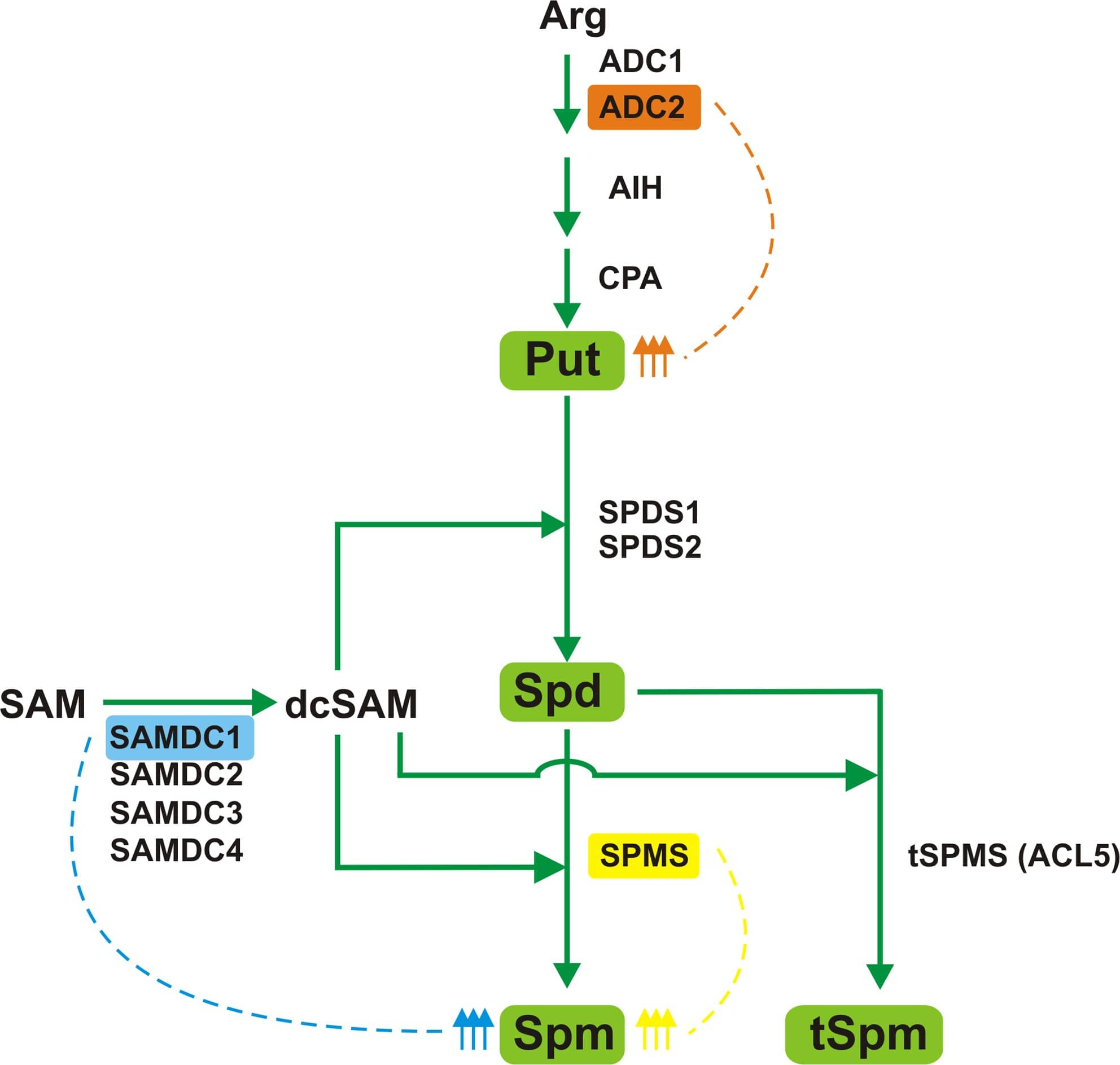
Polyamine biosynthesis pathway in Arabidopsis thaliana. Effects of ADC2, SAMDC1, or SPMS overexpression: overexpressed genes on studies cited in this review are highlighted in boxes; arrows indicate the effects on PA levels driven by overexpression of different PA biosynthesis genes. ACL5, ACAULIS5; ADC: arginine decarboxylase; AIH: agmatine iminohydrolase; CPA: N-carbamoylputrescine amidohydrolase; dcSAM: decarboxylated S-adenosylmethionine; SAM: S-adenosylmethionine; SAMDC: S-adenosylmethionine decarboxylase; SPDS: spermidine synthase; SPMS: spermine synthase. tSPMS: thermospermine synthase.
More recently, global “omic” approaches have also been applied to study the function of PAs in response to abiotic stresses. The expression of PA biosynthesis genes is affected by a number of abiotic stresses. Drought induces expression of ADC2, SPDS1, and SPMS (Alcazar et al., 2006a); ADC1, ADC2, and SAMDC2 expression are also induced by cold (Cuevas et al., 2008, 2009; Urano et al., 2003). The manipulation of PA levels by transgenic approaches and the use of loss or gain-of-function mutations has gained knowledge about their roles in plant stress in addition to their antioxidant and structure-stabilizing properties (Alcázar et al., 2010a; Gill and Tuteja, 2010).
In this work, we have studied transcriptome profiles in Arabidopsis transgenic plants with altered PA metabolism in order to identify common and specific gene networks affected by alteration of Put or Spm levels. Our results further reinforce previous evidences showing that PAs are regulatory signaling molecules in intricate crosstalks with hormonal pathways responsive to environmental changes, and that different PAs can trigger a differential transcriptional response.
Transcriptome analysis of Arabidopsis plants with increased Put levels
Transgenic lines with elevated Put Levels were obtained by constitutive homologous overexpression of ADC2 in Arabidopsis (Alcazar et al., 2005). These lines are resistant to freezing (Tiburcio et al., 2009) and drought stress (Alcázar et al. 2010b). Comparison of Affymetrix ATH1 microarray transcriptome profiles of ACD2 overexpressing and wild-type Col-0 plants by Affymetrix Microarray Suite 5.0 statistical algorithms, reveals that 1,608 genes are upregulated and 2,653 downregulated in these lines with elevated Put content (Alcazar et al., 2005). Categorization of both set of genes using the functional enrichment analysis tool GENECODIS 2.0 (Carmona-Saez et al., 2007; Nogales-Cadenas et al., 2009) shows that the set of overexpressed genes is enriched in those involved in responses to biotic and abiotic stresses as well as auxin-related genes (Table 1).
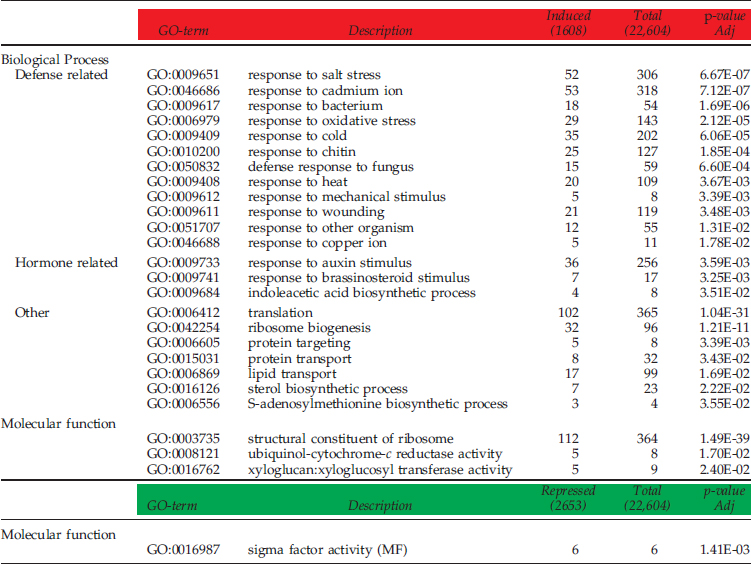
Enrichment analysis of differentially expressed genes in ADC2 overexpressing Arabidopsis plants compared to wild-type Col-0 plants is shown. Analysis was performed with the GENECODIS 2.0 software (Carmona-Saez et al., 2007; Nogales-Cadenas et al., 2009). (Red: upregulated; green: downregulated. Adj p-value: p-value obtained from hypergeometric distribution test and corrected with false discovery rate method of Benjamini and Hochberg).
Both correlations are also observed when the distribution of differentially expressed genes on ADC2 overexpressing plants is examined with the MAPMAN tool (Thimm et al., 2004; Usadel et al., 2005). The expression of a significant number of hormone and signaling related genes is altered in these lines (Additional data, Supplementary Tables S1 and S2). Among them, genes of the IAA biosynthesis pathway (NIT2, GH3.3, GH3.5, YDK1, IAR3, ILL6), auxin transport (PIN3), and genes coding for up to 20 auxin responsive proteins (Additional data, Supplementary Table S1). Also, genes coding for ethylene biosynthesis enzymes as well as several ethylene-responsive transcription factors are up- and downregulated (Additional data, Supplementary Table S1). In addition, a set of genes coding for some of the ABA biosynthesis enzymes (ABA1, NCDE3, NCDE4) and several ABA responsive genes such as transcription factors ABI1, ABF3, ABF4 appear downregulated, while other ABA putative responsive proteins appeared upregulated (Additional data, Supplementary Table S1). Changes were also observed for biotic stress related hormones. Jasmonate-induced proteins (putative jacalin lectin family proteins) were underexpressed, while two JA pathway genes (OPR2 and OPR3) were overexpressed (Additional data, Supplementary Table S1). Expression changes were also observed for several members of the S-adenosyl-L-methionine:carboxyl-methyltransferase protein family, involved in SA biosynthesis (Additional data, Supplementary Table S1). MAPMAN analysis also reveals that another set of genes with significant changes in expression corresponds to signaling-related genes (Additional data, Supplementary Fig. S1), most of them probably involved in stress responses, as suggested by their E-Northern BAR expression profiles (Additional data, Supplementary Fig. S1) as well as by the overrepresentation of some stress-related biological process annotations when GENECODIS enrichment analysis is applied to these particular gene subsets (data not shown).
Transcriptome analysis of Arabidopsis plants with increased Spm levels
Arabidopsis plants with increased Spm levels have been obtained by transgenic homologous overexpresssion of SAMDC1 gene (Marco et al., in press) or the SPMs gene (González et al., 2011). Elevated Spm levels, produced by homologous overexpression of SAMDC1 in Arabidopsis, enhances tolerance to drought and saline stress (Marco et al., in press). In contrast, Arabidopsis acl5/spms mutant plants, are unable to produce Spm and are hypersensitive to salt and drought stress, while exogenous addition of Spm suppresses these phenotypes (Yamaguchi et al., 2006, 2007). Transcriptome profiles have been obtained by Affymetrix ATH1 microarrays for both SAMDC1 and SPMS overexpressing plants (González et al., 2011; Marco et al., in press). When Significance Analysis of Microarrays software (SAM 3.0) (Tusher et al., 2001) is applied to both transcriptome data, different sets of genes with significant variations with respect to wild-type Col-0 plants are obtained for each type of Spm overproducer: 4,651 (2,083 upregulated and 2,568 downregulated) for 35S-SAMDC1 plants and 3,080 transcripts (1,132 upregulated and 1,948 downregulated) for 35S-SPMs plants (Table 2). GENECODIS functional enrichment analysis applied to both sets of genes shows again that the set of overexpressed genes for both types of Spm-overproducer plants appears enriched in annotation categories involved in defense-related processes from both biotic and abiotic stresses (Additional data, Supplementary Tables S2 and S3). Comparison of both transcriptomes shows that, although both SAMDC1 and SPMS overexpressing plants accumulate Spm, their transcriptome profiles differ. Only 234 upregulated and 333 downregulated genes are in common, which represents 12.2% and 18.4% of genes with significant variations in SAMDC1 and SPMS overexpressing plants, respectively (Table 2). Functional enrichment analysis of the upregulated genes indicates that the most predominant biological processes affected are related to biotic and abiotic stresses, and hormonal pathways in JA biosynthesis and JA/SA responses (Table 2). Moreover, two JA biosynthesis genes are upregulated in both SAMDC1 and SPMS overexpressing plants, as well as NCDE3, a key gene in the ABA biosynthesis pathway (Additional data, Supplementary Table S4). Common signaling-involved genes include 23 receptor-like kinases, three MAP (mitogen-activated protein) kinases and seven genes involved in calcium regulation, all being mainly upregulated. On the other hand, there is also a group of 60 common genes coding for transcription factors (Additional data, Supplementary Fig. S2). Enrichment analysis and BAR E-northern stress profiles of those set of common genes again suggests that Spm overproduction affects stress signaling responses (Additional data, Supplementary Fig. S2). Expression patterns for the majority of common genes are similar in both Spm-overproducer plants compared with wild-type, being the more pronounced differences in the case of SAMDC1 overexpressing lines. In summary, transcriptome analysis shows that elevated Spm levels have an important effect on stress response mechanisms of the plant. This result agrees with the observations done by Mitsuya et al. (2009) where external Spm treatment modulates the expression of a large number of defense-related genes.

Left: venn diagrams showing common genes from differentially expressed genes in SAMDC1 and SPMS overexpressing plants compared to wild-type Col-0 plants. Right: functional enrichment analysis of commonly differentially expressed genes both in SAMDC1 and SPMS overexpressing Arabidopsis plants compared to wild-type Col-0 plants. Analysis was carried out with the GENECODIS 2.0 software (Carmona-Saez et al., 2007; Nogales-Cadenas et al., 2009). (Red: upregulated; green: downregulated. Adj p-value: p-value obtained from hypergeometric distribution test and corrected with false discovery rate method of Benjamini and Hochberg.)
Transcriptome stress response is altered by modification of PA levels: common responses between Put and Spm overexpressors
When transcriptome profiles of Put and Spm-overeproducers are compared, only a set of 150 genes with significant expression changes appears in common between the Put and Spm accumulating plants. From this set, 71 genes always appear upregulated, and enriched in stress-related genes (Fig. 2).
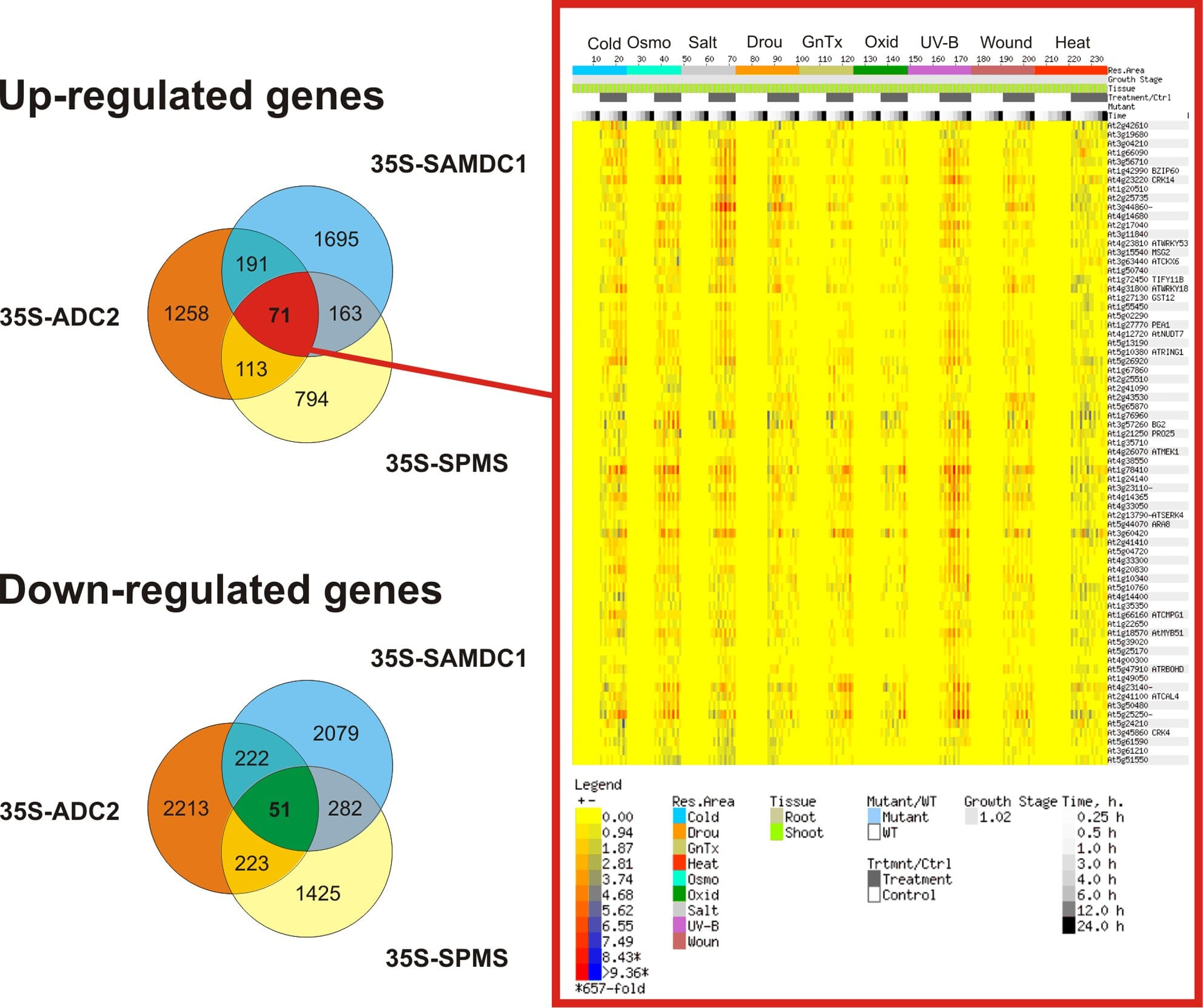
Expression profiles of common upregulated genes in PA overproducer plants. Left: Venn diagram analysis of common up- and downregulated genes from ADC2, SAMDC1, and SPMS overexpressor plants. Values represent the number of transcripts over and underexpressed in transgenic plants relative to wild-type Col-0 plants. Red box: E-northern heat map analysis of the 71 common upregulated genes in the three PA overproducer plants using abiotic stress series from BAR (Toufighi et al., 2005). Rows represent genes and columns represent experimental conditions. The color at a point represents the log2 of the ratio of the average of replicate treatments relative to the average of corresponding controls. The scale is shown in the figures.
MAPMAN analysis of the expression profiles of these 150 common genes shows similar expression patterns for the majority of common genes represented. On the other hand, the majority of gene sets considered are composed by single or few genes (Fig. 3), except for signaling-related genes, where seven genes involved in calcium signaling have similar expression profiles in Put and Spm overproducer plants (Fig. 4). Among common signaling-related genes, most are also stress-responsive, as shown by E-northern BAR analysis (Fig. 4), as well as by Enrichment analysis (data not shown). The same relationship with stress is shown also for common hormone-related genes (Fig. 3), including NCED3 (Schwartz et al., 1997) and LOX3 (Bannenberg et al., 2009), which code for ABA and JA biosynthesis enzymes, respectively.

Comparative analysis of expression profiles of common differentially expressed genes from ADC2, SAMDC1, and SPMS overexpressing plants. Only hormone-related genes are shown. Left: MAPMAN analysis (Thimm et al., 2004; Usadel et al., 2005). The signal from transgenic plants is expressed as a ratio relative to the signal in wild-type Col-0 plants converted to a log2 scale, and displayed. Right: Heatmap expression analysis using abiotic stress series from BAR (Toufighi et al., 2005). Rows represent genes and columns represent experimental conditions. The colour at a point represents the log2 of the ratio of the average of replicate treatments relative to the average of corresponding controls. The scale is shown in the figures. Orange boxes: ADC2 overexpressing plants. Blue boxes: SAMDC1 overexpressing plants; yellow boxes: SPMS overexpressing plants.

Comparative analysis of expression profiles of common differentially expressed genes from ADC2, SAMDC1, and SPMS overexpressing plants. Only signaling-related genes are shown. Left: MAPMAN analysis (Thimm et al., 2004; Usadel et al., 2005). The signal from transgenic plants is expressed as a ratio relative to the signal in wild-type Col-0 plants converted to a log2 scale, and displayed. Right: Heatmap expression analysis using abiotic stress series from BAR (Toufighi et al., 2005). Rows represent genes and columns represent experimental conditions. The colour at a point represents the log2 of the ratio of the average of replicate treatments relative to the average of corresponding controls. The scale is shown in the figures. Orange boxes: ADC2 overexpressing plants. Blue boxes: SAMDC1 overexpressing plants; yellow boxes: SPMS overexpressing plants.
Transcriptome analyses presented in this work show that alteration of PA levels alters expression profiles of a significant number of genes. The existence of a PA modulon expression system in plants could be one of the possible explanations for some of the transcriptional changes observed in PA accumulating plants. A PA modulon composed by several key transcriptions factors stimulated by PAs at the translational level, has been proposed in Escherichia coli (Igarashi and Kashiwagi, 2006) and yeast (Uemura et al., 2009), although no clear evidences have been found in plants. The existence of regulation at translation level by PAs has been demonstrated for SAMDC in Arabidopsis (Hanfrey et al., 2003). Further efforts should be made toward the identification of transcription factors controlling the expression of genes by PAs, to get insight into the potential existence of a PA modulon in plants.
Some of the transcriptional changes observed could be direct or indirect consequence of crosstalking between PAs with other signaling pathways including ROS signaling and ABA biosynthesis (Alcázar et al., 2010b). Indeed, there are previous evidences of crosstalk between PAs and ABA. Upregulation of PA biosynthesis genes ADC2, SPDS1, and SPMS and accumulation of Put under drought stress in Arabidopsis are ABA-dependent responses (Alcazar et al., 2006a). Evidence of crosstalk between Spm and ABA is also shown in SAMDC1 overexpressing Arabidopsis plants. These lines show elevated levels of ABA due to the induction of NCED3, a key enzyme involved in ABA biosynthesis (Marco et al., in press).
On the other hand, a possible link between PAs, Ca2+ homeostasis and stress responses has also been suggested (Alcázar et al., 2010a). Spm control of Ca2+ allocation through regulating Ca2+ permeable channels, including CAXs, has been described as a possible mechanism of action for the protective role of Spm against high salt and drought stress (Yamaguchi et al., 2006, 2007). Moreover, changes of free Ca2+ in the cytoplasm of guard cells are involved in stomatal movement that may explain drought tolerance induced by Spm. Furthermore, Ca2+ signaling genes are one of the gene categories mainly upregulated in Put and Spm-overproducer plants (Fig. 4). In addition, a Spm signaling pathway has been proposed to explain the role of enhanced PA accumulation observed during pathogen response in Arabidopsis (Mitsuya et al., 2009; Takahashi et al., 2003). This signaling pathway could function via the merged signal of Spm-activated Ca2+-influx and H2O2 produced by Spm-degradation by PA oxidases. Both processes are able to trigger mitochondrial disfunction, and cell death (Takahashi et al., 2003). Mitsuya et al. (2009) identified a set of genes commonly induced by Spm and Cucumber Mosaic virus (CMV) infection. Seven Spm-upregulated genes identified in this study are also overexpressed in the Spm-overproducer plants, including transcription factor AtbZIP60, and mitogen-activated protein kinase AtMAPK3. AtbZIP60 may control the expression of genes participating in protein folding and secretion, which may be required during CMV-elicited hypersentitive response (HR) (Iwata and Koizumi, 2005). AtMAPK3 is an ortholog of a wound-induced protein kinase (WIPK) whose expression is induced by Spm in tobacco (Takahashi et al., 2003).
Therefore, evidences shown above indicate that PAs could act as key regulatory molecules in both abiotic and biotic stress processes, acting by crosstalk with other stress related hormones like ABA, and mediating through Ca2+ signaling. Remarkably, Put accumulation in ADC2 overexpressor plants also dampened gibberellic acid (GA) biosynthesis, thus evidencing the occurrence of intricate crosstalks between Put, GAs and ABA (Alcazar et al., 2005; Cuevas et al., 2008). The nature of these crossregulations could be different depending on the PA involved.
In summary, accumulation of Put and/or Spm is capable of triggering activation of biotic/abiotic defense mechanisms. This evidence, in addition to the PA roles as antioxidant and structural stabilizers, provides promising applications of PA-content manipulation to crop breeding for enhanced stress tolerance (Alcázar et al. 2010a; Gill and Tuteja, 2010).
Footnotes
Acknowledgments
A.F. Tiburcio was supported by grant BIO2008-05493-CO2-01 (MICINN); F. Marco and P. Carrasco were funded by grant BIO2005-09252-C02-02 (MICINN). R. Alcázar, A.F. Tiburcio, and P. Carrasco also acknowledge grants-in-aid from ACTION COST FA0605.
Author Disclosure Statement
The authors declare that no competing financial interests exist.