




Abstract
Abstract
The pea (Pisum sativum L.) is an important pulse crop but the growing area is limited because of its relatively low yield stability. In many parts of the world the most important abiotic factor limiting the survival and yield of plants is the restricted water supply, and the crop productivity can only be increased by improving drought tolerance. Development of pea cultivars well adapted to dry conditions has been one of the major tasks in breeding programs. Conventional breeding of new cultivars for dry conditions required extensive selection and testing for yield performance over diverse environments using various biometrical approaches. Several morphological and biochemical traits have been proven to be related to drought resistance, and methods based on physiological attributes can also be used in development of better varieties. Osmoregulation plays a role in the maintenance of turgor pressure under water stress conditions, and information on the behaviour of genotypes under osmotic stress can help selection for drought resistance. Biotechnological approaches including in vitro test, genetic transformation, and the use of molecular markers and mutants could be useful tools in breeding of pea. In this minireview we summarized the present status of different approaches related to drought stress improvement in the pea.
Introduction
The water requirements of the pea is relatively high during growing season; the critical stages are the initial development (germination) and the flowering. After flowering, during the pod-filling phase the sensitivity of peas to drought stress is much less (Neumann and Aremu, 1991). Drought stress appearing during flowering resulted in yield losses mainly due to the lower number of pods per stalk (Neumann and Aremu, 1991).
There are large climatic variations between pea cropping areas, between years, and even within a cropping year (Annicchiarico and Iannucci, 2008). Drought is one of the most limiting factors in pea cropping in many parts of the world, affecting both quality and quantity of the yield (Ali et al., 1994; Boyer, 1982). According to estimations, about 90% of arable lands suffer from one or more environmental stresses, and the prediction is that water deficits will be the major abiotic factor (Dita et al., 2006).
Although precipitation during flowering has been proven to be the most important factor in seed yield in Narits and Keppart's experiments (2010), peas can suffer from drought during both the vegetative phase or during reproductive development. Both early (Ali et al., 1994) and terminal drought may be severe depending on cropping environments (Annicchiarico and Iannucci, 2008), thus, occurrence and distribution of rainfall can also affect the degree of losses (Stoddard et al., 2006).
Development of new varieties with wide adaptation ability including drought tolerance is the primary aim of pea breeding works (Abd-El Moneim et al., 1990), and it is necessary to increase competitiveness of legumes (Dar and Gowda, 2010). Tolerance to drought is a complex phenomenon in which different adaptations are involved (Sánchez et al., 2001); thus, it is very important to unravel mechanisms leading to drought tolerance and improvement of crop plant performance under drought circumstances.
Models
Plants can perceive environmental challenges including biotic and abiotic stresses and response to stress by an appropriate complex defense mechanism including altered metabolism, growth, and development (Bartels and Sunkar, 2005; Bornberg-Bauer, 2009).
When mild soil water deficit occurs, plants can maintain photosynthesis and turgor for a short period (Boyer, 1970; Morison et al., 2008.). However, with extended periods of negative soil water potential, the growth of plants is inhibited, the uptake and transport of mineral nutrition in plants are disturbed, and concurrently, the photosynthetic activity decreases (Boyer, 1970; Jewell et al., 2010). Simultaneously, morphological and physiological changes occur to decrease the evaporation of leaves; finally, some leaves will downfall and the remainder can produce wax on their surfaces (Toldi and Jenes, 2000). Drought stress can be accompanied by oxidative damage, resulting in changes in chlorophyll fluorescence, membrane stability, and peroxidase levels. Morphological, physiological, and biochemical responses of plants are reviewed by Anjum et al. (2011).
Although the plant height and leaf area were not influenced significantly, drought stress decreased the fresh and dry weight of the pea and especially the relative leaf water content. The decrease in relative leaf water content was the main factor in reduced growth in drought-treated plants (Alexieva et al., 2001).
Moreover, in the case of pulse crops the nitrogen-fixing bacteria can also be affected by drought stress. Symbiotic N2 fixation decreased under drought stress due to several physiological changes accompanying water stress: sucrose synthase activity of nodule decreased in addition to the decreasing levels of UDP-glucose, glucose-1-phosphate, glucose-6-phosphate, and fructose-6-phosphate and adenylate content in the nodule. Activity of NADP(+)-dependent isocitrate dehydrogenase increased as a result of water stress may be compensating for a possible C/N imbalance and/or supplying NADPH in circumstances where the pentose phosphate pathway was impaired (Galvez et al., 2005). Moreover, Frechilla et al. (2000) compared the effect of water stress on pea plants differing in their nitrogen nutrition (nitrogen fixation or nitrate assimilation), and they found that nodulated plants were less sensitive to drought considering the inhibiton of the growth, stomatal conductance, and internal CO2 concentration. However, glycolate oxidase (a key enzyme in the photorespiratory cycle) declined by 50% only in nitrogen-fixing plants. They concluded that nitrogen source was the major factor affecting pea responses to water stress but the difference in sensitivity was related to complex interactions with photorespiratory flux and stomatal conductance and not to the nitrogen assimilation (Frechilla et al., 2000). Physiological responses of legume nodules to drought are summarized by Arrese-Igor et al. (2011). Moreover, inoculation of peas with rhizobacteria containing 1-aminocyclopropane-1-carboxylic acid (ACC)-deaminase could help in eliminating the inhibitory effects of water stress on the growth of peas (Zahir et al., 2008). Ethylene synthesis in plants is increased by several biotic and abiotic stresses, and its production is often related with reduced growth and premature senescence and may be an indicator of plant susceptibility to stresses (Morgan and Drew, 1997). The ACC deaminase enzyme catalize the reaction, in which lowering of the ethylene levels occurs by hydrolysis of ACC, the immediate precursor of ethylene in plants (Shah et al., 1998).
When water deficit appears, availability of water to cells decrease; this reduced availability of water could be quantified as a decrease in water potencial (Verslues et al., 2006). Physiological processes of cells take place in aqueous ambience; thus, when water deficit occurs and the water potential falls (Ψ w ) the cells start to accumulate inorganic ions and to synthetize special molecules (proteins, proline, mannitol, sorbitol, etc.) to withold water within the cells. The process, called osmotic adjustment, leads to reduction of osmotic potential of cells (Ψ s ), which in turn, attracts water into the cell for maintenance turgor pressure (Sanchez et al., 2004). Reduction of turgor pressure induced by drought significantly inhibits the cell elongation; thus, cell growth is one of the most drought-sensitive physiological processes (Anjum et al., 2011). Accumulated solutes (known as compatible solutes or osmolyts) may play a role in protection of macromolecules in dehydrating cells beside turgor maintenance (Smirnoff, 1998).
Drought stress often results in increased transport of polyols (sugar alcohols), which are the reduced form of aldose and ketose sugars such as mannitol and sorbitol. They are osmotically active solutes in response to abiotic stress and they can accumulate in high concentration in the cell to compensate for reduced cell water potential. Their hydroxyl groups could replace water in establishing hydrogen bonds in the case of water deficit; thus, they play a role in the protection of enzyme activities and membranes (Noiraud et al., 2001). Accumulation of soluble sugars in pea epicotyls was the main factor in osmotic adjustment (34–46%), while contribution of increment of free proline content to osmotic adjustment proved to be much less (3–5%) (Sanchez et al., 2004). Sucrose content of seeds was also increased by drought (Sorensen et al., 2003). Relationship between yield performance under drought stress and osmoregulation capability of pea genotypes has often be proven (Neumann and Aremu, 1991; Rodriguez-Maribona et al., 1992). Correlation between growth and osmotic adjustment and turgor maintenance was observed on pea seedlings under water stress induced by 46 mM polyethylene glycol (PEG) 6000 (Sanchez et al., 2004). Measurements of turgor maintenance made at the early stages of development could be used to identify drought-tolerant genotypes (Sanchez et al., 2004).
Drought can result in changes in growth, yield, membrane integrity, pigment content, osmotic adjustment water relations, and photosynthetic activity in plants (Anjum et al., 2011). When pea plants suffer from drought they showed the greatest reductions in the rate of photosynthesis, transpiration, and glycolate oxidase activity (78, 83, and 44%, respectively) (Iturbe-Ormaetxe et al., 1998; Moran et al., 1994). Water stress also inhibited the activities of catalase, dehydroascorbate reductase, and glutathione reductase (72–85%) but increased the activities of nonspecific peroxidase and superoxide dismutase (32–42%) (Moran et al., 1994), and Iturbe-Ormaetxe et al. (1998) found that mild water stress caused an increase in zeaxanthin, malondialdehyde, oxidized proteins, and mitochondrial, cytosolic, and chloroplastic superoxide dismutase activities. Less than 20% reductions were found in the contents of chlorophyll a, carotenoids, and soluble protein (Moran et al., 1994.). According to Iturbe-Ormaetxe et al. (1998), severe water deficit almost completely inhibited photosynthesis and damaged the photosynthetic apparatus.
Traits Related to Drought Tolerance
Morphological and biochemical traits
The shoot-to-root ratio of drought-resistant cultivars (“Gobo,” “Solara”) were significantly smaller than that of sensitive plants in both control and drought treatments (Grzesiak et al., 1997). Dwarf type pea plants (“Progress” No. 9) were more drought resistant compared to tall phenotype (“Alaska”) in Iwaya-Inoue et al. (2003) experiments. Water of dwarf control and no-elongation zone of GA1-treated “Progress” No. 9 grown under light condition was more sustained during 3-h air drying compared to those of “Alaska” (Iwaya-Inoue et al., 2003).
Several experiments were conducted to compare the drought resistance of conventional leaf and semileafless cultivars. The leafy cultivar “Bohatyr” produces significantly more leaf area than semileafless “Grafila” (Semere and Froud-Williams, 2001). Even though in their experiments the leafy pea “Bohatyr” showed greater root and shoot competitive abilities than semileafless “Grafila,” the latter types (leaflets are replaced by tendrils) are reputed as more tolerant to water deficit than conventional leafed varieties, and it was supposed that the reduced leaf area of the semileafless varieties is the main factor. Gonzalez et al. (2001) studied the background of phenomena and they revealed that total leaf area and transpiration rate per plant were not significantly different. Osmolarity also did not differ among different leaf structure at tissue level, whereas at the epidermal vacuole level tendrils of the semileafless had a higher osmolarity than those of conventional pea. On the semileafless plants the tendrils are about 40% of the total leaf; thus, its more efficient osmotic adjustment may be involved in water use efficiency under water deficits (Gonzalez et al., 2001). However, under water deficit only stipules of semileafless pea plants showed significantly better ability to increase osmolarity by accumulation of potassium, magnesium, and chloride in more than other leaf structures (Gonzalez et al., 2002).
Epicuticular wax also plays important role in control the loss of water from the cuticle. Sánchez et al. (2001) measured the leaf epicuticular wax load in 20 pea cultivars and they did not found differences between semileafless and conventional leafy cultivars. It is varied between 0.19 and 0.41 g m−2 and depended more on crop year than cultivars, whereas the semileafless types showed a greater residual transpiration rate than conventional leafy cultivars. Finally, there was no correlation between residual transpiration rate and wax load. However, under drought conditions the wax load of cultivars increased significantly and it was accompanied by increased residual transpiration rate.
Under drought stress the roots of field pea (“Profi”) grown deeper in the soil than those under irrigated conditions: about 34% of the total pea roots were deeper than 0.23 m in the dry soil, whereas only about 20% of roots rooted in this depth of soil profile under irrigated conditions (Benjamin and Nielsen, 2006). However, osmotic stress induced by PEG 6000 resulted in shortening of primary root and increase of lateral root number (Kolbert et al., 2008).
Drought stress reduced the seed number in an intensity-dependent manner and the distribution of seeds was also affected: more seeds developed on the basal phytomers of drought-stressed pea plants than on control plants (Guilioni et al., 2003). Water deficit begun 1 week after forming the first pods resulted in 79% fewer seeds than in the controls (de Sousa-Majer et al., 2004). Net photosynthesis (Pn) was also decreased by water deficit only during the stress period. Relationship was revealed between final seed number and plant growth rate during critical period for seed set suggesting that pea can adjust the number of reproductive sinks in a balance with assimilate availability in the plant (Gulioni et al., 2003). Although yield was reduced when drought stress exists during flowering and pod filling, the size distribution of seeds was not affected consistently (Sorensen et al., 2003).
Crop-growing areas with low rainfall representing the short season environment, and field pea can performs well under these conditions if the crop flowers early, then filling of pods occurs when plant water status is still adequate (drought escape mechanism); thus, development of genotypes with vigorous early growth, flowering, and pod set are necessary. However, the yield performance of early-flowering genotypes can be low (Khan et al., 1996).
The chlorophyll content slightly increased, while the amounts of anthocyanins were not affected in drought-stressed pea plants. The soluble phenols in leaves increased markedly under drought stress (Alexieva et al., 2001). Drought stress led to full disruption of the chiral macroaggregates of the light-harvesting chlorophyll a/b pigment–protein complexes (LHCIIs) measured by circularly polarized chlorophyll luminescence (CPL) in detached pea leaves (Gussakovsky et al., 2002).
Water stress is often modeled by osmotic stress induced by PEG or mannitol. Generezova et al. (2009) studied the effect of osmotic stress induced by mannitol (0.6 M) on mitochrondial metabolic activity in etiolated pea seedlings and found that the growth of epicotyl and the water content of tissue were decreased. At the level of mitochondria the oxidation rates of malate and other respiratory substrates were also decreased. The greatest inhibition was found in the rate of proline oxidation (by 70%).
Osmotic adjustment
Morgan (1983) first selected for superior osmotic adjustment under dehydrating conditions and observed improved yields in wheat. Even though Khan et al. (1996) found only a little correlation between osmotic adjustment ability of pea genotypes and their yield performance under water-limited conditions, the most successful cultivar (“Dundale”) showed very good osmotic adjustment. Moreover, osmotic adjustment could also be a useful trait by extending the period of favorable water relations during pod fill (Khan et al., 1996).
Osmotic stress tolerance of different pea genotypes can be evaluated in in vitro experiments at the tissue level. Magyar-Tábori et al. (2009) tested eight field pea genotypes on media with 2.5, 5.0, 7.5, and 10.0% PEG, and they observed the relative growth rate of shoots and the multiplication rate of initial explant. All observed parameters were inhibited by PEG, although the PEG concentrations of 5.0 and 7.5% were the best treatments to classify genotypes into different tolerance groups (Fig. 1). Osmotic tolerance of these genotypes was also tested in other in vitro experiments at the cell level: the growth of callus cultures of the same genotypes were tested on media with osmoticum (mannitol in concentration of 0.2, 0.6, and 1.0 M). The highest concentration was proven to be the most efficient to distinguish genotype according to their osmotic stress tolerance.
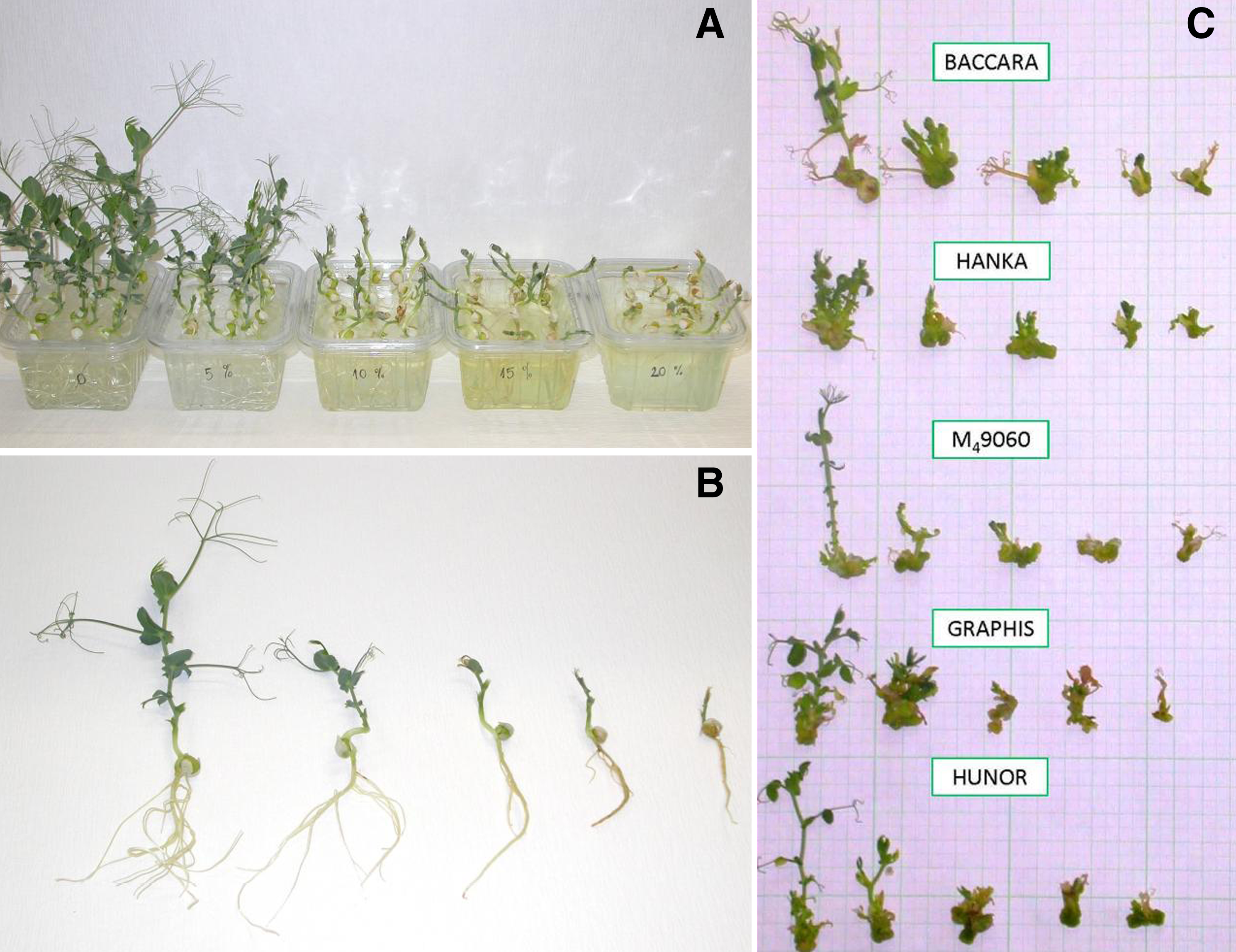
Growth inhibition induced by increasing PEG levels in different laboratory experiments.
Oxidative damages and antioxidant capacity
Drought stress as other environmental stress can be accompanied by oxidative damage including accumulation of activated oxygen forms (single oxygen, O21; superoxide radical, O2−; hydrogen peroxide, H2O2, and hydroxyl radical, HO−) in high concentration, resulting in changes in chlorophyll fluorescence, membrane stability, and peroxidase levels. Although reactive oxygen species (ROS) control many processes in plants and also participate in signaling events, they are toxic molecules and can injure cells (Mittler, 2002; Mittler et al., 2004). Producing, scavenging, and avoiding reactive oxygen intermediates have been summarized by Mittler (2002). Among mechanisms that might reduce reactive oxygen intermediates the antioxidants (catalase, ascorbate, superoxide dismutase, etc.) play a significant role in elimination of reactive oxygen molecules. In drought-stressed peas the specific activities of antioxidant enzymes content increased (Alexieva et al., 2001). Catalase and SOD (superoxide dismutase) activities were inhibited, whereas peroxidase activity was stimulated, while hydrogen peroxide level increased in drought-stressed pea plants (Alexieva et al., 2001). Gluthatione synthesis is also induced by oxidative stress (Smirnoff, 1998).
Mitochondria are the significant source of cellular ROS and oxidative damage of organelles disturbs the energy supply of cells required for repair mechanism (Taylor et al., 2005). Taylor et al. (2005) studied the effect of environmental stresses on the pea (“Green Feast”) mitohocondrial proteome (entire set of proteins expressed by the genome). The drought regimes they used (plants were not watered for 7 days) did not cause accumulation of lipid peroxidation end products significantly above controls, but drought treatment clearly affected leaf metabolism (the rates of dark respiration and especially net photosynthesis were significantly decreased) and caused oxidative modification of mitochondrial proteins. However, in mitochondria isolated from stressed pea leaves the assessment of lipoic acid moieties on mitochondrial enzymes showed that drought treatment decreased significantly the lipoic acid moieties apparent on the H protein of glycine decarboxylase (GDC-H), while lipoic acid moieties on both the pyruvate dehydrogenase complex (PDC) and the 2-oxoglutarate dehydrogenase complex were less affected.
Changes in phytohormone levels
Activity of cytokinins decreases in response to drought (Hare et al., 1997), while level of abscisic acid (ABA) increases (Morgan, 1990). Cytokinin oxidase/dehydrogenase enzymes maybe is responsible for the changes in the cytokinin pool under adverse environmental conditions (Vaseva-Gemisheva et al., 2005). Vaseva-Gemisheva et al. (2005) measured the expression of two putative cytokinin oxidase/dehydrogenase (CKX) genes (PsCKX1, PsCKX2) in response to different stress in the leaf and root tissue of “Manuela” pea plants by real-time RT-PCR. They observed an increased PsCKX1 mRNA expression in leaves of drought-stressed plants; however, the measured CKX activity in drought-stressed plants was inhibited in leaves and was above the control in roots. Because CKX enzyme is substrate-inducible it was supposed that decreased cytokinin content of water-deprived plants could be the cause of the contrary results. Moreover, measurements were made after a short period of water stress (4 days).
The phytohormone ABA is also involved in the response to environmental stresses such as drought, salt, and cold (Busk and Pagés, 1998). The main functions of ABA are the regulation of plant water balance and osmotic stress tolerance. The role of ABA in cellular dehydration tolerance including induction of genes that encodes dehydration tolerance proteins in cells (Zhu, 2002). ABA is also essential for stomatal closure, stress-responsive gene expression, and metabolic changes (Seki et al., 2007). ABA accumulation induced by osmotic stress is a result of both activation of synthesis and inhibition of degradation (Zhu, 2002). ABA aldehyde oxidase catalyzes the last step of ABA biosynthesis. Three isoforms of aldehyde oxidase (AO) were detected in pea plants; among them, only PAO-3 seemed to be responsible for stress-induced ABA production (Zdunek-Zastocka et al., 2004). In drought-stressed pea plants seedlings especially showed increased PsSNF5 (a member of SNF5 family of chromatin remodeling factors) expression, and it was assumed from the results that this gene involved in ABA response (Ríos et al., 2007). Although the stress-induced pea DNA helicase 47 (PDH47) was proven to play role in both the ABA-dependent and ABA-independent pathways in abiotic stress, its transcription was not induced under drought stress (Vashisht et al., 2005).
Because exogenously applied brassinosteroids (BRs) can increase the resistance of plants to water stress, Jager et al. (2008) studied BR mutants in the pea to determine whether changes in endogenous BR levels are involved in drought stress responses. They observed that in wild-type plants the water stress did not result in altered BR levels; moreover, the ABA levels in response to water stress were also not affected by BR deficiency. They concluded that in pea the changes in endogenous BR levels did not play role in response to drought.
Osmotic stress induced by PEG 6000 led to a significant increase of nitric oxide (NO) generation in pea roots. It was supposed that the initial phase of NO generation may play a role in the osmotic stress-induced signalization process leading to the modification of root morphology (Kolbert et al., 2008). The role of NO in stress responses in plants including NO reactions, signaling pathways, NO plant hormone interactions, and NO-induced and -mediated signalization under osmotic stress are detailed by Erdei and Kolbert (2008) in their review.
Tools
Conventional methods
Improvement of abiotic stress tolerance of crops by traditional breeding methods is limited by the multigenic nature of the trait (Bartels and Sunkar, 2005). However, stress tolerant crops have been bred mostly by introducing traits from stress-adopted wild relatives (Bartels and Sunkar, 2005). Field screening of genotypes for stress-response often involves studying them in contrasting conditions and estimating their susceptibility from their relative yield in different environments. The inhibition of relative growth rate (including changes in dry matter of both the above-ground parts and roots and length of shoots and roots of seedling) was smaller in drought resistant than in sensitive cultivar (Grzesiak et al., 1997).
Because the seriousness of the drought stress is unpredictable in field experiments and field selection for wide adaptation requires long time and much cost, they are increasingly supplemented with experiments in a controlled environment, and focus on methods could be applied in early selection stages (Annicchiarico and Iannucci, 2008). These kinds of experiments include mostly evaluation of germination and growth of seedling or whole plant under osmotic stress induced by molecules with osmotic effect (PEG, mannitol).
Sánchez et al. (1998) tested 49 pea genotypes both in a field condition and growth chamber for drought tolerance. In the field experiment the grain yield was 25% less in nonirrigated conditions than in the control. Genotypes with better turgor maintenance had higher yield but the trend of biomass production was opposite. Drought-tolerant pea genotypes had better turgor maintenance, which was significantly related to osmotic adjustment (Sánchez et al., 1998).
Sánchez et al. (1998) studied the soluble sugar and proline accumulation measured in the leaves of pea plants subjected to a period of dehydration. They found that accumulation of soluble sugars was significantly correlated to osmotic adjustment and their concentrations were significantly higher in genotypes with conventional leaf type than in the semileafless genotypes in both control and stress conditions. Moreover, the amount of carbohydrates increased proportionally to osmotic adjustment in all genotypes when exposed to stress. Sugars can also stabilize proteins and membranes, as osmoprotectors (Crow et al., 1992). The level of free proline was almost constant at high water potential and significantly increased when water potential decreased. However, its contribution to osmotic potential of leaf was only 0.5–1.8% (Sánchez et al., 1998).
Significantly increased levels of the metabolites in drought-stressed plants were detected including proline, valine, threonine, homoserine, myoinositol, γ-aminobutyrate, and trigonelline (Charlton et al., 2008).
Because drought is manifested primarly as osmotic stress, resulting in the disruption of homeostasis and ion distribution in the cell (Serrano et al., 1999), several experiments have been conducted by induction of osmotic stress to study responses of plants to stress. The high molecular weight PEG is commonly used to induce water deficits and to study the ability of different genotypes to tolerate stress in other species (Foito et al., 2009; Kiełkowska and Adamus, 2009; Orlikowska et al., 2009; Rakosy-Tican and Maior, 2009), as well as in peas (Sánchez et al., 2004; Singh et al., 1990; Singh & Singh, 1992) because of its ability to induce water stress.
Seed germination is a very important stage of development, determining successful crop production, and the early germination stage is very sensitive to osmotic stress (Almansouri et al., 2001; Dobránszki et al., 2006); thus, several studies were conducted in this phase.
Osmotic stress induced by PEG inhibited the germination and seedling growth in all cultivars and under each osmotic potential (from −2 to −8 bars) tested, but the rate of inhibition varied between genotypes (Okçu et al., 2005). The growth of radicle was the most inhibited by water stress, although the length of coleoptyle and the rate of germination were also affected. The best screening method for drought tolerance of genotypes was the evaluation of differences in the length of radicle at the level of −6 bar of water potential (Marjani et al., 2006). The same level of mannitol (−6 bar or −0.6 MPa) was found to be appropriate to detect differences in the seed germination parameters of dry peas with different drought tolerance (Grzesiak et al. 1997).
Brosowska and Weidner (2011) studied the effect of osmotic stress on the formation of a population of polysomes and their stability in pea seeds. They found that the long-term osmotic stress inhibited the germination of seeds and the growth of embryos and seedlings proportionally to its intensity. Under osmotic stress the free polysomes were present dominantly, whereas under intensive stress the share the membrane-bound and cytoskeleton-bound and cytoskeleton-membrane polysomes among total fraction of polysomes increased significantly. In early selection of pea breeding lines the chlorophyll a fluorescence signals analysed with the self-organizing map (SOM) can be used as a routine tool for the monitoring their degree of resistance against drought stress (Maldonado-Rodriguez et al., 2003).
Biotechnological Tools
The yield performance of several crops can not be further increased by traditional breeding methods; consequently, it is necessary to increase the efficiency of breeding work by combining all available tools including biotechnological possibilities (Metzlaff, 2009). Application of biotechnological tools requires both biological knowledge of target species and the mechanisms of stress tolerance (Dita et. al., 2006).
Molecular approaches
During molecular control of abiotic stress tolerance specific stress-related genes are activated and regulated; moreover, the activation of cascades of molecular networks is included (Vinocur and Altman, 2005; Wang et al., 2003). The role of biotechnological methods becomes more and more important as genes involved in stress resistance are cloned and their mode of action unravelled (Smirnoff, 1998). Novel breeding methods includes the investigations of the cellular bases of stress resistance and improvement of stress resistance by making transgenic plants with increased stress tolerance (Toldi et al., 2010). Investigation of mutants and transgenic plants with altered expression of genes involved in drought tolerance can significantly enhance to understand the molecular background of stress resistance (Smirnoff, 1998). Weigelt et al. (2009) studied the specific transcriptional and metabolic changes of carbon–nitrogen metabolism in ADP–glucose pyrophosphorylase-deficient pea embryos (IAGP-3). They found that IAGP-3 seeds displayed upregulation of several gene expressions related to stress responses and osmotic stress signaling. Regulation of water evaporation is controlled by stomata, and Ghasemi et al. (2010) reported that lip1 gene is involved in regulation of stomata aperture.
Genetic composition of the pea is about 4,800 Mbp spread across 2n=2x=14 chromosomes (Mc Phee, 2007). Recently, genes for several morphological traits have been mapped (Mc Phee, 2007) and advancement in biotechnology approaches to overcome biotic and abiotic stress in legumes have been reported (Dita et al., 2006). Relatively few quantitative trait locus (QTL) analyses in pea have been reported so far, and they associated mainly to biotic stress (72 QTL for 11 traits) and none of them related to abiotic stress (Dita et al., 2006; Mc Phee, 2007).
The use of molecular markers for the indirect selection of breeding lines shortens the time required for selection process compared to direct screening under greenhouse and field conditions (Dita et al., 2006). However, several factors should be considered such as level of polymorphism between parental lines, unclear expression of markers, false positive markers, discrepancy between the presence of the marker and target gene, and the presence of multiple genes scattered over several linkage groups (Dita et al., 2006).
Transgenic approaches
Up to the present the aim of genetic transformation in the pea were principally to prove the potential for transformation and establish a functional system for genetic transformation. During these experiments mainly antibiotic and herbicide resistance genes (npt II, hpt, bar, and all) were incorporated into the pea. Although difficulties can occurs associated with regeneration during organogenesis, several successful gene transformation with agronomic importance have been reported including incorporation of genes of virus coat proteins, α-amilase inhibitor (Mc Phee, 2008). Because the genetically modified pea has a relatively low risk to the environment (low levels of outcrossing <1%), the gene transformation could be a useful tool in pea breeding for drought tolerance (Mc Phee, 2008). Moreover, the genetic engineering would be the only option when genes responsible for drought tolerance originate from species, by which sexual hybridization would be impossible (distant relatives, nonplant sources, etc.) (Bhatnagar-Mathur et al., 2008). However, very few gene transformation experiments were conducted to improve the drought tolerance in the pea maybe due to the complexity of plant drought-resistant mechanisms at the whole plant, cellular, metabolic, and genetic levels (Jewell et al., 2010).
Several stress-induced proteins exist with known function (enzymes for osmolyte biosynthesis, detoxification enzymes, and others); after genetic characterization these metabolic traits seemed to be suitable for manipulation to improve stress tolerance but the abiotic stress tolerance can involve many genes at a time. However, expression of the cDNA encoding DREB1A (transcription factor) from the stress inducible rd29A promoter in transgenic Arabidopsis plants activated the expression of many stress-tolerant genes and resulted in improved tolerance to drought, salt loading, and freezing (Kasuga et al., 1999). In this way, by manipulation of a single gene encoding stress-inducible factor many genes involved in stress response could simultaneously be regulated (Bhatnagar-Mathur et al., 2008).
Genes responsible for production of osmoprotectants (mt1D, P5CR, P5CS) were cloned in many cases and one of them (mt1D, mannitol phosphate dehydrogenase enzyme) was introduced using by GENEBOOSTER™ particle accelerating device into the genotype “Akt” in order to improve its drought tolerance. A total of 36 putative transgenic plants were regenerated on selective medium. Evaluation of regenerants is in process (Molnár, 2008).
Conclusions
Improvement of pea genotypes for water stress tolerance has been facing difficulties due to the complex characteristic of drought tolerance. Factors in breeding for plant tolerance to drought can be manifested either as stress tolerance or as stress avoidance. Genetic engineering of specific genes can result in tolerance, whereas avoidance strategies, such as plant morphological, anatomical, and physiological changes, can be reached by using conventional breeding methods, including QTL analysis (Vinocur and Altman, 2005).
The screening methods should be nondestructive and based on simple selection criteria including traits that allow a rapid and accurate selection when compared to field performance (Saxena et al., 1994; Serraj et al., 2003; Wery et al., 1994). Traditional breeding methods incorporate selection for traits such as morphological and developmental characters and more frequently are based on osmotic adjustment ability. Recently, the newly revealed physiological changes induced by osmotic stress have also been used as selection criteria. The majority of physiological stresses result in disturbance in plant metabolism and cause oxidative damages by enhancing the production of ROS. Resistance of plants to abiotic stress is related to their antioxidant capacity; thus, the increased levels of the antioxidant molecules can help in prevention of stress damage (Monk et al., 1989).
Gradual acclimation of sensitive plants can result in increased tolerance, suggesting that genes responsible for tolerance are also present in nontolerant plants, and during gradual adaptation enhanced expression of these genes occurs. Moreover, it is supposed that stress-relevant genes are present in the whole plant kingdom (Bartels and Sunkar, 2005).
Clearing up the genetic background of the changes in physiological processes related to stress resistance can efficiently be utilized in pea breeding work, and possible epigenetic modifications of gene expression should also be taken into consideration (Metzlaff, 2009). However, the literature on the biochemical nature of the responses is still very few. Some physiological parameters especially traits for osmotic adjustment ability have been proven to be suitable for screening genotypes for abiotic stress.
Even though biotechnological methods are known as promising tools for improvement of stress resistance of plants very few advancements in the pea have been reported to date.
Footnotes
Author Disclosure Statement
The authors declare that no conflicting financial interests exist.