




Abstract
Abstract
Traditional Chinese medicine (TCM) is a comprehensive system of medical practice that has been used to diagnose, treat, and prevent illnesses for more than 3000 years. ZHENG (also known as “syndrome”) differentiation remains the essence of TCM. In China, TCM shares equal status, and integrated with Western medicine in the healthcare system to treat many types of diseases. Yet, compared to biomolecular science and Western medicine, the ZHENG/TCM approach to diagnostics might appear unobjective, but offers at the same time long-standing clinical and phenotypic-rich insights. With the current globalization of life sciences and the arrival of “Big Data” research and development, these two silos of medical lore are rapidly coalescing. The applications of multi-omics strategies to TCM have begun to provide novel insights into the essence and molecular basis of TCM ZHENG. We searched the Chinese electronic databases and PubMed for published articles related to “Omics” and “TCM ZHENG” and observed a dramatic increase in studies over the past few years. In this article, we provide a timely synthesis of the lessons learned, and the emerging applications of omics science in TCM ZHENG research. We suggest that the global health scholarship and the field of “developing world Omics” can usefully draw from TCM, and vice versa.
Introduction
ZHENG (also called “syndrome”) differentiation remains the essence of TCM. ZHENG is a key concept in TCM theory for the diagnosis of disease states and development of effective, individualized treatment strategies (Gu, 1956). ZHENG concerns the pathology of a disease, including the origin, cause, and features of a disease, and the conflicts between healthy state and pathogens. ZHENG reflects the nature of pathological changes at a certain stage, and aims to reveal the intrinsic quality of a disease completely and accurately. ZHENG differentiation entails the analysis of the data collected through any combination of four diagnostic methods (inspection, auscultation and olfaction, inquiry, and palpation) to obtain a diagnostic conclusion, which can be different from the practice of Western medicine.
Under the conceptual frame of ZHENG diagnosis in TCM, patients with the same disease might exhibit different ZHENGs and should therefore receive different treatments. Conversely, patients with different diseases might exhibit the same ZHENG and should therefore receive the same treatment (Chen and Wang, 2012). In addition, ZHENG classification is dynamic because the ZHENG changes during the evolution of a disease. Thus, TCM ZHENG classification could be considered as a method for the diagnosis and stratification of a single disease (Kong and Jiang, 2009).
TCM diagnosis depends on the intuition and experience of the physician trained in TCM theory. Compared with biomolecular science and Western-based medicine, the ZHENG method appears unobjective and lacking in accuracy and reproducibility. Furthermore, the meaning of the concept of ZHENG is different from its typical meaning and sometimes considered unclear. For example, in Spleen deficiency (Pi-Xu ZHENG), the word “spleen” does not refer to the organ, as in Western medicine. It is a term used to describe an entire group of physiological functions. Based on the so-called spleen–stomach theory, the spleen governs molecular transport and transformation because the spleen transforms food into nutrients, which are the sources of Qi and blood, and distributes the nutrients to the limbs and other organs. Hence, the theory of “spleen being acquired foundation” has emerged. This theory postulates that spleen deficiency (Pi-Xu) perturbs digestion, causing abdominal discomfort and fatigue. Because the spleen would typically maintain the respective body fluid pathways, signs of spleen deficiency include hemorrhage, swelling, and bruising (Gu, 1956). Moreover, there are no standard criteria for ZHENG differentiation, which further complicates the perception of the utility and validity of this method. Thus, researchers from China and abroad have attempted to characterize the material basis underlying TCM ZHENG (Chen et al., 2012; Dai et al., 2010).
The TCM has a holistic approach and the mechanism of this integrative approach to health and healthcare can now be better discerned using the OMICS technologies (Fig. 1) (Yun et al., 2012). The “-omics” technologies are rapidly emerging tools used to study large sets of biological molecules under certain physical or pathological conditions (Abu-Asab et al., 2010). The application of “-omics” in TCM research has attracted much attention in recent years (Buriani et al., 2012; Wang et al., 2012; Xu et al., 2011; Yun et al., 2012). Currently, the five most developed -omics technologies are genotyping, transcriptomics, epigenomics, proteomics, and metabolomics (Abu-Asab et al., 2010). Among these, transcriptomics, proteomics, and metabolomics are the major strategies used in TCM research.
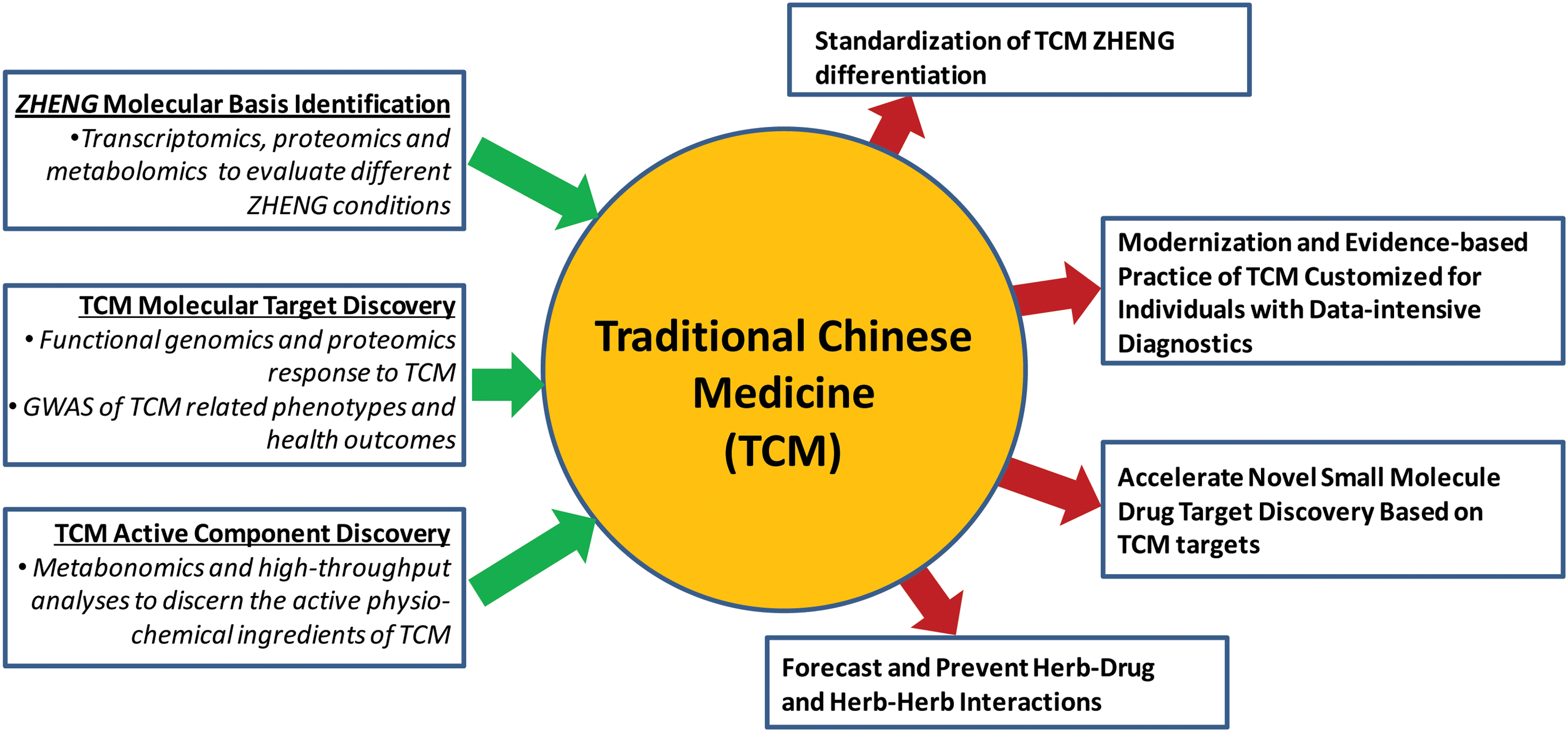
A schematic of the convergence of traditional Chinese medicine (TCM) and OMICS. Figure modified from Yun et al., 2012. The left side of the figure indicates the paths for integration of OMICS with TCM, and the right side indicates the anticipated outputs.
On October 20, 2012, we searched the Chinese electronic databases (including the China National Knowledge Infrastructure (CNKI), Chinese Scientific Journal Database (VIP), Chinese BioMedical Literature Database (CBM) and Wanfang), and PubMed for published articles related to “Omics” and “TCM ZHENG” and observed a dramatic increase in studies over the past few years. Herein, we provide a timely synthesis and review of the current application of systematic-omics in TCM ZHENG research.
Transcriptomics-Based TCM ZHENG Research
In the past decade, technological progress has enabled scientists to investigate genome-wide RNA expression using microarray platforms (Manning et al., 2007). Transcriptomics, or global gene expression profiling, is among the first fully developed “omics” sciences. Transcriptomics is now routinely used for evaluating the gene expression profiles of tens of thousands of genes in parallel (Celis et al., 2000). An important application of gene expression profiling is to associate differences in mRNA expression with phenotypic differences between groups of individuals to obtain phenotype-specific information about gene expression (Nachtomy et al., 2007). Transcriptomics facilitates the comprehensive study of diseases at the genomic level to identify novel molecular abnormalities and clinical biomarkers and investigate drug efficacies (Cui and Paules, 2010; Fang et al., 2008; Heijne et al., 2005).
The integration of transcriptomics with TCM philosophies over the past decade has facilitated the development of a new TCM study research paradigm (Cheng et al., 2010; Jiang et al., 2011; Zhang et al., 2011). For example, transcriptomics data was incorporated into a network-like structure of related genes to investigate the molecular basis underlying kidney deficiencies in rats. The results revealed that kidney deficiencies are accompanied by a significant downregulation of various neurotransmitters expressed at the hypothalamic-pituitary-adrenal (HPAT) axis, followed by a reduction in the expression of growth and sex hormone-related genes (Shen et al., 2007). This association has since been confirmed through studies using other animal models (Xu and Jiang, 2006). In addition, transcriptomics has been widely used for studying other types of TCM ZHENG. The results have shown that Yang deficiency-associated genes are associated with immunity (Ni et al., 2004), while Cold ZHENG-associated genes are associated with energy metabolism (Wang et al., 2006). As shown in Table 1, establishing TCM ZHENG animal models has facilitated the identification of a growing number of genes or gene sets associated with a particular TCM ZHENG. The function of these genes might explain the potential mechanism and foundation of a specific TCM ZHENG.
CHD, coronary heart disease; COPD, chronic obstructive pulmonary disease; HPAT, hypothalamus-pituitary-adrenal-thymus; NS, nonspecific disease; PBMC, peripheral blood mononuclear cell; RA, rheumatoid arthritis.
Proteomics-Based TCM ZHENG Research
Proteomics is an important research tool for elucidating the differential expression of proteins in tissues, reflecting complex biological mechanisms (Issaq et al., 2007; Plomin and Schalkwyk, 2007). There are two main approaches to proteomic research (Blonder et al., 2011). The first approach involves the use of mass spectrometry (MS) to obtain a specific pattern of peaks differentiating diseased from normal samples. The other approach involves the identification of discriminatory peaks to obtain mechanistic insights into underlying pathophysiological processes. Technically, proteomic analysis requires the combination of an extensive suite of technologies, including protein processing and separation, high-performance liquid chromatography (HPLC), MS, and bioinformatics. Among these, two-dimensional polyacrylamide gel electrophoresis (2-DE) is one of the most potent methods used to provide a context-based understanding of protein expression (Blonder et al., 2011; Sellers and Yates, 2003). Proteomics also complements genomic approaches, such as gene chip microarrays, and has been successfully used for clinical biomarker discovery (Blonder et al., 2011). The most frequently utilized specimens include peripheral body fluids, such as serum, urine, and whole blood; blood is the most widely used specimen because its molecular composition fluctuates in response to the dynamic physiological and pathological conditions of the patient (Albrethsen, 2011).
Proteomics technology complements the holistic theory of TCM. Proteomic science is considered a current hot topic and has been successfully used in TCM research (Lu et al., 2010) to characterize the differential expression profiles between healthy individuals and patients with different TCM ZHENG (Table 2). For example, serum proteomic analysis revealed the differential expression of 33 proteins associated with adrenal, thyroid, and gonadal secretion functions and immune responses in 9 cases with kidney-Yang deficiency compared with the expression of these protein in 12 healthy volunteers (Liu et al., 2007). These findings revealed the molecular mechanism underlying kidney-Yang deficiency. The proteomic analysis of patients with two interrelated ZHENG syndromes revealed distinctive serum protein expression profiles between these two patient groups: wind from Liver-Yang hyperactivity (Gan-Yang-Hua-Feng) and wind stirring due to Yin deficiency (Yin-Xu-Feng-Dong) (Xiong et al., 2011). This study also revealed that, although patients with the same ZHENG might have different disease diagnoses, these individuals share similar expression profiles, suggesting a unique molecular basis for TCM ZHENG. In another study, Sun et al. (2010) demonstrated the differential expression of six serum and three liver proteins in patients with different ZHENG types. These proteins were involved in immunity, the neuroendocrine system, nutrition, and substance metabolism (Sun et al., 2010). More importantly, this study indicated the feasibility of ZHENG research using proteomics-based strategies. Thus, the rapid growth of the proteomics field has provided new tools for the integration of TCM with modern technology and systems biology, thereby advancing the modernization and internationalization of TCM.
CS, cervical spondylosis; NS, nonspecific disease; PD, Parkinson's disease; UA-QDBS, Unstable angina with qi deficiency and blood stasis syndromes; WSGH, wind syndrome caused by Gan-yang hyperactivity.
Metabolomics-Based TCM ZHENG Research
As previously described, transcriptomic and genomic studies have emerged as powerful tools for understanding and resolving disease-related pathologies, including the underlying mechanisms that differentiate TCM ZHENG types. In recent years, metabolomics has been successfully applied to TCM ZHENG research (Raamsdonk et al., 2001). Technological advancements in both instrumentation (including MS, nuclear magnetic resonance (NMR), and gas and liquid chromatography) and informatics or chemometrics software have led to a recent surge in the utilization of metabolomics in human disease diagnostics and therapeutics (Dunn et al., 2005).
Currently, metabolomics is widely used to study human diseases. It has been shown that abnormal and normal cells exhibit distinct metabolic profiles, which facilitates the diagnosis of diseases, prediction of responses to therapy, and the development of new targeted therapies (Koslinski et al., 2011; Wang et al., 2010; Wei, 2011). Metabolomic approaches have been categorized as global or specific. Global metabolomics characterizes changes in the expression of a large number of metabolites under certain conditions to identify relevant metabolic trends. Specific metabolomics, however, examines changes in the expression of a smaller number of metabolites that are potentially altered under certain conditions (Vinayavekhin et al., 2010). Accumulating evidence has shown that the metabolic profile is more sensitive to environmental perturbations than the genetic and proteomic profiles; therefore, metabolic changes can be considered as early indicators of underlying genetic differences influenced through stress, diet, and environment-related physiological changes (Sofia et al., 2011). In fact, this notion is the basis for using NMR to examine urine samples, which is now a common method for the diagnosis of disease and evaluation of drug toxicity (Lusczek et al., 2013; Yang et al., 2011).
Metabolomics is particularly useful for TCM studies, as TCM assesses the human body through system discrimination and treats disease according to TCM ZHENG types and the Five-Zang and Six-Fu system, wherein a single ZHENG type involves multiple anatomical organizations or systems, and not a specific organ. Notably, TCM understands the internal organs through observing the physiological and pathological phenomena and therapeutic effects. The Five-Zang and Six-Fu system is a collective term for internal organs, which are divided into two major categories, namely the five zang-organs and the six fu-organs. The five zang-organs include the heart, liver, spleen, lung, and kidney; the six fu-organs include the gallbladder, stomach, small intestine, large intestine, urinary bladder, and sanjiao (or “triple burner”). TCM theories are based upon the relationships between these five zang- and six fu-organs. Characterizing these relationships can lead to a better understanding of how our body functions and the development of methods to treat illnesses. To date, metabolomics studies of TCM have largely focused on TCM theory (Table 3). Among the published studies, Xu et al. reported that liver-Qi stagnation ZHENG in rats significantly changed the spectral peaks of acetate, lactose (Lac), creatinine (Cr), glucose, ketocarnitine (3-HB), and the very low density lipoprotein (VLDL)/low density lipoprotein (LDL) ratio and reduced the phosphatidylcholine (PtdCho) and unsaturated fatty acid (UFA) content. Thus, these altered metabolites represent biomarkers of liver-Qi stagnation ZHENG (Xu et al., 2010). Li et al. showed that the presence of four metabolites (pyruvic acid, L-aspartic acid, glycerol, and cholesterol) could discriminate Yang deficiency from Non-Yang deficiency, further confirming the idea that altered metabolite profiles could serve as potential biomarkers of different TCM ZHENG subtypes, and TCM ZHENG has a specific molecular basis (Li et al., 2011). Moreover, the results of a subsequent study showed that pyretic pulmonary ZHENG in rats is characterized by changes in six metabolites. Huang Qin (Scutellariae sadix), a Chinese herb used for treating pyretic pulmonary ZHENG in TCM clinical practice, was used to resolve the differential levels of the six metabolites. The results suggested that these six metabolites were not only biomarkers of pyretic pulmonary ZHENG, but might also be response predictors of the use of Huang Qin for the treatment of pyretic pulmonary conditions (Liu et al., 2011). Taken together, these findings indicate that metabolomics might be a useful method for establishing and evaluating an effective animal model of TCM ZHENG.
CHD, coronary heart disease; GC gas chromatography; HPLC, high-performance liquid chromatography; MS, mass spectrometry; NMR, nuclear magnetic resonance; NS, not specific disease; TOF, time-of-flight.
In a clinical study of coronary heart disease (CHD) patients, including 6 cases diagnosed with Xin-blood stasis syndrome (XBSS) and 16 cases diagnosed with non-XBSS, Jian and colleagues observed that the lactic acid, beta-hydroxy butanoic acid, linoleic acid, and glucose contents were higher in XBSS patients than in non-XBSS patients, suggesting that characteristic metabolites can be used as biomarkers of Xin-blood stasis ZHENG in CHD patients (Jian et al., 2010). In addition, this study provided evidence for “Treating same diseases with different therapies”, which has been applied in TCM practice. Therefore, metabolomic applications represent powerful tools for TCM ZHENG research. Because of their high sensitivity and technical ease of sample preparation, metabolomic methods are more promising than transcriptomic and proteomic methods. These advantages might also reflect the increased amount of published metabolomics-based TCM ZHENG research.
Challenges
It is clear that recent technological advances in the -omics fields have benefited TCM ZHENG research and provided novel insights into the essence and molecular basis of TCM ZHENG. However, many limitations must be considered when interpreting the published findings. For example, most studies have primarily focused on identifying differentially expressed molecules among different ZHENG types. However, few investigations have focused on determining the functions of the identified molecules (Ding et al., 2010). Furthermore, although many TCM ZHENG animal models have been established based on TCM theory, it remains unknown whether these models accurately reflect human conditions (Chen et al., 2012). As TCM ZHENG differentiation is primarily based on the intuition of an experienced doctor, there is a large extent of low reproducibility in the field. Furthermore, the distinct features of TCM theories and diagnostic models are not amenable to the currently available statistical analysis methods. Nevertheless, we propose the combined use of transcriptomics, proteomics, and metabolomics with clinical samples, complemented by animal studies in TCM ZHENG research. Such empirical data should be integrated with clinical observations, as TCM theory is based on long-term clinical practice. In addition, as TCM ZHENG studies based on OMICS technologies has just started recently and is still in the early stage, bioinformatic analysis could be used to determine a potential network for future TCM ZHENG research (Li et al., 2007).
Conclusion
In conclusion, multi-omics is a significant strength to expand upon TCM ZHENG research and have thus far provided profound insights. The application of genomic-, proteomic-, and metabolomic-based technologies will likely facilitate the reconciliation and integration of TCM with Western medicine, and vice versa. Finally, we shall emphasize here that the global health scholarship and the field of “developing world Omics” can usefully draw from TCM as well.
Footnotes
Acknowledgments
This study was supported by National Science Fundation of China (81001061); Shanghai Nature Science Fund, Shanghai, China (09ZR1406800); Doctoral Programs Foundation of the Ministry of Education of China (20090071120076); Shanghai Science and Technology Committee Rising-Star Program (11QA1401300); Medical Talents Training Program of the Health Bureau of Shanghai (XYQ2011008); and Fudan University Zhuo-Xue Program.
Author Disclosure Statement
The authors declare that there are no conflicting financial interests.