




Abstract
Abstract
A large number of studies have suggested extracellular microRNAs (microRNAs in biofluids) as potential noninvasive biomarkers for pathophysiological conditions such as cancer. However, reported differentially expressed signatures of extracellular miRNAs in diseases are not uniformly consistent among studies. Here, we present “ExcellmiRDB”, a curated online database that provides integrated information about miRNAs levels in biofluids in a user-friendly way. Although many miRNA databases, including disease-oriented databases, have been launched before, the ExcellmiRDB is so far the only one specialized for storing curated data on miRNA levels in biofluid samples. At present, ExcellmiRDB has 2773 disease-extracellular miRNAs and 1108 biofluid-extracellular miRNAs relationships curated from 108 articles selected from more than 600 surveyed PubMed abstracts. Information about 992 miRNAs, 82 diseases, 21 biofluids, 8 species, 63 normalization reference genes, 5 techniques, 14 GEO profiles accession numbers, 7 human ethnic groups, and 18 compared clinical biomarkers have been provided in the database. A user can query ExcellmiRDB by selecting a disease or a miRNA or a biofluid. Additionally, the database provides two online network graphs to visualize and interact with the content of the database. The first network shows disease-extracellular miRNAs relationships, along with expression patterns and number of articles for a relationship. The second network visualizes biofluid-extracellular miRNAs relationships showing miRNAs spectrum across different types of biofluids. In conclusion, ExcellmiRDB is a new innovative resource for both academic and industrial researchers in translational omics who are developing miRNA biomarkers for noninvasive diagnostic or prognostic technologies. ExcellmiRDB is publicly available on www.excellmirdb.brfjaisalmer.com/.
Introduction
M
miRNAs are stable and detectable in biofluids such as blood, urine, saliva, feces, and breast milk. The miRNAs in biofluids are named as extracellular or circulatory or cell-free miRNAs. The mechanism of transportation of the miRNAs to circulation (or cell medium), functions of miRNAs in biofluids, and excretion of miRNAs from biofluids are largely unknown (Link et al., 2010; Michael et al., 2010; Rabinowits et al., 2009; Russo et al., 2012; Turchinovich et al., 2012; Yang et al., 2013). However, significant changes in the expression of extracellular miRNAs were reported in many diseases including cancer, cardiovascular, and infectious diseases, suggesting extracellular miRNAs as potential noninvasive biomarkers for diagnosis and prognosis of pathophysiological conditions (Corsten et al., 2010; Link et al., 2010; Liu et al., 2012; Mitchell et al., 2008; Weber et al., 2010). Also, alterations in the expression of several tissue-specific miRNAs were reported in blood and other biofluids, suggesting extracellular miRNAs can be noninvasive biomarkers for internal tissue injuries (Corcoran et al., 2011; Corsten et al., 2010). For example, liver-enriched miR-122 and miR-192 have significantly higher levels in serum of acetaminophen-induced acute liver injury patients (n=53) compared to healthy controls (n=25) using qRT-PCR (Starkey Lewis et al., 2011).
It has been reported that diagnosis potential of extracellular miRNAs was comparable with commonly used clinical markers (Bryant et al., 2012; Chen et al., 2012; Liu et al., 2012). For instance, Liu et al. (2012), using RT-qPCR, showed serum miR-15b and miR-130b can better classify hepatocellular carcinoma (HCC) (n=30 healthy, 57 patients) with 98.2% sensitivity and 91.5% specificity, compared to serum α-fetoprotein (AFP), the commonly used biomarker for screening HCC (sensitivity: 39%–65% and specificity: 76%–94%).
Despite highly significant results for alteration in the expression of extracellular miRNAs in a disease, results from individual studies do not match or overlap with other studies (Farina et al., 2014; Rao et al., 2013). For example, Fu et al. (2011) reported that miR-518d-5p and miR-93* were most significant differentially expressed miRNAs in serum of tuberculosis patients (n=75) compared to healthy subjects (n=55). However, different miRNAs, miR-19b-2* and miR-3179, using sputum by Yi et al. (2012), were reported as most significant differentially expressed miRNAs in tuberculosis patients (n=58; healthy controls n=38). Both studies used microarray and validated their results by RT-qPCR (Fu et al., 2011; Yi et al., 2012).
In addition to non-overlapping results between individual studies for extracellular miRNAs level in a disease, results could even be opposite. For example, Alexandrov et al. (2012) reported hsa-miR-146a was upregulated in human cerebrospinal fluid (CSF) and tissue-derived extracellular fluid (ECF) of Alzheimer's disease (n=12) using fluorescent miRNA-array-based analysis, and Muller et al. (2014) reported the same miRNA (hsa-miR-146a) was downregulated in cerebrospinal fluid of Alzheimer's disease (n=20) compared to matched controls (n=20) using qRT-PCR.
Moreover, reported differentially expressed extracellular miRNAs are not disease specific. An extracellular miRNA can be associated with several cancers and unrelated diseases. For example, miR-21 is reported upregulated in urine and plasma of patients having acute kidney injury 2 (n=80) compared to controls (n=40) using qRT-PCR (Du et al., 2013), and the same miRNA (miR-21) is also reported significantly differentially expressed in colorectal cancer patients compared to controls (90% specificity and sensitivity) using microfluid array technology (Kanaan et al., 2012). These nonconsistent and scattered information about disease–extracellular miRNAs relationships are available in an increasing number of research articles.
To manage this large amount of information, a database system could be an effective approach. Several miRNA-related databases have been developed. These databases are on-line repositories of different information about miRNAs. For example, miRBase (Griffiths-Jones et al., 2008), miRGator V3.0 (Cho et al., 2013), miRDeep V2 (Friedländer et al., 2012), DeepBase (Yang et al., 2010), and miRNEST (Szczesniak and Makalowska, 2014; Szcześniak et al., 2012) manage annotation and nomenclature of miRNAs; TarBase (Sethupathy et al., 2006), miRNAMap 2.0 (Hsu et al., 2008), microRNA.org (Betel et al., 2008), and mirTarBase (Hsu et al., 2011) provide miRNA- gene target relationships; miR2disase (Jiang et al., 2009), HMDD V2.0 (Li et al., 2014), and PhenomiR (Ruepp et al., 2010) collect and manage miRNA-disease relationships in human and other species. So far, three databases have cataloged information about extracellular miRNAs: Exocarta (Mathivanan and Simpson, 2009), miRandola (Russo et al., 2012), and recently, HMDD V2.0 (Li et al., 2014). miRandola is the only database specific for extracellular miRNAs. These databases mainly provide names of miRNA, biofluid type, and associated diseases. miRandola also provides classification of extracellular miRNAs.
These databases have less or no information about the level of miRNAs in biofluids and factors that can affect disease-extracellular miRNAs relationships. Other than a pathophysiological condition, several biological and technical factors may affect extracellular miRNAs signatures such as sample type, species, ethnic group, sex, isolation kit, technique, normalization methods, and sample size (McDonald et al., 2011; Meyer et al., 2010; Turchinovich et al., 2012). The information about miRNA level in biofluids in disease conditions and factors that can effect disease-extracellular miRNAs relationships are scattered and unstructured in a large number of published articles on extracellular miRNAs. To catalog the above specific information, we developed a manually curated database named “ExcellmiRDB” and provide it in a user-friendly way.
Material and Methods
Data curation
We retrieved abstracts about extracellular miRNAs, published until December, 2013, from PubMed, using the following keywords: [“Circulatory microRNAs ” OR “Extracellular microRNAs”], [“miRNA and biofluid name” e.g., plasma, blood, saliva, urine, semen, vaginal fluid, aqueous humor, vitreous humor, tears, mucus, cerebrospinal fluid, breast milk, follicular fluid]. We surveyed the retrieved abstracts and selected articles to include varieties of diseases, biofluids, techniques, and types of extracellular miRNAs (e.g., cell-free, exosomal, protein bound) as defined by Russo et al. (2012). For manual information annotation, all selected articles were deposited in a library created on Mendeley Software (Lo Russo et al., 2013). First, we defined an experiment in an article as statistical comparison between two biological conditions (e.g., healthy vs. breast cancer) or biofluids or time points. Then, for each defined experiment in an article, we manually curated information shown in Table 1. For each article, the curated information was extracted as a PDF file. Names of deregulated miRNAs and expression pattern information (up/down) were saved in an Excel file. These files were used for final data submission in ExcellmiRDB for each selected article.
ExcellmiRDB is a MySQL database running on Apache server with a web interface constructed in HTML, JAVAscript and CSS. PHP was used for server side programming. Cytoscapeweb was used for interactive networks visualization of disease-extracellular miRNAs and biofluid-extracellular miRNAs relationships in the database (Lopes et al., 2010). Node degree (number of the connecting nodes to a node) was calculated for the networks, using NetworkAnalyzer plugin (Assenov et al., 2008). The user can use node degree (e.g., node degree=one) as a filter to select extracellular miRNAs specific to a disease or a biofluid. For each edge (a line connecting a disease—an extracellular miRNA or a biofluid extracellular miRNA) we provided a p-value as the significance of the relationship using the Fisher t-test. We used Fisher's exact test to determine p-values, computed from a 2×2 contingency table composed of: 1) Number of articles having the disease/biofluid and the miRNA; 2) Number of articles that do not have the disease/biofluid but have the miRNA; 3) Number of articles that do not have the miRNA but have the disease/biofluid; and 4) Number of articles that neither have the miRNA nor the disease/biofluid.
Results
ExcellmiRDB cataloged 2773 disease-extracellular miRNAs and 1108 biofluid-extracellular miRNA relationships for 992 miRNAs in 21 biofluids for 82 associated biological conditions curated from 108 articles. These articles were selected by surveying more than 600 abstracts. Table 1 shows the statistics of various curated information. The database is implemented with standard web-technologies as MySQL and PHP and Apache web-server. A novel aspect in accessing the database is added by providing a web-based network graph visualization.
Data access
The database is provided publicly at http://www.excellmirdb.brfjaisalmer.com. It can be queried by selecting a disease (e.g., breast cancer) or an miRNA (e.g., miR-21) or a biofluid (e.g., urine). When a user queries the database for a disease or an miRNA or a biofluid name, the database system searches all experiments containing the queried disease or miRNA or body fluid name. Then, from the selected experiments, the system will retrieve the information such as PubMed Id, biofluid/disease/miRNA, species, technique, GEO dataset, sensitivity, or specificity.
The results will be displayed on a webpage and can be downloaded as a .txt file. The results will have the name of miRNA
The query can be further filtered by sample size (e.g., <20), technique (e.g., next generation sequencing or RT-PCR), species (e.g., human or pig), availability of GEO data set (YES/NO), allowing combination of intelligent and complex queries for refined relationships of diseases-extracellular miRNAs or biofluid-extracellular miRNAs.
Interactive network visualization for disease-extracellular miRNAs and biofluid-extracellular miRNAs relationships provide a user-friendly novel way to access and visualize information in a global view. To reduce the network complexity, we have provided an option to filter the network by number of articles, expression level (up or down) and node degree. Additionally, we provide a search option on network menu to select a miRNA and a disease/biofluid by name. Also, the user can select a region of the network and the information in that region (i.e., disease and miRNA name, expression pattern, number of articles
miRNA–disease network
Consistent deregulated extracellular miRNAs in a specific biological condition (more than one article) may be considered as potential biomarkers for associated diseases. Network visualization of disease-extracellular miRNAs relationships (Fig. 1) along with expression pattern and number of articles, showed that certain relationships were consistent between studies. For example, miR-21 in Lung Cancer, miR-122 in Chronic Hepatitis B, and miR-29a in Pulmonary Tuberculosis were upregulated in at least three research articles.
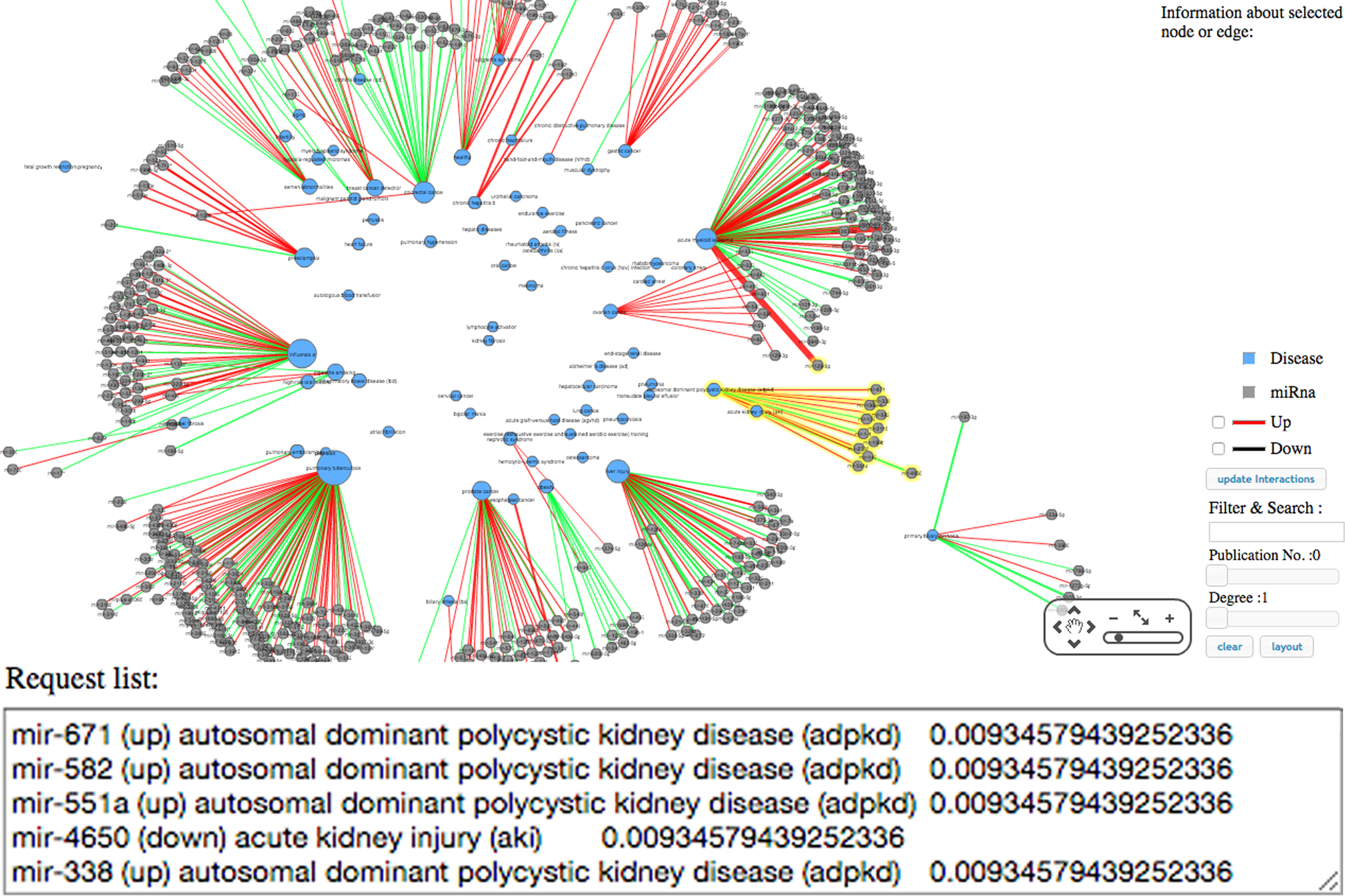
Interactive network of the disease–extracellular miRNA relationships. A node represents a disease or an miRNA. A line connecting two nodes shows a physical relationship based on manually curated data. Color of line represents expression pattern of an miRNA linked with the disease. Thickness of line represents number of articles for that relationship. miRNAs with node degree=1 are shown in the figure. Table at the bottom has information for selected region of the network [i.e., miRNA name, disease names, and p value (Fisher test)].
We found most extracellular miRNAs are overlapped between diseases. For instance, miR-21, miR-122, AND miR-197 were upregulated in 14, 10, and 7 biological conditions, respectively. Similarly, miR-16, miR-223, and miR-122 were downregulated in 10, 9, and 5 biological conditions, respectively. Node degree of an miRNA gives information about number of diseases associated with the miRNA. For instance, with node degree of one, the network will show miRNAs associated with only one disease. In our database, several miRNAs are disease specific, for example, miR-1937 is associated with primary biliary cirrhosis, mir-23b is associated with gastric cancer, and miR-30b is associated with pulmonary tuberculosis, specifically.
miRNA–biofluid network
We visualized the biofluid–miRNA relationships as a network (Fig. 2). The network showed biofluid specific and overlapped extracellular miRNAs. For example, breast milk have certain extracellular miRNAs that are not associated with any other biofluid such as miR-182-5p, miR-191-5p and miR-200c-3p. Additionally, the network showed that highest information were curated for blood samples (30 publications, 491 dysregulated extracellular miRNAs, and 29 diseases for serum).
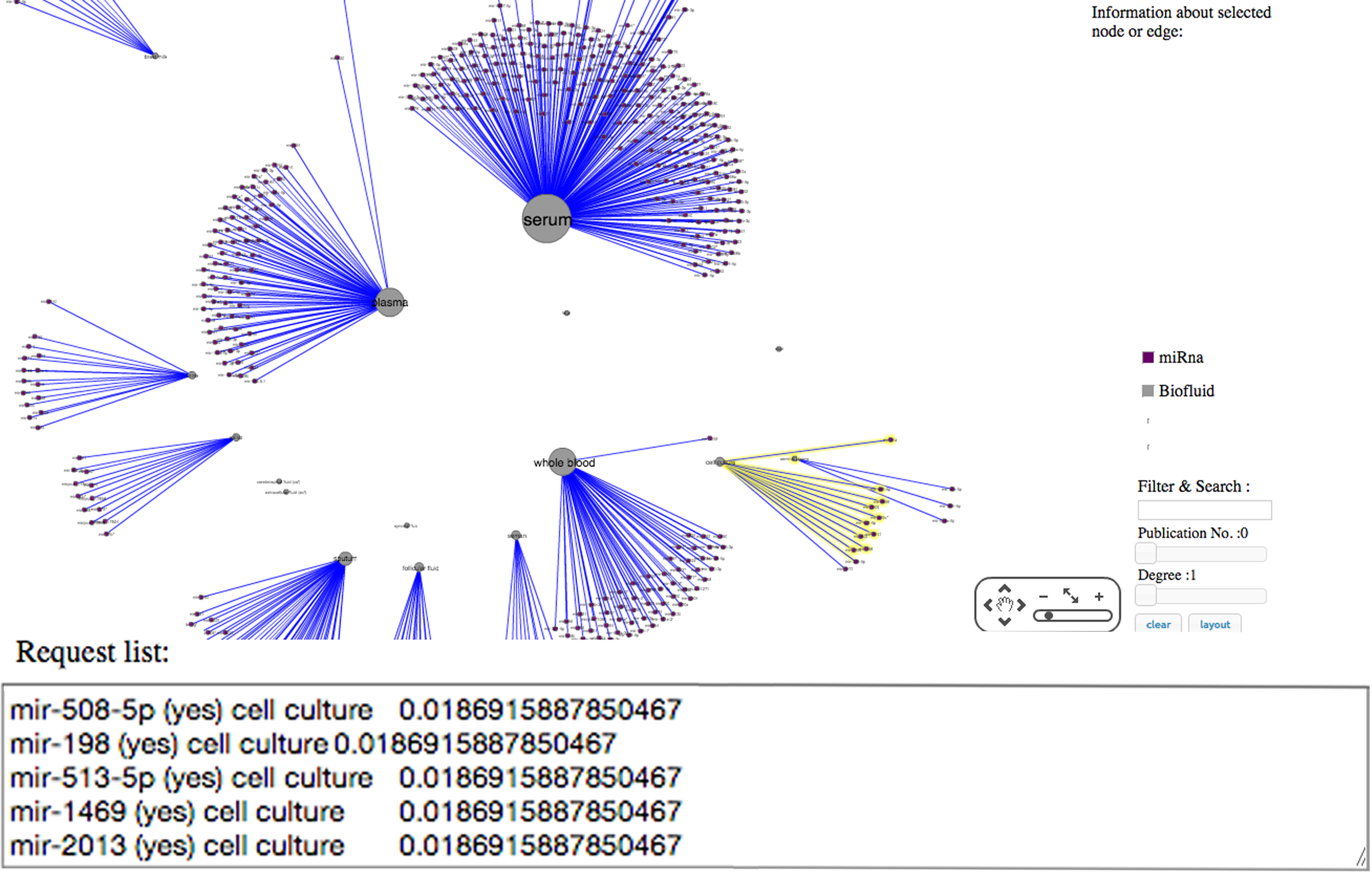
Interactive network of the biofluid–miRNA relationships. A node represents biofluid or an miRNA. A line connecting two nodes shows a physical relationship based on manually curated data. Table at the bottom has information for selected region of the network [i.e., miRNA name, biofluid names, and p value (Fisher test)].
Normalization methods
ExcellmiRDB have extracted technical information such as normalization methods (Fig. 3). The current database showed widely used normalization methods (e.g., U6 in 36 studies and miR-16 in 27 studies).
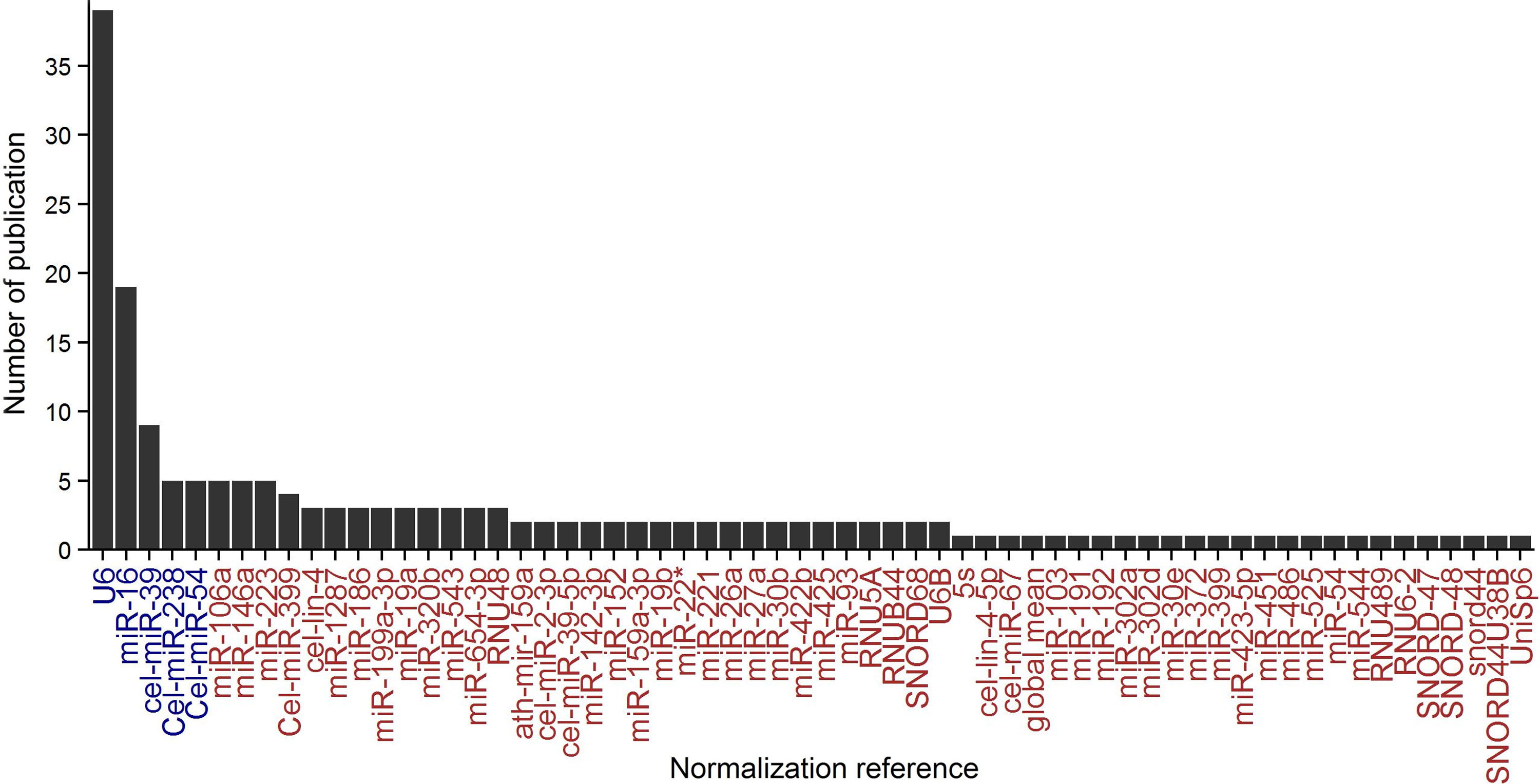
Frequency of used normalization methods (total 63) by number of publication. Top five widely used normalization methods highlighted by blue color.
Data upload
Any user can submit data to ExcellmiRDB using the “Upload” menu on the webpage. A sample .txt file is available on the database webpage for a large number of extracellular miRNAs and expression pattern information. A JavaScript will automatically upload data from the submitted file. We will examine the uploaded information carefully before final submission.
Discussion
As the number of published articles on extracellular miRNAs increases, ExcellmiRDB could serve as an entry point to access useful information on extracellular miRNAs implicated in human health. For instance, in 2008, there were only 23 articles published, but by October, 2014, more than 1130 articles have been published (PubMed search with term “circulatory microRNA or extracellular microRNA”).
Although many miRNA databases including diseas-oriented databases have been published before, so far ExcellmiRDB is the only one specialized to store information about the miRNA levels in body-fluid samples along with other information that have not been catalogued by other databases.
We have compared our curated information with other related databases (Table 2). The first database that cataloged information about extracellular miRNA was Exocarta (Mathivanan and Simpson, 2009). It manages information about the contents of exosomes, for example, protein, DNA, RNA, and miRNA. miRandola is the first database specifically designed for extracellular miRNAs (Russo et al., 2012). It gives information about extracellular miRNAs, associated diseases, body fluids, classification of extracellular miRNAs, and techniques used. miRandola has information curated from more than 89 articles (at the time of publication). Recently, the Human miRNA Disease Database (HMDD) V 2.0 listed extracellular miRNAs information including expression pattern information (Li et al., 2014). Certain other databases, for example, PhenomiR, miR2disease, provide miRNA-disease relationships without specifying extracellular or cellular miRNAs (Jiang et al., 2009; Ruepp et al., 2010). Our database accommodates information that previously has not been cataloged altogether in a single miRNA-diseases database, such as biofluids, species, ethnic group, normalization methods, sample size, and expression pattern.
information extracted on July, 14, 2014).
We have cataloged such information for several reasons. First, extracellular miRNAs were studied in organisms other than human and mouse, including dog (Mizuno et al., 2011), cow (Li et al., 2012), pig (Gidlöf et al., 2011), and horse (da Silveira et al., 2012). Their intercellular and inter-organ expression pattern and functions may be evolutionarily conserved. Second, there were differences found in expression profiles of miRNAs between human ethnic groups (Zhao et al., 2010). Third, identifying suitable normalization reference genes/miRNAs for analysis of the extracellular miRNAs using RT-PCR or microarray is a current problem and may cause inconsistency in the results (Thomas et al., 2009). Our database could be used to get the most widely used or body-fluid specific normalization methods. Fourth, small sample size has less confident results (Allison et al., 2006). We curated sample size information so a user can get most confident disease-miRNA relationships based on sample size. Additionally, we provided GEO dataset accession numbers so a user may access the raw/processed data for meta-analysis/re-analysis (Edgar et al., 2002; Wirapati et al., 2008).
Altogether, the information from ExcellmiRDB along with other databases will be useful for extracellular miRNAs research. For example, miRNAs functional annotation databases such as miRBase (Griffiths-Jones et al., 2008), miRNAMap 2.0 (Hsu et al., 2008), miRNApath (Chiromatzo et al., 2007) can provide great resources to investigate the functions of extracellular miRNAs in recipient cells. Databases such as microRNA.org (Betel et al., 2008) that provide expression level of miRNAs in tissues could be useful to get information about the tissue specific extracellular miRNAs.
Conclusions
ExcellmiRDB is an innovative and comprehensive online resource about extracellular miRNAs. It offers information about the disease-extracellular miRNAs and extracellular miRNAs-biofluid relationships and curated information. Future directions will be automatized for the extraction of cataloged information using machine learning and test mining algorithms for which our current content of the database can serve as a validation set.
Footnotes
Acknowledgment
Financial support from Council of Scientific and Industrial Research as Junior Research Fellowship to JB and computational facility provided by Bioinformatics Infrastructure Facility at University of Rajasthan is gratefully acknowledged.
Author Disclosure Statement
The authors declare no conflict of interest. No competing financial interests exist.